REVIEW 4 major objections 5 minor 30 references
Reason from Future: Reverse Thought Chain Enhances LLM Reasoning
T0 review · 4 major / 5 minor · reviewed 2026-08-07 · deepseek-v4-flash
Pith's one-line read Reason from Future claims that alternating backward target generation with forward steps reduces search space and improves LLM accuracy on math and search tasks.
desk verdict A solid, broad empirical paper on alternating backward/forward prompting, but the core mechanism is not isolated because G() is never measured. read the letter →
The pith
A machine-rendered reading of the paper's core claim, the machinery that carries it, and where it could break.
The reading
What carries the argument
The load-bearing mechanism is the alternating pair of generators: the Last Step Generator $G(p_\theta, S_{i-1}, T_{i-1})$ proposes the state just before the current target and explicitly outputs the transition connecting them, and the Stepwise Forward Reasoner $R(p_\theta, S_{i-1}, T_i)$ advances the current state toward that target. Two variants handle different problem geometries: RFF-T, for tree-search tasks like Game of 24, records failed attempts to avoid and backtracks through a verifier; RFF-G, for math and commonsense problems, accumulates all computed information into the state and stops when the State Checker decides the target is reachable. The State Checker $C(\cdot)$ is what turns the loop from open-ended generation into a bounded, goal-constrained search.
What would settle it
Take a fixed set of GSM8K and Game of 24 problems, record every intermediate target proposed by the Last Step Generator, and independently check whether that target is reachable from the current state in one forward transition; if RFF solves problems where a large fraction of proposed targets are invalid, then the reverse step is not doing the goal-steering the paper attributes to it.
Extended reading notes
Core claim
The central discovery is that reverse reasoning is not just a one-time planning pass; it is an iterative state-transition mechanism. RFF maintains a current solution state and a target state, and at each round the Last Step Generator derives a tighter pre-target state from the goal, the Stepwise Forward Reasoner advances one step toward that pre-target, and the State Checker stops when the states coincide; for tree-like problems a verifier backtracks from incorrect branches. Because the backward step must explicitly state the transition between pre-target and target, the model is forced to identify the core logical relation before computing, which the paper argues is why the search space collapses and error accumulation is reduced. The authors report that this pattern holds across search-tree tasks, directed-acyclic-graph math problems, and commonsense benchmarks, with the largest observed gains on smaller 7B-8B models.
Load-bearing premise
Everything depends on the Last Step Generator reliably naming a valid pre-target state and an explicit transition each round; the paper itself states in its Limitations section that the model was not trained for reverse thinking and that rare backward-step errors can cause failure.
Editorial extensions
If this is right
- On GSM8K, RFF raises Llama3-8B accuracy from 75.6% with CoT to 83.8%, and Qwen2.5-7B from 87.2% to 89.5%.
- In Game of 24, RFF at width 5 reaches 89% accuracy on Llama3-8B while visiting 9.9 states, versus Cumulative Reasoning at 19% with 89.8 states.
- In the redundant-number Game of 24 experiment, RFF still solves 85% of five-number puzzles with 28.62 visited states, while Cumulative Reasoning falls to 26% with 96.56 states.
- On GSM-Symbolic variants, RFF keeps a higher and more concentrated accuracy distribution than CoT across 50 transformed versions of GSM8K questions.
- Because RFF's state checker stops early when the forward state meets the backward target, it avoids the overthinking that hurts progressive-hint baselines on easy questions.
Reading between the lines
- If the Last Step Generator can be made reliable through fine-tuning or reinforcement learning, RFF-style alternating reasoning could become a decoding-time strategy for long-horizon planning tasks beyond math and the 24 game.
- The paper does not report standalone accuracy for the Last Step Generator; logging every proposed backward target and checking reachability would reveal whether the gains come from reverse planning itself or merely from the extra computation the alternating loop performs.
- RFF's framing of reasoning as alternating state transitions suggests a testable extension to tasks where each reverse step must name a resource or precondition, such as program synthesis or tool-use planning.
- The robustness on semantically transformed GSM8K variants hints that goal-anchored reasoning may generalize better under distribution shift than forward-only token-by-token calculation, a claim worth testing on other shifted benchmarks.
Editorial analysis
A structured set of objections, weighed in public.
Referee Report
Summary. The manuscript proposes Reasoning from Future (RFF), a prompting paradigm in which an LLM alternates a reverse 'Last Step Generator' G() with a forward stepwise reasoner R(), governed by a state checker C() and a verifier V(). Two algorithmic variants are presented: RFF-T for tree-search tasks such as Game of 24, with backtracking and avoidance of previously failed steps, and RFF-G for tasks modeled as directed acyclic graphs, such as arithmetic word problems and multiple-choice commonsense reasoning. The method is evaluated on Game of 24, GSM8K, SVAMP, ASDiv, MATH-500, CommonsenseQA, LogiQA, and GSM-Symbolic variants, using Llama3-8B-Instruct and Qwen2.5-7B-Instruct. The headline results are higher accuracy than CoT, CR, Least-to-Most, and Give-me-Hint on most math benchmarks (e.g., 83.8% vs 75.6% CoT on GSM8K for Llama3-8B) and dramatically fewer visited states in Game of 24 (e.g., 9.9 visited states at 89% accuracy vs 89.8 states at 19% accuracy for CR on the same model). The paper argues that reverse reasoning narrows the search space by imposing goal-oriented constraints on intermediate steps and thus mitigates error accumulation in forward reasoning.
Significance. If the accuracy and search-space claims hold, RFF is a useful contribution to prompt-level reasoning methods, especially for 7B-8B models where simple CoT is weak. The empirical breadth is a strength: five math benchmarks, two base models, a redundant-variable stress test in Section 4.4, and a GSM-Symbolic robustness analysis in Section 4.5. Appendix C provides the actual prompts for G, R, and C, which substantially aids reproducibility, and the Pair-vs-Single comparison in Appendix B is a useful first step toward understanding the role of alternating backward and forward reasoning. However, the paper's central mechanistic claim, that reverse reasoning is what reduces search space and error accumulation, is not directly tested. The generator G() is never measured separately, and no forward-only control with the same state-accumulation and checker machinery is reported. The empirical results are therefore suggestive but not yet conclusive, and the contribution would be materially strengthened by the missing controls and variance estimates.
major comments (4)
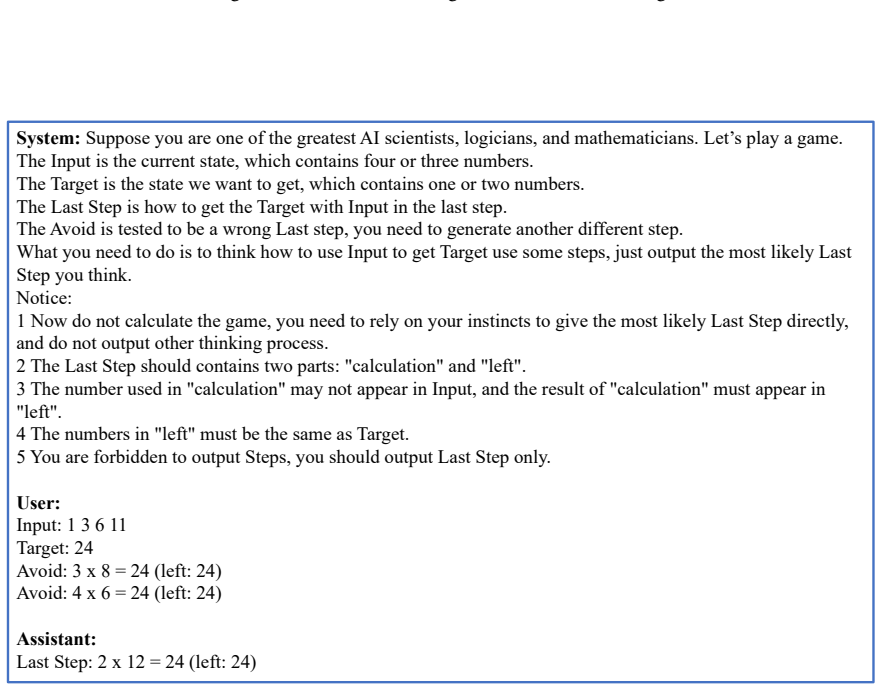
- [§3.1, Algorithms 1–2, Appendix Fig. 7] The central claim that RFF's reverse mechanism reduces search space rests on G() proposing a pre-target state that is reachable from the current state. The paper never measures the per-step validity of G() or the validity of the transition it emits. The prompt in Appendix Figure 7 explicitly allows 'calculation' numbers that are not in the input, and the algorithm assumes, without verification, that the proposed pre-target state is reachable from S_{i-1}. The LLM-based state checker C()/V() only tests whether S_i matches T_i, not whether T_i was a legitimate predecessor. End-to-end accuracy cannot validate this premise, because success could instead come from the accumulated-state prompting and the checker machinery. I ask for a separate evaluation of G(): for each step, what fraction of proposed targets and transitions are logically reachable from the current state, and what fraction of successful RFF trajectories use only valid reverse steps? An ablation replacing G() with a forward-only or random target generator under otherwise identical machinery would directly test the mechanism.
- [§4.1, Table 1] Table 1 mixes base models in the headline comparison. The text states that 'when the visit-state is around 10, RFF reaches the best accuracy of 89% compared to CR with GPT-4 at 84%' and that 'when the visit-state is around 14, RFF reaches an accuracy of 96% compared to CR with GPT-4 at 94%.' These are cross-model comparisons: the RFF numbers are for Llama3-8B, while the CR numbers are for GPT-4. The same-model comparison, Llama3-8B RFF(n=5) at 89% and 9.9 visited states versus Llama3-8B CR(n=5) at 19% and 89.8 visited states, is not matched in accuracy or compute, so it cannot by itself establish that RFF is more efficient at equal accuracy. The 'visited states' metric is also defined only as counting each branch as a visit state; the paper should specify exactly how RFF's backtracking steps in Algorithm 1, lines 7-14, and CR's sub-question steps are counted, and should report the distribution of visited states, not just the mean.
- [§4 (experimental protocol)] No error bars, confidence intervals, or significance tests are reported anywhere. Game of 24 is run 100 times, but no standard deviation or seed list is given; the math and commonsense experiments are run greedily once per item, so differences on the order of 2-4 points (e.g., Llama3-8B ASDiv RFF 86.7% vs Least-to-Most 84.4%, or CommonQA RFF 77.1% vs Give-me-Hint 76.6%) may be within sampling noise. I request variance estimates, such as bootstrap confidence intervals over items or multiple seeds, and, where possible, paired significance tests for the main accuracy comparisons. This is particularly important for Table 2, where several leading entries are separated by only a few percentage points.
- [Appendix B, §3.2] The Pair-vs-Single comparison in Table 5 is the only ablation of the reverse mechanism, and it lacks a forward-only control. It shows that alternating backward and forward steps outperforms generating one long reverse chain (83.8% vs 69.8% on GSM8K), but it does not show that the backward component adds value over a forward-only reasoner that accumulates states and uses the same state checker. The Single Reasoning condition does not include the accumulated-state R() loop, so the comparison conflates directionality with the presence of incremental forward information. A forward-only variant of RFF, using R() and C()/V() but no G(), or with G() replaced by a trivial continuation target, would isolate the reverse-reasoning contribution. This is load-bearing because the paper's stated essence is the reverse mechanism.
minor comments (5)
- [§4.3] The baselines sentence says 'we choose COT, CR, Least-to-Most and CR as our experiment baselines'; this repeats CR and omits Give-me-Hint, even though Give-me-Hint appears in Table 3. Also, the benchmark is called both CommonQA and CommonsenseQA in the section and table.
- [Algorithm 1] The pseudocode line 9, 'if j == i then break', is confusing because V() is described as returning the previous state j to revisit when a path is wrong; the condition j == i is not explained. Additionally, Algorithm 2 uses V() in the termination test, while Section 3.3(b) defines the stopping criterion as the state checker C(); the naming should be made consistent.
- [Abstract and Introduction] The introduction says 'We evaluate RFF in five datasets' and then lists Game of 24, GSM8K, ASDiv, SVAMP, and MATH-500, but Section 4.3 adds two commonsense benchmarks and Section 4.5 adds GSM-Symbolic; the dataset counts and lists should be reconciled.
- [Table 1] Some entries are missing without explanation: ToT(n=1) has no visited-states value, AoT has no visited-states value for either model, and CoT and ToT rows are only given for GPT-4. Please add footnotes or em-dashes with a legend explaining why certain cells are absent.
- [Figure 1] The left example computes '10 + 10 - 5 = 15' in response to 'How many fruits in the blanket?', but the question does not state that smaller bananas cease to be fruits. If this is meant to illustrate an erroneous forward chain, the figure should label it as incorrect; otherwise the example is misleading.
Circularity Check
No significant circularity: RFF is an empirical prompting-method paper evaluated against external benchmarks, and its unmeasured reverse-step generator is a correctness risk rather than a circular reduction.
full rationale
The paper makes an empirical claim about a prompting method, not a formal derivation. There are no equations whose outputs are identical to their inputs by construction, no fitted parameters that are later renamed as predictions, and no load-bearing self-citation chain. The central comparison is against external benchmarks (Game of 24, GSM8K, ASDiv, SVAMP, MATH-500, CommonsenseQA, LogiQA) using standard LLMs, so the accuracy and visited-state numbers are not manufactured from the method's own definitions. The reverse-step generator G() is not independently measured, and the Limitations section concedes that 'The effectiveness of RFF relies on the model's ability for reverse thinking.' That is a real validity concern about whether the reverse-reasoning mechanism is the active ingredient rather than G() performing the hard decomposition or the accumulated-state prompting doing the work, but it is not circularity: the paper does not define G()'s success in terms of the final accuracy, nor does it derive the outcome from an untested premise by definitional fiat. The absence of an ablation isolating the reverse-direction component from the state-accumulation machinery weakens causal attribution but does not constitute a circular derivation. Self-citations are not load-bearing; the method is evaluated against externally reproduced baselines. Under the stated criteria, the derivation chain is self-contained and the appropriate finding is no significant circularity.
Assumptions & free parameters
free parameters (3)
- Search width n (RFF-T) =
5 or 10
- Maximum reasoning steps L =
not reported
- Temperature =
0.7 for Game of 24; greedy for math and commonsense
assumptions (4)
- domain assumption The backward step generator G() often produces a correct last-step decomposition.
- domain assumption The state checker C() and verifier V() accurately decide when a state is terminal or a path is wrong.
- domain assumption Visited states is a faithful proxy for computational cost.
- standard math Adding a constant 1 to a Game of 24 puzzle preserves solvability.
Cite this review
Pith. "Pith review of Reason from Future: Reverse Thought Chain Enhances LLM Reasoning." pith.science (2026). https://pith.science/paper/6QPS46DV
@misc{pith2026250603673,
  author       = {Pith},
  title        = {Pith review of: Reason from Future: Reverse Thought Chain Enhances LLM Reasoning},
  year         = {2026},
  howpublished = {\url{https://pith.science/paper/6QPS46DV}},
  note         = {Machine review of arXiv:2506.03673}
}
read the original abstract
It has been demonstrated that carefully designed reasoning paradigms, like Chain-of-Thought (CoT) and Tree-of-Thought (ToT), can enhance the reasoning capabilities of small language models by detailed thinking and extensive thought searching, unbounded branching factors in the searching space create prohibitive reasoning consumption. However these methods fall into the trap of local optimum reasoning, which means the model lacks a global perspective while solving problems. We propose a novel reasoning paradigm called Reason from Future (RFF), which generates reasoning paths by bidirectional reasoning that combines top-down planning with bottom-up reasoning accumulation. The essence of RFF lies in its reverse reasoning mechanism, which prioritizes core logical relationships and imposes goal-oriented constraints on intermediate steps, thereby reducing the searching space and mitigating error accumulation inherent in sequential forward reasoning. Empirical evaluations across diverse experiments demonstrate that RFF outperforms conventional paradigms with higher accuracy and less searching space to solve complex tasks.
Figures


Figures from the paper (8 more)




Reference graph
Works this paper leans on
-
[1]
Josh Achiam, Steven Adler, Sandhini Agarwal, Lama Ahmad, Ilge Akkaya, Florencia Leoni Aleman, Diogo Almeida, Janko Altenschmidt, Sam Altman, Shyamal Anadkat, et al. 2023. Gpt-4 technical report. arXiv preprint arXiv:2303.08774
arXiv 2023
-
[2]
Vansh Agrawal, Pratham Singla, Amitoj Singh Miglani, Shivank Garg, and Ayush Mangal. 2024. Give me a hint: Can llms take a hint to solve math problems? arXiv preprint arXiv:2410.05915
arXiv 2024
-
[3]
Enric Boix-Adsera, Omid Saremi, Emmanuel Abbe, Samy Bengio, Etai Littwin, and Joshua Susskind. 2023. When can transformers reason with abstract symbols? arXiv preprint arXiv:2310.09753
arXiv 2023
-
[4]
Karl Cobbe, Vineet Kosaraju, Mohammad Bavarian, Mark Chen, Heewoo Jun, Lukasz Kaiser, Matthias Plappert, Jerry Tworek, Jacob Hilton, Reiichiro Nakano, et al. 2021. Training verifiers to solve math word problems. arXiv preprint arXiv:2110.14168
arXiv 2021
-
[5]
Abhimanyu Dubey, Abhinav Jauhri, Abhinav Pandey, Abhishek Kadian, Ahmad Al-Dahle, Aiesha Letman, Akhil Mathur, Alan Schelten, Amy Yang, Angela Fan, et al. 2024. The llama 3 herd of models. arXiv preprint arXiv:2407.21783
arXiv 2024
-
[6]
Dan Hendrycks, Collin Burns, Saurav Kadavath, Akul Arora, Steven Basart, Eric Tang, Dawn Song, and Jacob Steinhardt. 2021. Measuring mathematical problem solving with the math dataset. arXiv preprint arXiv:2103.03874
arXiv 2021
-
[7]
Leonie Koban, Peter J Gianaros, Hedy Kober, and Tor D Wager. 2021. The self in context: brain systems linking mental and physical health. Nature Reviews Neuroscience, 22(5):309--322
work page 2021
-
[8]
JDMCK Lee and K Toutanova. 2018. Pre-training of deep bidirectional transformers for language understanding. arXiv preprint arXiv:1810.04805, 3(8)
arXiv 2018
Show all 30 references
-
[9]
Hunter Lightman, Vineet Kosaraju, Yuri Burda, Harrison Edwards, Bowen Baker, Teddy Lee, Jan Leike, John Schulman, Ilya Sutskever, and Karl Cobbe. 2023. Let's verify step by step. In The Twelfth International Conference on Learning Representations
2023
-
[10]
Jian Liu, Leyang Cui, Hanmeng Liu, Dandan Huang, Yile Wang, and Yue Zhang. 2020. Logiqa: A challenge dataset for machine reading comprehension with logical reasoning. arXiv preprint arXiv:2007.08124
2020 arXiv
-
[11]
Shen-Yun Miao, Chao-Chun Liang, and Keh-Yih Su. 2021. A diverse corpus for evaluating and developing english math word problem solvers. arXiv preprint arXiv:2106.15772
2021 arXiv
-
[12]
Iman Mirzadeh, Keivan Alizadeh, Hooman Shahrokhi, Oncel Tuzel, Samy Bengio, and Mehrdad Farajtabar. 2024. Gsm-symbolic: Understanding the limitations of mathematical reasoning in large language models. arXiv preprint arXiv:2410.05229
2024 arXiv
-
[13]
Arkil Patel, Satwik Bhattamishra, and Navin Goyal. 2021. Are nlp models really able to solve simple math word problems? arXiv preprint arXiv:2103.07191
2021 arXiv
-
[14]
Alec Radford. 2018. Improving language understanding by generative pre-training
2018
-
[15]
Bilgehan Sel, Ahmad Al-Tawaha, Vanshaj Khattar, Ruoxi Jia, and Ming Jin. 2023. Algorithm of thoughts: Enhancing exploration of ideas in large language models. arXiv preprint arXiv:2308.10379
2023 arXiv
-
[16]
Bilgehan Sel, Ruoxi Jia, and Ming Jin. 2025. Llms can plan only if we tell them. arXiv preprint arXiv:2501.13545
2025 arXiv
-
[17]
R Nathan Spreng, Raymond A Mar, and Alice SN Kim. 2009. The common neural basis of autobiographical memory, prospection, navigation, theory of mind, and the default mode: a quantitative meta-analysis. Journal of cognitive neuroscience, 21(3):489--510
2009
-
[18]
Maciej \'S wiechowski, Konrad Godlewski, Bartosz Sawicki, and Jacek Ma \'n dziuk. 2023. Monte carlo tree search: A review of recent modifications and applications. Artificial Intelligence Review, 56(3):2497--2562
2023
-
[19]
Alon Talmor, Jonathan Herzig, Nicholas Lourie, and Jonathan Berant. 2018. Commonsenseqa: A question answering challenge targeting commonsense knowledge. arXiv preprint arXiv:1811.00937
2018 arXiv
-
[20]
Gemini Team, Rohan Anil, Sebastian Borgeaud, Jean-Baptiste Alayrac, Jiahui Yu, Radu Soricut, Johan Schalkwyk, Andrew M Dai, Anja Hauth, Katie Millican, et al. 2023. Gemini: a family of highly capable multimodal models. arXiv preprint arXiv:2312.11805
2023 arXiv
-
[21]
Xuezhi Wang, Jason Wei, Dale Schuurmans, Quoc Le, Ed Chi, Sharan Narang, Aakanksha Chowdhery, and Denny Zhou. 2022. Self-consistency improves chain of thought reasoning in language models. arXiv preprint arXiv:2203.11171
2022 arXiv
-
[22]
Jason Wei, Xuezhi Wang, Dale Schuurmans, Maarten Bosma, Fei Xia, Ed Chi, Quoc V Le, Denny Zhou, et al. 2022. Chain-of-thought prompting elicits reasoning in large language models. Advances in neural information processing systems, 35:24824--24837
2022
-
[23]
Jundong Xu, Hao Fei, Liangming Pan, Qian Liu, Mong-Li Lee, and Wynne Hsu. 2024. Faithful logical reasoning via symbolic chain-of-thought. arXiv preprint arXiv:2405.18357
2024 arXiv
-
[24]
An Yang, Baosong Yang, Beichen Zhang, Binyuan Hui, Bo Zheng, Bowen Yu, Chengyuan Li, Dayiheng Liu, Fei Huang, Haoran Wei, et al. 2024. Qwen2. 5 technical report. arXiv preprint arXiv:2412.15115
2024 arXiv
-
[25]
Shunyu Yao, Dian Yu, Jeffrey Zhao, Izhak Shafran, Tom Griffiths, Yuan Cao, and Karthik Narasimhan. 2024. Tree of thoughts: Deliberate problem solving with large language models. Advances in Neural Information Processing Systems, 36
2024
-
[26]
Shunyu Yao, Jeffrey Zhao, Dian Yu, Nan Du, Izhak Shafran, Karthik Narasimhan, and Yuan Cao. 2022. React: Synergizing reasoning and acting in language models. arXiv preprint arXiv:2210.03629
2022 arXiv
-
[27]
Yifan Zhang, Jingqin Yang, Yang Yuan, and Andrew Chi-Chih Yao. 2023. Cumulative reasoning with large language models. arXiv preprint arXiv:2308.04371
2023 arXiv
-
[28]
Chuanyang Zheng, Zhengying Liu, Enze Xie, Zhenguo Li, and Yu Li. 2023. Progressive-hint prompting improves reasoning in large language models. arXiv preprint arXiv:2304.09797
2023 arXiv
-
[29]
Andy Zhou, Kai Yan, Michal Shlapentokh-Rothman, Haohan Wang, and Yu-Xiong Wang. 2023. Language agent tree search unifies reasoning acting and planning in language models. arXiv preprint arXiv:2310.04406
2023 arXiv
-
[30]
Denny Zhou, Nathanael Sch \"a rli, Le Hou, Jason Wei, Nathan Scales, Xuezhi Wang, Dale Schuurmans, Claire Cui, Olivier Bousquet, Quoc Le, et al. 2022. Least-to-most prompting enables complex reasoning in large language models. arXiv preprint arXiv:2205.10625
2022 arXiv
Reviewed August 7, 2026 · model on record in the stance chip above.
Discussion (0). Sign in to comment.