REVIEW 1 major objections 4 minor 16 references
Classical BPS M5-brane on the plane wave background
T0 review · 1 major / 4 minor · reviewed 2026-08-07 · deepseek-v4-flash
Pith's one-line read The paper derives a family of BPS M5-brane solutions on a plane-wave background with nonzero angular momentum, including an explicit two-parameter rotating ellipsoidal five-brane.
desk verdict First explicit rotating BPS M5-brane solutions on the plane wave background, but the key sum-of-squares completion has an unverified step that a referee should check. read the letter →
The pith
A machine-rendered reading of the paper's core claim, the machinery that carries it, and where it could break.
The reading
What carries the argument
The machinery is the decomposition of the BPS condition into a sum of squares. The Hamiltonian plus angular-momentum terms is split as $H_1+H_2+H_3+H_4$, where $H_1$ contains momenta, $H_2$ contains 5-brackets without $X^3$, $H_3$ contains 5-brackets with $X^3$, and $H_4$ is the leftover. The paper uses the fundamental identity of the 5-bracket to combine squares, and chooses auxiliary signs $\hat{\eta}_a$ so that $H_4$ becomes proportional to the Gauss law constraint (3.4). Once Gauss law is imposed, BPS saturation reduces to $H_1=0$, $H_2=0$, $H_3=0$. The solution ansatz represents the embedding as block matrices $R_a(t)$, $\hat{R}_a(t)$ acting on the unit sphere, turning the first-order equations into matrix equations whose solutions are rotations $R(-\alpha t)R(0)R(\beta t)$. This reduction converts a field-theory BPS problem into finite-dimensional matrix algebra.
What would settle it
Substitute the explicit solution of Eqs. (3.46)-(3.47) into the original light-cone equations of motion and the Gauss law constraint, and evaluate the leftover term $H_4$ on the constraint surface; if $H_4$ does not vanish, the configuration is not BPS. Alternatively, integrate $X^A P^B - X^B P^A$ over the world-volume for the explicit solution and compare with the angular-momentum formulas (3.41).
Extended reading notes
Core claim
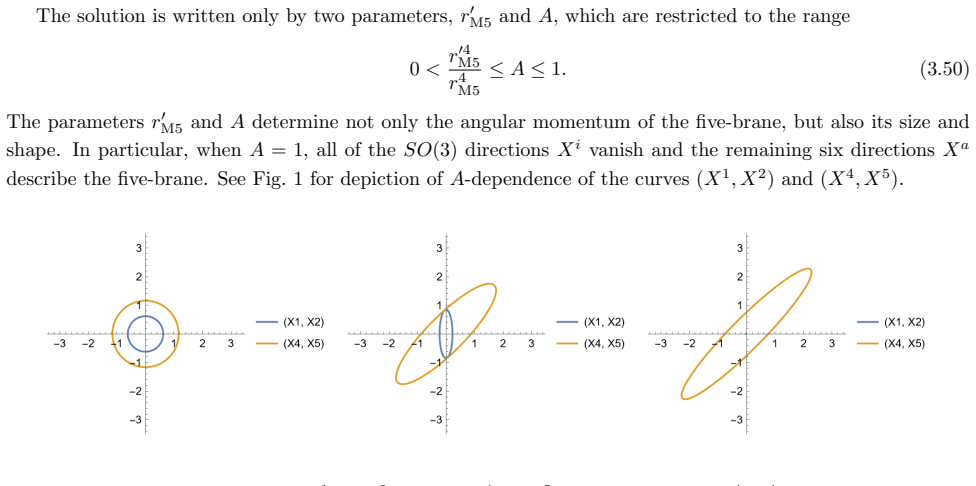
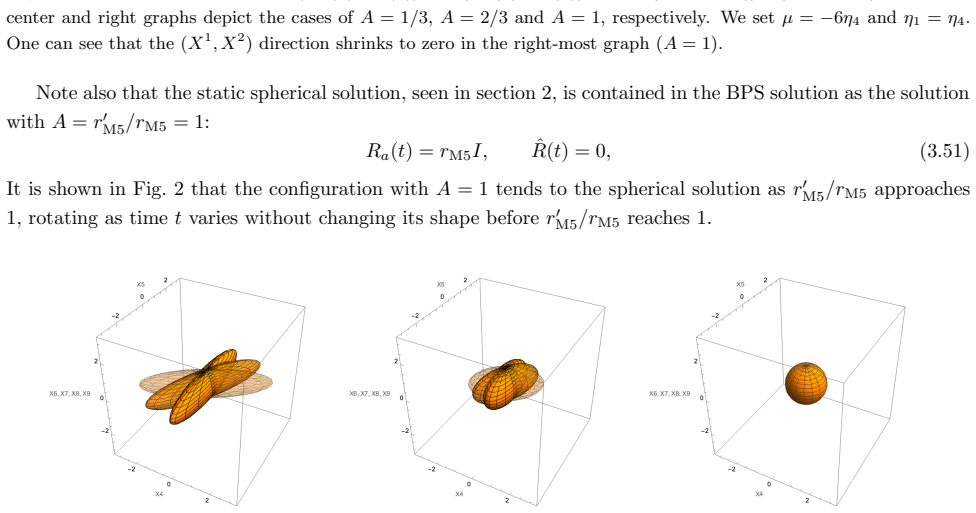
On the plane-wave background with constant flux $\mu$, the light-cone Hamiltonian admits a static spherical solution. The paper shows that the BPS saturation condition $H + \frac{\eta_1\mu}{3} M_{12} + \frac{\eta_4\mu}{6} M_{45} + \frac{\eta_6\mu}{6} M_{67} + \frac{\eta_8\mu}{6} M_{89}=0$ can be rewritten as a sum of nonnegative squares $H_1+H_2+H_3$, with a leftover $H_4$ that is proportional to the Gauss law constraint and to terms killed by a choice of auxiliary signs $\hat{\eta}_a$. Imposing the Gauss law forces each square to vanish, producing first-order equations. Under an ansatz where pairs of embedding coordinates are related by $2\times 2$ matrices acting on the unit five-sphere, these equations reduce to linear matrix equations whose solutions are products of rotations. The explicit two-parameter solution has two independent angular momentum components and describes a five-brane whose spatial image is an ellipsoid rotating at fixed angular velocities; setting $A = r_{M5}'^4/r_{M5}^4=1$ recovers the static spherical solution.
Load-bearing premise
The argument depends on the claim, stated without derivation after Eq. (3.5), that the leftover term $H_4$ is exactly proportional to the Gauss law constraint once the auxiliary signs are fixed, so that imposing Gauss law turns the BPS condition into a sum of squares; if $H_4$ does not vanish on the constraint surface, the first-order equations are not implied by BPS saturation.
Editorial extensions
If this is right
- The static spherical M5-brane vacuum is a special case of the new family, recovered when $A = r_{M5}'^4/r_{M5}^4 = 1$.
- BPS solutions exist with two independent nonzero angular-momentum components, while a solution with only $M_{12}$ nonzero and the other three components zero does not exist.
- The shape of the rotating brane is a time-independent ellipsoid, while the angular velocities are fixed by the flux $\mu$ and the sign choices, independent of the size parameters.
- The methodology gives a general procedure: any four angular-momentum components satisfying the derived inequalities can be translated into initial matrices and hence into a BPS solution.
- Solutions with at least one $\det R_a = 0$ are classified: no solution exists when exactly $\det R_4=0$ with $\det R_6, \det R_8$ nonzero, but solutions do exist when two or three determinants vanish.
Reading between the lines
- If the proposed correspondence with the quarter-BPS sector of the plane-wave matrix model holds, the same sum-of-squares rewriting should survive a double Wick rotation; testing the rotating ellipsoid against eigenvalue distributions of the quarter-BPS operator would be a direct check, though the paper does not perform it.
- The existence of a continuum of BPS solutions parameterized by angular momenta suggests that the BPS sector of the dual matrix model may be continuously degenerate, and one could look for corresponding saddle-point deformations in the matrix integral.
- The rigid rotation at fixed angular velocities, independent of the size parameters, resembles the behavior of rotating fuzzy-sphere phases in matrix models; an M-theoretic counterpart of those phases may emerge from quantizing the finite-dimensional data $(A, \det R_4, \det R_6, \det R_8)$.
- Because the explicit solution is built from $2\times 2$ matrix rotations, it may admit a natural generalization to other toric embeddings or to multiple M5-branes via a large-$N$ limit of the 5-bracket structure, though the paper does not pursue this.
Editorial analysis
A structured set of objections, weighed in public.
Referee Report
Summary. The paper studies the bosonic sector of a single M5-brane on the eleven-dimensional plane-wave background. Starting from the light-cone Hamiltonian, it recalls the known static spherical solution and then attacks the BPS saturation condition, which it rewrites as a sum of squares H1+H2+H3 plus a remainder H4. The authors assert that after imposing the Gauss law constraint and fixing the signs eta-hat_a, H4 drops out, so BPS saturation is equivalent to the vanishing of the squares in H1, H2 and H3. This yields first-order differential equations and algebraic constraints, which are solved under a block-matrix ansatz. The main result is an explicit two-parameter family describing an ellipsoidal five-brane rotating without changing its shape, with non-zero angular momentum M12 and M45, and with the static sphere recovered in a limit. Appendices contain the reduction of the BPS equations, the Gauss law constraint, degenerate cases with vanishing det R_a, and inequalities for the parameters.
Significance. If the derivation is completed, the paper provides the first explicit classical BPS solutions for a single M5-brane on the plane-wave background with non-zero angular momentum. The explicit closed-form solution, the recovery of the static sphere, the computation of the angular momentum with definite signs, and the detailed appendices for the degenerate cases are valuable. The connection to the quarter-BPS sector of the BMN matrix model is a plausible and interesting motivation. However, the central square-completion step relies on an unproven assertion about the remainder H4, so the significance is conditional on closing that gap.
major comments (1)
- [Section 3, after Eq. (3.32)] The claim that 'at least two out of three det R_hat_a are zero' follows from Eq. (3.24) is stated without proof. This is a load-bearing reduction because it justifies setting two of the R_hat_a matrices to zero and thereby reduces the solution to the two-parameter family. Under the assumption det R_a ≠ 0, Eq. (3.24) gives R_hat_b^T ε R_hat_c = 0 and R_hat_c^T ε R_hat_b = 0 for each cyclic pair; a short argument is needed to show that if two of det R_hat_a were non-zero this would force a contradiction. The authors should include this derivation and also justify the 'without loss of generality' relabeling that selects R_hat_6 = R_hat_8 = 0.
minor comments (4)
- [Section 2] The text refers to the 'Plank length'; this should be 'Planck length'.
- [Section 3, Eq. (3.5)] In the expression for H4, the summation over the index A in P^A is not specified; it should be stated explicitly that A runs over 1,...,9.
- [Section 3, Eq. (3.4)] The Gauss law constraint is written as a two-form equation; it would be clearer to state that the coefficients of every dσ^α ∧ dσ^β must vanish.
- [Section 3, Eq. (3.45)] The explicit solution uses the parameters r'_M5 and A, but the range (3.50) is stated only afterward; moving the range before the solution would improve readability.
Circularity Check
No significant circularity: the BPS equations come from the supersymmetry algebra, the sum-of-squares decomposition is a rewriting of that BPS condition, and the solution parameters A and r'_M5 label the family rather than being fitted to the result.
full rationale
The claimed derivation is essentially self-contained. The BPS condition (3.2) is taken from the standard supersymmetry algebra (3.1), not constructed so as to force the ellipsoidal solution. The rewriting (3.3) is presented as H1+H2+H3+H4, and the first-order equations H1=0 and H2=0 are consequences of saturating the BPS bound once H4 is removed by the Gauss-law constraint and the choice (3.9)-(3.10). The only questionable step is the assertion after (3.5) that the P^A(...) terms in H4 are proportional to the Gauss-law constraint (3.4); the paper does not display the integration-by-parts and fundamental-identity argument. That is a proof gap and a correctness risk, not circularity: the claim is not that some quantity is defined in terms of another and then rediscovered, nor is any fitted parameter renamed as a prediction. The ansatz (3.21) is a free choice of the authors rather than an imported result, and the self-citations [1-6] supply background and motivation (such as the matrix-model correspondence) but are not the load-bearing step that produces the rotating-ellipsoid solution. The two parameters A and r'_M5 in the explicit solution (3.46)-(3.47) are undetermined family labels subject to the range (3.50), not fit to the target angular momenta; the angular momenta are computed subsequently from the solution. Accordingly, there is no circularity in the derivation chain and the circularity score is 0.
Assumptions & free parameters
free parameters (2)
- A =
not fitted
- r'_M5 =
not fitted
assumptions (5)
- domain assumption The single M5-brane action is the bosonic PST action with chiral two-form, auxiliary scalar, and fermions set to zero.
- domain assumption The plane wave background metric and flux (Eq. (2.1)) are taken as given.
- domain assumption The light-cone supersymmetry algebra (Eq. (3.1)) with central charge terms mu/3 M_ij and mu/6 M_ab for the M5-brane on this background.
- standard math The 5-sphere embedding identity {x^{a2},...,x^{a5}} = epsilon^{a1...a6} x^{a1} (Eq. (2.12)).
- standard math The fundamental identity of the 5-bracket (Eq. (3.8)).
Cite this review
Pith. "Pith review of Classical BPS M5-brane on the plane wave background." pith.science (2026). https://pith.science/paper/BIH4PERG
@misc{pith2026250603708,
  author       = {Pith},
  title        = {Pith review of: Classical BPS M5-brane on the plane wave background},
  year         = {2026},
  howpublished = {\url{https://pith.science/paper/BIH4PERG}},
  note         = {Machine review of arXiv:2506.03708}
}
read the original abstract
We consider the bosonic theory for a single M5-brane on the plane-wave background and derive a family of BPS solutions with non-zero components of the angular momentum. By explicit construction of a BPS solution, we find the solution describes an ellipsoidal five-brane rotating without changing its shape. The methodology developed in this paper is expected to provide a strategy for obtaining the BPS solutions that correspond to a BPS sector in the dual gauge theory, such as the BMN matrix model.
Figures
Reference graph
Works this paper leans on
- [1]
-
[2]
D.E. Berenstein, J.M. Maldacena and H.S. Nastase, Strings in flat space and pp waves from N=4 superYang-Mills, JHEP 04 (2002) 013 [ hep-th/0202021]
arXiv 2002
-
[3]
J.M. Maldacena, M.M. Sheikh-Jabbari and M. Van Raamsdonk, Transverse five-branes in matrix theory , JHEP 01 (2003) 038 [ hep-th/0211139]
arXiv 2003
-
[4]
On the transverse M5-branes in matrix theory
Y. Asano, G. Ishiki, S. Shimasaki and S. Terashima, Spherical transverse M5-branes in matrix theory , Phys. Rev. D 96 (2017) 126003 [ 1701.07140]
work page Pith review arXiv 2017
- [5]
- [6]
-
[7]
P. Pasti, D.P. Sorokin and M. Tonin, Covariant action for a D = 11 five-brane with the chiral field , Phys. Lett. B 398 (1997) 41 [ hep-th/9701037]
arXiv 1997
-
[8]
Covariant Action for the Super-Five-Brane of M-Theory
I.A. Bandos, K. Lechner, A. Nurmagambetov, P. Pasti, D.P. Sorokin and M. Tonin, Covariant action for the superfive-brane of M theory , Phys. Rev. Lett. 78 (1997) 4332 [ hep-th/9701149]
work page Pith review arXiv 1997
Show all 16 references
-
[9]
Ho, C.-T
P.-M. Ho, C.-T. Ma and C.-H. Yeh, BPS States on M5-brane in Large C-field Background , JHEP 08 (2012) 076 [ 1206.1467]
2012 arXiv
- [10]
-
[11]
P.-M. Ho, Y. Imamura, Y. Matsuo and S. Shiba, M5-brane in three-form flux and multiple M2-branes , JHEP 08 (2008) 014 [ 0805.2898]
2008 arXiv
-
[12]
Howe, N.D
P.S. Howe, N.D. Lambert and P.C. West, The Selfdual string soliton , Nucl. Phys. B 515 (1998) 203 [hep-th/9709014]. 14
1998 arXiv
-
[13]
Howe, N.D
P.S. Howe, N.D. Lambert and P.C. West, The three-brane soliton of the M-five-brane , Phys. Lett. B 419 (1998) 79 [ hep-th/9710033]
1998 arXiv
-
[14]
Lust and A
D. Lust and A. Miemiec, Supersymmetric M5-branes with H field , Phys. Lett. B 476 (2000) 395 [hep-th/9912065]
2000 arXiv
-
[15]
Michishita, The M2 brane soliton on the M5 brane with constant 3 form , JHEP 09 (2000) 036 [hep-th/0008247]
Y. Michishita, The M2 brane soliton on the M5 brane with constant 3 form , JHEP 09 (2000) 036 [hep-th/0008247]
2000 arXiv
-
[16]
Youm, BPS solitons in M5 brane world volume theory with constant three form field , Phys
D. Youm, BPS solitons in M5 brane world volume theory with constant three form field , Phys. Rev. D 63 (2001) 045004 [ hep-th/0009082]. 15
2001 arXiv
Reviewed August 7, 2026 · model on record in the stance chip above.
Discussion (0). Sign in to comment.