REVIEW 4 major objections 5 minor 97 references
Cosmological Dynamics of Accelerating Model in $f(T)$ Gravity with Special Forms of Deceleration Parameter
T0 review · 4 major / 5 minor · reviewed 2026-08-07 · deepseek-v4-flash
Pith's one-line read Two deceleration-parameter models in f(T) gravity, fitted to chronometer and supernova data, place the start of cosmic acceleration near z ≈ 0.6 and give a universe age of 13–14 Gyr.
desk verdict The f(T) sector is a costume: with alpha=1, n=1 the torsion term cancels, so every dark-energy result is bookkeeping from the assumed q(z), not a prediction of modified gravity. read the letter →
The pith
A machine-rendered reading of the paper's core claim, the machinery that carries it, and where it could break.
The reading
What carries the argument
The argument runs through four linked pieces. First, teleparallel $f(T)$ gravity — a modified gravity whose action is a function of the torsion scalar $T$ of the Weitzenböck connection instead of the Ricci curvature of general relativity — supplies the background: for the flat FLRW metric $T = -6H^2$, and the Lagrangian $T + f(T)$ with $f(T) = \alpha(-T)^n$ produces the modified Friedmann equations (11)–(12). Second, each deceleration-parameter ansatz fixes the expansion history through the identity $\dot{H} = -(1+q)H^2$, yielding closed-form Hubble functions (21) and (23) in terms of $H_0$ and the ansatz parameters. Third, the reconstruction identities (15)–(16) convert the chosen $H(z)$ and $f(T)$ into a dark-energy density $\rho_{\mathrm{DE}}$, pressure $p_{\mathrm{DE}}$, and equation-of-state parameter $\omega_{\mathrm{DE}}$ given by (17), which the paper then diagnoses with energy conditions and the statefinder pair $(r,s)$. Fourth, a Bayesian Markov chain Monte Carlo likelihood fit to 31 cosmic chronometer points and to the joint chronometer-plus-Pantheon sample determines the median values of $H_0$, $q_0$, $q_1$, $q_2$, $N$, and the supernova absolute-magnitude nuisance parameter $M$ that drive every conclusion. The displayed dynamical plots are evaluated at the paper's stated choice $\alpha = 1$ and $n = 1$.
What would settle it
Set $\alpha = 1$ and $n = 1$ as the paper does: the action $T+f(T)$ vanishes, equations (11)–(12) force $\rho = p = 0$, and equation (34) must reduce to the kinematic identity $\omega_{\mathrm{DE}}(z) = (2q(z)-1)/3$ at every redshift. Evaluating that identity at the Model-1 cosmic-chronometer median parameters ($q_0 = -0.648$, $q_1 = -0.557$, $N = 22$) gives $\omega_0 \approx -0.765$, whereas the paper reports $\omega_0 = -0.6857$; recomputing the curves of Figures 6 and 7 from equations (21) and (34) at the tabulated medians would settle whether the discrepancy is an arithmetic or typographical inconsistency or evidence that the plotted dark-energy quantities are not the $f(T)$ reconstruction described.
Extended reading notes
Core claim
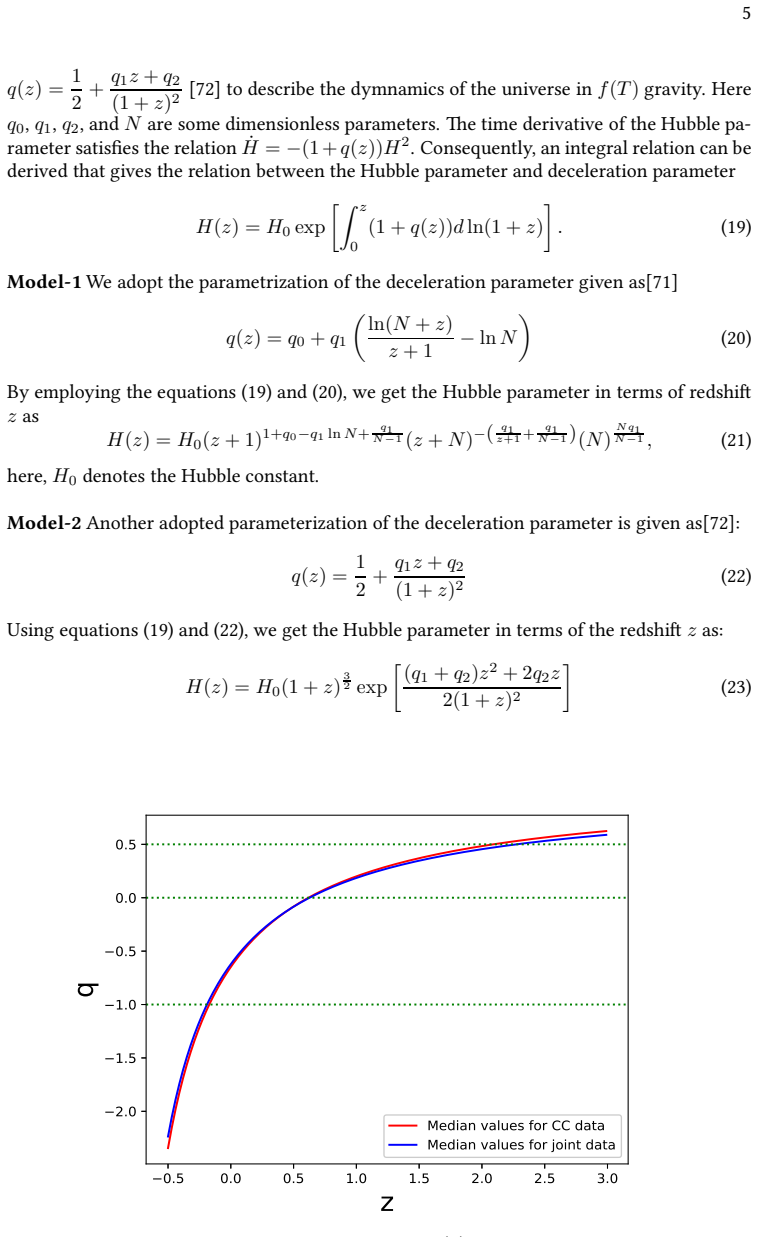
The central claim is that two redshift-dependent parameterizations of the deceleration parameter — $q(z) = q_0 + q_1(\ln(N+z)/(z+1) - \ln N)$ and $q(z) = \frac{1}{2} + (q_1 z + q_2)/(1+z)^2$ — embedded in the teleparallel model $f(T) = \alpha(-T)^n$ and constrained by Bayesian Monte Carlo fits to cosmic chronometer and joint (chronometer + Pantheon) data, reproduce the observed late-time acceleration. For the median parameters, the universe decelerates in the matter-dominated past and switches to acceleration at $z_t \approx 0.6$, the present $q_0$ is negative (about $-0.62$ to $-0.70$), and $\omega_{\mathrm{DE}}$ lies in the quintessence band today (roughly $-0.67$ to $-0.80$) before crossing the cosmological-constant line to phantom values at late times, behavior the authors call quintom dark energy. The reconstructed dark-energy density stays positive while the pressure turns negative, the energy conditions show the pattern expected for acceleration (SEC violated today; NEC, WEC, and DEC satisfied up to the present and violated in the phantom future), and the statefinder trajectories pass through the $\Lambda$CDM fixed point. The integrated age of the universe comes out at 13.07–13.78 Gyr depending on model and dataset, close to the $\Lambda$CDM value, so the authors conclude that both models are consistent with the observational evidence for current accelerated expansion.
Load-bearing premise
Every displayed dark-energy result is computed with the theory's free parameters fixed by hand to $\alpha = 1$ and $n = 1$, the choice that makes the action $T+f(T)$ identically zero, so the reported dark-energy behavior is a repackaging of the assumed expansion history rather than a prediction of $f(T)$ gravity, and fitting $n$ instead could alter the conclusions.
Editorial extensions
If this is right
- If the paper is right, both $q(z)$ parameterizations are observationally viable descriptions of the expansion history, with a matter-to-acceleration transition near $z \approx 0.6$ and a negative present-day $q_0$, so these kinematic forms alone are sufficient to fit the chronometer and supernova data.
- The dark-energy equation of state is predicted to lie in the quintessence window today and to cross into the phantom region in the future, implying that the NEC, WEC, and DEC — satisfied up to the present epoch — will eventually be violated while the SEC is already violated, a testable signature for upcoming surveys.
- The models predict a present universe age of 13.07–13.78 Gyr, consistent with the $\Lambda$CDM age, so they do not suffer from the age problem that plagues some accelerating cosmologies.
- The fitted $H_0 \approx 69$ km/s/Mpc is stable across both parameterizations and both dataset choices, and the statefinder trajectories pass through the $\Lambda$CDM fixed point $(r,s) = (1,0)$, so the models are kinematically close to $\Lambda$CDM in these diagnostics.
Reading between the lines
- Because the displayed results fix $\alpha = 1$ and $n = 1$, in which case $f(T) = -T$ and the gravitational action $T+f(T)$ vanishes identically, the field equations force $\rho = p = 0$ and the reported $\rho_{\mathrm{DE}}$, $p_{\mathrm{DE}}$, and $\omega_{\mathrm{DE}}$ equal exactly the kinematic identities $3H^2$, $-2\dot{H}-3H^2$, and $(2q-1)/3$ relabeled as dark energy; the quintessence-to-ph
- The parameter fit never varies $n$ or $\alpha$, so the $f(T)$ sector is not genuinely constrained by the data; marginalizing over $n$, or fitting it together with $q_0$, $q_1$, $q_2$, and $H_0$, would change the reconstructed $\omega_{\mathrm{DE}}$, the energy-condition verdicts, and possibly the transition redshift.
- A decisive cross-check, not performed in the paper, would rerun the same pipeline with $f(T) = 0$ (pure general-relativistic kinematics with the same two $q(z)$ ansätze) and compare the fitted $H_0$, $q_0$, $z_t$, and age; close agreement would show that the $f(T)$ dressing is observationally inert for these models.
Editorial analysis
A structured set of objections, weighed in public.
Referee Report
Summary. The paper studies power-law teleparallel gravity with f(T)=α(-T)^n in a flat FLRW universe, adopting two redshift-dependent deceleration-parameter ansätze q(z). It derives analytic H(z) expressions, fits the parameters to cosmic-chronometer and Pantheon data using MCMC/χ² minimization, and then displays effective dark-energy density, pressure, equation of state, energy conditions, statefinder diagnostics, and the age of the universe. The authors conclude that both models are consistent with the observed late-time accelerated expansion.
Significance. If the central claim were established, the paper would provide observational constraints on two q(z) parameterizations within f(T) gravity, including transition redshifts near z≈0.6, current quintessence-like EoS, and ages near 13–14 Gyr. The MCMC machinery and the analytic H(z) integrals are standard and appear internally consistent. However, the f(T) content is not actually tested: all displayed dynamical results use α=1 and n=1, for which the gravitational action T+f(T) vanishes identically, so the inferred dark-energy quantities are kinematic reconstructions from the assumed q(z) rather than predictions of f(T) gravity. The paper's central conclusion is therefore unsupported as written.
major comments (4)
- [Section 5.1, Eqs. (15)–(17)] The stated illustrative choice α=1, n=1 turns f(T)=α(-T)^n into f(T)=-T, making the action in Eq. (7) identically zero. Substituting f=-T, f_T=-1, and f_TT=0 into the field equations (11)–(12) gives ρ=0 and p=0 for any H(z). The effective dark-energy quantities (15)–(16) then reduce to ρ_DE=3H^2 and p_DE=-2H˙-3H^2, which are just the Einstein-tensor terms rearranged as a dark fluid. They carry no information about f(T), so the EoS behavior, phantom crossing, and energy-condition violations in Section 5 are not predictions of f(T) gravity.
- [Section 5.1, Tables 1–2] Under the stated n=1 choice, Eq. (34) simplifies to ω_DE=(2q-1)/3. Inserting the fitted values q0=-0.648 (CC) and q0=-0.622 (joint) gives ω0=-0.765 and -0.748, respectively, not the tabulated values -0.6857 and -0.6722 for Model-1. The reported EoS values therefore cannot be reproduced from the equations in the text, indicating either an algebraic error in Eq. (34) or the use of unstated parameter choices.
- [Section 4, Eqs. (24) and (29)] The MCMC likelihoods depend on H(z) only through the assumed q(z) parameterizations; the f(T) parameters α and n never enter the fits. Since Section 5 then fixes α and n by hand, the data constrain only the kinematic q-parameters, and the conclusion that these are f(T) gravity models consistent with observations is not established. A genuine dynamical test of f(T) would require constraining α and n through the field equations (11)–(12) or using independent matter-density data.
- [Section 5.4] The age calculation t0=∫ dz/[(1+z)H(z)] uses the same assumed H(z) and yields 13–14 Gyr. Because this result is independent of f(T), it cannot be cited as evidence in favor of the f(T) model; it is a kinematic consequence of the q(z) ansatz and the fitted H0.
minor comments (5)
- [Eq. (4)] The contorsion tensor expression appears to have an index-placement error; it should be compared with the standard definition, e.g., in reference [62].
- [Throughout] The text contains repeated OCR-like artifacts such as 'redshi/f_t', 'ma/t_ter', and 'a/t_tracted'; these should be corrected in the published version.
- [Section 5.3] The statefinder parameter s is defined without parentheses; it should read s=(r-1)/[3(q-1/2)].
- [Tables 1–2] The supernova absolute magnitude M is listed for the joint analysis but not for the CC-only fit; please clarify whether M was marginalized over in the CC-only analysis or treated as a nuisance parameter only for the Pantheon likelihood.
- [Figures 10–11] The statefinder trajectories would be easier to interpret with arrows indicating the direction of increasing time along the curve.
Circularity Check
The dark-energy results of Section 5 reduce by construction: for the plotted choice α=1, n=1 the f(T) action term T+f(T) vanishes, so ρ_DE, p_DE, ω_DE and the energy-condition/statefinder claims are kinematic consequences of the assumed q(z), not predictions of f(T) gravity.
-
self definitional
[Section 5.1, Eqs. (30)-(35); with Section 2 Eqs. (7), (15)-(17)]
"We take α = 1 and n = 1 for these graphical illustrations."
For f(T)=α(−T)^n, α=1,n=1 give f(T)=−T, so the action (7) has T+f(T)=0. Then (11)-(12) give ρ=p=0 identically, and (15)-(16) reduce to ρ_DE=3H^2, p_DE=−2H_dot−3H^2. Thus ω_DE=p_DE/ρ_DE depends only on H and H_dot; with H_dot=-(1+q)H^2, ω_DE=(2q−1)/3. Since H(z) is constructed from the assumed q(z) via (19), all Section 5 ρ_DE/p_DE/ω_DE, energy-condition, and statefinder plots are kinematic bookkeeping of the q(z) ansatz. The parameters α,n do not appear in the Section 4 χ^2 and are unconstrained; the f(T) model makes no independent contribution to the claimed dynamics.
-
fitted input called prediction
[Section 3, following Eqs. (20)-(23); Tables 1-2]
"The negative values indicate that the universe is currently undergoing an accelerated expansion at (z = 0). It has been demonstrated that the deceleration parameter supports the present phase of accelerated expansion."
q0 is a free parameter of the adopted q(z) ansatz (20) or (22), and the Hubble parameter is defined from that same ansatz by Eq. (19): H(z)=H0 exp[∫(1+q(z)) d ln(1+z)]. The MCMC analysis in Section 4 directly fits q0 (and q1, q2, N) to H(z) data. Reporting q0<0 and a transition redshift z_t is therefore restating the fitted parameters and their analytic consequences, not an independent gravitational prediction. The sentence 'the deceleration parameter supports the present phase of accelerated expansion' is equivalent, by construction, to the input parametrization that was fitted.
full rationale
The statistical fits to CC and Pantheon data are legitimate, and the paper is largely self-contained apart from standard external references for the q(z) parametrizations [71,72] and f(T) formalism [31,32]. However, the f(T) content of the derived dynamics is eviscerated by the hand-set choice α=1, n=1 in Section 5.1. For these values, T+f(T)=0 and the modified field equations (11)-(12) reduce to ρ=p=0; the reconstructed dark-energy density and pressure (15)-(16) are just the Einstein-tensor terms rearranged as a dark fluid. Consequently, the central conclusions—quintessence-like ω_DE now crossing to phantom, energy-condition violations, and accelerating expansion—are consequences of the assumed q(z) and the fitting of its free parameters, not of the power-law f(T) model. This is partial circularity: the model's prediction reduces to its kinematic input, although the data analysis itself is a genuine constraint on H(z). A non-trivial f(T) test would require constraining or fixing α,n to values where T+f(T) does not cancel and where the f(T) terms in (15)-(16) are not identically zero.
Assumptions & free parameters
free parameters (9)
- alpha (f(T) coupling) =
1 (hand-fixed)
- n (f(T) power) =
1 (hand-fixed)
- q0 (Model-1 present deceleration parameter) =
-0.648 (CC), -0.622 (joint)
- q1 (Model-1) =
-0.557 (CC), -0.53 (joint)
- N (Model-1) =
22 (CC), 22 +/- 3 (joint)
- q1 (Model-2) =
-0.12 (CC), -0.22 (joint)
- q2 (Model-2) =
-1.20 (CC), -1.17 (joint)
- H0 =
69.21 (CC), 68.9 (joint) for Model-1; 69.3, 69.1 for Model-2
- M (supernova absolute magnitude) =
23.804 (joint Model-1), 23.801 (joint Model-2)
assumptions (5)
- standard math The action S = (1/2 kappa^2) integral d^4x e [T+f(T)] + L_m yields field equations (8), (11), (12) for the diagonal FLRW tetrad.
- standard math The torsion scalar for flat FLRW is T=-6H^2.
- ad hoc to paper The deceleration parameter ansatze (20) and (22) are assumed a priori from refs [71,72] rather than derived from f(T) dynamics.
- ad hoc to paper alpha=1 and n=1 are fixed by hand for the derived rho_DE, p_DE, omega_DE and energy conditions.
- domain assumption The CC and Pantheon datasets are treated as independent, with the quoted covariance matrix for Pantheon.
Cite this review
Pith. "Pith review of Cosmological Dynamics of Accelerating Model in $f(T)$ Gravity with Special Forms of Deceleration Parameter." pith.science (2026). https://pith.science/paper/IHAMA2B2
@misc{pith2026250603756,
  author       = {Pith},
  title        = {Pith review of: Cosmological Dynamics of Accelerating Model in $f(T)$ Gravity with Special Forms of Deceleration Parameter},
  year         = {2026},
  howpublished = {\url{https://pith.science/paper/IHAMA2B2}},
  note         = {Machine review of arXiv:2506.03756}
}
abstract
In this paper, the dynamical behavior of the accelerated expansion of the universe is discussed within the framework of $f(T)$ gravity, considering power law functional form of $ f(T)=\alpha (-T)^{n}$. Two distinct redshift-dependent parameterization of the deceleration parameter such as $q(z)=q_{0}+ q_{1}\left(\frac{ \ln(N+z)}{z+1}-\ln N \right)$ and $ q(z)=\frac{1}{2}+ \frac{q_{1}z+ q_{2}}{(1+z)^2} $ are considered. We have derived the Hubble parameter in terms of redshift and discussed its effect on other cosmological parameters. Using Bayesian statistical analysis and $\chi^2$-minimization, the median values of the model parameters for both the cosmic chronometer(CC) and the joint(CC + Pantheon) dataset have been determined. Further, energy density, pressure, the equation of state for Dark Energy, Energy condition and statefinder diagnostics are analyzed. The current age of the universe is also computed for these models.
Figures


Figures from the paper (8 more)


Reference graph
Works this paper leans on
-
[1]
Observational evidence from supernovae for an accelerating universe and a cosmolog ical constant
Adam G Riess, Alexei V Filippenko, Peter Challis, Alejandro Clo cchia/t_ti, Alan Diercks, et al. Observational evidence from supernovae for an accelerating universe and a cosmolog ical constant. /T_he astronomical journal, 17 116:1009, 1998. doi: h/t_tps://doi.org/10.1086/300499
doi:10.1086/300499 1998
-
[2]
Measurements of ω and λ from 42 high-redshi/f_t supernovae./T_he Astrophysical Journal, 517:565, 1999
Saul Perlmu/t_ter, Goldhaber Aldering, Gerson Goldhaber, Ric hard A Knop, Peter Nugent, et al. Measurements of ω and λ from 42 high-redshi/f_t supernovae./T_he Astrophysical Journal, 517:565, 1999. doi: h/t_tps://doi.org/10. 1086/307221
1999
-
[3]
Planck 2018 results
Nabila Aghanim, Yashar Akrami, Mark Ashdown, Jonathan Aumont, C arlo Baccigalupi, et al. Planck 2018 results. VI. Cosmological parameters. Astronomy and Astrophysics, 641:A6, 2020. doi: h/t_tps://doi.org/10.1051/ 0004-6361/201833910
2018
-
[4]
Gary Hinshaw, D Larson, Eiichiro Komatsu, David N Spergel, CLaa B enne/t_t, et al. Nine-year wilkinson mi- crowave anisotropy probe (wmap) observations: cosmological par ameter results. /T_he Astrophysical Journal Supplement Series, 208:19, 2013. doi: h/t_tps://doi.org/10.1088/0067-0049/208/2/20
-
[5]
Edmund J Copeland, Mohammad Sami, and Shinji Tsujikawa. Dynamics o f dark energy. International Journal of Modern Physics D , 15:1753–1935, 2006. doi: h/t_tps://doi.org/10.1142/S021827180600942X
-
[6]
/T_he cosmological constant
Sean M Carroll. /T_he cosmological constant. Living reviews in relativity , 4:1–56, 2001. doi: h/t_tps://doi.org/10. 12942/lrr-2001-1
2001
-
[7]
Cosmological constant—the weight of the vacu um
/T_hanu Padmanabhan. Cosmological constant—the weight of the vacu um. Physics reports, 380:235–320, 2003. doi: h/t_tps://doi.org/10.1016/S0370-1573(03)00120-0
-
[8]
In the realm of the hubble tension—a review of solutions
Eleonora Di Valentino, Olga Mena, Supriya Pan, Luca Visinelli, Weiqiang Yang, et al. In the realm of the hubble tension—a review of solutions. Classical and /Q_uantum Gravity , 38:153001, 2021. doi: h/t_tps://doi.org/10.1088/ 1361-6382/ac086d
2021
Show all 97 references
-
[9]
Non-linear lagrangians and cosmological theory
Hans A Buchdahl. Non-linear lagrangians and cosmological theory. Monthly Notices of the Royal Astronomical Society, 150:1–8, 1970. doi: h/t_tps://doi.org/10.1093/mnras/150.1.1
1970 doi
-
[10]
Co incident general relativity
Jose Beltr´ an Jim´ enez, Lavinia Heisenberg, and Tomi Koivisto. Co incident general relativity. Physical Review D, 98:044048, 2018. doi: h/t_tps://doi.org/10.1103/PhysRevD.98.044048
2018 doi
-
[11]
Unified cosmic history in modifi ed gravity: from f (r) theory to lorentz non-invariant models
Shin’ichi Nojiri and Sergei D Odintsov. Unified cosmic history in modifi ed gravity: from f (r) theory to lorentz non-invariant models. Physics Reports, 505:59–144, 2011. doi: h/t_tps://doi.org/10.1016/j.physrep.2011.04.001
2011 doi
-
[12]
Modified gravity theories o n a nutshell: Inflation, bounce and late-time evolution
S Nojiri, S D Odintsov, and V K Oikonomou. Modified gravity theories o n a nutshell: Inflation, bounce and late-time evolution. Physics Reports, 692:1–104, 2017. doi: h/t_tps://doi.org/10.1016/j.physrep.2017.06.001
2017 doi
-
[13]
f (r, t) gravity
Tiberiu Harko, Francisco S N Lobo, Shin’ichi Nojiri, and Sergei D Od intsov. f (r, t) gravity. Physical Review D, 84:024020, 2011. doi: h/t_tps://doi.org/10.1103/PhysRevD.84.024020
2011 doi
-
[14]
Classical and /Q_uantum Gravity , 27:095007, 2010
Emilio Elizalde, Ratbay Myrzakulov, Valery V Obukhov, and D iego S´ aez-G´ omez.λcdm epoch reconstruction from f (r, g) and modified gauss–bonnet gravities. Classical and /Q_uantum Gravity , 27:095007, 2010. doi: h/t_tps://doi.org/10.1088/0264-9381/27/9/095007
2010 doi
-
[15]
Finite-time future singularities in modified gauss bonnet and f (r, g) gravity and singularity avoidance
Kazuharu Bamba, Sergei D Odintsov, Lorenzo Sebastiani, and Ser gio Zerbini. Finite-time future singularities in modified gauss bonnet and f (r, g) gravity and singularity avoidance. /T_he European Physical Journal C, 67: 295–310, 2010. doi: h/t_tps://doi.org/10.1140/epjc/s10052...
2010 doi
-
[16]
f (r, lm) gravity
Tiberiu Harko and Francisco S N Lobo. f (r, lm) gravity. /T_he European Physical Journal C , 70:373–379, 2010. doi: h/t_tps://doi.org/10.1140/epjc/s10052-010-1467-3
2010 doi
-
[17]
Extended gravity cosmography
Salvatore Capozziello, Rocco D’Agostino, and Orlando Luongo . Extended gravity cosmography. International Journal of Modern Physics D , 28:1930016, 2019. doi: h/t_tps://doi.org/10.1142/S0218271819300167
2019 doi
-
[19]
N Hulke, G. P. Singh, Binaya K Bishi, and Ashutosh Singh. Variable ch aplygin gas cosmologies in f (r, t) gravity with particle creation. New Astronomy, 77:101357, 2020. doi: h/t_tps://doi.org/10.1016/j.newast.2020. 101357
2020 doi
-
[20]
Anisotropic bianc hi type i cosmological models with generalized chaplygin gas and dynamical gravitational and cosmologica l constants
S Kotambkar, G P Singh, R Kelkar, and Binaya K Bishi. Anisotropic bianc hi type i cosmological models with generalized chaplygin gas and dynamical gravitational and cosmologica l constants. Communications in /T_heo- retical Physics, 67:222, 2017. doi: h/t_tps://doi.org/10.1088...
2017 doi
-
[21]
Romanshu Garg, G. P. Singh, Ashwini R Lalke, and Saibal Ray. Cosm ological model with linear equation of state parameter in f (r, lm) gravity. Physics Le/t_ters A, 525:129937, 2024. doi: h/t_tps://doi.org/10.1016/j.physleta. 2024.129937
2024
-
[22]
Cosmic evolution of holograph ic dark energy in f (q, t) gravity
S Mandal, A Singh, and R Chaubey. Cosmic evolution of holograph ic dark energy in f (q, t) gravity. In- ternational Journal of Geometric Methods in Modern Physics , 20:2350084, 2023. doi: h/t_tps://doi.org/10.1142/ S0219887823500846
2023
-
[23]
Lalke, G
Ashwini R. Lalke, G. P. Singh, and A Singh. Late-time acceleration from ekpyrotic bounce in f (q, t) gravity. International Journal of Geometric Methods in Modern Physi cs, 20:2350131, 2023. doi: h/t_tps://doi.org/10.1142/ S0219887823501311
2023
-
[24]
G. P. Singh, Romanshu Garg, and Ashutosh Singh. A generalized λcdm model with parameterized hubble parameter in particle creation, viscous and f (r) model framework. International Journal of Geometric Methods in Modern Physics, page 2250111, 2025. doi: h/t_tps://doi.org/10.114...
2025 doi
-
[25]
Late-t ime dynamics of dark energy eos in symmetric teleparallel gravity
Romanshu Garg, Gyan Prakash Singh, and Ashutosh Singh. Late-t ime dynamics of dark energy eos in symmetric teleparallel gravity. International Journal of Modern Physics A , 40:2550099, 2025. doi: h/t_tps: //doi.org/10.1142/S0217751X2550099X
2025 doi
-
[26]
Cosmic d ynamics and qualitative study of rastall model with spatial curvature
Ashutosh Singh, Gyan Prakash Singh, and Anirudh Pradhan. Cosmic d ynamics and qualitative study of rastall model with spatial curvature. International Journal of Modern Physics A , 37:2250104, 2022. doi: h/t_tps://doi. org/h/t_tps://doi.org/10.1142/S0217751X22501044
2022 doi
-
[27]
La- grangian formulation and implications of barotropic fluid cosmologies
Ashutosh Singh, Rakesh Raushan, Raghavendra Chaubey, Saja l Mandal, and Krishna Chandra Mishra. La- grangian formulation and implications of barotropic fluid cosmologies. International Journal of Geometric Methods in Modern Physics , 19:2250107, 2022. doi: h/t_tps://doi.org/h/t...
2022 doi
-
[28]
A new class of cosmological models in lyra geometry
G P Singh and Kalyani Desikan. A new class of cosmological models in lyra geometry. Pramana, 49:205–212,
-
[29]
Conservative wormholes in generalized κ (r, t) function
Ksh Newton Singh, G R P Teruel, S K Maurya, Tanmoy Chowdhury, and Farook Rahaman. Conservative wormholes in generalized κ (r, t) function. Journal of High Energy Astrophysics, 44:132–145, 2024. doi: h/t_tps: //doi.org/10.1016/j.jheap.2024.09.009
2024 doi
-
[30]
Flrw cosmolog y in weyl type f (q) gravity and observational constraints
G K Goswami, Rita Rani, J K Singh, and Anirudh Pradhan. Flrw cosmolog y in weyl type f (q) gravity and observational constraints. Journal of High Energy Astrophysics, 43:105–113, 2024. doi: h/t_tps://doi.org/10.1016/ j.jheap.2024.06.011
2024
-
[31]
Dark torsion as the c osmic speed-up
Gabriel R Bengochea and Rafael Ferraro. Dark torsion as the c osmic speed-up. Physical Review D , 79:124019,
-
[33]
Cosmol ogical solutions of f (t) gravity
Andronikos Paliathanasis, John D Barrow, and PGL Leach. Cosmol ogical solutions of f (t) gravity. Physical Review D, 94:023525, 2016. doi: h/t_tps://doi.org/10.1103/PhysRevD.94.023525
2016 doi
-
[34]
Reconstruction, thermodynamics and stability of λ cdm model in f (t, t) gravity
I G Salako, M E Rodrigues, A V Kpadonou, M J S Houndjo, and J Toss a. Reconstruction, thermodynamics and stability of λ cdm model in f (t, t) gravity. J. Cosmol. Astropart. Phys., 2013, 2013. doi: h/t_tps://doi.org/10.1088/ 0264-9381/33/12/125006
2013
-
[35]
Cosmography in f (t) gravity
Salvatore Capozziello, V F Cardone, H Farajollahi, and A Rav anpak. Cosmography in f (t) gravity. Physical Review D, 84:043527, 2011. doi: h/t_tps://doi.org/10.1103/PhysRevD.84.043527
2011 doi
- [36]
-
[37]
Ma/t_ter bounce cos- mology with the f (t) gravity
Yi-Fu Cai, Shih-Hung Chen, James B Dent, Sourish Du/t_ta, and Emmanue l N Saridakis. Ma/t_ter bounce cos- mology with the f (t) gravity. Classical and /Q_uantum Gravity , 28:215011, 2011. doi: h/t_tps://doi.org/10.1088/ 0264-9381/28/21/215011
2011
-
[38]
Y F Cai, J O Gong, D G Wang, and Z Wang. J. cosmol. astropart. phys . 2016
2016
-
[40]
f (t) teleparallel gravity and cosmology
Yi-Fu Cai, Salvatore Capozziello, Mariafelicia De Laurentis, a nd Emmanuel N Saridakis. f (t) teleparallel gravity and cosmology. Reports on Progress in Physics, 79:106901, 2016. doi: h/t_tps://doi.org/10.1088/0034-4885/ 79/10/106901
2016 doi
-
[41]
Equation of state for dark energy in f (t) gravity
Kazuharu Bamba, Chao-Qiang Geng, Chung-Chi Lee, and Ling-Wei L uo. Equation of state for dark energy in f (t) gravity. Journal of Cosmology and Astroparticle Physics , 2011:021, 2011. doi: h/t_tps://doi.org/10.1088/ 1475-7516/2011/01/021
2011
-
[42]
New schwarzschild-like solutions in f (t) gravity through noether symmetries
A Paliathanasis, S Basilakos, Emmanuel N Saridakis, Salvatore Capozziello, K Atazadeh, et al. New schwarzschild-like solutions in f (t) gravity through noether symmetries. Physical Review D, 89:104042, 2014. doi: h/t_tps://doi.org/10.1103/PhysRevD.89.104042
2014 doi
-
[43]
Model-independent reconstruction of f (t) teleparallel cosmology
Salvatore Capozziello, Rocco D’Agostino, and Orlando Luongo . Model-independent reconstruction of f (t) teleparallel cosmology. General Relativity and Gravitation , 49:141, 2017. doi: h/t_tps://doi.org/10.1007/ s10714-017-2304-x
2017
-
[44]
Exploring late-time cos- mic acceleration: A study of a linear f (t) cosmological model using observational data
A Zhadyranova, M Koussour, S Bekkhozhayev, V Zhumabekov a, and J Rayimbaev. Exploring late-time cos- mic acceleration: A study of a linear f (t) cosmological model using observational data. Physics of the Dark Universe, 45:101514, 2024. doi: h/t_tps://doi.org/10.1016/j.dark.20...
2024
-
[45]
A/t_tractor behavior of f (t) modified gravity and the cosmic acceleration
L K Duchaniya, Kanika Gandhi, and B Mishra. A/t_tractor behavior of f (t) modified gravity and the cosmic acceleration. Physics of the Dark Universe , 44:101461, 2024. doi: h/t_tps://doi.org/10.1016/j.dark.2024.101461
2024
-
[46]
Study of self-bound compact stars in f (t) gravity and observational constraints on the model parameters
S K Maurya, Himanshu Chaudhary, Allah Di/t_ta, G Mustafa, and Sa ibal Ray. Study of self-bound compact stars in f (t) gravity and observational constraints on the model parameters. /T_he European Physical Journal C , 84: 603, 2024. doi: h/t_tps://doi.org/10.1140/epjc/s10052-02...
2024 doi
-
[47]
Cosm ographical analysis for h(z) parametrization towards viscous f (t) gravity
S H Shekh, A Pradhan, A Dixit, S N Bayaskar, and S C Darunde. Cosm ographical analysis for h(z) parametrization towards viscous f (t) gravity. Modern Physics Le/t_ters A , page 2450187, 2025. doi: h/t_tps: //doi.org/10.1142/S0217732324501876
2025 doi
-
[48]
Accelerating scenarios of viscous fluid univ erse in modified f (t) gravity
Dinesh Chandra Maurya. Accelerating scenarios of viscous fluid univ erse in modified f (t) gravity. In- ternational Journal of Geometric Methods in Modern Physics , 19:2250144, 2022. doi: h/t_tps://doi.org/10.1142/ S0219887822501444
2022
-
[49]
Anisotropic compact stars in complexity formalism and isotropic stars made of anisotropic fluid und er minimal geometric deformation (mgd) context in f (t) gravity-theory
S K Maurya, Abdelghani Errehymy, M Govender, G Mustafa, Nu ha Al-Harbi, et al. Anisotropic compact stars in complexity formalism and isotropic stars made of anisotropic fluid und er minimal geometric deformation (mgd) context in f (t) gravity-theory. /T_he European Physical Jou...
2023
-
[50]
Anisotropic quintessence compact star in f (t) gravity with tolman kuchowicz metric potentials
Piyali Bhar, Farook Rahaman, Shyam Das, Somi Aktar, and Abd elghani Errehymy. Anisotropic quintessence compact star in f (t) gravity with tolman kuchowicz metric potentials. Communications in /T_heoretical Physics, 76:015401, 2024. doi: h/t_tps://doi.org/10.1088/1572-9494/ad08ad
2024 doi
-
[51]
Bounce inflation in f (t) cosmology: A unified inflaton-quintessence field
Kazuharu Bamba, G G L Nashed, W El Hanafy, and Sh K Ibraheem. Bounce inflation in f (t) cosmology: A unified inflaton-quintessence field. Physical Review D, 94:083513, 2016. doi: h/t_tps://doi.org/10.1103/PhysRevD. 94.083513
2016 doi
-
[52]
Can teleparallel f (t) models play a bridge between early and late time universe? Monthly Notices of the Royal Astronomical Society, 532:3126–3133, 2024
N S Kavya, Sai Swagat Mishra, P K Sahoo, and V Venkatesha. Can teleparallel f (t) models play a bridge between early and late time universe? Monthly Notices of the Royal Astronomical Society, 532:3126–3133, 2024. doi: h/t_tps://doi.org/10.1093/mnras/stae1723
2024 doi
-
[53]
Constraints on the parameters of modified chaplygin jacobi and modified chaplygin abel gases in f (t) gravity model
Himanshu Chaudhary, Ujjal Debnath, Tanusree Roy, Sayani Mait y, et al. Constraints on the parameters of modified chaplygin jacobi and modified chaplygin abel gases in f (t) gravity model. International Journal of Geometric Methods in Modern Physics , 21:2450248, 2024. doi: h/t_t...
2024 doi
-
[54]
Dy namical stability analysis of acceler- ating f (t) gravity models
L K Duchaniya, Santosh V Lohakare, B Mishra, and S K Tripathy. Dy namical stability analysis of acceler- ating f (t) gravity models. /T_he European Physical Journal C , 82:448, 2022. doi: h/t_tps://doi.org/10.1140/epjc/ s10052-022-10406-w
2022 doi
-
[55]
New obser vational constraints on f (t) gravity from cosmic chronometers
Rafael C Nunes, Supriya Pan, and Emmanuel N Saridakis. New obser vational constraints on f (t) gravity from cosmic chronometers. Journal of Cosmology and Astroparticle Physics , 2016:011, 2016. doi: h/t_tps://doi.org/10. 1088/1475-7516/2016/08/011
2016
-
[56]
On the temporal evolution of part icle production in f (t) gravity
Sanjay Mandal and P K Sahoo. On the temporal evolution of part icle production in f (t) gravity. Modern Physics Le/t_ters A, 35:2050328, 2020. doi: h/t_tps://doi.org/10.1142/S0217732320503289. 20
2020 doi
-
[57]
Role of deco upling process on the configurations of compact stars induced by thomas-fermi dark ma/t_ter with null compl exity in f (t) gravity
S K Maurya, Jitendra Kumar, and Sweeti Kiroriwal. Role of deco upling process on the configurations of compact stars induced by thomas-fermi dark ma/t_ter with null compl exity in f (t) gravity. Journal of High Energy Astrophysics, 44:194–209, 2024. doi: h/t_tps://doi.org/10.10...
2024 doi
-
[58]
Study of neutron star in f (t) and f (g) gravity framework with polytropic gas background
Samprity Das, Aroonkumar Beesham, and Surajit Cha/t_topadhya y. Study of neutron star in f (t) and f (g) gravity framework with polytropic gas background. Annals of Physics, 458:169460, 2023. doi: h/t_tps://doi.org/ 10.1016/j.aop.2023.169460
2023
-
[59]
/T_he clas sical and quantum implications of the ray- chaudhuri equation in f (t) gravity
Madhukrishna Chakraborty and Subenoy Chakraborty. /T_he clas sical and quantum implications of the ray- chaudhuri equation in f (t) gravity. Classical and /Q_uantum Gravity , 40:155010, 2023. doi: h/t_tps://doi.org/10. 1088/1361-6382/ace231
2023
-
[60]
A probe of cosmological models in modified teleparallel gravity
Archana Dixit, Anirudh Pradhan, and Dinesh Chandra Maurya. A probe of cosmological models in modified teleparallel gravity. International Journal of Geometric Methods in Modern Physi cs, 18:2150208, 2021. doi: h/t_tps://doi.org/10.1142/S021988782150208X
2021 doi
-
[61]
Gaussian processes and effective field theory of f (t) gravity under the h0 tension
Xin Ren, Sheng-Feng Yan, Yaqi Zhao, Yi-Fu Cai, and Emmanuel N Sarida kis. Gaussian processes and effective field theory of f (t) gravity under the h0 tension. /T_he Astrophysical Journal, 932:131, 2022. doi: h/t_tps://doi. org/10.3847/1538-4357/ac6ba5
2022 doi
-
[62]
Teleparallel gravity: an introduction , volume 173
Ruben Aldrovandi and Jose G Pereira. Teleparallel gravity: an introduction , volume 173. Springer Science & Business Media, 2012. doi: h/t_tps://doi.org/10.1007/978-94-007 -5143-9
2012 doi
-
[63]
/T_he teleparallel equivalent of general relat ivity
Jos´ e W Maluf. /T_he teleparallel equivalent of general relat ivity. Annalen der Physik , 525:339–357, 2013. doi: h/t_tps://doi.org/10.1002/andp.201200272
2013 doi
-
[64]
Exploring cosmological evolution and constraints in f (t) teleparallel gravity
M Koussour, A Altaibayeva, S Bekov, F Holmurodov, S Muminov , et al. Exploring cosmological evolution and constraints in f (t) teleparallel gravity. Physics of the Dark Universe , 46:101664, 2024. doi: h/t_tps://doi.org/10. 1016/j.dark.2024.101664
2024
-
[65]
Acceleration of the univers e with a simple trigonometric potential
Narayan Banerjee and Sudipta Das. Acceleration of the univers e with a simple trigonometric potential. General Relativity and Gravitation, 37:1695–1703, 2005. doi: h/t_tps://doi.org/10.1007/s10714-005-0152-6
2005 doi
-
[66]
Transition redshi/f_t: new kinem atic constraints from supernovae
J V Cunha and Jose Ademir Sales de Lima. Transition redshi/f_t: new kinem atic constraints from supernovae. Monthly Notices of the Royal Astronomical Society , 390:210–217, 2008
2008
-
[67]
Dynamical dark energ y models in the light of gravitational-wave transient catalogues
Celia Escamilla-Rivera and Antonio N´ ajera. Dynamical dark energ y models in the light of gravitational-wave transient catalogues. Journal of Cosmology and Astroparticle Physics , 2022:060, 2022. doi: h/t_tps://doi.org/10. 1088/1475-7516/2022/03/060
2022
-
[68]
P arametrization of deceleration parameter in f (q) gravity
Gaurav N Gadbail, Sanjay Mandal, and Pradyumn Kumar Sahoo. P arametrization of deceleration parameter in f (q) gravity. Physics, 4:1403–1412, 2022. doi: h/t_tps://doi.org/10.3390/physics4040090
2022 doi
-
[69]
Late times λ cdm f (t) gravity model with parameterized q(z)
S H Shekh, K S Wankhade, S N Khan, and A Dixit. Late times λ cdm f (t) gravity model with parameterized q(z). Modern Physics Le/t_ters A , 39:2450094, 2024. doi: h/t_tps://doi.org/10.1142/S0217732324500949
2024 doi
-
[70]
Diagnostic and comparative analysis of dark energy models with q(z) parametrizations
Dhruv Arora, Himanshu Chaudhary, Shibesh Kumar Jas Pacif, a nd G Mustafa. Diagnostic and comparative analysis of dark energy models with q(z) parametrizations. /T_he European Physical Journal Plus , 139(5):371,
-
[71]
A parametric reconstructio n of the deceleration parameter
Abdulla Al Mamon and Sudipta Das. A parametric reconstructio n of the deceleration parameter. /T_he European Physical Journal C , 77:495, 2017. doi: h/t_tps://doi.org/10.1140/epjc/s10052-017-5066-4
2017 doi
-
[72]
Observational constraints on the acce leration of the universe
Yungui Gong and Anzhong Wang. Observational constraints on the acce leration of the universe. Physical Review D, 73:083506, 2006. doi: h/t_tps://doi.org/10.1103/PhysRevD.73.083506
2006 doi
-
[73]
/Q_uintom models with an equation of state c rossing-1
Wen Zhao and Yang Zhang. /Q_uintom models with an equation of state c rossing-1. Physical Review D , 73: 123509, 2006. doi: h/t_tps://doi.org/10.1103/PhysRevD.73.123509
2006 doi
-
[75]
Constraints on the redshi/f_t dependence of the dark energy potential
Joan Simon, Licia Verde, and Raul Jimenez. Constraints on the redshi/f_t dependence of the dark energy potential. Physical Review D, 71:123001, 2005. doi: h/t_tps://doi.org/10.1103/PhysRevD.71.123001
2005 doi
-
[76]
How predictions of cosmological mode ls depend on hubble parameter data sets
G S Sharov and V O Vasiliev. How predictions of cosmological mode ls depend on hubble parameter data sets. Mathematical Modelling and Geometry , 6, 2018. doi: h/t_tp://dx.doi.org/10.26456/mmg/2018-611
2018 doi
-
[77]
Constraining cosmological parame ters based on relative galaxy ages
Raul Jimenez and Abraham Loeb. Constraining cosmological parame ters based on relative galaxy ages. /T_he Astrophysical Journal, 573:37, 2002. doi: h/t_tps://doi.org/10.1086/340549. 21
2002 doi
-
[78]
Affine eos cosmologies: Observational and dy namical system constraints
A Singh and S Krishnannair. Affine eos cosmologies: Observational and dy namical system constraints. As- tronomy and Computing, 47:100827, 2024. doi: h/t_tps://doi.org/10.1016/j.ascom.2024.100827
2024
-
[79]
Cosmic d ynamics with late-time constraints on the parametric deceleration parameter model
Ashwini R Lalke, Gyan Prakash Singh, and Ashutosh Singh. Cosmic d ynamics with late-time constraints on the parametric deceleration parameter model. /T_he European Physical Journal Plus , 139:288, 2024. doi: h/t_tps://doi.org/10.1140/epjp/s13360-024-05091-5
2024 doi
-
[80]
Late -time constraints on barotropic fluid cosmol- ogy
Sajal Mandal, Ashutosh Singh, and Raghavendra Chaubey. Late -time constraints on barotropic fluid cosmol- ogy. Physics Le/t_ters A, 519:129714, 2024. doi: h/t_tps://doi.org/10.1016/j.physleta.2024.129714
2024
-
[81]
/T_he complete light-curve sample of spectroscopically confirmed sne ia from pan-starrs1 and cosmological constraints from the combined pantheon sample
Daniel Moshe Scolnic, DO Jones, A Rest, YC Pan, R Chornock, et al. /T_he complete light-curve sample of spectroscopically confirmed sne ia from pan-starrs1 and cosmological constraints from the combined pantheon sample. /T_he Astrophysical Journal, 859:101, 2018. doi: h/t_tps:/...
2018 doi
-
[82]
Bvri light curves for 22 type ia supernovae
Adam G Riess, Robert P Kirshner, Brian P Schmidt, Saurabh Jha, Peter Challis, et al. Bvri light curves for 22 type ia supernovae. /T_he Astronomical Journal, 117:707, 1999. doi: h/t_tps://doi.org/10.1086/300738
1999 doi
-
[83]
Improved dark energy constraints from 100 new cfa supernova type ia light curves
Malcolm Hicken, W Michael Wood-Vasey, Stephane Blondin, Peter Challis, Saurabh Jha, et al. Improved dark energy constraints from 100 new cfa supernova type ia light curves. /T_he Astrophysical Journal, 700:1097, 2009. doi: h/t_tps://doi.org/10.1088/0004-637X/700/2/1097
2009 doi
-
[84]
/T_he data release of the sloan digital sky survey-ii supernova survey
Masao Sako, Bruce Basse/t_t, Andrew C Becker, Peter J Brown, H eather Campbell, et al. /T_he data release of the sloan digital sky survey-ii supernova survey. Publications of the Astronomical Society of the Pacific, 130:064002,
-
[85]
/T_he supernova legacy survey 3-year sample: Type ia supernovae photometric distances and cosmological constraint s
Julien Guy, Mark Sullivan, A Conley, N Regnault, P Astier, et al . /T_he supernova legacy survey 3-year sample: Type ia supernovae photometric distances and cosmological constraint s. Astronomy & Astrophysics, 523:A7,
-
[86]
/T_he carnegie super- nova project: first photometry data release of low-redshi/f_t type ia supernovae
Carlos Contreras, Mario Hamuy, MM Phillips, Gast´ on Folatelli, Nicholas B Suntzeff, et al. /T_he carnegie super- nova project: first photometry data release of low-redshi/f_t type ia supernovae. /T_he Astronomical Journal, 139: 519, 2010. doi: h/t_tps://doi.org/10.1088/0004-625...
2010 doi
-
[87]
Cosmological fluids with logarithmic equation of state
Sergei D Odintsov, V K Oikonomou, A V Timoshkin, Emmanuel N Saridak is, and R Myrzakulov. Cosmological fluids with logarithmic equation of state. Annals of Physics, 398:238–253, 2018. doi: h/t_tps://doi.org/10.1016/j. aop.2018.09.015
2018 doi
-
[88]
Relativistic cosmology
George F R Ellis, Roy Maartens, and Malcolm A H MacCallum. Relativistic cosmology. Cambridge University Press, 2012. doi: h/t_tp://dx.doi.org/10.1017/CBO9781139014403
2012 doi
-
[90]
Observational constraints on the deceleration parameter in a tilted universe
Kerkyra Asvesta, Lavrentios Kazantzidis, Leandros Perivolar opoulos, and Christos G Tsagas. Observational constraints on the deceleration parameter in a tilted universe. Monthly Notices of the Royal Astronomical Society, 513:2394–2406, 2022. doi: h/t_tps://doi.org/10.1093/mnra...
2022 doi
-
[91]
Observational constr aints on the expansion scalar and shear relation in the locally rotationally symmetric bianchi i model
A Singh, S Mandal, R Chaubey, and R Raushan. Observational constr aints on the expansion scalar and shear relation in the locally rotationally symmetric bianchi i model. Physics of the Dark Universe , 47:101798, 2025. doi: h/t_tps://doi.org/10.1016/j.dark.2024.101798
2025
-
[92]
emcee: the mcmc hammer
Daniel Foreman-Mackey, David W Hogg, Dustin Lang, and Jonathan G oodman. emcee: the mcmc hammer. Publications of the Astronomical Society of the Pacific , 125:306, 2013. doi: h/t_tps://doi.org/10.1086/670067
2013 doi
-
[93]
Romanshu Garg, Tanmoy Chowdhury, G. P. Singh, and Farook Raha man. Cosmological model with gong- zong parametrization in f (r, lm) gravity. Physics of the Dark Universe , 49:102025, 2025. ISSN 2212-6864. doi: h/t_tps://doi.org/10.1016/j.dark.2025.102025
2025
-
[94]
Energy conditions in the epoch of galaxy formation
Ma/t_t Visser. Energy conditions in the epoch of galaxy formation. Science, 276:88–90, 1997. doi: h/t_tps://doi. org/10.1126/science.276.5309.88
1997 doi
-
[95]
Homogeneous and anisotropic cosmologies with affi ne eos: a dynamical system perspective
Ashutosh Singh. Homogeneous and anisotropic cosmologies with affi ne eos: a dynamical system perspective. /T_he European Physical Journal C, 83:696, 2023. doi: h/t_tps://doi.org/10.1140/epjc/s10052-023-11879-z
2023 doi
-
[96]
Statefinder—a new geometrical diagnostic of dark energy
Varun Sahni, Tarun Deep Saini, Alexei A Starobinsky, and Ujjaini Al am. Statefinder—a new geometrical diagnostic of dark energy. Journal of Experimental and /T_heoretical Physics Le/t_ters , 77:201–206, 2003. doi: h/t_tps://doi.org/10.1134/1.1574831
2003 doi
-
[97]
Cosmic age, statefinder, and om diagnos tics in the decaying vacuum cosmol- ogy
Ming-Lei Tong and Yang Zhang. Cosmic age, statefinder, and om diagnos tics in the decaying vacuum cosmol- ogy. Physical Review D, 80:023503, 2009. doi: h/t_tps://doi.org/10.1103/PhysRevD.80.023503
2009 doi
-
[1997]
doi: h/t_tps://doi.org/10.1007/BF02845856
-
[2009]
doi: h/t_tps://doi.org/10.1103/PhysRevD.79.124019
-
[2010]
doi: h/t_tps://doi.org/10.1051/0004-6361/201014468
-
[2018]
doi: h/t_tps://doi.org/10.1088/1538-3873/aab4e0
-
[2024]
doi: h/t_tps://doi.org/10.1140/epjp/s13360-024-05163-6
Reviewed August 7, 2026 · model on record in the stance chip above.
Discussion (0). Sign in to comment.