REVIEW 4 major objections 4 minor 50 references
Analytical Reconstruction of Periodically Deformed Objects in Time-resolved CT
T0 review · 4 major / 4 minor · reviewed 2026-08-07 · deepseek-v4-flash
Pith's one-line read The paper argues that time-resolved CT of periodically deforming objects can be reconstructed analytically from the full projection set, and that the resulting images have about half the background noise of gating-based reconstructions…
desk verdict LIA pipeline is a solid, reproducible noise-reduction result; the FS identity is new but asserted rather than proven, and neither the general claim nor the 'no blurring' claim is fully supported yet. read the letter →
The pith
A machine-rendered reading of the paper's core claim, the machinery that carries it, and where it could break.
The reading
What carries the argument
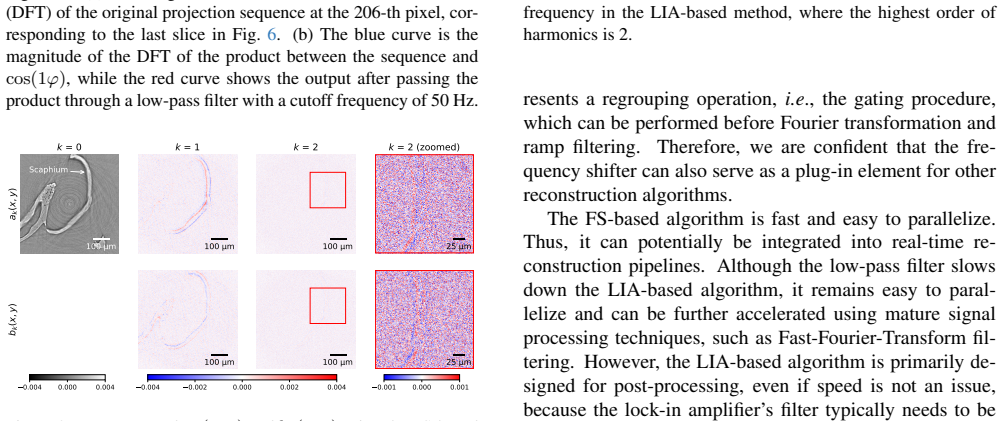
The frequency-shifter identity, Eqs. (33) and (34) in the paper, is the load-bearing object: under the phase-locking condition $\varphi=2N\theta$ (with $N$ an integer number of motion cycles per 180-degree scan), the filtered projection $\hat p(\theta,\varphi)$, after multiplication by $\cos(k\varphi)$ or $\sin(k\varphi)$ and integration over $\theta$, isolates the $k$-th spatial harmonic exactly because the cross terms vanish modulo the discrete sampling error. This removes the low-pass filter required by the lock-in amplifier pipeline and lets all projections contribute to every harmonic. The lock-in amplifier pipeline, in contrast, relies on mixing the projection sequence with reference sinusoids and low-pass filtering in the frequency domain to extract the projected harmonics $p_k,q_k$, followed by standard filtered backprojection.
What would settle it
A numerical phantom with known harmonics $a_k,b_k$ and phase $\varphi(\theta)=2N\theta+\varepsilon\sin\theta$ can settle the claim: if the error in the reconstructed $a_1$ grows with $\varepsilon$ rather than staying at the discrete-sampling level, the identity's exactness is confined to perfectly locked motion. An experimental check is to rerun the fish-hearing acquisition with the rotation speed detuned so $N$ is not an integer and compare the FS noise level and edge sharpness against the gating baseline.
Extended reading notes
Core claim
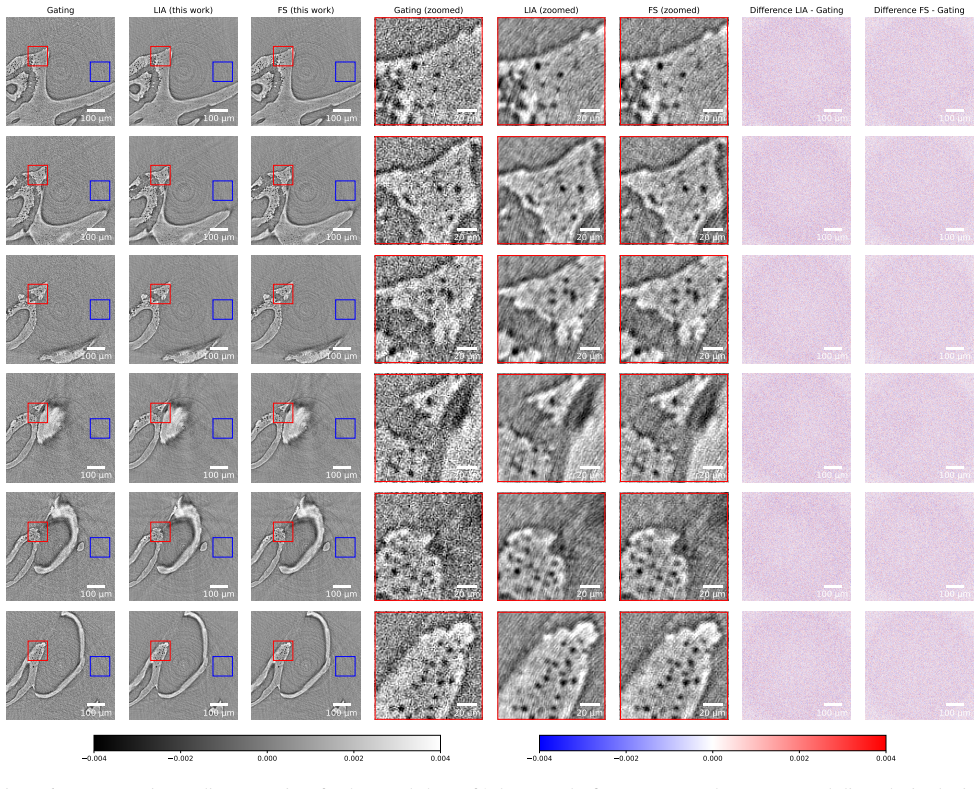
The central claim is that a periodically deformed object $f(x,y,\varphi)$, expanded in a Fourier series with spatial harmonics $a_k(x,y)$ and $b_k(x,y)$, can have those harmonics reconstructed analytically from the full time-resolved projection set rather than from gated subsets. The lock-in amplifier separates projected harmonics $p_k,q_k$ by multiplying the projection sequence by $\cos(k\varphi)$ or $\sin(k\varphi)$ and low-pass filtering, then each harmonic is recovered by filtered backprojection. The frequency-shifter method replaces that filter with the identity $$a_k(x,y)=2\int_0^\pi \hat p(\$\theta$,\varphi)\cos(k\varphi)\,\mathrm d\$\theta$,\qquad b_k(x,y)=2\int_0^\pi \hat p(\$\theta$,\varphi)\sin(k\varphi)\,\mathrm d\$\theta$,$$ valid when $\varphi=2N\theta$, so each distributed harmonic comes directly from filtered backprojection of the full data. The paper validates both on experimental synchrotron data of sound-stimulated fish hearing structures, reporting background standard deviations of roughly $5.9\text{--}8.0\times10^{-4}$ for LIA/FS versus $1.45\text{--}1.47\times10^{-3}$ for gating, and a supplementary demonstration that with a quarter of the projections the methods match gating quality.
Load-bearing premise
The load-bearing premise is that the motion phase $\varphi$ is exactly proportional to the rotation angle and completes an integer number of cycles over the 180-degree scan, $\varphi = 2N\theta$ with $N\in\mathbb{N}$, and the paper gives no error bound for free-running or jittered phases.
Editorial extensions
If this is right
- All projections contribute to every harmonic, so no projection data are discarded; in the reported experiment this yields background noise about half that of gating.
- The supplementary demonstration shows that using a quarter of the projections, either proposed method matches the gating-based reconstruction quality, implying a potential four-fold dose reduction or shorter exposures.
- Because the Fourier harmonics are reconstructed once, the dynamic distribution $f(x,y,\varphi)$ can be evaluated at any continuous phase, not only at gating-window centers, and the static component $a_0$ is directly available.
- The FS pipeline has no tuneable filter parameters and is fast and easy to parallelize, making it suited to real-time reconstruction, while the LIA pipeline needs filter tuning but gives slightly stronger noise suppression.
Reading between the lines
- Our inference: for motions whose phase is nearly but not exactly locked, the cross terms in the frequency-shifter identity will leak; a natural extension is to estimate $\varphi(\theta)$ from the projection data itself and apply the integration in a warped angle coordinate, which the paper does not develop.
- Our inference: because the harmonic separation operates on the projection stream before backprojection, the same mixing and filtering step should transfer as a plug-in to iterative or model-based CT reconstruction, where the noise-reduction benefit might differ; the paper only claims plug-in status for analytical algorithms.
- Our inference: the clean separation of the static component $a_0$ invites applying ring-artifact correction to the static image alone, which the paper flags as future work; a concrete test is whether correcting $a_0$ before recombining harmonics removes rings from dynamic frames without distorting the moving edges.
Editorial analysis
A structured set of objections, weighed in public.
Referee Report
Summary. The paper proposes two analytical reconstruction pipelines for time-resolved CT of periodically deformed objects: a lock-in amplifier (LIA) method that demodulates projection harmonics in the motion-phase direction, and a frequency-shifter (FS) method that aims to recover the spatial Fourier harmonics directly from the full projection set without low-pass filtering. Both methods use the entire set of projections instead of binning them into phase gates, and the authors validate them on synchrotron microtomography data of sound-stimulated fish hearing structures. Against a 20-bin gating reconstruction, the methods are reported to reduce background noise standard deviation by roughly a factor of two while visually preserving sharp features, and a quarter-dose demonstration with 5000 projections is claimed to match the gating quality at 20000 projections. The code is provided on GitHub.
Significance. If the results hold, the noise-reduction and dose-reduction properties are practically important for high-resolution dynamic CT, and the analytical nature of the methods makes them attractive for fast reconstruction. The paper has notable strengths: it validates on real experimental data, reports parameter sensitivity in Fig. 10, and ships reproducible code. The central theoretical claim for the FS pipeline, however, rests on an unproven orthogonality step in Sec. 3.2.2, and the 'without blurring' part of the central claim is not supported by any quantitative resolution metric. The experimental evidence is encouraging but does not yet close these gaps.
major comments (4)
- [§3.2.2, Eqs. (28)-(33)] The frequency-shifter identity is asserted rather than established. Substituting the expansion of p-hat and phi = 2N theta into Eq. (33) gives, for each k, a same-harmonic contribution (1/2) integral p-hat_k dtheta + (1/2) integral p-hat_k cos(4Nk theta) dtheta, plus cross terms involving integrals of p-hat_j cos(2N(j±k)theta) and q-hat_j sin(2N(j±k)theta). These integrals are not identically zero for a general compactly supported object; they are high-order Fourier coefficients that decay only as N grows. The Delta quantities defined in Eq. (28) therefore include continuous residual terms, not only 'inevitable discrete errors' from finite projection angles, and the text supplies no bound on their magnitude. Consequently Eq. (33) is not proven as an exact reconstruction formula, and the claim that the FS pipeline recovers harmonics without filtering is not established for the general periodic objects named in the abstract. A numerical phantom experiment that reports the ak/bk error as a function of N would provide the missing evidence.
- [§3.2.2, Eq. (27)] The derivation depends on exact phase locking phi = 2N theta with integer N. The fish experiment satisfies this condition with N = 1100, but cardiac and respiratory motion, which the abstract names as target applications, are generally free-running and do not satisfy this condition. No error bound is given for deviations from phase locking or for non-integer N. The FS method's scope is therefore overstated; either restrict the applicability statement to phase-locked periodic motion or provide an error analysis for the unlocked case.
- [§5.1, Table 1 and Fig. 6] The central claim that noise is suppressed 'without blurring the sharp features' is only supported qualitatively. Table 1 quantifies the background noise STD, but no quantitative measure of spatial resolution or edge sharpness is reported for the same reconstructions. Because the LIA pipeline involves low-pass filtering and the FS pipeline involves truncating the harmonic expansion, the absence of an edge-profile or MTF measurement leaves the no-blur claim unverified. Please add a quantitative resolution metric, such as an edge spread function or line profile across the scaphium boundary, for the gating, LIA, and FS reconstructions.
- [§5.1, Table 1 and §7.2, Table 2] The noise-reduction comparison rests on a single specimen and on STD values computed from one background region per reconstruction, without error bars or repeat acquisitions. The observed factor-of-two reduction is consistent across the six listed rows, but a bootstrap error estimate over independent noise realizations or a repeated-measurement experiment would substantially strengthen the quantitative claim.
minor comments (4)
- [§3.2.2, Eq. (31)] In Eq. (31) the integrand is written as cos(psi), whereas Eq. (29) has cos(k psi); the two lines are inconsistent for k larger than 1 and should be harmonized.
- [§5.1] The text and the caption for Fig. 6 refer to red boxes, while the caption for Table 1 refers to blue boxes; please use a single consistent color description.
- [§5.1] There is a typo in the name of the reconstruction algorithm: 'gridrecal' should read 'gridrec'.
- [§5.6] The statement that Eq. (29) 'represents a regrouping operation' is not self-evident; please expand the argument or remove the claim, because it is used to justify the plug-in applicability of the FS method to other reconstruction algorithms.
Circularity Check
No significant circularity: the derivation is self-contained, parameter choices are data-driven but not presented as predictions, and the self-citations provide experimental setup and tools rather than load-bearing justification.
full rationale
The paper proposes two analytical pipelines (LIA and FS) for reconstructing time-periodic objects from time-resolved CT. The central mathematical claim is Eq. (33): a_k(x,y) = 2∫_0^π p̂(θ,φ) cos(kφ) dθ under the phase-locking assumption φ = 2Nθ. This identity is derived within the paper from the Fourier expansion of the projections and the central slice theorem; it is not imported from a self-citation, nor is it equivalent to its inputs by construction. The derivation explicitly acknowledges residual discrete errors (Δ terms in Eqs. (28) and (31)), so it is an asymptotic/approximate identity, not a circular tautology. The LIA method uses a low-pass filter whose cutoff (50 Hz) is derived from the known stimulation frequency, and the harmonic truncation at k = 2 is justified by observed spectral energy; these are modeling choices for the experimental demonstration, not fitted parameters renamed as predictions. The noise-reduction claim is validated by comparing reconstructed images against gating-based reconstructions on experimental data, with parameters fixed before the comparison; no parameter is fitted to the target noise levels. The self-citations ([26], [27], [28]) describe the experimental setup, reconstruction implementation, and artifact padding; they are operational references, not the justification for the method's correctness. The paper contains no uniqueness theorem, no ansatz smuggled via citation, and no renaming of a known result as a new one. The reviewer's noted mathematical concern about omitted cross terms is a correctness or robustness issue under non-ideal conditions, not circularity, because the paper does not claim the identity holds exactly for arbitrary motion and explicitly flags the discretization error. Therefore, the derivation chain is self-contained and the circularity score is 0.
Assumptions & free parameters
free parameters (4)
- LIA low-pass cutoff frequency =
50 Hz
- LIA filter order =
6th order Butterworth
- Number of Fourier harmonics =
2
- Gating bin count =
20
assumptions (6)
- domain assumption The dynamic object is perfectly time-periodic and expandable in a Fourier series in phase φ
- standard math The Radon transform is linear and acts independently of the temporal phase φ
- standard math Central slice theorem and filtered backprojection reconstruct each spatial harmonic
- domain assumption The phase is linearly locked to the rotation angle: φ = 2Nθ with integer N
- standard math Riemann sums approximate the integrals in Eq. (29)-(31) with negligible error
- domain assumption Truncation at k=2 is sufficient; higher harmonics contribute little energy
Cite this review
Pith. "Pith review of Analytical Reconstruction of Periodically Deformed Objects in Time-resolved CT." pith.science (2026). https://pith.science/paper/FX4AMSH5
@misc{pith2026250603792,
  author       = {Pith},
  title        = {Pith review of: Analytical Reconstruction of Periodically Deformed Objects in Time-resolved CT},
  year         = {2026},
  howpublished = {\url{https://pith.science/paper/FX4AMSH5}},
  note         = {Machine review of arXiv:2506.03792}
}
read the original abstract
Time-resolved CT is an advanced measurement technique that has been widely used to observe dynamic objects, including periodically varying structures such as hearts, lungs, or hearing structures. To reconstruct these objects from CT projections, a common approach is to divide the projections into several collections based on their motion phases and perform reconstruction within each collection, assuming they originate from a static object. This describes the gating-based method, which is the standard approach for time-periodic reconstruction. However, the gating-based reconstruction algorithm only utilizes a limited subset of projections within each collection and ignores the correlation between different collections, leading to inefficient use of the radiation dose. To address this issue, we propose two analytical reconstruction pipelines in this paper, and validate them with experimental data captured using tomographic synchrotron microscopy. We demonstrate that our approaches significantly reduce random noise in the reconstructed images without blurring the sharp features of the observed objects. Equivalently, our methods can achieve the same reconstruction quality as gating-based methods but with a lower radiation dose. Our code is available at github.com/PeriodRecon.
Figures



Figures from the paper (7 more)





Reference graph
Works this paper leans on
-
[1]
Hassan Bahaloo, Fredrik Forsberg, Johan Casselgren, Hen- rik Lycksam, and Mikael Sj ¨odahl. Mapping of density- dependent material properties of dry manufactured snow us- ingµCT.Applied Physics A, 130(1):16, 2024. 1
work page 2024
- [2]
-
[3]
Zachary V . Braig, Lauren E. Dittman, Kimberly K. Amrami, and Sanjeev Kakar. Dynamic Computed Tomography of the Distal Radioulnar Joint Versus Magnetic Resonance Imaging in Detecting Foveal Tears of the Triangular Fibrocartilage Complex.HAND, page 15589447241232012, 2024. 1
work page 2024
-
[4]
Matthew J. Budoff, Jerold S. Shinbane, Stephan Achenbach, Paolo Raggi, and John A. Rumberger, editors.Cardiac CT Imaging. Springer London, 2006. 1
work page 2006
-
[5]
Thorsten M. Buzug. Computed Tomography. InSpringer Handbook of Medical Technology, pages 311–342. Springer Berlin Heidelberg, Berlin, Heidelberg, 2011. 1, 3
work page 2011
-
[6]
Simone Carmignato. Accuracy of industrial computed to- mography measurements: Experimental results from an in- ternational comparison.CIRP Annals, 61(1):491–494, 2012. 1
work page 2012
-
[7]
Jose-Luis Cercos-Pita, Luca Fardin, Hugo Leclerc, Bertrand Maury, Gaetano Perchiazzi, Alberto Bravin, and Sam Bayat. Lung tissue biomechanics imaged with synchrotron phase contrast microtomography in live rats.Scientific Reports, 12 (1):5056, 2022. 2
work page 2022
-
[8]
L. De Chiffre, S. Carmignato, J.-P. Kruth, R. Schmitt, and A. Weckenmann. Industrial applications of computed tomogra- phy.CIRP Annals, 63(2):655–677, 2014. 1
work page 2014
Show all 50 references
-
[9]
Kazerooni
Benoit Desjardins and Ella A. Kazerooni. ECG-Gated Car- diac CT.American Journal of Roentgenology, 182(4):993– 1010, 2004. 1, 2
2004
-
[10]
Advances in the metrological traceability and performance of X-ray computed tomography.CIRP An- nals, 71(2):693–716, 2022
Wim Dewulf, Harald Bosse, Simone Carmignato, and Richard Leach. Advances in the metrological traceability and performance of X-ray computed tomography.CIRP An- nals, 71(2):693–716, 2022. 1
2022
-
[11]
Dowd, Graham H
Betsy A. Dowd, Graham H. Campbell, Robert B. Marr, Vivek V . Nagarkar, Sameer V . Tipnis, Lisa Axe, and D. P. Siddons. Developments in synchrotron x-ray computed mi- crotomography at the National Synchrotron Light Source. InDevelopments in X-Ray Tomography II, pages 224–236, D...
1999
-
[12]
Self-Gating: An Adaptive Center-of-Mass Approach for Respiratory Gating in PET.IEEE Transactions on Medical Imaging, 37(5):1140–1148, 2018
Tao Feng, Jizhe Wang, Youjun Sun, Wentao Zhu, Yun Dong, and Hongdi Li. Self-Gating: An Adaptive Center-of-Mass Approach for Respiratory Gating in PET.IEEE Transactions on Medical Imaging, 37(5):1140–1148, 2018. 2
2018
-
[13]
Glavin, Scott A
Daniel P. Glavin, Scott A. Eckley, Jos ´e C. Aponte, Eve L. Berger, Aaron S. Burton, Jason P. Dworkin, Jamie E. Elsila, Frank T. Ferguson, Yoshihiro Furukawa, Heather V . Gra- ham, Toshiki Koga, Michael Liss, Hannah L. McLain, Hi- roshi Naraoka, Yasuhiro Oba, Eric T. Parker, K...
2024
-
[14]
CT-Based Radiogenomics of P4HA3 Expression in Clear Cell Renal Cell Carcinoma.Academic Radiology, 31(3):902–908, 2024
Federico Greco, Andrea Panunzio, Alessandro Tafuri, Cate- rina Bernetti, Vincenzo Pagliarulo, Bruno Beomonte Zobel, Arnaldo Scardapane, and Carlo Augusto Mallio. CT-Based Radiogenomics of P4HA3 Expression in Clear Cell Renal Cell Carcinoma.Academic Radiology, 31(3):902–908, 2024. 1
2024
-
[15]
Gustafsson
F. Gustafsson. Determining the initial states in forward- backward filtering.IEEE Transactions on Signal Processing, 44(4):988–992, 1996. 6
1996
-
[16]
TomoPy: a framework for the analysis of syn- chrotron tomographic data.Journal of Synchrotron Radia- tion, 21(5):1188–1193, 2014
Doga G ¨ursoy, Francesco De Carlo, Xianghui Xiao, and Chris Jacobsen. TomoPy: a framework for the analysis of syn- chrotron tomographic data.Journal of Synchrotron Radia- tion, 21(5):1188–1193, 2014. 5
2014
-
[17]
Hoffman, and David W
Jacob Herrmann, Eric A. Hoffman, and David W. Kaczka. Frequency-Selective Computed Tomography: Applications During Periodic Thoracic Motion.IEEE Transactions on Medical Imaging, 36(8):1722–1732, 2017. 2
2017
-
[18]
Hugo and Mihaela Rosu
Geoffrey D. Hugo and Mihaela Rosu. Advances in 4D radi- ation therapy for managing respiration: Part I – 4D imaging. Zeitschrift f¨ur Medizinische Physik, 22(4):258–271, 2012. 2 9
2012
-
[19]
Huynh, Donna Parizadeh, Ahmed K
Thien J. Huynh, Donna Parizadeh, Ahmed K. Ahmed, Christopher T. Gandia, Hal C. Davison, John V . Murray, Ian T. Mark, Ajay A. Madhavan, Darya Shlapak, Todd D. Rozen, Waleed Brinjikji, Prasanna Vibhute, Vivek Gupta, Kacie Brewer, and Olga Fermo. Lateral Decubitus Dynamic CT Mye...
2024
-
[20]
X-ray computed tomography.Physics in Medicine and Biology, 51(13):R29–R43, 2006
Willi A Kalender. X-ray computed tomography.Physics in Medicine and Biology, 51(13):R29–R43, 2006. 1
2006
-
[21]
Saboo, Suhny Abbara, Sandra Halliburton, and Prabhakar Rajiah
Kevin Kalisz, Ji Buethe, Sachin S. Saboo, Suhny Abbara, Sandra Halliburton, and Prabhakar Rajiah. Artifacts at Car- diac CT: Physics and Solutions.RadioGraphics, 36(7): 2064–2083, 2016. 1
2016
-
[22]
Kaushal Kishore and S. A. Akbar. Evolution of Lock-In Amplifier as Portable Sensor Interface Platform: A Review. IEEE Sensors Journal, 20(18):10345–10354, 2020. 3
2020
-
[23]
Optimising 4D imaging of fast- oscillating structures using X-ray microtomography with ret- rospective gating.Scientific Reports, 14(1), 2024
Antoine Klos, Lucie Bailly, Sabine Rolland Du Roscoat, Laurent Org ´eas, Nathalie Henrich Bernardoni, Ludovic Broche, and Andrew King. Optimising 4D imaging of fast- oscillating structures using X-ray microtomography with ret- rospective gating.Scientific Reports, 14(1), 2024....
2024
-
[24]
Kulkarni, Alice Fung, Avinash R
Naveen M. Kulkarni, Alice Fung, Avinash R. Kambadakone, and Benjamin M. Yeh. Computed Tomography Techniques, Protocols, Advancements, and Future Directions in Liver Diseases.Magnetic Resonance Imaging Clinics of North America, 29(3):305–320, 2021. 1
2021
-
[25]
PET respiratory motion correction: quo vadis?Physics in Medicine & Biology, 67(3):03TR02,
F Lamare, A Bousse, K Thielemans, C Liu, T Merlin, H Fayad, and D Visvikis. PET respiratory motion correction: quo vadis?Physics in Medicine & Biology, 67(3):03TR02,
-
[26]
Maiditsch, Friedrich Ladich, Martin Heß, Chris- tian M
Isabelle P. Maiditsch, Friedrich Ladich, Martin Heß, Chris- tian M. Schlep ¨utz, and Tanja Schulz-Mirbach. Reveal- ing sound-induced motion patterns in fish hearing structures in 4D: a standing wave tube-like setup designed for high- resolution time-resolved tomography.Journal...
2022
-
[27]
Marone and M
F. Marone and M. Stampanoni. Regridding reconstruction al- gorithm for real-time tomographic imaging.Journal of Syn- chrotron Radiation, 19(6):1029–1037, 2012. 5
2012
-
[28]
Fast reconstruction algorithm dealing with tomography artifacts
Federica Marone, Beat M ¨unch, and Marco Stampanoni. Fast reconstruction algorithm dealing with tomography artifacts. InDevelopments in X-Ray Tomography VII, page 780410, San Diego, California, USA, 2010. 5, 8
2010
-
[29]
Dynamic obser- vation of a damping material using micro X-ray computed tomography coupled with a phase-locked loop.Polymer Test- ing, 117:107810, 2023
Masami Matsubara, Taichi Komatsu, Ryo Takara, Masakazu Kobayashi, Shogo Furuta, Kentaro Uesugi, Asahiro Na- gatani, Shozo Kawamura, and Daiki Tajiri. Dynamic obser- vation of a damping material using micro X-ray computed tomography coupled with a phase-locked loop.Polymer Test...
2023
-
[30]
Krauss, Gerald Novak, Joy Nagel- berg, and Mahindra Patel
Joseph Maytal, Joel M. Krauss, Gerald Novak, Joy Nagel- berg, and Mahindra Patel. The Role of Brain Computed Tomography in Evaluating Children with New Onset of Seizures in the Emergency Department.Epilepsia, 41(8): 950–954, 2000. 1
2000
-
[31]
Mijjum, B
M. Mijjum, B. J. Andrews, T. J. McCoy, C. M. Corrigan, M. W. Caffee, and M. M. Tremblay. Using X-ray computed microtomography (µCT) to determine subsample-specific cosmogenic noble gas production rates of E (enstatite) chon- drites.Meteoritics & Planetary Science, page maps.14309,
-
[32]
Schwyn, Simon M
Rajmund Mokso, Daniel A. Schwyn, Simon M. Walker, Michael Doube, Martina Wicklein, Tonya M ¨uller, Marco Stampanoni, Graham K. Taylor, and Holger G. Krapp. Four-dimensional in vivo X-ray microscopy with projection- guided gating.Scientific Reports, 5(1):8727, 2015. 2
2015
-
[33]
Schlep ¨utz, Gerd Theidel, Heiner Billich, Elmar Schmid, Tine Celcer, Gordan Mikul- jan, Leonardo Sala, Federica Marone, Nick Schlumpf, and Marco Stampanoni
Rajmund Mokso, Christian M. Schlep ¨utz, Gerd Theidel, Heiner Billich, Elmar Schmid, Tine Celcer, Gordan Mikul- jan, Leonardo Sala, Federica Marone, Nick Schlumpf, and Marco Stampanoni. GigaFRoST: the gigabit fast readout sys- tem for tomography.Journal of Synchrotron Radiatio...
2017
-
[34]
Spatiotemporal computed tomography of dynamic processes.Optical Engineering, 50(12):123201,
Beat M ¨unch. Spatiotemporal computed tomography of dynamic processes.Optical Engineering, 50(12):123201,
-
[35]
S. A. Nehmeh, Y . E. Erdi, T. Pan, E. Yorke, G. S. Mageras, K. E. Rosenzweig, H. Schoder, H. Mostafavi, O. Squire, A. Pevsner, S. M. Larson, and J. L. Humm. Quantitation of respiratory motion during 4D-PET/CT acquisition.Medical Physics, 31(6):1333–1338, 2004. 1, 2
2004
-
[36]
Osman, Christian Cohade, Yuji Nakamoto, and Richard L
Medhat M. Osman, Christian Cohade, Yuji Nakamoto, and Richard L. Wahl. Respiratory motion artifacts on PET emis- sion images obtained using CT attenuation correction on PET-CT.European Journal of Nuclear Medicine and Molec- ular Imaging, 30(4):603–606, 2003. 1
2003
-
[37]
Cardiac CT and CT coronary angiography: technology and application.Heart, 94(6):781–792, 2008
W T Roberts, J J Bax, and L C Davies. Cardiac CT and CT coronary angiography: technology and application.Heart, 94(6):781–792, 2008. 1
2008
-
[38]
Schlep¨utz, Wilhelm Wimmer, Aaron K
Margaux Schmeltz, Aleksandra Ivanovic, Christian M. Schlep¨utz, Wilhelm Wimmer, Aaron K. Remenschneider, Marco Caversaccio, Marco Stampanoni, Lukas Anschuetz, and Anne Bonnin. The human middle ear in motion: 3D visualization and quantification using dynamic synchrotron- based ...
-
[39]
Scofield
John H. Scofield. Frequency-domain description of a lock- in amplifier.American Journal of Physics, 62(2):129–133,
-
[40]
Sluimer, A
I. Sluimer, A. Schilham, M. Prokop, and B. Van Ginneken. Computer analysis of computed tomography scans of the lung: a survey.IEEE Transactions on Medical Imaging, 25 (4):385–405, 2006. 1
2006
-
[41]
X-ray computed tomography for additive manufacturing: a review.Measure- ment Science and Technology, 27(7):072001, 2016
A Thompson, I Maskery, and R K Leach. X-ray computed tomography for additive manufacturing: a review.Measure- ment Science and Technology, 27(7):072001, 2016. 1
2016
-
[42]
Oliphant, Matt Haberland, Tyler Reddy, David Cournapeau, Evgeni Burovski, Pearu Peterson, Warren Weckesser, Jonathan Bright, St ´efan J
Pauli Virtanen, Ralf Gommers, Travis E. Oliphant, Matt Haberland, Tyler Reddy, David Cournapeau, Evgeni Burovski, Pearu Peterson, Warren Weckesser, Jonathan Bright, St ´efan J. Van Der Walt, Matthew Brett, Joshua Wilson, K. Jarrod Millman, Nikolay Mayorov, Andrew R. J. Nelson,...
2020
-
[43]
Walker, Andrew J
Matthew D. Walker, Andrew J. Morgan, Kevin M. Bradley, and Daniel R. McGowan. Data-Driven Respiratory Gat- ing Outperforms Device-Based Gating for Clinical18 F-FDG PET/CT.Journal of Nuclear Medicine, 61(11):1678–1683,
-
[44]
Walker, Daniel A
Simon M. Walker, Daniel A. Schwyn, Rajmund Mokso, Martina Wicklein, Tonya M ¨uller, Michael Doube, Marco Stampanoni, Holger G. Krapp, and Graham K. Taylor. In Vivo Time-Resolved Microtomography Reveals the Me- chanics of the Blowfly Flight Motor.PLoS Biology, 12(3): e1001823, 2014. 2
2014
-
[45]
Werner, J
Matthias K. Werner, J. Anthony Parker, Gerald M. Kolodny, Jeffrey R. English, and Matthew R. Palmer. Respiratory Gat- ing Enhances Imaging of Pulmonary Nodules and Measure- ment of Tracer Uptake in FDG PET/CT.American Journal of Roentgenology, 193(6):1640–1645, 2009. 1
2009
-
[46]
Withers, Charles Bouman, Simone Carmignato, Veerle Cnudde, David Grimaldi, Charlotte K
Philip J. Withers, Charles Bouman, Simone Carmignato, Veerle Cnudde, David Grimaldi, Charlotte K. Hagen, Eric Maire, Marena Manley, Anton Du Plessis, and Stuart R. Stock. X-ray computed tomography.Nature Reviews Meth- ods Primers, 1(1):18, 2021. 1
2021
-
[47]
Time- resolved x-ray stroboscopic phase tomography using Talbot interferometer for dynamic deformation measurements.Re- view of Scientific Instruments, 92(4):043702, 2021
Yanlin Wu, Hidekazu Takano, and Atsushi Momose. Time- resolved x-ray stroboscopic phase tomography using Talbot interferometer for dynamic deformation measurements.Re- view of Scientific Instruments, 92(4):043702, 2021. 1, 2
2021
-
[48]
Qi Zhang, Duo Zhang, and Greta S. P. Mok. Comparison of different attenuation correction methods for dual gating my- ocardial perfusion spect/ct.IEEE Transactions on Radiation and Plasma Medical Sciences, 3(5):565–571, 2019. 2
2019
-
[49]
Court, Peter A
Yongbin Zhang, Jinzhong Yang, Lifei Zhang, Laurence E. Court, Peter A. Balter, and Lei Dong. Modeling respiratory motion for reducing motion artifacts in 4D CT images.Med- ical Physics, 40(4):041716, 2013. 1 11 Analytical Reconstruction of Periodically Deformed Objects in Time...
2013
-
[50]
Video comparison The supplementary video compares the reconstruction re- sults of the gating-based method and our approaches, cov- ering the entire period of the sound
More results 7.1. Video comparison The supplementary video compares the reconstruction re- sults of the gating-based method and our approaches, cov- ering the entire period of the sound. More videos are also available on the YouTube channel @PeriodRecon. 7.2. Example of low-do...
Reviewed August 7, 2026 · model on record in the stance chip above.
Discussion (0). Sign in to comment.