REVIEW 3 major objections 5 minor 1 cited by
ConText: Driving In-context Learning for Text Removal and Segmentation
T0 review · 3 major / 5 minor · reviewed 2026-08-07 · deepseek-v4-flash
Pith's one-line read ConText claims that adapting visual in-context learning to OCR by chaining text removal and segmentation into a single prompt yields state-of-the-art results on both task families.
desk verdict Solid SOTA numbers for OCR text removal and segmentation, but the in-context learnability evidence is confounded by the self-prompting training trick. read the letter →
The pith
A machine-rendered reading of the paper's core claim, the machinery that carries it, and where it could break.
The reading
What carries the argument
The load-bearing object is the task-chaining compositor: the prompt is built as a 2×3 grid of [original image, removed image, segmentation mask] covering both the demonstration pair and the query. During training both the removal and the segmentation labels are partially masked with spatially aligned masks, and a weight-shared decoder reconstructs both, so the model can exploit the fact that both outputs describe the same text regions. Two supporting mechanisms carry the rest: context-aware aggregation (CAA), a lightweight shared cross-attention module that enriches each label representation with features drawn from the other demonstration, and self-prompting, which with probability 0.2 builds the input from two identical pairs so the model keeps relying on the demonstration rather than becoming a task specialist. The backbone is a ViT-L masked autoencoder initialized from a pre-trained in-context segmentation checkpoint.
What would settle it
Train ConText with the same recipe but replace every pseudo-label with human-annotated removal and segmentation targets on the same images, then re-run the same benchmarks; if the reported margins collapse, the gains were partly fitting the pseudo-label teacher's bias. A second check: evaluate ConText with a demonstration drawn from a different script or style than the query, and if performance barely moves, the model has lost the demonstration sensitivity that self-prompting is claimed to preserve.
Extended reading notes
Core claim
The central claim is that restructuring the in-context prompt from a single image-label pair into a task chain—original image, removed image, segmentation mask—lets one masked-autoencoder-style model perform text removal and segmentation in a single forward pass, and do so better than models fine-tuned for either task alone. The argument leans on a simple identity: the segmentation mask is exactly the visual difference between the original image and its erased version, so chaining the tasks gives the model an intermediate to reason through instead of demanding a direct one-step mapping. The paper attributes the remaining margin to context-aware aggregation, a shared cross-attention module that injects each demonstration's features into the other's label representation, and to self-prompting, which with probability 0.2 feeds two identical input-output pairs so the model cannot collapse into a demonstration-independent specialist. On the paper's numbers, ConText reaches a PSNR of 38.36 averaged over three text removal benchmarks and an fgIoU of 76.77% averaged over four segmentation datasets, outperforming both in-context generalists and task-specific specialists, and it retains a visible performance gap between ground-truth and randomly sampled demonstrations.
Load-bearing premise
The load-bearing premise is that the training labels are trustworthy, and several are not human-annotated: as disclosed in Appendix B.1, removal images for TextSeg are produced by an external eraser model and segmentation masks for SCUT-EnsText and SCUT-Syn are computed by gray-scale differencing, so part of the reported gains could be fitting those pseudo-labels rather than genuine in-context reasoning.
Editorial extensions
If this is right
- Any pair of visual tasks joined by a shared logical identity—here, that the segmentation mask equals the difference between an image and its erased version—can be chained into a single prompt to lift performance on both tasks.
- In-context models trained on visually heterogeneous domains need explicit pressure, such as self-prompting, to stay demonstration-sensitive; without it, the model degrades into a context-free specialist.
- The growing gap between ground-truth and random demonstration performance as training data scales indicates that the model's gains come partly from genuine in-context inference, and that this capability improves with more data.
- A single randomly chosen demonstration suffices for the model to beat task-specific specialists, suggesting that costly demonstration retrieval is not needed for OCR-style in-context tasks.
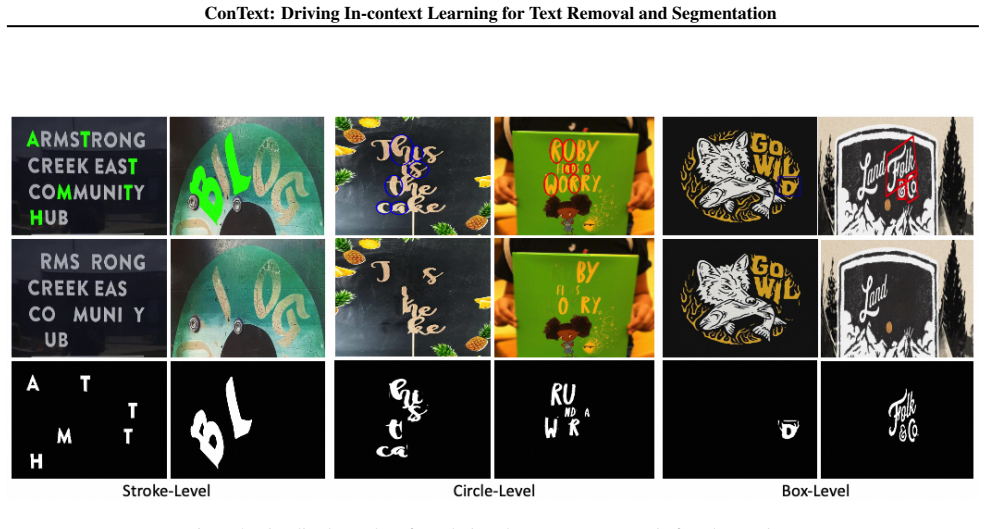
- The model can follow explicit human-style visual prompts—colored circles, boxes, and strokes drawn on the query image—without ever training on such annotations, which the paper presents as evidence of generalized in-context understanding.
Reading between the lines
- If the intermediate-reasoning story is right, then adding a third linked task to the chain—say, text detection or recognition—should further improve removal and segmentation; this is a direct and cheap test of the task-chaining mechanism.
- Because the removal labels for TextSeg come from another eraser model and the segmentation masks for SCUT-EnsText and SCUT-Syn come from gray-scale differencing, the reported margins may partly encode that teacher's biases; retraining with purely human annotations would measure that contamination.
- The fixed self-prompting probability of 0.2 trades off in-context sensitivity against task accuracy, so a schedule that anneals the probability during training, or adapts it per sample, might dominate the fixed setting.
- The watermark-removal result suggests the same chain composer transfers beyond OCR to any foreground-erasure task pair, such as shadow or reflection removal, where an erasure output and a foreground mask are naturally paired.
Editorial analysis
A structured set of objections, weighed in public.
Referee Report
Summary. The paper proposes ConText, a visual in-context learning (V-ICL) framework for text removal and segmentation. Three components are introduced: a task-chaining prompt that combines image, removal, and segmentation labels; a context-aware aggregation (CAA) module that fuses cross-demonstration information; and a self-prompting (SP) training strategy that occasionally feeds the model two identical input-output pairs. Experiments on multiple text removal and segmentation benchmarks report state-of-the-art results for random-demonstration inference (average PSNR 38.36 over three removal benchmarks; average fgIoU 76.77 over four segmentation benchmarks) and further claim generalized in-context learnability, evidenced by a large performance gap when the demonstration is the ground-truth label instead of a randomly selected sample.
Significance. If the central claims hold, this is a useful contribution to V-ICL for OCR: it is the first OCR-focused V-ICL generalist, it releases code, and it reports strong improvements over both generalist baselines and task-specific specialists on standard benchmarks. The random-demonstration SOTA numbers are supported by extensive comparisons and appear independent of the learnability-protocol confound discussed below. However, the paper's broader claim that self-prompting preserves generalized in-context learnability rests on a GT-demonstration measurement that may be in-distribution for ConText but out-of-distribution for the baselines, so the ICL-specific conclusion needs additional controls or a reinterpretation before the contribution is fully established.
major comments (3)
- [Section 5.3, Figure 5, Table 5, Appendix B.2] The ground-truth demonstration protocol is not precisely defined, and the reported numbers indicate a confound. If the 'ground-truth-based demonstration' is the query image paired with its own ground-truth label, then this input is exactly the self-prompting condition described in Section 4.3 ('two identical input-output pairs'), which ConText was trained on with probability 0.2 but the Painter and SegGPT baselines were not. Table 5 shows that the RS-versus-GT gap on TotalText segmentation and SCUT-EnsText removal grows from +0.65 fgIoU / +0.37 PSNR without SP to +3.98 fgIoU / +1.42 PSNR with SP-0.2. This pattern is consistent with the model memorizing the identical-pair training condition rather than with a general ability to reason from arbitrary GT demonstrations. Please (a) define the protocol explicitly, (b) add a control with a non-identical but ground-truth demonstration, and (c) either train baselines under the same self-prompting schedule or reinterpret the gap as an upper-bound measurement rather than evidence against 'context-free inference'.
- [Appendix B.1 and Impact Statement] The training targets for ConTextV include pseudo-labels: removal labels for TextSeg are generated by ViT-Eraser, and segmentation masks for SCUT-EnsText and SCUT-Syn are produced by gray-scale distance between original and erased images. The Impact Statement itself acknowledges that these labels can introduce noise and bias. Because ConTextV is trained on these pseudo-labeled datasets and then compared with specialists on TextSeg segmentation (Table 2) and SCUT-EnsText removal (Table 3), a systematic bias in the pseudo-labels could inflate the reported specialist-level results. Please quantify the quality of the pseudo-labels (for example, IoU against human masks on a subset) or provide an ablation that removes the pseudo-labeled datasets; without such evidence, the specialist comparison does not fully isolate the effect of the model design from the effect of the training labels.
- [Section 5.3, PromptText, Appendix B.4] The claim that PromptText is 'not training-involved' is inaccurate for ConTextV and for any baseline trained on TextSeg, because PromptText is constructed from the TextSeg validation set. Since ConTextV is trained on TextSeg training data, the evaluation is not fully held-out for that model. The HierText-trained ConText row provides a partially clean check, but the section should either restrict the claim to ConText or evaluate PromptText on a dataset that is disjoint from all training sets; the current wording overstates the generalization evidence.
minor comments (5)
- [Section 1 (contribution bullet)] The bullet lists '+4.50PNSR'; 'PNSR' should be 'PSNR.'
- [Section 5.4, Table 5] The table headers 'RS / GT' are ambiguous: clarify that the first value is the random-selected score and the second value is the delta from the GT-demonstration score, not an absolute GT score.
- [Appendix B.2, Tables 11-13] The rows reporting ground-truth-demonstration results are not visually labeled; add a caption note or row labels (e.g., 'GT demo') so readers can distinguish them from random-demonstration rows.
- [Figure 5 caption] The phrase 'a sounding upper and lower bounds' should be 'a sound upper and lower bound' (or 'sound upper and lower bounds').
- [Section 5.4] The sentence 'the intuitivelinear fusion (eF1) yields a significant improvement (+3.61%) fgIoU for segmentation and +1.33 PSNR for removal)' has a mismatched parenthesis and should be reworded for clarity.
Circularity Check
The GT-demonstration 'upper bound' behind the generalized in-context learnability claim is the self-prompting training distribution, so that claim is partly forced; the random-demonstration SOTA numbers remain independent.
-
fitted input called prediction
[Section 4.3 (Self-prompting); Section 5.3 (In-context Learnability); Table 5; Appendix B.1]
"we propose constructing model inputs by using two identical input-output pairs (eFi = eFj) with a certain probability ... The probability of self-prompting is set to 0.2 ... Figure 5 reports all models’ performance given both the randomly-selected and ground-truth-based demonstration samples, yielding the upper and the normal in-context inference abilities ... RS (GT) denotes the model’s performance with randomly-selected (ground-truth) demonstration."
The 'ground-truth demonstration' evaluation is the same input condition as the self-prompting training strategy: the demonstration and query are identical input-output pairs (eFi = eFj). ConText was trained on exactly this pattern with probability 0.2, while the Painter/SegGPT baselines were not, so the large RS-vs-GT gap in Table 5 (+3.98 fgIoU / +1.42 PSNR with SP-0.2, vs +0.65 / +0.37 without SP) largely measures recall of the trained self-prompting condition rather than generalized in-context inference from novel demonstrations. The paper uses this gap as the central evidence that self-prompting 'prevent[s] the model's in-context learnability from devolving into specialist-like, context-free inference,' but the upper bound is in-distribution by construction.
full rationale
The main SOTA results (Section 5.2, Tables 1-3, 9) are evaluated on held-out benchmarks with random demonstrations and are independent of the training-design choices, so they are not circular. The only load-bearing circularity is the in-context learnability metric in Section 5.3: the GT-demonstration condition duplicates the self-prompting training input defined in Section 4.3 (eFi = eFj, p=0.2), so the claimed 'upper bound' and the resulting RS-vs-GT gap are in part forced by the training distribution rather than by genuine ICL. This is a fitted training augmentation presented as a prediction of an upper bound, and it is the central evidence for the paper's claim that self-prompting preserves generalized in-context learnability. The pseudo-label caveats acknowledged in the Impact Statement are real data-quality risks but are not circular, since the reported comparisons use independent human-annotated benchmarks for the headline numbers. No load-bearing self-citation chain was found.
Assumptions & free parameters
free parameters (5)
- self-prompting probability =
0.2
- masking ratio =
85%
- removal reconstruction loss weight =
0.3
- pixel-level supervision loss weight =
1
- CAA learnable weights alpha_o, alpha_y =
learned
assumptions (4)
- domain assumption The segmentation mask corresponds to the visual difference between the original image and its erased counterpart.
- domain assumption MAE-style mask reconstruction is a suitable training objective for text removal and segmentation.
- domain assumption Cross-attention aggregation at the query label position improves in-context reasoning.
- domain assumption Pseudo-labeled removal and segmentation targets are accurate enough to serve as ground truth.
Cite this review
Pith. "Pith review of ConText: Driving In-context Learning for Text Removal and Segmentation." pith.science (2026). https://pith.science/paper/OEVLLUCN
@misc{pith2026250603799,
  author       = {Pith},
  title        = {Pith review of: ConText: Driving In-context Learning for Text Removal and Segmentation},
  year         = {2026},
  howpublished = {\url{https://pith.science/paper/OEVLLUCN}},
  note         = {Machine review of arXiv:2506.03799}
}
read the original abstract
This paper presents the first study on adapting the visual in-context learning (V-ICL) paradigm to optical character recognition tasks, specifically focusing on text removal and segmentation. Most existing V-ICL generalists employ a reasoning-as-reconstruction approach: they turn to using a straightforward image-label compositor as the prompt and query input, and then masking the query label to generate the desired output. This direct prompt confines the model to a challenging single-step reasoning process. To address this, we propose a task-chaining compositor in the form of image-removal-segmentation, providing an enhanced prompt that elicits reasoning with enriched intermediates. Additionally, we introduce context-aware aggregation, integrating the chained prompt pattern into the latent query representation, thereby strengthening the model's in-context reasoning. We also consider the issue of visual heterogeneity, which complicates the selection of homogeneous demonstrations in text recognition. Accordingly, this is effectively addressed through a simple self-prompting strategy, preventing the model's in-context learnability from devolving into specialist-like, context-free inference. Collectively, these insights culminate in our ConText model, which achieves new state-of-the-art across both in- and out-of-domain benchmarks. The code is available at https://github.com/Ferenas/ConText.
Figures


Figures from the paper (6 more)



Forward citations
Cited by 1 Pith paper
-
Decouple before Align: Visual Disentanglement Enhances Prompt Tuning
Decoupling images into foreground and background before aligning them with text improves CLIP prompt tuning on few-shot and generalization benchmarks.
Reference graph
Works this paper leans on
-
[1]
What learning algorithm is in-context learning? investigations with linear models
Aky \"u rek, E., Schuurmans, D., Andreas, J., Ma, T., and Zhou, D. What learning algorithm is in-context learning? investigations with linear models. arXiv preprint arXiv:2211.15661, 2022
arXiv 2022
-
[2]
L., Darrell, T., Malik, J., and Efros, A
Bai, Y., Geng, X., Mangalam, K., Bar, A., Yuille, A. L., Darrell, T., Malik, J., and Efros, A. A. Sequential modeling enables scalable learning for large vision models. In Proceedings of the IEEE/CVF Conference on Computer Vision and Pattern Recognition, pp.\ 22861--22872, 2024
2024
-
[3]
Visual prompting via image inpainting
Bar, A., Gandelsman, Y., Darrell, T., Globerson, A., and Efros, A. Visual prompting via image inpainting. Advances in Neural Information Processing Systems, 35: 0 25005--25017, 2022
2022
-
[4]
Scene text removal via cascaded text stroke detection and erasing
Bian, X., Wang, C., Quan, W., Ye, J., Zhang, X., and Yan, D.-M. Scene text removal via cascaded text stroke detection and erasing. Computational Visual Media, 8: 0 273--287, 2022
2022
-
[5]
Coco\_ts dataset: pixel--level annotations based on weak supervision for scene text segmentation
Bonechi, S., Andreini, P., Bianchini, M., and Scarselli, F. Coco\_ts dataset: pixel--level annotations based on weak supervision for scene text segmentation. In International Conference on Artificial Neural Networks, pp.\ 238--250. Springer, 2019
2019
-
[6]
D., Dhariwal, P., Neelakantan, A., Shyam, P., Sastry, G., Askell, A., et al
Brown, T., Mann, B., Ryder, N., Subbiah, M., Kaplan, J. D., Dhariwal, P., Neelakantan, A., Shyam, P., Sastry, G., Askell, A., et al. Language models are few-shot learners. Advances in neural information processing systems, 33: 0 1877--1901, 2020
1901
-
[7]
Textdiffuser: Diffusion models as text painters
Chen, J., Huang, Y., Lv, T., Cui, L., Chen, Q., and Wei, F. Textdiffuser: Diffusion models as text painters. Advances in Neural Information Processing Systems, 36, 2023
2023
-
[8]
Encoder-decoder with atrous separable convolution for semantic image segmentation
Chen, L.-C., Zhu, Y., Papandreou, G., Schroff, F., and Adam, H. Encoder-decoder with atrous separable convolution for semantic image segmentation. In Proceedings of the European conference on computer vision (ECCV), pp.\ 801--818, 2018
2018
Show all 97 references
-
[9]
Ch'ng, C. K. and Chan, C. S. Total-text: A comprehensive dataset for scene text detection and recognition. In 2017 14th IAPR international conference on document analysis and recognition (ICDAR), volume 1, pp.\ 935--942. IEEE, 2017
2017
-
[10]
and Chen, P.-I
Conrad, B. and Chen, P.-I. Two-stage seamless text erasing on real-world scene images. In 2021 IEEE International Conference on Image Processing (ICIP), pp.\ 1309--1313. IEEE, 2021
2021
-
[11]
Why can gpt learn in-context? language models implicitly perform gradient descent as meta-optimizers
Dai, D., Sun, Y., Dong, L., Hao, Y., Ma, S., Sui, Z., and Wei, F. Why can gpt learn in-context? language models implicitly perform gradient descent as meta-optimizers. arXiv preprint arXiv:2212.10559, 2022
2022 arXiv
-
[12]
A survey on in-context learning
Dong, Q., Li, L., Dai, D., Zheng, C., Ma, J., Li, R., Xia, H., Xu, J., Wu, Z., Liu, T., et al. A survey on in-context learning. arXiv preprint arXiv:2301.00234, 2022
2022 arXiv
-
[13]
An image is worth 16x16 words: Transformers for image recognition at scale
Dosovitskiy, A., Beyer, L., Kolesnikov, A., Weissenborn, D., Zhai, X., Unterthiner, T., Dehghani, M., Minderer, M., Heigold, G., Gelly, S., et al. An image is worth 16x16 words: Transformers for image recognition at scale. arXiv preprint arXiv:2010.11929, 2020
2010 arXiv
-
[14]
Modeling stroke mask for end-to-end text erasing
Du, X., Zhou, Z., Zheng, Y., Ma, T., Wu, X., and Jin, C. Modeling stroke mask for end-to-end text erasing. In Proceedings of the IEEE/CVF Winter Conference on Applications of Computer Vision, pp.\ 6151--6159, 2023 a
2023
-
[15]
Progressive scene text erasing with self-supervision
Du, X., Zhou, Z., Zheng, Y., Wu, X., Ma, T., and Jin, C. Progressive scene text erasing with self-supervision. Computer Vision and Image Understanding, 233: 0 103712, 2023 b
2023
-
[16]
Progressive scene text erasing with self-supervision
Du, X., Zhou, Z., Zheng, Y., Wu, X., Ma, T., and Jin, C. Progressive scene text erasing with self-supervision. Computer Vision and Image Understanding, 233: 0 103712, 2023 c
2023
-
[17]
M., Loy, C
Fang, Z., Li, X., Li, X., Buhmann, J. M., Loy, C. C., and Liu, M. Explore in-context learning for 3d point cloud understanding. Advances in Neural Information Processing Systems, 36, 2023
2023
-
[18]
S., and Valiant, G
Garg, S., Tsipras, D., Liang, P. S., and Valiant, G. What can transformers learn in-context? a case study of simple function classes. Advances in Neural Information Processing Systems, 35: 0 30583--30598, 2022
2022
-
[19]
Masked autoencoders are scalable vision learners
He, K., Chen, X., Xie, S., Li, Y., Doll \'a r, P., and Girshick, R. Masked autoencoders are scalable vision learners. In Proceedings of the IEEE/CVF conference on computer vision and pattern recognition, pp.\ 16000--16009, 2022
2022
-
[20]
J., and Wang, Z
Hou, Y., Chen, J. J., and Wang, Z. Multi-branch network with ensemble learning for text removal in the wild. In Proceedings of the Asian Conference on Computer Vision, pp.\ 1333--1349, 2022
2022
-
[21]
Self-supervised text erasing with controllable image synthesis
Jiang, G., Wang, S., Ge, T., Jiang, Y., Wei, Y., and Lian, D. Self-supervised text erasing with controllable image synthesis. In Proceedings of the 30th ACM International Conference on Multimedia, pp.\ 1973--1983, 2022
1973
-
[22]
C., and Gevers, T
Karaoglu, S., Van Gemert, J. C., and Gevers, T. Object reading: text recognition for object recognition. In Computer Vision--ECCV 2012. Workshops and Demonstrations: Florence, Italy, October 7-13, 2012, Proceedings, Part III 12, pp.\ 456--465. Springer, 2012
2012
-
[23]
G., Mestre, S
Karatzas, D., Shafait, F., Uchida, S., Iwamura, M., i Bigorda, L. G., Mestre, S. R., Mas, J., Mota, D. F., Almazan, J. A., and De Las Heras, L. P. Icdar 2013 robust reading competition. In 2013 12th international conference on document analysis and recognition, pp.\ 1484--1493...
2013
-
[24]
Kingma, D. P. and Ba, J. Adam: A method for stochastic optimization. International Conference on Learning Representations (ICLR), 2015
2015
-
[25]
C., Lo, W.-Y., et al
Kirillov, A., Mintun, E., Ravi, N., Mao, H., Rolland, C., Gustafson, L., Xiao, T., Whitehead, S., Berg, A. C., Lo, W.-Y., et al. Segment anything. arXiv preprint arXiv:2304.02643, 2023
2023 arXiv
-
[26]
Crafting papers on machine learning
Langley, P. Crafting papers on machine learning. In Langley, P. (ed.), Proceedings of the 17th International Conference on Machine Learning (ICML 2000), pp.\ 1207--1216, Stanford, CA, 2000. Morgan Kaufmann
2000
-
[27]
and Choi, C
Lee, H. and Choi, C. The surprisingly straightforward scene text removal method with gated attention and region of interest generation: A comprehensive prominent model analysis. In European Conference on Computer Vision, pp.\ 457--472. Springer, 2022
2022
-
[28]
Monte carlo linear clustering with single-point supervision is enough for infrared small target detection
Li, B., Wang, Y., Wang, L., Zhang, F., Liu, T., Lin, Z., An, W., and Guo, Y. Monte carlo linear clustering with single-point supervision is enough for infrared small target detection. In Proceedings of the IEEE/CVF International Conference on Computer Vision, pp.\ 1009--1019, 2023 a
2023
-
[29]
Ddaug: Differentiable data augmentation for weakly supervised semantic segmentation
Li, B., Zhang, F., Wang, L., Wang, Y., Liu, T., Lin, Z., An, W., and Guo, Y. Ddaug: Differentiable data augmentation for weakly supervised semantic segmentation. IEEE Transactions on Multimedia, 26: 0 4764--4775, 2023 b
2023
-
[30]
The closeness of in-context learning and weight shifting for softmax regression
Li, S., Song, Z., Xia, Y., Yu, T., and Zhou, T. The closeness of in-context learning and weight shifting for softmax regression. arXiv preprint arXiv:2304.13276, 2023 c
2023 arXiv
-
[31]
and Qiu, X
Li, X. and Qiu, X. Finding supporting examples for in-context learning. CoRR, 2023
2023
-
[32]
Erasenet: End-to-end text removal in the wild
Liu, C., Liu, Y., Jin, L., Zhang, S., Luo, C., and Wang, Y. Erasenet: End-to-end text removal in the wild. IEEE Transactions on Image Processing, 29: 0 8760--8775, 2020
2020
-
[33]
Don’t forget me: accurate background recovery for text removal via modeling local-global context
Liu, C., Jin, L., Liu, Y., Luo, C., Chen, B., Guo, F., and Ding, K. Don’t forget me: accurate background recovery for text removal via modeling local-global context. In European Conference on Computer Vision, pp.\ 409--426. Springer, 2022 a
2022
-
[34]
Don’t forget me: accurate background recovery for text removal via modeling local-global context
Liu, C., Jin, L., Liu, Y., Luo, C., Chen, B., Guo, F., and Ding, K. Don’t forget me: accurate background recovery for text removal via modeling local-global context. In European Conference on Computer Vision, pp.\ 409--426. Springer, 2022 b
2022
-
[35]
Audio-visual segmentation via unlabeled frame exploitation
Liu, J., Liu, Y., Zhang, F., Ju, C., Zhang, Y., and Wang, Y. Audio-visual segmentation via unlabeled frame exploitation. In Proceedings of the IEEE/CVF Conference on Computer Vision and Pattern Recognition, pp.\ 26328--26339, 2024
2024
-
[36]
In-context vectors: Making in context learning more effective and controllable through latent space steering
Liu, S., Ye, H., Xing, L., and Zou, J. In-context vectors: Making in context learning more effective and controllable through latent space steering. arXiv preprint arXiv:2311.06668, 2023
2023 arXiv
-
[37]
Wdnet: Watermark-decomposition network for visible watermark removal
Liu, Y., Zhu, Z., and Bai, X. Wdnet: Watermark-decomposition network for visible watermark removal. In Proceedings of the IEEE/CVF winter conference on applications of computer vision, pp.\ 3685--3693, 2021
2021
-
[38]
Towards end-to-end unified scene text detection and layout analysis
Long, S., Qin, S., Panteleev, D., Bissacco, A., Fujii, Y., and Raptis, M. Towards end-to-end unified scene text detection and layout analysis. In Proceedings of the IEEE/CVF Conference on Computer Vision and Pattern Recognition, pp.\ 1049--1059, 2022
2022
-
[39]
and Zhu, A
Lyu, G. and Zhu, A. Psstrnet: progressive segmentation-guided scene text removal network. In 2022 IEEE International Conference on Multimedia and Expo (ICME), pp.\ 1--6. IEEE, 2022
2022
-
[40]
Lyu, G., Liu, K., Zhu, A., Uchida, S., and Iwana, B. K. Fetnet: Feature erasing and transferring network for scene text removal. Pattern Recognition, 140: 0 109531, 2023
2023
-
[41]
Diffusionseg: Adapting diffusion towards unsupervised object discovery
Ma, C., Yang, Y., Ju, C., Zhang, F., Liu, J., Wang, Y., Zhang, Y., and Wang, Y. Diffusionseg: Adapting diffusion towards unsupervised object discovery. arXiv preprint arXiv:2303.09813, 2023
2023 arXiv
-
[42]
Which examples to annotate for in-context learning? towards effective and efficient selection
Mavromatis, C., Srinivasan, B., Shen, Z., Zhang, J., Rangwala, H., Faloutsos, C., and Karypis, G. Which examples to annotate for in-context learning? towards effective and efficient selection. arXiv preprint arXiv:2310.20046, 2023
-
[43]
Rethinking the role of demonstrations: What makes in-context learning work? arXiv preprint arXiv:2202.12837, 2022
Min, S., Lyu, X., Holtzman, A., Artetxe, M., Lewis, M., Hajishirzi, H., and Zettlemoyer, L. Rethinking the role of demonstrations: What makes in-context learning work? arXiv preprint arXiv:2202.12837, 2022
2022 arXiv
-
[44]
Conditional generative adversarial nets
Mirza, M. Conditional generative adversarial nets. arXiv preprint arXiv:1411.1784, 2014
2014 arXiv
-
[45]
Scene text eraser
Nakamura, T., Zhu, A., Yanai, K., and Uchida, S. Scene text eraser. In 2017 14th IAPR International Conference on Document Analysis and Recognition (ICDAR), volume 1, pp.\ 832--837. IEEE, 2017
2017
-
[46]
Fine-grained visible watermark removal
Niu, L., Zhao, X., Zhang, B., and Zhang, L. Fine-grained visible watermark removal. In Proceedings of the IEEE/CVF international conference on computer vision, pp.\ 12770--12779, 2023
2023
-
[47]
Otsu, N. et al. A threshold selection method from gray-level histograms. Automatica, 11 0 (285-296): 0 23--27, 1975
1975
-
[48]
What in-context learning “learns” in-context: Disentangling task recognition and task learning
Pan, J. What in-context learning “learns” in-context: Disentangling task recognition and task learning. Master's thesis, Princeton University, 2023
2023
-
[49]
Viteraser: Harnessing the power of vision transformers for scene text removal with segmim pretraining
Peng, D., Liu, C., Liu, Y., and Jin, L. Viteraser: Harnessing the power of vision transformers for scene text removal with segmim pretraining. In Proceedings of the AAAI Conference on Artificial Intelligence, volume 38, pp.\ 4468--4477, 2024 a
2024
-
[50]
Upocr: Towards unified pixel-level ocr interface
Peng, D., Yang, Z., Zhang, J., Liu, C., Shi, Y., Ding, K., Guo, F., and Jin, L. Upocr: Towards unified pixel-level ocr interface. In Forty-first International Conference on Machine Learning, 2024 b
2024
-
[51]
Image-to-image translation with conditional adversarial networks
Phillip, I., Jun-Yan, Z., Tinghui, Z., Alexei, A., et al. Image-to-image translation with conditional adversarial networks. In Proceedings of the IEEE conference on computer vision and pattern recognition, volume 3, 2017
2017
-
[52]
Looking from a higher-level perspective: Attention and recognition enhanced multi-scale scene text segmentation
Ren, Y., Zhang, J., Chen, B., Zhang, X., and Jin, L. Looking from a higher-level perspective: Attention and recognition enhanced multi-scale scene text segmentation. In Proceedings of the Asian Conference on Computer Vision, pp.\ 3138--3154, 2022
2022
-
[53]
High-resolution image synthesis with latent diffusion models
Rombach, R., Blattmann, A., Lorenz, D., Esser, P., and Ommer, B. High-resolution image synthesis with latent diffusion models. In Proceedings of the IEEE/CVF conference on computer vision and pattern recognition, pp.\ 10684--10695, 2022
2022
-
[54]
Learning to retrieve prompts for in-context learning
Rubin, O., Herzig, J., and Berant, J. Learning to retrieve prompts for in-context learning. arXiv preprint arXiv:2112.08633, 2021
2021 arXiv
-
[55]
and Coustaty, M
Sahay, R. and Coustaty, M. An enhanced prototypical network architecture for few-shot handwritten urdu character recognition. IEEE Access, 11: 0 33682--33696, 2023
2023
-
[56]
What does clip know about a red circle? visual prompt engineering for vlms
Shtedritski, A., Rupprecht, C., and Vedaldi, A. What does clip know about a red circle? visual prompt engineering for vlms. arXiv preprint arXiv:2304.06712, 2023
2023 arXiv
-
[57]
A., Forn \'e s, A., Kessentini, Y., and Megyesi, B
Souibgui, M. A., Forn \'e s, A., Kessentini, Y., and Megyesi, B. Few shots are all you need: A progressive few shot learning approach for low resource handwritten text recognition. arXiv preprint arXiv:2107.10064, 2021
2021 arXiv
-
[58]
H., Shi, W., Wang, T., Xin, J., Zhang, R., Ostendorf, M., Zettlemoyer, L., Smith, N
Su, H., Kasai, J., Wu, C. H., Shi, W., Wang, T., Xin, J., Zhang, R., Ostendorf, M., Zettlemoyer, L., Smith, N. A., et al. Selective annotation makes language models better few-shot learners. arXiv preprint arXiv:2209.01975, 2022
2022 arXiv
-
[59]
Exploring effective factors for improving visual in-context learning
Sun, Y., Chen, Q., Wang, J., Wang, J., and Li, Z. Exploring effective factors for improving visual in-context learning. arXiv preprint arXiv:2304.04748, 2023
2023
-
[60]
Stroke-based scene text erasing using synthetic data for training
Tang, Z., Miyazaki, T., Sugaya, Y., and Omachi, S. Stroke-based scene text erasing using synthetic data for training. IEEE Transactions on Image Processing, 30: 0 9306--9320, 2021
2021
-
[61]
Llama: Open and efficient foundation language models
Touvron, H., Lavril, T., Izacard, G., Martinet, X., Lachaux, M.-A., Lacroix, T., Rozi \`e re, B., Goyal, N., Hambro, E., Azhar, F., et al. Llama: Open and efficient foundation language models. arXiv preprint arXiv:2302.13971, 2023
2023 arXiv
-
[62]
Mtrnet++: One-stage mask-based scene text eraser
Tursun, O., Denman, S., Zeng, R., Sivapalan, S., Sridharan, S., and Fookes, C. Mtrnet++: One-stage mask-based scene text eraser. Computer Vision and Image Understanding, 201: 0 103066, 2020
2020
-
[63]
N., Kim, S
Vo, Q. N., Kim, S. H., Yang, H. J., and Lee, G. Binarization of degraded document images based on hierarchical deep supervised network. Pattern Recognition, 74: 0 568--586, 2018
2018
-
[64]
Transformers learn in-context by gradient descent
Von Oswald, J., Niklasson, E., Randazzo, E., Sacramento, J., Mordvintsev, A., Zhmoginov, A., and Vladymyrov, M. Transformers learn in-context by gradient descent. In International Conference on Machine Learning, pp.\ 35151--35174. PMLR, 2023
2023
-
[65]
Deep high-resolution representation learning for visual recognition
Wang, J., Sun, K., Cheng, T., Jiang, B., Deng, C., Zhao, Y., Liu, D., Mu, Y., Tan, M., Wang, X., et al. Deep high-resolution representation learning for visual recognition. IEEE transactions on pattern analysis and machine intelligence, 43 0 (10): 0 3349--3364, 2020
2020
-
[66]
Label words are anchors: An information flow perspective for understanding in-context learning
Wang, L., Li, L., Dai, D., Chen, D., Zhou, H., Meng, F., Zhou, J., and Sun, X. Label words are anchors: An information flow perspective for understanding in-context learning. arXiv preprint arXiv:2305.14160, 2023 a
2023 arXiv
-
[67]
and Zhou, D
Wang, X. and Zhou, D. Chain-of-thought reasoning without prompting. arXiv preprint arXiv:2402.10200, 2024
2024 arXiv
-
[68]
Images speak in images: A generalist painter for in-context visual learning
Wang, X., Wang, W., Cao, Y., Shen, C., and Huang, T. Images speak in images: A generalist painter for in-context visual learning. In Proceedings of the IEEE/CVF Conference on Computer Vision and Pattern Recognition, pp.\ 6830--6839, 2023 b
2023
-
[69]
Textformer: component-aware text segmentation with transformer
Wang, X., Wu, C., Yu, H., Li, B., and Xue, X. Textformer: component-aware text segmentation with transformer. In 2023 IEEE International Conference on Multimedia and Expo (ICME), pp.\ 1877--1882. IEEE, 2023 c
2023
-
[70]
Seggpt: Segmenting everything in context
Wang, X., Zhang, X., Cao, Y., Wang, W., Shen, C., and Huang, T. Seggpt: Segmenting everything in context. arXiv preprint arXiv:2304.03284, 2023 d
2023 arXiv
-
[71]
Skeleton-in-context: Unified skeleton sequence modeling with in-context learning
Wang, X., Fang, Z., Li, X., Li, X., Chen, C., and Liu, M. Skeleton-in-context: Unified skeleton sequence modeling with in-context learning. In Proceedings of the IEEE/CVF Conference on Computer Vision and Pattern Recognition, pp.\ 2436--2446, 2024
2024
-
[72]
What is the real need for scene text removal? exploring the background integrity and erasure exhaustivity properties
Wang, Y., Xie, H., Wang, Z., Qu, Y., and Zhang, Y. What is the real need for scene text removal? exploring the background integrity and erasure exhaustivity properties. IEEE Transactions on Image Processing, 2023 e
2023
-
[73]
In-context learning unlocked for diffusion models
Wang, Z., Jiang, Y., Lu, Y., He, P., Chen, W., Wang, Z., Zhou, M., et al. In-context learning unlocked for diffusion models. Advances in Neural Information Processing Systems, 36: 0 8542--8562, 2023 f
2023
-
[74]
V., Zhou, D., et al
Wei, J., Wang, X., Schuurmans, D., Bosma, M., Xia, F., Chi, E., Le, Q. V., Zhou, D., et al. Chain-of-thought prompting elicits reasoning in large language models. Advances in neural information processing systems, 35: 0 24824--24837, 2022
2022
-
[75]
The learnability of in-context learning
Wies, N., Levine, Y., and Shashua, A. The learnability of in-context learning. Advances in Neural Information Processing Systems, 36: 0 36637--36651, 2023
2023
-
[76]
M., and Luo, P
Xie, E., Wang, W., Yu, Z., Anandkumar, A., Alvarez, J. M., and Luo, P. Segformer: Simple and efficient design for semantic segmentation with transformers. Advances in neural information processing systems, 34: 0 12077--12090, 2021 a
2021
-
[77]
M., Raghunathan, A., Liang, P., and Ma, T
Xie, S. M., Raghunathan, A., Liang, P., and Ma, T. An explanation of in-context learning as implicit bayesian inference. arXiv preprint arXiv:2111.02080, 2021 b
2021 arXiv
-
[78]
Rethinking text segmentation: A novel dataset and a text-specific refinement approach
Xu, X., Zhang, Z., Wang, Z., Price, B., Wang, Z., and Shi, H. Rethinking text segmentation: A novel dataset and a text-specific refinement approach. In Proceedings of the IEEE/CVF conference on computer vision and pattern recognition, pp.\ 12045--12055, 2021
2021
-
[79]
Bts: a bi-lingual benchmark for text segmentation in the wild
Xu, X., Qi, Z., Ma, J., Zhang, H., Shan, Y., and Qie, X. Bts: a bi-lingual benchmark for text segmentation in the wild. In Proceedings of the IEEE/CVF conference on computer vision and pattern recognition, pp.\ 19152--19162, 2022
2022
-
[80]
Set-of-mark prompting unleashes extraordinary visual grounding in gpt-4v
Yang, J., Zhang, H., Li, F., Zou, X., Li, C., and Gao, J. Set-of-mark prompting unleashes extraordinary visual grounding in gpt-4v. arXiv preprint arXiv:2310.11441, 2023
2023 arXiv
-
[81]
Multi-modal prototypes for open-world semantic segmentation
Yang, Y., Ma, C., Ju, C., Zhang, F., Yao, J., Zhang, Y., and Wang, Y. Multi-modal prototypes for open-world semantic segmentation. International Journal of Computer Vision, 132 0 (12): 0 6004--6020, 2024
2024
-
[82]
Hi-sam: Marrying segment anything model for hierarchical text segmentation
Ye, M., Zhang, J., Liu, J., Liu, C., Yin, B., Liu, C., Du, B., and Tao, D. Hi-sam: Marrying segment anything model for hierarchical text segmentation. arXiv preprint arXiv:2401.17904, 2024
2024 arXiv
-
[83]
Scene text segmentation with text-focused transformers
Yu, H., Wang, X., Niu, K., Li, B., and Xue, X. Scene text segmentation with text-focused transformers. In Proceedings of the 31st ACM International Conference on Multimedia, pp.\ 2898--2907, 2023 a
2023
-
[84]
Scene text segmentation with text-focused transformers
Yu, H., Wang, X., Niu, K., Li, B., and Xue, X. Scene text segmentation with text-focused transformers. In Proceedings of the 31st ACM International Conference on Multimedia, pp.\ 2898--2907, 2023 b
2023
-
[85]
Eaformer: Scene text segmentation with edge-aware transformers
Yu, H., Fu, T., Li, B., and Xue, X. Eaformer: Scene text segmentation with edge-aware transformers. In European Conference on Computer Vision, pp.\ 410--427. Springer, 2024
2024
-
[86]
and Ananiadou, S
Yu, Z. and Ananiadou, S. How do large language models learn in-context? query and key matrices of in-context heads are two towers for metric learning. arXiv preprint arXiv:2402.02872, 2024
2024 arXiv
-
[87]
and Nakayama, H
Zdenek, J. and Nakayama, H. Erasing scene text with weak supervision. In Proceedings of the IEEE/CVF Winter Conference on Applications of Computer Vision, pp.\ 2238--2246, 2020
2020
-
[88]
Choose what you need: Disentangled representation learning for scene text recognition removal and editing
Zhang, B., Xie, H., Gao, Z., and Wang, Y. Choose what you need: Disentangled representation learning for scene text recognition removal and editing. In Proceedings of the IEEE/CVF Conference on Computer Vision and Pattern Recognition, pp.\ 28358--28368, 2024 a
2024
-
[89]
Complementary patch for weakly supervised semantic segmentation
Zhang, F., Gu, C., Zhang, C., and Dai, Y. Complementary patch for weakly supervised semantic segmentation. In Proceedings of the IEEE/CVF international conference on computer vision, pp.\ 7242--7251, 2021
2021
-
[90]
Uncovering prototypical knowledge for weakly open-vocabulary semantic segmentation
Zhang, F., Zhou, T., Li, B., He, H., Ma, C., Zhang, T., Yao, J., Zhang, Y., and Wang, Y. Uncovering prototypical knowledge for weakly open-vocabulary semantic segmentation. Advances in Neural Information Processing Systems, 36: 0 73652--73665, 2023 a
2023
-
[91]
Instruct me more! random prompting for visual in-context learning
Zhang, J., Wang, B., Li, L., Nakashima, Y., and Nagahara, H. Instruct me more! random prompting for visual in-context learning. In Proceedings of the IEEE/CVF Winter Conference on Applications of Computer Vision, pp.\ 2597--2606, 2024 b
2024
-
[92]
Ensnet: Ensconce text in the wild
Zhang, S., Liu, Y., Jin, L., Huang, Y., and Lai, S. Ensnet: Ensconce text in the wild. In Proceedings of the AAAI conference on artificial intelligence, volume 33, pp.\ 801--808, 2019
2019
-
[93]
G4seg: Generation for inexact segmentation refinement with diffusion models, 2025
Zhang, T., Zhang, F., Yao, J., Zhang, Y., and Wang, Y. G4seg: Generation for inexact segmentation refinement with diffusion models, 2025. URL https://arxiv.org/abs/2506.01539
2025 arXiv
-
[94]
What makes good examples for visual in-context learning? Advances in Neural Information Processing Systems, 36: 0 17773--17794, 2023 b
Zhang, Y., Zhou, K., and Liu, Z. What makes good examples for visual in-context learning? Advances in Neural Information Processing Systems, 36: 0 17773--17794, 2023 b
2023
-
[95]
Image segmentation in foundation model era: A survey
Zhou, T., Xia, W., Zhang, F., Chang, B., Wang, W., Yuan, Y., Konukoglu, E., and Cremers, D. Image segmentation in foundation model era: A survey. arXiv preprint arXiv:2408.12957, 2024
2024 arXiv
-
[96]
Visual text generation in the wild
Zhu, Y., Liu, J., Gao, F., Liu, W., Wang, X., Wang, P., Huang, F., Yao, C., and Yang, Z. Visual text generation in the wild. arXiv preprint arXiv:2407.14138, 2024
2024 arXiv
-
[97]
write newline
" write newline "" before.all 'output.state := FUNCTION n.dashify 't := "" t empty not t #1 #1 substring "-" = t #1 #2 substring "--" = not "--" * t #2 global.max substring 't := t #1 #1 substring "-" = "-" * t #2 global.max substring 't := while if t #1 #1 substring * t #2 gl...
Reviewed August 7, 2026 · model on record in the stance chip above.
Discussion (0). Sign in to comment.