REVIEW 3 major objections 5 minor 81 references
Survey of Active Learning Hyperparameters: Insights from a Large-Scale Experimental Grid
T0 review · 3 major / 5 minor · reviewed 2026-08-07 · deepseek-v4-flash
Pith's one-line read In active learning, the strategy implementation can matter more than the strategy itself, and about 4,000 varied runs can reproduce full-grid rankings.
desk verdict The field's largest AL hyperparameter grid, with code and raw data released, is worth refereeing; but the flagship 'implementation beats strategy' number (QUIRE at 44.5%) may be an artifact of zero-imputation and needs a complete-case check. read the letter →
The pith
A machine-rendered reading of the paper's core claim, the machinery that carries it, and where it could break.
The reading
What carries the argument
The paper's central object is a dense experimental grid over the hyperparameter tuple E = (S, D, T, I, b, L), with 92 datasets, 5 train-test splits, 20 start sets, 28 strategy implementations, 6 batch sizes, and 3 learner models, totaling 4,636,800 combinations and 4,560,876 completed runs. The argument is carried by three correlation instruments: metric-based heatmaps using Pearson correlation between aggregated metric vectors; queried-samples-based heatmaps using 1 - Jaccard similarity between the sets of samples selected for labeling; and leaderboard ranking-invariance heatmaps using two-sided Kendall's tau-b between strategy rankings across datasets. The first two measure whether outcomes and selected samples are the same, while the third measures whether conclusions change, which is the aspect that matters for reproducibility. The same machinery yields the grid-subsample analysis, where Spearman correlation between rankings from random subsets of growing size and rankings from the full grid identifies the roughly 4,000-combination stability threshold.
What would settle it
Take two implementations of the same strategy, for example the two QUIRE variants, and run them on a fresh collection of, say, 60 datasets from other domains including images and text; if their metric correlation is consistently above 0.8 rather than the reported 44.5%, the implementation-dominance claim would not generalize, and if the 4,000-combination stability threshold fails on those domains, the recommended study design would need revision.
Extended reading notes
Core claim
On the paper's own terms, the discovery is that AL experiment outcomes are governed by the full tuple of hyperparameters, and that tuple cannot be collapsed to a single 'which strategy' choice. Using metric-based Pearson correlations, queried-sample Jaccard similarities, and leaderboard ranking-invariance correlations, the authors find that same-named strategies from different codebases can behave almost independently (QUIRE at 44.5% metric correlation), while strategies from the same framework correlate strongly (one framework's self-correlation was 89.8%), so implementation and framework design choices can outweigh the strategic principle. They consequently recommend reporting and varying implementations explicitly, and they show that a random subset of about 4,000 combinations drawn from a varied grid yields leaderboard correlations of 80 to 100 percent with the full 4.6-million-combination grid, while smaller subsets scatter widely. They also find that batch size and learner model are high-impact, that train-test split and start set can be fixed without loss, and that the F1-score aggregated by the full mean is the safest evaluation metric.
Load-bearing premise
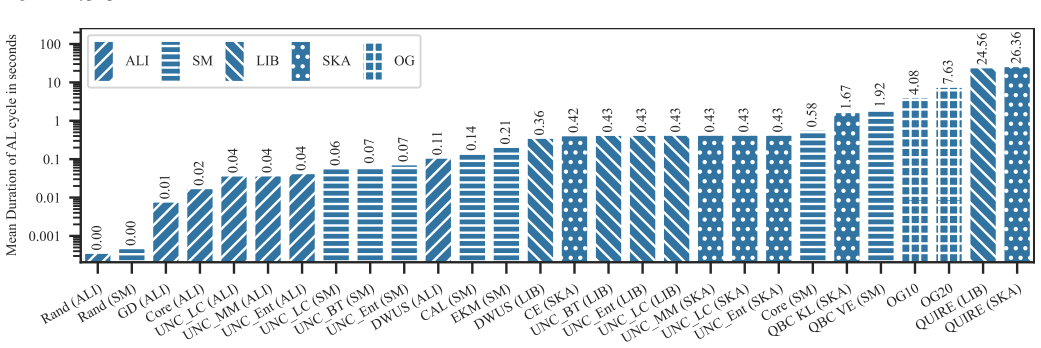
The grid built from 92 tabular datasets, three classical learners, and 28 strategy implementations is assumed to be representative enough that the observed influence patterns and the roughly 4,000-combination sufficiency threshold generalize to active learning as a whole, including deep learning and non-tabular data, even though about 75,924 slow combinations were excluded and imputed as zero.
Editorial extensions
If this is right
- If the central claim holds, any AL benchmark that varies strategies while fixing a single implementation is measuring a mix of strategy and implementation, so two papers using the same strategy in different codebases can reach opposite conclusions without either being wrong.
- A study that draws a varied random grid of about 4,000 hyperparameter combinations can reproduce the full-grid leaderboard to 80 to 100 percent correlation, so reproducibility does not require millions of runs.
- Batch size and learner model should be varied deliberately, with at least one small and one large batch size and the MLP as the safest single learner choice, while train-test splits and start sets can be fixed.
- The full-mean F1-score is the recommended evaluation metric, because ramp-up-only or plateau-only aggregation can change conclusions and the phase boundary is dataset-dependent.
- Strategy families such as uncertainty-based, diversity-based, and combined showed no consistent performance grouping, so recommendations should target concrete implementations and settings rather than family labels.
Reading between the lines
- This suggests a cheap robustness test for future AL papers: before claiming strategy A beats strategy B, re-run both in at least two independent implementations and require the ordering to survive the implementation change; otherwise the result is about code, not method.
- The 4,000-combination threshold could be turned into a practical bootstrap protocol: draw small varied subsets, check ranking stability, and stop growing the grid once correlation saturates, which would reduce benchmarking cost for new AL methods.
- The finding that two random baselines selected the same samples yet produced different metrics (100 percent query overlap but only 78.5 percent metric correlation) implies that even a random baseline is implementation-sensitive through sample ordering, so baselines need their iteration order fixed and reported.
- One open test is whether implementation dominance persists for deep neural network settings, where uncertainty estimation varies more across frameworks than for MLP, SVM, and RF; if it weakens, the conclusion is specific to classical learners on tabular data.
Editorial analysis
A structured set of objections, weighed in public.
Referee Report
Summary. The paper reports a large-scale active learning (AL) benchmark: a hyperparameter grid of 4,636,800 combinations built from 92 tabular datasets, 28 AL strategy implementations from five frameworks, three learners, six batch sizes, five train-test splits, and 20 start sets. The authors record metrics and queried sample sets for the roughly 4.56 million combinations that completed within a 5-minute per-cycle limit, then quantify the influence of each hyperparameter via metric-based Pearson correlations, queried-samples Jaccard similarity, and leaderboard-ranking Kendall tau-b correlations. They conclude that the specific implementation of an AL strategy can affect performance more than the strategy itself (exemplified by a 44.5% correlation between two QUIRE implementations), that dataset diversity matters more than specific dataset choices, and that roughly 4,000 randomly drawn hyperparameter combinations already produce leaderboard rankings highly correlated with the full grid. They close with recommendations for designing reproducible AL evaluations.
Significance. If the central empirical claims survive scrutiny, this is one of the largest and most transparent AL benchmarking efforts to date, with the source code and raw results publicly released. The paper provides a useful mapping of which hyperparameters matter (batch size, learner model, strategy implementation) and which appear relatively inert (train-test splits, start sets), and the practical recommendation of a ~4,000-combination grid is actionable. The authors are also commendably explicit about their runtime limits, missing data, and the choice to fix aggregation metrics. However, the flagship claim about implementation beating strategy rests on correlations computed after zero-imputing a non-randomly missing subset of the grid, and the paper does not provide a complete-case check; this is a load-bearing internal-validity concern.
major comments (3)
- [Sec. IV-A and IV-G] The central claim that the QUIRE implementations correlate only 44.5% is computed on result vectors in which missing cells are filled with a fixed value of 0 (the interpolation strategy described in Sec. IV-B). Sec. IV-A states that the missing results "are mainly from the largest datasets and both implementations of the QUIRE AL strategy," so the missingness is concentrated in exactly the two implementations being compared. If the two implementations time out on different subsets of the large datasets, zero-imputation injects discordant pairs into the Pearson correlation and mechanically lowers the observed value. The paper must show that the low QUIRE correlation survives a complete-case analysis (restricting to hyperparameter combinations where both implementations completed) or under a more realistic imputation model; without this, the flagship example for "implementation beats strategy" is not secure.
- [Sec. IV-B3 and IV-J] The "4,000 combinations suffice" threshold in Fig. 11 is derived from the leaderboard ranking-invariance correlation between random subsets and the full grid, and the full grid itself contains the 75,924 zero-imputed missing cells. Because those missing cells are concentrated in the largest datasets and in QUIRE implementations, the subset-stability analysis may reflect the imputation pattern rather than the true structure of AL results. The authors should re-run the subsampling analysis on the complete-case portion of the grid (or with a missing-indicator included) to demonstrate that the 4,000-combination recommendation is robust to the treatment of missing results.
- [Sec. IV-G and Fig. 8] The conclusion that implementation choices dominate strategy identity is also supported by the average within-framework versus cross-framework correlations in Fig. 8, but the paper provides no uncertainty quantification for the differences between these averages. The reported standard deviations overlap considerably (e.g., a mean of 89.8% for ALI with the lowest standard deviation still leaves a wide range), so a permutation or bootstrap test is needed to establish that the within-framework correlation is significantly higher than the cross-framework baseline. This is a secondary support for the central claim, but it should be reported as a provisional observation until such a test is added.
minor comments (5)
- [Sec. IV-B2] The queried-samples heatmap formula is internally inconsistent: the text says "we subtract the Jaccard index from 1 so that 1 indicates full similarity," but the displayed expression is 1 - (sum of Jaccard indices)/|V|, which would be 0 for identical sets, while the diagonal of the displayed matrix shows 1. Please clarify whether the heatmaps plot J or 1-J, and correct the formula or the caption accordingly.
- [Sec. II-C] There are several typos, e.g., "complxeity" should be "complexity," "practicioners" should be "practitioners," and "framworks" should be "frameworks." A careful proofreading pass is needed.
- [Sec. IV-C] The sentence "we use the the F1-score" contains a duplicated article; it should read "we use the F1-score."
- [Fig. 7 and Fig. 8] The 28x28 strategy heatmaps and the framework correlation figure are nearly impossible to read at preprint resolution; the axis labels and cell values are illegible. Please provide vector graphics or a higher-resolution version, and consider an interactive or zoomable appendix.
- [Sec. II-D] The grid notation in Sec. II-D lists "c" and "M" in the hyperparameter sets but then states they are not part of the experimental grid; this is a notational muddle that should be clarified in the text rather than only in the table.
Circularity Check
No significant circularity: the paper reports measured correlations from a large empirical grid; the 'implementation beats strategy' claim is a direct observational finding, not a fitted or self-referential prediction.
full rationale
The paper's derivation chain is empirical rather than deductive: it defines an experiment grid, runs 4.56M combinations, and reports correlations among hyperparameter-conditioned result vectors. No parameter is fitted to a subset and then renamed a prediction. The headline finding in Sec IV-G ('the specific implementation of AL strategies can impact performance more than the underlying strategy itself') is a direct reading of the metric-based heatmap's observed correlations (e.g., the two QUIRE implementations at 44.5% correlation), not a quantity forced by the construction of the heatmap. The heatmap measures exactly this quantity: as stated in Sec IV-B, 'If two combinations produce similar ML metrics, they have a high correlation.' The subset-stability analysis in Sec IV-J uses the full grid as its own reference benchmark; the paper explicitly labels this as an assumption ('Under the assumption that our hyperparameter grid is large enough to include almost any other possible AL evaluation scenarios'), so it is a consistency check rather than a self-referential derivation. The main caveat relevant to the central claim is internal validity, not circularity: missing cells are imputed as 0 (Sec IV-B: 'interpolating the results using a fixed value of 0'), and Sec IV-A reports that missing results 'are mainly from the largest datasets and both implementations of the QUIRE AL strategy'; this could bias the QUIRE correlation, but that is a data-quality threat to an empirical measurement, not an equivalence between input and output. I therefore find no step where a claimed prediction reduces by construction to its inputs.
Assumptions & free parameters
assumptions (5)
- domain assumption 92 tabular classification datasets and three classical learners (MLP, SVM, RF) are representative of active learning practice.
- domain assumption The 28 strategy implementations from five frameworks fairly represent AL strategy design.
- ad hoc to paper Missing results (runtime limits, implementation errors) can be imputed with a fixed value of 0 without distorting leaderboard rankings.
- ad hoc to paper The 5-minute per-cycle runtime limit excludes only a negligible part of the grid.
- standard math Pearson correlation, Jaccard index and Kendall tau-b are appropriate similarity measures for this comparison.
Cite this review
Pith. "Pith review of Survey of Active Learning Hyperparameters: Insights from a Large-Scale Experimental Grid." pith.science (2026). https://pith.science/paper/XI2EJMRM
@misc{pith2026250603817,
  author       = {Pith},
  title        = {Pith review of: Survey of Active Learning Hyperparameters: Insights from a Large-Scale Experimental Grid},
  year         = {2026},
  howpublished = {\url{https://pith.science/paper/XI2EJMRM}},
  note         = {Machine review of arXiv:2506.03817}
}
read the original abstract
Annotating data is a time-consuming and costly task, but it is inherently required for supervised machine learning. Active Learning (AL) is an established method that minimizes human labeling effort by iteratively selecting the most informative unlabeled samples for expert annotation, thereby improving the overall classification performance. Even though AL has been known for decades, AL is still rarely used in real-world applications. As indicated in the two community web surveys among the NLP community about AL, two main reasons continue to hold practitioners back from using AL: first, the complexity of setting AL up, and second, a lack of trust in its effectiveness. We hypothesize that both reasons share the same culprit: the large hyperparameter space of AL. This mostly unexplored hyperparameter space often leads to misleading and irreproducible AL experiment results. In this study, we first compiled a large hyperparameter grid of over 4.6 million hyperparameter combinations, second, recorded the performance of all combinations in the so-far biggest conducted AL study, and third, analyzed the impact of each hyperparameter in the experiment results. In the end, we give recommendations about the influence of each hyperparameter, demonstrate the surprising influence of the concrete AL strategy implementation, and outline an experimental study design for reproducible AL experiments with minimal computational effort, thus contributing to more reproducible and trustworthy AL research in the future.
Figures


Figures from the paper (10 more)



Reference graph
Works this paper leans on
-
[1]
Active Learning Literature Survey,
B. Settles, “Active Learning Literature Survey,” University of Wisconsin- Madison Department of Computer Sciences, Technical Report, 2009
2009
-
[2]
A web survey on the use of active learning to support annotation of text data,
K. Tomanek and F. Olsson, “A web survey on the use of active learning to support annotation of text data,” inProceedings of the NAACL HLT 2009 Workshop on Active Learning for Natural Language Processing, E. Ringger, R. Haertel, and K. Tomanek, Eds. Boulder, Colorado: Association for Computational Linguistics, 2009, pp. 45–48
work page 2009
-
[3]
Have LLMs Made Active Learning Obsolete? Surveying the NLP Community,
J. Romberg, C. Schr ¨oder, J. Gonsior, K. Tomanek, and F. Olsson, “Have LLMs Made Active Learning Obsolete? Surveying the NLP Community,” 2025
work page 2025
-
[4]
Active Learning for Spreadsheet Cell Classification,
J. Gonsior, J. Rehak, M. Thiele, E. Koci, M. G ¨unther, and W. Lehner, “Active Learning for Spreadsheet Cell Classification,” inProceedings of the Workshops of the EDBT/ICDT 2020 Joint Conference, Copen- hagen, Denmark, March 30, 2020, ser. CEUR Workshop Proceedings, A. Poulovassilis, D. Auber, N. Bikakis, P. K. Chrysanthis, G. Pa- pastefanatos, M. A. Sha...
work page 2020
-
[5]
DeepCA VE: An Interactive Analysis Tool for Automated Machine Learning,
R. Sass, E. Bergman, A. Biedenkapp, F. Hutter, and M. Lindauer, “DeepCA VE: An Interactive Analysis Tool for Automated Machine Learning,” 2022
work page 2022
-
[6]
Diminishing Uncertainty Within the Training Pool: Active Learning for Medical Image Segmentation,
V . Nath, D. Yang, B. A. Landman, D. Xu, and H. R. Roth, “Diminishing Uncertainty Within the Training Pool: Active Learning for Medical Image Segmentation,”IEEE Transactions on Medical Imaging, vol. 40, no. 10, pp. 2534–2547, 2021
work page 2021
-
[7]
Active Learning for Air Quality Station Location Recommendation,
S. D. Narayanan, A. Agnihotri, and N. Batra, “Active Learning for Air Quality Station Location Recommendation,” inProceedings of the 7th ACM IKDD CoDS and 25th COMAD, ser. CoDS COMAD 2020. New York, NY , USA: Association for Computing Machinery, 2020, pp. 326– 327
work page 2020
-
[8]
DECAL: DEployable Clinical Active Learning,
Y .-y. Logan, M. Prabhushankar, and G. AlRegib, “DECAL: DEployable Clinical Active Learning,” 2022
work page 2022
Show all 81 references
-
[9]
Using Active Learning for Assisted Short Answer Grading,
J. Kishaan, M. Muthuraja, D. Nair, and P. G. Pl ¨oger, “Using Active Learning for Assisted Short Answer Grading,” inICML 2020 Workshop on Real World Experiment Design and Active Learning, 2020
2020
-
[10]
Unsupervised Active Learning For Video Annotation,
E. Demir, Z. Cataltepe, U. Ekmekci, M. Budnik, and L. Besacier, “Unsupervised Active Learning For Video Annotation,” inICML Active Learning Workshop 2015, Lille, France, 2015
2015
-
[11]
A benchmark and comparison of active learning for logistic regression,
Y . Yang and M. Loog, “A benchmark and comparison of active learning for logistic regression,”Pattern Recognition, vol. 83, pp. 401–415, 2018
2018
-
[12]
Is margin all you need? An extensive empirical study of active learning on tabular data,
D. Bahri, H. Jiang, T. Schuster, and A. Rostamizadeh, “Is margin all you need? An extensive empirical study of active learning on tabular data,” 2022
2022
-
[13]
Revisiting uncertainty-based query strategies for active learning with transformers,
C. Schr ¨oder, A. Niekler, and M. Potthast, “Revisiting uncertainty-based query strategies for active learning with transformers,” inFindings of the Association for Computational Linguistics: ACL 2022, S. Muresan, P. Nakov, and A. Villavicencio, Eds. Dublin, Ireland: Associati...
2022
-
[14]
Learning active learning at the cross- roads? Evaluation and discussion,
L. Desreumaux and V . Lemaire, “Learning active learning at the cross- roads? Evaluation and discussion,”CEUR Workshop Proceedings, vol. 2660, pp. 38–54, 2020
2020
-
[15]
A comparative survey: Benchmarking for pool-based active learning,
X. Zhan, H. Liu, Q. Li, and A. B. Chan, “A comparative survey: Benchmarking for pool-based active learning,” inProceedings of the Thirtieth International Joint Conference on Artificial Intelligence, IJCAI 2021, Virtual Event / Montreal, Canada, 19-27 August 2021, Z. Zhou, Ed. ...
2021
-
[16]
On the Fragility of Active Learners for Text Classification,
A. Ghose and E. T. Nguyen, “On the Fragility of Active Learners for Text Classification,” inProceedings of the 2024 Conference on Empirical Methods in Natural Language Processing, Y . Al-Onaizan, M. Bansal, and Y .-N. Chen, Eds. Miami, Florida, USA: Association for Computation...
2024
-
[17]
Randomness is the Root of All Evil: More Reliable Evaluation of Deep Active Learning,
Y . Ji, D. Kaestner, O. Wirth, and C. Wressnegger, “Randomness is the Root of All Evil: More Reliable Evaluation of Deep Active Learning,” in 2023 IEEE/CVF Winter Conference on Applications of Computer Vision (WACV), ser. W ACV 2023. Waikoloa, HI, USA: IEEE, 2023, pp. 3932– 3941
2023
-
[18]
ALPBench: A Benchmark for Active Learning Pipelines on Tabular Data,
V . Margraf, M. Wever, S. Gilhuber, G. M. Tavares, T. Seidl, and E. H ¨ullermeier, “ALPBench: A Benchmark for Active Learning Pipelines on Tabular Data,” 2024
2024
-
[19]
When Does Active Learning Work?
L. P. G. Evans, N. M. Adams, and C. Anagnostopoulos, “When Does Active Learning Work?” inAdvances in Intelligent Data Analysis XII, A. Tucker, F. H¨oppner, A. Siebes, and S. Swift, Eds. Berlin, Heidelberg: Springer, 2013, pp. 174–185
2013
-
[20]
Challenges of Reliable, Realistic and Comparable Active Learning Evaluation
D. Kottke, A. Calma, D. Huseljic, G. M. Krempl, and B. Sick, “Challenges of Reliable, Realistic and Comparable Active Learning Evaluation.” inIAL@PKDD/ECML 2017, 2017, pp. 2–14
2017
-
[21]
Em- pirical investigation of active learning strategies,
D. Pereira-Santos, R. B. C. Prud ˆencio, and A. C. De Carvalho, “Em- pirical investigation of active learning strategies,”Neurocomputing, vol. 326–327, pp. 15–27, 2019
2019
-
[22]
Active learning: An empirical study of common baselines,
M. E. Ramirez-Loaiza, M. Sharma, G. Kumar, and M. Bilgic, “Active learning: An empirical study of common baselines,”Data Mining and Knowledge Discovery, vol. 31, no. 2, pp. 287–313, 2017
2017
-
[23]
Rebuilding Trust in Active Learning with Actionable Metrics,
A. Abraham and L. Dreyfus-Schmidt, “Rebuilding Trust in Active Learning with Actionable Metrics,”IEEE International Conference on Data Mining Workshops, ICDMW, vol. 2020-November, pp. 836–843, 2020
2020
-
[24]
Re-Benchmarking Pool-Based Active Learning for Binary Classification,
P.-Y . Lu, C.-L. Li, and H.-T. Lin, “Re-Benchmarking Pool-Based Active Learning for Binary Classification,” 2023
2023
-
[25]
On initial pools for deep active learning,
A. L. Chandra, S. V . Desai, C. Devaguptapu, and V . N. Balasubramanian, “On initial pools for deep active learning,” inNeurIPS 2020 Workshop on Pre-Registration in Machine Learning, ser. Proceedings of Machine Learning Research, L. Bertinetto, J. F. Henriques, S. Albanie, M. ...
2020
-
[26]
An overview and a bench- mark of active learning for outlier detection with one-class classifiers,
H. Trittenbach, A. Englhardt, and K. B ¨ohm, “An overview and a bench- mark of active learning for outlier detection with one-class classifiers,” Expert Systems with Applications, vol. 168, p. 114372, 2021
2021
-
[27]
Sample Noise Impact on Active Learning,
A. Abraham and L. Dreyfus-Schmidt, “Sample Noise Impact on Active Learning,”CEUR Workshop Proceedings, vol. 3079, pp. 80–88, 2021
2021
-
[28]
Hitting the target: Stopping active learning at the cost-based optimum,
Z. Pullar-Strecker, K. Dost, E. Frank, and J. Wicker, “Hitting the target: Stopping active learning at the cost-based optimum,”Machine Learning, pp. 1–19, 2022
2022
-
[29]
A Comparative Survey of Deep Active Learning,
X. Zhan, Q. Wang, K.-h. Huang, H. Xiong, D. Dou, and A. B. Chan, “A Comparative Survey of Deep Active Learning,” 2022
2022
-
[30]
Active learning for logistic regression: An evaluation,
A. I. Schein and L. H. Ungar, “Active learning for logistic regression: An evaluation,”Machine learning, vol. 68, no. 3, pp. 235–265, 2007
2007
-
[31]
The UCI Machine Learning Repository,
M. Kelly, R. Longjohn, and K. Nottingham, “The UCI Machine Learning Repository,” 2017. ARXIV PREPRINT: SURVEY OF ACTIVE LEARNING HYPERPARAMETERS 19
2017
-
[32]
OpenML Bench- marking Suites,
B. Bischl, G. Casalicchio, M. Feurer, P. Gijsbers, F. Hutter, M. Lang, R. Gomes Mantovani, J. van Rijn, and J. Vanschoren, “OpenML Bench- marking Suites,”Proceedings of the Neural Information Processing Systems Track on Datasets and Benchmarks, vol. 1, 2021
2021
-
[33]
Learning active learning from data,
K. Konyushkova, R. Sznitman, and P. Fua, “Learning active learning from data,” inAdvances in Neural Information Processing Systems 30: Annual Conference on Neural Information Processing Systems 2017, December 4-9, 2017, Long Beach, CA, USA, I. Guyon, U. von Luxburg, S. Bengio,...
2017
-
[34]
Comparing and Improving Active Learning Uncertainty Measures for Transformer Models by Discarding Outliers,
J. Gonsior, C. Falkenberg, S. Magino, A. Reusch, C. Hartmann, M. Thiele, and W. Lehner, “Comparing and Improving Active Learning Uncertainty Measures for Transformer Models by Discarding Outliers,” Information Systems Frontiers, 2024
2024
-
[35]
Imagenet: A large- scale hierarchical image database,
J. Deng, W. Dong, R. Socher, L. Li, K. Li, and F. Li, “Imagenet: A large- scale hierarchical image database,” in2009 IEEE Computer Society Conference on Computer Vision and Pattern Recognition (CVPR 2009), 20-25 June 2009, Miami, Florida, USA. IEEE Computer Society, 2009, pp. 248–255
2009
-
[36]
Probabilistic Active Learning: Towards Combining Versatility, Optimality and Efficiency,
G. Krempl, D. Kottke, and M. Spiliopoulou, “Probabilistic Active Learning: Towards Combining Versatility, Optimality and Efficiency,” in Discovery Science, S. D ˇzeroski, P. Panov, D. Kocev, and L. Todorovski, Eds. Cham: Springer International Publishing, 2014, pp. 168–179
2014
-
[37]
ImitAL: Learned Active Learning Strategy on Synthetic Data,
J. Gonsior, M. Thiele, and W. Lehner, “ImitAL: Learned Active Learning Strategy on Synthetic Data,” inDiscovery Science - 25th International Conference, DS 2022, Montpellier, France, October 10-12, 2022, Pro- ceedings, ser. Lecture Notes in Computer Science, P. Poncelet and D....
2022
-
[38]
Let us know your decision: Pool-based active training of a generative classifier with the selection strategy 4DS,
T. Reitmaier and B. Sick, “Let us know your decision: Pool-based active training of a generative classifier with the selection strategy 4DS,” Information Sciences, vol. 230, pp. 106–131, 2013
2013
-
[39]
Active Learn- ing for Support Vector Machines with Maximum Model Change,
W. Cai, Y . Zhang, S. Zhou, W. Wang, C. Ding, and X. Gu, “Active Learn- ing for Support Vector Machines with Maximum Model Change,” in Machine Learning and Knowledge Discovery in Databases, T. Calders, F. Esposito, E. H ¨ullermeier, and R. Meo, Eds. Berlin, Heidelberg: Springe...
2014
-
[40]
A Novel Uncertainty Sampling Algorithm for Cost-Sensitive Multiclass Active Learning,
K.-H. Huang and H.-T. Lin, “A Novel Uncertainty Sampling Algorithm for Cost-Sensitive Multiclass Active Learning,” in2016 IEEE 16th International Conference on Data Mining (ICDM), 2016, pp. 925–930
2016
-
[41]
To Actively Initialize Active Learning,
Y . Yang and M. Loog, “To Actively Initialize Active Learning,”Pattern Recognition, vol. 131, p. 108836, 2022
2022
-
[42]
Individual Comparisons by Ranking Methods,
F. Wilcoxon, “Individual Comparisons by Ranking Methods,”Biometrics Bulletin, vol. 1, no. 6, p. 80, 1945
1945
-
[43]
Active learning by querying informa- tive and representative examples,
S. Huang, R. Jin, and Z. Zhou, “Active learning by querying informa- tive and representative examples,” inAdvances in Neural Information Processing Systems 23: 24th Annual Conference on Neural Information Processing Systems 2010. Proceedings of a meeting held 6-9 December 2010...
2010
-
[44]
Optimised probabilistic active learning (OPAL),
G. Krempl, D. Kottke, and V . Lemaire, “Optimised probabilistic active learning (OPAL),”Machine learning, vol. 100, no. 2, pp. 449–476, 2015
2015
-
[45]
Active learning using transductive sparse Bayesian regression,
Y . Son and J. Lee, “Active learning using transductive sparse Bayesian regression,”Information Sciences, vol. 374, pp. 240–254, 2016
2016
-
[46]
Statistical Comparisons of Classifiers over Multiple Data Sets,
J. Dem ˇsar, “Statistical Comparisons of Classifiers over Multiple Data Sets,”J. Mach. Learn. Res., vol. 7, pp. 1–30, 2006
2006
-
[47]
Kaggle: Your Machine Learning and Data Science Community
“Kaggle: Your Machine Learning and Data Science Community.”
-
[48]
ALiPy: Active Learning in Python,
Y .-P. Tang, G.-X. Li, and S.-J. Huang, “ALiPy: Active Learning in Python,” 2019
2019
-
[49]
Libact: Pool-based Active Learning in Python,
Y .-Y . Yang, S.-C. Lee, Y .-A. Chung, T.-E. Wu, S.-A. Chen, and H.-T. Lin, “Libact: Pool-based Active Learning in Python,” 2017
2017
-
[50]
Google/active-learning,
Y . Yang, “Google/active-learning,” Google, 2024
2024
-
[51]
Scikit-activeml: A Library and Toolbox for Active Learning Algorithms,
D. Kottke, M. Herde, T. P. Minh, A. Benz, P. Mergard, A. Roghman, C. Sandrock, and B. Sick, “Scikit-activeml: A Library and Toolbox for Active Learning Algorithms,” 2021
2021
-
[52]
Small-text: Active learning for text classification in python,
C. Schr ¨oder, L. M ¨uller, A. Niekler, and M. Potthast, “Small-text: Active learning for text classification in python,” inProceedings of the 17th Conference of the European Chapter of the Association for Computa- tional Linguistics: System Demonstrations, D. Croce and L. Sol...
2023
-
[53]
Active learning by acquiring contrastive examples,
K. Margatina, G. Vernikos, L. Barrault, and N. Aletras, “Active learning by acquiring contrastive examples,” inProceedings of the 2021 Con- ference on Empirical Methods in Natural Language Processing, M.-F. Moens, X. Huang, L. Specia, and S. W.-t. Yih, Eds. Online and Punta Ca...
2021
-
[54]
Active learning for convolutional neural networks: A core-set approach,
O. Sener and S. Savarese, “Active learning for convolutional neural networks: A core-set approach,” in6th International Conference on Learning Representations, ICLR 2018, Vancouver, BC, Canada, April 30 - May 3, 2018, Conference Track Proceedings. OpenReview.net, 2018
2018
-
[55]
Dual Strategy Active Learning,
P. Donmez, J. G. Carbonell, and P. N. Bennett, “Dual Strategy Active Learning,” inProceedings of the 18th European Conference on Machine Learning, ser. ECML ’07. Berlin, Heidelberg: Springer-Verlag, 2007, pp. 116–127
2007
-
[56]
Active learning using pre- clustering,
H. T. Nguyen and A. W. M. Smeulders, “Active learning using pre- clustering,” inMachine Learning, Proceedings of the Twenty-first In- ternational Conference (ICML 2004), Banff, Alberta, Canada, July 4- 8, 2004, ser. ACM International Conference Proceeding Series, C. E. Brodley...
2004
-
[57]
Cold-start active learning through self-supervised language modeling,
M. Yuan, H.-T. Lin, and J. Boyd-Graber, “Cold-start active learning through self-supervised language modeling,” inProceedings of the 2020 Conference on Empirical Methods in Natural Language Processing (EMNLP), B. Webber, T. Cohn, Y . He, and Y . Liu, Eds. Online: Association f...
2020
-
[58]
RALF: A reinforced active learning formulation for object class recognition,
S. Ebert, M. Fritz, and B. Schiele, “RALF: A reinforced active learning formulation for object class recognition,” in2012 IEEE Conference on Computer Vision and Pattern Recognition, Providence, RI, USA, June 16-21, 2012. IEEE Computer Society, 2012, pp. 3626–3633
2012
-
[59]
Learning how to actively learn: A deep imitation learning approach,
M. Liu, W. Buntine, and G. Haffari, “Learning how to actively learn: A deep imitation learning approach,” inProceedings of the 56th Annual Meeting of the Association for Computational Linguistics (Volume 1: Long Papers), I. Gurevych and Y . Miyao, Eds. Melbourne, Australia: As...
2018
-
[60]
Query by committee,
H. S. Seung, M. Opper, and H. Sompolinsky, “Query by committee,” in Proceedings of the Fifth Annual Workshop on Computational Learning Theory, ser. COLT92. Pittsburgh Pennsylvania USA: ACM, 1992, pp. 287–294
1992
-
[61]
Query Learning Strategies Using Boosting and Bagging
N. Abe and H. Mamitsuka, “Query Learning Strategies Using Boosting and Bagging.” inProceedings of the Fifteenth International Conference on Machine Learning (ICML 1998), Madison, Wisconsin, USA, July 24- 27, 1998, ser. ICML 1998. Morgan Kaufmann Publishers Inc., 1998, pp. 1–9
1998
-
[62]
Active Learning for Regression Based on Query by Committee,
R. Burbidge, J. J. Rowland, and R. D. King, “Active Learning for Regression Based on Query by Committee,” inIntelligent Data En- gineering and Automated Learning - IDEAL 2007, H. Yin, P. Tino, E. Corchado, W. Byrne, and X. Yao, Eds. Berlin, Heidelberg: Springer Berlin Heidelbe...
2007
-
[63]
Entropy-based active learning for object recognition,
A. Holub, P. Perona, and M. C. Burl, “Entropy-based active learning for object recognition,” in2008 IEEE Computer Society Conference on Computer Vision and Pattern Recognition Workshops. Anchorage, AK, USA: IEEE, 2008, pp. 1–8
2008
-
[64]
A Sequential Algorithm for Training Text Classifiers
D. D. Lewis and W. A. Gale, “A Sequential Algorithm for Training Text Classifiers.” inSIGIR 1994. Springer London, 1994, pp. 3–12
1994
-
[65]
Mining the Web with active hidden Markov models,
T. Scheffer, C. Decomain, and S. Wrobel, “Mining the Web with active hidden Markov models,” inProceedings 2001 IEEE International Conference on Data Mining, ser. ICDM-01. San Jose, CA, USA: IEEE Comput. Soc, 2001, pp. 645–646
2001
-
[66]
Active learning to recognize multiple types of plankton,
Tong Luo, K. Kramer, S. Samson, A. Remsen, D. Goldgof, L. Hall, and T. Hopkins, “Active learning to recognize multiple types of plankton,” inProceedings of the 17th International Conference on Pattern Recog- nition, 2004. ICPR 2004.Cambridge, UK: IEEE, 2004, pp. 478–481 V ol.3
2004
-
[67]
Mind your outliers! investigating the negative impact of outliers on active learning for visual question answering,
S. Karamcheti, R. Krishna, L. Fei-Fei, and C. Manning, “Mind your outliers! investigating the negative impact of outliers on active learning for visual question answering,” inProceedings of the 59th Annual Meeting of the Association for Computational Linguistics and the 11th I...
2021
-
[68]
VII. Note on regression and inheritance in the case of two parents,
K. Pearson and F. Galton, “VII. Note on regression and inheritance in the case of two parents,”Proceedings of the Royal Society of London, vol. 58, no. 347-352, pp. 240–242, 1895
-
[69]
The Finley Affair: A Signal Event in the History of Forecast Verification,
A. H. Murphy, “The Finley Affair: A Signal Event in the History of Forecast Verification,”Weather and Forecasting, vol. 11, no. 1, pp. 3– 20, 1996
1996
-
[70]
A New Measure of Rank Correlation,
M. G. Kendall, “A New Measure of Rank Correlation,”Biometrika, vol. 30, no. 1/2, pp. 81–93, 1938
1938
-
[71]
The Proof and Measurement of Association between Two Things,
C. Spearman, “The Proof and Measurement of Association between Two Things,”The American Journal of Psychology, vol. 15, no. 1, pp. 72– 101, 1904
1904
-
[72]
A Mathematical Theory of Communication,
C. E. Shannon, “A Mathematical Theory of Communication,”Bell System Technical Journal, vol. 27, no. 3, pp. 379–423, 1948. ARXIV PREPRINT: SURVEY OF ACTIVE LEARNING HYPERPARAMETERS 20
1948
-
[73]
A Survey of Active Learning for Text Classification using Deep Neural Networks,
C. Schr ¨oder and A. Niekler, “A Survey of Active Learning for Text Classification using Deep Neural Networks,” 2020
2020
-
[74]
Cartography active learning,
M. Zhang and B. Plank, “Cartography active learning,” inFindings of the Association for Computational Linguistics: EMNLP 2021, M.-F. Moens, X. Huang, L. Specia, and S. W.-t. Yih, Eds. Punta Cana, Dominican Republic: Association for Computational Linguistics, 2021, pp. 395– 406
2021
-
[75]
Batchbald: Efficient and diverse batch acquisition for deep bayesian active learning,
A. Kirsch, J. van Amersfoort, and Y . Gal, “Batchbald: Efficient and diverse batch acquisition for deep bayesian active learning,” inAdvances in Neural Information Processing Systems 32: Annual Conference on Neural Information Processing Systems 2019, NeurIPS 2019, December 8-...
2019
-
[76]
Bayesian Active Learning for Classification and Preference Learning,
N. Houlsby, F. Husz ´ar, Z. Ghahramani, and M. Lengyel, “Bayesian Active Learning for Classification and Preference Learning,” 2011
2011
-
[77]
Deep Bayesian active learning for natural language processing: Results of a large-scale empirical study,
A. Siddhant and Z. C. Lipton, “Deep Bayesian active learning for natural language processing: Results of a large-scale empirical study,” inProceedings of the 2018 Conference on Empirical Methods in Natural Language Processing, E. Riloff, D. Chiang, J. Hockenmaier, and J. Tsuji...
2018
-
[78]
Selection via proxy: Efficient data selection for deep learning,
C. Coleman, C. Yeh, S. Mussmann, B. Mirzasoleiman, P. Bailis, P. Liang, J. Leskovec, and M. Zaharia, “Selection via proxy: Efficient data selection for deep learning,” in8th International Conference on Learning Representations, ICLR 2020, Addis Ababa, Ethiopia, April 26-30, 20...
2020
-
[79]
Active learning by learning,
W. Hsu and H. Lin, “Active learning by learning,” inProceedings of the Twenty-Ninth AAAI Conference on Artificial Intelligence, January 25-30, 2015, Austin, Texas, USA, B. Bonet and S. Koenig, Eds. AAAI Press, 2015, pp. 2659–2665
2015
-
[80]
Discovering General- Purpose Active Learning Strategies,
K. Konyushkova, R. Sznitman, and P. Fua, “Discovering General- Purpose Active Learning Strategies,” 2019
2019
-
[81]
Querying discriminative and representative samples for batch mode active learning,
Z. Wang and J. Ye, “Querying discriminative and representative samples for batch mode active learning,” inThe 19th ACM SIGKDD International Conference on Knowledge Discovery and Data Mining, KDD 2013, Chicago, IL, USA, August 11-14, 2013, I. S. Dhillon, Y . Koren, R. Ghani, T....
2013
Reviewed August 7, 2026 · model on record in the stance chip above.
Discussion (0). Sign in to comment.