Beyond Diamond: Interpretable Machine Learning Reveals Design Principles for Quantum Defect Host Materials
Pith reviewed 2026-05-19 11:32 UTC · model grok-4.3
The pith
Machine learning on compositions alone extracts consensus design rules to identify 122 high-confidence quantum defect host candidates.
A machine-rendered reading of the paper's core claim, the machinery that carries it, and where it could break.
Core claim
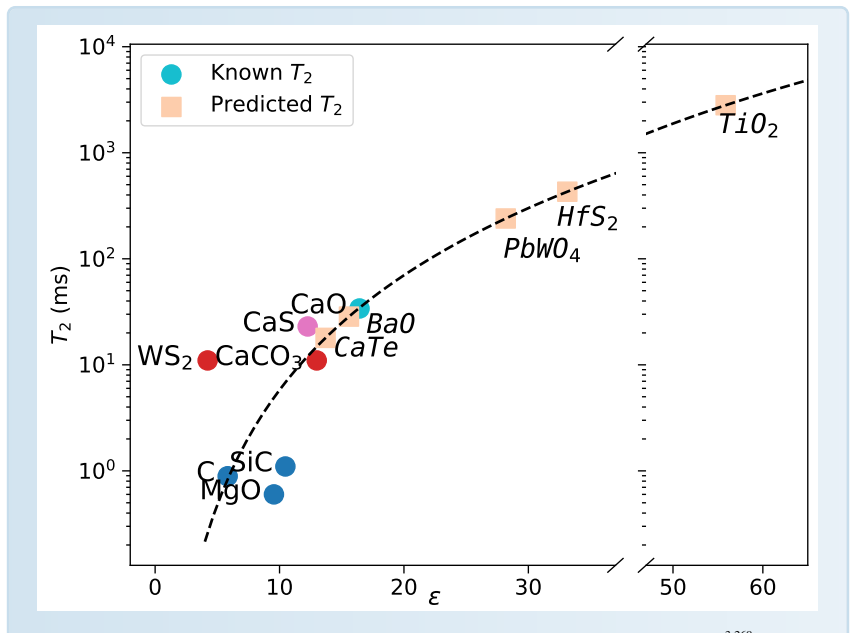
By contrasting feature attributions across seven diverse classifiers in a heterogeneous Rashomon set, the framework extracts consensus design rules that no single model identifies alone: filled valence s-, d-, and f-shells, low chemical heterogeneity, and enrichment in C, S, Si, and O favor quantum compatibility. Screening approximately 45,000 thermodynamically stable compounds identifies 122 high-confidence candidates with recovery of most experimentally verified hosts and new predictions including TiO2, PbWO4, and layered chalcogenides, while density functional perturbation theory on 12 materials validates dielectric screening as a coherence proxy with R squared of 0.89 against measured T2
What carries the argument
Heterogeneous Rashomon set ensembles that contrast feature attributions from seven diverse classifiers to extract consensus design rules from composition-only data.
Load-bearing premise
That consensus feature attributions from composition-only classifiers trained on existing data capture the essential physical requirements for quantum defect hosting.
What would settle it
Experimental measurement of spin coherence time T2 in TiO2 or another high-confidence candidate to test whether the dielectric screening correlation holds beyond the twelve materials already examined.
Figures



read the original abstract
Solid-state spin defects in wide-bandgap semiconductors are leading candidates for quantum information processing, but systematic identification of suitable host materials remains limited by the cost of first-principles screening across vast chemical spaces. We address this with a composition-only machine learning framework built on heterogeneous Rashomon set ensembles: by contrasting the feature attributions of seven diverse classifiers, we extract consensus design rules that no single model identifies alone-filled valence s-, d-, and f-shells, low chemical heterogeneity, and enrichment in C, S, Si, and O favor quantum compatibility. Screening approximately 45,000 thermodynamically stable compounds, we identify 122 high-confidence candidates (confidence > 0.95), recovering most experimentally verified hosts (C, SiC, ZnO, ZnS) and predicting unexplored materials including TiO$_2$, PbWO$_4$, and layered chalcogenides (HfS$_2$, ZrS$_2$). Density functional perturbation theory calculations on 12 representative materials validate dielectric screening as a coherence proxy (R$^2$ = 0.89 against experimental T$_2$), and vacancy calculations for TiO$_2$ reveal deep, isolated mid-gap states favorable for spin-defect hosting. The framework provides transferable, physically grounded design principles for rational quantum materials discovery beyond traditional carbide and nitride hosts.
Editorial analysis
A structured set of objections, weighed in public.
Referee Report
Summary. The manuscript introduces a composition-only machine learning framework using a heterogeneous Rashomon set of seven diverse classifiers to derive consensus design rules for quantum defect host materials. Key rules identified include filled valence s-, d-, and f-shells, low chemical heterogeneity, and enrichment in C, S, Si, and O. Screening ~45,000 thermodynamically stable compounds yields 122 high-confidence candidates (confidence >0.95), recovering known hosts such as C, SiC, ZnO, and ZnS while predicting new ones including TiO2, PbWO4, and layered chalcogenides. DFT validation on 12 materials shows dielectric screening correlating with experimental T2 (R²=0.89), and TiO2 vacancy calculations indicate favorable mid-gap states.
Significance. If the consensus attributions reliably capture physical requirements for isolated spin defects and the dielectric-T2 correlation generalizes, the approach could provide transferable, interpretable guidelines to accelerate discovery of quantum materials beyond carbides and nitrides. The recovery of verified hosts and the high R² value on the tested subset offer supporting evidence, though the composition-only filter and limited structural validation constrain the strength of the central claims.
major comments (3)
- [DFT validation section] The validation of dielectric screening as a coherence proxy rests on R²=0.89 for only 12 materials against experimental T2, but the manuscript provides no details on how these 12 were selected from the 122 candidates or whether they represent the full diversity of predicted hosts (e.g., layered chalcogenides vs. oxides). This selection process is load-bearing for the claim that the proxy will hold for the broader screened set.
- [Methods and results on Rashomon ensemble] The design rules are extracted from feature attributions of classifiers trained on the same literature-curated data used to label 'quantum compatibility.' This creates a risk that the consensus (filled shells, C/S/Si/O enrichment) largely reflects correlations in the training distribution rather than causal structural requirements, as composition vectors omit defect formation energies, local symmetry, and phonon coupling.
- [TiO2 calculations and candidate screening] Post-hoc DFT checks on TiO2 vacancies confirm mid-gap states, but no equivalent structural or defect-specific calculations are reported for the remaining ~110 candidates. Without these, it is unclear whether the composition-based filter has pre-selected hosts whose lattices are actually compatible with isolated spin defects.
minor comments (2)
- [Data preparation] Clarify the exact definition and source of the 'quantum compatibility' labels used for training the seven classifiers, including any post-hoc filtering steps applied to the initial literature data.
- [Abstract and screening results] The abstract states recovery of 'most experimentally verified hosts' but does not list which known hosts were missed or the precise confidence scores assigned to them.
Simulated Author's Rebuttal
We thank the referee for their detailed and constructive feedback. We address each major comment point by point below, clarifying our approach and indicating revisions where they strengthen the manuscript without altering its core claims.
read point-by-point responses
-
Referee: [DFT validation section] The validation of dielectric screening as a coherence proxy rests on R²=0.89 for only 12 materials against experimental T2, but the manuscript provides no details on how these 12 were selected from the 122 candidates or whether they represent the full diversity of predicted hosts (e.g., layered chalcogenides vs. oxides). This selection process is load-bearing for the claim that the proxy will hold for the broader screened set.
Authors: We thank the referee for this observation. The 12 materials were deliberately chosen to span the dominant chemical families among the 122 high-confidence candidates, specifically including binary oxides (TiO2, ZnO), sulfides (ZnS), carbides (SiC), and layered chalcogenides (HfS2, ZrS2), while prioritizing those with published experimental T2 values. This selection was intended to test the dielectric proxy across representative classes rather than a random subset. To address the lack of explicit documentation, we will add a supplementary table and brief methods paragraph describing the selection criteria and confirming coverage of the main predicted host types. revision: yes
-
Referee: [Methods and results on Rashomon ensemble] The design rules are extracted from feature attributions of classifiers trained on the same literature-curated data used to label 'quantum compatibility.' This creates a risk that the consensus (filled shells, C/S/Si/O enrichment) largely reflects correlations in the training distribution rather than causal structural requirements, as composition vectors omit defect formation energies, local symmetry, and phonon coupling.
Authors: We agree that composition-only descriptors capture statistical associations rather than direct causal physics and that defect formation energies, site symmetry, and phonon spectra are omitted. The Rashomon ensemble mitigates some of this by requiring feature importance to be consistent across architecturally distinct models, thereby reducing the influence of any single model's idiosyncrasies. The recovered rules also align with known requirements for spin-defect hosts (e.g., filled shells to suppress paramagnetic centers) and successfully retrieve experimentally verified materials. We will revise the discussion section to state explicitly that the rules are correlative screening heuristics, not causal mechanisms, and to note that they are meant to be followed by structure-aware DFT validation. revision: partial
-
Referee: [TiO2 calculations and candidate screening] Post-hoc DFT checks on TiO2 vacancies confirm mid-gap states, but no equivalent structural or defect-specific calculations are reported for the remaining ~110 candidates. Without these, it is unclear whether the composition-based filter has pre-selected hosts whose lattices are actually compatible with isolated spin defects.
Authors: We acknowledge that exhaustive defect calculations for all 122 candidates would offer more direct validation. Such calculations, however, remain computationally prohibitive at the scale of this screening study; the composition-only filter is explicitly positioned as an efficient pre-screen to identify a manageable set of candidates for subsequent, resource-intensive first-principles work. TiO2 was selected as a representative new candidate for detailed vacancy analysis to illustrate the promise of the screened set. The dielectric validation performed on 12 diverse materials provides supporting evidence for the broader cohort. We will add a clarifying paragraph in the discussion stating that the ML stage is a prioritization tool and that full structural and defect-specific DFT remains necessary for any candidate advanced to experimental consideration. revision: no
Circularity Check
No significant circularity: standard supervised ML screening with post-hoc validation
full rationale
The paper trains composition-only classifiers on literature-labeled quantum defect hosts, extracts consensus feature attributions via a Rashomon ensemble, and screens ~45k compounds for high-confidence matches. This is a conventional supervised learning pipeline whose outputs (design rules and candidate list) are not equivalent to the inputs by construction; the rules are post-hoc interpretations of model behavior rather than a redefinition or forced renaming of the training labels. DFT validation on a subset of candidates (dielectric-T2 correlation and TiO2 mid-gap states) supplies an independent physical check outside the original classifier training. No self-citations, ansatzes, or uniqueness theorems are invoked to close the loop, and the central claim does not reduce to a fitted parameter being relabeled as a prediction. The framework is self-contained against external benchmarks.
Axiom & Free-Parameter Ledger
free parameters (2)
- confidence threshold
- number of classifiers
axioms (1)
- domain assumption Composition-only features are sufficient to screen for quantum defect compatibility without initial structural information
Reference graph
Works this paper leans on
-
[1]
Building a quantum- ready ecosystem
Abhishek Purohit, Maninder Kaur, Zeki Can Seskir, Matthew T Posner, and Araceli Venegas-Gomez. Building a quantum- ready ecosystem. IET Quantum Communication, 5(1):1–18, 2024
work page 2024
-
[2]
Review of distributed quantum computing: from sin- gle qpu to high performance quantum computing
David Barral, F Javier Cardama, Guillermo Díaz-Camacho, Daniel Faílde, Iago F Llovo, Mariamo Mussa-Juane, Jorge 9 Vázquez-Pérez, Juan Villasuso, César Piñeiro, Natalia Costas, et al. Review of distributed quantum computing: from sin- gle qpu to high performance quantum computing. Computer Science Review, 57:100747, 2025
work page 2025
-
[3]
Scalable entanglement certi- fication via quantum communication
Pharnam Bakhshinezhad, Mohammad Mehboudi, Carles Roch I Carceller, and Armin Tavakoli. Scalable entanglement certi- fication via quantum communication. PRX Quantum, 5(2):020319, 2024
work page 2024
-
[4]
Quantum sensing and metrology for fundamental physics with molecules
David DeMille, Nicholas R Hutzler, Ana Maria Rey, and Tanya Zelevinsky. Quantum sensing and metrology for fundamental physics with molecules. Nature Physics, 20(5):741–749, 2024
work page 2024
-
[5]
An elementary review on basic principles and developments of qubits for quantum computing
Eunmi Chae, Joonhee Choi, and Junki Kim. An elementary review on basic principles and developments of qubits for quantum computing. Nano Convergence, 11(1):11, 2024
work page 2024
-
[6]
Quantum computing with trapped ions.Physics reports, 469(4):155–203, 2008
Hartmut Häffner, Christian F Roos, and Rainer Blatt. Quantum computing with trapped ions.Physics reports, 469(4):155–203, 2008
work page 2008
-
[7]
Robust and fast microwave-driven quantum logic for trapped-ion qubits
MA Weber, MF Gely, RK Hanley, TP Harty, AD Leu, CM Löschnauer, DP Nadlinger, and DM Lucas. Robust and fast microwave-driven quantum logic for trapped-ion qubits. Physical Review A, 110(1):L010601, 2024
work page 2024
-
[8]
Cold-atom quantum simulators of gauge theories
Jad C Halimeh, Monika Aidelsburger, Fabian Grusdt, Philipp Hauke, and Bing Yang. Cold-atom quantum simulators of gauge theories. Nature Physics, pages 1–12, 2025
work page 2025
-
[9]
John Clarke and Frank K Wilhelm. Superconducting quantum bits. Nature, 453(7198):1031–1042, 2008
work page 2008
-
[10]
Semiconductor qubits in practice
Anasua Chatterjee, Paul Stevenson, Silvano De Franceschi, Andrea Morello, Nathalie P de Leon, and Ferdinand Kuemmeth. Semiconductor qubits in practice. Nature Reviews Physics, 3(3):157–177, 2021
work page 2021
-
[11]
Rabi and ramsey oscillations of a majorana qubit in a quantum dot- superconductor array
Haining Pan, Sankar Das Sarma, and Chun-Xiao Liu. Rabi and ramsey oscillations of a majorana qubit in a quantum dot- superconductor array. Physical Review B, 111(7):075416, 2025
work page 2025
-
[12]
Quantum entanglement between optical and microwave photonic qubits
Srujan Meesala, David Lake, Steven Wood, Piero Chiappina, Changchun Zhong, Andrew D Beyer, Matthew D Shaw, Liang Jiang, and Oskar Painter. Quantum entanglement between optical and microwave photonic qubits. Physical Review X , 14(3):031055, 2024
work page 2024
-
[13]
A millisecond integrated quantum memory for photonic qubits
Yu-Ping Liu, Zhong-Wen Ou, Tian-Xiang Zhu, Ming-Xu Su, Chao Liu, Yong-Jian Han, Zong-Quan Zhou, Chuan-Feng Li, and Guang-Can Guo. A millisecond integrated quantum memory for photonic qubits. Science Advances, 11(13):eadu5264, 2025
work page 2025
-
[14]
Quantum computing in the nisq era and beyond
John Preskill. Quantum computing in the nisq era and beyond. Quantum, 2:79, 2018
work page 2018
-
[15]
Yutaro Akahoshi, Kazunori Maruyama, Hirotaka Oshima, Shintaro Sato, and Keisuke Fujii. Partially fault-tolerant quan- tum computing architecture with error-corrected clifford gates and space-time efficient analog rotations. PRX quantum , 5(1):010337, 2024
work page 2024
-
[16]
Scalable, high-fidelity all-electronic control of trapped-ion qubits
CM Löschnauer, J Mosca Toba, AC Hughes, SA King, MA Weber, R Srinivas, R Matt, R Nourshargh, DTC Allcock, CJ Bal- lance, et al. Scalable, high-fidelity all-electronic control of trapped-ion qubits. arXiv preprint arXiv:2407.07694, 2024
-
[17]
P-Y Song, J-F Wei, Peng Xu, L-L Yan, M Feng, Shi-Lei Su, and Gang Chen. Fast realization of high-fidelity nonadiabatic holonomic quantum gates with a time-optimal-control technique in rydberg atoms. Physical Review A, 109(2):022613, 2024
work page 2024
-
[18]
Roads towards fault-tolerant universal quantum computation
Earl T Campbell, Barbara M Terhal, and Christophe Vuillot. Roads towards fault-tolerant universal quantum computation. Nature, 549(7671):172–179, 2017
work page 2017
-
[19]
Quantum many-body simulations on digital quantum computers: State-of-the-art and future challenges
Benedikt Fauseweh. Quantum many-body simulations on digital quantum computers: State-of-the-art and future challenges. Nature Communications, 15(1):2123, 2024
work page 2024
-
[20]
Materials challenges and opportunities for quantum computing hardware
Nathalie P De Leon, Kohei M Itoh, Dohun Kim, Karan K Mehta, Tracy E Northup, Hanhee Paik, BS Palmer, Nitin Samarth, Sorawis Sangtawesin, and David W Steuerman. Materials challenges and opportunities for quantum computing hardware. Science, 372(6539):eabb2823, 2021
work page 2021
-
[21]
Challenges in reliable quantum computing
Diana Franklin and Frederic T Chong. Challenges in reliable quantum computing. Nano, quantum and molecular computing: implications to high level design and validation, pages 247–266, 2004
work page 2004
-
[22]
Nitrogen-vacancy center in diamond: Model of the electronic structure and associ- ated dynamics
NB Manson, JP Harrison, and MJ Sellars. Nitrogen-vacancy center in diamond: Model of the electronic structure and associ- ated dynamics. Physical Review B—Condensed Matter and Materials Physics , 74(10):104303, 2006
work page 2006
-
[23]
Coherent microwave, optical, and mechanical quantum control of spin qubits in diamond
Laura Orphal-Kobin, Cem Güney Torun, Julian M Bopp, Gregor Pieplow, and Tim Schröder. Coherent microwave, optical, and mechanical quantum control of spin qubits in diamond. Advanced Quantum Technologies, 8(2):2300432, 2025
work page 2025
-
[24]
Scalable fault-tolerant quantum technologies with silicon color centers
Stephanie Simmons. Scalable fault-tolerant quantum technologies with silicon color centers. PRX quantum, 5(1):010102, 2024
work page 2024
-
[25]
Scalable quantum photonics with single color centers in silicon carbide
Marina Radulaski, Matthias Widmann, Matthias Niethammer, Jingyuan Linda Zhang, Sang-Yun Lee, Torsten Rendler, Kon- stantinos G Lagoudakis, Nguyen Tien Son, Erik Janzen, and Takeshi Ohshima. Scalable quantum photonics with single color centers in silicon carbide. Nano letters, 17(3):1782–1786, 2017
work page 2017
-
[26]
Carbon defect qubit in two-dimensional ws2
Song Li, Gerg ˝o Thiering, Péter Udvarhelyi, Viktor Ivády, and Adam Gali. Carbon defect qubit in two-dimensional ws2. Nature communications, 13(1):1210, 2022
work page 2022
-
[27]
Yeonghun Lee, Yaoqiao Hu, Xiuyao Lang, Dongwook Kim, Kejun Li, Yuan Ping, Kai-Mei C Fu, and Kyeongjae Cho. Spin- defect qubits in two-dimensional transition metal dichalcogenides operating at telecom wavelengths.Nature Communications, 13(1):7501, 2022
work page 2022
-
[28]
Quantum guidelines for solid-state spin defects
Gary Wolfowicz, F Joseph Heremans, Christopher P Anderson, Shun Kanai, Hosung Seo, Adam Gali, Giulia Galli, and David D Awschalom. Quantum guidelines for solid-state spin defects. Nature Reviews Materials, 6(10):906–925, 2021
work page 2021
-
[29]
Quantum 10 computing with defects
JR Weber, WF Koehl, JB Varley, Anderson Janotti, BB Buckley, CG Van de Walle, and David D Awschalom. Quantum 10 computing with defects. Proceedings of the National Academy of Sciences, 107(19):8513–8518, 2010
work page 2010
-
[30]
Identifying candidate hosts for quantum defects via data mining
Austin M Ferrenti, Nathalie P de Leon, Jeff D Thompson, and Robert J Cava. Identifying candidate hosts for quantum defects via data mining. npj Computational Materials, 6(1):126, 2020
work page 2020
-
[31]
Computational screening of all stoichio- metric inorganic materials
DW Davies, KT Butler, AJ Jackson, A Morris, JM Frost, JM Skelton, and A Walsh. Computational screening of all stoichio- metric inorganic materials. chem 2016, 1 (4), 617–627
work page 2016
-
[32]
Rodrick Kuate Defo, Haimi Nguyen, Mark JH Ku, and Trevor David Rhone. Methods to accelerate high-throughput screening of atomic qubit candidates in van der waals materials. Journal of Applied Physics, 129(22), 2021
work page 2021
-
[33]
High-throughput identification of spin-photon interfaces in silicon
Yihuang Xiong, Céline Bourgois, Natalya Sheremetyeva, Wei Chen, Diana Dahliah, Hanbin Song, Jiongzhi Zheng, Sinéad M Griffin, Alp Sipahigil, and Geoffroy Hautier. High-throughput identification of spin-photon interfaces in silicon. Science Advances, 9(40):eadh8617, 2023
work page 2023
-
[34]
Discovery of atomic clock-like spin defects in simple oxides from first principles
Joel Davidsson, Mykyta Onizhuk, Christian V orwerk, and Giulia Galli. Discovery of atomic clock-like spin defects in simple oxides from first principles. Nature Communications, 15(1):4812, 2024
work page 2024
-
[35]
Accelerating materials discovery using machine learning
Yongfei Juan, Yongbing Dai, Yang Yang, and Jiao Zhang. Accelerating materials discovery using machine learning. Journal of Materials Science & Technology, 79:178–190, 2021
work page 2021
-
[36]
Methods, progresses, and opportunities of materials informatics
Chen Li and Kun Zheng. Methods, progresses, and opportunities of materials informatics. InfoMat, 5(8):e12425, 2023
work page 2023
-
[37]
Predicting solid state material platforms for quantum technologies
Oliver Lerstøl Hebnes, Marianne Etzelmüller Bathen, Øyvind Sigmundson Schøyen, Sebastian G Winther-Larsen, Lasse Vines, and Morten Hjorth-Jensen. Predicting solid state material platforms for quantum technologies. npj Computational Materials, 8(1):207, 2022
work page 2022
-
[38]
Solid-state electronic spin coherence time approaching one second
Nir Bar-Gill, Linh M Pham, Andrejs Jarmola, Dmitry Budker, and Ronald L Walsworth. Solid-state electronic spin coherence time approaching one second. Nature communications, 4(1):1743, 2013
work page 2013
-
[39]
A Jarmola, VM Acosta, K Jensen, S Chemerisov, and D Budker. Temperature-and magnetic-field-dependent longitudinal spin relaxation in nitrogen-vacancy ensembles in diamond. Physical review letters, 108(19):197601, 2012
work page 2012
-
[40]
Commentary: The materials project: A materials genome approach to accelerating materials innovation
Anubhav Jain, Shyue Ping Ong, Geoffroy Hautier, Wei Chen, William Davidson Richards, Stephen Dacek, Shreyas Cholia, Dan Gunter, David Skinner, Gerbrand Ceder, et al. Commentary: The materials project: A materials genome approach to accelerating materials innovation. APL materials, 1(1), 2013
work page 2013
-
[41]
Dejan Zagorac, H Müller, S Ruehl, J Zagorac, and Silke Rehme. Recent developments in the inorganic crystal structure database: theoretical crystal structure data and related features. Journal of applied crystallography, 52(5):918–925, 2019
work page 2019
-
[42]
Combinatorial screening for new materials in unconstrained composition space with machine learning
Bryce Meredig, Ankit Agrawal, Scott Kirklin, James E Saal, Jeff W Doak, Alan Thompson, Kunpeng Zhang, Alok Choudhary, and Christopher Wolverton. Combinatorial screening for new materials in unconstrained composition space with machine learning. Physical Review B, 89(9):094104, 2014
work page 2014
-
[43]
A general-purpose machine learning framework for predicting properties of inorganic materials
Logan Ward, Ankit Agrawal, Alok Choudhary, and Christopher Wolverton. A general-purpose machine learning framework for predicting properties of inorganic materials. npj Computational Materials, 2(1):1–7, 2016
work page 2016
-
[44]
Daniel W. Apley and Jingyu Zhu. Visualizing the effects of predictor variables in black box supervised learning models. Journal of the Royal Statistical Society Series B: Statistical Methodology, 82(4):1059–1086, 06 2020
work page 2020
-
[45]
Building heterogeneous ensembles by pooling homoge- neous ensembles
Maryam Sabzevari, Gonzalo Martínez-Muñoz, and Alberto Suárez. Building heterogeneous ensembles by pooling homoge- neous ensembles. International Journal of Machine Learning and Cybernetics, pages 1–8, 2022
work page 2022
-
[46]
Statistical modeling: The two cultures
Leo Breiman. Statistical modeling: The two cultures. Quality control and applied statistics, 48(1):81–82, 2003
work page 2003
-
[47]
Davide Chicco and Giuseppe Jurman. The matthews correlation coefficient (mcc) should replace the roc auc as the standard metric for assessing binary classification. BioData Mining, 16(1):4, 2023
work page 2023
-
[48]
G. Kresse and J. Furthmüller. Efficient iterative schemes for ab initio total-energy calculations using a plane-wave basis set. Phys. Rev. B, 54(16):11169–11186, 1996
work page 1996
-
[49]
G. Kresse and D. Joubert. From ultrasoft pseudopotentials to the projector augmented-wave method.Phys. Rev. B, 59(3):1758– 1775, 1999
work page 1999
-
[50]
P. E. Blöchl. Projector augmented-wave method. Phys. Rev. B, 50(24):17953–17979, 1994
work page 1994
-
[51]
J. P. Perdew, K. Burke, and M. Ernzerhof. Generalized gradient approximation made simple. Phys. Rev. Lett., 77(18):3865– 3868, 1996
work page 1996
-
[52]
C. Freysoldt, J. Neugebauer, and C. G. Van de Walle. Fully ab initio finite-size corrections for charged-defect supercell calculations. Phys. Rev. Lett., 102(1):016402, 2009
work page 2009
-
[53]
S. B. Zhang and J. E. Northrup. Chemical potential dependence of defect formation energies in gaas: Application to ga self-diffusion. Phys. Rev. Lett., 67(17):2339–2342, 1991
work page 1991
-
[54]
S. Lany and A. Zunger. Assessment of correction methods for the band-gap problem and for finite-size effects in supercell defect calculations: Case studies for zno and gaas. Phys. Rev. B, 78(23):235104, 2008
work page 2008
-
[55]
Ab initio calculation of the macroscopic dielectric constant in silicon
Stefano Baroni and Raffaele Resta. Ab initio calculation of the macroscopic dielectric constant in silicon. Phys. Rev. B, 33:7017–7021, 05 1986
work page 1986
- [56]
-
[57]
Generalized scaling of spin qubit coherence in over 12,000 host materials
Shun Kanai, F Joseph Heremans, Hosung Seo, Gary Wolfowicz, Christopher P Anderson, Sean E Sullivan, Mykyta Onizhuk, Giulia Galli, David D Awschalom, and Hideo Ohno. Generalized scaling of spin qubit coherence in over 12,000 host materials. Proceedings of the National Academy of Sciences, 119(15):e2121808119, 2022. 11
work page 2022
-
[58]
An nv- center in magnesium oxide as a spin qubit for hybrid quantum technologies
Vrindaa Somjit, Joel Davidsson, Yu Jin, and Giulia Galli. An nv- center in magnesium oxide as a spin qubit for hybrid quantum technologies. npj Computational Materials, 11(1):74, 2025
work page 2025
-
[59]
Viet-Anh Ha and Feliciano Giustino. High-throughput screening of 2d materials identifies p-type monolayer ws2 as potential ultra-high mobility semiconductor. npj Computational Materials, 10(1), sep 2024
work page 2024
-
[60]
Wu Liu, Ning Meng, Xiaomin Huo, Yao Lu, Yu Zhang, Xiaofeng Huang, Zhenqun Liang, Suling Zhao, Bo Qiao, Zhiqin Liang, Zheng Xu, and Dandan Song. Machine learning enables intelligent screening of interface materials towards minimizing voltage losses for p-i-n type perovskite solar cells. Journal of Energy Chemistry, 83:128–137, aug 2023
work page 2023
-
[61]
Samad Razzaq and Kai S. Exner. Materials screening by the descriptor gmax( η): The free-energy span model in electrocatal- ysis. ACS Catalysis, 13(3):1740–1758, jan 2023. 12
work page 2023
discussion (0)
Sign in with ORCID, Apple, or X to comment. Anyone can read and Pith papers without signing in.