REVIEW 4 major objections 7 minor 1 cited by
Animal Pose Labeling Using General-Purpose Point Trackers
T0 review · 4 major / 7 minor · reviewed 2026-08-07 · deepseek-v4-flash
Pith's one-line read The paper claims that fine-tuning only the appearance embedding of a pre-trained point tracker at test time labels animal videos from sparse frames, reaching 81.6% four-pixel accuracy with six labeled frames on a 60-frame video.
desk verdict A practical test-time fine-tuning trick that works on two animal domains; the generality claim is wider than the evidence. read the letter →
The pith
A machine-rendered reading of the paper's core claim, the machinery that carries it, and where it could break.
The reading
What carries the argument
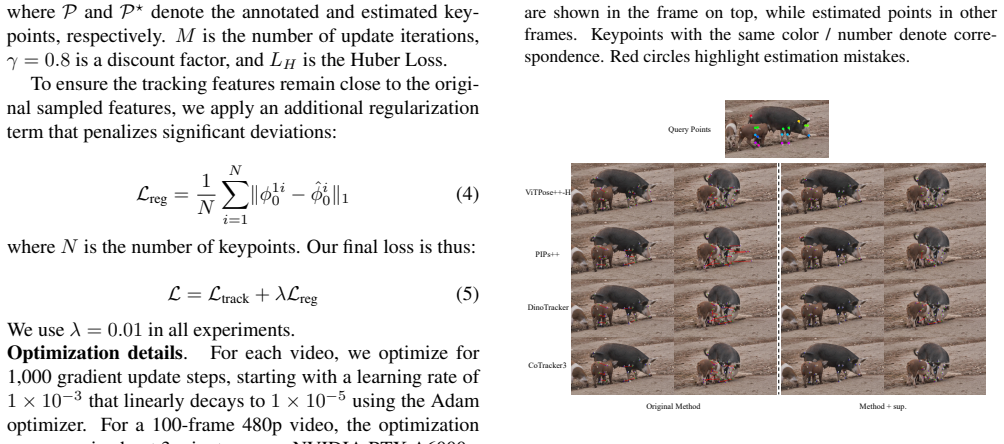
The load-bearing mechanism is the optimizable query-point appearance embedding $\hat\phi_0$ inside CoTracker3, a pre-trained general-purpose point tracker. The tracker represents each point by local-neighborhood features and refines tracks through iterative correlation with those features; the paper replaces the fixed first-frame query features with an average of features from the first frame and all annotated frames, then treats that embedding as the only trainable parameter at test time. Correlation features are recomputed as $\mathrm{MLP}(\langle \hat\phi_0, \phi_t^s \rangle)$ across multiple scales, and the loss combines a Huber tracking term with an $\ell^1$ regularization term that keeps the embedding close to the original appearance features. This isolates instance-specific appearance from shared temporal knowledge, and the ablation shows that fine-tuning this embedding alone beats fine-tuning the feature extractor or all components.
What would settle it
Apply the method to an animal morphology or motion regime outside the two tested domains—for example an octopus arm or a bat in flight—with a few manually labeled frames, and compare its δ_avg against off-the-shelf tracking and against a variant that also fine-tunes the correlation or update modules. If appearance-only optimization no longer wins, the claim that shared temporal knowledge suffices is falsified.
Extended reading notes
Core claim
The central claim is that a general-purpose point tracker becomes a reliable animal pose labeler when one component is optimized per video: the query-point appearance embedding, which describes what each keypoint looks like. The tracker already knows how points move, so the paper initializes the embedding from the first frame and all annotated frames, then fits it with a Huber tracking loss plus a small regularization toward the original features. The feature extractor, correlation module, and iterative update transformer are all kept fixed. On DAVIS-Animals this reaches a δ_avg of 67.53, and on DeepFly3D a δ_avg of 70.80, ahead of baselines used out of the box or fine-tuned with the same supervision, while also giving the lowest masked-jitter score. The paper thus establishes per-video test-time optimization as a workable substitute for large cross-species pose training sets.
Load-bearing premise
The load-bearing premise is that the temporal tracking knowledge in the pre-trained point tracker transfers across animal species and motion styles without adaptation, so that optimizing only the appearance embedding of each query keypoint is enough to track it accurately.
Editorial extensions
If this is right
- A researcher with new animal video needs only a handful of manually labeled frames; the method then labels every remaining frame, removing the need to collect or train on a large species-specific dataset.
- The same optimization recipe works across morphologies as different as quadrupeds and tethered fruit flies, evidence that test-time adaptation can substitute for cross-species training.
- Accuracy and annotation cost trade directly against each other, with reported accuracy rising as the annotated-frame interval shrinks, so users can tune cost to the needs of their behavior study.
- When Kalman filtering is added as post-processing, all methods improve on accuracy and jitter, and the paper's per-video appearance adaptation still leads on both metrics.
- Because the loss supervises occluded and visible tracks alike, the pipeline can be used for dense behavioral quantification where keypoints disappear and reappear, not just for clearly visible joints.
Reading between the lines
- The appearance-versus-temporal split is not obviously animal-specific; the same recipe could be tested on other articulated or deformable objects, such as robot hands or surgical tools, where a user supplies a few keypoints and the tracker supplies the temporal prior.
- The pseudo-label ablation, which drops δ_avg from 67.53 with manual labels to 51.17 with detector-generated labels, suggests an untested active-labeling loop: run the tracker, ask the user to correct only low-confidence or high-jitter frames, then re-optimize the appearance embedding.
- The masked-jitter metric penalizes stationary background points that make raw jitter look artificially low, so a stronger trajectory-level smoothness prior, applied after or during optimization, is a natural next step that the paper's Kalman-filter experiment only begins to explore.
Editorial analysis
A structured set of objections, weighed in public.
Referee Report
Summary. The paper proposes a test-time optimization method for animal pose labeling. Given a video and sparse keypoint annotations from a human or a pose detector, the method fine-tunes only the query-point appearance embedding of a frozen CoTracker3 point tracker, keeping the feature extractor, correlation MLP, and transformer update modules fixed. The optimized embedding is then used to track keypoints in all frames. Experiments on a new DAVIS-Animals dataset (quadrupeds) and on DeepFly3D (tethered flies) show that the method outperforms out-of-the-box point trackers, fine-tuned baselines, and pose estimators, with ablations on which components to fine-tune, annotation density, annotation strategies, and pseudo-labels.
Significance. The paper's central hypothesis—that temporal tracking knowledge can be shared across animal species while appearance information is instance-specific—is appealing and the experiments provide initial evidence in its favor. The method is simple, computationally efficient (about 3 minutes per video), and achieves state-of-the-art results on two very different domains, which is a meaningful empirical contribution. The ablation in Table 2 is informative, and the additional long-duration, fast-motion, and Kalman-filter experiments strengthen the practical claims. If the results are statistically robust and the dataset is fully documented, this could be a valuable tool for animal behavior analysis. However, the broad claim that the method applies 'to any video of interest' is not fully supported by the two tested domains, and the lack of error bars makes the reported gaps against baselines difficult to assess.
major comments (4)
- [Section 3 (Datasets)] The DAVIS-Animals dataset is central to the evaluation, but the manuscript provides virtually no documentation of its construction. The authors state only that they sampled 15 videos from DAVIS and manually annotated them following the ViTPose keypoint definition; they do not specify the number of keypoints per animal, the annotation instructions, the quality-control procedure, or inter-annotator agreement. Without this information, the reported numbers on this dataset cannot be reproduced or interpreted. Please provide a full description of the annotation protocol and, ideally, release the annotations.
- [Section 2.2, Eqs. (1)-(2)] Equation (1) defines the optimized query embedding \hat{\phi}_0 as an average of features \phi^1_t at scale 1 only, while Eq. (2) computes correlations \langle \hat{\phi}_0, \phi^s_t \rangle for all scales s=1,...,S. It is unclear whether \hat{\phi}_0 is intended to be a multi-scale vector (i.e., an average computed per scale) or whether only scale-1 features participate in the correlation. This ambiguity directly affects the method's implementation and reproducibility; the notation must specify how features at scales s>1 are initialized and optimized.
- [Section 3.1, Table 1] The main quantitative results are reported as single numbers with no error bars, confidence intervals, or per-video variance, despite using only 15 videos per dataset. The improvement over the strongest baseline is 3-4 points in δ_avg, and without any measure of variance it is impossible to assess whether this difference is statistically reliable. The authors should report the standard deviation across videos, a per-video breakdown, or results from multiple optimization runs, especially because the optimization involves stochastic gradient updates.
- [Section 2.2 and Section 1] The paper's central claim is that 'we can share the knowledge of temporal tracking across all instances, while the unique knowledge we need in each example lies in appearance,' and this motivates the claim that the method can be 'directly applied to any video of interest.' The ablation in Table 2 supports the choice of optimizing only the query embedding on DAVIS-Animals, but no component ablation is reported for DeepFly3D, and no third domain is tested. If the frozen correlation and update components of CoTracker3 do not transfer to other morphologies (e.g., fish, birds, or invertebrates), the 'general-purpose' assertion would be too strong. Please either add a third-domain ablation or explicitly qualify the claim to the tested domains.
minor comments (7)
- [Section 2.1] The text refers to 'CoTracker3 [7]' in the first mention and later to '[8]' for the same model; please ensure a consistent citation (reference [7] is the earlier CoTracker paper, [8] is CoTracker3).
- [Section 2.2, Eq. (4)] The notation \phi^{1i}_0 is not defined; please clarify whether i indexes keypoints and 1 indicates scale, and use a consistent superscript/subscript convention throughout.
- [Section 3.1] The masked jittering metric J_masked assigns a weight of 10 to incorrect points without justification; please motivate this choice or report per-threshold metrics that do not require an arbitrary weighting factor.
- [Section 1, footnote 1] The introduction's statement of 81.6% accuracy with 6 annotated frames for a 60-frame video is not tied to a specific experiment in Section 3; please specify the dataset, annotation interval, and number of videos used for this number.
- [Section 3] The descriptions of fine-tuning for the baselines (PIPs++, DINO-Tracker, ViTPose++-H, SuperAnimal) do not provide optimization details such as learning rate, number of steps, or loss weights; please include these details to ensure the comparison is fair.
- [Supplementary Section B] The long-duration and fast-motion results are presented only as figures; please provide the numerical values in tables for precise comparison.
- [General] The paper mentions a project webpage but does not link to code or the DAVIS-Animals annotations; releasing the code and the new dataset would substantially improve reproducibility.
Circularity Check
No circularity: the test-time optimization is evaluated on held-out frames, and the only self-citation is non-load-bearing.
full rationale
The paper's derivation chain is a legitimate test-time optimization protocol. Equation 1 initializes the query appearance embedding \(\hat{\phi}_0\) from the annotated frames, and Equations 3–5 define a supervised tracking loss plus a fixed regularization (\(\lambda=0.01\), \(\gamma=0.8\)). The optimized embedding is then used with the frozen CoTracker3 components to track the remaining frames. The evaluation explicitly uses disjoint frames: Section 3.1 states the method and baselines are trained on frames 0, 10, ... and tested on frames 5, 15, ..., so the reported \(\delta_{\text{avg}}\) and 4-pixel accuracy are not fitting targets. Hyperparameters are fixed across experiments and not tuned per dataset to maximize the reported metric. The only self-citation is [18] (PointOdyssey / PIPs++), which is used as a baseline and for the image-resizing convention; it is not load-bearing for the central claim. The claim that temporal-tracking knowledge transfers across animal species is an empirical assumption, not a derivation, and is supported by the ablation in Table 2 on DAVIS-Animals; the lack of a third domain is an external-validity concern, not circularity. No prediction in the paper reduces by construction to its input.
Assumptions & free parameters
free parameters (4)
- λ (regularization weight) =
0.01
- γ (loss discount factor) =
0.8
- optimization steps =
1000
- learning rate schedule =
1e-3 to 1e-5
assumptions (2)
- domain assumption CoTracker3's temporal tracking knowledge transfers across animal species and video domains.
- domain assumption Sparse annotated frames provide enough signal to optimize the appearance embedding without overfitting to the annotated frames.
Cite this review
Pith. "Pith review of Animal Pose Labeling Using General-Purpose Point Trackers." pith.science (2026). https://pith.science/paper/NVAFJWJB
@misc{pith2026250603868,
  author       = {Pith},
  title        = {Pith review of: Animal Pose Labeling Using General-Purpose Point Trackers},
  year         = {2026},
  howpublished = {\url{https://pith.science/paper/NVAFJWJB}},
  note         = {Machine review of arXiv:2506.03868}
}
read the original abstract
Automatically estimating animal poses from videos is important for studying animal behaviors. Existing methods do not perform reliably since they are trained on datasets that are not comprehensive enough to capture all necessary animal behaviors. However, it is very challenging to collect such datasets due to the large variations in animal morphology. In this paper, we propose an animal pose labeling pipeline that follows a different strategy, i.e. test time optimization. Given a video, we fine-tune a lightweight appearance embedding inside a pre-trained general-purpose point tracker on a sparse set of annotated frames. These annotations can be obtained from human labelers or off-the-shelf pose detectors. The fine-tuned model is then applied to the rest of the frames for automatic labeling. Our method achieves state-of-the-art performance at a reasonable annotation cost. We believe our pipeline offers a valuable tool for the automatic quantification of animal behavior. Visit our project webpage at https://zhuoyang-pan.github.io/animal-labeling.
Figures


Figures from the paper (5 more)


Forward citations
Cited by 1 Pith paper
-
Promptable Animal Pose Tracking Across Species
A promptable framework using frozen foundation-model features achieves competitive keypoint tracking accuracy and cross-species generalization on animal video benchmarks, with supervised and unsupervised variants.
Reference graph
Works this paper leans on
-
[1]
Creatures great and SMAL: Recovering the shape and motion of animals from video
Benjamin Biggs, Thomas Roddick, Andrew Fitzgibbon, and Roberto Cipolla. Creatures great and SMAL: Recovering the shape and motion of animals from video. InACCV, 2018. 3
work page 2018
-
[2]
Z. Cao, G. Hidalgo Martinez, T. Simon, S. Wei, and Y . A. Sheikh. Openpose: Realtime multi-person 2d pose estima- tion using part affinity fields.IEEE Transactions on Pattern Analysis and Machine Intelligence, 2019. 1
work page 2019
-
[3]
Carl Doersch, Ankush Gupta, Larisa Markeeva, Adria Re- casens, Lucas Smaira, Yusuf Aytar, Joao Carreira, Andrew Zisserman, and Yi Yang. Tap-vid: A benchmark for track- ing any point in a video.Advances in Neural Information Processing Systems, 35:13610–13626, 2022. 2, 3
work page 2022
-
[4]
Humans in 4d: Re- constructing and tracking humans with transformers
Shubham Goel, Georgios Pavlakos, Jathushan Rajasegaran, Angjoo Kanazawa, and Jitendra Malik. Humans in 4d: Re- constructing and tracking humans with transformers. In Proceedings of the IEEE/CVF International Conference on Computer Vision, pages 14783–14794, 2023. 1
work page 2023
-
[5]
Jacob M Graving, Daniel Chae, Hemal Naik, Liang Li, Ben- jamin Koger, Blair R Costelloe, and Iain D Couzin. Deep- posekit, a software toolkit for fast and robust animal pose estimation using deep learning.Elife, 8:e47994, 2019. 1
work page 2019
-
[6]
Semih G ¨unel, Helge Rhodin, Daniel Morales, Jo˜ao Campag- nolo, Pavan Ramdya, and Pascal Fua. Deepfly3d, a deep learning-based approach for 3d limb and appendage tracking in tethered, adult drosophila.Elife, 8:e48571, 2019. 1, 3
work page 2019
-
[7]
Co- tracker: It is better to track together.arXiv preprint arXiv:2307.07635, 2023
Nikita Karaev, Ignacio Rocco, Benjamin Graham, Natalia Neverova, Andrea Vedaldi, and Christian Rupprecht. Co- tracker: It is better to track together.arXiv preprint arXiv:2307.07635, 2023. 2
arXiv 2023
-
[8]
Nikita Karaev, Iurii Makarov, Jianyuan Wang, Natalia Neverova, Andrea Vedaldi, and Christian Rupprecht. Co- tracker3: Simpler and better point tracking by pseudo- labelling real videos.arXiv preprint arXiv:2410.11831,
Show all 18 references
-
[9]
Multi-animal pose estimation, identification and track- ing with deeplabcut.Nature Methods, 19(4):496–504, 2022
Jessy Lauer, Mu Zhou, Shaokai Ye, William Menegas, Stef- fen Schneider, Tanmay Nath, Mohammed Mostafizur Rah- man, Valentina Di Santo, Daniel Soberanes, Guoping Feng, et al. Multi-animal pose estimation, identification and track- ing with deeplabcut.Nature Methods, 19(4):496–5...
2022
-
[10]
Deeplabcut: markerless pose estima- tion of user-defined body parts with deep learning.Nature neuroscience, 21(9):1281–1289, 2018
Alexander Mathis, Pranav Mamidanna, Kevin M Cury, Taiga Abe, Venkatesh N Murthy, Mackenzie Weygandt Mathis, and Matthias Bethge. Deeplabcut: markerless pose estima- tion of user-defined body parts with deep learning.Nature neuroscience, 21(9):1281–1289, 2018. 1
2018
-
[11]
Using deeplabcut for 3d markerless pose estimation across species and behaviors.Nature protocols, 14(7):2152–2176, 2019
Tanmay Nath, Alexander Mathis, An Chi Chen, Amir Patel, Matthias Bethge, and Mackenzie Weygandt Mathis. Using deeplabcut for 3d markerless pose estimation across species and behaviors.Nature protocols, 14(7):2152–2176, 2019
2019
-
[12]
Fast animal pose estimation using deep neural networks.Nature methods, 16(1):117–125, 2019
Talmo D Pereira, Diego E Aldarondo, Lindsay Willmore, Mikhail Kislin, Samuel S-H Wang, Mala Murthy, and Joshua W Shaevitz. Fast animal pose estimation using deep neural networks.Nature methods, 16(1):117–125, 2019. 1
2019
-
[13]
The 2017 davis challenge on video object segmentation.arXiv preprint arXiv:1704.00675, 2017
Jordi Pont-Tuset, Federico Perazzi, Sergi Caelles, Pablo Ar- bel´aez, Alex Sorkine-Hornung, and Luc Van Gool. The 2017 davis challenge on video object segmentation.arXiv preprint arXiv:1704.00675, 2017. 3
2017 arXiv
-
[14]
Dino-tracker: Taming dino for self-supervised point track- ing in a single video
Narek Tumanyan, Assaf Singer, Shai Bagon, and Tali Dekel. Dino-tracker: Taming dino for self-supervised point track- ing in a single video. InEuropean Conference on Computer Vision, pages 367–385. Springer, 2025. 4
2025
-
[15]
Vit- pose: Simple vision transformer baselines for human pose estimation.Advances in Neural Information Processing Sys- tems, 35:38571–38584, 2022
Yufei Xu, Jing Zhang, Qiming Zhang, and Dacheng Tao. Vit- pose: Simple vision transformer baselines for human pose estimation.Advances in Neural Information Processing Sys- tems, 35:38571–38584, 2022. 1, 3, 4, 2
2022
-
[16]
Apt-36k: A large-scale benchmark for animal pose estimation and tracking.Advances in Neural Information Processing Systems, 35:17301–17313, 2022
Yuxiang Yang, Junjie Yang, Yufei Xu, Jing Zhang, Long Lan, and Dacheng Tao. Apt-36k: A large-scale benchmark for animal pose estimation and tracking.Advances in Neural Information Processing Systems, 35:17301–17313, 2022. 3
2022
-
[17]
Superanimal pretrained pose estimation models for behavioral analysis.Nature Commu- nications, 15(1):5165, 2024
Shaokai Ye, Anastasiia Filippova, Jessy Lauer, Steffen Schneider, Maxime Vidal, Tian Qiu, Alexander Mathis, and Mackenzie Weygandt Mathis. Superanimal pretrained pose estimation models for behavioral analysis.Nature Commu- nications, 15(1):5165, 2024. 1, 3, 4, 2
2024
-
[18]
Pointodyssey: A large-scale synthetic dataset for long-term point tracking
Yang Zheng, Adam W Harley, Bokui Shen, Gordon Wet- zstein, and Leonidas J Guibas. Pointodyssey: A large-scale synthetic dataset for long-term point tracking. InProceed- ings of the IEEE/CVF International Conference on Com- puter Vision, pages 19855–19865, 2023. 3, 4 Animal Pos...
2023
Reviewed August 7, 2026 · model on record in the stance chip above.
Discussion (0). Sign in to comment.