REVIEW 3 major objections 6 minor 55 references
Joint Video Enhancement with Deblurring, Super-Resolution, and Frame Interpolation Network
T0 review · 3 major / 6 minor · reviewed 2026-08-07 · deepseek-v4-flash
Pith's one-line read This paper proposes DSFN, a single network that performs video deblurring, super-resolution, and frame interpolation at the same time, and reports higher PSNR and SSIM than sequential combinations of state-of-the-art methods on Adobe240…
desk verdict A genuinely new three-task joint video enhancement network with a real runtime win, but the headline superiority claim rests on an uneven baseline comparison. read the letter →
The pith
A machine-rendered reading of the paper's core claim, the machinery that carries it, and where it could break.
The reading
What carries the argument
The load-bearing mechanism is the shared feature representation produced by the encoder, which feeds both the JDSR module and the TFBFI module. JDSR performs deblurring and 4x up-scaling jointly in the channel dimension, with the high-resolution image produced only at the end by a periodic shuffling operation; TFBFI estimates two offset fields from three consecutive keyframes and applies deformable convolution to warp the restored central feature map into the two intermediate frames. The two-level cascade refines the enhanced feature maps rather than increasing network width, and a loss applied to the intermediate outputs of the first level improves learning.
What would settle it
Retrain all sequential baselines on the same Adobe240 training data and augmentation used for DSFN, then compare PSNR and SSIM on the 4x enhanced videos of the Adobe240 and GOPRO test sets; if a retrained pipeline matches or exceeds DSFN's 29.427 dB and 28.254 dB, the claimed superiority of joint modeling would be refuted.
Extended reading notes
Core claim
The central claim is that the three video restoration tasks are better solved as one integrated problem. DSFN combines a joint deblurring and super-resolution (JDSR) module, which restores a deblurred, up-scaled feature map of the central frame directly from an encoder's shared feature representation, with a triple-frame-based frame interpolation (TFBFI) module, which predicts two offset fields and uses deformable convolution to warp the restored feature map into two intermediate frames. Two cascaded DSFN stages, sharing parameters within each level, refine the outputs. The authors report that this joint approach outperforms sequential combinations of state-of-the-art methods, for example 29.427 dB PSNR versus 27.839 dB for the best sequential pipeline on Adobe240 and 28.254 dB versus 27.596 dB on GOPRO, with a smaller network and a processing time of about 0.02 seconds per frame, because all operations run on feature maps at the input scale.
Load-bearing premise
The comparison assumes the sequential baselines were evaluated fairly: only the CDVD and STFAN deblurring networks were retrained on the Adobe240 training set, while STAR, Zooming-SloMo, RBPN, AdaCoF, Super-SloMo, and BIN were used with their original pre-trained weights, so the reported advantage depends on that protocol.
Editorial extensions
If this is right
- A single DSFN can replace a three-stage pipeline, so the error accumulation that hurt sequential methods is avoided entirely.
- The joint approach reaches higher PSNR and SSIM than the sequential baselines on both Adobe240 and GOPRO, including on intermediate frames where leftover blur previously degraded interpolation.
- The 0.02 s/frame runtime and 10.9 million parameters make the method practical for applications where three separate models would be too slow.
- Combining the modules in one network means the deblurred and up-scaled features are directly reused for interpolation, which is why the intermediate frames no longer lose quality relative to the keyframes.
Reading between the lines
- A fairer comparison would retrain every baseline on the same Adobe240 training splits with identical degradation and augmentation; the reported margin might narrow, but the qualitative point that joint modeling avoids intermediate-frame quality collapse would likely remain.
- The two-offset-field design and shared encoder could be adapted to arbitrary-frame interpolation, producing more than two intermediate frames from the same three keyframes by predicting additional offset fields.
- The same joint-training principle should extend to other combinations of degradations, such as blur plus compression artifacts plus noise, where interferences between tasks are even stronger.
- Because the paper's real-blurry-dataset demonstration is qualitative only, a quantitative evaluation on real degraded footage with reference frames would be a natural next test of the claim.
Editorial analysis
A structured set of objections, weighed in public.
Referee Report
Summary. The paper proposes DSFN, a joint video enhancement network that simultaneously performs video deblurring, 4x super-resolution, and frame interpolation on low-resolution, low-frame-rate, blurry videos. The architecture contains an encoder, a joint deblurring and super-resolution (JDSR) module, a triple-frame-based frame interpolation (TFBFI) module, and a decoder, arranged in a two-level structure with shared parameters between levels. The network is trained end-to-end on Adobe240 using an L1 loss applied to both the first-level and final outputs. Experiments compare DSFN against several sequential pipelines built from existing methods (e.g., CDVD+STAR, STFAN+Zooming-SloMo, BIN+RBPN) on Adobe240 and GOPRO, reporting PSNR/SSIM, parameter counts, and runtime. The paper's central claim is that the joint formulation outperforms the sequential state of the art while being smaller and faster.
Significance. If the reported comparison is fair, the paper would make a useful contribution: joint multi-factor video enhancement is a practically important but under-explored problem, and the proposed architecture is comparatively lightweight (10.9M parameters, 0.02 s/frame) and produces plausible qualitative results including on a real blurry dataset. The paper clearly formulates the integrated enhancement task and provides a specific network design, with quantitative results on two public datasets. However, the significance is currently conditional on the evaluation protocol, because several baselines are not trained under the same degradation model as the proposed method.
major comments (3)
- [Section 5, first paragraph and Tables 1-2] The comparison is not balanced. The manuscript states that only CDVD and STFAN were re-trained on the Adobe240 training set, while STAR, Zooming-SloMo, RBPN, AdaCoF, Super-SloMo, and BIN were used with their original pre-trained weights. The proposed DSFN, in contrast, is trained end-to-end on Adobe240 with the same 11-frame accumulation, 30 fps temporal downsampling, and 4x bicubic downsampling used at test time. This means the proposed method is directly adapted to the exact degradation distribution, whereas most baseline components face a domain shift from their original training data. The reported margins in Tables 1 and 2 (e.g., 29.427 vs. 27.839 PSNR on Adobe240; 28.254 vs. 27.596 on GOPRO for the best sequential pipeline) could narrow substantially or disappear if all baseline modules were retrained and the sequential pipelines were tuned on the same protocol. This is the load-bearing weakness in the headline claim that the proposed method 'outperforms other sequential state-of-the-art techniques.' The authors should either retrain all baselines under the same protocol, fine-tune them on Adobe240, or provide a clearly justified alternative such as using checkpoints that are known to generalize to this setting.
- [Tables 1-2 and Section 5.1] No error bars, confidence intervals, or paired significance tests are reported. The performance numbers are averaged over the test sets, but the gap on GOPRO between the proposed method (28.254) and BIN+RBPN (27.596) is about 0.66 dB, and the per-sequence variance could be large. Without statistical testing or at least reporting per-sequence results, it is impossible to judge whether the observed advantage reflects a real improvement of the joint model or is within the noise of the evaluation. The authors should add standard deviations, per-sequence scatter plots, or paired tests (e.g., Wilcoxon signed-rank) across test sequences.
- [Sections 3.7 and 5.1.1-5.1.2] The claimed effectiveness of the individual modules and of the two-level design is not backed by ablation studies. Section 5.1.1 attributes the 'Deblurred and up-scaled' column to the JDSR module and Section 5.1.2 attributes the intermediate-frame column to the TFBFI module, but these are comparisons of different output types, not controlled ablations. Similarly, Section 3.7 asserts that the multi-level architecture is more effective than simply increasing network size, but no experiment compares a one-level DSFN against the two-level DSFN with matched total parameters and compute. Adding such ablations would substantiate the architectural claims and help isolate the source of the improvement.
minor comments (6)
- [Section 3.7] Typo: 'duplicated frames frames' should read 'duplicated frames'.
- [Introduction] Typo: 'In other word' should be 'In other words'.
- [Section 4.3 and Table 3] The runtime in Table 3 is reported as seconds per frame but the hardware, batch size, and input resolution used for timing are not described beyond the general GPU model. Please specify these conditions to make the efficiency claim reproducible.
- [Equation (12)] The loss coefficients 1/5 and 1/3 are defined implicitly by the size of Ω1 and Ω2, but the reader must infer this. It would be clearer to explicitly state that Ω1 contains 5 indices and Ω2 contains 3, and to note that the scaling by 1/5 and 1/3 is a weighting, not a normalization by number of frames.
- [Section 5.4] The visualization of offset fields averages nine offset values per location to resemble optical flow. This is a useful sanity check, but it may hide the structure of the deformable offsets; consider also showing the raw offset fields or a clearer description of how the averaging is performed.
- [General] The manuscript does not mention plans to release code, trained models, or the exact evaluation scripts. Given that the main claim depends on a fair comparison protocol, releasing the retrained baselines and the evaluation pipeline would greatly increase reproducibility.
Circularity Check
No circularity: the network is trained end-to-end on data and evaluated on held-out frames; no fitted formula or self-citation is presented as a derivation.
full rationale
The paper is an empirical deep-learning system. Its stated goal is to learn a joint deblurring, super-resolution, and frame-interpolation mapping from low-quality to high-quality video, optimized by the MAE loss in Eq. (12) on Adobe240 training data. The architecture components (encoder Eqs. (2)-(3), JDSR Eq. (4), TFBFI Eqs. (5)-(6), decoder Eqs. (7)-(8), and periodic shuffling Eq. (11)) are all learned modules trained against ground-truth frames; no output is defined in terms of itself, and no fitted parameter is later relabeled as a prediction. The only self-citation is reference [35], a related-work citation for conventional frame-rate up-conversion, and it is not load-bearing for any claimed result. The comparison protocol does give the proposed method a training-distribution advantage because most sequential baselines use original pretrained weights while DSFN is trained on the same degradation used at test time; however, this is a fairness and soundness concern about the empirical comparison, not circular reasoning. No circular step can be exhibited from the paper's equations or citations, so the circularity score is 0.
Assumptions & free parameters
free parameters (5)
- blur synthesis window =
11 frames
- random noise sigma =
0.01
- upscaling factor =
4
- loss weights =
1/5 for level 1, 1/3 for level 2
- number of levels =
2
assumptions (4)
- domain assumption Accumulating 11 frames at 240fps produces realistic motion blur equivalent to a 30fps blurry video.
- domain assumption Bicubic downsampling is an adequate model for low-resolution video acquisition.
- domain assumption Deformable convolution with estimated offset fields can represent the motion needed for frame interpolation.
- standard math Standard backpropagation and Adam optimization will find parameters minimizing the L1 loss.
Cite this review
Pith. "Pith review of Joint Video Enhancement with Deblurring, Super-Resolution, and Frame Interpolation Network." pith.science (2026). https://pith.science/paper/2ZZTHO6O
@misc{pith2026250603892,
  author       = {Pith},
  title        = {Pith review of: Joint Video Enhancement with Deblurring, Super-Resolution, and Frame Interpolation Network},
  year         = {2026},
  howpublished = {\url{https://pith.science/paper/2ZZTHO6O}},
  note         = {Machine review of arXiv:2506.03892}
}
read the original abstract
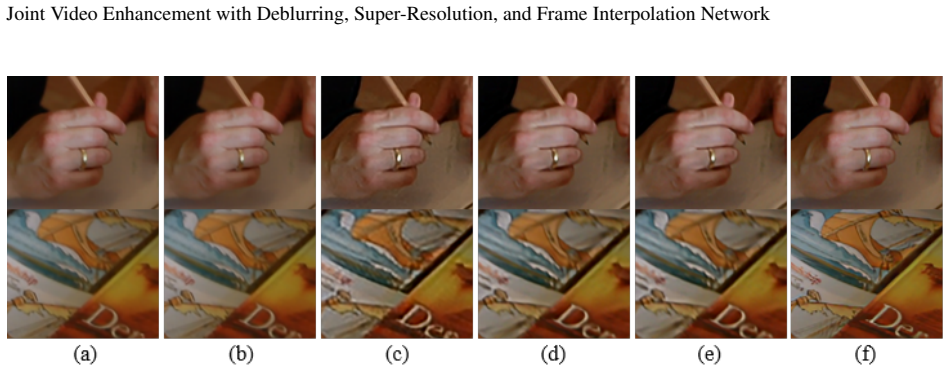
Video quality is often severely degraded by multiple factors rather than a single factor. These low-quality videos can be restored to high-quality videos by sequentially performing appropriate video enhancement techniques. However, the sequential approach was inefficient and sub-optimal because most video enhancement approaches were designed without taking into account that multiple factors together degrade video quality. In this paper, we propose a new joint video enhancement method that mitigates multiple degradation factors simultaneously by resolving an integrated enhancement problem. Our proposed network, named DSFN, directly produces a high-resolution, high-frame-rate, and clear video from a low-resolution, low-frame-rate, and blurry video. In the DSFN, low-resolution and blurry input frames are enhanced by a joint deblurring and super-resolution (JDSR) module. Meanwhile, intermediate frames between input adjacent frames are interpolated by a triple-frame-based frame interpolation (TFBFI) module. The proper combination of the proposed modules of DSFN can achieve superior performance on the joint video enhancement task. Experimental results show that the proposed method outperforms other sequential state-of-the-art techniques on public datasets with a smaller network size and faster processing time.
Figures


Figures from the paper (6 more)


Reference graph
Works this paper leans on
-
[1]
Recurrent back-projection network for video super-resolution
Muhammad Haris, Gregory Shakhnarovich, and Norimichi Ukita. Recurrent back-projection network for video super-resolution. InProceedings of the IEEE Conference on Computer Vision and Pattern Recognition, pages 3897–3906, 2019
work page 2019
-
[2]
Video super-resolution via deep draft-ensemble learning
Renjie Liao, Xin Tao, Ruiyu Li, Ziyang Ma, and Jiaya Jia. Video super-resolution via deep draft-ensemble learning. InProceedings of the IEEE International Conference on Computer Vision, pages 531–539, 2015
work page 2015
-
[3]
Deep video super-resolution network using dynamic upsampling filters without explicit motion compensation
Younghyun Jo, Seoung Wug Oh, Jaeyeon Kang, and Seon Joo Kim. Deep video super-resolution network using dynamic upsampling filters without explicit motion compensation. InProceedings of the IEEE conference on computer vision and pattern recognition, pages 3224–3232, 2018
2018
-
[4]
Armin Kappeler, Seunghwan Yoo, Qiqin Dai, and Aggelos K Katsaggelos. Video super-resolution with convolu- tional neural networks.IEEE Transactions on Computational Imaging, 2(2):109–122, 2016
work page 2016
-
[5]
Real-time video super-resolution with spatio-temporal networks and motion compensation
Jose Caballero, Christian Ledig, Andrew Aitken, Alejandro Acosta, Johannes Totz, Zehan Wang, and Wenzhe Shi. Real-time video super-resolution with spatio-temporal networks and motion compensation. InProceedings of the IEEE Conference on Computer Vision and Pattern Recognition, pages 4778–4787, 2017
work page 2017
-
[6]
Video frame interpolation via adaptive convolution
Simon Niklaus, Long Mai, and Feng Liu. Video frame interpolation via adaptive convolution. InProceedings of the IEEE Conference on Computer Vision and Pattern Recognition, pages 670–679, 2017
work page 2017
-
[7]
Video frame interpolation via adaptive separable convolution
Simon Niklaus, Long Mai, and Feng Liu. Video frame interpolation via adaptive separable convolution. In Proceedings of the IEEE International Conference on Computer Vision, pages 261–270, 2017
work page 2017
-
[8]
Context-aware synthesis for video frame interpolation
Simon Niklaus and Feng Liu. Context-aware synthesis for video frame interpolation. InProceedings of the IEEE Conference on Computer Vision and Pattern Recognition, pages 1701–1710, 2018
work page 2018
Show all 55 references
-
[9]
Depth-aware video frame interpolation
Wenbo Bao, Wei-Sheng Lai, Chao Ma, Xiaoyun Zhang, Zhiyong Gao, and Ming-Hsuan Yang. Depth-aware video frame interpolation. InProceedings of the IEEE Conference on Computer Vision and Pattern Recognition, pages 3703–3712, 2019
2019
-
[10]
Spatio-temporal filter adaptive network for video deblurring
Shangchen Zhou, Jiawei Zhang, Jinshan Pan, Haozhe Xie, Wangmeng Zuo, and Jimmy Ren. Spatio-temporal filter adaptive network for video deblurring. InProceedings of the IEEE International Conference on Computer Vision, pages 2482–2491, 2019
2019
-
[11]
Edvr: Video restoration with enhanced deformable convolutional networks
Xintao Wang, Kelvin CK Chan, Ke Yu, Chao Dong, and Chen Change Loy. Edvr: Video restoration with enhanced deformable convolutional networks. InProceedings of the IEEE Conference on Computer Vision and Pattern Recognition Workshops, pages 0–0, 2019
2019
-
[12]
Cascaded deep video deblurring using temporal sharpness prior
Jinshan Pan, Haoran Bai, and Jinhui Tang. Cascaded deep video deblurring using temporal sharpness prior. In Proceedings of the IEEE/CVF Conference on Computer Vision and Pattern Recognition, pages 3043–3051, 2020. 12 Joint Video Enhancement with Deblurring, Super-Resolution, a...
2020
-
[13]
Blurry video frame interpolation
Wang Shen, Wenbo Bao, Guangtao Zhai, Li Chen, Xiongkuo Min, and Zhiyong Gao. Blurry video frame interpolation. InProceedings of the IEEE/CVF Conference on Computer Vision and Pattern Recognition, pages 5114–5123, 2020
2020
-
[14]
Space-time-aware multi-resolution video en- hancement
Muhammad Haris, Greg Shakhnarovich, and Norimichi Ukita. Space-time-aware multi-resolution video en- hancement. InProceedings of the IEEE/CVF Conference on Computer Vision and Pattern Recognition, pages 2859–2868, 2020
2020
-
[15]
Zooming slow-mo: Fast and accurate one-stage space-time video super-resolution
Xiaoyu Xiang, Yapeng Tian, Yulun Zhang, Yun Fu, Jan P Allebach, and Chenliang Xu. Zooming slow-mo: Fast and accurate one-stage space-time video super-resolution. InProceedings of the IEEE/CVF Conference on Computer Vision and Pattern Recognition, pages 3370–3379, 2020
2020
-
[16]
Video deblurring for hand-held cameras using patch-based synthesis.ACM Transactions on Graphics (TOG), 31(4):1–9, 2012
Sunghyun Cho, Jue Wang, and Seungyong Lee. Video deblurring for hand-held cameras using patch-based synthesis.ACM Transactions on Graphics (TOG), 31(4):1–9, 2012
2012
-
[17]
Deep video deblurring for hand-held cameras
Shuochen Su, Mauricio Delbracio, Jue Wang, Guillermo Sapiro, Wolfgang Heidrich, and Oliver Wang. Deep video deblurring for hand-held cameras. InProceedings of the IEEE Conference on Computer Vision and Pattern Recognition, pages 1279–1288, 2017
2017
-
[18]
Deep multi-scale convolutional neural network for dynamic scene deblurring
Seungjun Nah, Tae Hyun Kim, and Kyoung Mu Lee. Deep multi-scale convolutional neural network for dynamic scene deblurring. InThe IEEE Conference on Computer Vision and Pattern Recognition (CVPR), July 2017
2017
-
[19]
Image super-resolution using deep convolutional networks.IEEE transactions on pattern analysis and machine intelligence, 38(2):295–307, 2015
Chao Dong, Chen Change Loy, Kaiming He, and Xiaoou Tang. Image super-resolution using deep convolutional networks.IEEE transactions on pattern analysis and machine intelligence, 38(2):295–307, 2015
2015
-
[20]
Accurate image super-resolution using very deep convolutional networks
Jiwon Kim, Jung Kwon Lee, and Kyoung Mu Lee. Accurate image super-resolution using very deep convolutional networks. InProceedings of the IEEE conference on computer vision and pattern recognition, pages 1646–1654, 2016
2016
-
[21]
Enhanced deep residual networks for single image super-resolution
Bee Lim, Sanghyun Son, Heewon Kim, Seungjun Nah, and Kyoung Mu Lee. Enhanced deep residual networks for single image super-resolution. InProceedings of the IEEE conference on computer vision and pattern recognition workshops, pages 136–144, 2017
2017
-
[22]
Photo-realistic single image super-resolution using a generative adversarial network
Christian Ledig, Lucas Theis, Ferenc Huszár, Jose Caballero, Andrew Cunningham, Alejandro Acosta, Andrew Aitken, Alykhan Tejani, Johannes Totz, Zehan Wang, et al. Photo-realistic single image super-resolution using a generative adversarial network. InProceedings of the IEEE co...
2017
-
[23]
Real-time single image and video super-resolution using an efficient sub-pixel convolutional neural network
Wenzhe Shi, Jose Caballero, Ferenc Huszár, Johannes Totz, Andrew P Aitken, Rob Bishop, Daniel Rueckert, and Zehan Wang. Real-time single image and video super-resolution using an efficient sub-pixel convolutional neural network. InProceedings of the IEEE conference on computer...
2016
-
[24]
Bidirectional recurrent convolutional networks for multi-frame super- resolution
Yan Huang, Wei Wang, and Liang Wang. Bidirectional recurrent convolutional networks for multi-frame super- resolution. InAdvances in Neural Information Processing Systems, pages 235–243, 2015
2015
-
[25]
Detail-revealing deep video super-resolution
Xin Tao, Hongyun Gao, Renjie Liao, Jue Wang, and Jiaya Jia. Detail-revealing deep video super-resolution. In Proceedings of the IEEE International Conference on Computer Vision, pages 4472–4480, 2017
2017
-
[26]
Frame-recurrent video super-resolution
Mehdi SM Sajjadi, Raviteja Vemulapalli, and Matthew Brown. Frame-recurrent video super-resolution. In Proceedings of the IEEE Conference on Computer Vision and Pattern Recognition, pages 6626–6634, 2018
2018
-
[27]
Video super-resolution with recurrent structure-detail network
Takashi Isobe, Xu Jia, Shuhang Gu, Songjiang Li, Shengjin Wang, and Qi Tian. Video super-resolution with recurrent structure-detail network. InEuropean conference on computer vision, pages 645–660. Springer, 2020
2020
-
[28]
Efficient video super-resolution through recurrent latent space propagation
Dario Fuoli, Shuhang Gu, and Radu Timofte. Efficient video super-resolution through recurrent latent space propagation. In2019 IEEE/CVF International Conference on Computer Vision Workshop (ICCVW), pages 3476–3485. IEEE, 2019
2019
-
[29]
Basicvsr: The search for essential components in video super-resolution and beyond
Kelvin CK Chan, Xintao Wang, Ke Yu, Chao Dong, and Chen Change Loy. Basicvsr: The search for essential components in video super-resolution and beyond. InProceedings of the IEEE/CVF Conference on Computer Vision and Pattern Recognition, pages 4947–4956, 2021
2021
-
[30]
Basicvsr++: Improving video super- resolution with enhanced propagation and alignment
Kelvin CK Chan, Shangchen Zhou, Xiangyu Xu, and Chen Change Loy. Basicvsr++: Improving video super- resolution with enhanced propagation and alignment. InProceedings of the IEEE/CVF Conference on Computer Vision and Pattern Recognition, pages 5972–5981, 2022
2022
-
[31]
New frame rate up-conversion using bi-directional motion estimation.IEEE Transactions on Consumer Electronics, 46(3):603–609, 2000
Byung-Tae Choi, Sung-Hee Lee, and Sung-Jea Ko. New frame rate up-conversion using bi-directional motion estimation.IEEE Transactions on Consumer Electronics, 46(3):603–609, 2000
2000
-
[32]
Dual motion estimation for frame rate up-conversion.IEEE Transactions on Circuits and Systems for Video Technology, 20(12):1909–1914, 2010
Suk-Ju Kang, Sungjoo Yoo, and Young Hwan Kim. Dual motion estimation for frame rate up-conversion.IEEE Transactions on Circuits and Systems for Video Technology, 20(12):1909–1914, 2010. 13 Joint Video Enhancement with Deblurring, Super-Resolution, and Frame Interpolation Network
1909
-
[33]
Frame rate up-conversion using trilateral filtering.IEEE Transactions on Circuits and Systems for Video Technology, 20(6):886–893, 2010
Ci Wang, Lei Zhang, Yuwen He, and Yap-Peng Tan. Frame rate up-conversion using trilateral filtering.IEEE Transactions on Circuits and Systems for Video Technology, 20(6):886–893, 2010
2010
-
[34]
Novel true-motion estimation algorithm and its application to motion- compensated temporal frame interpolation.IEEE Transactions on Image Processing, 22(8):2931–2945, 2012
Salih Dikbas and Yucel Altunbasak. Novel true-motion estimation algorithm and its application to motion- compensated temporal frame interpolation.IEEE Transactions on Image Processing, 22(8):2931–2945, 2012
2012
-
[35]
Triple-frame-based bi-directional motion estimation for motion-compensated frame interpolation.IEEE Transactions on Circuits and Systems for Video Technology, 29(5):1251–1258, 2018
Giyong Choi, PyeongGang Heo, and HyunWook Park. Triple-frame-based bi-directional motion estimation for motion-compensated frame interpolation.IEEE Transactions on Circuits and Systems for Video Technology, 29(5):1251–1258, 2018
2018
-
[36]
Deep video frame interpolation using cyclic frame generation
Yu-Lun Liu, Yi-Tung Liao, Yen-Yu Lin, and Yung-Yu Chuang. Deep video frame interpolation using cyclic frame generation. InProceedings of the AAAI Conference on Artificial Intelligence, volume 33, pages 8794–8802, 2019
2019
-
[37]
Super slomo: High quality estimation of multiple intermediate frames for video interpolation
Huaizu Jiang, Deqing Sun, Varun Jampani, Ming-Hsuan Yang, Erik Learned-Miller, and Jan Kautz. Super slomo: High quality estimation of multiple intermediate frames for video interpolation. InProceedings of the IEEE Conference on Computer Vision and Pattern Recognition, pages 90...
2018
-
[38]
Softmax splatting for video frame interpolation
Simon Niklaus and Feng Liu. Softmax splatting for video frame interpolation. InProceedings of the IEEE/CVF Conference on Computer Vision and Pattern Recognition, pages 5437–5446, 2020
2020
-
[39]
Phasenet for video frame interpolation
Simone Meyer, Abdelaziz Djelouah, Brian McWilliams, Alexander Sorkine-Hornung, Markus Gross, and Christo- pher Schroers. Phasenet for video frame interpolation. InProceedings of the IEEE Conference on Computer Vision and Pattern Recognition, pages 498–507, 2018
2018
-
[40]
Adacof: Adaptive collaboration of flows for video frame interpolation
Hyeongmin Lee, Taeoh Kim, Tae-young Chung, Daehyun Pak, Yuseok Ban, and Sangyoun Lee. Adacof: Adaptive collaboration of flows for video frame interpolation. InProceedings of the IEEE/CVF Conference on Computer Vision and Pattern Recognition, pages 5316–5325, 2020
2020
-
[41]
Generalized video deblurring for dynamic scenes
Tae Hyun Kim and Kyoung Mu Lee. Generalized video deblurring for dynamic scenes. InProceedings of the IEEE Conference on Computer Vision and Pattern Recognition, pages 5426–5434, 2015
2015
-
[42]
Video deblurring via semantic segmentation and pixel-wise non-linear kernel
Wenqi Ren, Jinshan Pan, Xiaochun Cao, and Ming-Hsuan Yang. Video deblurring via semantic segmentation and pixel-wise non-linear kernel. InProceedings of the IEEE International Conference on Computer Vision, pages 1077–1085, 2017
2017
-
[43]
Robust multichannel blind deconvolution via fast alternating minimization
Filip Sroubek and Peyman Milanfar. Robust multichannel blind deconvolution via fast alternating minimization. IEEE Transactions on Image processing, 21(4):1687–1700, 2011
2011
-
[44]
Hand-held video deblurring via efficient fourier aggregation.IEEE Transactions on Computational Imaging, 1(4):270–283, 2015
Mauricio Delbracio and Guillermo Sapiro. Hand-held video deblurring via efficient fourier aggregation.IEEE Transactions on Computational Imaging, 1(4):270–283, 2015
2015
-
[45]
Burst deblurring: Removing camera shake through fourier burst accumulation
Mauricio Delbracio and Guillermo Sapiro. Burst deblurring: Removing camera shake through fourier burst accumulation. InProceedings of the IEEE Conference on Computer Vision and Pattern Recognition, pages 2385–2393, 2015
2015
-
[46]
Online video deblurring via dynamic temporal blending network
Tae Hyun Kim, Kyoung Mu Lee, Bernhard Scholkopf, and Michael Hirsch. Online video deblurring via dynamic temporal blending network. InProceedings of the IEEE International Conference on Computer Vision, pages 4038–4047, 2017
2017
-
[47]
Learning blind motion deblurring
Patrick Wieschollek, Michael Hirsch, Bernhard Scholkopf, and Hendrik Lensch. Learning blind motion deblurring. InProceedings of the IEEE International Conference on Computer Vision, pages 231–240, 2017
2017
-
[48]
Recurrent neural networks with intra-frame iterations for video deblurring
Seungjun Nah, Sanghyun Son, and Kyoung Mu Lee. Recurrent neural networks with intra-frame iterations for video deblurring. InProceedings of the IEEE Conference on Computer Vision and Pattern Recognition, pages 8102–8111, 2019
2019
-
[49]
Convolutional lstm network: A machine learning approach for precipitation nowcasting
SHI Xingjian, Zhourong Chen, Hao Wang, Dit-Yan Yeung, Wai-Kin Wong, and Wang-chun Woo. Convolutional lstm network: A machine learning approach for precipitation nowcasting. InAdvances in neural information processing systems, pages 802–810, 2015
2015
-
[50]
Deformable convolutional networks
Jifeng Dai, Haozhi Qi, Yuwen Xiong, Yi Li, Guodong Zhang, Han Hu, and Yichen Wei. Deformable convolutional networks. InProceedings of the IEEE international conference on computer vision, pages 764–773, 2017
2017
-
[51]
Tdan: Temporally-deformable alignment network for video super-resolution
Yapeng Tian, Yulun Zhang, Yun Fu, and Chenliang Xu. Tdan: Temporally-deformable alignment network for video super-resolution. InProceedings of the IEEE/CVF Conference on Computer Vision and Pattern Recognition, pages 3360–3369, 2020
2020
-
[52]
Deep residual learning for image recognition
Kaiming He, Xiangyu Zhang, Shaoqing Ren, and Jian Sun. Deep residual learning for image recognition. In Proceedings of the IEEE conference on computer vision and pattern recognition, pages 770–778, 2016
2016
-
[53]
Automatic differentiation in pytorch
Adam Paszke, Sam Gross, Soumith Chintala, Gregory Chanan, Edward Yang, Zachary DeVito, Zeming Lin, Alban Desmaison, Luca Antiga, and Adam Lerer. Automatic differentiation in pytorch. 2017. 14 Joint Video Enhancement with Deblurring, Super-Resolution, and Frame Interpolation Network
2017
-
[54]
Adam: A method for stochastic optimization.arXiv preprint arXiv:1412.6980, 2014
Diederik P Kingma and Jimmy Ba. Adam: A method for stochastic optimization.arXiv preprint arXiv:1412.6980, 2014
2014 arXiv
-
[55]
Liteflownet: A lightweight convolutional neural network for optical flow estimation
Tak-Wai Hui, Xiaoou Tang, and Chen Change Loy. Liteflownet: A lightweight convolutional neural network for optical flow estimation. InProceedings of the IEEE conference on computer vision and pattern recognition, pages 8981–8989, 2018. 15
2018
Reviewed August 7, 2026 · model on record in the stance chip above.
Discussion (0). Sign in to comment.