REVIEW 4 major objections 7 minor 1 cited by
Solsmith: Solidity Random Program Generator for Compiler Testing
T0 review · 4 major / 7 minor · reviewed 2026-08-07 · deepseek-v4-flash
Pith's one-line read Solsmith randomly generates valid Solidity programs that expose confirmed defects in the Solidity compiler, with four distinct bugs found in solc 0.8.0.
desk verdict A plausible new Solidity fuzzer with real bug reports, but the evaluation is thin and the consistency oracle may be unsound on evaluation order. read the letter →
The pith
A machine-rendered reading of the paper's core claim, the machinery that carries it, and where it could break.
The reading
What carries the argument
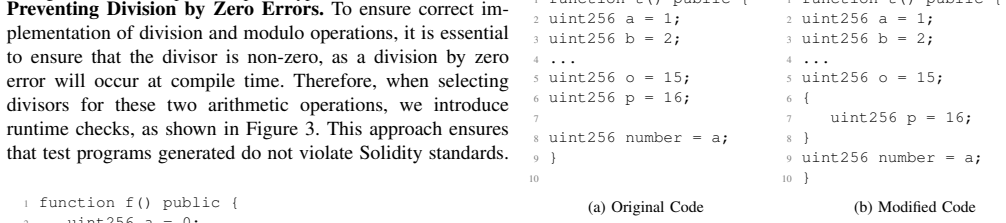
The central object is the Solsmith generator, whose mechanism is the combination of three design objectives with language-specific strategies. Consistency is achieved by avoiding the four documented Solidity undefined behaviors (inline-assembly length operations on storage arrays, function-parameter evaluation-order dependence, dangling references, and verbatim bytecode) and by suppressing behavioral differences between the old and via-IR code generators, such as repeated placeholder use and expression evaluation order. Diversity comes from a wide feature set and manually adjusted frequencies, including distorting frequencies so optimizations fire more often. Compliance is ensured by explicit type conversions, division-by-zero guards, array-bounds checks, and unchecked blocks for overflow-sensitive code. Differential testing across three solc configurations provides the oracle.
What would settle it
Re-running the four minimal reproducers on solc 0.8.0 with the stated flags and finding that a reported divergence is a documented, intended difference between the old and via-IR code generators, or that the divergence persists after the relevant compiler fix, would overturn the claim that all four are confirmed compiler defects.
Extended reading notes
Core claim
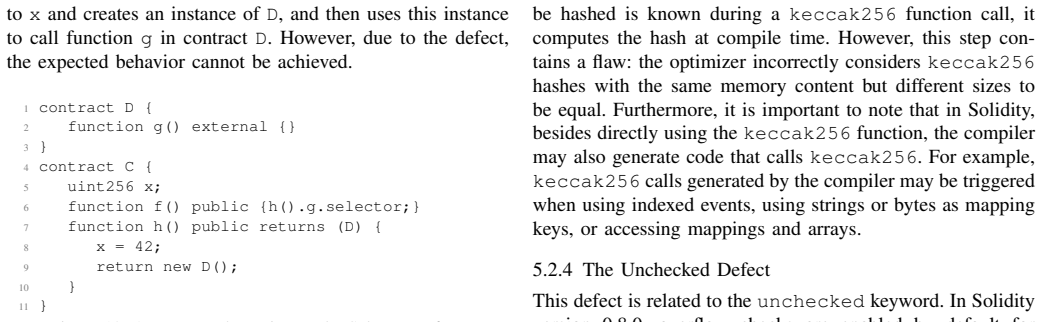
The central claim is that careful random generation of Solidity programs, guided by language-specific consistency and compliance strategies, can reveal genuine Solidity compiler defects. The paper reports four confirmed defects in solc 0.8.0: a FullInliner defect that reorders function-call arguments during inlining, a function-selector defect under the via-IR pipeline that drops side effects, a keccak256 optimizer defect that treats hashes of different lengths as equal, and an unchecked-block defect where the via-IR pipeline mishandles increment at uint256 maximum and decrement at minimum. For each defect the paper gives a minimal triggering program and a root-cause explanation.
Load-bearing premise
The evaluation assumes that Solsmith's consistency strategies fully eliminate undefined behavior and IR-dependent semantic differences, so any differential behavior across the three compiler configurations is a genuine compiler defect rather than a legitimate semantic difference.
Editorial extensions
If this is right
- The four confirmed defects give the Solidity team minimal reproducers and root causes for optimizer and via-IR pipeline bugs.
- Solidity compilers still harbor configuration-dependent bugs that only appear under certain optimizer step sequences or IR settings.
- Compiler testing research for Solidity needs dedicated program generators, not just testing methods, because generic generators do not transfer to Solidity's semantics.
- The generator's strategies can be extended to later compiler versions and additional optimization combinations to find further defects.
Reading between the lines
- The frequency-distortion approach for triggering optimizer paths could be automated with search or learning to maximize bug-finding per generated program.
- The reported defects suggest that differential testing across optimizer and runs settings, rather than just compiler versions, is a high-yield oracle for smart-contract compilers.
- The same consistency strategies could be adapted to other smart-contract languages whose compilers offer both direct and IR-based code generation paths.
- Because the compiler itself can emit keccak256 calls for mappings and indexed events, the keccak256 defect may affect real contracts, not just synthetic test cases.
Editorial analysis
A structured set of objections, weighed in public.
Referee Report
Summary. The paper presents Solsmith, a random test program generator for the Solidity compiler. Its design is organized around three objectives—consistency, diversity, and compliance—and implements strategies that include avoiding undefined behaviors, mitigating IR-dependent semantic differences, increasing the frequency of optimizer-triggering constructs, and inserting runtime checks for type, division, and array-bound errors. The tool is evaluated by differential testing: 100,000 generated programs are run under three configurations of solc (standard, optimizer with runs=1, and optimizer with runs=2^32−1), and the paper reports four distinct defects in solc 0.8.0, with a minimized example and a root-cause discussion for each. The paper concludes that these results demonstrate the effectiveness and potential of Solsmith.
Significance. If the central claims are substantiated, Solsmith would be a valuable contribution to Solidity compiler testing, an area with relatively few dedicated program generators. The open-source release of the tool and the detailed description of generation strategies are concrete assets. However, the evaluation as presented does not yet establish the claimed effectiveness: the differential oracle is not convincingly sound, the link between Solsmith's generated programs and the four reported defects is not shown, and there is no baseline comparison to random generation or existing Solidity fuzzers. The paper therefore provides a useful design and an interesting set of candidate bugs, but the evidence for the headline contribution is incomplete.
major comments (4)
- [§4.2.2 and §5.2] The differential-testing oracle is not sound because the avoidance of expression-evaluation-order differences is incomplete. The strategy in §4.2.2 tracks only variables that have been incremented or decremented and replaces them with constants on reuse; it does not prevent side-effecting function calls from appearing as subexpressions of arithmetic or relational expressions, even though §4.1.3 explicitly includes function-call expressions that return results. Solidity leaves the evaluation order of expression children unspecified, and the legacy and viaIR code generators are known to differ on this point. Consequently, a cross-configuration output difference that involves such a call is not necessarily a compiler defect. The four reported defects must be re-examined under this criterion, or the generator's consistency strategy must be strengthened, before the claim that Solsmith reveals confirmed defects can be accepted.
- [§5.2.1–§5.2.4 and Figures 9–12] The manuscript does not establish that the four defect-triggering programs are outputs of Solsmith. Figure 9 is a standalone Yul program, not a Solidity contract; Figures 10–12 are Solidity snippets but no reduction process is described, and no statistics are given on how many Solsmith-generated programs triggered each defect before minimization. Without this link, the four 'confirmed defects' cannot be attributed to Solsmith's generation strategy.
- [§5] The evaluation lacks baseline comparisons and quantitative success metrics. To support the claim that Solsmith is effective, the paper should compare against a random generator that ignores the described strategies, or against an existing Solidity fuzzer such as FUZZOL, using the same differential-testing harness. It should also report the number of defect-triggering programs per 100,000, the false-positive rate, and runtime. Without such a baseline, the four defects cannot be attributed to the generator's design.
- [§5.2] The word 'confirmed' is not verifiable because the paper gives no upstream issue or pull-request identifiers from the Solidity repository. Providing these links is standard for compiler-testing papers and is necessary to substantiate that the reported defects are genuine and not false positives of the comparison setup.
minor comments (7)
- [§4.2.1] The text refers to 'John et al. [25]', but reference [25] is the YARPGen paper by Livinskii, Babokin, and Regehr; correct the citation.
- [§3.4] The heading 'Preventing Integer Overflow' is misleading because wrapping arithmetic inside an `unchecked` block is not prevention of overflow; it is a deliberate choice to use wrapping semantics. Rephrase to something like 'Avoiding overflow-induced reverts'.
- [§5.1] The three configurations are all variations of cross-optimization testing on the same compiler version, whereas the background section (§2.2) also describes cross-version and cross-compilation strategies, which are not used in the evaluation. Clarify why only cross-optimization is chosen.
- [§5.2.1] Figure 9 is written in Yul, not Solidity; state this in the caption and explain how a Solidity test program produced by Solsmith reduces to this Yul snippet.
- [§5.2.3] The term 'cse option' is not defined; state that this is the common-subexpression-elimination step of the Yul optimizer.
- [§5.2.1] The phrase 'non-expression-splitted' should be 'non-expression-split'.
- [§3.2 and §4.2.2] The text lists 'function argument evaluation order' as undefined behavior in §3.2, but §4.2.2 discusses it as an IR-dependent difference; make the relationship between these two concepts explicit.
Circularity Check
No significant circularity: Solsmith is an empirical tool report whose claims are evaluated by differential testing against external solc configurations, with only a non-load-bearing self-citation.
full rationale
The paper's central claim is that Solsmith generates valid, diverse Solidity programs and that differential testing across compiler configurations revealed four defects. This claim is not derived from the paper's own definitions or from fitted parameters. The generation strategies in Sections 3 and 4 are design choices, not models fitted to the evaluation outcomes, and the reported defects in Section 5.2 are presented as independently observed behavioral differences with root-cause analyses. The only self-citation is reference [2], which supports background statements about smart-contract adoption in the introduction and is not load-bearing for the compiler-testing contribution. No uniqueness theorem, ansatz, or known result is imported from the authors' prior work to force a conclusion. The paper does not define any prediction in terms of its inputs, and the differential-testing oracle is an external behavior comparison rather than a circular self-check. Accordingly, no circular step is identified, and the score of 1 merely acknowledges the presence of one minor, non-load-bearing self-citation.
Assumptions & free parameters
free parameters (3)
- Maximum allowed local variables (16) =
16
- Maximum nesting depth =
not specified
- Feature generation probabilities =
not specified
assumptions (3)
- domain assumption Differential testing across solc configurations is a valid oracle for compiler defects.
- domain assumption Generated programs avoid all undefined behaviors and IR-dependent semantic differences listed in Section 3.2.
- domain assumption Solidity compiler versions 0.8.0 and later have the semantics described in the paper.
Cite this review
Pith. "Pith review of Solsmith: Solidity Random Program Generator for Compiler Testing." pith.science (2026). https://pith.science/paper/BFOMSCKU
@misc{pith2026250603909,
  author       = {Pith},
  title        = {Pith review of: Solsmith: Solidity Random Program Generator for Compiler Testing},
  year         = {2026},
  howpublished = {\url{https://pith.science/paper/BFOMSCKU}},
  note         = {Machine review of arXiv:2506.03909}
}
read the original abstract
Smart contracts are computer programs that run on blockchain platforms, with Solidity being the most widely used language for their development. As blockchain technology advances, smart contracts have become increasingly important across various fields. In order for smart contracts to operate correctly, the correctness of the compiler is particularly crucial. Although some research efforts have been devoted to testing Solidity compilers, they primarily focus on testing methods and do not address the core issue of generating test programs. To fill this gap, this paper designs and implements Solsmith, a test program generator specifically aimed at uncovering defects in Solidity compilers. It tests the compiler correctness by generating valid and diverse Solidity programs. We have designed a series of unique program generation strategies tailored to Solidity, including enabling optimizations more frequently, avoiding undefined behaviour, and mitigating behavioural differences caused by intermediate representations. To validate the effectiveness of Solsmith, we assess the effectiveness of the test programs generated by Solsmith using the approach of differential testing. The preliminary results show that Solsmith can generate the expected test programs and uncover four confirmed defects in Solidity compilers, demonstrating the effectiveness and potential of Solsmith.
Figures


Figures from the paper (7 more)




Forward citations
Cited by 1 Pith paper
-
Clinically-guided Data Synthesis for Laryngeal Lesion Detection
The abstract reports that 10% synthetic data improves laryngeal lesion detection by 9% internally and 22.1% externally, but the submitted full text is a different paper.
Reference graph
Works this paper leans on
-
[1]
Challenges and common solutions in smart contract development,
N. Kannengiesser, S. Lins, K. Winter, and A. Sunyaev, “Challenges and common solutions in smart contract development,”TSE, vol. 48, no. 11, pp. 4291–4318, 2021
work page 2021
-
[2]
Understanding solidity event logging practices in the wild,
L. Li, Y . Liang, Z. Liu, and Z. Yu, “Understanding solidity event logging practices in the wild,” inPro- ceedings of the 31st ACM Joint European Software Engineering Conference and Symposium on the F oun- dations of Software Engineering, ESEC/FSE 2023, (New York, NY , USA), p. 300–312, Association for Computing Machinery, 2023
work page 2023
-
[3]
A. M. Antonopoulos and G. Wood,Mastering ethereum: building smart contracts and dapps. 2018
work page 2018
-
[4]
Ethereum: A secure decentralised gener- alised transaction ledger,
G. Woodet al., “Ethereum: A secure decentralised gener- alised transaction ledger,”Ethereum project yellow paper, vol. 151, no. 2014, pp. 1–32, 2014
work page 2014
-
[5]
Use of blockchain-based smart contracts in logistics and supply chains,
M. A. Alqarni, S. H. Chauhdary, and S. Saleem, “Use of blockchain-based smart contracts in logistics and supply chains,”Electronics, vol. 12, no. 6, p. 1340, 2023
work page 2023
-
[6]
An empirical study of smart contract decompilers,
X. Liu, B. Hua, and Z. Pan, “An empirical study of smart contract decompilers,” inSANER, pp. 1–12, 2023
work page 2023
-
[7]
Super-optimization of smart con- tracts,
E. Albert, P. Gordillo, A. Hern ´andez-Cerezo, A. Rubio, and M. A. Schett, “Super-optimization of smart con- tracts,”TOSEM, vol. 31, no. 4, pp. 1–29, 2022
work page 2022
-
[8]
J. Chen, J. Patra, M. Pradel, Y . Xiong, H. Zhang, D. Hao, and L. Zhang, “A survey of compiler testing,”CSUR, vol. 53, no. 1, pp. 1–36, 2020
work page 2020
Show all 34 references
-
[9]
Differential testing: a new approach to change detection,
R. B. Evans and A. Savoia, “Differential testing: a new approach to change detection,” inThe 6th Joint Meeting on European Software Engineering Conference and the ACM SIGSOFT Symposium on the F oundations of Software Engineering: Companion Papers, ESEC-FSE companion ’07, (New ...
2007
-
[10]
Does the failing test execute a single or multiple faults? an approach to classifying failing tests,
Z. Yu, C. Bai, and K.-Y . Cai, “Does the failing test execute a single or multiple faults? an approach to classifying failing tests,” inProceedings of the 37th Inter- national Conference on Software Engineering - V olume 1, ICSE ’15, p. 924–935, IEEE Press, 2015
2015
-
[11]
Alleviating patch overfitting with automatic test generation: A study of feasibility and effectiveness for the nopol repair system,
Z. Yu, M. Martinez, B. Danglot, T. Durieux, and M. Mon- perrus, “Alleviating patch overfitting with automatic test generation: A study of feasibility and effectiveness for the nopol repair system,”Empirical Softw. Engg., vol. 24, p. 33–67, feb 2019
2019
-
[12]
A snowballing literature study on test amplification,
B. Danglot, O. Vera-Perez, Z. Yu, A. Zaidman, M. Mon- perrus, and B. Baudry, “A snowballing literature study on test amplification,”Journal of Systems and Software, vol. 157, p. 110398, 2019
2019
-
[13]
Mutation-oriented test data augmentation for gui software fault localization,
Z. Yu, C. Bai, and K.-Y . Cai, “Mutation-oriented test data augmentation for gui software fault localization,” Information and Software Technology, vol. 55, no. 12, pp. 2076–2098, 2013
2013
-
[14]
Boosting compiler testing by injecting real-world code,
S. Li, T. Theodoridis, and Z. Su, “Boosting compiler testing by injecting real-world code,”PLDI, pp. 223–245
-
[15]
Taming compiler fuzzers,
Y . Chen, A. Groce, C. Zhang, W.-K. Wong, X. Fern, E. Eide, and J. Regehr, “Taming compiler fuzzers,” in PLDI, pp. 197–208, 2013
2013
-
[16]
Llm-based code generation method for golang compiler testing,
Q. Gu, “Llm-based code generation method for golang compiler testing,” inESEC/FSE, pp. 2201–2203, 2023
2023
-
[17]
Syntax-aware mutation for testing the solidity compiler,
C. Mitropoulos, T. Sotiropoulos, S. Ioannidis, and D. Mitropoulos, “Syntax-aware mutation for testing the solidity compiler,” inESORICS, pp. 327–347, 2023
2023
-
[18]
Differential testing solidity compiler through deep contract manipu- lation and mutation,
Z. Tian, F. Wang, Y . Chen, and L. Chen, “Differential testing solidity compiler through deep contract manipu- lation and mutation,”Software Quality Journal, vol. 32, p. 765–790, Apr. 2024
2024
-
[19]
Spectest: Specification-based compiler testing,
R. Schumi and J. Sun, “Spectest: Specification-based compiler testing,” inF ASE 2021, pp. 269–291, 2021
2021
-
[20]
Finding and understanding bugs in c compilers,
X. Yang, Y . Chen, E. Eide, and J. Regehr, “Finding and understanding bugs in c compilers,” inPLDI, pp. 283– 294, 2011
2011
-
[21]
Kubo: Precise and scalable detection of user-triggerable undefined behavior bugs in os kernel.,
C. Liu, Y . Chen, and L. Lu, “Kubo: Precise and scalable detection of user-triggerable undefined behavior bugs in os kernel.,” inNDSS, 2021
2021
-
[22]
Differential testing for software,
W. M. McKeeman, “Differential testing for software,” Digital Technical Journal, vol. 10, no. 1, pp. 100–107
-
[23]
Differential testing: a new approach to change detection,
R. B. Evans and A. Savoia, “Differential testing: a new approach to change detection,” inESEC/FSE, pp. 549– 552, 2007
2007
-
[24]
Rustsmith: Random differential compiler testing for rust,
M. Sharma, P. Yu, and A. F. Donaldson, “Rustsmith: Random differential compiler testing for rust,” inISSTA, pp. 1483–1486, 2023
2023
-
[25]
Random testing for c and c++ compilers with yarpgen,
V . Livinskii, D. Babokin, and J. Regehr, “Random testing for c and c++ compilers with yarpgen,”OOPSLA, pp. 1– 25, 2020
2020
-
[26]
using-the-compiler: input-description
Soliditylang, “using-the-compiler: input-description.” https://docs.soliditylang.org/en/latest/using-the-compiler. html#input-description, 2025
2025
-
[27]
https://hardhat.org/docs, 2025
hardhat. https://hardhat.org/docs, 2025. [Online] ac- cessed 2025-02-24
2025
-
[28]
Compiler testing using template java programs,
Z. Zang, N. Wiatrek, M. Gligoric, and A. Shi, “Compiler testing using template java programs,” inASE, pp. 1–13
-
[29]
Compiler optimiza- tion testing based on optimization-guided equivalence transformations,
J. Wu, J. Zheng, Z. Yang, and Z. Yu, “Compiler optimiza- tion testing based on optimization-guided equivalence transformations,” inCompanion Proceedings of the 33rd ACM International Conference on the F oundations of Software Engineering, FSE, 2025
2025
-
[30]
Test-case reduction and deduplication almost for free with transformation- based compiler testing,
A. F. Donaldson, P. Thomson, V . Teliman, S. Milizia, A. P. Maselco, and A. Karpi ´nski, “Test-case reduction and deduplication almost for free with transformation- based compiler testing,” inPLDI, pp. 1017–1032, 2021
2021
-
[31]
Finding typing com- piler bugs,
S. Chaliasos, T. Sotiropoulos, D. Spinellis, A. Gervais, B. Livshits, and D. Mitropoulos, “Finding typing com- piler bugs,” inPLDI, pp. 183–198, 2022
2022
-
[32]
Nnsmith: Generating diverse and valid test cases for deep learning compilers,
J. Liu, J. Lin, C. Tan, A. Panda, and L. Zhang, “Nnsmith: Generating diverse and valid test cases for deep learning compilers,” inASPLOS, pp. 530–543, 2023
2023
-
[33]
A new methodology for generating test cases for a programming language compiler,
D. M. Berry, “A new methodology for generating test cases for a programming language compiler,”ACM Sig- plan Notices, vol. 18, no. 2, pp. 46–56, 1983
1983
-
[34]
Orthogonal latin squares: an application of experiment design to compiler testing,
R. Mandl, “Orthogonal latin squares: an application of experiment design to compiler testing,”Communications of the ACM, vol. 28, no. 10, pp. 1054–1058, 1985
1985
Reviewed August 7, 2026 · model on record in the stance chip above.
Discussion (0). Sign in to comment.