REVIEW 4 major objections 6 minor 30 references
Compositional Generalisation for Explainable Hate Speech Detection
T0 review · 4 major / 6 minor · reviewed 2026-08-07 · deepseek-v4-flash
Pith's one-line read The paper claims that training on expression-balanced synthetic data lets hate speech models recognise harmful phrases in unseen combinations without losing in-domain accuracy, and supports this with a new benchmark, TARGET.
desk verdict Real gains on the ICSF side and a genuinely new benchmark, but the 'no loss' claim in the abstract is contradicted by the paper's own classification results. read the letter →
The pith
A machine-rendered reading of the paper's core claim, the machinery that carries it, and where it could break.
The reading
What carries the argument
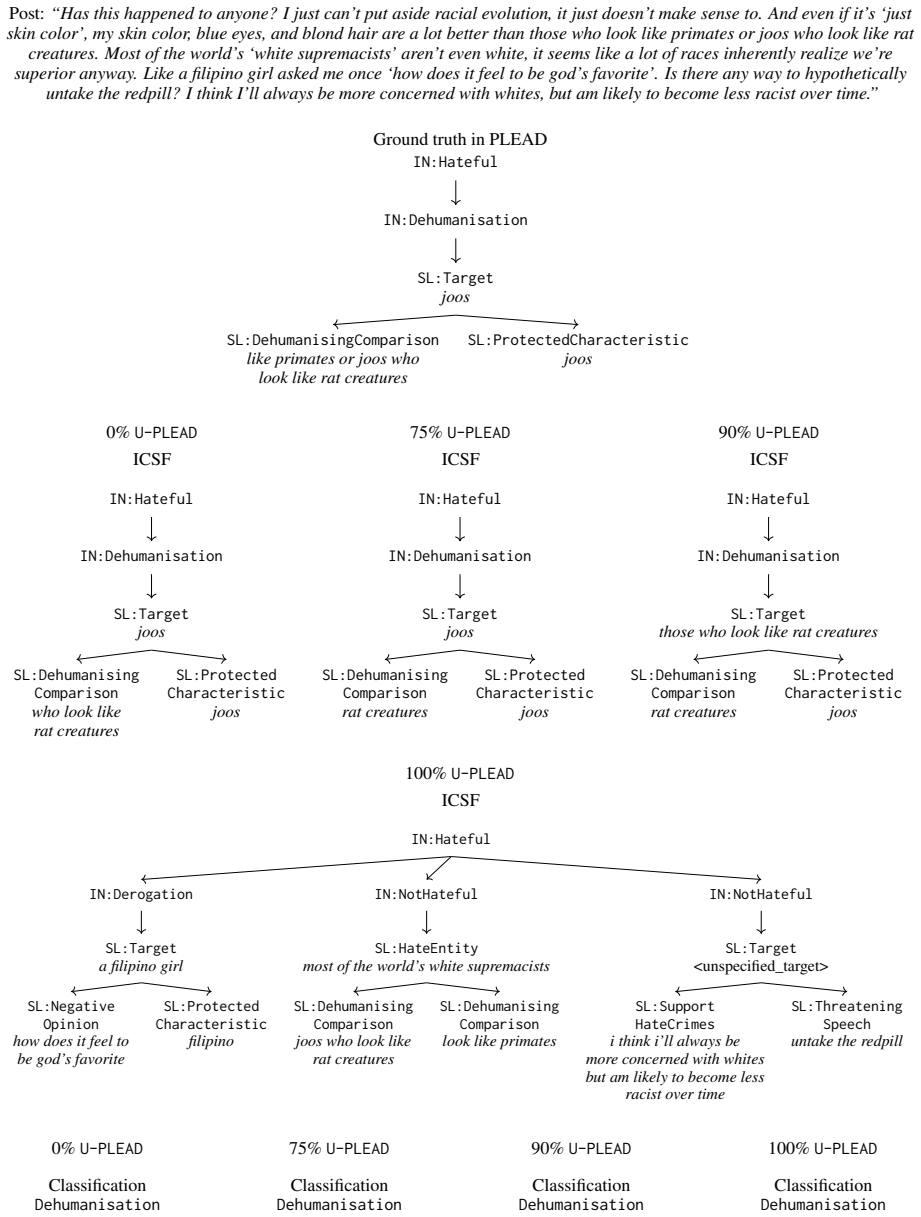
The Hate Speech Grammar G defines how terminal spans (targets, protected characteristics, dehumanising comparisons, threats, opinions, support/hate entities) combine into full posts and their slot trees. Constraints C1–C5 require every target and every expression to appear with equal frequency across classes and with every other slot, which removes the spurious correlations found in natural data. A main-tree/injected-slots split lets the generator satisfy these constraints without making every post hateful: hateful expressions are attached to subtrees that cannot trigger a policy rule, so models also learn that harmful lexemes can appear in innocuous sentences. TARGET then scores compositional generalisation with eight tests in which targets, expressions, or stance spans are unseen at training time.
What would settle it
Evaluate a model trained with 75% U-PLEAD on naturally occurring hate speech whose target–expression pairs never appeared in U-PLEAD; if the large gains observed on TARGET fail to transfer to that real-world corpus, the effect is an artefact of the synthetic benchmark rather than evidence of compositional generalisation.
Extended reading notes
Core claim
Training with balanced synthetic data changes how models generalise. In the paper's experiments, Gemma-2-9B and LLaMA-3.1-8B trained on 75% U-PLEAD and 25% PLEAD raise production F1 on TARGET from about 23% to about 45%, and Micro F1 from about 46% to 50%, while staying above 70% Micro F1 on the original PLEAD test set. The authors interpret this as evidence that removing correlations between expressions, targets, and intent labels teaches models the atomic meaning of slot labels rather than their accidental co-occurrence patterns.
Load-bearing premise
TARGET is generated from the same grammar, the same PLEAD-derived span clusters, and the same LLM post-generation pipeline as U-PLEAD, so the observed generalisation gains may reflect learning regularities of that generator rather than genuine understanding of hate speech.
Editorial extensions
If this is right
- At 75% synthetic substitution, explanation quality (production F1) on unseen combinations roughly doubles for both model families while in-domain PLEAD Micro F1 stays above 70%.
- Intent classification plus slot filling matches black-box classification accuracy, so structured, explainable output no longer costs performance.
- The grammar-and-balancing procedure carries over to any span-labelled task with an explicit ontology, including new policy rules added after deployment.
- Best TARGET Micro F1 (50.34%) remains well below the benchmark's 76.25% label-accuracy ceiling, so compositional generalisation in this setting is far from solved.
Reading between the lines
- If the mechanism is correlation removal, cheaper resampling or reweighting of real data might achieve similar gains where coverage suffices; synthetic generation matters most for the tail combinations that real data cannot supply.
- The injected-slots technique is a counterfactual-style robustness property (hateful lexemes in non-hateful contexts), and a direct probe would be whether U-PLEAD-trained models resist 'I am not saying X' quotations better than PLEAD-only models.
- TARGET's inclusion of newly protected groups (pregnancy, veteran status) mimics policy changes, suggesting the same protocol could pre-test a detection policy's readiness for newly protected characteristics before deployment.
Editorial analysis
A structured set of objections, weighed in public.
Referee Report
Summary. The paper addresses compositional generalization in hate speech detection, arguing that models trained on span-level annotations fail to treat slot labels as atomic and therefore struggle with unseen combinations of known expressions. The authors construct U-PLEAD, a synthetic dataset of ~364k posts generated from a hand-defined grammar G and balanced so that expressions and targets occur with equal frequency across contexts and classes, and TARGET, an eight-test benchmark of ~10.6k generated posts (with 800 manually inspected) evaluating generalization to unseen targets, expressions, and their combinations. They fine-tune Gemma-2-9B and LLaMA-3.1-8B in two settings (intent classification and intent classification with slot filling, ICSF) on mixtures of PLEAD and U-PLEAD, reporting that on TARGET, replacing 75% of the PLEAD training set yields Micro F1 improvements from ~46% to ~50% and PF1 improvements from ~23% to ~45% for ICSF models, while claiming no loss on the PLEAD test set.
Significance. If the empirical claims hold, the work would be valuable: it provides a large balanced synthetic resource, a new benchmark for compositional generalization in a socially important task, and consistent evidence across two model families that balanced synthetic data can substantially improve slot-filling generalization. The PF1 gains on TARGET are large, and the accompanying EMA gains confirm the improvement is not merely from over-tagging. The study is carefully designed with constraint-based generation, exclusion of generator models from evaluation, and manual validation of a subset of the benchmark. However, the headline 'without any loss' claim is contradicted by the authors' own classification results, and the synthetic shared-generator design limits the extent to which the gains can be interpreted as generalization to natural hate speech. These issues are fixable but currently prevent the paper from supporting its central claims as stated.
major comments (4)
- [Section 1, Section 4.2, Figure 2a] The contributions (Section 1, third bullet) claim that substituting U-PLEAD enhances generalization 'without any loss in performance on the PLEAD test set' for both classification and slot-filling models. This is contradicted by Section 4.2 and Figure 2a, where classification models show a 12% performance drop at the 75%/25% U-PLEAD partition, and ICSF models still show a drop of less than 2%, not zero. The abstract and contributions should restrict the no-loss claim to ICSF models or explicitly present the classification trade-off as a limitation.
- [Sections 3.2, 3.3, 4.3] The TARGET benchmark is generated from the same grammar G, the same PLEAD-derived expression clusters (with unseen spans from unused clusters), and the same Vicuna-30B/GPT-3.5-Turbo post-generation pipeline as U-PLEAD. The large PF1 improvements on TARGET (Table 4) could therefore reflect the model learning the generator's statistical regularities rather than genuine compositional understanding of hate speech slots. The Limitations section acknowledges the benchmark's synthetic nature but does not address this shared-provenance circularity. To support the central generalization claim, the authors should either evaluate on held-out human-authored posts with novel target-expression combinations or provide an analysis demonstrating that the gains are not explained by lexical or syntactic overlap between U-PLEAD and TARGET.
- [Abstract, Section 3.3] The abstract describes TARGET as '~8,000 manually validated posts,' but Section 3.3 states that only 100 posts per generalisation test were manually inspected, i.e., 800 posts in total, while the full benchmark contains 10,593 generated pairs. This misrepresents the extent of manual validation and should be corrected (e.g., to '~800 manually validated posts' or with a clear distinction between generated and manually inspected instances).
- [Section 3.3] The manual inspection found that only 76.25% of posts carry the correct classification label and 69.5% correctly reflect the associated tree. Because the generalization improvements are measured on TARGET, label noise of this magnitude could compress or bias the observed gap. The paper should report the per-test validation accuracy (which is currently omitted) and, ideally, verify that the main conclusions are robust when restricting evaluation to the manually validated subset.
minor comments (6)
- [Figure 2 caption] The caption contains a typo: 'Are results are reported' should read 'All results are reported on the PLEAD test set.'
- [Table 2] The row 'PLEADU-PLEAD56.60' lacks a separator; it should be 'PLEAD → U-PLEAD' to be readable.
- [Appendix B] The sentence 'To balance this, we enforce that ~70% of the trees in U-PLEAD contain no injections, while the other half cover all required injections' is numerically inconsistent; 'the other half' should refer to the remaining ~30% of trees.
- [Section 4 (general)] The paper reports averages over three seeds but provides no standard deviations or confidence intervals; given the small differences in some TARGET results (e.g., Table 3, LLaMA-cls 0% vs 75%), error bars would help establish significance.
- [Section 3.3] The footnote marker after 'GPT-4o 2' is awkwardly placed; move the marker to the end of the sentence.
- [Table 1] The column shorthand (e.g., 'T|E X') is difficult to parse; a brief legend explaining the notation would improve clarity.
Circularity Check
No circular derivation found: U-PLEAD and TARGET form a controlled train/test pair, the generalization gains are empirical and not entailed by construction, and the flagged concerns (self-generated benchmark provenance, an internally contradicted 'without any loss' claim) are validity and correctness issues rather than circularity.
full rationale
The paper's derivation chain is: Section 3.1 defines grammar G from PLEAD's published span ontology; Section 3.2 generates U-PLEAD (364,261 posts) by enumerating trees under balance constraints C1-C5 and translating them with Vicuna-30B and GPT-3.5; Section 3.3 generates TARGET as the controlled complement, sampling unseen spans from clusters unused in U-PLEAD and adding protected groups absent from PLEAD; Sections 4.1-4.3 fine-tune Gemma-2-9B and LLaMA-3.1-8B on PLEAD/U-PLEAD mixtures and evaluate on the human-sourced PLEAD test set and on TARGET. No link in this chain is circular: no parameter is fitted to TARGET, TARGET instances are excluded from U-PLEAD by design, and the reported gains (e.g., ICSF PF1 rising from 22.95 to 44.98 on TARGET at 75% U-PLEAD) are not entailed by the construction; the outcome could have been null, and classification models show smaller gains while ICSF models regress on Tests 3/3b. The grammar is defined in this paper rather than imported by citation, and the self-citations that anchor the setup (PLEAD 2022, AAA 2021) are to published, externally accessible artifacts, not to unverified theorems. Two flagged concerns do not rise to circularity. First, the Limitations section concedes that the generalisation benchmark is 'entirely synthetic'; because TARGET shares grammar G, the PLEAD-derived cluster inventory, and the Vicuna/GPT post-generation pipeline with U-PLEAD, measured gains may partly reflect learning the generator's regularities, an external-validity caveat the paper acknowledges. Second, the abstract and contributions claim of 'no loss in performance on the PLEAD test set' is contradicted by the paper's own Section 4.2 observation that classification models 'drop 12% with the 75%/25% partition'; this internal inconsistency is a correctness and reporting risk, not a circular derivation. Since no prediction reduces to its input by construction, the circularity score is 0.
Assumptions & free parameters
free parameters (3)
- Sentence-BERT clustering threshold =
0.5
- Cluster counts per slot =
40 protected targets/hate entities; 20 for other slots
- Fraction of trees without injected slots =
~70% (text also says "the other half" covering injections)
assumptions (5)
- domain assumption PLEAD slot and intent annotations are an accurate, policy-complete representation of hate speech phenomena.
- ad hoc to paper The Hate Speech Grammar G generates all and only the tree structures that can occur in hate speech posts under the policy.
- domain assumption LLM-generated posts preserve the intended slot structure and intent label of their grammar tree.
- domain assumption Balancing the frequency of expression-label-target combinations eliminates the spurious correlations that cause models to fail on unseen combinations.
- domain assumption Models evaluated (Gemma-2-9B, LLaMA-3.1-8B) have not memorized the specific TARGET spans through pretraining.
Cite this review
Pith. "Pith review of Compositional Generalisation for Explainable Hate Speech Detection." pith.science (2026). https://pith.science/paper/ANV3AKSH
@misc{pith2026250603916,
  author       = {Pith},
  title        = {Pith review of: Compositional Generalisation for Explainable Hate Speech Detection},
  year         = {2026},
  howpublished = {\url{https://pith.science/paper/ANV3AKSH}},
  note         = {Machine review of arXiv:2506.03916}
}
read the original abstract
Hate speech detection is key to online content moderation, but current models struggle to generalise beyond their training data. This has been linked to dataset biases and the use of sentence-level labels, which fail to teach models the underlying structure of hate speech. In this work, we show that even when models are trained with more fine-grained, span-level annotations (e.g., "artists" is labeled as target and "are parasites" as dehumanising comparison), they struggle to disentangle the meaning of these labels from the surrounding context. As a result, combinations of expressions that deviate from those seen during training remain particularly difficult for models to detect. We investigate whether training on a dataset where expressions occur with equal frequency across all contexts can improve generalisation. To this end, we create U-PLEAD, a dataset of ~364,000 synthetic posts, along with a novel compositional generalisation benchmark of ~8,000 manually validated posts. Training on a combination of U-PLEAD and real data improves compositional generalisation while achieving state-of-the-art performance on the human-sourced PLEAD.
Figures


Figures from the paper (4 more)



Reference graph
Works this paper leans on
-
[1]
Armen Aghajanyan, Jean Maillard, Akshat Shrivastava, Keith Diedrick, Michael Haeger, Haoran Li, Yashar Mehdad, Veselin Stoyanov, Anuj Kumar, Mike Lewis, and Sonal Gupta. 2020. https://doi.org/10.18653/v1/2020.emnlp-main.408 Conversational semantic parsing . In Proceedings of the 2020 Conference on Empirical Methods in Natural Language Processing, EMNLP 20...
-
[2]
Agostina Calabrese, Michele Bevilacqua, Bj \" o rn Ross, Rocco Tripodi, and Roberto Navigli. 2021. https://doi.org/10.1145/3447535.3462484 AAA: F air evaluation for abuse detection systems wanted . In WebSci '21: 13th ACM Web Science Conference 2021, Virtual Event, United Kingdom, June 21-25, 2021 , pages 243--252. ACM
-
[3]
Bos, Bj \" o rn Ross, Mirella Lapata, and Francesco Barbieri
Agostina Calabrese, Leonardo Neves, Neil Shah, Maarten W. Bos, Bj \" o rn Ross, Mirella Lapata, and Francesco Barbieri. 2024. https://aclanthology.org/2024.acl-short.38 Explainability and hate speech: Structured explanations make social media moderators faster . In Proceedings of the 62nd Annual Meeting of the Association for Computational Linguistics, AC...
work page 2024
-
[4]
Agostina Calabrese, Bj \" o rn Ross, and Mirella Lapata. 2022. https://transacl.org/ojs/index.php/tacl/article/view/4059 Explainable abuse detection as intent classification and slot filling . Trans. Assoc. Comput. Linguistics, 10:1440--1454
work page 2022
-
[5]
Ishita Dasgupta, Erin Grant, and Tom Griffiths. 2022. https://proceedings.mlr.press/v162/dasgupta22b.html Distinguishing rule and exemplar-based generalization in learning systems . In International Conference on Machine Learning, ICML 2022, 17-23 July 2022, Baltimore, Maryland, USA , volume 162 of Proceedings of Machine Learning Research, pages 4816--4830. PMLR
work page 2022
-
[6]
Aaron Grattafiori, Abhimanyu Dubey, Abhinav Jauhri, Abhinav Pandey, Abhishek Kadian, Ahmad Al-Dahle, Aiesha Letman, Akhil Mathur, Alan Schelten, Alex Vaughan, and 1 others. 2024. The llama 3 herd of models. arXiv preprint arXiv:2407.21783
arXiv 2024
-
[7]
John Haas. 2012. Hate speech and stereotypic talk. In The handbook of intergroup communication, pages 128--140. Routledge
work page 2012
-
[8]
Dieuwke Hupkes, Mario Giulianelli, Verna Dankers, Mikel Artetxe, Yanai Elazar, Tiago Pimentel, Christos E. Christodoulopoulos, Karim Lasri, Naomi Saphra, Arabella Sinclair, Dennis Ulmer, Florian Schottmann, Khuyagbaatar Batsuren, Kaiser Sun, Koustuv Sinha, Leila Khalatbari, Maria Ryskina, Rita Frieske, Ryan Cotterell, and Zhijing Jin. 2023. https://doi.or...
Show all 30 references
-
[9]
Brendan Kennedy, Xisen Jin, Aida Mostafazadeh Davani, Morteza Dehghani, and Xiang Ren. 2020. https://doi.org/10.18653/v1/2020.acl-main.483 Contextualizing hate speech classifiers with post-hoc explanation . In Proceedings of the 58th Annual Meeting of the Association for Compu...
2020 doi
- [10]
-
[11]
Matthias Lindemann, Alexander Koller, and Ivan Titov. 2023. https://doi.org/10.18653/V1/2023.ACL-LONG.810 Compositional generalization without trees using multiset tagging and latent permutations . In Proceedings of the 61st Annual Meeting of the Association for Computational ...
2023 doi
-
[12]
Aida Mostafazadeh Davani, Ali Omrani, Brendan Kennedy, Mohammad Atari, Xiang Ren, and Morteza Dehghani. 2021. Improving counterfactual generation for fair hate speech detection. In Proceedings of the 5th Workshop on Online Abuse and Harms (WOAH 2021)
2021
-
[13]
Marzieh Mozafari, Reza Farahbakhsh, and No \" e l Crespi. 2019. https://doi.org/10.1007/978-3-030-36687-2\_77 A BERT -based transfer learning approach for hate speech detection in online social media . In Complex Networks and Their Applications VIII - Volume 1 Proceedings of t...
2019 doi
-
[14]
Mooney, and Michel Galley
Chris Quirk, Raymond J. Mooney, and Michel Galley. 2015. https://doi.org/10.3115/v1/p15-1085 Language to code: Learning semantic parsers for if-this-then-that recipes . In Proceedings of the 53rd Annual Meeting of the Association for Computational Linguistics and the 7th Inter...
2015 doi
-
[15]
Nils Reimers and Iryna Gurevych. 2019. https://arxiv.org/abs/1908.10084 Sentence-bert: Sentence embeddings using siamese bert-networks . In Proceedings of the 2019 Conference on Empirical Methods in Natural Language Processing. Association for Computational Linguistics
2019 arXiv
-
[16]
Paula Reyero Lobo, Joseph Kwarteng, Mayra Russo, Miriam Fahimi, Kristen Scott, Antonio Ferrara, Indira Sen, and Miriam Fernandez. 2023. A multidisciplinary lens of bias in hate speech. In Proceedings of the International Conference on Advances in Social Networks Analysis and M...
2023
-
[17]
Morgane Rivi \`e re, Shreya Pathak, Pier Giuseppe Sessa, Cassidy Hardin, Surya Bhupatiraju, L \'e onard Hussenot, Thomas Mesnard, Bobak Shahriari, Alexandre Ram \'e , Johan Ferret, and 1 others. 2024. Gemma 2: Improving open language models at a practical size. arXiv preprint ...
2024 arXiv
-
[18]
Pierrehumbert
Paul R \" o ttger, Bertie Vidgen, Dirk Hovy, and Janet B. Pierrehumbert. 2022. https://doi.org/10.18653/V1/2022.NAACL-MAIN.13 Two contrasting data annotation paradigms for subjective NLP tasks . In Proceedings of the 2022 Conference of the North American Chapter of the Associa...
2022 doi
-
[19]
Marzieh Saeidi, Majid Yazdani, and Andreas Vlachos. 2021. Cross-policy compliance detection via question answering. In Proceedings of the 2021 Conference on Empirical Methods in Natural Language Processing, pages 8622--8632
2021
-
[20]
Sheikh Muhammad Sarwar and Vanessa Murdock. 2022. Unsupervised domain adaptation for hate speech detection using a data augmentation approach. In Proceedings of the International AAAI Conference on Web and Social Media, volume 16, pages 852--862
2022
-
[21]
Manuel Tonneau, Diyi Liu, Niyati Malhotra, Scott A Hale, Samuel P Fraiberger, Victor Orozco-Olvera, and Paul R \"o ttger. 2024. Hateday: Insights from a global hate speech dataset representative of a day on twitter. arXiv preprint arXiv:2411.15462
2024 arXiv
-
[22]
Bertie Vidgen, Tristan Thrush, Zeerak Talat, and Douwe Kiela. 2021. https://doi.org/10.18653/v1/2021.acl-long.132 Learning from the worst: Dynamically generated datasets to improve online hate detection . In Proceedings of the 59th Annual Meeting of the Association for Computa...
2021 doi
-
[23]
William Warner and Julia Hirschberg. 2012. Detecting hate speech on the world wide web. In Proceedings of the second workshop on language in social media, pages 19--26
2012
-
[24]
Michael Wiegand, Josef Ruppenhofer, and Thomas Kleinbauer. 2019. Detection of abusive language: the problem of biased datasets. In Proceedings of the 2019 conference of the North American Chapter of the Association for Computational Linguistics: human language technologies, vo...
2019
-
[25]
Wenjie Yin and Arkaitz Zubiaga. 2021. Towards generalisable hate speech detection: a review on obstacles and solutions. PeerJ Computer Science, 7:e598
2021
-
[26]
Michael Yoder, Lynnette Ng, David West Brown, and Kathleen M Carley. 2022. How hate speech varies by target identity: A computational analysis. In Proceedings of the 26th Conference on Computational Natural Language Learning (CoNLL), pages 27--39
2022
-
[27]
Hao Zheng and Mirella Lapata. 2021. https://doi.org/10.18653/v1/2021.findings-emnlp.88 Compositional generalization via semantic tagging . In Findings of the Association for Computational Linguistics: EMNLP 2021, pages 1022--1032, Punta Cana, Dominican Republic. Association fo...
2021 doi
-
[28]
Maike Z \"u fle, Verna Dankers, and Ivan Titov. 2023. Latent feature-based data splits to improve generalisation evaluation: A hate speech detection case study. In Proceedings of the 1st GenBench Workshop on (Benchmarking) Generalisation in NLP, pages 112--129
2023
-
[29]
online" 'onlinestring :=
ENTRY address archivePrefix author booktitle chapter edition editor eid eprint eprinttype howpublished institution journal key month note number organization pages publisher school series title type volume year doi pubmed url lastchecked label extra.label sort.label short.list...
-
[30]
write newline
" write newline "" before.all 'output.state := FUNCTION n.dashify 't := "" t empty not t #1 #1 substring "-" = t #1 #2 substring "--" = not "--" * t #2 global.max substring 't := t #1 #1 substring "-" = "-" * t #2 global.max substring 't := while if t #1 #1 substring * t #2 gl...
Reviewed August 7, 2026 · model on record in the stance chip above.
Discussion (0). Sign in to comment.