REVIEW 3 major objections 6 minor 44 references
High-efficiency telecom frequency conversion via a diamond-type atomic ensemble
T0 review · 3 major / 6 minor · reviewed 2026-08-07 · deepseek-v4-flash
Pith's one-line read Diamond-type four-wave mixing in a cold rubidium-87 ensemble converts 795 nm light to 1367 nm at 66% and 80% efficiency for optical depths of 75 and 110.
desk verdict Solid experimental advance, but the record claim at OD 75 rests on an unquantified calibration that could wipe out the one-point margin over the previous best. read the letter →
The pith
A machine-rendered reading of the paper's core claim, the machinery that carries it, and where it could break.
The reading
What carries the argument
The load-bearing mechanism is diamond-type four-wave mixing in a Zeeman-sublevel structure of 87Rb: a 795 nm probe, a 780 nm coupling field, and a 1324 nm driving field act on four levels connected in a diamond, and phase matching produces a 1367 nm signal. The coherence between the two upper levels is maintained through a cycling transition on the lower transition, and the detuned coupling field creates an Autler-Townes shift that changes the optimal detunings. The theory uses Heisenberg–Langevin and Maxwell–Schrödinger equations to derive a scattering matrix whose off-diagonal entry $C(0)$ gives the conversion efficiency $\eta_s = |C(0)|^2$; the vacuum-noise coefficients do not enter the probe transmission $T_p$ or $\eta_s$, which is why the scheme is argued to preserve quantum states.
What would settle it
Remeasure the conversion efficiency with the neutral-density filter replaced by a calibrated attenuator and with independent power meters at the input and output, then compare the corrected values at optical depths 75 and 110; if the corrected efficiency at OD 75 falls at or below 65% or the OD 110 value falls below 80%, the central claim of surpassing all previous atomic-system efficiencies would need revision.
Extended reading notes
Core claim
The central claim is that diamond-type four-wave mixing in a cold 87Rb ensemble converts a weak coherent 795 nm probe into 1367 nm light with conversion efficiency $\eta_s = 66\%$ at OD 75 and $\eta_s = 80\%$ at OD 110, exceeding the 65% previously reported in atomic systems and approaching the theoretical prediction of more than 80% at moderate optical depth. The authors attribute the improvement to a single-Zeeman-sublevel cycling transition that avoids population loss, combined with a detuned coupling field whose Autler-Townes shift moves the optimum two-photon detuning away from resonance. They also show that the measured V-type and cascade-type EIT spectra match theory and that the same optimized parameter set works for frequency up-conversion, with $\eta_p \approx \eta_s$. The demonstration uses a weak coherent field, not a single-photon input, so the claim that quantum states are preserved comes from the earlier theoretical framework and has not yet been tested experimentally.
Load-bearing premise
The absolute conversion efficiencies are obtained by dividing measured counts by the transmission of the detection path, dominated by a neutral-density filter with a nominal 1% transmission and a signal path around 75%, so a few percent error in those calibration factors would change the reported 66% and 80%.
Editorial extensions
If this is right
- At optical depth 110 the conversion efficiency reaches 80%, which the paper claims surpasses all previously reported values in atomic systems.
- The theoretical model predicts roughly 90% efficiency at optical depth 200, so the same scheme should approach near-unity conversion with denser ensembles.
- The optimized parameters also maximize up-conversion back to 795 nm, so the scheme can act as a bidirectional frequency interface between rubidium memories and telecom fiber.
- Because the noise terms drop out of the steady-state transmission and conversion expressions, the paper argues that the conversion process can preserve quantum states at high efficiency when a quantum input is used.
Reading between the lines
- The reported 66% at optical depth 75 sits only one percentage point above the 65% claimed in a prior copolarized study, so the record margin depends on the absolute calibration of the detection chain.
- The natural next experiment is to send a heralded single photon or an entangled photon pair through the same converter and measure the output correlation functions; this paper does not perform that test.
- If laser linewidth is what washes out the predicted spectral oscillations at high optical depth, narrower-linewidth lasers could reveal the full structure and possibly improve efficiency further.
- A fully bidirectional telecom-to-rubidium interface would follow if the computed up-conversion path is realized experimentally, but the paper only calculates it.
Editorial analysis
A structured set of objections, weighed in public.
Referee Report
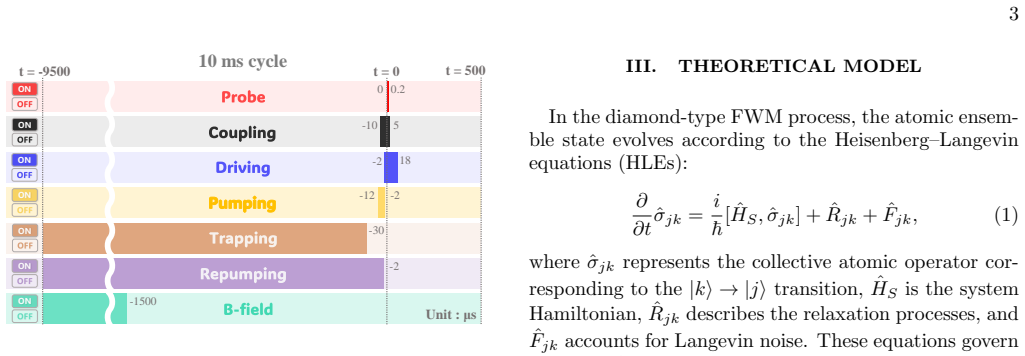
Summary. The paper reports an experimental demonstration of telecom frequency conversion from 795 nm to 1367 nm via diamond-type four-wave mixing in a cold 87Rb ensemble. The authors measure conversion efficiencies of 66% at an optical depth of 75 and 80% at an optical depth of 110 using a 200 nW coherent probe pulse. They also measure the associated V-type and cascade-type electromagnetically induced transparency spectra and compare them with a theoretical model based on Heisenberg-Langevin and Maxwell-Schrödinger equations. The central claim is that these efficiencies surpass all previously reported values for atomic systems.
Significance. If the measured efficiencies are robust, this work constitutes a meaningful advance: it reports record conversion efficiency at a lower optical depth than prior experiments (OD 75 versus approximately 150 for the previous 65% result), and the systematic characterization of the built-in EIT spectra provides practical guidance for parameter optimization. The experimental description is detailed, including the timing sequence, beam parameters, and detection paths. However, the headline record claim rests entirely on the absolute calibration of two detection paths, and the paper provides no uncertainty budget or independent calibration anchor. The comparison with prior single-photon-level experiments is also not fully substantiated, since the present measurement uses a bright coherent pulse containing many photons. These issues currently limit the strength of the central claim, although they appear addressable within the scope of a revision.
major comments (3)
- [II and IV.A] The absolute conversion efficiencies quoted in Sec. IV.A (66% and 80%) are obtained by dividing measured PMT count ratios by the detection-path efficiencies given in Sec. II: 'approximately 0.2%' for the probe and 'approximately 75%' for the signal. The paper provides no uncertainty budget, no measured tolerances for the component transmissions (including the neutral-density filter described only as having 1% transmission), and no independent calibration check of the PMT gains (stated as 164 mV/nW and 0.065 mV/nW without uncertainties). Because the claimed 66% result is only 1 percentage point above the previous 65% record (Ref. [27]), a relative calibration error of a few percent in either detection path would erase the claimed distinction. The authors should provide a full propagation-of-errors analysis and anchor the absolute scale with an independent reference measurement, for example by comparing the inferred incident probe power with a calibrated power meter at the interaction region.
- [IV (comparison with Refs. [26,27]) and Conclusions] The abstract states that the results 'surpass all previously reported values in atomic systems,' while the conclusion specifies 'exceed previously demonstrated efficiencies in cold atomic systems using single-photon-level inputs.' The present measurement uses a 200 nW coherent probe pulse, corresponding to roughly 10^5 photons per 200 ns, whereas Refs. [26] and [27] operated at single-photon level. If any power-dependent mechanism affects the conversion efficiency (e.g., two-photon absorption, saturation, or nonlinear loss), the comparison is not apples-to-apples. The authors should either demonstrate explicitly that the inferred efficiency is independent of input photon number by measuring eta_s at several probe powers, or qualify the record claim to the specific coherent-state regime investigated. As written, the conclusion overclaims beyond what the experiment demonstrates.
- [III and Figs. 3, 4] The theoretical model contains free parameters (the atomic decoherence rates gamma_jk in the Heisenberg-Langevin equations), but the manuscript does not state how these rates are chosen, whether they are taken from the prior theoretical work [15], from independent linewidth measurements, or fitted to the present spectra. Without this information, the agreement between the theoretical curves and the experimental data in Figs. 3 and 4 cannot be assessed as a genuine prediction, and the statement that the spectral trends are 'consistent with the theoretical predictions' is not fully supported. The authors should specify the values of gamma_jk used for the plotted curves and indicate whether any fitting was performed.
minor comments (6)
- [IV.A] The headline efficiencies (66% and 80%) are quoted without explicit error bars in the text, even though the figure captions mention standard deviations from 8 data points; please provide the standard deviation or confidence interval for these peak values.
- [IV.B] The 'combined laser linewidth of approximately 5 MHz' is not defined; please clarify how this value was measured or estimated, and whether it is the sum of the linewidths of all three lasers.
- [II and IV] The manuscript uses 'approximately' for several quantitative values (e.g., 0.2%, 75%, 5 MHz); replacing these with measured values and tolerances would strengthen the quantitative claims.
- [Figs. 3 and 4] In the FWM spectra, the green experimental squares for eta_s are plotted without visible error bars; consider enlarging the symbols or adding error bars to these points in the final figures.
- [Abstract vs. Conclusions] The abstract says 'surpass all previously reported values in atomic systems' while the conclusion says 'exceed previously demonstrated efficiencies in cold atomic systems using single-photon-level inputs'; please harmonize the wording to avoid overstatement.
- [III] Equation (5) and the accompanying claim that Tp and eta_s are independent of vacuum noise are stated without derivation; please add a brief explanation or a more explicit reference to Ref. [15] so that the reader can follow the logic without consulting that paper.
Circularity Check
No significant circularity: the reported conversion efficiencies are direct experimental measurements; self-citations to prior theory are testable context, not inputs that force the measured values.
full rationale
The paper's central claim—66% and 80% telecom conversion efficiencies at OD 75 and 110—is an experimental measurement, not a quantity derived from the model. The measured ηs values are obtained from PMT count ratios using stated detection-path efficiencies for the probe and signal fields (Sec. II), while the theoretical model is used to predict spectra and guide parameter choice (Secs. III–IV); the data are compared with those predictions rather than generated by them. Citations to the authors' prior work [15,41] supply the theoretical framework and the quantum-state-preservation argument, but those are separate calculations with stated assumptions (OD, Rabi frequencies, detunings) and do not take the reported efficiencies as inputs. The paper also explicitly defers experimental verification of quantum fidelity to future work. No step in the derivation reduces, by construction, to its own inputs. The unquantified absolute detection calibration in Sec. II is a measurement-uncertainty concern, not a circularity, and does not change this verdict.
Assumptions & free parameters
free parameters (1)
- atomic decoherence rates gamma_jk in the HLE model
assumptions (3)
- domain assumption The Heisenberg-Langevin and Maxwell-Schrodinger model (Eqs. 1-5) accurately describes diamond-type FWM and its noise properties.
- domain assumption The selected Zeeman sublevels form a closed cycling transition between states |1> and |3>, eliminating population loss.
- domain assumption The probe is weak enough that the driving field can be treated as a constant and the response linearized.
Cite this review
Pith. "Pith review of High-efficiency telecom frequency conversion via a diamond-type atomic ensemble." pith.science (2026). https://pith.science/paper/OSY5UZG3
@misc{pith2026250603957,
  author       = {Pith},
  title        = {Pith review of: High-efficiency telecom frequency conversion via a diamond-type atomic ensemble},
  year         = {2026},
  howpublished = {\url{https://pith.science/paper/OSY5UZG3}},
  note         = {Machine review of arXiv:2506.03957}
}
read the original abstract
Efficient telecom frequency conversion (TFC) in atomic systems is crucial for integrating atom-based quantum nodes into low-loss fiber-optic quantum networks. Here, we demonstrate high-efficiency TFC from 795 nm to 1367 nm in a cold 87Rb ensemble via diamond-type four-wave mixing (FWM), achieving conversion efficiencies of 66% and 80% at optical depths of 75 and 110, respectively, using a weak coherent probe field. These results surpass all previously reported values in atomic systems, enabled by a systematic investigation of the built-in V-type and cascade-type electromagnetically induced transparency spectra that guided the optimization of FWM conditions. Although this work employs coherent fields, our previous theoretical study has shown that quantum states can be preserved with high fidelity during the conversion process, highlighting the promise of diamond-type atomic FWM as a robust interface for long-distance quantum communication.
Figures


Figures from the paper (1 more)

Reference graph
Works this paper leans on
-
[15]
P.-H. Tseng, L.-C. Chen, J.-S. Shiu, and Y.-F. Chen, Quantum interface for telecom frequency conversion based on diamond-type atomic ensembles, Phys. Rev. A 109, 043716 (2024)
work page 2024
-
[27]
Y. O. Dudin, A. G. Radnaev, R. Zhao, J. Z. Blumoff, T. A. B. Kennedy, and A. Kuzmich, Entanglement of light- shift compensated atomic spin waves with telecom light, Phys. Rev. Lett. 105, 260502 (2010)
work page 2010
-
[26]
A. G. Radnaev, Y. O. Dudin, R. Zhao, H. H. Jen, S. D. Jenkins, A. Kuzmich, and T. A. B. Kennedy, A quan- tum memory with telecom-wavelength conversion, Na- ture Phys. 6, 894 (2010)
work page 2010
-
[1]
H. J. Kimble, The quantum internet, Nature 453, 1023 (2008)
2008
-
[2]
T. van Leent, M. Bock, F. Fertig, R. Garthoff, S. Eppelt, Y. Zhou, P. Malik, M. Seubert, T. Bauer, W. Rosen- feld, W. Zhang, C. Becher, and H. Weinfurter, Entan- gling single atoms over 33 km telecom fibre, Nature 607, 69 (2022)
work page 2022
-
[3]
X.-Y. Luo, Y. Yu, J.-L. Liu, M.-Y. Zheng, C.-Y. Wang, B. Wang, J. Li, X. Jiang, X.-P. Xie, Q. Zhang, X.-H. Bao, and J.-W. Pan, Postselected entanglement between two atomic ensembles separated by 12.5 km, Phys. Rev. Lett. 129, 050503 (2022)
work page 2022
-
[4]
Azuma, S
K. Azuma, S. E. Economou, D. Elkouss, P. Hilaire, L. Jiang, H.-K. Lo, and I. Tzitrin, Quantum repeaters: From quantum networks to the quantum internet, Rev. Mod. Phys. 95, 045006 (2023)
2023
-
[5]
A. K. Ekert, Quantum cryptography based on Bell’s the- orem, Phys. Rev. Lett. 67, 661 (1991)
1991
Show all 44 references
-
[6]
Gisin, G
N. Gisin, G. Ribordy, W. Tittel, and H. Zbinden, Quan- tum cryptography, Rev. Mod. Phys. 74, 145 (2002)
2002
-
[7]
D. P. Nadlinger, P. Drmota, B. C. Nichol, G. Araneda, D. Main, R. Srinivas, D. M. Lucas, C. J. Ballance, K. Ivanov, E. Y.-Z. Tan, P. Sekatski, R. L. Urbanke, R. Renner, N. Sangouard, and J.-D. Bancal, Experimental quantum key distribution certified by Bell’s theorem, Nature 60...
2022
-
[8]
C. H. Bennett, G. Brassard, C. Cr´ epeau, R. Jozsa, A. Peres, and W. K. Wootters, Teleporting an unknown quantum state via dual classical and Einstein-Podolsky- Rosen channels, Phys. Rev. Lett. 70, 1895 (1993)
1993
-
[9]
Bouwmeester, J.-W
D. Bouwmeester, J.-W. Pan, K. Mattle, M. Eibl, H. We- infurter, and A. Zeilinger, Experimental quantum tele- portation, Nature 390, 575 (1997)
1997
-
[10]
X.-S. Ma, T. Herbst, T. Scheidl, D. Wang, S. Kropatschek, W. Naylor, B. Wittmann, A. Mech, J. Kofler, E. Anisimova, V. Makarov, T. Jennewein, R. Ursin, and A. Zeilinger, Quantum teleportation over 143 kilometres using active feed-forward, Nature 489, 269 (2012)
2012
-
[11]
Valivarthi, S
R. Valivarthi, S. I. Davis, C. Pe˜ na, S. Xie, N. Lauk, L. Narv´ aez, J. P. Allmaras, A. D. Beyer, Y. Gim, M. Hus- sein, G. Iskander, H. L. Kim, B. Korzh, A. Mueller, M. Rominsky, M. Shaw, D. Tang, E. E. Wollman, C. Simon, P. Spentzouris, D. Oblak, N. Sinclair, and M. Spiropul...
2020
-
[12]
X. Cao, M. Zopf, and F. Ding, Telecom wavelength single photon sources, J. Semicond. 40, 071901 (2019)
2019
-
[13]
Gogyan, Qubit transfer between photons at telecom and visible wavelengths in a slow-light atomic medium, Phys
A. Gogyan, Qubit transfer between photons at telecom and visible wavelengths in a slow-light atomic medium, Phys. Rev. A 81, 024304 (2010)
2010
-
[14]
H. H. Jen and T. A. B. Kennedy, Efficiency of light- frequency conversion in an atomic ensemble, Phys. Rev. A 82, 023815 (2010)
2010
-
[16]
L.-M. Duan, M. D. Lukin, J. I. Cirac, and P. Zoller, Long- distance quantum communication with atomic ensembles and linear optics, Nature 414, 413 (2001)
2001
-
[17]
Kumar, Quantum frequency conversion, Opt
P. Kumar, Quantum frequency conversion, Opt. Lett.15, 1476 (1990). 7
1990
-
[18]
K. D. Greve, L. Yu, P. L. McMahon, J. S. Pelc, C. M. Natarajan, N. Y. Kim, E. Abe, S. Maier, C. Schneider, M. Kamp, S. H¨ ofling, R. H. Hadfield, A. Forchel, M. M. Fejer, and Y. Yamamoto, Quantum-dot spin–photon entanglement via frequency downconversion to telecom wavelength, ...
2012
-
[19]
M. Bock, P. Eich, S. Kucera, M. Kreis, A. Lenhard, C. Becher, and J. Eschner, High-fidelity entanglement be- tween a trapped ion and a telecom photon via quantum frequency conversion, Nat. Commun. 9, 1998 (2018)
2018
-
[20]
Strobel, S
T. Strobel, S. Kazmaier, T. Bauer, M. Sch¨ afer, A. Choud- hary, N. L. Sharma, R. Joos, C. Nawrath, J. H. We- ber, W. Nie, G. Bhayani, L. Wagner, A. Bisquerra, M. Geitz, R.-P. Braun, C. Hopfmann, S. L. Portalupi, C. Becher, and P. Michler, High-fidelity distribution of trig- g...
2024
-
[21]
Y. Yu, F. Ma, X.-Y. Luo, B. Jing, P.-F. Sun, R.-Z. Fang, C.-W. Yang, H. Liu, M.-Y. Zheng, X.-P. Xie, W.- J. Zhang, L.-X. You, Z. Wang, T.-Y. Chen, Q. Zhang, X.-H. Bao, and J.-W. Pan, Entanglement of two quan- tum memories via fibres over dozens of kilometres, Na- ture 578, 240 (2020)
2020
-
[22]
Z.-Y. Zhou, Y. Li, D.-S. Ding, W. Zhang, S. Shi, B.-S. Shi, and G.-C. Guo, Orbital angular momentum photonic quantum interface, Light Sci. Appl. 5, e16019 (2016)
2016
-
[23]
R. T. Willis, F. E. Becerra, L. A. Orozco, and S. L. Rol- ston, Four-wave mixing in the diamond configuration in an atomic vapor, Phys. Rev. A 79, 033814 (2009)
2009
-
[24]
F. E. Becerra, R. T. Willis, S. L. Rolston, H. J. Carmichael, and L. A. Orozco, Nondegenerate four-wave mixing in rubidium vapor: Transient regime, Phys. Rev. A 82, 043833 (2010)
2010
-
[25]
Jeong, H
H. Jeong, H. Kim, J. Bae, J. Park, and H. S. Moon, Doppler-broadened four-wave mixing under double- resonance optical pumping in the 5 S1/2–5P3/2–4D5/2 transition of warm 87Rb atoms, Opt. Express 29, 42384 (2021)
2021
-
[28]
Zhang, Y.-H
W.-H. Zhang, Y.-H. Ye, L. Zeng, M.-X. Dong, E.-Z. Li, J.-Y. Peng, Y. Li, D.-S. Ding, and B.-S. Shi, Telecom- wavelength conversion in a high optical depth cold atomic system, Opt. Express 31, 8042 (2023)
2023
-
[29]
Ikuta, Y
R. Ikuta, Y. Kusaka, T. Kitano, H. Kato, T. Yamamoto, M. Koashi, and N. Imoto, Wide-band quantum interface for visible-to-telecommunication wavelength conversion, Nat. Commun. 2, 537 (2011)
2011
-
[30]
Zaske, A
S. Zaske, A. Lenhard, C. A. Keßler, J. Kettler, C. Hepp, C. Arend, R. Albrecht, W.-M. Schulz, M. Jetter, P. Mich- ler, and C. Becher, Visible-to-telecom quantum frequency conversion of light from a single quantum emitter, Phys. Rev. Lett. 109, 147404 (2012)
2012
-
[31]
van Leent, M
T. van Leent, M. Bock, R. Garthoff, K. Redeker, W. Zhang, T. Bauer, W. Rosenfeld, C. Becher, and H. We- infurter, Long-distance distribution of atom-photon en- tanglement at telecom wavelength, Phys. Rev. Lett. 124, 010510 (2020)
2020
-
[32]
Wengerowsky, S
S. Wengerowsky, S. Duranti, L. Heller, and H. de Ried- matten, Quantum frequency conversion of photons with microsecond duration from the visible to the telecommu- nication C band, Phys. Rev. Appl. 23, 024049 (2025)
2025
-
[33]
Hamer, S
A. Hamer, S. M. R. Tabar, P. Yashwantrao, A. Aghababaei, F. Vewinger, and S. Stellmer, Frequency conversion to the telecom O-band using pressurized hy- drogen, Opt. Lett. 49, 506 (2024)
2024
-
[34]
Hamer, F
A. Hamer, F. Vewinger, T. Peters, M. H. Frosz, and S. Stellmer, Frequency conversion in a hydrogen-filled hollow-core fiber using continuous-wave fields, Opt. Lett. 49, 6952 (2024)
2024
-
[35]
J. A. Rowland, C. Perrella, R. F. Offer, A. N. Luiten, B. M. Sparkes, and T. J. Weinhold, Characterization of near-infrared to telecom frequency conversion in a rubidium-filled hollow-core photonic-crystal fiber, Opt. Express 33, 18076 (2025)
2025
-
[36]
Kang and H.-R
H.-J. Kang and H.-R. Noh, Coherence effects in electro- magnetically induced transparency in V-type systems of 87Rb, Opt. Express 25, 21762 (2017)
2017
-
[37]
C. R. Higgins and I. G. Hughes, Electromagnetically in- duced transparency in a V-system with 87Rb vapour in the hyperfine Paschen-Back regime, J. Phys. B: At. Mol. Opt. Phys. 54, 165403 (2021)
2021
-
[38]
J. Wang, L. B. Kong, X. H. Tu, K. J. Jiang, K. Li, H. W. Xiong, Y. Zhu, and M. S. Zhan, Electromagnetically induced transparency in multi-level cascade scheme of cold rubidium atoms, Phys. Lett. A 328, 437 (2004)
2004
-
[39]
Kumar, V
R. Kumar, V. Gokhroo, and S. N. Chormaic, Multi- level cascaded electromagnetically induced transparency in cold atoms using an optical nanofibre interface, New J. Phys. 17, 123012 (2015)
2015
-
[40]
Ketterle, K
W. Ketterle, K. B. Davis, M. A. Joffe, A. Martin, and D. E. Pritchard, High densities of cold atoms in a dark spontaneous-force optical trap, Phys. Rev. Lett. 70, 2253 (1993)
1993
-
[41]
Cheng, J.-J
C.-Y. Cheng, J.-J. Lee, Z.-Y. Liu, J.-S. Shiu, and Y.-F. Chen, Quantum frequency conversion based on resonant four-wave mixing, Phys. Rev. A 103, 023711 (2021)
2021
-
[42]
Liu, J.-S
Z.-Y. Liu, J.-S. Shiu, C.-Y. Cheng, and Y.-F. Chen, Con- trolling frequency-domain Hong-Ou-Mandel interference via electromagnetically induced transparency, Phys. Rev. A 108, 013702 (2023)
2023
-
[43]
Shiu, Z.-Y
J.-S. Shiu, Z.-Y. Liu, C.-Y. Cheng, Y.-C. Huang, I. A. Yu, Y.-C. Chen, C.-S. Chuu, C.-M. Li, S.-Y. Wang, and Y.-F. Chen, Observation of highly correlated ultrabright bipho- tons through increased atomic ensemble density in spon- taneous four-wave mixing, Phys. Rev. Res. 6, L03...
2024
-
[44]
Shiu, C.-W
J.-S. Shiu, C.-W. Lin, Y.-C. Huang, M.-J. Lin, I.- C. Huang, T.-H. Wu, P.-C. Kaun, and Y.-F. Chen, Frequency-tunable biphoton generation via spontaneous four-wave mixing, Phys. Rev. A 110, 063723 (2024)
2024
Reviewed August 7, 2026 · model on record in the stance chip above.
Discussion (0). Sign in to comment.