REVIEW 5 major objections 6 minor 25 references
On Support Samples of Next Word Prediction
T0 review · 5 major / 6 minor · reviewed 2026-08-07 · deepseek-v4-flash
Pith's one-line read Support status of a training sample for next-word prediction is intrinsic and can be predicted from an untrained model's gradients with over 80% accuracy.
desk verdict A genuinely interesting data-centric interpretability result whose headline 'intrinsic support' claim needs cross-seed evidence before it fully lands. read the letter →
The pith
A machine-rendered reading of the paper's core claim, the machinery that carries it, and where it could break.
The reading
What carries the argument
The load-bearing identity is the representer theorem for the next-word predictor: $\theta_v = (1/(2N\lambda))\sum_i (\mathbb{1}(y_i=v) - p(v|x_i))\phi(x_i)$. It converts 'how much sample $i$ backs the decision to predict $v$' into the coefficient $\alpha_i = \mathbb{1}(y_i=v) - p(v|x_i)$, which is computable once the model is at a stationary point. Support samples are defined by thresholding $|\alpha_i|$, which yields the two types and makes sample importance an algebraic fact about a checkpoint rather than a counterfactual calculation. The same decomposition justifies using gradient features from a randomly initialized checkpoint as a predictor of support status, because the gradient of the log-likelihood at initialization contains exactly the terms $\mathbb{1}(y_i=v) - p(v|x_i)$ that define $\alpha_i$.
What would settle it
Train two identical-configuration GPT-2 models on the same data with different random seeds, compute their support sets at the final checkpoints, and measure the overlap; if support status is truly intrinsic the sets should largely coincide, while a large divergence would indicate the 80% pre-training prediction is an artifact of a particular training trajectory rather than an intrinsic property.
Extended reading notes
Core claim
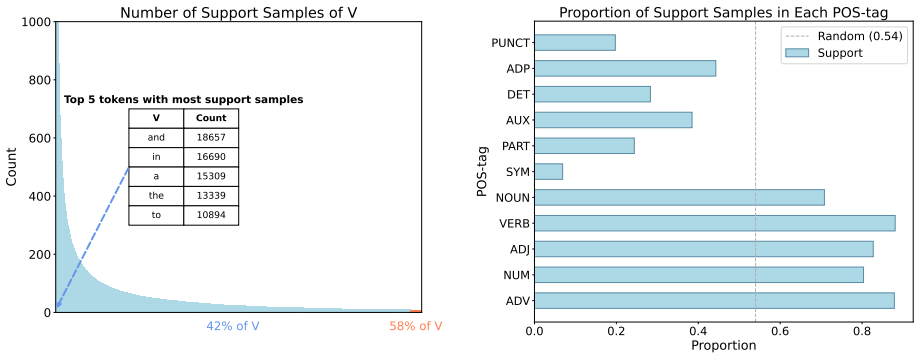
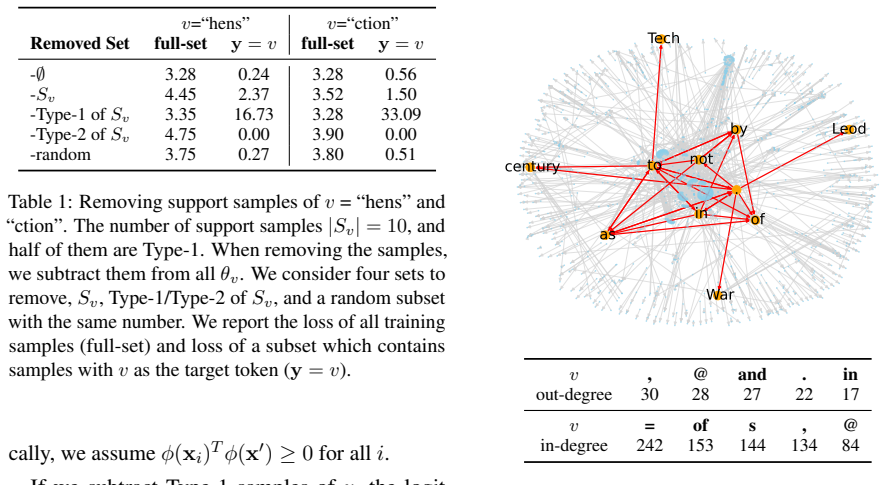
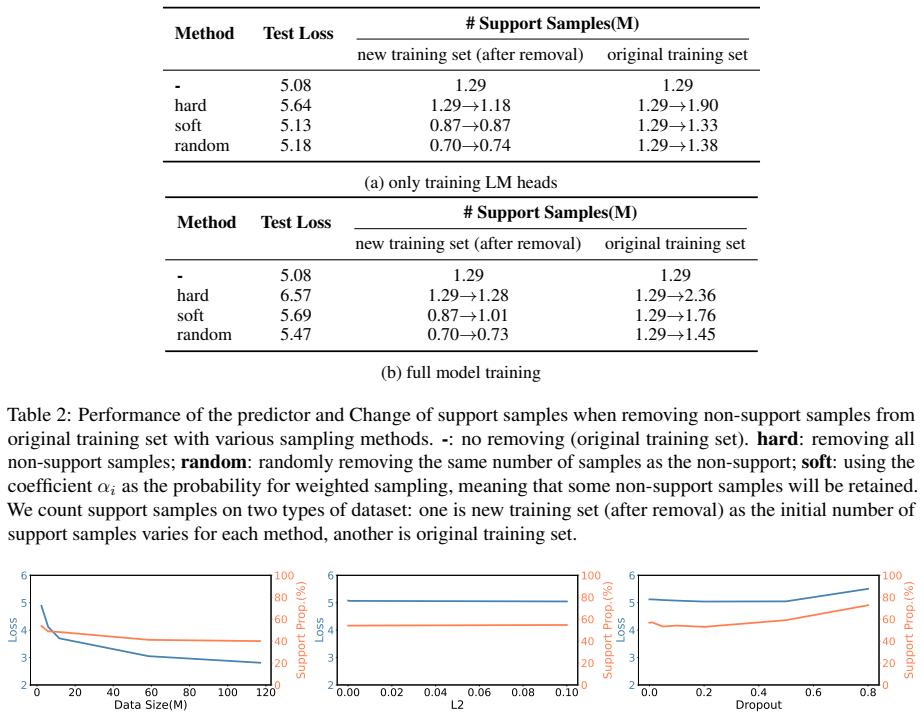
Given a token $v$, the decomposition $\theta_v = (1/(2N\lambda))\sum_i (\mathbb{1}(y_i=v) - p(v|x_i))\phi(x_i)$ ties every training sample's contribution to the prediction head to a scalar coefficient $\alpha_i = \mathbb{1}(y_i=v) - p(v|x_i)$. The paper defines support samples as those with $|\alpha_i| \geq \tau$, and shows empirically that they are overwhelmingly hard-to-predict examples: more than half of the training set is support, the token-wise distribution is heavily skewed, and content words like verbs are far more likely to be support than function words like punctuation. Type-1 support samples (same target token, low confidence) pull the logit toward $v$, while Type-2 support samples (different target token, high confidence in $v$) push it away; counterfactual removal experiments show both kinds matter, and Type-2 samples are essential for keeping other predictions intact. The central discovery is that support status can be predicted from the very beginning of training: a simple MLP on randomly projected gradients of the untrained model reaches about 80% accuracy, close to the 85% ceiling obtained with features from the final checkpoint, and the paper interprets this as evidence that support samples are intrinsic rather than a byproduct of the training trajectory. A second set of experiments shows non-support samples matter for representation learning: removing them harms full-model training, their proportion rises in deeper layers, and a small number of them prevents overfitting of the head.
Load-bearing premise
The representer-theorem equation that defines support samples assumes the model is at a stationary point of the L2-regularized likelihood, but a GPT-2 trained by SGD never exactly reaches one, so the support labels and all downstream claims inherit whatever error that approximation introduces.
Editorial extensions
If this is right
- Pre-training data curation becomes possible: support samples can be flagged from random-init gradients before training, so a corpus can be pruned or weighted in advance.
- Removing all non-support samples harms full-model training; data-pruning schemes should keep a fraction of them to preserve representation learning.
- The Type-1/Type-2 split shows that sample selection based only on perplexity or difficulty ignores the samples that prevent wrong predictions, and those Type-2 samples keep other predictions intact.
- Support proportion is a usable monitoring metric: fewer support samples correlate with lower loss, and scaling up data reduces the support proportion while L2 and embedding dropout do not.
- Layer-wise support probing locates a qualitative representational shift around the sixth layer of a 12-layer model, indicating that non-support samples are concentrated where intermediate representations form.
Reading between the lines
- The paper does not test whether support sets are identical across random seeds; if they are, a single precomputed support set for a corpus could be reused across model scales and training runs, turning the 80% classifier into a practical corpus-curation tool.
- The gap between the random-init classifier (80%) and the final-checkpoint ceiling (85%) aligns with the paper's own observation that the support/non-support boundary is fuzzy; an active-learning query of boundary samples could push attribution accuracy higher without extra model training.
- The sharp rise in non-support samples between layers 5 and 6 hints at a representational phase transition; replicating the probe on models with different depth or width would show whether the transition tracks depth or capacity.
- Gradient features at initialization may encode sample learnability independently of optimizer choice; comparing the 80% figure across SGD, Adam, and batch-order variations would delimit how intrinsic the property truly is.
Editorial analysis
A structured set of objections, weighed in public.
Referee Report
Summary. The paper proposes a data-centric interpretability framework for next-word prediction. For a softmax language model with L2 regularization, Theorem 1 (following Crammer-Singer and Yeh et al.) decomposes each prediction-head parameter vector θ_v as a weighted sum of hidden representations ϕ(x_i), with coefficients α_i = 1(y_i=v) − p(v|x_i). The authors define support samples as those with |α_i| ≥ τ (τ=0.9), classify them into Type-1 (same target, low confidence) and Type-2 (different target, spuriously confident), and report that support samples are numerous (54% of wikitext-2 for GPT-2 117M), concentrated on certain tokens/POS tags, and that non-support samples matter mainly for representation learning. They further claim that support status is an intrinsic property: a classifier on random-projected gradients of a randomly initialized model predicts support labels with about 80% accuracy. The paper includes scaling experiments to 1.5B parameters and releases code.
Significance. The representer-theorem decomposition is a clean and computationally efficient way to trace LM-head parameters back to training samples, and the paper's code release is a strength. The observation that gradient features at initialization carry signal about later training difficulty is interesting and falsifiable, and the distinction between Type-1/Type-2 support is a useful conceptual contribution. However, the headline 'intrinsic property' claim is currently under-supported: it rests on single-run support labels, a post hoc threshold, and no comparison against trivial lexical baselines. The paper is therefore significant as an exploratory study, but the strong interpretation needs substantially more evidence.
major comments (5)
- [§2, Eq. (1)] Theorem 1 is stated under the assumption that θ is a stationary point of the L2-regularized MLE loss. The model used to compute the coefficients α_i is trained by SGD and is not at a stationary point, so Eq. (1) is only an approximation; no residual or error bound is reported. Because every support label in the paper is derived from these α_i values, the approximation error propagates into all downstream claims. Please report the gradient norm (or the relative reconstruction error of θ_v under Eq. (1)) at the checkpoints used, and show that the resulting support sets are stable under this approximation (e.g., by comparing against a model trained with a much smaller learning rate or higher precision).
- [§5 (Abstract)] The claim that being a support sample is an 'intrinsic property' requires that support labels be stable across random seeds, since the labels are defined from trained parameters θ (Section 2) and θ depends on the seed. The paper reports a single training run per configuration and no cross-seed agreement statistics in Sections 3, 5, or Appendix E. Without this, the 80% classification accuracy may be predicting the idiosyncratic support set of one run. Please add multi-seed experiments and report overlap measures (e.g., Jaccard index) of support sets as well as the mean and variance of classifier accuracy across seeds.
- [§5, Figure 5] The support-vs-non-support classification experiment lacks a baseline using simple sample statistics. Section 3 shows that support prevalence varies strongly by target token identity and POS tag (Figures 1 and 2), so a classifier might achieve high accuracy by exploiting token-frequency or POS cues rather than any 'intrinsic' property of the sample. Please include control features such as target-token frequency, POS tag, prefix length, and token identity, and report whether the gradient features add accuracy beyond those baselines.
- [§3, Table 1] The directional interpretation of Type-1/Type-2 removal rests on the assumption that ϕ(x_i)^T ϕ(x') ≥ 0 for all i and x' (stated before Table 1). This is not guaranteed for GPT-2 hidden states after LayerNorm and residual connections, and the paper does not verify it. Please report the fraction of negative inner products in the actual representations used; if the fraction is non-negligible, the qualitative claims about 'pulling toward' and 'pushing away' need qualification or a different argument.
- [§4, Table 2] The removal/retraining experiments are each based on a single run, yet they support conclusions about overfitting, generalization, and the relative merits of hard/soft/random sampling (e.g., 'soft better than hard', 'random surpasses soft for full model'). The reported test losses are close (5.08 vs. 5.13 vs. 5.18 in Table 2a), and without variance or significance testing these differences are not interpretable. Please provide multiple seeds with standard deviations and, ideally, significance tests for the key comparisons.
minor comments (6)
- [§3] The phrase 'highly screwed' should be 'highly skewed'.
- [§2, Claim 3] In the definition of M, the probability is written as p(v|x) but v is not bound; it should be p(y|x).
- [§5] The classifier is trained and tested on splits of the same dataset D whose support labels come from a model trained on the whole D; this is an in-sample classification benchmark, not a test of generalization to new data. Please state this limitation explicitly and, if possible, add a cross-corpus evaluation.
- [Appendix B] The threshold τ=0.9 is selected on the same data used for all subsequent measurements; the paper should report the main quantitative claims for a range of τ (e.g., 0.8 and 1.0) to show they are not threshold artifacts.
- [§6] The layer-wise probing experiment does not specify how the probe heads are trained (optimizer, epochs, data split) or whether the same τ is applied to the probe's own α values; please add these details.
- [References] The reference list contains duplicate entries for Grosse et al. 2023a and 2023b with the same arXiv number; please merge them.
Circularity Check
No significant circularity: the Section 5 support-prediction classifier is a genuine held-out predictor; only the 'non-support less influential' phrasing restates the definition.
-
self definitional
[Definition 2 (Section 2) and Abstract]
"The coefficients of samples α_i ≜1(y_i=v)−p(v|x_i) describe their importance in θ_v. A large α_i implies a bigger influence... Definition 2. The support samples of predicting token v are defined to be S_v ={(x_i,y_i)|τ≤|α_i|}. ... The non-support samples are ¯S."
Equation 1 makes θ_v a weighted sum of ϕ(x_i) with weights α_i. Non-support samples are defined as those with |α_i| < τ, so by construction they contribute less to θ_v than support samples. Stating that 'non-support samples are less influential in direct predictions' (Abstract) is therefore a restatement of the definition and Eq. 1, not an empirical discovery. This does not affect the main Section 5 prediction result, which is a genuine held-out classifier, but the influence claim is definitional.
full rationale
The paper's derivation chain is largely self-contained. Theorem 1 is an external representer theorem (Crammer and Singer 2001; Yeh et al. 2018), and the support labels are computed from that theorem at the trained model's final checkpoint. The Section 5 classifier is a genuine supervised predictor: it is trained on features from a randomly initialized model and labels from the final checkpoint, then evaluated on a held-out 1:1 split of the same dataset. This is not a fit to the target; the classifier must learn a mapping from initial-gradient features to final support status, and even at the last checkpoint the upper-bound accuracy is only 85%, showing the mapping is not deterministic. The threshold τ=0.9 is chosen post hoc from the α distribution, but the paper explicitly states the framework generalizes to any threshold, so this is a construct-validity caveat rather than a circular prediction. The only definitional element is the statement that non-support samples are less influential in direct predictions, which follows immediately from the definition of non-support as small |α_i| and the representer decomposition; this is a restatement rather than an independent discovery. The paper's stronger 'intrinsic property' claim is operationalized as predictability from early/random checkpoints and cross-sample independence; the paper does not test cross-seed stability, which limits external validity but is not a circularity. No load-bearing self-citations or imported uniqueness theorems appear in the derivation.
Assumptions & free parameters
free parameters (1)
- support threshold tau =
0.9
assumptions (3)
- domain assumption The model parameters theta are at a stationary point of the L2-regularized maximum likelihood loss.
- ad hoc to paper For the counterfactual interpretation, hidden-feature inner products are non-negative for all training samples i and test sample x'.
- domain assumption The next-word predictor can be decomposed as p(v|x) proportional to exp(theta_v^T phi(x)) with the representation function phi shared across tokens.
Cite this review
Pith. "Pith review of On Support Samples of Next Word Prediction." pith.science (2026). https://pith.science/paper/IXE7YJXU
@misc{pith2026250604047,
  author       = {Pith},
  title        = {Pith review of: On Support Samples of Next Word Prediction},
  year         = {2026},
  howpublished = {\url{https://pith.science/paper/IXE7YJXU}},
  note         = {Machine review of arXiv:2506.04047}
}
read the original abstract
Language models excel in various tasks by making complex decisions, yet understanding the rationale behind these decisions remains a challenge. This paper investigates \emph{data-centric interpretability} in language models, focusing on the next-word prediction task. Using representer theorem, we identify two types of \emph{support samples}-those that either promote or deter specific predictions. Our findings reveal that being a support sample is an intrinsic property, predictable even before training begins. Additionally, while non-support samples are less influential in direct predictions, they play a critical role in preventing overfitting and shaping generalization and representation learning. Notably, the importance of non-support samples increases in deeper layers, suggesting their significant role in intermediate representation formation. These insights shed light on the interplay between data and model decisions, offering a new dimension to understanding language model behavior and interpretability.
Figures
Figures from the paper (5 more)


Reference graph
Works this paper leans on
-
[1]
online" 'onlinestring :=
ENTRY address archivePrefix author booktitle chapter edition editor eid eprint eprinttype howpublished institution journal key month note number organization pages publisher school series title type volume year doi pubmed url lastchecked label extra.label sort.label short.list INTEGERS output.state before.all mid.sentence after.sentence after.block STRING...
-
[2]
write newline
" write newline "" before.all 'output.state := FUNCTION n.dashify 't := "" t empty not t #1 #1 substring "-" = t #1 #2 substring "--" = not "--" * t #2 global.max substring 't := t #1 #1 substring "-" = "-" * t #2 global.max substring 't := while if t #1 #1 substring * t #2 global.max substring 't := if while FUNCTION word.in bbl.in capitalize " " * FUNCT...
-
[3]
Juhan Bae, Wu Lin, Jonathan Lorraine, and Roger Baker Grosse. 2024. https://openreview.net/forum?id=3NaqGg92KZ Training data attribution via approximate unrolling . In The Thirty-eighth Annual Conference on Neural Information Processing Systems
work page 2024
-
[4]
Juhan Bae, Nathan Hoyen Ng, Alston Lo, Marzyeh Ghassemi, and Roger Baker Grosse. 2022. https://openreview.net/forum?id=hzbguA9zMJ If influence functions are the answer, then what is the question? In Advances in Neural Information Processing Systems
work page 2022
-
[5]
Robert John Nicholas Baldock, Hartmut Maennel, and Behnam Neyshabur. 2021. https://openreview.net/forum?id=WWRBHhH158K Deep learning through the lens of example difficulty . In Advances in Neural Information Processing Systems
2021
-
[6]
Samyadeep Basu, Phil Pope, and Soheil Feizi. 2021. https://openreview.net/forum?id=xHKVVHGDOEk Influence functions in deep learning are fragile . In International Conference on Learning Representations
work page 2021
-
[7]
Koby Crammer and Yoram Singer. 2001. On the algorithmic implementation of multiclass kernel-based vector machines. J. Mach. Learn. Res., 2:265--292
work page 2001
-
[8]
Nelson Elhage, Neel Nanda, Catherine Olsson, Tom Henighan, Nicholas Joseph, Ben Mann, Amanda Askell, Yuntao Bai, Anna Chen, Tom Conerly, Nova DasSarma, Dawn Drain, Deep Ganguli, Zac Hatfield-Dodds, Danny Hernandez, Andy Jones, Jackson Kernion, Liane Lovitt, Kamal Ndousse, Dario Amodei, Tom Brown, Jack Clark, Jared Kaplan, Sam McCandlish, and Chris Olah. 2...
2021
Show all 25 references
-
[9]
Roger Grosse, Juhan Bae, Cem Anil, Nelson Elhage, Alex Tamkin, Amirhossein Tajdini, Benoit Steiner, Dustin Li, Esin Durmus, Ethan Perez, Evan Hubinger, Kamilė Lukošiūtė, Karina Nguyen, Nicholas Joseph, Sam McCandlish, Jared Kaplan, and Samuel R. Bowman. 2023 a . https://arxiv....
2023 arXiv
- [10]
-
[11]
Satoshi Hara, Atsushi Nitanda, and Takanori Maehara. 2019. https://proceedings.neurips.cc/paper_files/paper/2019/file/5f14615696649541a025d3d0f8e0447f-Paper.pdf Data cleansing for models trained with sgd . In Advances in Neural Information Processing Systems, volume 32. Curran...
2019
-
[12]
Andrew Ilyas, Sung Min Park, Logan Engstrom, Guillaume Leclerc, and Aleksander Madry. 2022. Datamodels: Predicting predictions from training data. In ICML
2022
-
[13]
Ziheng Jiang, Chiyuan Zhang, Kunal Talwar, and Michael C Mozer. 2021. https://proceedings.mlr.press/v139/jiang21k.html Characterizing structural regularities of labeled data in overparameterized models . In Proceedings of the 38th International Conference on Machine Learning, ...
2021
-
[14]
Pang Wei Koh and Percy Liang. 2017. https://proceedings.mlr.press/v70/koh17a.html Understanding black-box predictions via influence functions . In Proceedings of the 34th International Conference on Machine Learning, volume 70 of Proceedings of Machine Learning Research, pages...
2017
-
[15]
Pang Wei W Koh, Kai-Siang Ang, Hubert Teo, and Percy S Liang. 2019. https://proceedings.neurips.cc/paper_files/paper/2019/file/a78482ce76496fcf49085f2190e675b4-Paper.pdf On the accuracy of influence functions for measuring group effects . In Advances in Neural Information Proc...
2019
-
[16]
Devin Kwok, Nikhil Anand, Jonathan Frankle, Gintare Karolina Dziugaite, and David Rolnick. 2024. Dataset difficulty and the role of inductive bias. arXiv preprint arXiv:2401.01867
2024 arXiv
-
[17]
Aleksander Madry, Andrew Ilyas, Logan Engstrom, Sung Min (Sam) Park, and Kristian Georgiev. 2024. Data attribution at scale. Tutorial presented at the 41st International Conference on Machine Learning (ICML)
2024
-
[18]
Sung Min Park, Kristian Georgiev, Andrew Ilyas, Guillaume Leclerc, and Aleksander Madry. 2023. Trak: Attributing model behavior at scale. In International Conference on Machine Learning (ICML)
2023
-
[19]
Mansheej Paul, Surya Ganguli, and Gintare Karolina Dziugaite. 2021. https://openreview.net/forum?id=Uj7pF-D-YvT Deep learning on a data diet: Finding important examples early in training . In Advances in Neural Information Processing Systems
2021
-
[20]
Garima Pruthi, Frederick Liu, Satyen Kale, and Mukund Sundararajan. 2020. https://proceedings.neurips.cc/paper_files/paper/2020/file/e6385d39ec9394f2f3a354d9d2b88eec-Paper.pdf Estimating training data influence by tracing gradient descent . In Advances in Neural Information Pr...
2020
-
[21]
Ben Sorscher, Robert Geirhos, Shashank Shekhar, Surya Ganguli, and Ari S. Morcos. 2022. https://openreview.net/forum?id=UmvSlP-PyV Beyond neural scaling laws: beating power law scaling via data pruning . In Advances in Neural Information Processing Systems
2022
-
[22]
Smith, and Yejin Choi
Swabha Swayamdipta, Roy Schwartz, Nicholas Lourie, Yizhong Wang, Hannaneh Hajishirzi, Noah A. Smith, and Yejin Choi. 2020. https://doi.org/10.18653/v1/2020.emnlp-main.746 Dataset cartography: Mapping and diagnosing datasets with training dynamics . In Proceedings of the 2020 C...
2020 doi
-
[23]
Markosyan, Luke Zettlemoyer, and Armen Aghajanyan
Kushal Tirumala, Aram H. Markosyan, Luke Zettlemoyer, and Armen Aghajanyan. 2022. Memorization without overfitting: Analyzing the training dynamics of large language models. In Advances in Neural Information Processing Systems 35: Annual Conference on Neural Information Proces...
2022
-
[24]
Mariya Toneva, Alessandro Sordoni, Remi Tachet des Combes, Adam Trischler, Yoshua Bengio, and Geoffrey J. Gordon. 2019. https://openreview.net/forum?id=BJlxm30cKm An empirical study of example forgetting during deep neural network learning . In International Conference on Lear...
2019
-
[25]
Chih - Kuan Yeh, Joon Sik Kim, Ian En - Hsu Yen, and Pradeep Ravikumar. 2018. Representer point selection for explaining deep neural networks. In Advances in Neural Information Processing Systems 31: Annual Conference on Neural Information Processing Systems 2018, NeurIPS 2018...
2018
Reviewed August 7, 2026 · model on record in the stance chip above.
Discussion (0). Sign in to comment.