REVIEW 4 major objections 6 minor 12 references
Crowd-SFT: Crowdsourcing for LLM Alignment
T0 review · 4 major / 6 minor · reviewed 2026-08-07 · deepseek-v4-flash
Pith's one-line read Competitive multi-model selection cuts fine-tuning distance by up to 55% and a point reward scheme tracks Shapley contributions.
desk verdict A plausible proof-of-concept for crowdsourced SFT, but the reward-fairness evidence lives in a linear toy model never tied to real fine-tuning. read the letter →
The pith
A machine-rendered reading of the paper's core claim, the machinery that carries it, and where it could break.
The reading
What carries the argument
The carrying mechanism is the linear update rule in a preference vector space, $M_{\text{candidate},g}(t) = M_t + \delta(C_g(t) - M_t)$, where $C_g(t)$ is the point-weighted centroid of group $g$'s user preference vectors at round $t$. The paper treats both model outputs and user preferences as points in an $n$-dimensional embedding space, defines 'alignment' as Euclidean (or other metric) distance to an expert target, and iterates: group, update each clone toward its centroid, select the clone closest to the target, reward its group by rank. This turns fine-tuning into a competitive, centroid-pulling process that the paper uses to show both convergence and contribution tracking.
What would settle it
Run the same three-iteration multi-model tournament on an actual open LLM using the same fine-tuning transcripts, measure the embedding-space distance of generated responses to the target centroid, and check whether the winning model's distance drops by the predicted 20–55% relative to single-model SFT; if the observed movement does not track the linear-centroid model, the framework's convergence claim is not supported.
Extended reading notes
Core claim
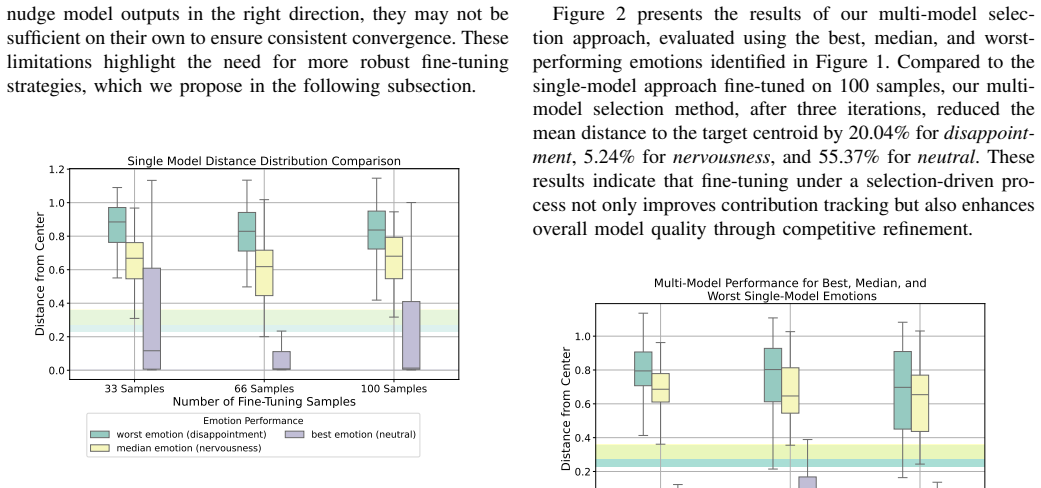
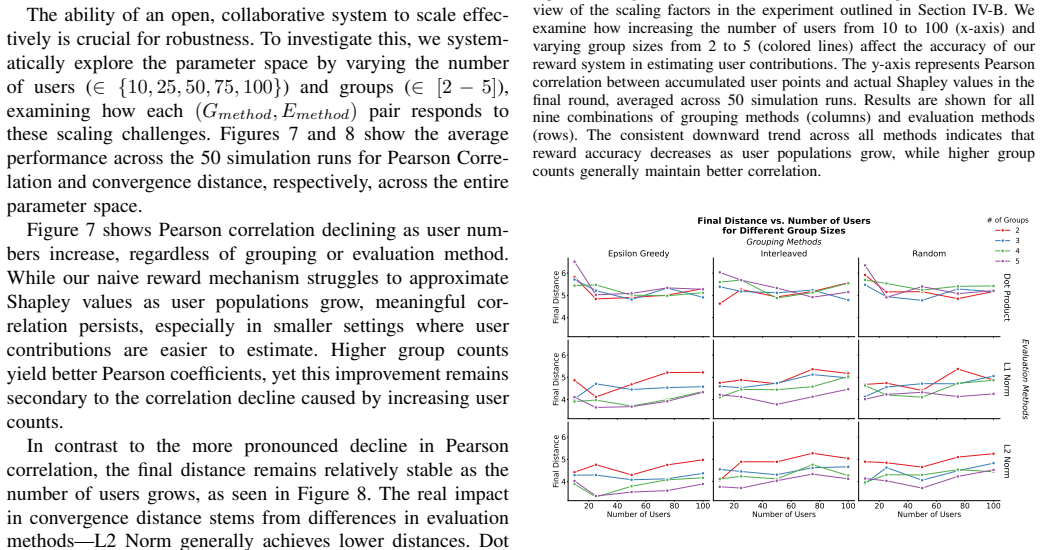
On the paper's own terms, the central discovery is that introducing selection pressure among multiple fine-tuned variants makes alignment more reliable: with the same 100-sample feedback pool, competitive selection of the best of three clones per iteration reduced mean distance to the target centroid by 20.04% (disappointment), 5.24% (nervousness), and 55.37% (neutral) relative to single-model SFT, and improved all 28 emotions in the corpus. In a separate preference-space simulation using movie-genre preference data, accumulated points from a tournament rank reward correlate with approximate Shapley values, with random and interleaved grouping producing higher correlation than deterministic grouping, meaning the reward system can approximate fair contribution tracking. The paper also reports a trade-off: L2-norm evaluation gives the best convergence distance, while dot-product evaluation gives the best Shapley correlation, and reward fairness degrades as the number of users grows.
Load-bearing premise
All convergence and fairness numbers come from a simulation where fine-tuning is modeled as a straight-line step toward a group's weighted preference centroid, with a step size $\delta$ that is never reported; if real SFT does not move model weights that way, the measured 20–55% improvements and Shapley correlations may not transfer to actual LLMs.
Editorial extensions
If this is right
- Multi-model selection reduces target distance in all 28 emotions in the text experiment, not just the three highlighted cases.
- A rank-based point reward can stand in for Shapley values, avoiding the combinatorial cost of exact Shapley computation.
- Injecting randomness into user grouping improves both convergence and reward fairness compared to deterministic grouping.
- The method choice involves a trade-off: L2 norm minimizes convergence distance, while dot product maximizes contribution-tracking accuracy.
- Scaling to larger user populations weakens reward fairness, so the point mechanism needs revision before open deployment at scale.
Reading between the lines
- If the linear-centroid update is a faithful proxy, the reported 55% improvement should be sensitive to the step size $\delta$; varying $\delta$ across simulations would map how much the headline number depends on this un-reported parameter.
- The same tournament-with-points design could be lifted into RLHF by treating the reward model, not the policy, as the object being crowd-updated, an extension the paper names but does not test.
- The Shapley-correlation decline with user count suggests that orthogonalization, clustering, or stratified sampling of users may be needed to keep contribution estimates fair at internet scale.
- The preference-space framing is general enough that the mechanism could be tested in non-text settings, such as community-driven recommendation or content moderation, where a defined target vector exists.
Editorial analysis
A structured set of objections, weighed in public.
Referee Report
Summary. The paper proposes Crowd-SFT, an iterative crowdsourced fine-tuning framework in which users are partitioned into groups, each group fine-tunes a model instance, the best model advances via an evaluation function, and users receive point rewards based on their group's rank. Experiment 1 (Section III) measures LLM fine-tuning as movement in a GoEmotions-derived emotion embedding space and reports that a competitive multi-model selection strategy reduces mean distance to an emotion target by up to 55.37% relative to single-model fine-tuning. Experiment 2 (Section IV) replaces LLMs with a MovieLens-based simulation that updates a model point by δ toward a group's weighted preference centroid, and reports Pearson correlations between accumulated user points and estimated Shapley values across grouping and evaluation methods. The paper concludes that the framework yields fair, scalable contribution tracking and improved convergence.
Significance. If the claims held, the framework would address a real bottleneck in SFT and RLHF annotation: the cost and homogeneity of small annotator pools. The contribution-tracking idea (tournament selection plus Shapley-correlated point rewards) is timely and the authors make several good-faith empirical gestures: they use a real LLM and a real emotion classifier in Section III, they provide the code at a public repository, and Section VI acknowledges the lack of real-world validation. However, the central fairness claim is validated only inside a linear-centroid simulation that is never calibrated to actual SFT, and the headline convergence claim is not controlled for training compute. The paper is best read as a proof-of-concept whose central claims require substantial additional evidence before they can be accepted as applying to LLM alignment.
major comments (4)
- [Section IV-B, Eq. (1)] The model update M_candidate,g(t) = M_t + δ(C_g(t) − M_t) is asserted without derivation or calibration; δ is never reported or varied. Because all reward-fairness results (Pearson correlations in Section IV-C and Figures 6–8) are produced inside this linear-centroid model, the Shapley-correlation evidence is not evidence about LLM fine-tuning unless this update is shown to faithfully represent SFT dynamics. A concrete fix is to calibrate the simulation to the distance trajectories measured in Section III-B, or to replace the assumed update with an empirical one derived from fine-tuning checkpoints, and to report sensitivity of the Pearson correlations to δ.
- [Section III-B] The claimed 20.04%, 5.24%, and 55.37% reductions are not controlled for total training compute or number of updates. The single-model baseline is one fine-tuning run of 100 samples (Section III-A), while the multi-model condition uses three clones per iteration for three iterations, removing the winner's samples after each round; this means the multi-model condition performs more fine-tuning runs and sees a different data schedule. To support the attribution to 'selection pressure' rather than to extra compute or data splitting, the authors should report epochs, total sample-updates, and include a same-compute control (e.g., selecting the best of three independent single runs without iterative advancement).
- [Section IV-B, step 6] The Shapley ground truth is not defined. The authors state that 'we compute the estimated Shapley values for each user and compare them to their accumulated points,' but the characteristic function v(S) over user subsets is never specified, nor is it explained how KernelSHAP is applied to this game. Without v(S), the reported Pearson correlations in Figures 6–8 cannot be reproduced or interpreted. Moreover, because the point rewards are based on the same distance-to-expert ranking used to define the implied game, the correlation may be partly built into the setup; the authors should define v(S) explicitly and, ideally, validate the point rule against a Shapley value computed from a separate, held-out measure of model quality.
- [Sections III-B and IV-C] No statistical tests are reported. The headline improvements and the grouping/evaluation method rankings are based on means over 50 prompts or 50 simulation runs, with no confidence intervals or hypothesis tests; Table I's winning percentages do not convey whether the differences are meaningful. The authors should provide significance tests and effect sizes for the central comparisons, including the claimed 55% reduction and the Dot Product versus L2 Norm trade-off.
minor comments (6)
- [Abstract and Section III-B] The abstract's '55% reduction' refers to the best emotion (neutral) at the third iteration; please report the median and range across all 28 emotions and qualify the claim accordingly.
- [Abstract] The phrase 'over single-model selection' should be 'over single-model fine-tuning,' since the baseline in Section III-A has no selection mechanism.
- [Section IV-B] The number of users, number of groups, number of rounds, and MovieLens preprocessing (normalization, genres used) should be stated in the setup rather than only in figure captions; '50 users and 3 groups' appears only in the Figure 6 caption.
- [Section IV-B, Eq. (2)] The notation Δ_g = m − argsort(E_method(M_candidate,g(t), E)) is ambiguous; define whether argsort returns an ascending or descending rank and clarify how ties are broken.
- [Figure 6] The y-axis label 'Average Inverse Pearson Correlation' is undefined; if it is the reciprocal of r, it is not defined for correlations near zero. Plot the raw correlation (with error bars) or define the transformation explicitly.
- [Section VI] The term 'winner-takes-most' is vague; the reward rule gives m, m−1, ..., 1 points to all groups, so describe the rule precisely (e.g., rank-based decreasing rewards) rather than using this term.
Circularity Check
No circularity found: Experiment 1 is a fixed-metric algorithmic comparison on real LLM fine-tuning, and Experiment 2's Shapley correlation is an internal consistency check of a rank-based approximation inside an explicitly synthetic model, not an independent validation presented as derived from its own outputs.
full rationale
The paper's two experiments are self-contained but disconnected. Experiment 1 (Section III) is an empirical, fixed-metric comparison: models are fine-tuned on the same GoEmotions neighbor pool, evaluated by the same distance-to-centroid metric used for selection, and single-model versus multi-model outcomes are compared. Selecting the model with minimal distance and then reporting that same distance is the algorithm being tested, not a hidden fit or a quantity defined circularly in terms of the reported improvement. The comparison could have failed; the reported 20.04%, 5.24%, and 55.37% reductions are contingent empirical results for specific emotions. Experiment 2 (Section IV-B) is explicitly synthetic: fine-tuning is defined as M_candidate,g(t) = M_t + delta(C_g(t) - M_t), points are awarded by ranking E_method(M_candidate,g(t), E), and Shapley values are approximated with KernelSHAP on the same distance-to-expert function. The resulting Pearson correlation therefore measures how well a simple rank-based rule recovers an additive attribution of the same linear distance function. This is an internal consistency check, not an independent empirical validation of fairness in real SFT, and it is not circular: the point rule is not defined in terms of Shapley values, the correlation is not 1 by construction, and the paper reports method-dependent trade-offs (Table I, Figures 6-8). The paper itself concedes the scope limitation in Section VI: 'A critical next step is validating the framework in real-world settings with human participants.' There are no load-bearing self-citations, no fitted parameters renamed as predictions, and no uniqueness theorem imported from the authors. The main risks are external validity and the under-specified Shapley characteristic function, neither of which constitutes circular derivation.
Assumptions & free parameters
free parameters (4)
- delta (update step size)
- k (nearest-neighbor count) =
100
- selection noise rate =
0.05
- number of clones per iteration =
3
assumptions (4)
- domain assumption Euclidean distance between output embeddings and a target centroid measures model alignment quality.
- ad hoc to paper Fine-tuning can be represented as a linear step toward the weighted centroid of a group's preference vectors.
- domain assumption KernelSHAP yields valid estimates of individual user contributions in the simulated game.
- domain assumption Users are honest and consistent, and the expert target is a fixed preference vector.
Cite this review
Pith. "Pith review of Crowd-SFT: Crowdsourcing for LLM Alignment." pith.science (2026). https://pith.science/paper/L7T35TI3
@misc{pith2026250604063,
  author       = {Pith},
  title        = {Pith review of: Crowd-SFT: Crowdsourcing for LLM Alignment},
  year         = {2026},
  howpublished = {\url{https://pith.science/paper/L7T35TI3}},
  note         = {Machine review of arXiv:2506.04063}
}
read the original abstract
Large Language Models (LLMs) increasingly rely on Supervised Fine-Tuning (SFT) and Reinforcement Learning from Human Feedback (RLHF) to align model responses with human preferences. While RLHF employs a reinforcement learning approach with a separate reward model, SFT uses human-curated datasets for supervised learning. Both approaches traditionally depend on small, vetted groups of annotators, making them costly, prone to bias, and limited in scalability. We propose an open, crowd-sourced fine-tuning framework that addresses these limitations by enabling broader feedback collection for SFT without extensive annotator training. Our framework promotes incentive fairness via a point-based reward system correlated with Shapley values and guides model convergence through iterative model updates. Our multi-model selection framework demonstrates up to a 55% reduction in target distance over single-model selection, enabling subsequent experiments that validate our point-based reward mechanism's close alignment with Shapley values (a well-established method for attributing individual contributions) thereby supporting fair and scalable participation.
Figures


Figures from the paper (2 more)

Reference graph
Works this paper leans on
-
[1]
Aligning large language models with human: A survey,
Y . Wang, W. Zhong, L. Li, F. Mi, X. Zeng, W. Huang, L. Shang, X. Jiang, and Q. Liu, “Aligning large language models with human: A survey,” 2023. [Online]. Available: https://arxiv.org/abs/2307.12966
arXiv 2023
-
[2]
Open problems and fundamental limitations of reinforcement learning from human feedback,
S. Casper, X. Davies, C. Shi, T. K. Gilbert, J. Scheurer, J. Rando, R. Freedman, T. Korbak, D. Lindner, P. Freire, T. Wang, S. Marks, C.-R. Segerie, M. Carroll, A. Peng, P. Christoffersen, M. Damani, S. Slocum, U. Anwar, A. Siththaranjan, M. Nadeau, E. J. Michaud, J. Pfau, D. Krasheninnikov, X. Chen, L. Langosco, P. Hase, E. Bıyık, A. Dragan, D. Krueger, ...
arXiv 2023
-
[3]
Training a Helpful and Harmless Assis- tant with Reinforcement Learning from Human Feedback,
Y . Bai, A. Jones, K. Ndousse, A. Askell, A. Chen, N. DasSarma, D. Drain, S. Fort, D. Ganguli, T. Henighan, N. Joseph, S. Kadavath, J. Kernion, T. Conerly, S. El-Showk, N. Elhage, Z. Hatfield-Dodds, D. Hernandez, T. Hume, S. Johnston, S. Kravec, L. Lovitt, N. Nanda, C. Olsson, D. Amodei, T. Brown, J. Clark, S. McCandlish, C. Olah, B. Mann, and J. Kaplan, ...
arXiv 2022
-
[4]
Training language models to follow instructions with human feedback,
L. Ouyang, J. Wu, X. Jiang, D. Almeida, C. L. Wainwright, P. Mishkin, C. Zhang, S. Agarwal, K. Slama, A. Ray, J. Schulman, J. Hilton, F. Kelton, L. Miller, M. Simens, A. Askell, P. Welinder, P. Christiano, J. Leike, and R. Lowe, “Training language models to follow instructions with human feedback,” 2022. [Online]. Available: https://arxiv.org/abs/2203.02155
arXiv 2022
-
[5]
Chatbot arena: An open platform for evaluating llms by human preference,
W.-L. Chiang, L. Zheng, Y . Sheng, A. N. Angelopoulos, T. Li, D. Li, H. Zhang, B. Zhu, M. Jordan, J. E. Gonzalez, and I. Stoica, “Chatbot arena: An open platform for evaluating llms by human preference,”
-
[6]
Varco arena: A tournament approach to reference-free benchmarking large language models,
S. Son, J.-M. Oh, H. Jin, C. Jang, J. Jeong, and K. Kim, “Varco arena: A tournament approach to reference-free benchmarking large language models,” 2024. [Online]. Available: https://arxiv.org/abs/2411.01281
arXiv 2024
-
[7]
A Marketplace for Data: An Algorithmic Solution,
A. Agarwal, M. Dahleh, and T. Sarkar, “A Marketplace for Data: An Algorithmic Solution,” in Proceedings of the 2019 ACM Conference on Economics and Computation , ser. EC ’19. New York, NY , USA: Association for Computing Machinery, Jun. 2019, pp. 701–726
work page 2019
-
[8]
Transparent Contribution Evaluation for Secure Federated Learning on Blockchain
S. Ma, Y . Cao, and L. Xiong, “Transparent Contribution Evaluation for Secure Federated Learning on Blockchain.” IEEE Computer Society, Apr. 2021, pp. 88–91
work page 2021
Show all 12 references
-
[9]
Goemotions: A dataset of fine-grained emotions,
D. Demszky, D. Movshovitz-Attias, J. Ko, A. Cowen, G. Nemade, and S. Ravi, “Goemotions: A dataset of fine-grained emotions,” 2020. [Online]. Available: https://arxiv.org/abs/2005.00547
2020 arXiv
-
[10]
A unified approach to interpreting model predictions,
S. M. Lundberg and S.-I. Lee, “A unified approach to interpreting model predictions,” in Proceedings of the 31st International Conference on Neural Information Processing Systems , ser. NIPS’17. Red Hook, NY , USA: Curran Associates Inc., 2017, pp. 4768–4777
2017
-
[11]
Improving kernelshap: Practical shapley value estimation using linear regression,
I. Covert and S.-I. Lee, “Improving kernelshap: Practical shapley value estimation using linear regression,” in Proceedings of The 24th International Conference on Artificial Intelligence and Statistics , ser. Proceedings of Machine Learning Research, A. Banerjee and K. Fukumi...
2021
-
[2024]
Available: https://arxiv.org/abs/2403.04132
[Online]. Available: https://arxiv.org/abs/2403.04132
Reviewed August 7, 2026 · model on record in the stance chip above.
Discussion (0). Sign in to comment.