Adaptive tuning of Hamiltonian Monte Carlo methods
Pith reviewed 2026-05-19 11:54 UTC · model grok-4.3
The pith
Adaptive tuning selects system-specific integrators and hyperparameters for HMC using Gaussian analysis and burn-in data.
A machine-rendered reading of the paper's core claim, the machinery that carries it, and where it could break.
Core claim
The Adaptive Tuning (ATune) procedure detects a problem-specific splitting integrator and credible hyperparameter values by combining closed-form guidance from the multivariate Gaussian model with statistics generated in the burn-in stage, thereby removing settings that produce resonance artifacts or poor mixing and yielding superior stability, performance, and accuracy for both standard and generalized HMC relative to conventional heuristic tuning.
What carries the argument
The ATune procedure, which fuses multivariate-Gaussian theoretical analysis with burn-in simulation statistics to choose a splitting integrator and hyperparameter set including randomization intervals.
If this is right
- Adaptively tuned standard and generalized HMC exhibit higher stability, performance, and accuracy than heuristically tuned HMC with established integrators.
- Generalized HMC achieves higher sampling performance than standard HMC when both are adaptively tuned.
- The method introduces no extra computational cost during production simulations and can be added to any existing HMC-based Bayesian inference package.
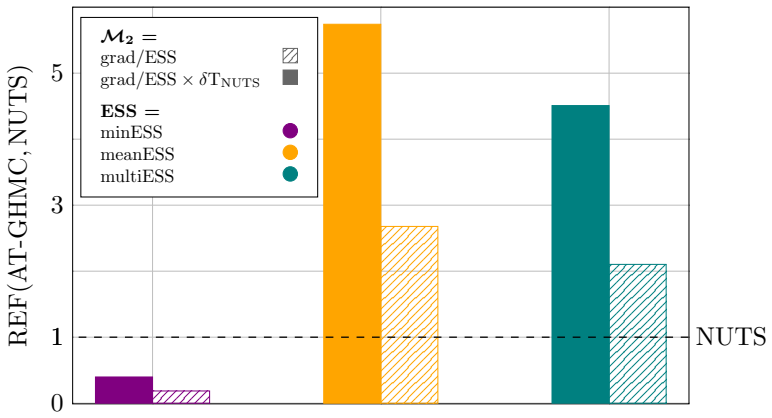
- In real-world tasks such as endocrine-therapy-resistance modeling and epidemic-outbreak simulation, the tuned samplers compare favorably with NUTS.
Where Pith is reading between the lines
- The same burn-in-plus-theory recipe could be tested on other gradient-based samplers to see whether automatic integrator selection reduces manual tuning effort across MCMC families.
- If the Gaussian-derived intervals prove robust, practitioners could run short pilot simulations once and reuse the resulting parameter ranges for repeated inference on similar data sets.
- In high-dimensional latent-variable models common in machine learning, removing resonance-prone settings early might shorten the time needed to reach reliable posterior estimates.
Load-bearing premise
Recommendations derived from the multivariate Gaussian model remain effective when transferred to the non-Gaussian target distributions that appear in real applications.
What would settle it
Apply the adaptively chosen integrator and hyperparameters to a distinctly non-Gaussian model and check whether sampling stability, accuracy, and effective sample size remain clearly better than heuristic tuning; repeated failure on such models would disprove the transfer claim.
Figures


read the original abstract
With the recently increased interest in probabilistic models, the efficiency of an underlying sampler becomes a crucial consideration. Hamiltonian Monte Carlo (HMC) is one popular option for models of this kind. Performance of the method, however, strongly relies on a choice of parameters associated with an integration for Hamiltonian equations. Up to date, such a choice remains mainly heuristic or introduces time complexity. We propose a novel computationally inexpensive and flexible approach (we call it Adaptive Tuning or ATune) that, by combining a theoretical analysis of the multivariate Gaussian model with simulation data generated during a burn-in stage of a HMC simulation, detects a system specific splitting integrator with a set of reliable sampler's hyperparameters, including their credible randomization intervals, to be readily used in a production simulation. The method automatically eliminates those values of simulation parameters which could cause undesired extreme scenarios, such as resonance artifacts, low accuracy or poor sampling. The new approach is implemented in the in-house software package HaiCS, with no computational overheads introduced in a production simulation, and can be easily incorporated in any package for Bayesian inference with HMC. The tests on popular statistical models reveal the superiority of adaptively tuned standard and generalized HMC methods in terms of stability, performance and accuracy over conventional HMC tuned heuristically and coupled with the well-established integrators. We also claim that the generalized HMC is preferable for achieving high sampling performance. The efficiency of the new methodology is assessed in comparison with state-of-the-art samplers, e.g. NUTS, in real-world applications, such as endocrine therapy resistance in cancer, modeling of cell-cell adhesion dynamics and influenza A epidemic outbreak.
Editorial analysis
A structured set of objections, weighed in public.
Referee Report
Summary. The manuscript proposes ATune, a method for adaptive tuning of Hamiltonian Monte Carlo (HMC) that combines a theoretical analysis performed on the multivariate Gaussian model to select splitting integrators and credible randomization intervals for hyperparameters with empirical data collected during a burn-in stage to eliminate unsuitable parameter values that could cause resonance, low accuracy or poor sampling. The approach is implemented in the HaiCS package with no production overhead and is tested on statistical models plus three real-world applications (endocrine therapy resistance, cell-cell adhesion, influenza A outbreak), claiming improved stability, performance and accuracy over heuristically tuned standard HMC and NUTS, while asserting that generalized HMC is preferable for high sampling efficiency.
Significance. If the Gaussian-derived integrator and hyperparameter choices transfer reliably to non-Gaussian targets, the method supplies a practical, low-overhead alternative to heuristic or expensive tuning procedures for HMC in Bayesian inference. The reported empirical comparisons on real applications demonstrate concrete gains in stability and effective sample size, and the automatic elimination of pathological parameter regimes plus provision of randomization intervals constitute useful engineering contributions that could be adopted in existing HMC software.
major comments (3)
- [§3] §3 (Gaussian theoretical analysis): the integrator and hyperparameter recommendations (including credible randomization intervals) are derived exclusively under the multivariate Gaussian assumption; no error bound, sensitivity analysis, or transfer theorem is provided quantifying performance degradation when the target deviates from quadratic potentials, yet these fixed choices are applied unchanged to the non-Gaussian models in §5.1–5.3. This assumption is load-bearing for the central superiority claim.
- [§4–5] §4–5 (experimental comparisons): all reported gains are measured against heuristically tuned HMC and NUTS; no baseline using target-specific optimal tuning (or an oracle) is included, so it remains unclear whether the observed improvements in ESS and stability arise from the adaptive procedure itself or simply from avoiding poor heuristic choices.
- [§5.2] §5.2 (cell adhesion application): the claim that generalized HMC is preferable for high sampling performance rests on the same unverified transfer of Gaussian-optimal splitting; the reported metrics do not isolate whether the advantage persists after controlling for the specific integrator chosen by ATune.
minor comments (3)
- [§2] The notation distinguishing 'credible randomization intervals' from ordinary credible intervals should be introduced explicitly in §2 to avoid reader confusion.
- [§4] Figure captions in §4 would benefit from stating the exact number of independent runs and the burn-in length used for each method.
- A short discussion of how ATune interacts with existing adaptive HMC literature (e.g., NUTS) would clarify novelty.
Simulated Author's Rebuttal
We thank the referee for the constructive and detailed comments on our manuscript. We address each major comment point by point below, providing the strongest honest defense of the work while acknowledging where revisions are warranted to improve clarity and rigor.
read point-by-point responses
-
Referee: [§3] §3 (Gaussian theoretical analysis): the integrator and hyperparameter recommendations (including credible randomization intervals) are derived exclusively under the multivariate Gaussian assumption; no error bound, sensitivity analysis, or transfer theorem is provided quantifying performance degradation when the target deviates from quadratic potentials, yet these fixed choices are applied unchanged to the non-Gaussian models in §5.1–5.3. This assumption is load-bearing for the central superiority claim.
Authors: We agree that the derivations in §3 rely on the multivariate Gaussian model, which permits exact analysis of resonance, stability, and optimal hyperparameter regimes for quadratic potentials. This choice follows standard practice in the HMC literature for obtaining closed-form insights. The ATune method is not limited to these fixed Gaussian-derived values; it explicitly combines them with burn-in simulation data collected from the actual target distribution to eliminate pathological parameter regimes and define credible randomization intervals. While the current manuscript does not include a formal transfer theorem or quantitative error bounds for non-quadratic potentials, the empirical results across the statistical models in §5.1 and the three real-world applications in §5.2–5.3 provide evidence that the recommendations transfer effectively in practice. To address the concern directly, we will add a dedicated paragraph in the revised §3 and a limitations subsection in the discussion that acknowledges the Gaussian assumption, references related robustness studies, and outlines directions for future sensitivity analysis. revision: partial
-
Referee: [§4–5] §4–5 (experimental comparisons): all reported gains are measured against heuristically tuned HMC and NUTS; no baseline using target-specific optimal tuning (or an oracle) is included, so it remains unclear whether the observed improvements in ESS and stability arise from the adaptive procedure itself or simply from avoiding poor heuristic choices.
Authors: The experimental comparisons in §4 and §5 are intentionally made against heuristically tuned HMC (using common default integrators and hand-tuned step sizes) and against NUTS, as these represent the practical baselines most users employ. An oracle baseline that supplies target-specific optimal parameters a priori is not included because determining such optima typically requires exhaustive search or prior knowledge that is unavailable in realistic Bayesian inference settings; this would undermine the goal of an automatic, low-overhead tuning procedure. The reported gains therefore reflect improvement relative to standard practice rather than an absolute optimum. We will revise the opening paragraphs of §4 and the discussion in §5 to explicitly articulate this rationale and to note that ATune’s contribution is the automatic avoidance of poor regimes without incurring the cost of oracle-level tuning. revision: partial
-
Referee: [§5.2] §5.2 (cell adhesion application): the claim that generalized HMC is preferable for high sampling performance rests on the same unverified transfer of Gaussian-optimal splitting; the reported metrics do not isolate whether the advantage persists after controlling for the specific integrator chosen by ATune.
Authors: In §5.2 the generalized HMC variant is run with the integrator and hyperparameter set that ATune selects specifically for the cell-cell adhesion model; the same adaptive procedure is applied to the standard HMC variant for a fair comparison. The observed improvements in ESS and stability therefore occur under consistent, model-specific tuning rather than under a fixed Gaussian-derived integrator. To make this isolation clearer, we will add a short explanatory sentence in §5.2 stating that both variants receive the benefit of ATune’s adaptive selection and that the performance differential is measured under those tuned conditions. If space allows, we will also include a brief note on the selected integrators for each variant. revision: yes
Circularity Check
No significant circularity; derivation combines independent Gaussian theory with target-specific burn-in data
full rationale
The paper grounds integrator and hyperparameter selection in a separate theoretical analysis performed on the multivariate Gaussian model, then augments it with fresh simulation data collected during burn-in on the actual target distribution to eliminate unsuitable parameter values. This process is not self-definitional, nor does any claimed result reduce by construction to a fitted input or prior self-citation. The final performance claims are supported by direct comparisons against heuristic HMC, NUTS, and other baselines on real-world non-Gaussian models, providing external benchmarks rather than tautological validation. No load-bearing step equates the output to the input by definition or renames a known result as a novel derivation.
Axiom & Free-Parameter Ledger
free parameters (1)
- credible randomization intervals for hyperparameters
axioms (1)
- domain assumption Multivariate Gaussian distributions admit closed-form or easily analyzable behavior under splitting integrators that can guide hyperparameter choice for more general targets.
Reference graph
Works this paper leans on
-
[1]
S.Duane, A.Kennedy, B.J.Pendleton, D.Roweth, HybridMonteCarlo, Physics Letters B 195 (2) (1987) 216–222.doi:https://doi.org/10. 49 1016/0370-2693(87)91197-X
work page 1987
-
[2]
R. M. Neal, MCMC using Hamiltonian dynamics, Handbook of Markov Chain Monte Carlo 2 (11) (2011) 2.doi:10.1201/b10905-6
- [3]
-
[4]
Optimizing The Integrator Step Size for Hamiltonian Monte Carlo
M. Betancourt, S. Byrne, M. Girolami, Optimizing The Integrator Step Size for Hamiltonian Monte Carlo, arXiv preprint, arXiv:1411.6669 (2014). doi:10.48550/arXiv.1411.6669
work page internal anchor Pith review Pith/arXiv arXiv doi:10.48550/arxiv.1411.6669 2014
-
[5]
M. D. Hoffman, A. Gelman, The No-U-Turn sampler: adaptively setting path lengths in Hamiltonian Monte Carlo., Journal of Machine Learning Research 15 (1) (2014) 1593–1623. URL https://www.jmlr.org/papers/volume15/hoffman14a/ hoffman14a.pdf
work page 2014
-
[6]
L. Verlet, Computer "Experiments" on Classical Fluids. I. Thermody- namical Properties of Lennard-Jones Molecules, Physical Review 159 (1967) 98–103.doi:10.1103/PhysRev.159.98
-
[7]
W. C. Swope, H. C. Andersen, P. H. Berens, K. R. Wilson, A computer simulation method for the calculation of equilibrium constants for the formation of physical clusters of molecules: Application to small water clusters, The Journal of Chemical Physics 76 (1) (1982) 637–649.doi: 10.1063/1.442716
-
[8]
R. I. McLachlan, On the Numerical Integration of Ordinary Differen- tial Equations by Symmetric Composition Methods, SIAM Journal on Scientific Computing 16 (1) (1995) 151–168.doi:10.1137/0916010
-
[9]
T. Takaishi, P. de Forcrand, Testing and tuning symplectic integrators for the hybrid Monte Carlo algorithm in lattice QCD, Physical Review E 73 (2006) 036706.doi:10.1103/PhysRevE.73.036706
-
[10]
S. Blanes, F. Casas, J. M. Sanz-Serna, Numerical integrators for the Hybrid Monte Carlo method, SIAM Journal on Scientific Computing 36 (4) (2014) A1556–A1580.doi:10.1137/130932740. 50
-
[11]
M. Fernández-Pendás, E. Akhmatskaya, J. M. Sanz-Serna, Adaptive multi-stage integrators for optimal energy conservation in molecular simulations, Journal of Computational Physics 327 (2016) 434–449. doi:10.1016/j.jcp.2016.09.035
-
[12]
E. Akhmatskaya, M. Fernández-Pendás, T. Radivojević, J. M. Sanz- Serna, Adaptive Splitting Integrators for Enhancing Sampling Efficiency of Modified Hamiltonian Monte Carlo Methods in Molecular Simulation, Langmuir 33 (42) (2017) 11530–11542, pMID: 28689416.doi:10.1021/ acs.langmuir.7b01372
work page 2017
-
[13]
T. Radivojević, M. Fernández-Pendás, J. M. Sanz-Serna, E. Akhmatskaya, Multi-stage splitting integrators for sampling with modified Hamiltonian Monte Carlo methods, Journal of Computational Physics 373 (2018) 900–916.doi:10.1016/j.jcp.2018.07.023
-
[14]
L. Nagar, M. Fernández-Pendás, J. M. Sanz-Serna, E. Akhmatskaya, Adaptive multi-stage integration schemes for Hamiltonian Monte Carlo, Journal of Computational Physics 502 (2024) 112800.doi:10.1016/j. jcp.2024.112800
work page doi:10.1016/j 2024
-
[15]
C. Tamborrino, F. Diele, C. Marangi, C. Tarantino, Adaptive parame- ters tuning based on energy-preserving splitting integration for Hamil- tonian Monte Carlo Method, Communications in Nonlinear Science and Numerical Simulation 137 (2024) 108168.doi:10.1016/j.cnsns.2024. 108168
-
[16]
N. Bou-Rabee, J. M. Sanz-Serna, Geometric integrators and the Hamil- tonian Monte Carlo method, Acta Numerica 27 (2018) 113–206.doi: 10.1017/S0962492917000101
- [17]
-
[18]
P. B. Mackenzie, An improved hybrid Monte Carlo method, Physics Letters B 226 (1989) 369–371.doi:10.1016/0370-2693(89)91212-4
-
[19]
N. Bou-Rabee, J. M. Sanz-Serna, Randomized Hamiltonian Monte Carlo, The Annals of Applied Probability 27 (2017). doi:10.1214/ 16-AAP1255. 51
work page 2017
-
[20]
M. Girolami, B. Calderhead, Riemann Manifold Langevin and Hamil- tonian Monte Carlo Methods, Journal of the Royal Statistical Society Series B: Statistical Methodology 73 (2011) 123–214.doi:10.1111/j. 1467-9868.2010.00765.x
work page doi:10.1111/j 2011
-
[21]
C. C. Margossian, A. Gelman, For how many iterations should we run Markov chain Monte Carlo?, arXiv preprint, arXiv.2311.02726 (2023). doi:10.48550/arXiv.2311.02726
-
[22]
S. Apers, S. Gribling, D. Szilágyi, Hamiltonian Monte Carlo for ef- ficient Gaussian sampling: long and random steps, arXiv preprint, arXiv:2209.12771 (2022). doi:10.48550/arXiv.2209.12771
-
[23]
N. Bou-Rabee, B. Carpenter, M. Marsden, GIST: Gibbs self- tuning for locally adaptive Hamiltonian Monte Carlo, arXiv preprint, arXiv.2404.15253 (2024). doi:10.48550/arXiv.2404.15253
-
[24]
N. Bou-Rabee, B. Carpenter, T. S. Kleppe, M. Marsden, Incorporating Local Step-Size Adaptivity into the No-U-Turn Sampler using Gibbs Self Tuning, arXiv preprint, arXiv.2408.08259 (2024).doi:10.48550/ arXiv.2408.08259
-
[25]
doi: 10.48550/arXiv.2410.21587
C.Modi, ATLAS:AdaptingTrajectoryLengthsandStep-SizeforHamil- tonian Monte Carlo, arXiv preprint, arXiv:2410.21587 (2024). doi: 10.48550/arXiv.2410.21587
-
[26]
M. Biron-Lattes, N. Surjanovic, S. Syed, T. Campbell, A. Bouchard- Côté, autoMALA: Locally adaptive Metropolis-adjusted Langevin algorithm, in: S. Dasgupta, S. Mandt, Y. Li (Eds.), Proceedings of The 27th International Conference on Artificial Intelligence and Statistics, Vol. 238 of Proceedings of Machine Learning Research, PMLR, 2024, pp. 4600–4608. URL...
work page 2024
-
[27]
P. Sountsov, M. D. Hoffman, Focusing on Difficult Directions for Learn- ing HMC Trajectory Lengths, arXiv preprint, arXiv:2110.11576 (2021). doi:10.48550/arXiv.2110.11576
-
[28]
Y. Chen, K. Gatmiry, When does Metropolized Hamiltonian Monte Carlo provably outperform Metropolis-adjusted Langevin algorithm?, 52 arXiv preprint, arXiv:2304.04724 (2023). doi:10.48550/arXiv.2304. 04724
-
[29]
A. M. Horowitz, A generalized guided Monte Carlo algorithm, Physics Letters B 268 (2) (1991) 247–252. doi:https://doi.org/10.1016/ 0370-2693(91)90812-5
work page 1991
-
[30]
A. Kennedy, B. Pendleton, Cost of the generalised hybrid Monte Carlo algorithm for free field theory, Nuclear Physics B 607 (3) (2001) 456–510. doi:10.1016/S0550-3213(01)00129-8
-
[31]
P. Diaconis, S. Holmes, R. M. Neal, Analysis of a nonreversible Markov chain sampler, Annals of Applied Probability 10 (2000) 726–752.doi: 10.1214/AOAP/1019487508
-
[32]
M. Ottobre, Markov Chain Monte Carlo and Irreversibility, Re- ports on Mathematical Physics 77 (2016) 267–292. doi:10.1016/ S0034-4877(16)30031-3
work page 2016
-
[33]
R. M. Neal, Improving Asymptotic Variance of MCMC Estimators: Non-reversible Chains are Better, arXiv preprint, arXiv:math/0407281 (2004). doi:10.48550/arXiv.math/0407281
work page internal anchor Pith review Pith/arXiv arXiv doi:10.48550/arxiv.math/0407281 2004
-
[34]
Y. Sun, F. Gomez, J. Schmidhuber, Improving the Asymptotic Perfor- mance of Markov Chain Monte-Carlo by Inserting Vortices, Advances in Neural Information Processing Systems 23 (2010). URL https://proceedings.neurips.cc/paper/2010/hash/ 819f46e52c25763a55cc642422644317-Abstract.html
work page 2010
-
[35]
A. B. Duncan, T. Lelièvre, G. A. Pavliotis, Variance Reduction Us- ing Nonreversible Langevin Samplers, Journal of Statistical Physics 163 (2016) 457–491.doi:10.1007/S10955-016-1491-2
-
[36]
Z. Song, Z. Tan, On Irreversible Metropolis Sampling Related to Langevin Dynamics, SIAM Journal on Scientific Computing 44 (2022) A2089–A2120.doi:10.1137/21M1423701
-
[37]
Y. Fang, J. M. Sanz-Serna, R. D. Skeel, Compressible generalized hybrid Monte Carlo, The Journal of Chemical Physics 140 (2014). doi:10. 1063/1.4874000. 53
work page 2014
-
[38]
N. Gouraud, P. L. Bris, A. Majka, P. Monmarché, HMC and under- damped langevin united in the unadjusted convex smooth case, arXiv preprint, arXiv.2202.00977 (2022).doi:10.48550/arXiv.2202.00977
-
[39]
L. Riou-Durand, J. Vogrinc, Metropolis Adjusted Langevin Trajecto- ries: a robust alternative to Hamiltonian Monte Carlo, arXiv preprint, arXiv.2202.13230 (2022). doi:10.48550/arXiv.2202.13230
-
[40]
M. D. Hoffman, P. Sountsov, Tuning-Free Generalized Hamiltonian Monte Carlo (2022). URL https://proceedings.mlr.press/v151/hoffman22a.html
work page 2022
-
[41]
L. Riou-Durand, P. Sountsov, J. Vogrinc, C. C. Margossian, S. Power, Adaptive Tuning for Metropolis Adjusted Langevin Trajectories (2023). URL https://proceedings.mlr.press/v206/riou-durand23a.html
work page 2023
- [42]
-
[43]
J. Sanz-Serna, M. Calvo, Numerical Hamiltonian Problems, Chapman and Hall, London, 1994.doi:10.1137/1037075
-
[44]
Splitting and composition methods in the numerical integration of differential equations
S. Blanes, F. Casas, A. Murua, Splitting and composition methods in the numerical integration of differential equations, arXiv preprint, arXiv:0812.0377 (2008). doi:10.48550/ARXIV.0812.0377
work page internal anchor Pith review Pith/arXiv arXiv doi:10.48550/arxiv.0812.0377 2008
-
[45]
C. M. Campos, J. Sanz-Serna, Palindromic 3-stage splitting integrators, a roadmap, Journal of Computational Physics 346 (2017) 340–355.doi: 10.1016/j.jcp.2017.06.006
-
[46]
C. Predescu, R. A. Lippert, M. P. Eastwood, D. Ierardi, H. Xu, M. Ø. Jensen, K. J. Bowers, J. Gullingsrud, C. A. Rendleman, R. O. Dror, D. E. Shaw, Computationally efficient molecular dynamics integrators with improved sampling accuracy, Molecular Physics 110 (9-10) (2012) 967–983.doi:10.1080/00268976.2012.681311
-
[47]
C. J. Geyer, Practical Markov Chain Monte Carlo, Statistical Science 7 (4) (1992) 473 – 483.doi:10.1214/ss/1177011137. 54
-
[48]
Statistical Science , author =
A. Gelman, D. B. Rubin, Inference from Iterative Simulation Using Multiple Sequences, Statistical Science 7 (4) (1992) 457–472. doi: 10.1214/ss/1177011136
-
[49]
S. P. Brooks, A. Gelman, General Methods for Monitoring Convergence ofIterativeSimulations, JournalofComputationalandGraphicalStatis- tics 7 (4) (1998) 434–455.doi:10.1080/10618600.1998.10474787
-
[50]
A. Vehtari, A. Gelman, D. Simpson, B. Carpenter, P.-C. Bürkner, Rank- Normalization, Folding, and Localization: An ImprovedˆR for Assess- ing Convergence of MCMC (with Discussion), Bayesian analysis 16 (2) (2021) 667–718.doi:10.1214/20-BA1221
-
[51]
M. Plummer, N. Best, K. Cowles, K. Vines, CODA: convergence diag- nosis and output analysis for MCMC, R news 6 (1) (2006) 7–11. URL http://oro.open.ac.uk/22547/
work page 2006
-
[52]
L. Nagar, M. Fernández-Pendás, J. M. Sanz-Serna, E. Akhmatskaya, Finding the optimal integration coefficient for a palindromic multi-stage splittingintegratorinHMCapplicationstoBayesianinference, mendeley data (2023). doi:10.17632/5mmh4wcdd6.1
-
[53]
T. Radivojević, Enhancing Sampling in Computational Statistics Using Modified Hamiltonians, Ph.D.thesis, UPV/EHU,Bilbao (Spain)(2016). doi:20.500.11824/323
work page 2016
-
[54]
T. Radivojević, E. Akhmatskaya, Modified Hamiltonian Monte Carlo for Bayesian inference, Statistics and Computing 30 (2) (2020) 377–404. doi:10.1007/s11222-019-09885-x
-
[55]
H. Inouzhe, M. X. Rodríguez-Álvarez, L. Nagar, E. Akhmatskaya, Dy- namic SIR/SEIR-like models comprising a time-dependent transmission rate: Hamiltonian Monte Carlo approach with applications to COVID- 19, arXiv preprint, arXiv:2301.06385 (2023). doi:10.48550/ARXIV. 2301.06385
work page internal anchor Pith review Pith/arXiv arXiv doi:10.48550/arxiv 2023
-
[56]
J. M. Flegal, J. Hughes, D. Vats, N. Dai, K. Gupta, U. Maji, mcmcse: Monte Carlo Standard Errors for MCMC, Accessed: 2025-4-30 (2021). URL https://CRAN.R-project.org/package=mcmcse 55
work page 2025
-
[57]
D. Vats, J. M. Flegal, G. L. Jones, Multivariate output analysis for Markov chain Monte Carlo, Biometrika 106 (2019) 321–337.doi:10. 1093/biomet/asz002
work page 2019
-
[58]
J. S. Liu, Monte Carlo strategies in scientific computing, Vol. 10, Springer, New York, 2001.doi:10.1007/978-0-387-76371-2
-
[59]
Lichman, et al., UCI machine learning repository (2013)
M. Lichman, et al., UCI machine learning repository (2013). URL http://archive.ics.uci.edu/ml/index.php
work page 2013
-
[60]
M. Piva, G. Domenici, O. Iriondo, M. Rábano, B. M. Simões, V. Co- maills, I. Barredo, J. A. López-Ruiz, I. Zabalza, R. Kypta, M. d. M. Vi- vanco, Sox2 promotes tamoxifen resistance in breast cancer cells, EMBO Molecular Medicine 6 (1) (2014) 66–79.doi:10.1002/emmm.201303411
-
[61]
M. A. Mansournia, A. Geroldinger, S. Greenland, G. Heinze, Separa- tion in Logistic Regression: Causes, Consequences, and Control, Amer- ican Journal of Epidemiology 187 (2018) 864–870.doi:10.1093/aje/ kwx299
- [62]
-
[63]
Stan Development Team, Stan Modeling Language Users Guide and Reference Manual, Stan Development Team, version 2.33 (2024). URL https://mc-stan.org
work page 2024
-
[64]
Stan Development Team, RStan: the R interface to Stan, R package version 2.32.6 (2024). URL https://mc-stan.org/
work page 2024
-
[65]
N. J. Armstrong, K. J. Painter, J. A. Sherratt, A continuum approach to modelling cell-cell adhesion, Journal of Theoretical Biology 243 (1) (2006) 98–113.doi:10.1016/j.jtbi.2006.05.030
-
[66]
A. Gerisch, M. A. J. Chaplain, Mathematical modelling of cancer cell invasion of tissue: Local and non-local models and the effect of adhesion, Journal of Theoretical Biology 250 (4) (2008) 684–704.doi:10.1016/ j.jtbi.2007.10.026. 56
work page 2008
-
[67]
H. Murakawa, H. Togashi, Continuous models for cell–cell adhesion, Journal of Theoretical Biology 374 (2015) 1–12. doi:https://doi. org/10.1016/j.jtbi.2015.03.002
-
[68]
J. A. Carrillo, Y. Huang, M. Schmidtchen, Zoology of a Nonlocal Cross- Diffusion Model for Two Species, SIAM Journal on Applied Mathemat- ics 78 (2) (2018) 1078–1104.doi:10.1137/17M1128782
-
[69]
J. A. Carrillo, H. Murakawa, M. Sato, H. Togashi, O. Trush, A popula- tion dynamics model of cell-cell adhesion incorporating population pres- sure and density saturation, Journal of Theoretical Biology 474 (2019) 14–24.doi:10.1016/j.jtbi.2019.04.023
- [70]
-
[71]
doi:10.1523/JNEUROSCI.3107-18.2019
-
[72]
Modelling stripe formation in zebrafish: an agent- based approach
A. Volkening, B. Sandstede, Modelling stripe formation in zebrafish: an agent-based approach, Journal of The Royal Society Interface 12 (2015) 20150812. doi:10.1098/rsif.2015.0812
-
[73]
W. D. Martinson, A. Volkening, M. Schmidtchen, C. Venkataraman, J. A. Carrillo, Linking discrete and continuous models of cell birth and migration, Royal Society Open Science 11 (2024).doi:10.1098/rsos. 232002
-
[74]
Y. Matsunaga, M. Noda, H. Murakawa, K. Hayashi, A. Nagasaka, S. In- oue, T. Miyata, T. Miura, K. ichiro Kubo, K. Nakajima, Reelin tran- sientlypromotesN-cadherin–dependentneuronaladhesionduringmouse cortical development, Proceedings of the National Academy of Sciences of the United States of America 114 (8) (2017) 2048–2053. URL https://www.jstor.org/stab...
-
[75]
M. J. Simpson, R. E. Baker, S. T. Vittadello, O. J. MacLaren, Practi- cal parameter identifiability for spatio-temporal models of cell invasion, Journal of the Royal Society Interface 17 (2020).doi:10.1098/RSIF. 2020.0055. 57
-
[76]
C. Falcó, D. J. Cohen, J. A. Carrillo, R. E. Baker, Quantifying tis- sue growth, shape and collision via continuum models and Bayesian inference, Journal of the Royal Society Interface 20 (2023). doi: 10.1098/RSIF.2023.0184
-
[77]
M. J. Simpson, R. E. Baker, Parameter identifiability, parameter es- timation and model prediction for differential equation models, arXiv preprint, arXiv:2405.08177 (2025).doi:10.48550/arXiv.2405.08177
- [78]
-
[79]
J. A. Carrillo, A. Chertock, Y. Huang, A Finite-Volume Method for Nonlinear Nonlocal Equations with a Gradient Flow Structure, Com- munications in Computational Physics 17 (1) (2015) 233–258. doi: 10.4208/cicp.160214.010814a
-
[80]
R. Bailo, J. A. Carrillo, H. Murakawa, M. Schmidtchen, Conver- gence of a fully discrete and energy-dissipating finite-volume scheme for aggregation-diffusion equations, Mathematical Models and Meth- ods in Applied Sciences 30 (13) (2020) 2487–2522. doi:10.1142/ S0218202520500487
work page 2020
discussion (0)
Sign in with ORCID, Apple, or X to comment. Anyone can read and Pith papers without signing in.