REVIEW 2 major objections 2 minor 31 references
Complexity and Manipulation of International Kidney Exchange Programmes with Country-Specific Parameters
T0 review · 2 major / 2 minor · reviewed 2026-08-07 · deepseek-v4-flash
Pith's one-line read International kidney-exchange pools can be run by a mechanism that no country can profit by manipulating through its segment limits, and the paper pins down the exact computational and welfare price of that safety.
desk verdict The complexity dichotomy is a real contribution, but the paper's main mechanism theorem is false. read the letter →
The pith
A machine-rendered reading of the paper's core claim, the machinery that carries it, and where it could break.
The reading
What carries the argument
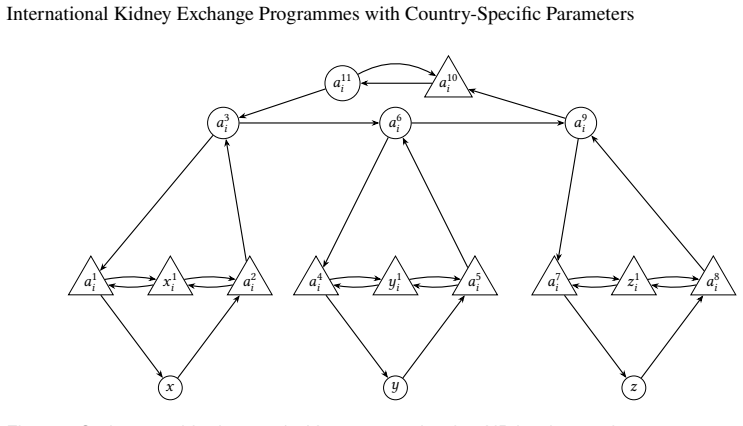
The central object is the $\Gamma$-cycle packing: a vertex-disjoint set of directed cycles in the compatibility graph, each obeying the country-specific tuple $\Gamma$ — a per-country national cycle length limit, a collectively agreed international cycle length limit (icl), and per-country caps on the size of a consecutive segment of that country's pairs inside an international cycle (iss) and on the number of such segments (isn). The hardness half of the dichotomy is carried by gadget reductions from Perfect 3-Dimensional and 4-Dimensional Matching; each gadget confines every feasible cycle to a single clause, and a 'long segment' of $m=\text{iss}_j+1$ consecutive vertices in the enclosing country blocks any cycle that would traverse two gadgets. The tractable regimes all reduce to maximum matching in a general or bipartite graph, because under those parameters every feasible cycle has length at most two or the problem decomposes cleanly by country. The mechanism $\mathcal{M}_{\text{order}}$ is carried by three components: the pre-selected maximum national packing (which secures individual rationality), the random order over candidate international cycles (which gives every feasible international cycle a selection probability of at least $1/d^*$), and the substitution rule that replaces a turnable non-$\Gamma$ cycle by a uniformly chosen sub-cycle with at most one segment per country (which makes a country's expected utility monotone under downward misreporting of its limits). The load-bearing identity is the bound $\max\{c_{\text{int}}, d^*\}$: the national pre-selection loses at most a factor $c_{\text{int}}$ against the international part of the optimum, the random selection loses at most a factor $d^*$, and the two factors combine into the maximum.
What would settle it
Systematically search all small two-country compatibility graphs and parameter values for a single instance in which a country strictly increases its expected number of transplants by declaring a lower international segment size or segment number; Theorem 4 asserts no such instance exists, so one concrete hit would refute the central mechanism claim. Independently, a polynomial-time algorithm for any parameter set outside the seven regimes listed in Theorem 2 — for instance $n=3$ with international cycle limit 3 and all other limits minimal — would falsify the claimed dichotomy.
Extended reading notes
Core claim
The paper's central claims are threefold. First, it completely classifies the complexity of Max $\Gamma$-Cycle Packing, the problem of finding a vertex-disjoint set of feasible cycles that maximises the number of transplants: for every fixed tuple $\Gamma=(n,\text{icl},\text{ncl},\text{iss},\text{isn})$, the problem is polynomial-time solvable in exactly seven regimes and NP-hard — even for the perfect-packing decision version — in every other regime, with hardness appearing already for two countries and with parameter values that are each individually tractable in the single-country setting (Theorem 2). Second, it shows that the natural maximum-packing mechanism $\mathcal{M}_{\text{int}}$ is neither individually rational nor incentive compatible, and more strongly that no mechanism can be both efficient and IR (Proposition 1) or both nonempty and IC (Proposition 4). Third, it designs $\mathcal{M}_{\text{order}}$, which pre-selects a maximum national $\Gamma$-cycle packing to secure IR and then, over the remaining graph, greedily adds international cycles in a random order, replacing each 'turnable' non-$\Gamma$ cycle by a uniformly random substitute that is itself an international $\Gamma$-cycle with at most one segment per country. The paper proves $\mathcal{M}_{\text{order}}$ is IC with respect to segment size and segment number (Theorem 4), that its approximation ratio is at most $\max\{c_{\text{int}}, d^*\}$, and that this bound is tight and asymptotically optimal because no IR mechanism can beat $c_{\text{int}}$ and no IC mechanism can beat $d^*$ (Theorems 3 and 5).
Load-bearing premise
Countries may misreport their international segment size and segment number only by declaring lower values, while their national cycle limits are public and fixed; if a country could also declare larger limits, the mechanism's incentive-compatibility guarantee is not established, and one exhibited instance already shows $\mathcal{M}_{\text{order}}$ can be manipulated through the national cycle limit.
Editorial extensions
If this is right
- Planners get an exact worst-case map: in all but seven parameter regimes, optimising an international exchange round is NP-hard even with two countries, and the seven tractable regimes reduce to matching problems solvable in polynomial time.
- The merged-pool optimum is strategically unusable: because it is neither individually rational nor incentive compatible, and because no efficient-IR or nonempty-IC mechanism exists, $\mathcal{M}_{\text{order}}$ is the first round mechanism to achieve both properties.
- The worst-case price of honesty is exactly bounded: any IR mechanism must lose a factor $c_{\text{int}}$ and any IC mechanism a factor $d^*$, and $\mathcal{M}_{\text{order}}$ attains $\max\{c_{\text{int}}, d^*\}$ — asymptotically no IR-and-IC mechanism can do better.
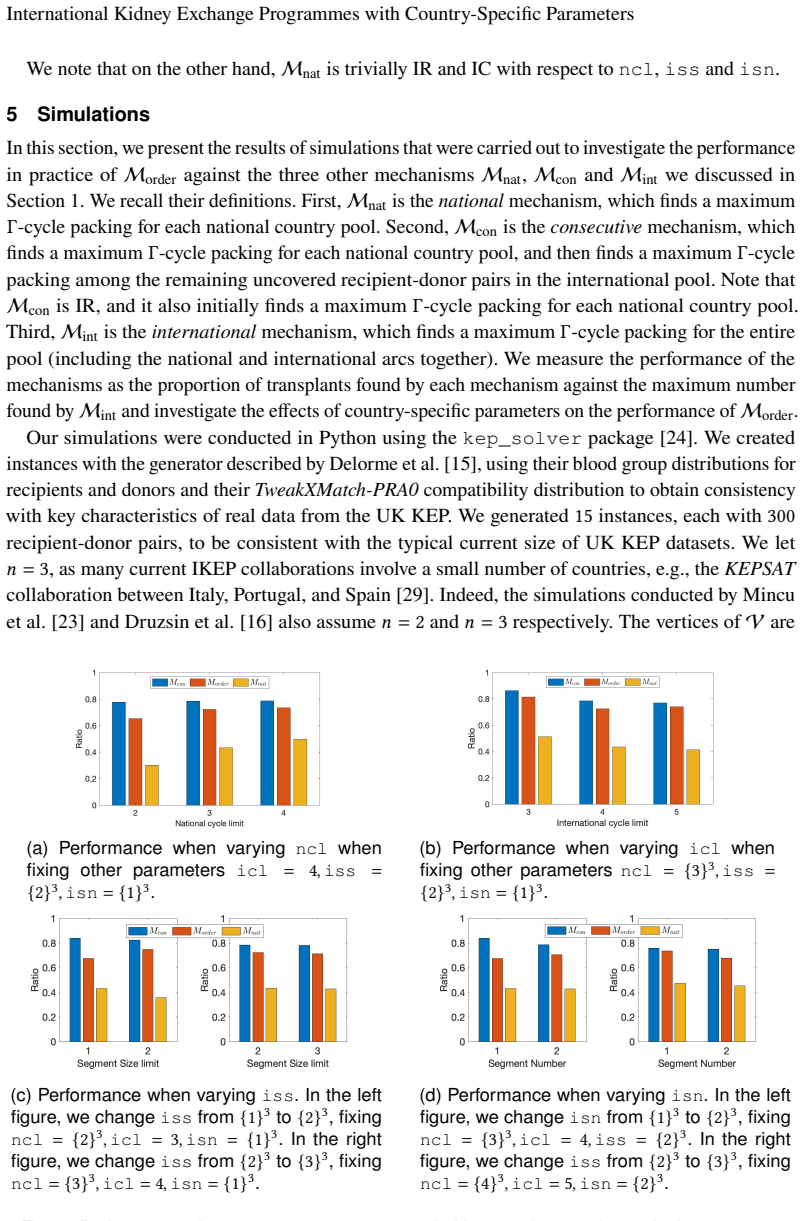
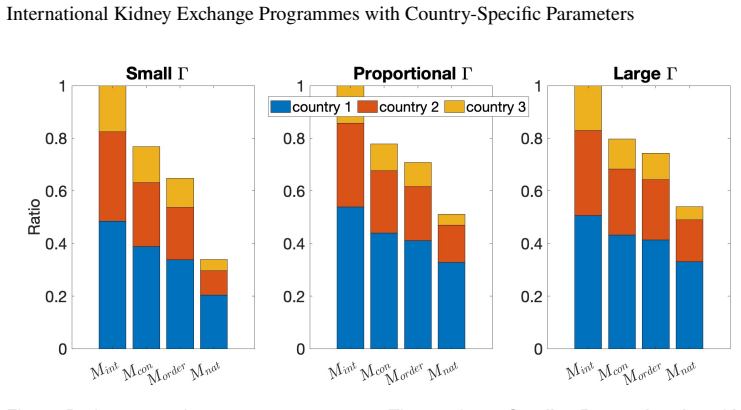
- In expectation the price is much smaller: simulations show $\mathcal{M}_{\text{order}}$ delivers about 72% of the unconstrained optimum's transplants, about 91% of the individually rational but manipulable consecutive mechanism's, and 84% more than purely national exchange.
- The guarantee stops at the international segment parameters: $\mathcal{M}_{\text{order}}$ is not IC with respect to national cycle limits, and Example 4 exhibits a country that gains by under-reporting its national limit.
Reading between the lines
- The incentive guarantee rests on the assumption that countries may only report strictly lower segment sizes or segment numbers; if manipulation were two-sided, the proof of Theorem 4 would not go through, and testing for profitable upward misreports is the most direct stress test of the design.
- The substitution trick — replacing an invalid long cycle by a uniformly random valid sub-cycle to keep expected utilities monotone — is a transferable design for other allocation problems with per-agent quota constraints, such as organ allocation with regional caps or matching with coarse priorities.
- Because the lower-bound constructions for IC mechanisms rely on very long international cycles, the manipulation risk that $\mathcal{M}_{\text{order}}$ guards against may be small in today's IKEPs; the paper itself notes the constructions become more relevant once long non-directed-donor chains are allowed.
- Completing the incentive picture requires a mechanism that is also IC with respect to national cycle limits, or a proof that no such mechanism exists — Example 4 shows the obstruction is concrete rather than a proof artefact.
Editorial analysis
A structured set of objections, weighed in public.
Referee Report
Summary. The paper studies international kidney exchange programmes with country-specific parameters, encoded as a tuple Γ. It contributes a complete complexity dichotomy for the problem of finding a maximum Γ-cycle packing (Theorem 2), and a mechanism M_order that is claimed to be individually rational (IR) and incentive compatible (IC) with respect to international segment size and segment number (Theorem 4), with an approximation ratio of at most max{c_int, d*} that is tight and asymptotically optimal (Theorem 5). The paper also reports simulations suggesting that M_order performs well in practice. The complexity dichotomy is a substantial combinatorial contribution, but the mechanism-design results contain a fundamental error: the claimed selection probabilities in the random-order greedy procedure are not correct, and Theorem 5 is false as stated.
Significance. If the complexity dichotomy is correct, it provides a complete classification of the tractability of maximum Γ-cycle packing for all parameter sets, building on and extending the single-country result of Abraham et al. This is a valuable contribution to the algorithmic kidney-exchange literature. The mechanism M_order is an interesting proposal for combining IR and IC in a multi-country setting, and the simulation study with released code and data is a useful practical addition. However, the central theoretical claims about M_order are not merely unproven; Theorem 5 is contradicted by a concrete instance, and the proof of Theorem 4 rests on a false assertion about selection probabilities. Thus the mechanism-design half of the paper, which is a headline contribution in the abstract and introduction, cannot be accepted in its current form.
major comments (2)
- [Section 4.2, Theorem 4 proof]
- [Section 4.2, Theorem 5, inequality (6)]
minor comments (2)
- [Example 1]
- [Theorem 4 proof]
Circularity Check
No significant circularity: the paper's theorems are derived from independent hardness reductions and direct probabilistic arguments, not from fitted inputs or self-citations.
full rationale
The paper's central claims are self-contained in the relevant sense. The complexity dichotomy (Theorem 2) reduces from Perfect 3-Dimensional Matching and Perfect 4-Dimensional Matching, which are independent NP-complete problems, and the only external complexity result, Theorem 1 of Abraham et al. [1], is cited for the single-country base case and is not authored by the present authors. The mechanism design results are proven directly: IR follows from Step 1 of Algorithm 1, IC is established in Theorem 4 via an explicit comparison of expected utilities under true and misreported parameters, and the approximation ratio in Theorem 5 is bounded against opt(I) using inequalities (5)-(8), with tightness and asymptotic optimality shown by constructed examples. No parameter is fitted to simulation data, and no 'prediction' is a renamed input or fitted value. The downward-only misreporting assumption is an explicitly stated modelling restriction, not a conclusion smuggled in by definition; moreover, the paper explicitly demonstrates in Example 4 that Morder is not IC with respect to ncl, which confirms the IC notion is not vacuous. The possible flaw in the selection-probability claim underlying inequality (6), if it exists, would be a correctness gap in the proof, not a circular derivation, because it does not make the theorem's conclusion equivalent to its assumptions by construction. Self-citations to prior work by the same authors appear only in related-work context or as a simulation generator, and none is load-bearing for the new theorems. Hence no circularity is present.
Assumptions & free parameters
assumptions (6)
- standard math NP-completeness of Perfect 3-Dimensional Matching and Perfect 4-Dimensional Matching
- standard math Polynomial-time solvability of maximum weight perfect matching in general and bipartite graphs, including Edmonds' algorithm
- domain assumption Countries can misreport segment size and segment number only by reporting lower values, due to resource limits
- domain assumption National cycle limits ncl_i are public knowledge and not manipulable
- domain assumption Every country is willing to participate in international cycles, so iss_i >= 1 and isn_i >= 1
- domain assumption Non-directed donors, compatible pairs, and weighted objectives are excluded from the model
Cite this review
Pith. "Pith review of Complexity and Manipulation of International Kidney Exchange Programmes with Country-Specific Parameters." pith.science (2026). https://pith.science/paper/SA3RW7PT
@misc{pith2026250604092,
  author       = {Pith},
  title        = {Pith review of: Complexity and Manipulation of International Kidney Exchange Programmes with Country-Specific Parameters},
  year         = {2026},
  howpublished = {\url{https://pith.science/paper/SA3RW7PT}},
  note         = {Machine review of arXiv:2506.04092}
}
abstract
Kidney Exchange Programmes (KEPs) facilitate the exchange of kidneys, and larger pools of recipient-donor pairs tend to yield proportionally more transplants, leading to the proposal of international KEPs (IKEPs). However, as studied by \citet{mincu2021ip}, practical limitations must be considered in IKEPs to ensure that countries remain willing to participate. Thus, we study IKEPs with country-specific parameters, represented by a tuple $\Gamma$, restricting the selected transplants to be feasible for the countries to conduct, e.g., imposing an upper limit on the number of consecutive exchanges within a country's borders. We provide a complete complexity dichotomy for the problem of finding a feasible (according to the constraints given by $\Gamma$) cycle packing with the maximum number of transplants, for every possible $\Gamma$. We also study the potential for countries to misreport their parameters to increase their allocation. As manipulation can harm the total number of transplants, we propose a novel individually rational and incentive compatible mechanism $\mathcal{M}_{\text{order}}$. We first give a theoretical approximation ratio for $\mathcal{M}_{\text{order}}$ in terms of the number of transplants, and show that the approximation ratio of $\mathcal{M}_{\text{order}}$ is asymptotically optimal. We then use simulations which suggest that, in practice, the performance of $\mathcal{M}_{\text{order}}$ is significantly better than this worst-case ratio.
Figures


Figures from the paper (17 more)





Reference graph
Works this paper leans on
-
[1]
Abraham, Avrim Blum, and Tuomas Sandholm
David J. Abraham, Avrim Blum, and Tuomas Sandholm. 2007. Clearing Algorithms for Barter Exchange Markets: Enabling Nationwide Kidney Exchanges. InProceedings of EC ’07: the 8th ACM Conference on Electronic Commerce International Kidney Exchange Programmes with Country-Specific Parameters (San Diego, California, USA). Association for Computing Machinery, N...
work page 2007
-
[2]
Nikhil Agarwal, Itai Ashlagi, Eduardo Azevedo, Clayton R Featherstone, and Ömer Karaduman. 2019. Market failure in kidney exchange.American Economic Review109, 11 (2019), 4026–4070
work page 2019
-
[3]
Itai Ashlagi and Alvin E Roth. 2014. Free riding and participation in large scale, multi-hospital kidney exchange. Theoretical Economics9, 3 (2014), 817–863
work page 2014
-
[4]
D. A. Axelrod, M. A. Schnitzler, H. Xiao, W. Irish, E. Tuttle-Newhall, S.-H. Chang, B. L. Kasiske, T. Alhamad, and K. L. Lentine. 2018. An economic assessment of contemporary kidney transplant practice.American Journal of Transplantation18 (2018), 1168–1176
work page 2018
-
[5]
Márton Benedek, Péter Biró, Walter Kern, and Daniël Paulusma. 2022. Computing Balanced Solutions for Large International Kidney Exchange Schemes. InProceedings of the 21st International Conference on Autonomous Agents and Multiagent Systems(Virtual Event, New Zealand)(AAMAS ’22). International Foundation for Autonomous Agents and Multiagent Systems, Richl...
work page 2022
-
[6]
Márton Benedek, Péter Biró, Daniel Paulusma, and Xin Ye. 2024. Computing balanced solutions for large international kidney exchange schemes.Autonomous Agents and Multi-Agent Systems38, 1 (2024), 1–41
work page 2024
-
[7]
PéterBiróandBernadetteHaase-Kromwijketal.2019. BuildingKidneyExchangeProgrammesinEurope–AnOverview of Exchange Practice and Activities.Transplantation103 (2019), 1514–1522
work page 2019
-
[8]
Péter Biró, Márton Gyetvai, Xenia Klimentova, João Pedro Pedroso, William Pettersson, and Ana Viana. 2020. Compensation Scheme With Shapley Value For Multi-Country Kidney Exchange Programmes. InProceedings of ECMS ’20: the 34th International Conference on Modelling and Simulation, Mike Steglich, Christian Mueller, Gaby Neumann, and Mathias Walther (Eds.)....
work page 2020
Show all 31 references
-
[9]
PéterBiró,BernadetteHaase-Kromwijk,TommyAndersson,EyjólfurIngiÁsgeirsson,TatianaBaltesová,IoannisBoletis, Catarina Bolotinha, Gregor Bond, Georg Böhmig, Lisa Burnapp, et al. 2019. Building Kidney Exchange Programmes in European overview of exchange practice and activities.Tran...
2019
-
[10]
Péter Biró, Walter Kern, Dömötör Pálvölgyi, and Daniel Paulusma. 2019. Generalized Matching Games for International Kidney Exchange. InProceedings of the 18th International Conference on Autonomous Agents and MultiAgent Systems (Montreal QC, Canada)(AAMAS ’19). International F...
2019
-
[11]
Valentín, and Ana Viana
Péter Biró, Joris van de Klundert, David Manlove, William Pettersson, Tommy Andersson, Lisa Burnapp, Pavel Chromy, Pablo Delgado, Piotr Dworczak, Bernadette Haase, Aline Hemke, Rachel Johnson, Xenia Klimentova, Dirk Kuypers, Alessandro Nanni Costa, Bart Smeulders, Frits Spieks...
2021
-
[12]
Danny Blom, Bart Smeulders, and Frits C. R. Spieksma. 2024. Rejection-proof mechanisms for multi-agent kidney exchange.Games and Economic Behaviour143 (2024), 25–50
2024
-
[13]
Opting into optimal matchings
AvrimBlum,IoannisCaragiannis,NikaHaghtalab,ArielDProcaccia,EviatarBProcaccia,andRohitVaish.2017. Opting into optimal matchings. InProceedings of the Twenty-Eighth Annual ACM-SIAM Symposium on Discrete Algorithms (Barcelona, Spain)(SODA ’17). ACM-SIAM, Society for Industrial an...
2017
-
[14]
Julien Combe, Victor Hiller, Olivier Tercieux, Benoît Audry, Jules Baudet, Géraldine Malaquin, François Kerbaul, Corinne Antoine, Marie-Alice Macher, Christian Jacquelinet, Olivier Bastien, and Myriam Pastural. 2022. Perspectives pouruneévolutionduprogrammededoncroisédereinsen...
2022 doi
-
[15]
MaxenceDelorme,SergioGarcía,JacekGondzio,JörgKalcsics,DavidManlove,WilliamPettersson,andJamesTrimble
-
[16]
Kristóf Druzsin, Péter Biró, Xenia Klimentova, and Rita Fleiner. 2024. Performance evaluation of national and international kidney exchange programmes with the ENCKEP simulator.Central European Journal of Operations Research32, 923–943 (2024), 1–21
2024
-
[17]
2024.European Kidney Paired Exchange Programme
European Commission. 2024.European Kidney Paired Exchange Programme. EU4Health Programme (EU4H). https: //ec.europa.eu/info/funding-tenders/opportunities/portal/screen/opportunities/projects-details/43332642/101160850
2024
-
[18]
A. Hart, J. M. Smith, M. A. Skeans, S. K. Gustafson, D. E. Stewart, W. S. Cherikh, J. L. Wainright, A. Kucheryavaya, M. Woodbury, J. J. Snyder, B. L. Kasiske, and A. K. Israni. 2017. OPTN/SRTR 2015 Annual data report: Kidney.American Journal of Transplantation17 (2017), 21–116
2017
-
[19]
Richard M. Karp. 1972.Reducibility among Combinatorial Problems. Springer US, Boston, MA, 85–103. International Kidney Exchange Programmes with Country-Specific Parameters
1972
-
[20]
Xenia Klimentova, Ana Viana, João Pedro Pedroso, and Nicolau Santos. 2021. Fairness models for multi-agent kidney exchange programmes.Omega102 (2021), 102333
2021
-
[21]
2021.Nephrology in Poland
Monika Lichodziejewska-Niemierko, Jarosław Czerwiński, Alicja Dębska-Ślizień, Ryszard Gellert, Ryszard Grenda, Jolanta Małyszko, Beata Naumnik, Michał Nowicki, Janusz Ostrowski, and Andrzej Więcek. 2021.Nephrology in Poland. Springer International Publishing, Cham, 593–606. ht...
2021 doi
-
[22]
Vazirani
Silvio Micali and Vijay V. Vazirani. 1980. An𝑂( √︁ |𝑉||𝐸|) algoithm for finding maximum matching in general graphs. In2013 IEEE 54th Annual Symposium on Foundations of Computer Science. IEEE Computer Society, Los Alamitos, CA, USA, 17–27. https://doi.org/10.1109/SFCS.1980.12
1980 doi
-
[23]
IPsolutionsforinternational kidney exchange programmes.Central European Journal of Operations Research29 (2021), 403–423
Radu-StefanMincu,PéterBiró,MártonGyetvai,AlexandruPopa,andUtkarshVerma.2021. IPsolutionsforinternational kidney exchange programmes.Central European Journal of Operations Research29 (2021), 403–423
2021
-
[24]
William Pettersson. 2022. Kep_solver: A Python package for kidney exchange programme exploration.Journal of Open Source Software7, 80 (2022), 4881
2022
-
[25]
2 (1986), 5–9
F.T.Rapaport.1986.Thecaseforalivingemotionallyrelatedinternationalkidneydonorexchangeregistry.Transplantation proceedings18(3) Suppl. 2 (1986), 5–9
1986
-
[26]
Alvin E Roth, Tayfun Sönmez, and M Utku Ünver. 2005. Pairwise kidney exchange.Journal of Economic theory125, 2 (2005), 151–188
2005
-
[27]
Zhaohong Sun, Taiki Todo, and Toby Walsh. 2021. Fair Pairwise Exchange among Groups.. InProceedings of IJCAI ’21: the30thInternationalJointConferenceonArtificialIntelligence.InternationalJointConferenceonArtificialIntelligence, Montreal, Canada, 419–425
2021
-
[28]
Panos Toulis and David C Parkes. 2015. Design and analysis of multi-hospital kidney exchange mechanisms using random graphs.Games and Economic Behavior91 (2015), 360–382
2015
-
[29]
María Oliva Valentín, Marta Garcia, Alessandro Nanni Costa, Catarina Bolotinha, Lluis Guirado, Fabio Vistoli, Alberto Breda, Pamela Fiaschetti, and Beatriz Dominguez-Gil. 2019. International cooperation for kidney exchange success. Transplantation103, 6 (2019), e180–e181
2019
-
[30]
Ilse Duus Weinreich, Tommy Andersson, Margrét Birna Andrésdóttir, Mats Bengtsson, Alireza Biglarnia, Claus Bistrup, LineBoulland,HelleBruunsgaard,IlkkaHelanterä,KulliKölvald,JouniLauronen,JørnPetterLindahl,KarinSkov,Søren Schwarz Sørensen, Lars Wennberg, and Per Lindner. 2023....
2023
-
[2022]
Improved instance generation for kidney exchange programmes.Computers & Operations Research141 (2022), 105707
2022
Reviewed August 7, 2026 · model on record in the stance chip above.
Discussion (0). Sign in to comment.