REVIEW 2 major objections 5 minor 136 references
The Near-Centaur Environment: Satellites, Rings, and Debris
T0 review · 2 major / 5 minor · reviewed 2026-08-07 · deepseek-v4-flash
Pith's one-line read This review argues that the scarcity of satellites around Centaurs compared with Kuiper Belt objects is likely real: the transition from safe trans-Neptunian orbits to planet-crossing Centaur orbits destroys binaries, so the two known…
desk verdict A solid, honest review chapter that earns its keep with a useful homogenized ring table, but its one interpretive claim about binary fractions is more speculative than the prose admits. read the letter →
The pith
A machine-rendered reading of the paper's core claim, the machinery that carries it, and where it could break.
The reading
What carries the argument
The comparison rests on the tightness metric $a_b/r_H$, the binary semimajor axis relative to the mutual Hill sphere, which distinguishes 'tight' binaries that can survive encounters from 'wide' ones that are easily disrupted. Around this metric the chapter combines three observational tools: HST direct imaging for binary detection, stellar occultations for rings and debris, and the cumulative binary fractions of dynamical classes.
What would settle it
Re-derive detection limits for all 58 Centaur and 109 GPC Hubble fields, compute bias-corrected binary fractions, and compare with identically-processed TNO fields; if the corrected Centaur fraction matches the about-10-percent hot-TNO value, the decline is mostly bias. Alternatively, discovering a wide Centaur binary with $a_b/r_H > 1\%$ would directly contradict the destruction scenario.
Extended reading notes
Core claim
The chapter consolidates the evidence that Centaur-like bodies are transitional objects whose local environment is shaped by destruction, not formation. It argues that the decreasing binary fraction from Cold Classicals (~30%), through dynamically excited trans-Neptunian populations (~10%), to the Centaur and Jupiter-family-comet populations, could very easily be a real effect and not due entirely to observational biases. The two known GPC binaries are tight (semimajor axis well below 1% of the mutual Hill radius), consistent with simulations showing that wide binaries are disrupted by scattering encounters with Neptune, and their survival over tens of Myr is unlikely—yet they exist, suggesting they are survivors of an initial fraction consistent with the source population.
Load-bearing premise
That the Hubble samples of Centaurs and TNOs are comparable enough that the raw detection fractions (0/58 and 2/109 versus roughly 10 percent) can be compared while ignoring detection biases.
Editorial extensions
If this is right
- If the decline is real, the binary fraction acts as a dynamical clock recording the integrated encounter history with the giant planets.
- The two known GPC binaries are tight, low-probability survivors, implying that most Centaur binaries have already been disrupted.
- Disrupted binaries should leave 'pairs'—objects on very similar orbits—which have not yet been searched for.
- Rings around Centaurs may be either primordial objects from the TNO region or generated by the transition; the absence of rings on small TNOs must be checked.
- Observational biases being what they are, wide Centaur binaries must be rarer than tight ones, consistent with dynamical destruction.
Reading between the lines
- If the binary-fraction decline is real, the fraction of Centaurs that are former binary members acting as 'pairs' could be used to estimate the disruption rate and the original binary fraction.
- The chapter's own call for homogeneous non-detection upper limits implies that archival HST data could be reanalyzed to settle the claim; existing HST data may already contain the answer.
- The pattern would predict that Jupiter-family comets should have essentially no binaries, which is consistent with current knowledge and testable with future occultation surveys.
Editorial analysis
A structured set of objections, weighed in public.
Referee Report
Summary. This chapter reviews the current state of knowledge on satellites, rings, and debris around Centaurs and Giant Planet Crossers (GPCs). It catalogs the known detections and non-detections, summarizes the observational techniques (stellar occultations, direct imaging, light curves, spectroscopy), compares the properties of these systems with trans-Neptunian binaries and ringed bodies, and discusses formation and confinement mechanisms. A particular strength is the consistent re-derivation of ring optical depths in Table 9.4, with explicit acknowledgment of the gray-screen assumption and the factor-of-two ambiguity in published values. The chapter concludes with a list of open questions and future prospects from JWST, LSST, and ELTs.
Significance. As a review, this chapter is a valuable synthesis of a rapidly evolving field. It provides a convenient, carefully referenced inventory of the sparse detections of satellites, rings, and debris around Centaur-like objects, and it usefully highlights the observational selection effects that complicate population-level comparisons. The consistent optical-depth tabulation is a genuine service to the community. The chapter's interpretive proposal—that the apparent deficit of Centaur binaries relative to TNOs may reflect dynamical destruction rather than observational bias—is an interesting hypothesis, but it is presented with appropriate caveats and is not overstated as a definitive finding. The overall assessment is that the chapter is reliable and informative, with several local issues that should be corrected before publication.
major comments (2)
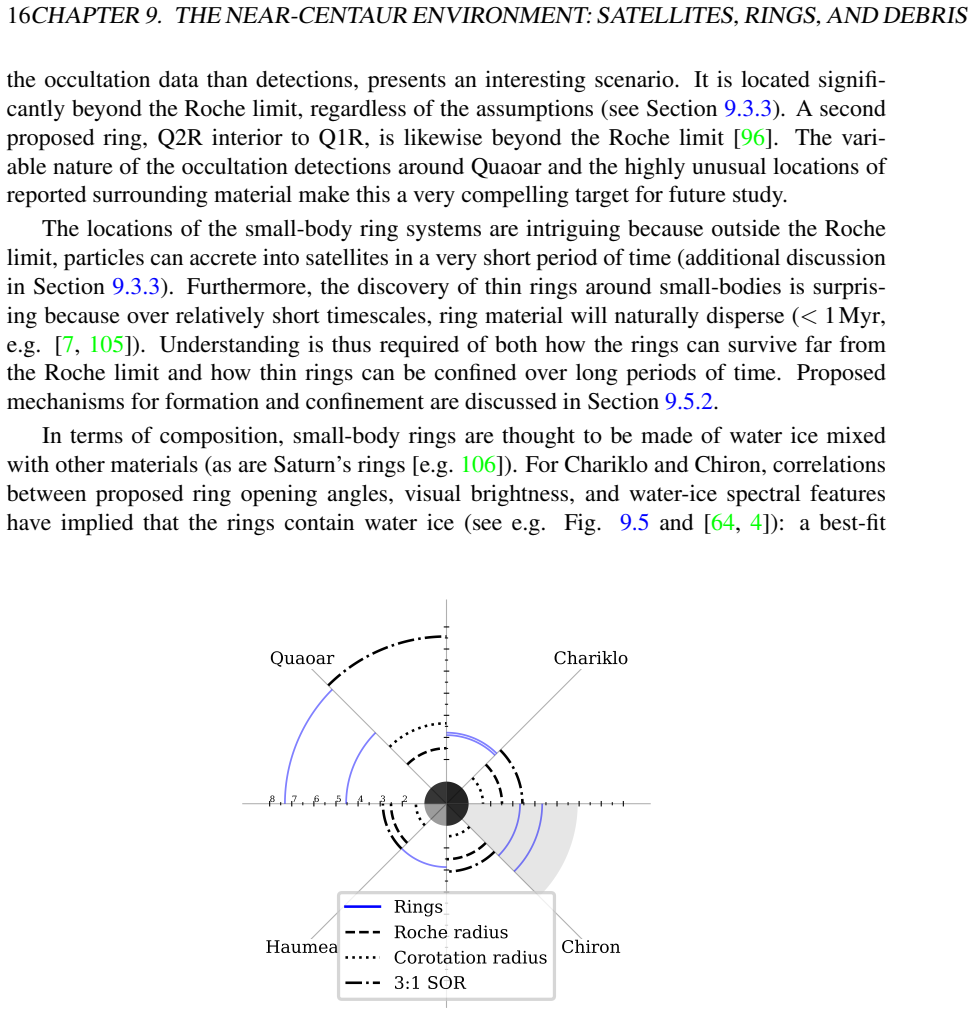
- [§9.3.3] The Roche-limit formula as printed—"a_Roche = (4πABC ρp γρs)^{1/3}"—is dimensionally inconsistent, since it multiplies the primary density by the dimensionless γ and the secondary density rather than dividing by them. The surrounding text (e.g., "γ needs to be low" to push the Roche limit outward) and the standard form in the cited literature indicate the intended expression is a_Roche = (4πABC ρp / (γ ρs))^{1/3}. This typographical error should be corrected, as it directly affects the interpretation of ring locations relative to the Roche limit in Figure 9.7 and the associated discussion.
- [§9.2.2 and §9.6.2] The statement that the decreasing binary fraction "could very easily be a real effect" is stronger than the evidence presented. The chapter itself notes that the 0/58 and 2/109 counts come from heterogeneous HST programs with different instruments, filters, and strategies, and §9.6.2 admits that no detailed non-detection upper limits are published for the 109 GPCs. Furthermore, the [68] sample included the known binary Typhon–Echidna without detecting it, demonstrating that the surveyed subset is incomplete for known systems. While the chapter later frames this as speculation, the phrase "very easily" implies a likelihood assessment that the raw counts cannot support. I recommend rephrasing to something like "could be a real effect, but the current heterogeneous observations cannot distinguish this from observational bias."
minor comments (5)
- [§9.1.2] The text states that six Centaurs have published stellar occultation results, but the same paragraph adds a third Centaur (2008 YB3) and additional GPCs. Please clarify the count or the classification criteria for this sentence.
- [§9.2.2] In the sentence "The two GPC binaries have some of the smallest semimajor axes," the context and Figure 9.6 indicate that the intended quantity is the ratio a_b/r_H, not the semimajor axis itself. Please correct the wording.
- [§9.5.2] The sentence beginning "This scenario would require a single Neptune encounter..." contains a comma splice and confusing logic. Please break it into shorter, clearer sentences.
- [§9.2.2] The phrase "Ignoring biases and considering simply the frequency" is appropriate for a back-of-the-envelope comparison, but consider moving the caveat about the lack of completeness (from §9.6.2) to this location so that readers immediately see the limitation.
- [Table 9.4] In the note for Quaoar Q1R 2021 Aug 27, the explanation of why an infinite optical depth is avoided is clear, but the wording "we use the optical depth because the maximum apparent opacity... returns infinite optical depth a)" includes a stray "a)" that should be removed.
Circularity Check
No circular derivation: the chapter is a review whose interpretive claims are explicitly hedged and whose self-citations point to external published results.
full rationale
This is a review chapter, not a derivation chain. Its central interpretive statement about declining binary fractions is presented as a possibility ('could very easily be a real effect and not due entirely to observational biases') and is immediately preceded by 'Ignoring biases and considering simply the frequency of binary detections versus numbers observed' (Sec. 9.2.2). The chapter itself identifies why that comparison cannot be a forced result: 'Due to the different instrument configurations, filters, and observation strategies, it is difficult to accurately determine the rate of binary systems within the Centaur and GPC populations' (Sec. 9.2.2), and later, 'there are no detailed publications of non-detections or upper limits for binary components around the 109 Centaur-like objects observed with HST' (Sec. 9.6.2). No parameter is fitted and then renamed a prediction, and no conclusion is justified solely by a self-citation. Author self-citations that do appear ([114], [122], [6], [91], [67]) point to published simulations or observations that are external to this chapter; the chapter's synthesis does not reduce to them. Thus no circular step is present.
Assumptions & free parameters
free parameters (1)
- Geometric factor gamma for Roche radius =
1.6 in Figure 9.7; range 0.85 to 1.6 discussed
assumptions (4)
- standard math Gray-screen transmission law T = e^(-tau0)
- domain assumption Normal optical depth relation tau_N = tau_0 sin|B|
- domain assumption Centaurs defined as q > 5.2 AU and a_sun < 30 AU; GPCs defined as 5.2 < q < 30 AU
- domain assumption Roche radius formula a_Roche = (4*pi*A*B*C*rho_p / (gamma*rho_s))^(1/3)
Cite this review
Pith. "Pith review of The Near-Centaur Environment: Satellites, Rings, and Debris." pith.science (2026). https://pith.science/paper/6F5A6MXX
@misc{pith2026250604130,
  author       = {Pith},
  title        = {Pith review of: The Near-Centaur Environment: Satellites, Rings, and Debris},
  year         = {2026},
  howpublished = {\url{https://pith.science/paper/6F5A6MXX}},
  note         = {Machine review of arXiv:2506.04130}
}
read the original abstract
The unexpected finding of a ring system around the Centaur (10199) Chariklo opened a new window for dynamical studies and posed many questions about the formation and evolutionary mechanisms of Centaurs as well as the relationship to satellites and outbursting activity. As minor planets that cross the orbits of the giant planets, Centaurs have short dynamical lifetimes: Centaurs are supplied from the trans-Neptunian region and some fraction migrates inward to become Jupiter-family comets. Given these dynamical pathways, a comparison of attributes across these classifications provides information to understand the source population(s) and the processes that have affected these minor planets throughout their lifetimes. In this chapter we review the current knowledge of satellites, rings, and debris around Centaur-like bodies, discuss the observational techniques involved, place the information into context with the trans-Neptunian Objects, and consider what the results tell us about the outer solar system. We also examine open questions and future prospects.
Figures


Figures from the paper (4 more)



Reference graph
Works this paper leans on
-
[68]
Hub- ble Space Telescope Search for Activity in High-perihelion Objects
Jing Li, David Jewitt, Max Mutchler, Jessica Agarwal, and Harold Weaver. Hub- ble Space Telescope Search for Activity in High-perihelion Objects. AJ, 159(5):209, April 2020
work page 2020
-
[1]
Bus, Marc W
Schelte J. Bus, Marc W. Buie, David G. Schleicher, William B. Hubbard, Robert L. Marcialis, Richard Hill, Lawrence H. Wasserman, John R. Spencer, Robert L. Millis, Otto G. Franz, Amanda S. Bosh, Edward W. Dunham, Charles H. Ford, James W. Young, J. L. Elliott, Richard Meserole, Catherine B. Olkin, Stephen W. McDonald, Jeffrey A. Foust, Lisa M. Sopata, and...
1996
-
[2]
J. L. Elliot, C. B. Olkin, E. W. Dunham, C. H. Ford, D. K. Gilmore, D. Kurtz, D. Laz- zaro, D. M. Rank, P. Temi, R. M. Bandyopadhyay, J. Barroso, A. Barucci, A. S. Bosh, M. W. Buie, S. J. Bus, C. C. Dahn, D. W. Foryta, W. B. Hubbard, D. F. Lopes, R. L. Marcialis, S. W. McDonald, R. L. Millis, H. Reitsema, D. G. Schleicher, B. Sicardy, R. P. S. Stone, and ...
1995
-
[3]
Ruprecht, Amanda S
Jessica D. Ruprecht, Amanda S. Bosh, Michael J. Person, Federica B. Bianco, Ben- jamin J. Fulton, Amanda A. S. Gulbis, Schelte J. Bus, and Amanda M. Zangari. 29 November 2011 stellar occultation by 2060 Chiron: Symmetric jet-like features. Icarus, 252:271–276, May 2015
2011
-
[4]
J. L. Ortiz, R. Duffard, N. Pinilla-Alonso, A. Alvarez-Candal, P. Santos-Sanz, N. Morales, E. Fern ´andez-Valenzuela, J. Licandro, A. Campo Bagatin, and A. Thi- rouin. Possible ring material around centaur (2060) Chiron. A&A, 576:A18, April 2015
2015
-
[5]
J. L. Ortiz, C. L. Pereira, B. Sicardy, F. Braga-Ribas, A. Takey, A. M. Fouad, A. A. Shaker, S. Kaspi, N. Brosch, M. Kretlow, R. Leiva, J. Desmars, B. E. Morgado, N. Morales, M. Vara-Lubiano, P. Santos-Sanz, E. Fern´andez-Valenzuela, D. Souami, R. Duffard, F. L. Rommel, Y . Kilic, O. Erece, D. Koseoglu, E. Ege, R. Morales, A. Alvarez-Candal, J. L. Rizos, ...
2022
-
[6]
Sickafoose, Stephen E
Amanda A. Sickafoose, Stephen E. Levine, Amanda S. Bosh, Michael J. Person, Car- los A. Zuluaga, Bastian Knieling, Mark C. Lewis, and Karsten Schindler. Material around the Centaur (2060) Chiron from the 2018 November 28 UT Stellar Occulta- tion. PSJ, 4(11):221, November 2023. 29 30BIBLIOGRAPHY
2018
-
[7]
Braga-Ribas, B
F. Braga-Ribas, B. Sicardy, J. L. Ortiz, C. Snodgrass, F. Roques, R. Vieira-Martins, J. I. B. Camargo, M. Assafin, R. Duffard, E. Jehin, J. Pollock, R. Leiva, M. Emilio, D. I. Machado, C. Colazo, E. Lellouch, J. Skottfelt, M. Gillon, N. Ligier, L. Ma- quet, G. Benedetti-Rossi, A. Ramos Gomes, P. Kervella, H. Monteiro, R. Sfair, M. El Moutamid, G. Tancredi...
2014
Show all 136 references
-
[8]
Leiva, B
R. Leiva, B. Sicardy, J. I. B. Camargo, J. L. Ortiz, J. Desmars, D. B´erard, E. Lellouch, E. Meza, P. Kervella, C. Snodgrass, R. Duffard, N. Morales, A. R. Gomes-J ´unior, G. Benedetti-Rossi, R. Vieira-Martins, F. Braga-Ribas, M. Assafin, B. E. Morgado, F. Colas, C. De Witt, A...
2017
-
[9]
B ´erard, B
D. B ´erard, B. Sicardy, J. I. B. Camargo, J. Desmars, F. Braga-Ribas, J. L. Ortiz, R. Duffard, N. Morales, E. Meza, R. Leiva, G. Benedetti-Rossi, R. Vieira-Martins, A. R. Gomes J´unior, M. Assafin, F. Colas, J. L. Dauvergne, P. Kervella, J. Lecacheux, L. Maquet, F. Vachier, S...
2017
-
[10]
B. E. Morgado, B. Sicardy, F. Braga-Ribas, J. Desmars, A. R. Gomes-J ´unior, D. B ´erard, R. Leiva, J. L. Ortiz, R. Vieira-Martins, G. Benedetti-Rossi, P. Santos- Sanz, J. I. B. Camargo, R. Duffard, F. L. Rommel, M. Assafin, R. C. Boufleur, F. Colas, M. Kretlow, W. Beisker, R....
2013
-
[11]
Santos-Sanz, A
P. Santos-Sanz, A. Gomes J ´unior, B. Morgado, B. J. Holler, J. Stansberry, H. B. Ham- mel, B. Sicardy, N. Morales, J. Desmars, N. Pinilla-Alonso, R. French, Z.-Y . Lin, E. Fern´andez-Valenzuela, M. Vara-Lubiano, M. Kretlow, D. Souami, F. Braga-Ribas, J. Camargo, G. Benedetti-...
2023
-
[12]
Rousselot, P
P. Rousselot, P. P. Korsun, I. Kulyk, A. Guilbert-Lepoutre, and J. M. Petit. A long-term follow up of 174P/Echeclus. MNRAS, 462:S432–S442, November 2016
2016
-
[13]
Bauer, Young-Jun Choi, Paul R
James M. Bauer, Young-Jun Choi, Paul R. Weissman, John A. Stansberry, Yanga R. Fern´andez, Henry G. Roe, Bonnie J. Buratti, and Hyun-Il Sung. The Large-Grained Dust Coma of 174P/Echeclus. PASP, 120(866):393, April 2008
2008
-
[14]
C. L. Pereira, F. Braga-Ribas, B. Sicardy, A. R. Gomes-J ´unior, J. L. Ortiz, H. C. Branco, J. I. B. Camargo, B. E. Morgado, R. Vieira-Martins, M. Assafin, G. Benedetti- Rossi, J. Desmars, M. Emilio, R. Morales, F. L. Rommel, T. Hayamizu, T. Gon- dou, E. Jehin, R. A. Artola, A...
2024
-
[15]
D. Jewitt. The Persistent Coma of Comet P/Schwassmann-Wachmann 1. ApJ, 351:277, March 1990
1990
-
[16]
Wierzchos and M
K. Wierzchos and M. Womack. CO Gas and Dust Outbursts from Centaur 29P/Schwassmann-Wachmann. AJ, 159(4):136, April 2020
2020
-
[17]
M. W. Buie, J. M. Keller, R. Miles, M. Kretlow, V . Nikitin, RECON Team, and Can- CON Occultation Team. Occultation results for 29p/schwassmann-wachmann. In Asteroids, Comets, Meteors Conference, page Abstract #2445, Houston, 2023. Lunar and Planetary Institute
2023
-
[18]
Noll, Harold F
Keith S. Noll, Harold F. Levison, Will M. Grundy, and Denise C. Stephens. Discovery of a binary centaur. Icarus, 184(2):611–618, 2006
2006
-
[19]
W. M. Grundy, K. S. Noll, J. Virtanen, K. Muinonen, S. D. Kern, D. C. Stephens, J. A. Stansberry, H. F. Levison, and J. R. Spencer. (42355) Typhon Echidna: Scheduling observations for binary orbit determination. Icarus, 197(1):260–268, September 2008. 32BIBLIOGRAPHY
2008
-
[20]
J. A. Stansberry, W. M. Grundy, M. Mueller, S. D. Benecchi, G. H. Rieke, K. S. Noll, M. W. Buie, H. F. Levison, S. B. Porter, and H. G. Roe. Physical properties of trans- neptunian binaries (120347) Salacia-Actaea and (42355) Typhon-Echidna. Icarus, 219(2):676–688, June 2012
2012
-
[21]
Grundy, J.A
W.M. Grundy, J.A. Stansberry, K.S. Noll, D.C. Stephens, D.E. Trilling, S.D. Kern, J.R. Spencer, D.P. Cruikshank, and H.F. Levison. The orbit, mass, size, albedo, and density of (65489) ceto/phorcys: A tidally-evolved binary centaur. Icarus, 191(1):286–297, 2007
2007
-
[22]
Ortiz, P
J.L. Ortiz, P. Santos-Sanz, B. Sicardy, G. Benedetti-Rossi, D. B ´erard, N. Morales, R. Duffard, F. Braga-Ribas, C. Hopp, U. Ries, V . Nascimbeni, F. Marzari, V . Granata, A. P´al, C. Kiss, T. Pribulla, R. Komˇz´ık, K. Hornoch, P. Pravec, P. Bacci, M. Maestrip- ieri, L. Nerli,...
2017
-
[23]
Morgado, B
B.E. Morgado, B. Sicardy, F. Braga-Ribas, J.L. Ortiz, H. Salo, F. Vachier, J. Des- mars, C. L. Pereira, P. Santos-Sanz, R. Sfair, T. de Santana, M. Assafin, R. Vieira- Martins, A. R. Gomes-Junior, G. Margoti, V .S. Dhillon, E. Fern ´andez-Valenzuela, J. Broughton, J. Bradshaw,...
2023
-
[24]
R. A. N. Araujo, R. Sfair, and O. C. Winter. The Rings of Chariklo under Close Encounters with the Giant Planets. ApJ, 824(2):80, June 2016
2016
-
[25]
Kueny, Chadwick A
Colin Orion Chandler, Jay K. Kueny, Chadwick A. Trujillo, David E. Trilling, and William J. Oldroyd. Cometary Activity Discovered on a Distant Centaur: A Non- aqueous Sublimation Mechanism. ApJ, 892(2):L38, April 2020. BIBLIOGRAPHY33
2020
-
[26]
F. L. Rommel, F. Braga-Ribas, J. Desmars, J. I. B. Camargo, J. L. Ortiz, B. Sicardy, R. Vieira-Martins, M. Assafin, P. Santos-Sanz, R. Duffard, E. Fern´andez-Valenzuela, J. Lecacheux, B. E. Morgado, G. Benedetti-Rossi, A. R. Gomes-J´unior, C. L. Pereira, D. Herald, W. Hanna, J...
2020
-
[27]
Fern ´andez-Valenzuela, N
E. Fern ´andez-Valenzuela, N. Morales, M. Vara-Lubiano, J. L. Ortiz, G. Benedetti- Rossi, B. Sicardy, M. Kretlow, P. Santos-Sanz, B. Morgado, D. Souami, F. Organero, L. Ana, F. Fonseca, A. Rom ´an, S. Alonso, R. Gonc ¸alves, M. Ferreira, R. Iglesias- Marzoa, J. L. Lamadrid, A....
2019
-
[28]
Fern ´andez-Valenzuela, J
E. Fern ´andez-Valenzuela, J. L. Ortiz, R. Duffard, N. Morales, and P. Santos- Sanz. Physical properties of centaur (54598) Bienor from photometry. MNRAS, 466(4):4147–4158, April 2017
2017
-
[29]
Santos-Sanz, J
P. Santos-Sanz, J. L. Ortiz, B. Sicardy, G. Benedetti-Rossi, N. Morales, E. Fern´andez- Valenzuela, R. Duffard, R. Iglesias-Marzoa, J. L. Lamadrid, N. Ma ´ıcas, L. P ´erez, K. Gazeas, J. C. Guirado, V . Peris, F. J. Ballesteros, F. Organero, L. Ana-Hern´andez, F. Fonseca, A. A...
2017
-
[30]
Strauss, Rodrigo Leiva, John M
Ryder H. Strauss, Rodrigo Leiva, John M. Keller, Elizabeth Wilde, Marc W. Buie, Robert J. Weryk, J. J. Kavelaars, Terry Bridges, Lawrence H. Wasserman, David E. Trilling, Deanna Ainsworth, Seth Anthony, Robert Baker, Jerry Bardecker, James K. Bean, Stephen Bock, Stefani Chase,...
2014
-
[31]
J. L. Elliot, E. Dunham, L. H. Wasserman, R. L. Millis, and J. Churms. The radii of Uranian rings alpha , beta , gamma , delta , epsilon , eta , 4, 5, and 6 from their occultations of SAO 158687. AJ, 83:980–992, August 1978
1978
-
[32]
A. S. Bosh, C. B. Olkin, R. G. French, and P. D. Nicholson. Saturn’s F Ring: Kine- matics and Particle Sizes from Stellar Occultation Studies. Icarus, 157(1):57–75, May 2002
2002
-
[33]
Miles and M
R. Miles and M. Kretlow. Studying Comets by the Stellar Occultation Method.Jour- nal for Occultation Astronomy, 8(1):11–13, January 2018
2018
-
[34]
Combes, J
M. Combes, J. Lecacheux, T. Encrenaz, B. Sicardy, Y . Zeau, and D. Malaise. On stellar occultations by comets. Icarus, 56(2):229–232, 1983
1983
-
[35]
Fern ´andez, Dennis D
Yanga R. Fern ´andez, Dennis D. Wellnitz, Marc W. Buie, Edward W. Dunham, Robert L. Millis, Ralph A. Nye, John A. Stansberry, Lawrence H. Wasserman, Michael F. A’Hearn, Carey M. Lisse, Meg E. Golden, Michael J. Person, Robert R. Howell, Robert L. Marcialis, and Joseph N. Spita...
1999
-
[36]
Extinction in the Coma of Comet 17P/Holmes
Pedro Lacerda and David Jewitt. Extinction in the Coma of Comet 17P/Holmes. ApJ, 760(1):L2, November 2012
2012
-
[37]
Miles and M
R. Miles and M. Kretlow. Comet 29P/Schwassmann-Wachmann 1: The Appulse of 2020 December 8 and Future Prospects for Stellar Occultations, 2021-2029.Journal for Occultation Astronomy, 11(3):3–9, July 2021
2020
-
[38]
H. J. Reitsema, W. B. Hubbard, L. A. Lebofsky, and D. J. Tholen. AAAS Research Briefing.Science, 215(4531):388–389, January 1982
1982
-
[39]
Fern ´andez-Valenzuela, B
E. Fern ´andez-Valenzuela, B. J. Holler, J. L. Ortiz, F. Vachier, F. Braga Ribas, F. L. Rommel, J. Desmars, M. Buie, A. M. Levine, V . Nikitin, M. F. Skrutskie, C. Col- lyer, A. Verbiscer, J. Stansberry, D. DeColibus, J. Castro Chac´on, N. Chanover, R. J. McMillan, R. P. Boyle...
2023
-
[40]
A. A. Sickafoose, A. S. Bosh, S. E. Levine, C. A. Zuluaga, A. Genade, K. Schindler, T. A. Lister, and M. J. Person. A stellar occultation by Vanth, a satellite of (90482) Orcus. Icarus, 319:657–668, February 2019
2019
-
[41]
Darin Ragozzine, Seth Pincock, Benjamin C. N. Proudfoot, Dallin Spencer, Simon Porter, and Will Grundy. Beyond Point Masses. I. New Non-Keplerian Model- ing Tools Applied to Trans-Neptunian Triple (47171) Lempo.arXiv e-prints, page arXiv:2403.12785, March 2024
2024 arXiv
-
[42]
Benjamin C. N. Proudfoot, Darin A. Ragozzine, Meagan L. Thatcher, Will Grundy, Dallin J. Spencer, Tahina M. Alailima, Sawyer Allen, Penelope C. Bowden, Susanne Byrd, Conner D. Camacho, Gibson H. Campbell, Edison P. Carlisle, Jacob A. Chris- tensen, Noah K. Christensen, Kaelyn ...
2024
-
[43]
Verbiscer, Michael F
Anne J. Verbiscer, Michael F. Skrutskie, and Douglas P. Hamilton. Saturn’s largest ring. Nature, 461(7267):1098–1100, October 2009
2009
-
[44]
Tiscareno, Mark R
Matthew S. Tiscareno, Mark R. Showalter, Richard G. French, Joseph A. Burns, Jef- frey N. Cuzzi, Imke de Pater, Douglas P. Hamilton, Matthew M. Hedman, Philip D. Nicholson, Daniel Tamayo, Anne J. Verbiscer, Stefanie N. Milam, and John A. Stansberry. Observing Planetary Rings a...
2016
-
[45]
A. L. Cochran and W. D. Cochran. The first detection of CN and the distribution of CO + gas in the coma of Comet P/Schwassmann-Wachman 1. Icarus, 90(1):172–175, March 1991
1991
-
[46]
M. F. A’Hearn, D. G. Schleicher, R. L. Millis, P. D. Feldman, and D. T. Thompson. Comet Bowell 1980b. AJ, 89:579–591, April 1984
1984
-
[47]
Dust Outburst Dynamics and Hazard Assessment for Close Spacecraft-Comet Encounters
Uwe Fink, Walter Harris, Lyn Doose, Kat V olk, Laura Woodney, Tony Farnham, and Maria Womack. Dust Outburst Dynamics and Hazard Assessment for Close Spacecraft-Comet Encounters. PSJ, 2(4):154, August 2021. 36BIBLIOGRAPHY
2021
-
[48]
Rousselot
P. Rousselot. 174P/Echeclus: a strange case of outburst. A&A, 480(2):543–550, March 2008
2008
-
[49]
J. A. Stansberry, J. Van Cleve, W. T. Reach, D. P. Cruikshank, J. P. Emery, Y . R. Fer- nandez, V . S. Meadows, K. Y . L. Su, K. Misselt, G. H. Rieke, E. T. Young, M. W. Werner, C. W. Engelbracht, K. D. Gordon, D. C. Hines, D. M. Kelly, J. E. Mor- rison, and J. Muzerolle. Spit...
2004
-
[50]
Disintegrating Asteroid P/2013 R3
David Jewitt, Jessica Agarwal, Jing Li, Harold Weaver, Max Mutchler, and Stephen Larson. Disintegrating Asteroid P/2013 R3. ApJ, 784(1):L8, March 2014
2013
-
[51]
Weissman, S
Paul R. Weissman, S. R. Chesley, Y . J. Choi, J. M. Bauer, S. C. Tegler, W. J. Ro- manishin, G. Consolmagno, and J. A. Stansberry. Motion of the Activity Source As- sociated with Active Centaur 174P/Echeclus (60558). InAAS/Division for Planetary Sciences Meeting Abstracts #38,...
2006
-
[52]
Singer, S
Kelsi N. Singer, S. Alan Stern, John Elliott, Reza R. Karimi, Daniel Stern, Arthur B. Chimelewski, Michael J. Fong, John Andrews, William F. Bottke, Catherine B. Olkin, Paul Propster, and Sam W. Thurman. A new spacecraft mission concept combining the first exploration of the C...
2021
-
[53]
Thomas G. M ¨uller, Emmanuel Lellouch, Hermann B ¨ohnhardt, John Stansberry, An- tonella Barucci, Jacques Crovisier, Audrey Delsanti, Alain Doressoundiram, Elisa- betta Dotto, Ren ´e Duffard, Sonia Fornasier, Olivier Groussin, Pedro J. Guti ´errez, Olivier Hainaut, Alan W. Har...
2009
-
[54]
G. H. Rieke, E. T. Young, C. W. Engelbracht, D. M. Kelly, F. J. Low, E. E. Haller, J. W. Beeman, K. D. Gordon, J. A. Stansberry, K. A. Misselt, J. Cadien, J. E. Morrison, G. Rivlis, W. B. Latter, A. Noriega-Crespo, D. L. Padgett, K. R. Stapelfeldt, D. C. Hines, E. Egami, J. Mu...
2004
-
[55]
Poglitsch, C
A. Poglitsch, C. Waelkens, N. Geis, H. Feuchtgruber, B. Vandenbussche, L. Ro- driguez, O. Krause, E. Renotte, C. van Hoof, P. Saraceno, J. Cepa, F. Kerschbaum, P. Agn`ese, B. Ali, B. Altieri, P. Andreani, J.-L. Augueres, Z. Balog, L. Barl, O. H. Bauer, N. Belbachir, M. Benedet...
2010
-
[56]
M. J. Griffin, A. Abergel, A. Abreu, P. a. R. Ade, P. Andr ´e, J.-L. Augueres, T. Babbedge, Y . Bae, T. Baillie, J.-P. Baluteau, M. J. Barlow, G. Bendo, D. Be- nielli, J. J. Bock, P. Bonhomme, D. Brisbin, C. Brockley-Blatt, M. Caldwell, C. Cara, N. Castro-Rodriguez, R. Cerulli...
2010
-
[57]
F. L. Rommel, F. Braga-Ribas, J. L. Ortiz, B. Sicardy, P. Santos-Sanz, J. Desmars, and J. I. B. Camargo. A large topographic feature on the surface of the trans-Neptunian object (307261) 2002 MS4 measured from stellar occultations. A&A, August 2023
2002
-
[58]
J. L. Ortiz, P. Santos-Sanz, B. Sicardy, G. Benedetti-Rossi, R. Duffard, N. Morales, F. Braga-Ribas, E. Fern ´andez-Valenzuela, V . Nascimbeni, D. Nardiello, A. Carbog- nani, L. Buzzi, A. Aletti, P. Bacci, M. Maestripieri, L. Mazzei, H. Mikuz, J. Skvarc, 38BIBLIOGRAPHY F. Ciab...
2002
-
[59]
Bottke, Harold F
David Nesvorn ´y, David V okrouhlick´y, William F. Bottke, Harold F. Levison, and William M. Grundy. Very Slow Rotators from Tidally Synchronized Binaries. ApJ, 893(1):L16, April 2020
2020
-
[60]
Sheppard
Audrey Thirouin and Scott S. Sheppard. The Plutino Population: An Abundance of Contact Binaries. AJ, 155(6):248, May 2018
2018
-
[61]
Showalter, Susan D
Mark R. Showalter, Susan D. Benecchi, Marc W. Buie, William M. Grundy, James T. Keane, Carey M. Lisse, Cathy B. Olkin, Simon B. Porter, Stuart J. Robbins, Kelsi N. Singer, Anne J. Verbiscer, Harold A. Weaver, Amanda M. Zangari, Douglas P. Hamil- ton, David E. Kaufmann, Tod R. ...
2021
-
[62]
Thirouin, J
A. Thirouin, J. L. Ortiz, R. Duffard, P. Santos-Sanz, F. J. Aceituno, and N. Morales. Short-term variability of a sample of 29 trans-Neptunian objects and Centaurs. A&A, 522:A93, November 2010
2010
-
[63]
M. M. Hedman, P. D. Nicholson, J. N. Cuzzi, R. N. Clark, G. Filacchione, F. Capac- cioni, and M. Ciarniello. Connections between spectra and structure in Saturn’s main rings based on Cassini VIMS data. Icarus, 223(1):105–130, March 2013
2013
-
[64]
Duffard, N
R. Duffard, N. Pinilla-Alonso, J. L. Ortiz, A. Alvarez-Candal, B. Sicardy, P. Santos- Sanz, N. Morales, C. Colazo, E. Fern ´andez-Valenzuela, and F. Braga-Ribas. Photo- metric and spectroscopic evidence for a dense ring system around Centaur Chariklo. A&A, 568:A79, August 2014
2014
-
[65]
TNOs are Cool
P. Santos-Sanz, E. Lellouch, S. Fornasier, C. Kiss, A. Pal, T. G. M ¨uller, E. Vilenius, J. Stansberry, M. Mommert, A. Delsanti, M. Mueller, N. Peixinho, F. Henry, J. L. Ortiz, A. Thirouin, S. Protopapa, R. Duffard, N. Szalai, T. Lim, C. Ejeta, P. Hartogh, A. W. Harris, and M....
2012
-
[66]
Levison and Martin J
Harold F. Levison and Martin J. Duncan. From the Kuiper Belt to Jupiter-Family Comets: The Spatial Distribution of Ecliptic Comets. Icarus, 127(1):13–32, May 1997
1997
-
[67]
Sarid, K
G. Sarid, K. V olk, J. K. Steckloff, W. Harris, M. Womack, and L. M. Woodney. 29P/Schwassmann-Wachmann 1, A Centaur in the Gateway to the Jupiter-family Comets. ApJ, 883(1):L25, September 2019
2019
-
[69]
Noll, William M
Keith S. Noll, William M. Grundy, David Nesvorn ´y, and Audrey Thirouin. Chapter 9 - Trans-Neptunian binaries (2018). In Dina Prialnik, M. Antonietta Barucci, and Leslie A. Young, editors,The Trans-Neptunian Solar System, pages 205–224. Else- vier, January 2020
2018
-
[70]
The nuclei of Jupiter family comets: A critical review of our present knowledge
Nicolas Thomas. The nuclei of Jupiter family comets: A critical review of our present knowledge. Planet. Space Sci., 57(10):1106–1117, August 2009
2009
-
[71]
Safrit, Jordan K
Taylor K. Safrit, Jordan K. Steckloff, Amanda S. Bosh, David Nesvorny, Kevin Walsh, Ramon Brasser, and David A. Minton. The Formation of Bilobate Comet Shapes through Sublimative Torques. PSJ, 2(1):14, February 2021
2021
-
[72]
Parker and J
Alex H. Parker and J. J. Kavelaars. Destruction of Binary Minor Planets During Neptune Scattering. ApJ, 722(2):L204–L208, October 2010
2010
-
[73]
Binary survival in the outer solar system
David Nesvorn ´y and David V okrouhlick´y. Binary survival in the outer solar system. Icarus, 331:49–61, October 2019
2019
-
[74]
Stone and Nathan A
Lukas R. Stone and Nathan A. Kaib. Evolution of primordial Kuiper belt binaries through a giant planet instability. MNRAS, 505(1):L31–L35, July 2021
2021
-
[75]
R. A. N. Araujo, M. A. Galiazzo, O. C. Winter, and R. Sfair. The journey of Typhon- Echidna as a binary system through the planetary region. MNRAS, 476(4):5323– 5331, June 2018
2018
-
[76]
W. M. Grundy, K. S. Noll, H. G. Roe, M. W. Buie, S. B. Porter, A. H. Parker, D. Nesvorn ´y, H. F. Levison, S. D. Benecchi, D. C. Stephens, and C. A. Trujillo. Mutual orbit orientations of transneptunian binaries. Icarus, 334:62–78, December 2019
2019
-
[77]
Campbell, Lukas R
Hunter M. Campbell, Lukas R. Stone, and Nathan A. Kaib. Close Trans-Neptunian Object Passages as a Driver of the Origin and Evolution of Ultrawide Kuiper Belt Binaries. AJ, 165(1):19, January 2023
2023
-
[78]
Sheppard and David C
Scott S. Sheppard and David C. Jewitt. Time-resolved Photometry of Kuiper Belt Objects: Rotations, Shapes, and Phase Functions. AJ, 124(3):1757–1775, September 2002. 40BIBLIOGRAPHY
2002
-
[79]
Schwamb, Elena Hadjiyska, Suzanne Tourtellotte, and Patricio Rojo
David Rabinowitz, Megan E. Schwamb, Elena Hadjiyska, Suzanne Tourtellotte, and Patricio Rojo. The Peculiar Photometric Properties of 2010 WG9: A Slowly Rotating Trans-Neptunian Object from the Oort Cloud. AJ, 146(1):17, July 2013
2010
-
[80]
Rings in the Solar System: A Short Review
S ´ebastien Charnoz, Aur´elien Crida, and Ryuki Hyodo. Rings in the Solar System: A Short Review. In Hans J. Deeg and Juan Antonio Belmonte, editors,Handbook of Exoplanets, page 54. Springer International Publishing, 2018
2018
-
[81]
J. N. Cuzzi, A. D. Whizin, R. C. Hogan, A. R. Dobrovolskis, L. Dones, M. R. Showal- ter, J. E. Colwell, and J. D. Scargle. Saturn’s F Ring core: Calm in the midst of chaos. Icarus, 232:157–175, April 2014
2014
-
[82]
Ockert-Bell, Joseph A
Maureen E. Ockert-Bell, Joseph A. Burns, Ingrid J. Daubar, Peter C. Thomas, Joseph Veverka, M. J. S. Belton, and Kenneth P. Klaasen. The Structure of Jupiter’s Ring System as Revealed by the Galileo Imaging Experiment. Icarus, 138(2):188–213, April 1999
1999
-
[83]
J. L. Elliot, E. Dunham, and D. Mink. The rings of Uranus. Nature, 267(5609):328– 330, May 1977
1977
-
[84]
Peter Goldreich and Carolyn C. Porco. Shepherding of the Uranian Rings. II. Dynam- ics. AJ, 93:730, March 1987
1987
-
[85]
C. C. Porco and P. Goldreich. Shepherding of the Uranian Rings. I. Kinematics. AJ, 93:724, March 1987
1987
-
[86]
Showalter and Jack J
Mark R. Showalter and Jack J. Lissauer. The Second Ring-Moon System of Uranus: Discovery and Dynamics.Science, 311(5763):973–977, February 2006
2006
-
[87]
W. B. Hubbard, A. Brahic, B. Sicardy, L. R. Elicer, F. Roques, and F. Vilas. Occul- tation detection of a neptunian ring-like arc. Nature, 319(6055):636–640, February 1986
1986
-
[88]
Souami, S
D. Souami, S. Renner, B. Sicardy, M. Langlois, B. Carry, P. Delorme, and P. Go- laszewska. Neptune’s ring arcs from VLT/SPHERE-IRDIS near-infrared observa- tions. A&A, 657:A134, January 2022
2022
-
[89]
The confinement of Neptune’s ring arcs by the moon Galatea
Fathi Namouni and Carolyn Porco. The confinement of Neptune’s ring arcs by the moon Galatea. Nature, 417(6884):45–47, May 2002
2002
-
[90]
Stationary Configurations for Co-orbital Satel- lites with Small Arbitrary Masses.Celestial Mechanics and Dynamical Astronomy, 88(4):397–414, April 2004
St ´efan Renner and Bruno Sicardy. Stationary Configurations for Co-orbital Satel- lites with Small Arbitrary Masses.Celestial Mechanics and Dynamical Astronomy, 88(4):397–414, April 2004
2004
-
[91]
S. M. Giuliatti Winter, G. Madeira, and R. Sfair. Neptune’s ring arcs confined by coor- bital satellites: dust orbital evolution through solar radiation. MNRAS, 496(1):590– 597, July 2020
2020
-
[92]
Marcialis and Bonnie J
Robert L. Marcialis and Bonnie J. Buratti. CCD Photometry of 2060 Chiron in 1985 and 1991. Icarus, 104(2):234–243, August 1993. BIBLIOGRAPHY41
1985
-
[93]
Alvarez-Candal, C Snodgrass, G.˜P
S Fornasier, D Lazzaro, A. Alvarez-Candal, C Snodgrass, G.˜P. P Tozzi, J.˜M. M Carvano, Y . Jim´enez-Teja, J.˜S. S Silva, and D.˜M. M Bramich. The Centaur 10199 Chariklo: Investigation into rotational period, absolute magnitude, and cometary ac- tivity. A&A, 568:L11, August 2014
2014
-
[94]
M. D. Melita, R. Duffard, J.L. Ortiz, and A. Campo-Bagatin. Assessment of different formation scenarios for the ring system of (10199) chariklo.Astronomy l& Astro- physics, 602:A27, 2017
2017
-
[95]
J. L. Ortiz, P. J. Guti ´errez, A. Sota, V . Casanova, and V . R. Teixeira. Rotational brightness variations in Trans-Neptunian Object 50000 Quaoar. A&A, 409:L13–L16, October 2003
2003
-
[96]
C. L. Pereira, B. Sicardy, B. E. Morgado, F. Braga-Ribas, E. Fern ´andez-Valenzuela, D. Souami, B. J. Holler, R. C. Boufleur, G. Margoti, M. Assafin, J. L. Ortiz, P. Santos- Sanz, B. Epinat, P. Kervella, J. Desmars, R. Vieira-Martins, Y . Kilic, A. R. Gomes J´unior, J. I. B. C...
2023
-
[97]
C. L. Pereira, B. Sicardy, B. E. Morgado, F. Braga-Ribas, E. Fern ´andez-Valenzuela, D. Souami, B. J. Holler, R. C. Boufleur, G. Margoti, M. Assafin, J. L. Ortiz, P. Santos- Sanz, B. Epinat, P. Kervella, J. Desmars, R. Vieira-Martins, Y . Kilic, A. R. Gomes- J´unior, J. I. B. ...
2024
-
[98]
Rabinowitz, Kristina Barkume, Michael E
David L. Rabinowitz, Kristina Barkume, Michael E. Brown, Henry Roe, Michael Schwartz, Suzanne Tourtellotte, and Chad Trujillo. Photometric Observations Con- straining the Size, Shape, and Albedo of 2003 EL61, a Rapidly Rotating, Pluto-sized Object in the Kuiper Belt. ApJ, 639(...
2003
-
[99]
A. A. Sickafoose, A. S. Bosh, J. P. Emery, M. J. Person, C. A. Zuluaga, M. Womack, F. Bianco, S. J. Bus, J. D. Ruprecht, and A. M. Zangari. Characterization of material around the centaur (2060) chiron from a visible and near-infrared stellar occultation in 2011.Monthly Notice...
2011
-
[100]
B. E. Morgado, B. Sicardy, F. Braga-Ribas, J. L. Ortiz, H. Salo, F. Vachier, J. Des- mars, C. L. Pereira, P. Santos-Sanz, R. Sfair, T. de Santana, M. Assafin, R. Vieira- Martins, A. R. Gomes-J ´unior, G. Margoti, V . S. Dhillon, E. Fern ´andez-Valenzuela, J. Broughton, J. Brad...
2024
-
[101]
K. J. Meech and M. J. S. Belton. (2060) Chiron. IAU Circ., 4770:1, April 1989
1989
-
[102]
Luu and David C
Jane X. Luu and David C. Jewitt. Cometary Activity in 2060 Chiron. AJ, 100:913, September 1990
1990
-
[103]
Braga-Ribas, C
F. Braga-Ribas, C. L. Pereira, B. Sicardy, J. L. Ortiz, J. Desmars, A. Sickafoose, M. Emilio, B. Morgado, G. Margoti, F. L. Rommel, J. I. B. Camargo, M. Assafin, R. Vieira-Martins, A. R. Gomes-J ´unior, P. Santos-Sanz, N. Morales, M. Kretlow, J. Lecacheux, F. Colas, R. Boninse...
2018
-
[104]
Brown, Kristina M
Michael E. Brown, Kristina M. Barkume, Darin Ragozzine, and Emily L. Schaller. A collisional family of icy objects in the Kuiper belt. Nature, 446(7133):294–296, March 2007
2007
-
[105]
On the mass and origin of chariklo’s rings
Margaret Pan and Yanqin Wu. On the mass and origin of chariklo’s rings. ApJ, 821(1):18, apr 2016
2016
-
[106]
Nicholson, Matthew M
Philip D. Nicholson, Matthew M. Hedman, Roger N. Clark, Mark R. Showalter, Dale P. Cruikshank, Jeffrey N. Cuzzi, Gianrico Filacchione, Fabrizio Capaccioni, Priscilla Cerroni, Gary B. Hansen, Bruno Sicardy, Pierre Drossart, Robert H. Brown, Bonnie J. Buratti, Kevin H. Baines, a...
2008
-
[107]
Groussin, P
O. Groussin, P. Lamy, and L. Jorda. Properties of the nuclei of Centaurs Chiron and Chariklo. A&A, 413:1163–1175, January 2004
2004
-
[108]
J. L. Elliot, R. G. French, K. J. Meech, and J. H. Elias. Structure of the uranian rings. i. square-well model and particle-size constraints.Astronomical Journal, 89:1587– 1603, 1984. BIBLIOGRAPHY43
1984
-
[109]
J. N. Cuzzi. Rings of uranus – not so thick, not so black. Icarus, 63:312–316, 1985
1985
-
[110]
R. G. French, J. L. Elliot, and S. Levine. Structure of the uranian rings. ii. ring orbits and widths. Icarus, 67:134–163, 1986
1986
-
[111]
M. S. Tiscareno, M. M. Hedman, J.A. Burns, and J. Castillo-Rogez. Compositions and Origins of Outer Planet Systems: Insights from the Roche Critical Density.Astrophys J Lett, 765(1):1602–1697, December 2013
2013
-
[112]
C. C. Porco, P. C. Thomas, J.W. Weiss, and D. C. Richardson. Saturn’s small satellites: clues to their origins.Science, 318(1):1602–1697, December 2007
2007
-
[113]
Sicardy, R
B. Sicardy, R. Leiva, S. Renner, F. Roques, M. El Moutamid, P. Santos-Sanz, and J. Desmars. Ring dynamics around non-axisymmetric bodies with application to Chariklo and Haumea.Nature Astronomy, 3:146–153, April 2019
2019
-
[114]
Sickafoose and Mark C
Amanda A. Sickafoose and Mark C. Lewis. Numerical Simulations of (10199) Chariklo’s Rings with a Resonant Perturber. PSJ, 5(2):32, February 2024
2024
-
[115]
De Pater, S
I. De Pater, S. Renner, M. R. Showalter, and B. Sicardy. The Rings of Neptune. In M. S. Tiscareno and C. D. Murray, editors,Planetary Ring Systems. Properties, Structure, and Evolution, pages 112–124. Cambridge University Press, 2018
2018
-
[116]
Use of the Geometric Elements in Numerical Sim- ulations.Celestial Mechanics and Dynamical Astronomy, 94(2):237–248, February 2006
St ´efan Renner and Bruno Sicardy. Use of the Geometric Elements in Numerical Sim- ulations.Celestial Mechanics and Dynamical Astronomy, 94(2):237–248, February 2006
2006
-
[117]
Ribeiro, O
T. Ribeiro, O. C. Winter, D. Mour ˜ao, L. A. G. Boldrin, and J. P. S. Carvalho. Quasi circular orbits around prolate bodies. MNRAS, 506(2):3068–3078, September 2021
2021
-
[118]
Goldreich and S
P. Goldreich and S. Tremaine. Towards a theory for the Uranian rings. Nature, 277:97– 99, January 1979
1979
-
[119]
M. D. Melita and J. C. B. Papaloizou. Apse-alignment in narrow-eccentric ringlets and its implications for theε-ring of Uranus and the ring system of (10199) Chariklo. Icarus, 335:113366, January 2020
2020
-
[120]
Resonances in Nonaxisymmetric Gravitational Potentials
Bruno Sicardy. Resonances in Nonaxisymmetric Gravitational Potentials. AJ, 159(3):102, March 2020
2020
-
[121]
O. C. Winter and C. D. Murray. Resonance and chaos. I. First-order interior reso- nances. A&A, 319:290–304, March 1997
1997
-
[122]
S. M. Giuliatti Winter, G. Madeira, T. Ribeiro, O. C. Winter, G. O. Barbosa, and G. Borderes-Motta. The stability around Chariklo and the confinement of its rings. A&A, 679:A62, November 2023
2023
-
[123]
O. C. Winter, G. Borderes-Motta, and T. Ribeiro. On the location of the ring around the dwarf planet Haumea. MNRAS, 484(3):3765–3771, April 2019. 44BIBLIOGRAPHY
2019
-
[124]
Madeira, S
G. Madeira, S. M. Giuliatti Winter, T. Ribeiro, and O. C. Winter. Dynamics around non-spherical symmetric bodies - I. The case of a spherical body with mass anomaly. MNRAS, 510(1):1450–1469, February 2022
2022
-
[125]
Ribeiro, O
T. Ribeiro, O. C. Winter, G. Madeira, and S. M. Giuliatti Winter. Dynamics around non-spherical symmetric bodies: II. The case of a prolate body. MNRAS, 525(1):44– 56, October 2023
2023
-
[126]
Simulating the Smallest Ring World of Chariklo
Shugo Michikoshi and Eiichiro Kokubo. Simulating the Smallest Ring World of Chariklo. ApJ, 837(1):L13, March 2017
2017
-
[127]
Weissman
Young-Jun Choi and P. Weissman. Discovery of Cometary Activity for Centaur 174P/Echeclus (60558). InAAS/Division for Planetary Sciences Meeting Abstracts #38, volume 38 ofAAS/Division for Planetary Sciences Meeting Abstracts, page 37.05, September 2006
2006
-
[128]
Physical Characterization of the 2017 December Outburst of the Centaur 174P/Echeclus
Theodore Kareta, Benjamin Sharkey, John Noonan, Kat V olk, Vishnu Reddy, Walter Harris, and Richard Miles. Physical Characterization of the 2017 December Outburst of the Centaur 174P/Echeclus. AJ, 158(6):255, December 2019
2017
-
[129]
J. M. Trigo-Rodr ´ıguez, E. Garc ´ıa-Melendo, B. J. R. Davidsson, A. S ´anchez, D. Rodr´ıguez, J. Lacruz, J. A. de Los Reyes, and S. Pastor. Outburst activity in comets. I. Continuous monitoring of comet 29P/Schwassmann-Wachmann 1. A&A, 485(2):599–606, July 2008
2008
-
[130]
S. A. Stern, O. L. White, W. M. Grundy, B. A. Keeney, J. D. Hofgartner, D. Nesvorn´y, W. B. McKinnon, D. C. Richardson, J. C. Marohnic, A. J. Verbiscer, S. D. Benecchi, P. M. Schenk, J. M. Moore, New Horizons Geology, and Geophysics Investigation Team. The Properties and Origi...
2023
-
[131]
FORMA- TION OF CENTAURS’ RINGS THROUGH THEIR PARTIAL TIDAL DISRUP- TION DURING PLANETARY ENCOUNTERS
Ryuki Hyodo, S ´ebastien Charnoz, Hidenori Genda, and Keiji Ohtsuki. FORMA- TION OF CENTAURS’ RINGS THROUGH THEIR PARTIAL TIDAL DISRUP- TION DURING PLANETARY ENCOUNTERS. ApJ, 828(1):L8, August 2016
2016
-
[132]
Hinse, and Stephen C
Jeremy Wood, Jonti Horner, Tobias C. Hinse, and Stephen C. Marsden. The Dynami- cal History of Chariklo and Its Rings. AJ, 153(6):245, June 2017
2017
-
[133]
N-body Simula- tions of Ring Formation Process around the Dwarf Planet Haumea
Iori Sumida, Yuya Ishizawa, Natsuki Hosono, and Takanori Sasaki. N-body Simula- tions of Ring Formation Process around the Dwarf Planet Haumea. ApJ, 897(1):21, 2020
2020
-
[134]
Combi, and Martin Rubin
Valeriy Tenishev, Michael R. Combi, and Martin Rubin. Numerical Simulation of Dust in a Cometary Coma: Application to Comet 67P/Churyumov-Gerasimenko. ApJ, 732(2):104, May 2011
2011
-
[135]
Activity of BIBLIOGRAPHY45 (2060) Chiron possibly caused by impacts? MNRAS, 475(2):2512–2518, January 2018
Stefan Cikota, Estela Fern ´andez-Valenzuela, Jose Luis Ortiz, Nicol´as Morales, Ren ´e Duffard, Jesus Aceituno, Aleksandar Cikota, and Pablo Santos-Sanz. Activity of BIBLIOGRAPHY45 (2060) Chiron possibly caused by impacts? MNRAS, 475(2):2512–2518, January 2018
2018
-
[136]
Markus Kasper, Jean-Luc Beuzit, Christophe Verinaud, Raffaele G. Gratton, Florian Kerber, Natalia Yaitskova, Anthony Boccaletti, Niranjan Thatte, Hans Martin Schmid, Christoph Keller, Pierre Baudoz, Lyu Abe, Emmanuel Aller-Carpentier, Jacopo An- tichi, Mariangela Bonavita, Kje...
2010
Reviewed August 7, 2026 · model on record in the stance chip above.
Discussion (0). Sign in to comment.