REVIEW 3 major objections 5 minor 32 references
Programmable wrinkling for functionally-graded auxetic circular membranes
T0 review · 3 major / 5 minor · reviewed 2026-08-07 · deepseek-v4-flash
Pith's one-line read Radial grading of stiffness and Poisson ratio can program the appearance, growth, merging, and disappearance of wrinkled regions in auxetic membranes as the applied traction rises.
desk verdict A solid proof-of-concept for programming wrinkling regions in graded auxetic membranes; the axisymmetry assumption is the key caveat and Eq. (4) has a typo. read the letter →
The pith
A machine-rendered reading of the paper's core claim, the machinery that carries it, and where it could break.
The reading
What carries the argument
The central object is the relaxed strain energy density of tension field theory $W^R$, which replaces the parent membrane energy whenever either principal stress would be compressive, setting that stress component to zero. Wrinkles are taken to appear as soon as a principal stress becomes compressive; the relevant threshold is the natural width, e.g. $\lambda_\Phi^*=\sqrt{1+\nu-\lambda_R^2\nu}$, at which the circumferential stress vanishes. Under the axisymmetric ansatz, the equilibrium equation reduces to a single ordinary differential equation for the radial coordinate $r(R)$, and a wrinkled region is precisely a zone where the relaxed circumferential stress is zero.
What would settle it
Fabricate or simulate an annular auxetic membrane with the two-step Young-modulus profile of Case 2, load the outer rim, and image the surface; if the observed wrinkles are not concentric annuli that appear, merge, and partially unwrinkle as in Figure 8, or if a non-axisymmetric pattern appears at a lower load, the predicted wrinkling regions are wrong.
Extended reading notes
Core claim
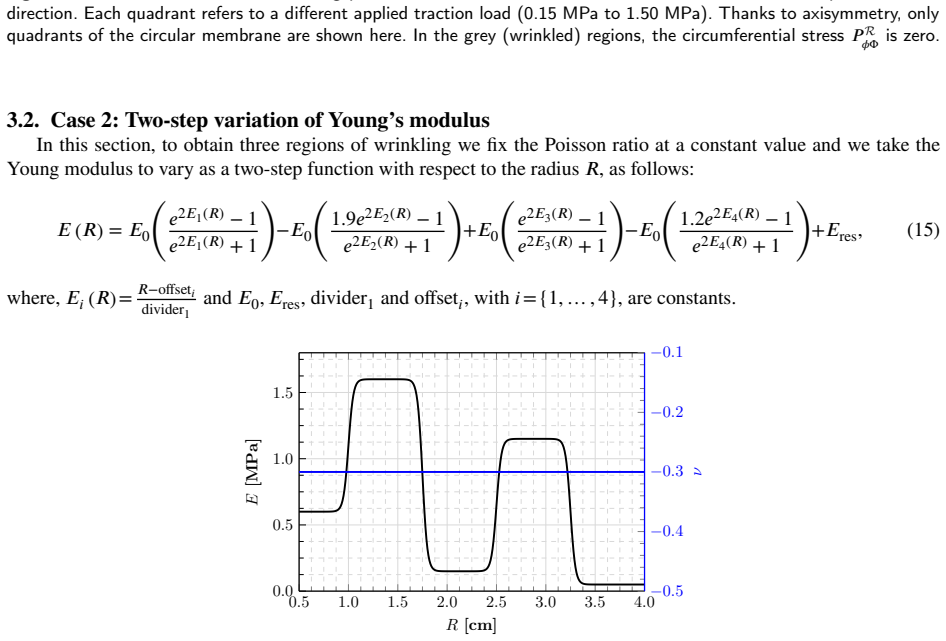
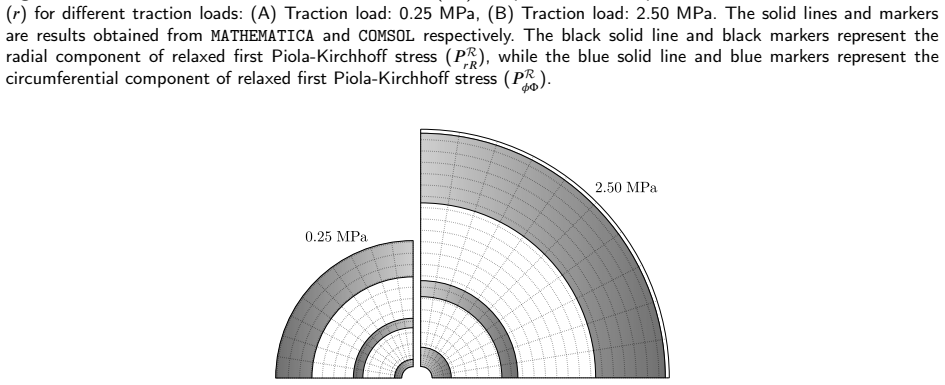
The central claim is that spatially graded material properties give direct control over where wrinkles form in a soft auxetic membrane. Under the axisymmetric deformation $r=r(R)$, $\phi=\Phi$, equilibrium reduces to a single radial ODE, and wrinkles are identified with zones where the relaxed circumferential stress vanishes, $P^R_{\phi\Phi}=0$. With a linearly decreasing Young modulus and a Gaussian Poisson-ratio profile, a new wrinkled annulus appears at higher loads and merges with the inner one; with a two-step Young-modulus profile, three separate wrinkled regions form and the outer one can partially unwrinkle as the load grows; and when the material properties depend on the deformed radius, one wrinkled region grows while another stays nearly fixed.
Load-bearing premise
The analysis assumes the deformation stays perfectly axisymmetric, so wrinkles can only form as concentric circular annuli; if a symmetry-breaking pattern with wavy or azimuthally varying wrinkles were energetically preferred, the predicted wrinkling regions would not match the actual ones.
Editorial extensions
If this is right
- Prescribing a linearly decreasing Young modulus toward the inner rim lowers the traction needed to start wrinkling there.
- A Gaussian Poisson-ratio profile can generate a second wrinkled annulus that merges with the inner one as the load increases, producing a single large wrinkled region.
- A two-step Young-modulus profile can produce three separated wrinkled regions, and one of them can partially unwrinkle at higher tractions.
- When the material properties depend on the deformed radius, the inner wrinkled region grows with load while the outer region remains nearly stationary.
- The relaxed energy predicts wrinkled regions that are subsets of the compressive-stress regions found from the unrelaxed membrane energy, so using the parent energy alone overestimates wrinkling.
Reading between the lines
- A direct test of the axisymmetric assumption would be a full two-dimensional simulation that allows $\phi\neq\Phi$; if azimuthally modulated wrinkles become stable at lower tractions, the predicted concentric annuli would need revision.
- Since the authors note the method generalizes to other geometries, the same relaxed-energy machinery could be applied to rectangular or arbitrarily shaped membranes, where grading along two directions might produce even richer wrinkle layouts.
- Fabrication via auxetic metamaterials introduces a microstructure scale, so the effective graded properties would require homogenization and the model would need to be adapted to predict wrinkle wavelengths, which the present continuum theory does not resolve.
Editorial analysis
A structured set of objections, weighed in public.
Referee Report
Summary. The paper studies wrinkling in annular membranes made of a compressible auxetic material with radially graded Young's modulus and Poisson ratio. Using Pipkin's tension field theory, the authors construct a relaxed membrane energy, reduce the equilibrium equations under an axisymmetric ansatz to a single radial ODE, and solve it numerically in Mathematica and COMSOL for three material profiles. Their central claim is that appropriately chosen spatial inhomogeneities can produce non-trivial sequences of wrinkling regions that appear, broaden, merge, and partially disappear as the applied edge traction is increased. The numerical results are cross-validated between the two implementations.
Significance. If the central claim holds, the paper provides a useful proof-of-concept for designing auxetic membranes with controlled wrinkling patterns through material grading, which could be relevant for morphing surfaces and soft actuators. The cross-validation between two independent numerical implementations (Mathematica and COMSOL) is a strength, and the exposition of tension field theory is accessible. However, the axisymmetric ansatz is enforced by construction in both solvers and is never verified against symmetry-breaking solutions, and an intermediate formula in the plane-stress reduction is mathematically inconsistent. These issues must be addressed before the paper's conclusions can be considered fully supported.
major comments (3)
- [Section 2, Eq. (4)] Equation (4) is incorrect. At the reference configuration λ_R=λ_Φ=1, it yields λ_Z = sqrt(1 - ν/(1-ν)) = sqrt((1-2ν)/(1-ν)), which is not 1 for ν<0. The undeformed state would therefore have a non-unit thickness stretch and a non-zero out-of-plane stress, contradicting the definition of the reference state. The correct plane-stress solution of (3) is λ_Z^2 = [1+ν-ν(λ_R^2+λ_Φ^2)]/(1-ν). Since the membrane energy (5) is presented as being obtained by substituting (4) into (3), the derivation as written is invalid. The authors should correct (4) and re-derive (5), or explicitly state that (5) is the standard plane-stress membrane energy adopted as the model and remove the incorrect intermediate formula.
- [Section 2, Eq. (1) and Eq. (10); Section S2] The analysis is restricted to the axisymmetric ansatz r=r(R), φ=Φ, and the COMSOL verification in Section S2 is constructed by revolving a 2D strip around the Z-axis, so it enforces the same ansatz by construction. No stability analysis, bifurcation check, or full two-dimensional solve is provided. The central claim that graded material properties can 'program' wrinkling patterns is therefore established only within the axisymmetric class. If non-axisymmetric wrinkled solutions (e.g., azimuthally localized wrinkles) are energetically preferred, the predicted annular wrinkling regions would be incorrect. Please verify the ansatz for at least one representative case with a full 2D simulation that does not impose axisymmetry, or revise the claims to explicitly refer to axisymmetric wrinkling patterns.
- [Abstract and Section 3.2] The abstract states that wrinkled regions can 'appear, broaden, merge, and eventually disappear again' as the applied traction is increased monotonically. The results show partial unwrinkling of the outer region in Case 2 (Section 3.2, Figure 7B and Table S2: the outer wrinkled interval [4.4591,6.0563] cm at 0.25 MPa becomes [7.7125,10.7820] cm at 2.50 MPa, while the current outer radius is 10.9584 cm), but no complete wrinkled region vanishes. The wording 'eventually disappear again' is therefore stronger than the evidence presented. Please either provide a case where an entire wrinkled region disappears or moderate the abstract and conclusions accordingly.
minor comments (5)
- [Section 3.1] The phrase 'wrinkling occurs only along the circumferential direction' is inconsistent with Section 2.1, where a zero circumferential stress is stated to lead to wrinkles parallel to the radial direction. Please make the orientation terminology uniform.
- [Section 3.2] Similarly, the phrase 'wrinkles appear along the circumferential direction' should be revised to match the orientation defined in Section 2.1.
- [Supplementary S1] The smooth Heaviside approximation uses β=3000. A brief convergence study with respect to β would strengthen confidence that the results are insensitive to this regularization parameter.
- [Supplementary S2] The COMSOL implementation description is abbreviated. Please clarify how the 3D revolved model enforces the plane-stress condition and how the logical operator LOGOPT is implemented numerically.
- [Figure 5 and Figure 8] The captions use inconsistent color terminology: Figure 5 refers to 'dark regions' while Figure 8 refers to 'grey (wrinkled) regions'. Please unify the wording and ensure the figures are printed consistently.
Circularity Check
No significant circularity: material gradations are inputs, wrinkling intervals are computed outputs; TFT is an external model, and the axisymmetric ansatz is a limitation, not a circular step.
full rationale
The derivation is self-contained and non-circular. The material profiles E(R), nu(R) (Eqs. 12, 15, 16) are prescribed inputs; the wrinkling intervals are obtained by solving the radial equilibrium equation (Eq. 10) with boundary conditions (Eq. 11) under the relaxed strain energy (Eq. 7), so the locations of zero circumferential stress are computed outputs rather than fitted parameters. Tension field theory is adopted from external references (Pipkin 1986b, Steigmann and Green 1990), not from a self-citation, and no uniqueness theorem from the authors is invoked to force the ansatz. The cited works by Zurlo and co-workers are listed only as earlier applications of TFT to other material classes and do not support any step of the derivation. The COMSOL model is described as a revolution of a 2D strip (SI Section S2), so it shares the axisymmetry of the Mathematica ODE; the cross-check therefore validates the discretization, not the symmetry assumption. That the ansatz r=r(R), phi=Phi (Eq. 1) restricts patterns to annuli and is not tested against symmetry-breaking wrinkles is a modeling limitation, not a circularity: no output quantity is equal by construction to an input quantity, and no fitted value is renamed as a prediction. The paper even labels the results a 'proof of concept' and lists experimental validation as future work, consistent with a forward model rather than a self-fulfilling fit.
Assumptions & free parameters
free parameters (4)
- Case 1 material profile parameters (E_int, E_out, c0, offset, divider) =
E_int=1.30 MPa, E_out=1.00 MPa, c0=-0.9223, offset=1.670 cm, divider=0.8941 cm
- Case 2 material profile parameters (E_res, E0, offset1-4, divider1) =
E_res=0.60 MPa, E0=0.50 MPa, offsets 1.00, 1.75, 2.50, 3.25 cm, divider1=0.05 cm
- Case 3 material profile parameters (E_res*, E0*, offset_a, offset_b, divider_a, nu_out, nu_int) =
E_res*=E0*=0.50 MPa, offset_a=1.25 cm, offset_b=2.75 cm, divider_a=0.05 cm, nu_out=-0.3, nu_int=-0.6
- Heaviside smoothing parameter beta =
3000
assumptions (6)
- domain assumption Axisymmetric deformation ansatz: r = r(R), phi = Phi, z = z(Z).
- domain assumption Plane stress state: P_ZZ = 0, with the out-of-plane stretch given by Eq. (4).
- domain assumption Tension field theory: wrinkles appear whenever a principal in-plane stress becomes compressive, and the relaxed energy sets that stress component to zero.
- domain assumption Compressible Kirchhoff material model (Eq. 3) with radially varying Young modulus and Poisson ratio.
- domain assumption Local constitutive response: the same strain energy form applies at every point, with material parameters depending on the radial coordinate.
- ad hoc to paper The smooth Heaviside approximation with beta=3000 correctly approximates the relaxed energy branches.
Cite this review
Pith. "Pith review of Programmable wrinkling for functionally-graded auxetic circular membranes." pith.science (2026). https://pith.science/paper/7US4SONQ
@misc{pith2026250604148,
  author       = {Pith},
  title        = {Pith review of: Programmable wrinkling for functionally-graded auxetic circular membranes},
  year         = {2026},
  howpublished = {\url{https://pith.science/paper/7US4SONQ}},
  note         = {Machine review of arXiv:2506.04148}
}
read the original abstract
Materials with negative Poisson's ratio, also known as auxetic materials, display exotic properties such as expansion in all directions under uni-axial tension. For their unique properties, these materials find a broad range of applications in robotic, structural, aerospace, and biomedical engineering. In this work we study the wrinkling behavior of thin and soft auxetic membranes, subjected to edge tractions. We show that spatial inhomogeneities of the Young modulus and of the Poisson ratio can be suitably tailored to produce non-trivial wrinkling patterns, with wrinkled regions that can appear, broaden, merge, and eventually disappear again, as the magnitude of applied tractions is increased monotonically. To model wrinkling in a functionally graded membrane, we employ the mathematically elegant and physically transparent tension field theory, an approximated method that we implement in commercially available software. Beyond unveiling the challenging technological potential to achieve non-standard wrinkling on-demand in auxetic membranes, our study also confirms the potential of using tension field theory to study, analytically and numerically, instabilities in functionally graded materials.
Figures


Figures from the paper (8 more)





Reference graph
Works this paper leans on
-
[1]
Challenges and solutions for application and wider adoption of wearable robots
Babič,J.,Laffranchi,M.,Tessari,F.,Verstraten,T.,Novak,D.,Šarabon,N.,Ugurlu,B.,Peternel,L.,Torricelli,D.,Veneman,J.F.,2021. Challenges and solutions for application and wider adoption of wearable robots. Wearable Technologies 2, e14. Bertoldi, K., Vitelli, V., Christensen, J., Van Hecke, M.,
work page 2021
-
[9]
Archive for Rational Mechanics and Analysis 161, 181–204
Macroscopic response of nematic elastomers via relaxation of a class of so(3)-invariant energies. Archive for Rational Mechanics and Analysis 161, 181–204. DOI:10.1007/s002050100174. Dym, C.L., Shames, I.H.,
-
[11]
International Journal of Mechanical Sciences 213, 106876
Buckling of stretched disks—with comparisons and extensions to auxetics. International Journal of Mechanical Sciences 213, 106876. DOI:10.1016/j.ijmecsci.2021.106876. Fu, B., Sperber, E., Eke, F.,
arXiv 2021
-
[14]
Journal of the Mechanics and Physics of Solids 122, 84–97
The out-of-plane behaviour of dielectric membranes: Description of wrinkling and pull-in instabilities. Journal of the Mechanics and Physics of Solids 122, 84–97. DOI:10.1016/j.jmps.2018.09.006. Haughton,D.,Ogden,R.,1978a. Ontheincrementalequationsinnon-linearelasticity—I.Membranetheory. JournaloftheMechanicsandPhysics of Solids 26, 93–110. DOI:10.1016/00...
-
[16]
Thin-Walled Structures 161, 107512
Wrinkling analysis of circular membranes by a fourier based reduced model. Thin-Walled Structures 161, 107512. DOI:10.1016/j.tws.2021.107512. Kaur,M.,Kim,W.S.,2019. Towardasmartcompliantroboticgripperequippedwith3d-designedcellularfingers. AdvancedIntelligentSystems1, 1900019. DOI:10.1002/aisy.201900019. Khurana, A., Joglekar, M., Zurlo, G., 2022a. Electr...
arXiv 2021
-
[26]
The wrinkling of thin membranes: Part I—theory DOI:10.1115/1.3173133. Steigmann, D.J., Green, A.E.,
-
[30]
International Journal of Engineering Science 136, 1–16
On the wrinkling and restabilization of highly stretched sheets. International Journal of Engineering Science 136, 1–16. DOI:10.1016/j.ijengsci.2018.12.002. Wang, T., Yang, Y., Xu, F.,
-
[31]
Proceedings of the Royal Society A: Mathematical, Physical and Engineering Sciences 478, 20220149
Mechanics of tension-induced film wrinkling and restabilization: a review. Proceedings of the Royal Society A: Mathematical, Physical and Engineering Sciences 478, 20220149. DOI:10.1098/rspa.2022.0149. Wojciechowski, K., Brańka, A.,
arXiv 2022
Show all 32 references
-
[32]
Preliminary design of a te morphing surface for rotorcraft, in: AIAA Scitech 2020 Forum, p
2020
- [138]
- [1883]
-
[1938]
Proceedings of the 5th International
On tension field theory. Proceedings of the 5th International. Congress for Applied Mechanics Harvard University & MIT , 88–92. Ren,X.,Das,R.,Tran,P.,Ngo,T.D.,Xie,Y.M.,2018. Auxeticmetamaterialsandstructures:Areview. SmartMaterialsandStructures27,023001. Roddeman, D., Drukker,...
2018
-
[1960]
In: Principles of classical mechanics and field theory/Prinzipien der Klassischen Mechanik und Feldtheorie , 226–858
The classical field theories. In: Principles of classical mechanics and field theory/Prinzipien der Klassischen Mechanik und Feldtheorie , 226–858. DOI:10.1007/978-3-642-45943-6_2 . Wagner, H.,
-
[1970]
Soviet Physics, Solid state 11, 2938–2943
Ferromagnetic films having a negative Poisson ratio. Soviet Physics, Solid state 11, 2938–2943. Puntel,E.,Deseri,L.,Fried,E.,2011.Wrinklingofastretchedthinsheet.JournalofElasticity105,137–170.DOI: 10.1007/s10659-010-9290-5. Reddy, N.H., Saxena, P.,
2011 doi
-
[1987]
Science 235, 1038–1040
Foam structures with a negative Poisson’s ratio. Science 235, 1038–1040. DOI:10.1126/science.235.4792.1038. Lakes, R.,
-
[1990]
Proceedings of the Royal Society of London
Tension-field theory. Proceedings of the Royal Society of London. A. Mathematical and Physical Sciences 429, 141–173. DOI:10.1098/rspa.1990.0055. Timoshenko, S.,
1990
-
[1993]
DOI:10.1002/adma.19930050416
Advances in negative Poisson’s ratio materials. DOI:10.1002/adma.19930050416. Lazarus, A., Reis, P.M.,
-
[1994]
IMA Journal of Applied Mathematics 52, 297–308
Relaxed energy densities for large deformations of membranes. IMA Journal of Applied Mathematics 52, 297–308. DOI:10.1093/imamat/52.3.297. Pipkin,A.C.,1995. Relaxedenergydensitiesforanisotropicmembranes,in:Parker,D.F.,England,A.H.(Eds.),IUTAMSymposiumonAnisotropy, Inhomogeneit...
1995 doi
-
[2002]
Nature 419, 579–580
Wrinkling of an elastic sheet under tension. Nature 419, 579–580. DOI:https://doi.org/ 10.1038/419579b. Cesana,P.,Plucinsky,P.,Bhattacharya,K.,2015. Effectivebehaviorofnematicelastomermembranes. ArchiveforRationalMechanicsandAnalysis 218, 863–905. DOI:10.1007/s00205-015-0871-0...
2015 doi
-
[2004]
The non-linear field theories of mechanics, Springer, pp. 1–579. DOI:10.1007/978-3-662-10388-3 . Truesdell, C., Toupin, R.,
-
[2011]
Applied Physics Letters 98, 123507
Compression-induced failure of electroactive polymeric thin films. Applied Physics Letters 98, 123507. DOI:10.1063/1.3568885. De Tommasi, D., Puglisi, G., Zurlo, G.,
-
[2012]
International Journal of Non-Linear Mechanics 47, 355–361
Taut states of dielectric elastomer membranes. International Journal of Non-Linear Mechanics 47, 355–361. DOI:10.1016/j.ijnonlinmec.2011.08.002. DeSimone, A., Dolzmann, G.,
2011 doi
-
[2013]
Journal of Nonlinear Science 23, 777–805
Wrinkling behavior of highly stretched rectangular elastic films via parametric global bifurcation. Journal of Nonlinear Science 23, 777–805. DOI:10.1007/s00332-013-9168-3. Huang, W., Yan, W., Xu, R., Huang, Q., Yang, J., Trochu, F., Hu, H.,
-
[2015]
Advanced Engineering Materials 17, 815–820
Soft actuation of structured cylinders through auxetic behavior. Advanced Engineering Materials 17, 815–820. DOI:10.1002/adem.201400433. Lim, T.C.,
-
[2016]
Progress in Aerospace Sciences 86, 1–19
Solar sail technology—a state of the art review. Progress in Aerospace Sciences 86, 1–19. DOI:10.1016/j. paerosci.2016.07.001. Gorissen, B., Melancon, D., Vasios, N., Torbati, M., Bertoldi, K.,
2016 doi
-
[2017]
Nature Reviews Materials 2, 1–11
Flexible mechanical metamaterials. Nature Reviews Materials 2, 1–11. DOI:10.1038/natrevmats.2017.66. Bonfanti, A., Bhaskar, A.,
2017 doi
-
[2018]
International Journal of Solids and Structures 136-137, 203–219
Instabilities in the axisymmetric magnetoelastic deformation of a cylindrical membrane. International Journal of Solids and Structures 136-137, 203–219. DOI:10.1016/j.ijsolstr.2017.12.015. Reissner, E.,
2017 doi
-
[2019]
Extreme Mechanics Letters 33, 100556
Elastic stabilization of wrinkles in thin films by auxetic microstructure. Extreme Mechanics Letters 33, 100556. DOI:10.1016/j.eml.2019.100556. Cerda, E., Ravi-Chandar, K., Mahadevan, L.,
2019
-
[2020]
Science Robotics 5, eabb1967
Inflatable soft jumper inspired by shell snapping. Science Robotics 5, eabb1967. DOI:10.1126/scirobotics.abb1967. Sairam Pamulaparthi Venkata et al.:Preprint submitted to Elsevier Page 12 of 16 Programmable wrinkling for thin circular membranes Greaney, P., Meere, M., Zurlo, G.,
-
[2021]
URL:https://www.comsol.com/comsol-multiphysics
COMSOL AB, Stockholm, Sweden. URL:https://www.comsol.com/comsol-multiphysics. Dai,Z.,Lu,N.,2021. Pokingandbulgingofsuspendedthinsheets:Slippage,instabilities,andmetrology. JournaloftheMechanicsandPhysicsof Solids 149, 104320. DOI:10.1016/j.jmps.2021.104320. Dai, Z., Rao, Y., Lu, N.,
2021
-
[2022]
International Journal of Solids and Structures 257, 111829
Two-dimensional crystals on adhesive substrates subjected to uniform transverse pressure. International Journal of Solids and Structures 257, 111829. DOI:10.1016/j.ijsolstr.2022.111829. Damil,N.,Potier-Ferry,M.,2010. Influenceoflocalwrinklingonmembranebehaviour:anewapproachbyt...
2022
-
[2030]
DOI:10.1103/PhysRevB.19
Reviewed August 7, 2026 · model on record in the stance chip above.
Discussion (0). Sign in to comment.