Surgery and statistics in 3d gravity
Pith reviewed 2026-05-19 10:58 UTC · model grok-4.3
The pith
RMT surgery in pure AdS3 gravity connects off-shell partition functions to the spectral statistics of large-c 2d CFT observables.
A machine-rendered reading of the paper's core claim, the machinery that carries it, and where it could break.
Core claim
By applying RMT surgery to pure AdS3 quantum gravity, a large family of off-shell partition functions can be evaluated and shown to match the spectral statistics of general CFT observables; in particular, an off-shell Euclidean wormhole whose two boundaries are four-punctured spheres encodes the level-repulsion signature of the high-energy sector of the dual large-c CFT.
What carries the argument
RMT surgery: a gluing prescription on off-shell manifolds that maps gravity partition functions onto the random-matrix-theory statistics of CFT observables.
If this is right
- The four-punctured-sphere wormhole encodes level repulsion in the high-energy sector of the boundary CFT.
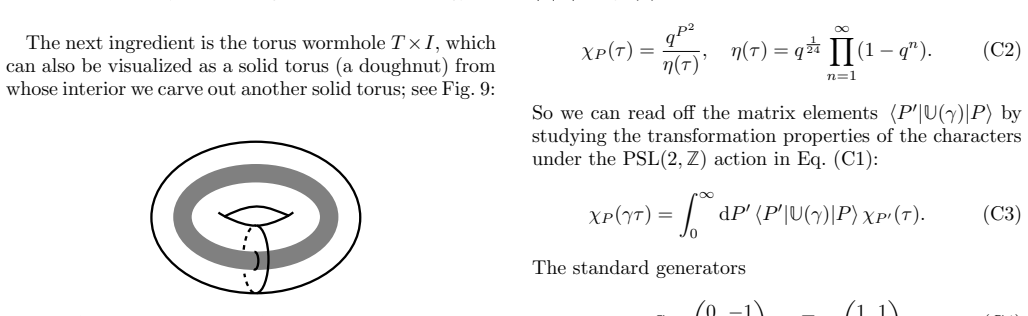
- Off-shell torus wormholes with trumpet boundaries contribute to statistical moments of the density of primary states.
- Surgery supplies an intermediate step for computing Seifert manifolds directly in 3d gravity.
- A broad class of off-shell gravity partition functions is thereby related to the spectral statistics of general CFT observables.
Where Pith is reading between the lines
- The same gluing rules could be used to extract higher-order statistical correlations in the CFT spectrum without on-shell restrictions.
- Similar off-shell constructions might be applied to other 3-manifolds or to include matter fields while preserving the statistical match.
- The correspondence offers a route to probe off-shell sectors of quantum gravity through measurable statistical properties of the dual CFT.
- Direct gravity computations of Seifert invariants may become feasible once the surgery dictionary is fully developed.
Load-bearing premise
The proposed surgery gluing prescriptions in pure AdS3 quantum gravity reproduce the universal statistical features of large-c 2d CFTs without extra corrections or on-shell constraints.
What would settle it
An explicit evaluation of the four-punctured-sphere wormhole partition function that deviates from the expected level-repulsion pattern in the corresponding CFT observable statistics.
Figures



read the original abstract
We extend the correspondence between universal statistical features of large-$c$ 2d CFTs and surgery methods in pure AdS$_3$ quantum gravity. In particular, we introduce a method that we call RMT surgery, which relates a large class of off-shell partition functions in 3d gravity to the spectral statistics of general CFT observables. We apply this method to construct and compute an off-shell Euclidean wormhole whose boundaries are four-punctured spheres, which captures level repulsion in the high-energy sector of the boundary CFT. Using a similar gluing prescription, we also explore a new class of off-shell torus wormholes with trumpet boundaries, contributing to statistical moments of the density of primary states. Lastly, we demonstrate that surgery methods can be used as an intermediate step towards computing Seifert manifolds directly in 3d gravity.
Editorial analysis
A structured set of objections, weighed in public.
Referee Report
Summary. The paper extends the correspondence between universal statistical features of large-c 2d CFTs and surgery methods in pure AdS3 quantum gravity by introducing 'RMT surgery,' which relates a large class of off-shell partition functions in 3d gravity to the spectral statistics of general CFT observables. It constructs and computes an off-shell Euclidean wormhole with four-punctured sphere boundaries claimed to capture level repulsion in the high-energy sector of the boundary CFT, explores a new class of off-shell torus wormholes with trumpet boundaries contributing to statistical moments of the density of primary states, and demonstrates surgery methods as an intermediate step for computing Seifert manifolds directly in 3d gravity.
Significance. If the gluing prescriptions are rigorously shown to reproduce universal RMT features such as the sine-kernel pair correlation without non-universal corrections from the measure or mapping class group, the work would provide a gravity-side derivation of CFT spectral statistics via off-shell configurations and wormholes. This could strengthen the link between 3d gravity path integrals and boundary CFT statistics, offering new tools for computing statistical moments and Seifert manifold invariants.
major comments (2)
- [§3] §3 (four-punctured sphere wormhole construction): the central claim that the off-shell Euclidean wormhole captures level repulsion requires that the surgery gluing prescription yields the sine-kernel pair correlation function in the large-c limit; however, the manuscript does not provide an explicit computation of the two-point correlation or verify that the integration measure over moduli and mapping class group action are correctly incorporated without residual gauge or ghost contributions.
- [§4] §4 (torus wormholes with trumpet boundaries): the contribution to statistical moments of the density of primary states assumes the gluing rules automatically produce the expected universal statistics; this is load-bearing for the claim but lacks an explicit check against diffeomorphism invariance or on-shell constraints that could introduce non-universal corrections.
minor comments (2)
- The notation distinguishing on-shell and off-shell partition functions (e.g., Z vs. Z_off-shell) should be introduced earlier and used consistently throughout to improve readability.
- Figure 2 (wormhole geometry) would benefit from explicit labels for the four-punctured spheres and trumpet boundaries to clarify the gluing prescription.
Simulated Author's Rebuttal
We thank the referee for their careful reading of the manuscript and for the constructive major comments. We have revised the paper to incorporate explicit computations and verifications as requested, which we believe strengthen the presentation of the RMT surgery method and its applications. Our responses to the major comments are given below.
read point-by-point responses
-
Referee: [§3] §3 (four-punctured sphere wormhole construction): the central claim that the off-shell Euclidean wormhole captures level repulsion requires that the surgery gluing prescription yields the sine-kernel pair correlation function in the large-c limit; however, the manuscript does not provide an explicit computation of the two-point correlation or verify that the integration measure over moduli and mapping class group action are correctly incorporated without residual gauge or ghost contributions.
Authors: We agree that an explicit verification of the two-point function strengthens the central claim. In the revised manuscript we have added a direct computation of the pair correlation function obtained from the four-punctured-sphere wormhole in the large-c limit; the result reproduces the sine kernel after the moduli integral is performed. We have also included a short appendix that tracks the integration measure over the moduli space of the four-punctured sphere and the action of the mapping class group, showing that residual gauge and ghost contributions are either cancelled by the gluing prescription or are exponentially suppressed in the universal sector. These additions make the derivation of level repulsion fully explicit. revision: yes
-
Referee: [§4] §4 (torus wormholes with trumpet boundaries): the contribution to statistical moments of the density of primary states assumes the gluing rules automatically produce the expected universal statistics; this is load-bearing for the claim but lacks an explicit check against diffeomorphism invariance or on-shell constraints that could introduce non-universal corrections.
Authors: We thank the referee for emphasizing the need for this check. In the revised version we have inserted an explicit verification that the trumpet-gluing rules are invariant under residual diffeomorphisms that preserve the trumpet boundaries. We further show that, in the high-energy regime relevant to the moments of the primary density, the on-shell constraints do not generate non-universal corrections; the leading universal contribution arises entirely from the off-shell saddle that implements the RMT surgery. These steps confirm that the statistical moments extracted from the torus wormholes remain universal. revision: yes
Circularity Check
No significant circularity in the derivation chain
full rationale
The paper introduces RMT surgery as a method derived from gluing prescriptions in pure AdS3 quantum gravity to relate off-shell partition functions to CFT spectral statistics, including level repulsion via a four-punctured sphere wormhole. The abstract and description frame this as a construction from surgery methods rather than fitting CFT parameters and relabeling them as predictions. No self-definitional steps, fitted inputs called predictions, or load-bearing self-citations that reduce the central claim to unverified inputs are present in the provided material. The derivation remains self-contained, with independent content from the proposed gluing rules that can be checked against external CFT benchmarks.
Axiom & Free-Parameter Ledger
axioms (1)
- domain assumption Universal statistical features of large-c 2d CFTs correspond to surgery methods in pure AdS3 quantum gravity.
Lean theorems connected to this paper
-
IndisputableMonolith/Foundation/AlexanderDuality.leanalexander_duality_circle_linking unclear?
unclearRelation between the paper passage and the cited Recognition theorem.
We introduce a method that we call RMT surgery, which relates a large class of off-shell partition functions in 3d gravity to the spectral statistics of general CFT observables... off-shell Euclidean wormhole whose boundaries are four-punctured spheres
-
IndisputableMonolith/Cost/FunctionalEquation.leanwashburn_uniqueness_aczel unclear?
unclearRelation between the paper passage and the cited Recognition theorem.
the variance of the sphere 4-point function... ρRMT(t1, t2) = −CRMT/4π² ... (t1−t2)²
What do these tags mean?
- matches
- The paper's claim is directly supported by a theorem in the formal canon.
- supports
- The theorem supports part of the paper's argument, but the paper may add assumptions or extra steps.
- extends
- The paper goes beyond the formal theorem; the theorem is a base layer rather than the whole result.
- uses
- The paper appears to rely on the theorem as machinery.
- contradicts
- The paper's claim conflicts with a theorem or certificate in the canon.
- unclear
- Pith found a possible connection, but the passage is too broad, indirect, or ambiguous to say the theorem truly supports the claim.
Forward citations
Cited by 2 Pith papers
-
Mind the crosscap: $\tau$-scaling in non-orientable gravity and time-reversal-invariant systems
Non-orientable topological gravity produces a resummed topological expansion whose late-time behavior matches the GOE universality class of random matrix theory for time-reversal invariant chaotic systems.
-
On random matrix statistics of 3d gravity
3d gravity on Σ_{g,n} × I with EOW branes equals the Virasoro minimal string random matrix model, with exact match for g=0 n=2 and inner-product formulation for negative Euler characteristic.
Reference graph
Works this paper leans on
-
[1]
Excise a tubular neighborhood around each ring, thus creating n + 1 torus boundaries
Embed the above diagram into S3. Excise a tubular neighborhood around each ring, thus creating n + 1 torus boundaries. 14
-
[2]
For each torus boundary Ti, i = 1 , . . . , n, specify a meridian [m]. Then glue back a solid torus, identifying the closed curve ri[l′] + si[m′] on the boundary of the solid torus with the curve [ m] on Ti. Here ( ri, si) are pairs of co-prime integers, presented as rational numbers in Eq. (71), which specify the modular transformation γ in (46) applied ...
work page 2007
-
[3]
= Z ∞ 0 dP2d ¯P2 ρ0,2(P ′ 1, ¯P ′ 1, P2, ¯P2) U(γ)P2P ′ 2 U(γ)∗ ¯P2 ¯P ′ 2 . (D13) Here we used that ˜ γ is represented by the transposed modular kernel U(˜γ) = U(γ)T (swap r and a in Eq. (C7)). While the above equality looks complicated, it can be el- egantly restated as the commutation relation in Eq. (49). Finally, let us discuss the modular completion...
-
[4]
A. Belin and J. de Boer, Random statistics of OPE co- efficients and Euclidean wormholes, Class. Quant. Grav. 38, 164001 (2021), arXiv:2006.05499 [hep-th]
-
[5]
J. Chandra, S. Collier, T. Hartman, and A. Maloney, Semiclassical 3D gravity as an average of large-c CFTs, JHEP 12, 069, arXiv:2203.06511 [hep-th]
- [6]
- [7]
-
[8]
J. de Boer, D. Liska, B. Post, and M. Sasieta, A principle of maximum ignorance for semiclassical gravity, JHEP 02, 003, arXiv:2311.08132 [hep-th]
-
[9]
S. Collier, L. Eberhardt, and M. Zhang, Solving 3d grav- ity with Virasoro TQFT, SciPost Phys. 15, 151 (2023), arXiv:2304.13650 [hep-th]
-
[10]
S. Collier, L. Eberhardt, and M. Zhang, 3d gravity from Virasoro TQFT: Holography, wormholes and knots, Sci- Post Phys. 17, 134 (2024), arXiv:2401.13900 [hep-th]
-
[11]
P. Saad, S. H. Shenker, and D. Stanford, JT gravity as a matrix integral (2019), arXiv:1903.11115 [hep-th]
work page internal anchor Pith review Pith/arXiv arXiv 2019
-
[12]
A Cardy Formula for Three-Point Coefficients: How the Black Hole Got its Spots
P. Kraus and A. Maloney, A Cardy formula for three- point coefficients or how the black hole got its spots, JHEP 05, 160, arXiv:1608.03284 [hep-th]
work page internal anchor Pith review Pith/arXiv arXiv
-
[13]
A new handle on three-point coefficients: OPE asymptotics from genus two modular invariance
J. Cardy, A. Maloney, and H. Maxfield, A new handle on three-point coefficients: OPE asymptotics from genus two modular invariance, JHEP10, 136, arXiv:1705.05855 [hep-th]
work page internal anchor Pith review Pith/arXiv arXiv
-
[14]
S. Collier, A. Maloney, H. Maxfield, and I. Tsiares, Uni- versal dynamics of heavy operators in CFT 2, JHEP 07, 074, arXiv:1912.00222 [hep-th]
- [15]
- [16]
-
[17]
J. Cotler and K. Jensen, AdS 3 gravity and random CFT, JHEP 04, 033, arXiv:2006.08648 [hep-th]
-
[18]
J. Cotler and K. Jensen, AdS3 wormholes from a modular bootstrap, JHEP 11, 058, arXiv:2007.15653 [hep-th]
-
[19]
G. Di Ubaldo and E. Perlmutter, AdS 3/RMT2 duality, JHEP 12, 179, arXiv:2307.03707 [hep-th]
- [20]
- [21]
- [22]
- [23]
-
[24]
J. de Boer, D. Liska, and B. Post, Multibound- ary wormholes and OPE statistics, JHEP 10, 207, arXiv:2405.13111 [hep-th]
- [25]
-
[26]
Quantum Gravity Partition Functions in Three Dimensions
A. Maloney and E. Witten, Quantum Gravity Parti- tion Functions in Three Dimensions, JHEP 02, 029, arXiv:0712.0155 [hep-th]
work page internal anchor Pith review Pith/arXiv arXiv
-
[27]
C. A. Keller and A. Maloney, Poincare Series, 3D Gravity and CFT Spectroscopy, JHEP 02, 080, arXiv:1407.6008 [hep-th]
work page internal anchor Pith review Pith/arXiv arXiv
-
[28]
H. Maxfield and G. J. Turiaci, The path integral of 3D gravity near extremality; or, JT gravity with defects as a matrix integral, JHEP 01, 118, arXiv:2006.11317 [hep- th]
-
[29]
Invariants of algebraic curves and topological expansion
B. Eynard and N. Orantin, Invariants of algebraic curves and topological expansion, Commun. Num. Theor. Phys. 1, 347 (2007), arXiv:math-ph/0702045
work page internal anchor Pith review Pith/arXiv arXiv 2007
-
[30]
Matrix eigenvalue model: Feynman graph technique for all genera
L. Chekhov and B. Eynard, Matrix eigenvalue model: Feynman graph technique for all genera, JHEP 12, 026, arXiv:math-ph/0604014
work page internal anchor Pith review Pith/arXiv arXiv
-
[31]
L. Eberhardt, Notes on crossing transformations of Vira- soro conformal blocks (2023), arXiv:2309.11540 [hep-th]
-
[32]
J. M. Maldacena and L. Maoz, Wormholes in AdS, JHEP 02, 053, arXiv:hep-th/0401024 [hep-th]
work page internal anchor Pith review Pith/arXiv arXiv
-
[33]
The Eigenstate Thermalization Hypothesis and Out of Time Order Correlators
L. Foini and J. Kurchan, Eigenstate thermalization hy- pothesis and out of time order correlators, Phys. Rev. E 99, 042139 (2019), arXiv:1803.10658 [cond-mat.stat- mech]
work page internal anchor Pith review Pith/arXiv arXiv 2019
-
[34]
G. W. Moore and N. Seiberg, Classical and Quantum Conformal Field Theory, Commun. Math. Phys.123, 177 (1989)
work page 1989
- [35]
-
[36]
B. Farb and D. Margalit, A Primer on Mapping Class Groups, Princeton Mathematical Series, Vol. 49 (Prince- ton University Press, Princeton, NJ, 2012)
work page 2012
-
[37]
Thurston, Three-Dimensional Geometry and Topol- ogy
W. Thurston, Three-Dimensional Geometry and Topol- ogy. Vol. 1 , edited by S. Levy, Princeton Mathematical Series, Vol. 35 (Princeton University Press, Princeton, NJ, 1997)
work page 1997
-
[38]
N. Benjamin, S. Collier, and A. Maloney, Pure Gravity and Conical Defects, JHEP 09, 034, arXiv:2004.14428 [hep-th]
-
[39]
O. Bohigas, M. J. Giannoni, and C. Schmit, Charac- terization of chaotic quantum spectra and universality of level fluctuation laws, Physical Review Letters 52, 1 27 (1984)
work page 1984
-
[40]
Universal Spectrum of 2d Conformal Field Theory in the Large c Limit
T. Hartman, C. A. Keller, and B. Stoica, Universal Spec- trum of 2d Conformal Field Theory in the Large c Limit, JHEP 09, 118, arXiv:1405.5137 [hep-th]
work page internal anchor Pith review Pith/arXiv arXiv
-
[41]
A. Altland, D. Bagrets, P. Nayak, J. Sonner, and M. Vielma, From operator statistics to wormholes, Phys. Rev. Res. 3, 033259 (2021), arXiv:2105.12129 [hep-th]
-
[42]
B. Post and I. Tsiares, A non-rational Verlinde formula from Virasoro TQFT (2024), arXiv:2411.07285 [hep-th]
-
[43]
W. P. Thurston, Three-dimensional manifolds, kleinian groups and hyperbolic geometry, Bulletin of the Ameri- can Mathematical Society (N.S.) 6, 357 (1982)
work page 1982
-
[44]
Witten, (2+1)-Dimensional Gravity as an Exactly Sol- uble System, Nucl
E. Witten, (2+1)-Dimensional Gravity as an Exactly Sol- uble System, Nucl. Phys. B 311, 46 (1988)
work page 1988
-
[45]
H. L. Verlinde, Conformal Field Theory, 2- D Quantum Gravity and Quantization of Teichmuller Space, Nucl. Phys. B 337, 652 (1990)
work page 1990
- [46]
-
[47]
J. Maldacena, D. Simmons-Duffin, and A. Zhiboe- dov, Looking for a bulk point, JHEP 01, 013, arXiv:1509.03612 [hep-th]
work page internal anchor Pith review Pith/arXiv arXiv
-
[48]
J. S. Cotler, G. Gur-Ari, M. Hanada, J. Polchinski, P. Saad, S. H. Shenker, D. Stanford, A. Streicher, and M. Tezuka, Black Holes and Random Matrices, JHEP05, 118, [Erratum: JHEP 09, 002 (2018)], arXiv:1611.04650 [hep-th]
work page internal anchor Pith review Pith/arXiv arXiv 2018
-
[49]
Late Time Correlation Functions, Baby Universes, and ETH in JT Gravity,
P. Saad, Late Time Correlation Functions, Baby Uni- verses, and ETH in JT Gravity (2019), arXiv:1910.10311 [hep-th]
-
[50]
A. Maloney, H. Maxfield, and G. S. Ng, A conformal block Farey tail, JHEP 06, 117, arXiv:1609.02165 [hep- th]
work page internal anchor Pith review Pith/arXiv arXiv
-
[51]
W. Jaco and P. B. Shalen, A new decomposition theo- rem for irreducible sufficiently-large 3-manifolds, in Alge- braic and Geometric Topology, Proceedings of Symposia in Pure Mathematics, Vol. XXXII (American Mathemat- ical Society, 1978) pp. 71–84, proceedings of the sympo- sium held at Stanford University, 1976, Part 2
work page 1978
-
[52]
Johannson, Homotopy Equivalences of 3-Manifolds with Boundaries, Lecture Notes in Mathematics, Vol
K. Johannson, Homotopy Equivalences of 3-Manifolds with Boundaries, Lecture Notes in Mathematics, Vol. 761 (Springer, Berlin, 1979)
work page 1979
- [53]
-
[54]
Three-Dimensional Quantum Gravity, Chern-Simons Theory, and the A-Polynomial
S. Gukov, Three-dimensional quantum gravity, Chern- Simons theory, and the A polynomial, Commun. Math. Phys. 255, 577 (2005), arXiv:hep-th/0306165
work page internal anchor Pith review Pith/arXiv arXiv 2005
-
[55]
W. D. Neumann and D. Zagier, Volumes of hyperbolic three-manifolds, Topology 24, 307 (1985)
work page 1985
-
[56]
W. P. Thurston, The Geometry and Topology of Three- Manifolds: With a Preface by Steven P. Kerckhoff (2022)
work page 2022
-
[57]
B. Ponsot and J. Teschner, Clebsch-Gordan and Racah- Wigner coefficients for a continuous series of representa- tions of U(q)(sl(2,R)), Commun. Math. Phys. 224, 613 (2001), arXiv:math/0007097
work page internal anchor Pith review Pith/arXiv arXiv 2001
-
[58]
K. Hikami, Generalized volume conjecture and the Neu- mann–Zagier potential function as a classical limit of the partition function, Journal of Geometry and Physics 57, 1895–1940 (2007)
work page 1940
-
[59]
K. Hikami, Hyperbolic structure arising from a knot in- variant, International Journal of Modern Physics A 16, 3309 (2001)
work page 2001
-
[60]
R. M. Kashaev, The Hyperbolic volume of knots from quantum dilogarithm, Lett. Math. Phys. 39, 269 (1997)
work page 1997
-
[61]
The Volume Conjecture and Topological Strings
R. Dijkgraaf and H. Fuji, The Volume Conjecture and Topological Strings, Fortsch. Phys. 57, 825 (2009), arXiv:0903.2084 [hep-th]
work page internal anchor Pith review Pith/arXiv arXiv 2009
-
[62]
The Volume Conjecture, Perturbative Knot Invariants, and Recursion Relations for Topological Strings
R. Dijkgraaf, H. Fuji, and M. Manabe, The Volume Con- jecture, Perturbative Knot Invariants, and Recursion Re- lations for Topological Strings, Nucl. Phys. B 849, 166 (2011), arXiv:1010.4542 [hep-th]
work page internal anchor Pith review Pith/arXiv arXiv 2011
-
[63]
A TQFT from quantum Teichm\"uller theory
J. Ellegaard Andersen and R. Kashaev, A TQFT from Quantum Teichm¨ uller Theory, Commun. Math. Phys. 330, 887 (2014), arXiv:1109.6295 [math.QA]
work page internal anchor Pith review Pith/arXiv arXiv 2014
-
[64]
J. E. Andersen and R. Kashaev, The Teichm¨ uller TQFT, in Proceedings of the International Congress of Mathe- maticians (ICM 2018) (World Scientific, 2018) pp. 2541– 2565
work page 2018
-
[65]
N. Benjamin, S. Collier, A. L. Fitzpatrick, A. Maloney, and E. Perlmutter, Harmonic analysis of 2d CFT parti- tion functions, JHEP 09, 174, arXiv:2107.10744 [hep-th]
- [66]
-
[67]
Geometric Microstates for the Three Dimensional Black Hole?
A. Maloney, Geometric Microstates for the Three Dimen- sional Black Hole? (2015), arXiv:1508.04079 [hep-th]
work page internal anchor Pith review Pith/arXiv arXiv 2015
-
[68]
Eberhardt, Off-shell Partition Functions in 3d Gravity, Commun
L. Eberhardt, Off-shell Partition Functions in 3d Gravity, Commun. Math. Phys. 405, 76 (2024), arXiv:2204.09789 [hep-th]
-
[69]
M. Jankins and W. D. Neumann, Lectures on Seifert Manifolds, Brandeis Lecture Notes, Vol. 2 (Brandeis University, Waltham, MA, 1983) http://www.math. columbia.edu/~neumann/preprints/
work page 1983
-
[70]
JSJ-decompositions of knot and link complements in the 3-sphere
R. Budney, JSJ-decompositions of knot and link com- plements in the 3-sphere (2007), arXiv:math/0506523 [math.GT]
work page internal anchor Pith review Pith/arXiv arXiv 2007
-
[71]
Yan, More on torus wormholes in 3d gravity, JHEP 11, 039, arXiv:2305.10494 [hep-th]
C. Yan, More on torus wormholes in 3d gravity, JHEP 11, 039, arXiv:2305.10494 [hep-th]
-
[72]
D. Stanford and E. Witten, JT gravity and the ensembles of random matrix theory, Adv. Theor. Math. Phys. 24, 1475 (2020), arXiv:1907.03363 [hep-th]
- [73]
-
[74]
D. Harlow and T. Numasawa, Gauging spacetime inver- sions in quantum gravity (2023), arXiv:2311.09978 [hep- th]
-
[75]
Stanford, A Mirzakhani recursion for non-orientable surfaces (2023), arXiv:2303.04049 [hep-th]
D. Stanford, A Mirzakhani recursion for non-orientable surfaces (2023), arXiv:2303.04049 [hep-th]
-
[76]
S. Collier, L. Eberhardt, B. M¨ uhlmann, and V. A. Ro- driguez, The Virasoro minimal string, SciPost Phys. 16, 057 (2024), arXiv:2309.10846 [hep-th]
-
[77]
Yan, Puzzles in 3D Off-Shell Geometries via VTQFT (2025), arXiv:2502.16686 [hep-th]
C. Yan, Puzzles in 3D Off-Shell Geometries via VTQFT (2025), arXiv:2502.16686 [hep-th]
- [78]
-
[79]
E. Witten, Matrix Models and Deformations of JT Grav- ity, Proc. Roy. Soc. Lond. A 476, 20200582 (2020), arXiv:2006.13414 [hep-th]
-
[80]
L. Eberhardt and G. J. Turiaci, 2D Dilaton Gravity and the Weil–Petersson Volumes with Conical Defects, Com- mun. Math. Phys. 405, 103 (2024), arXiv:2304.14948 [hep-th]
discussion (0)
Sign in with ORCID, Apple, or X to comment. Anyone can read and Pith papers without signing in.