REVIEW 3 major objections 4 minor 1 cited by
FullDiT2: Efficient In-Context Conditioning for Video Diffusion Transformers
T0 review · 3 major / 4 minor · reviewed 2026-08-07 · deepseek-v4-flash
Pith's one-line read In-context video control runs 2-3x faster per diffusion step with quality intact.
desk verdict Solid engineering contribution on efficient in-context conditioning for video DiTs; the speedup is real, the selection-stability assumption is under-tested, but the paper deserves review. read the letter →
The pith
A machine-rendered reading of the paper's core claim, the machinery that carries it, and where it could break.
The reading
What carries the argument
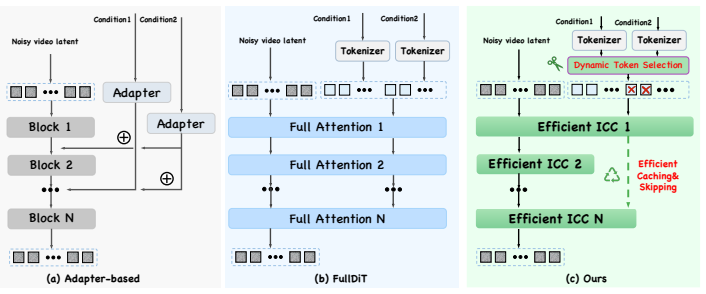
Two mechanisms carry the argument. Dynamic Token Selection is a lightweight learned MLP that predicts an importance score for each reference token from its value-vector features, keeps the top half of tokens for attention, and re-concatenates the dropped tokens' original hidden states after the feed-forward network so their information still reaches later blocks, cutting the attention length from $O((N_x+N_c)^2)$ toward $O((N_x+N_c/2)^2)$. Selective Context Caching has two halves: step-wise caching computes the selected reference keys and values only at the first diffusion step and reuses them at every later step, while layer-wise caching processes reference tokens only in the first layer plus the four layers with the highest Block Importance Index — a measure of how much a layer's noisy-latent output changes when the reference keys and values are included. The decoupled-attention identity — that reference self-attention plus noisy-to-all attention is exactly equivalent to full attention with the reference-to-noisy block masked — is what lets cached keys and values be reused without the training-inference mismatch that naive caching would cause.
What would settle it
Measure the cosine similarity of the selected reference tokens' key and value features between the first and later diffusion steps on a task outside the paper's set — for example, a fast camera motion or a subject whose appearance changes across the video — and compare the cached-condition model against the full-recomputation model on identity, camera-error, and pose metrics; if similarity drops markedly and task metrics degrade under caching while the baseline holds, the stability premise that the speedup depends on fails.
Extended reading notes
Core claim
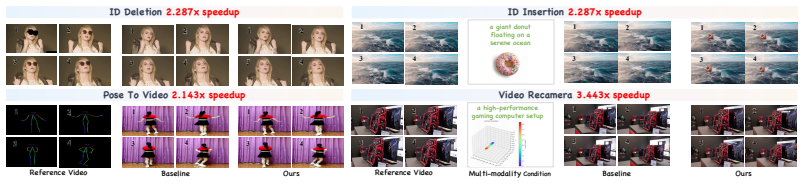
The paper's central claim is that in-context conditioning can be made two to three times cheaper per diffusion step without sacrificing control fidelity, because the conditioning signal is internally redundant in two independent ways. Token-level analysis across six tasks shows long-tail differences between consecutive reference frames and strong attention concentration — about half of the reference tokens absorb over 85% of the attention from the noisy latents — so a learned per-block selector can drop the uninformative half. The second redundancy is temporal and layer-wise: reference-token features remain stable across diffusion steps while their influence varies strongly across blocks, so the framework computes selected reference keys and values once at the first step and reuses them later, and it restricts full reference processing to the five layers with the highest Block Importance Index. To make caching safe, the paper replaces full attention with decoupled attention — reference queries attend only to reference keys while noisy queries attend to all keys — and proves this equals masked attention with the reference-to-noisy block masked off. On identity editing, re-camera, trajectory-to-video, and pose-to-video tasks, FullDiT2 reports 2.1-3.4x per-step speedups with quality metrics matching or beating the unoptimized baseline.
Load-bearing premise
The per-step speedup rests on the premise that reference-condition token features stay nearly unchanged across diffusion steps, so keys and values computed once at the first step remain valid for every later step; if those features drift under another task, sampling schedule, or longer generation, the cached conditioning would go stale and the efficiency-quality tradeoff would break.
Editorial extensions
If this is right
- Tasks that stack dense conditions benefit most: with a reference video plus a camera trajectory, per-step latency drops to about a third of baseline and FLOPs fall to roughly 32%.
- Because the method prunes and caches the condition pathway rather than the noisy-latent pathway, it can be composed with general DiT accelerators that reduce noisy-latent work.
- Across the six tasks, identity similarity, pose accuracy, camera error, and text-alignment metrics stay in the baseline's range, with identity editing sometimes scoring higher than the full-computation run.
- The decoupled-attention equivalence keeps cached inference computing the same masked-attention output the model saw in training, so the speedup does not require retraining with a different attention pattern.
Reading between the lines
- The fixed configuration — top 50% token selection and five reference-processing layers — is tuned to one 28-layer pretrained model; the most direct extension is an adaptivity rule that re-selects tokens or refreshes the cache when drift is detected during sampling.
- Because the block-importance profile is measured once on a sample set, the method presupposes that a task's layer-wise condition usage stays similar across prompts; a testable extension is measuring how the optimal layer set moves across conditioning modalities and prompt types.
- The value-vector-based importance predictor is a proxy for attention salience; for conditions whose relevant tokens shift early versus late in the diffusion process, an attention-grounded selection signal might prove more robust.
Editorial analysis
A structured set of objections, weighed in public.
Referee Report
Summary. The paper proposes FullDiT2, an efficiency framework for in-context conditioning in video diffusion transformers. It combines dynamic token selection, which keeps only the top 50% of reference tokens per block, with selective context caching, which reuses reference keys and values across diffusion timesteps and skips reference processing in most transformer blocks. A decoupled attention formulation is introduced to make the cached computation match a masked-attention target. Experiments on six video editing and generation tasks report 2.1–3.4x per-step speedups with point-estimate quality metrics that are mixed but often close to baseline, plus ablations of the selection ratio, random selection, layer choice, and caching variants.
Significance. If the efficiency-quality trade-off holds, FullDiT2 is a practically useful contribution for deploying in-context conditioning video models. The paper has real strengths: the speedup numbers are direct measurements on the same hardware; the decoupled-attention equivalence proof in Appendix D is correct under standard scaled dot-product attention; the ablations in Table 2 isolate the contribution of each component; and the comparison with Delta-DiT and FORA in Appendix C.2 is informative. The main weakness is that the central claim of 'minimal degradation or even higher performance' rests on small, custom, point-estimate evaluations and on an unverified assumption that the identity of important reference tokens, not just their features, is stable across timesteps.
major comments (3)
- [Section 3.3.2, Figure 2d] The step-wise context caching scheme computes reference K/V only at the first diffusion timestep and reuses them for all later steps, while the Dynamic Token Selection in Section 3.3.1 is executed only at that first step. The paper supports this with the observation that reference token features are stable across timesteps, but the central trade-off also requires that the identity of the selected top-50% tokens is stable: if the important-token set shifts during denoising, the cached K/V omit tokens that later attention steps would need, and no subsequent computation recovers them. Figure 2d reports cosine similarity of reference hidden states in the pretrained full-attention model, not in the finetuned decoupled model actually used at inference, and Figure 2c shows layer-wise divergence rather than timestep-wise selection stability. Please provide a direct analysis of selection overlap across timesteps (for example, the Jaccard index of the top-k sets) or an ablation of the caching start timestep; without this, the claim that caching preserves conditioning quality is not fully supported.
- [Section 4.2, Tables 1 and 3; Appendix B] All quality comparisons are point estimates on small custom test sets (40 videos per ID task, 50 ReCamera pairs, and 100 pose videos, per Appendix B) and no error bars or significance tests are reported. The results are also mixed: for ID Delete, PSNR drops from 27.432 to 26.236 and SSIM from 0.903 to 0.875; for ReCamera, RotErr worsens from 1.855 to 1.924 while TransErr improves. Given the abstract claim of 'minimal degradation or even higher performance,' these fluctuations need confidence intervals or statistical tests; otherwise the quality-preservation claim is not quantitatively established.
- [Section 3.3.1, Eq. (3)] The importance prediction network phi takes f(Vc), but the feature transform f is never defined, and the architecture and training objective of phi are not specified. Because Dynamic Token Selection is one of the two core contributions, the manuscript should state what f is (for example, identity, value norm, or a learned projection) and how phi is trained (jointly with the finetuning or separately). This is needed for reproducibility and to assess whether the selection mechanism is actually what drives the attention concentration reported in Figure 2b.
minor comments (4)
- [Abstract and Section 1] There are several typos and wording issues: 'dynamical token selection' should be 'dynamic token selection'; 'identity important context tokens' should be 'identify'; 'exponential-growth computation overhead' should be 'quadratic' because attention scales quadratically with sequence length; and 'peformance' should be 'performance'.
- [Section 4.2 and Appendix C.2] Section 4.2 refers to 'Table 3' for the main quantitative comparison, but the main comparison table is labeled Table 1, and the appendix also contains a Table 3 for the Delta-DiT/FORA comparison. Please renumber the tables consistently.
- [Appendix C.3, Table 4] The theoretical attention-only speedup for the ReCamera setting is computed as about 7.57x, while the measured speedup in Table 1 is 3.43x and the GFLOPs reduction is about 3.04x. The paper should state explicitly that the appendix formulas count only self-attention token-pair interactions and explain the gap relative to measured end-to-end latency, which includes projections, MLPs, and other overheads.
- [Section 4.1 and Appendix A] The units 'Lat.(step/s)' and 'GFLOPs' are used inconsistently: latency is reported as seconds per step (so a lower value is better, as marked), while GFLOPs per step is a total computation value. Clarify the units in the table headers and in the text describing the efficiency measurements.
Circularity Check
No significant circularity: the efficiency gains are either directly measured or algebraically derived from explicit architectural choices, and no fitted quantity is repackaged as a prediction.
full rationale
FullDiT2's central efficiency claim, a 2-3x speedup per diffusion step, is not obtained by fitting a target and then reporting the fit as a prediction. The reduction chain is: FullDiT's ICC cost is quadratic in the concatenated sequence length (Section 3.2); Dynamic Token Selection halves Nc; step caching reuses reference K/V after t=0; layer caching restricts reference processing to Ls=5 layers. The Appendix C.3 cost formulas are algebraic consequences of these architectural choices with stated T, L, Ls, and the latency/FLOPs numbers in Tables 1 and 3 are direct measurements. The decoupled-attention equivalence in Appendix D is an exact algebraic identity under standard scaled dot-product attention, so it does not smuggle in the efficiency conclusion. The quality-preservation claim is empirical; no quality metric used in evaluation (CLIP-I, DINO, PSNR, PCK, etc.) is a fitted parameter of the method. The BI-based layer selection is an analysis-driven configuration choice computed on the pretrained FullDiT baseline and then ablated (Table 2); it is not a prediction derived from the reported quality metrics. FullDiT [14] is cited as the baseline model by overlapping authors, but this self-citation is not load-bearing: the baseline is an externally published architecture and all comparisons are actual measurements. The skeptical concern that cached token selection could be stale across timesteps targets the empirical validity of the stability assumption (supported only by Fig. 2d), which is a correctness/robustness risk, not a circular derivation. No step in the paper's own equations equates a claimed output with an input by construction.
Assumptions & free parameters
free parameters (4)
- token selection ratio k/n_c =
0.5 (top 50%)
- number of context-processing layers L_s =
5 (layer 0 plus top-4 BI layers)
- importance prediction network phi (MLP weights) =
learned during fine-tuning
- caching start timestep =
t=0 (first sampling step)
assumptions (4)
- domain assumption Reference (context) token features remain approximately stable across diffusion timesteps, so K/V computed at the first step can be reused for all steps.
- domain assumption Value-vector norm or simple features predict the attention relevance of a token, as used by the learned importance predictor.
- domain assumption The Block Importance Index computed on a finite set of training samples generalizes to test samples and remains valid after fine-tuning.
- standard math Standard softmax attention equivalence used in the decoupled attention proof.
Cite this review
Pith. "Pith review of FullDiT2: Efficient In-Context Conditioning for Video Diffusion Transformers." pith.science (2026). https://pith.science/paper/7TR7JGFC
@misc{pith2026250604213,
  author       = {Pith},
  title        = {Pith review of: FullDiT2: Efficient In-Context Conditioning for Video Diffusion Transformers},
  year         = {2026},
  howpublished = {\url{https://pith.science/paper/7TR7JGFC}},
  note         = {Machine review of arXiv:2506.04213}
}
read the original abstract
Fine-grained and efficient controllability on video diffusion transformers has raised increasing desires for the applicability. Recently, In-context Conditioning emerged as a powerful paradigm for unified conditional video generation, which enables diverse controls by concatenating varying context conditioning signals with noisy video latents into a long unified token sequence and jointly processing them via full-attention, e.g., FullDiT. Despite their effectiveness, these methods face quadratic computation overhead as task complexity increases, hindering practical deployment. In this paper, we study the efficiency bottleneck neglected in original in-context conditioning video generation framework. We begin with systematic analysis to identify two key sources of the computation inefficiencies: the inherent redundancy within context condition tokens and the computational redundancy in context-latent interactions throughout the diffusion process. Based on these insights, we propose FullDiT2, an efficient in-context conditioning framework for general controllability in both video generation and editing tasks, which innovates from two key perspectives. Firstly, to address the token redundancy, FullDiT2 leverages a dynamic token selection mechanism to adaptively identify important context tokens, reducing the sequence length for unified full-attention. Additionally, a selective context caching mechanism is devised to minimize redundant interactions between condition tokens and video latents. Extensive experiments on six diverse conditional video editing and generation tasks demonstrate that FullDiT2 achieves significant computation reduction and 2-3 times speedup in averaged time cost per diffusion step, with minimal degradation or even higher performance in video generation quality. The project page is at \href{https://fulldit2.github.io/}{https://fulldit2.github.io/}.
Figures


Figures from the paper (4 more)


Forward citations
Cited by 1 Pith paper
-
VideoCanvas: Unified Video Completion from Arbitrary Spatiotemporal Patches via In-Context Conditioning
A single diffusion model with in-context conditioning and fractional RoPE positions completes videos from arbitrary spatio-temporal image patches.
Reference graph
Works this paper leans on
-
[1]
Zhuoyi Yang, Jiayan Teng, Wendi Zheng, Ming Ding, Shiyu Huang, Jiazheng Xu, Yuanming Yang, Wenyi Hong, Xiaohan Zhang, Guanyu Feng, et al. Cogvideox: Text-to-video diffusion models with an expert transformer.arXiv preprint arXiv:2408.06072, 2024
arXiv 2024
-
[2]
Wan: Open and advanced large-scale video generative models.arXiv preprint arXiv:2503.20314, 2025
Ang Wang, Baole Ai, Bin Wen, Chaojie Mao, Chen-Wei Xie, Di Chen, Feiwu Yu, Haiming Zhao, Jianxiao Yang, Jianyuan Zeng, et al. Wan: Open and advanced large-scale video generative models.arXiv preprint arXiv:2503.20314, 2025
arXiv 2025
-
[3]
Xiangyu Peng, Zangwei Zheng, Chenhui Shen, Tom Young, Xinying Guo, Binluo Wang, Hang Xu, Hongxin Liu, Mingyan Jiang, Wenjun Li, et al. Open-sora 2.0: Training a commercial-level video generation model in200k.arXiv preprint arXiv:2503.09642, 2025
arXiv 2025
-
[4]
Xuanhua He, Quande Liu, Shengju Qian, Xin Wang, Tao Hu, Ke Cao, Keyu Yan, and Jie Zhang. Id-animator: Zero-shot identity-preserving human video generation.arXiv preprint arXiv:2404.15275, 2024
arXiv 2024
-
[5]
Zixuan Ye, Huijuan Huang, Xintao Wang, Pengfei Wan, Di Zhang, and Wenhan Luo. Stylemas- ter: Stylize your video with artistic generation and translation.arXiv preprint arXiv:2412.07744, 2024
arXiv 2024
-
[6]
Gongye Liu, Menghan Xia, Yong Zhang, Haoxin Chen, Jinbo Xing, Yibo Wang, Xintao Wang, Yujiu Yang, and Ying Shan. Stylecrafter: Enhancing stylized text-to-video generation with style adapter.arXiv preprint arXiv:2312.00330, 2023
arXiv 2023
-
[7]
Gamegen-x: Interactive open-world game video generation.arXiv preprint arXiv:2411.00769, 2024
Haoxuan Che, Xuanhua He, Quande Liu, Cheng Jin, and Hao Chen. Gamegen-x: Interactive open-world game video generation.arXiv preprint arXiv:2411.00769, 2024
arXiv 2024
-
[8]
Sparsectrl: Adding sparse controls to text-to-video diffusion models
Yuwei Guo, Ceyuan Yang, Anyi Rao, Maneesh Agrawala, Dahua Lin, and Bo Dai. Sparsectrl: Adding sparse controls to text-to-video diffusion models. InEuropean Conference on Computer Vision, pages 330–348. Springer, 2024
2024
Show all 54 references
-
[9]
Follow-your-emoji: Fine-controllable and expressive freestyle portrait animation.arXiv preprint arXiv:2406.01900, 2024
Yue Ma, Hongyu Liu, Hongfa Wang, Heng Pan, Yingqing He, Junkun Yuan, Ailing Zeng, Chengfei Cai, Heung-Yeung Shum, Wei Liu, et al. Follow-your-emoji: Fine-controllable and expressive freestyle portrait animation.arXiv preprint arXiv:2406.01900, 2024
2024 arXiv
-
[10]
Con- trolnext: Powerful and efficient control for image and video generation.arXiv preprint arXiv:2408.06070, 2024
Bohao Peng, Jian Wang, Yuechen Zhang, Wenbo Li, Ming-Chang Yang, and Jiaya Jia. Con- trolnext: Powerful and efficient control for image and video generation.arXiv preprint arXiv:2408.06070, 2024
2024 arXiv
-
[11]
Ominicontrol: Minimal and universal control for diffusion transformer.arXiv preprint arXiv:2411.15098, 2024
Zhenxiong Tan, Songhua Liu, Xingyi Yang, Qiaochu Xue, and Xinchao Wang. Ominicontrol: Minimal and universal control for diffusion transformer.arXiv preprint arXiv:2411.15098, 2024
2024 arXiv
-
[12]
Omnihuman-1: Rethinking the scaling-up of one-stage conditioned human animation models.arXiv preprint arXiv:2502.01061, 2025
Gaojie Lin, Jianwen Jiang, Jiaqi Yang, Zerong Zheng, and Chao Liang. Omnihuman-1: Rethinking the scaling-up of one-stage conditioned human animation models.arXiv preprint arXiv:2502.01061, 2025. 10
2025 arXiv
-
[13]
Long context tuning for video generation.arXiv preprint arXiv:2503.10589, 2025
Yuwei Guo, Ceyuan Yang, Ziyan Yang, Zhibei Ma, Zhijie Lin, Zhenheng Yang, Dahua Lin, and Lu Jiang. Long context tuning for video generation.arXiv preprint arXiv:2503.10589, 2025
2025 arXiv
-
[14]
Fulldit: Multi-task video generative foundation model with full attention
Xuan Ju, Weicai Ye, Quande Liu, Qiulin Wang, Xintao Wang, Pengfei Wan, Di Zhang, Kun Gai, and Qiang Xu. Fulldit: Multi-task video generative foundation model with full attention. arXiv preprint arXiv:2503.19907, 2025
2025 arXiv
-
[15]
Cameractrl: Enabling camera control for text-to-video generation.arXiv preprint arXiv:2404.02101, 2024
Hao He, Yinghao Xu, Yuwei Guo, Gordon Wetzstein, Bo Dai, Hongsheng Li, and Ceyuan Yang. Cameractrl: Enabling camera control for text-to-video generation.arXiv preprint arXiv:2404.02101, 2024
2024 arXiv
-
[16]
Follow your pose: Pose-guided text-to-video generation using pose-free videos
Yue Ma, Yingqing He, Xiaodong Cun, Xintao Wang, Siran Chen, Xiu Li, and Qifeng Chen. Follow your pose: Pose-guided text-to-video generation using pose-free videos. InProceedings of the AAAI Conference on Artificial Intelligence, volume 38, pages 4117–4125, 2024
2024
-
[17]
Recammaster: Camera-controlled generative rendering from a single video.arXiv preprint arXiv:2503.11647, 2025
Jianhong Bai, Menghan Xia, Xiao Fu, Xintao Wang, Lianrui Mu, Jinwen Cao, Zuozhu Liu, Haoji Hu, Xiang Bai, Pengfei Wan, et al. Recammaster: Camera-controlled generative rendering from a single video.arXiv preprint arXiv:2503.11647, 2025
2025 arXiv
-
[18]
In-context lora for diffusion transformers.arXiv preprint arXiv:2410.23775, 2024
Lianghua Huang, Wei Wang, Zhi-Fan Wu, Yupeng Shi, Huanzhang Dou, Chen Liang, Yutong Feng, Yu Liu, and Jingren Zhou. In-context lora for diffusion transformers.arXiv preprint arXiv:2410.23775, 2024
2024 arXiv
-
[19]
Less-to- more generalization: Unlocking more controllability by in-context generation.arXiv preprint arXiv:2504.02160, 2025
Shaojin Wu, Mengqi Huang, Wenxu Wu, Yufeng Cheng, Fei Ding, and Qian He. Less-to- more generalization: Unlocking more controllability by in-context generation.arXiv preprint arXiv:2504.02160, 2025
2025 arXiv
-
[20]
Visualcloze: A universal image generation framework via visual in-context learning.arXiv preprint arXiv:2504.07960, 2025
Zhong-Yu Li, Ruoyi Du, Juncheng Yan, Le Zhuo, Zhen Li, Peng Gao, Zhanyu Ma, and Ming- Ming Cheng. Visualcloze: A universal image generation framework via visual in-context learning.arXiv preprint arXiv:2504.07960, 2025
2025
-
[21]
Insert anything: Image insertion via in-context editing in dit.arXiv preprint arXiv:2504.15009, 2025
Wensong Song, Hong Jiang, Zongxing Yang, Ruijie Quan, and Yi Yang. Insert anything: Image insertion via in-context editing in dit.arXiv preprint arXiv:2504.15009, 2025
2025 arXiv
-
[22]
Dreamo: A unified framework for image customization
Chong Mou, Yanze Wu, Wenxu Wu, Zinan Guo, Pengze Zhang, Yufeng Cheng, Yiming Luo, Fei Ding, Shiwen Zhang, Xinghui Li, et al. Dreamo: A unified framework for image customization. arXiv preprint arXiv:2504.16915, 2025
2025
-
[23]
Ominicontrol2: Efficient conditioning for diffusion transformers.arXiv preprint arXiv:2503.08280, 2025
Zhenxiong Tan, Qiaochu Xue, Xingyi Yang, Songhua Liu, and Xinchao Wang. Ominicontrol2: Efficient conditioning for diffusion transformers.arXiv preprint arXiv:2503.08280, 2025
2025 arXiv
-
[24]
Denoising diffusion implicit models.arXiv preprint arXiv:2010.02502, 2020
Jiaming Song, Chenlin Meng, and Stefano Ermon. Denoising diffusion implicit models.arXiv preprint arXiv:2010.02502, 2020
2010 arXiv
-
[25]
Progressive distillation for fast sampling of diffusion models
Tim Salimans and Jonathan Ho. Progressive distillation for fast sampling of diffusion models. arXiv preprint arXiv:2202.00512, 2022
2022 arXiv
-
[26]
On distillation of guided diffusion models
Chenlin Meng, Robin Rombach, Ruiqi Gao, Diederik Kingma, Stefano Ermon, Jonathan Ho, and Tim Salimans. On distillation of guided diffusion models. InProceedings of the IEEE/CVF Conference on Computer Vision and Pattern Recognition, pages 14297–14306, 2023
2023
-
[27]
Latent consistency models: Synthesizing high-resolution images with few-step inference.arXiv preprint arXiv:2310.04378, 2023
Simian Luo, Yiqin Tan, Longbo Huang, Jian Li, and Hang Zhao. Latent consistency models: Synthesizing high-resolution images with few-step inference.arXiv preprint arXiv:2310.04378, 2023
2023 arXiv
-
[28]
Q-diffusion: Quantizing diffusion models
Xiuyu Li, Yijiang Liu, Long Lian, Huanrui Yang, Zhen Dong, Daniel Kang, Shanghang Zhang, and Kurt Keutzer. Q-diffusion: Quantizing diffusion models. InProceedings of the IEEE/CVF International Conference on Computer Vision, pages 17535–17545, 2023
2023
-
[29]
Ld-pruner: Ef- ficient pruning of latent diffusion models using task-agnostic insights
Thibault Castells, Hyoung-Kyu Song, Bo-Kyeong Kim, and Shinkook Choi. Ld-pruner: Ef- ficient pruning of latent diffusion models using task-agnostic insights. InProceedings of the IEEE/CVF Conference on Computer Vision and Pattern Recognition, pages 821–830, 2024
2024
-
[30]
Token merging for fast stable diffusion
Daniel Bolya and Judy Hoffman. Token merging for fast stable diffusion. InProceedings of the IEEE/CVF conference on computer vision and pattern recognition, pages 4599–4603, 2023. 11
2023
-
[31]
Importance-based token merging for diffusion models.arXiv preprint arXiv:2411.16720, 2024
Haoyu Wu, Jingyi Xu, Hieu Le, and Dimitris Samaras. Importance-based token merging for diffusion models.arXiv preprint arXiv:2411.16720, 2024
2024 arXiv
-
[32]
Fora: Fast- forward caching in diffusion transformer acceleration.arXiv preprint arXiv:2407.01425, 2024
Pratheba Selvaraju, Tianyu Ding, Tianyi Chen, Ilya Zharkov, and Luming Liang. Fora: Fast- forward caching in diffusion transformer acceleration.arXiv preprint arXiv:2407.01425, 2024
2024 arXiv
-
[33]
delta-dit: A training-free acceleration method tailored for diffusion transformers.arXiv preprint arXiv:2406.01125, 2024
Pengtao Chen, Mingzhu Shen, Peng Ye, Jianjian Cao, Chongjun Tu, Christos-Savvas Bouganis, Yiren Zhao, and Tao Chen. delta-dit: A training-free acceleration method tailored for diffusion transformers.arXiv preprint arXiv:2406.01125, 2024
2024 arXiv
-
[34]
Learning-to-cache: Accelerating diffusion transformer via layer caching.Advances in Neural Information Processing Systems, 37:133282–133304, 2024
Xinyin Ma, Gongfan Fang, Michael Bi Mi, and Xinchao Wang. Learning-to-cache: Accelerating diffusion transformer via layer caching.Advances in Neural Information Processing Systems, 37:133282–133304, 2024
2024
-
[35]
Relactrl: Relevance-guided efficient control for diffusion transformers.arXiv preprint arXiv:2502.14377, 2025
Ke Cao, Jing Wang, Ao Ma, Jiasong Feng, Zhanjie Zhang, Xuanhua He, Shanyuan Liu, Bo Cheng, Dawei Leng, Yuhui Yin, et al. Relactrl: Relevance-guided efficient control for diffusion transformers.arXiv preprint arXiv:2502.14377, 2025
2025
-
[36]
Scalable diffusion models with transformers
William Peebles and Saining Xie. Scalable diffusion models with transformers. InProceedings of the IEEE/CVF international conference on computer vision, pages 4195–4205, 2023
2023
-
[37]
Flow matching for generative modeling.arXiv preprint arXiv:2210.02747, 2022
Yaron Lipman, Ricky TQ Chen, Heli Ben-Hamu, Maximilian Nickel, and Matt Le. Flow matching for generative modeling.arXiv preprint arXiv:2210.02747, 2022
2022 arXiv
-
[38]
Llm pruning and distillation in practice: The minitron approach.arXiv preprint arXiv:2408.11796, 2024
Sharath Turuvekere Sreenivas, Saurav Muralidharan, Raviraj Joshi, Marcin Chochowski, Ameya Sunil Mahabaleshwarkar, Gerald Shen, Jiaqi Zeng, Zijia Chen, Yoshi Suhara, Shizhe Diao, et al. Llm pruning and distillation in practice: The minitron approach.arXiv preprint arXiv:2408.1...
2024 arXiv
-
[39]
Flashattention: Fast and memory-efficient exact attention with io-awareness.Advances in neural information processing systems, 35:16344–16359, 2022
Tri Dao, Dan Fu, Stefano Ermon, Atri Rudra, and Christopher Ré. Flashattention: Fast and memory-efficient exact attention with io-awareness.Advances in neural information processing systems, 35:16344–16359, 2022
2022
-
[40]
Attention score is not all you need for token importance indicator in KV cache reduction: Value also matters
Zhiyu Guo, Hidetaka Kamigaito, and Taro Watanabe. Attention score is not all you need for token importance indicator in KV cache reduction: Value also matters. In Yaser Al- Onaizan, Mohit Bansal, and Yun-Nung Chen, editors,Proceedings of the 2024 Conference on Empirical Method...
2024
-
[41]
Vbench: Comprehensive benchmark suite for video generative models
Ziqi Huang, Yinan He, Jiashuo Yu, Fan Zhang, Chenyang Si, Yuming Jiang, Yuanhan Zhang, Tianxing Wu, Qingyang Jin, Nattapol Chanpaisit, et al. Vbench: Comprehensive benchmark suite for video generative models. InProceedings of the IEEE/CVF Conference on Computer Vision and Patt...
2024
-
[42]
Using k-poselets for detecting people and localizing their keypoints
Georgia Gkioxari, Bharath Hariharan, Ross Girshick, and Jitendra Malik. Using k-poselets for detecting people and localizing their keypoints. InProceedings of the IEEE Conference on Computer Vision and Pattern Recognition, pages 3582–3589, 2014
2014
-
[43]
Sam 2: Segment anything in images and videos.arXiv preprint arXiv:2408.00714, 2024
Nikhila Ravi, Valentin Gabeur, Yuan-Ting Hu, Ronghang Hu, Chaitanya Ryali, Tengyu Ma, Haitham Khedr, Roman Rädle, Chloe Rolland, Laura Gustafson, et al. Sam 2: Segment anything in images and videos.arXiv preprint arXiv:2408.00714, 2024
2024 arXiv
-
[44]
Adding conditional control to text-to-image diffusion models
Lvmin Zhang, Anyi Rao, and Maneesh Agrawala. Adding conditional control to text-to-image diffusion models. InProceedings of the IEEE/CVF international conference on computer vision, pages 3836–3847, 2023
2023
-
[45]
inserted
Qiuheng Wang, Yukai Shi, Jiarong Ou, Rui Chen, Ke Lin, Jiahao Wang, Boyuan Jiang, Haotian Yang, Mingwu Zheng, Xin Tao, et al. Koala-36m: A large-scale video dataset improving con- sistency between fine-grained conditions and video content.arXiv preprint arXiv:2410.08260, 2024....
-
[46]
Attention is computed only over theN x noisy latent tokens for allLlayers andTtimesteps
Baseline DiT (No Condition):In this standard configuration, no condition tokens are processed. Attention is computed only over theN x noisy latent tokens for allLlayers andTtimesteps. Cno_cond =T LN2 x (10)
-
[47]
All L layers and T timesteps perform attention over the total sequence length(N x +N c)≈3N x
Baseline ICC (FullDiT-style):Here, the full set of Nc reference condition tokens are concatenated with Nx noisy latent tokens. All L layers and T timesteps perform attention over the total sequence length(N x +N c)≈3N x. Cbaseline_icc ≈T L(3Nx)2 = 9T LN2 x (11)
-
[48]
16 At the first timestep (t= 1 ), reference K/V must be computed
FullDiT2 (Ours):Our method incorporates Dynamic Token Selection (reducing effective reference length to N ′ c ≈N x), step-wise context caching for reference tokens (computed at t= 1 , reused for T−1steps), and layer-wise context caching (L s layers process reference,L−L s laye...
-
[49]
Caching: Step:No Dynamic Token Selection is applied ( Nc ≈2N x)
Baseline + Sel. Caching: Step:No Dynamic Token Selection is applied ( Nc ≈2N x). All L layers process reference tokens. Reference K/V are computed at t= 1 and reused for the subsequent T−1steps. Cstep_cache ≈L(7N 2 x ) + (T−1)L(3N 2 x ) = (3T+ 4)LN 2 x (15)
-
[50]
Caching: Layer:No Dynamic Token Selection ( Nc ≈2N x) and no step-wise context caching
Baseline+Sel. Caching: Layer:No Dynamic Token Selection ( Nc ≈2N x) and no step-wise context caching. Reference tokens are processed in Ls layers, and skipped in L−L s layers, for all T timesteps. Clayer_cache ≈T Ls(3Nx)2 + (L−L s)N 2 x =T(L+ 8L s)N 2 x (16)
-
[51]
All L layers and T timesteps process the reduced sequence length (Nx +N ′ c)≈2N x
Baseline + Dynamic Token Selection:Only Dynamic Token Selection is active (effective reference length N ′ c ≈N x). All L layers and T timesteps process the reduced sequence length (Nx +N ′ c)≈2N x. No stepwise caching or layer caching. Cdts_only ≈T L(Nx +N x)2 = 4T LN2 x (17)
-
[52]
Context Caching are active
Ours w/o Dynamic Token Selection:FullDiT2 framework but with Dynamic Token Selection disabled (Nc ≈2N x is used instead ofN ′ c ≈N x). Context Caching are active. Cours_no_dts ≈(L+ 6L s)N 2 x + (T−1)(L+ 2L s)N 2 x = (T L+ (2T+ 4)Ls)N 2 x (18)
-
[53]
Reference K/V are recomputed at every step
Ours w/o Selective Caching: Step:FullDiT2 framework but with step-wise context caching disabled. Reference K/V are recomputed at every step. The cost of the first step is effectively repeated Ttimes. Cours_no_temporal ≈T Ls(3N 2 x ) + (L−L s)N 2 x =T(L+ 2L s)N 2 x (19)
-
[54]
Ours w/o Selective Caching: Layer ( Ls →L ):FullDiT2 framework but with layer-wise context caching disabled; allLlayers process reference tokens. Cours_no_layer ≈3LN 2 x + (T−1)2LN 2 x = (2T+ 1)LN 2 x (20) Summary Table of Computational Costs and Speedup RatiosFinally, we summ...
Reviewed August 7, 2026 · model on record in the stance chip above.
Discussion (0). Sign in to comment.