REVIEW 4 major objections 4 minor 20 references
LayerFlow: A Unified Model for Layer-aware Video Generation
T0 review · 4 major / 4 minor · reviewed 2026-08-07 · deepseek-v4-flash
Pith's one-line read LayerFlow is a unified text-to-video model that, from per-layer prompts, generates a transparent foreground, a clean background, and the blended scene, and can also decompose an input blended video into layers or conditionally generate…
desk verdict A genuinely new unified formulation for layered video generation with a clever two-LoRA training trick, but the paper never measures whether the layers actually recomposite—so the central capability is asserted, not shown. read the letter →
The pith
A machine-rendered reading of the paper's core claim, the machinery that carries it, and where it could break.
The reading
What carries the argument
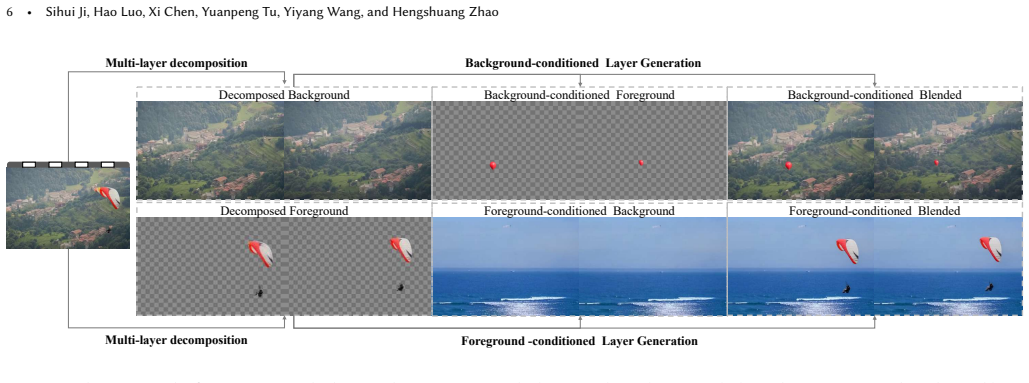
The central object is the layered temporal-subclip representation: each layer's video (foreground RGB, foreground alpha, background, blended) is treated as a sub-clip, and all sub-clips are concatenated into one long sequence of latent tokens, with per-layer prompts prefixed by an index number and a learnable layer embedding added to the encoded text. This lets a single 3D attention pass share information between layers and between text and vision, which gives inter-layer coherence. The second mechanism is the toggled LoRA pair: a Motion LoRA on the query/key/value projections is trained on duplicated static frames to absorb the 'static image' mode, while a Content LoRA is trained with the Motion LoRA switched on for images and off for videos; at inference only the Content LoRA remains, restoring the base model's motion prior.
What would settle it
Take the trained LayerFlow model and run inference with the Motion LoRA kept active instead of removed, on a fixed set of 50 per-layer prompt triples; if the generated videos become static (Dynamic Degree near zero) while a purely-video-trained model moves, the Motion LoRA is not actually restoring the base prior. The complementary check is to retrain Content LoRA without Motion LoRA on the image-video mixture and see whether aesthetic quality already collapses; that would show the static-image accommodation is essential.
Extended reading notes
Core claim
The paper's core claim is that a pretrained text-to-video diffusion transformer can become layer-aware by concatenating the visual tokens of four sub-clips (foreground RGB, foreground alpha, background, blended) along the time axis and adding a learnable layer embedding to the text embedding of each clip's prompt. With this single representation, the same model handles generation, decomposition, and foreground- or background-conditioned generation. The other load-bearing claim is that joint image-video training works through two low-rank adapters: a Motion LoRA trained on frozen duplicated frames makes the model accept static layered images, and a Content LoRA trained on both images and videos refines appearance; deleting Motion LoRA at inference restores the base model's dynamics while keeping the content gains. The paper presents VBench scores and a user study as evidence that this joint-data model beats both a purely-video version and ad-hoc LayerDiffuse-plus-motion baselines.
Load-bearing premise
The pipeline's bet is that a Motion LoRA trained on static duplicated frames can be cleanly switched off at inference, leaving the base model's motion behavior intact; if that toggle is lossy, the final model will be either static or low-fidelity, and the whole joint image-video training approach fails.
Editorial extensions
If this is right
- A user can specify one prompt for the foreground, one for the background, and one for the blended scene, and LayerFlow emits all three videos aligned to their own texts.
- The same trained model decomposes an input blended video into independent foreground and background layers, which can then be edited or recomposited.
- Given only a foreground or only a background video, the model fills in the missing layer and the blended result, making it a general layer-conditioned video generator.
- Because the training procedure only needs static layered images to refine appearance, high-quality paired multi-layer video datasets are not required.
Reading between the lines
- The temporal-subclip design is likely extensible to more than three layers if the layer-embedding set becomes continuous rather than fixed; the paper lists variable layer counts as its stated limitation, so a direct next test is a two-foreground-layer variant.
- The 'remove Motion LoRA at inference' behavior implies that the base model's motion prior survives inside the frozen backbone and is only masked during training; measuring motion statistics with and without the adapter on a fixed prompt set would quantify how fully the prior is restored.
- Treating conditioning as 'remove the noise from one sub-clip and exclude it from the loss' is essentially a learned layer-aware inpainting primitive, so the same framework could support object removal, insertion, or relighting by conditioning on edited layers.
- Dynamic Degree scores in the paper are higher for foreground and blended clips than for backgrounds, which suggests prompts implying fast or unusual motion are the most likely stress test for the claimed motion restoration.
Editorial analysis
A structured set of objections, weighed in public.
Referee Report
Summary. LayerFlow proposes a unified model for layer-aware video generation built on a text-to-video diffusion transformer (CogVideoX). Given per-layer prompts, it generates a transparent foreground (with alpha), a clean background, a blended composition, and it extends to decomposition and foreground/background-conditioned generation. The method concatenates sub-clips of all layers into one long sequence, adds layer embeddings to text embeddings, and uses a three-stage training pipeline with a Motion LoRA and a Content LoRA to combine coarse video data with high-quality static layered images. Experiments report VBench metrics, a user study, and ablations against two alternative architectures.
Significance. If the central claims hold, LayerFlow would be a notable systems contribution as one of the first unified frameworks for multi-layer video generation, decomposition, and conditioned recomposition. The paper is clearly written, the training pipeline is concrete, and the authors provide a substantial ablation study plus a 30-annotator user study. The use of a released pretrained model, explicit training stages, and open evaluation prompts are strengths. However, the load-bearing claim of cross-layer consistency is never directly measured, and several quantitative claims lack uncertainty information. These gaps need to be addressed before the paper can be fully accepted.
major comments (4)
- [Section 4.1, Tables 1 and 3] The central claim of mutually consistent layers is never directly tested. The training loss in Eq. (1) supervises each sub-clip independently, and no metric or user-study question checks whether the generated blended clip equals the alpha-composite of the generated foreground and background, or whether decomposing a real blended video and recompositing the outputs reconstructs the input. The paper dismisses segmentation metrics in Section 4.1 but substitutes no reconstruction metric. I request a quantitative compositing consistency check (e.g., LPIPS/PSNR between the recomposited foreground-over-background and the generated blended clip, and round-trip reconstruction error on the decomposition task) and a corresponding qualitative showcase.
- [Tables 1, 2, and 3] No error bars, confidence intervals, or significance tests are reported for any VBench metric or for the user-study preference scores. The text claims 'significantly better' and 'dominant superiority' (Section 4.3), but with a single run of a stochastic generation model and a user study without variance, these claims are not statistically supported. Please report variance over multiple seeds/prompt subsets and a significance test for the user study.
- [Section 3.2, Eq. (2)] The central mechanism for preserving motion—training a Motion LoRA on duplicated static frames and then removing it at inference—is not directly ablated. The paper never reports Dynamic Degree or other motion metrics with and without the Motion LoRA at inference. Without this ablation, the claim that removing Motion LoRA 'restores video dynamics' is only supported by qualitative examples. Please add a quantitative comparison that isolates the effect of Motion LoRA removal.
- [Section 4.1] The evaluation currently measures per-layer quality only (aesthetics, text alignment, frame consistency) plus a high-level user study. This does not verify the decomposition task's key property: that the separated foreground and background, together with the alpha channel, form a valid decomposition of the blended input. Traditional segmentation metrics are dismissed because occluded regions are reconstructed, but the paper should provide a reconstruction-based metric (e.g., alpha-composite reconstruction error) or a perceptual consistency metric to validate the decomposition.
minor comments (4)
- [Section 3.2] The LoRA ranks and the scales alpha for Content LoRA are not reported in the implementation details; please state these hyperparameters.
- [Table 1] The entry '0.62-0.66' for Dynamic Degree appears to be a range or formatting artifact, and several entries have missing spaces (e.g., '0.23120.2350'); please fix the table formatting.
- [Section 1 and Abstract] There are several typos: 'seperately' in Section 1, 'Layerd' near the start of the introduction, and 'dupilated' in Section 3.2. A proofread pass is needed.
- [Section 4.3] The heading 'Overal framework' is misspelled; also, the text around Table 3 switches between discussing Frame Consistency values and Aesthetic Quality without clearly separating the two; please restructure for readability.
Circularity Check
No circularity found: LayerFlow is a trained systems contribution whose claims are supported by empirical ablations and user studies, not by definitional reduction or self-citation.
full rationale
LayerFlow is a systems paper that trains a video generation model; it does not derive a physical quantity from fitted parameters, so the circularity burden is low. The central mechanism—concatenating per-layer sub-clips with layer embeddings and training through a three-stage LoRA pipeline—is presented as a construction, not as a prediction derived from the loss. The Motion LoRA is trained on static duplicated frames and then removed at inference to 'restore video dynamics'; this is an empirical design choice validated by ablations (Table 1, Figure 3), not a tautology, because nothing in the loss definition forces the base model's motion prior to return. The paper's conditional generation variants (foreground/background-conditioned generation, decomposition) are implemented by masking or dropping the condition clip from the loss and relying on attention sharing; again, this is a stated architectural modification, not an equation that reduces to its input. The evaluation uses VBench metrics and user studies; the absence of a direct compositing-consistency metric is a validation gap and a concern for external validity, not circularity. No load-bearing step relies on a self-citation, no uniqueness theorem is imported from the authors' prior work, and no known result is merely renamed. The paper is self-contained with respect to its training and evaluation claims, and the main risks are empirical (whether the model truly produces compositable layers) rather than logical circularity.
Assumptions & free parameters
free parameters (4)
- Motion LoRA scale alpha =
1 for static frames, 0 for dynamic videos
- LoRA ranks (unreported)
- Learning rates for three stages =
1e-4, 1e-3, 5e-3
- Number of trainable transformer blocks =
1/6 of blocks
assumptions (5)
- domain assumption CogVideoX provides a strong motion prior that can be transferred to layer-aware generation.
- domain assumption Automatically segmented and inpainted videos are sufficient as coarse training data for the base model.
- ad hoc to paper Copy-pasted foreground matting data onto background videos is a valid training signal for layered video generation.
- domain assumption MULAN and image matting datasets provide high-quality layered annotations that transfer to video.
- domain assumption VBench metrics and a user study are adequate for evaluating layer-aware video quality.
invented entities (2)
-
Layer embeddings
-
Motion LoRA and Content LoRA
Cite this review
Pith. "Pith review of LayerFlow: A Unified Model for Layer-aware Video Generation." pith.science (2026). https://pith.science/paper/66NZIJBS
@misc{pith2026250604228,
  author       = {Pith},
  title        = {Pith review of: LayerFlow: A Unified Model for Layer-aware Video Generation},
  year         = {2026},
  howpublished = {\url{https://pith.science/paper/66NZIJBS}},
  note         = {Machine review of arXiv:2506.04228}
}
read the original abstract
We present LayerFlow, a unified solution for layer-aware video generation. Given per-layer prompts, LayerFlow generates videos for the transparent foreground, clean background, and blended scene. It also supports versatile variants like decomposing a blended video or generating the background for the given foreground and vice versa. Starting from a text-to-video diffusion transformer, we organize the videos for different layers as sub-clips, and leverage layer embeddings to distinguish each clip and the corresponding layer-wise prompts. In this way, we seamlessly support the aforementioned variants in one unified framework. For the lack of high-quality layer-wise training videos, we design a multi-stage training strategy to accommodate static images with high-quality layer annotations. Specifically, we first train the model with low-quality video data. Then, we tune a motion LoRA to make the model compatible with static frames. Afterward, we train the content LoRA on the mixture of image data with high-quality layered images along with copy-pasted video data. During inference, we remove the motion LoRA thus generating smooth videos with desired layers.
Figures


Figures from the paper (6 more)



Reference graph
Works this paper leans on
-
[3]
Video generation models as world simulators. 2024.URL https://openai. com/research/video-generation-models- as-world-simulators(2024). Hila Chefer, Shiran Zada, Roni Paiss, Ariel Ephrat, Omer Tov, Michael Rubinstein, Lior Wolf, Tali Dekel, Tomer Michaeli, and Inbar Mosseri
work page 2024
-
[4]
Haoxin Chen, Yong Zhang, Xiaodong Cun, Menghan Xia, Xintao Wang, Chao Weng, and Ying Shan
Still-moving: Customized video generation without customized video data.ACM Transactions on Graphics (TOG)43, 6 (2024), 1–11. Haoxin Chen, Yong Zhang, Xiaodong Cun, Menghan Xia, Xintao Wang, Chao Weng, and Ying Shan
work page 2024
-
[5]
arXiv:2401.09047 [cs.CV] Xuewei Chen, Zhimin Chen, and Yiren Song
VideoCrafter2: Overcoming Data Limitations for High-Quality Video Diffusion Models. arXiv:2401.09047 [cs.CV] Xuewei Chen, Zhimin Chen, and Yiren Song
-
[7]
Zeqi Gu, Wenqi Xian, Noah Snavely, and Abe Davis
Segment and track anything.arXiv:2305.06558(2023). Zeqi Gu, Wenqi Xian, Noah Snavely, and Abe Davis
arXiv 2023
-
[8]
Factormatte: Redefining video matting for re-composition tasks.TOG(2023). Yuwei Guo, Ceyuan Yang, Anyi Rao, Zhengyang Liang, Yaohui Wang, Yu Qiao, Maneesh Agrawala, Dahua Lin, and Bo Dai
work page 2023
-
[9]
Jonathan Ho, Ajay Jain, and Pieter Abbeel
Animatediff: Animate your personalized text-to-image diffusion models without specific tuning.arXiv:2307.04725(2023). Jonathan Ho, Ajay Jain, and Pieter Abbeel
arXiv 2023
-
[11]
Cogvlm2: Visual language models for image and video understanding.arXiv:2408.16500(2024). Edward J Hu, Yelong Shen, Phillip Wallis, Zeyuan Allen-Zhu, Yuanzhi Li, Shean Wang, Lu Wang, and Weizhu Chen
arXiv 2024
-
[13]
Generative Omnimatte: Learning to Decompose Video into Layers
Generative Omnimatte: Learning to Decompose Video into Layers.arXiv preprint arXiv:2411.16683(2024). Erika Lu, Forrester Cole, Tali Dekel, Andrew Zisserman, William T Freeman, and Michael Rubinstein
work page Pith review arXiv 2024
Show all 20 references
-
[14]
William Peebles and Saining Xie
Trailblazer: Trajectory control for diffusion-based video generation.arXiv:2401.00896(2023). William Peebles and Saining Xie
2023 arXiv
-
[15]
Colin Raffel, Noam Shazeer, Adam Roberts, Katherine Lee, Sharan Narang, Michael Matena, Yanqi Zhou, Wei Li, and Peter J Liu
Alfie: Democratising RGBA Image Generation With No $$$.arXiv:2408.14826(2024). Colin Raffel, Noam Shazeer, Adam Roberts, Katherine Lee, Sharan Narang, Michael Matena, Yanqi Zhou, Wei Li, and Peter J Liu
2024 arXiv
-
[17]
Zhouxia Wang, Ziyang Yuan, Xintao Wang, Yaowei Li, Tianshui Chen, Menghan Xia, Ping Luo, and Ying Shan
TransPixeler: Advancing Text-to-Video Generation with Transparency.CoRR(2025). Zhouxia Wang, Ziyang Yuan, Xintao Wang, Yaowei Li, Tianshui Chen, Menghan Xia, Ping Luo, and Ying Shan
2025
-
[18]
InSIGGRAPH
Motionctrl: A unified and flexible motion controller for video generation. InSIGGRAPH. Shiyuan Yang, Liang Hou, Haibin Huang, Chongyang Ma, Pengfei Wan, Di Zhang, Xiaodong Chen, and Jing Liao. 2024a. Direct-a-video: Customized video generation with user-directed camera movemen...
2024 arXiv
-
[19]
Youcai Zhang, Xinyu Huang, Jinyu Ma, Zhaoyang Li, Zhaochuan Luo, Yanchun Xie, Yuzhuo Qin, Tong Luo, Yaqian Li, Shilong Liu, et al
Transparent image layer diffusion using latent transparency.arXiv:2402.17113(2024). Youcai Zhang, Xinyu Huang, Jinyu Ma, Zhaoyang Li, Zhaochuan Luo, Yanchun Xie, Yuzhuo Qin, Tong Luo, Yaqian Li, Shilong Liu, et al. 2024a. Recognize anything: A strong image tagging model. InCVP...
2024 arXiv
-
[20]
InProceedings of the IEEE/CVF International Conference on Computer Vision
Propainter: Improving propagation and transformer for video inpainting. InProceedings of the IEEE/CVF International Conference on Computer Vision. 10477–10486. SIGGRAPH Conference Papers ’25, August 10–14, 2025, Vancouver, BC, Canada. LayerFlow : A Unified Model for Layer-awar...
2025
-
[2020]
Petru-Daniel Tudosiu, Yongxin Yang, Shifeng Zhang, Fei Chen, Steven McDonagh, Gerasimos Lampouras, Ignacio Iacobacci, and Sarah Parisot
Exploring the limits of transfer learning with a unified text-to-text transformer.JMLR(2020). Petru-Daniel Tudosiu, Yongxin Yang, Shifeng Zhang, Fei Chen, Steven McDonagh, Gerasimos Lampouras, Ignacio Iacobacci, and Sarah Parisot
2020
-
[2021]
Ziqi Huang, Yinan He, Jiashuo Yu, Fan Zhang, Chenyang Si, Yuming Jiang, Yuanhan Zhang, Tianxing Wu, Qingyang Jin, Nattapol Chanpaisit, et al
Lora: Low-rank adaptation of large language models.arXiv:2106.09685(2021). Ziqi Huang, Yinan He, Jiashuo Yu, Fan Zhang, Chenyang Si, Yuming Jiang, Yuanhan Zhang, Tianxing Wu, Qingyang Jin, Nattapol Chanpaisit, et al
2021 arXiv
-
[2022]
arXiv:2205.15868(2022)
Cogvideo: Large-scale pretraining for text-to-video generation via transformers. arXiv:2205.15868(2022). Wenyi Hong, Weihan Wang, Ming Ding, Wenmeng Yu, Qingsong Lv, Yan Wang, Yean Cheng, Shiyu Huang, Junhui Ji, Zhao Xue, et al
2022 arXiv
-
[2023]
Jianhong Bai, Tianyu He, Yuchi Wang, Junliang Guo, Haoji Hu, Zuozhu Liu, and Jiang Bian
Qwen-vl: A versatile vision-language model for understanding, localization, text reading, and beyond.arXiv:2308.12966(2023). Jianhong Bai, Tianyu He, Yuchi Wang, Junliang Guo, Haoji Hu, Zuozhu Liu, and Jiang Bian
2023 arXiv
-
[2024]
Tim Brooks, Bill Peebles, Connor Holmes, Will DePue, Yufei Guo, Li Jing, David Schnurr, Joe Taylor, Troy Luhman, Eric Luhman, et al
Uniedit: A unified tuning-free framework for video motion and appearance editing.arXiv preprint arXiv:2402.13185(2024). Tim Brooks, Bill Peebles, Connor Holmes, Will DePue, Yufei Guo, Li Jing, David Schnurr, Joe Taylor, Troy Luhman, Eric Luhman, et al
2024 arXiv
-
[2025]
Yangming Cheng, Liulei Li, Yuanyou Xu, Xiaodi Li, Zongxin Yang, Wenguan Wang, and Yi Yang
TransAnimate: Taming Layer Diffusion to Generate RGBA Video.arXiv preprint arXiv:2503.17934(2025). Yangming Cheng, Liulei Li, Yuanyou Xu, Xiaodi Li, Zongxin Yang, Wenguan Wang, and Yi Yang
2025 arXiv
Reviewed August 7, 2026 · model on record in the stance chip above.
Discussion (0). Sign in to comment.