REVIEW 3 major objections 7 minor 15 references
Zero-Shot Adaptation of Parameter-Efficient Fine-Tuning in Diffusion Models
T0 review · 3 major / 7 minor · reviewed 2026-08-07 · deepseek-v4-flash
Pith's one-line read ProLoRA transfers a LoRA adapter from one diffusion model to another with no target training data, by projecting the adapter's subspace and null-space components onto the target weights, and reports performance comparable to training the…
desk verdict ProLoRA's broad experiments and practical idea are worth engaging, but Eq. 2 drops unquantified cross terms and the 'nullspace' claim overstates what is preserved; this needs a major revision before I'd trust the method as stated. read the letter →
The pith
A machine-rendered reading of the paper's core claim, the machinery that carries it, and where it could break.
The reading
What carries the argument
The central object is the orthogonal decomposition of a weight matrix from its singular value decomposition, splitting the left and right singular vectors into subspace bases and null-space bases. The paper uses this to decompose the source adapter $\Delta$ W_s into a subspace component and a null-space component, and then transfers each component to the target model by projecting onto the target's corresponding bases (Eqs. 2 and 3). A subspace-similarity score, based on the Frobenius inner product of left and right singular vectors, selects which source-target module pairs are aligned enough for transfer.
What would settle it
Compute the Frobenius norms of the two dropped cross terms, U_s,parallel U_s,parallel^T $\Delta$ W_s V_s,perp^T V_s,perp and U_s,perp U_s,perp^T $\Delta$ W_s V_s,parallel^T V_s,parallel, for a typical source-target pair such as SDXL to SSD-1B; if either norm is comparable to the kept components, then the transferred adapter is not a faithful copy of the source effect and the reported style-transfer match would not be expected to generalize.
Extended reading notes
Core claim
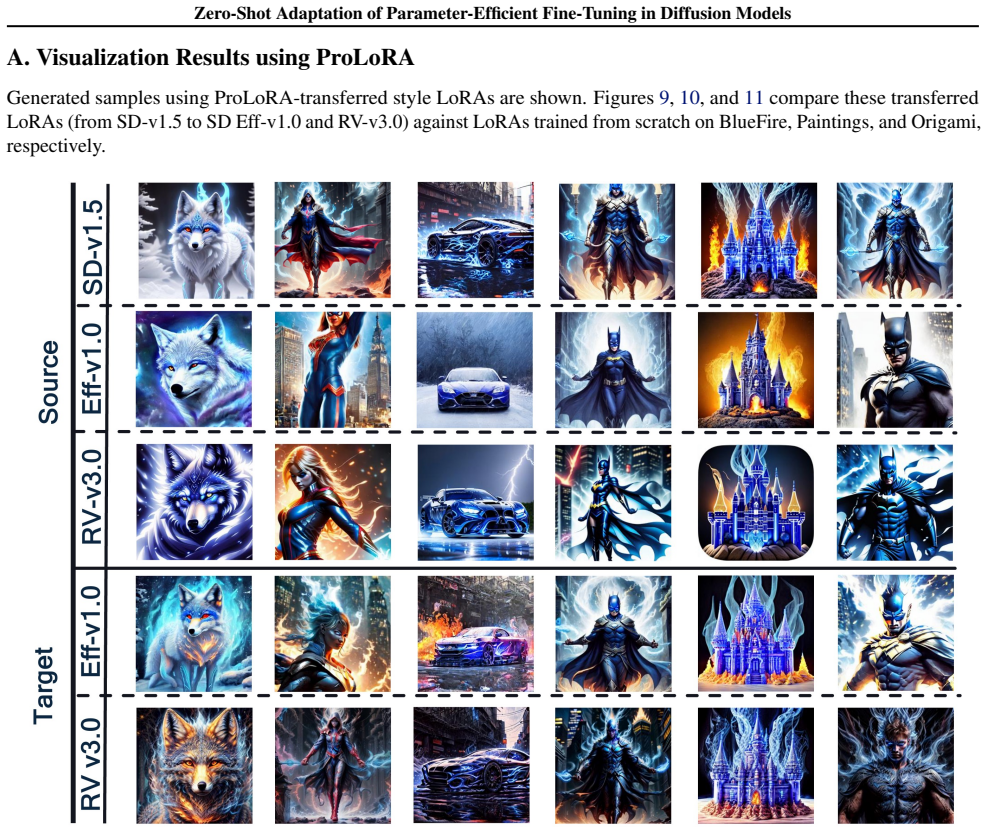
The central claim is that a pre-trained LoRA adapter can be transferred between text-to-image diffusion models by writing the source adapter as the sum of a subspace part and a null-space part relative to the source base weights, and then projecting each part onto the corresponding subspace and null space of the target base weights, as in Eq. 3. The paper argues that this preserves the adapter's effect on both the range and the orthogonal complement of the weight matrix, and that the transferred adapter performs comparably to a LoRA trained from scratch on the target model. Evidence is given for style LoRAs, DreamBooth concept LoRAs, LCM acceleration LoRAs, and also for DoRA and FouRA adapters, with the projection applied to the up and down matrices in each case.
Load-bearing premise
Equation 2 approximates the source adapter by keeping only the subspace-subspace and null-space-null-space projections while dropping the two cross terms, and the paper does not quantify how small those dropped terms are.
Editorial extensions
If this is right
- A user can migrate a fine-tuned style or concept adapter to a newer, distilled, or pruned base model without keeping the original training data or spending compute on retraining.
- The method extends beyond standard LoRA to other low-rank parameter-efficient adapters such as DoRA and FouRA, since it treats the adapter as a generic low-rank update.
- Because the transfer is a closed-form projection, it can be applied repeatedly as base models evolve, although the paper reports that chained transfers accumulate some error.
- The transferred adapter can also serve as an initialization for target-model fine-tuning, reaching the performance of random initialization in fewer iterations.
Reading between the lines
- The same projection formula should apply to adapter transfer in large language models and vision transformers, where weight matrices have similar low-rank update structures; the paper's text-generation experiments on TinyLlama support this direction.
- The null-space component may be what carries style or identity information that is not captured by the principal subspace, which would explain why dropping it degrades style transfer in the ablations.
- A practical test would be to measure how transfer quality degrades as source-target subspace similarity decreases, since the method relies on the two models sharing well-aligned layer subspaces.
- The method's dependence on singular value decomposition of full weight matrices could be replaced by randomized or streaming SVD for very large models, preserving the core idea at lower computational cost.
Editorial analysis
A structured set of objections, weighed in public.
Referee Report
Summary. This paper introduces ProLoRA, a training-free method for transferring LoRA-style adapters between text-to-image diffusion models. The proposed pipeline computes SVDs of source and target weight matrices, measures subspace similarity (Eq. 1) to select layer pairs, decomposes the source adapter into subspace and nullspace components (Eq. 2), and projects those components into the target weight spaces (Eq. 3). The authors report experiments on style, concept, LCM, DoRA, and FouRA adapters across SDXL, SD-v1.5, SSD-1B, and related models, plus text-generation transfer for TinyLlama, claiming performance comparable to training the adapter directly on the target.
Significance. If the central claim holds, ProLoRA would be a useful practical contribution: it turns adapter migration into a closed-form, data-free post-processing step with no target training. The paper is commendable for its breadth of evaluation, covering multiple adapter families, model pairs, and tasks, and for including copy baselines and ablations. The method also has a clearly stated limitation (threshold tau) and the paper includes sensitivity analyses. However, the mathematical derivation in Section 4 is the foundation of the method, and the issues described below currently prevent the paper from supporting its stated claims.
major comments (3)
- [Section 4.2, Eq. (2); Section 4.3, Eq. (3)] Equation (2) is not a decomposition of Delta Ws into row-subspace and row-nullspace components. Because Vs,parallel and Vs,perp have orthonormal columns, Vs,parallel^T Vs,parallel = I_r and Vs,perp^T Vs,perp = I, so the two terms on the right-hand side reduce to Us,parallel Us,parallel^T Delta Ws and Us,perp Us,perp^T Delta Ws. Their sum equals Delta Ws exactly (since Us,parallel Us,parallel^T + Us,perp Us,perp^T = I_m). Thus Eq. (2) is an identity with no right-side projection. If the intended row-space projectors were Vs,parallel Vs,parallel^T and Vs,perp Vs,perp^T, then the full orthogonal expansion also contains the cross terms Us,parallel Us,parallel^T Delta Ws Vs,perp Vs,perp^T and Us,perp Us,perp^T Delta Ws Vs,parallel Vs,parallel^T, which are dropped without any bound; for a full-rank source with m < n, Us,perp is empty and the dropped term P_parallel Delta Ws Q_perp is exactly the right-nullspace component that Sections 4.2 and 5.3.1 claim to preserve. Equation (3) inherits this problem and in fact uses no right singular vectors at all, since the V factors again collapse to identities. The central claim that ProLoRA transfers the adapter's effect on both the subspace and nullspace of the source weights to the target is therefore not supported by the formulas as written. The authors should either correct the projectors and quantify the dropped cross terms (e.g., report ||P_parallel Delta Ws Q_perp||_F and ||P_perp Delta Ws Q_parallel||_F over all transferred layers), or reformulate the method and its motivation to describe the left-projection operation that Eq. (3) actually implements.
- [Table 1; also Tables 9 and 10] In Table 1, the ProLoRA rows for each dataset/model are printed with only two numeric entries (HPSv2, LPIPS) while the CSD-MMD column is filled only for the LoRA-from-scratch rows. The same omission appears in Tables 9 and 10. Because CSD-MMD is the paper's primary style-transfer metric and the claim of comparable style transfer rests on it, the main quantitative table does not currently support the conclusion. Please restore the missing values and re-verify the numbers.
- [Section 4.3, last paragraph] The paragraph on transferring between weights with different dimensions (m != m' or n != n') states that a common subspace is identified using a linear projection described in Farhadzadeh et al. (2025), but the present paper gives no definition of this projection, no criterion for choosing its dimension, and no verification that the resulting subspace alignment preserves the properties required by Eq. (3). Since several experiments (e.g., SDXL to SSD-1B) involve architecturally different models, this step is necessary for the method to apply at all. The authors should specify the projection explicitly or restrict the claims to same-shape layer pairs.
minor comments (7)
- [Section 4.3] The text writes "Vt = [UV,parallel UV,perp]" but this should be "[Vt,parallel Vt,perp]".
- [Section 5.2] The sentence "The source LoRA is then projected onto its corresponding target module using equation 2" should refer to Eq. (3), not Eq. (2).
- [Table 2] The formatting of Table 2 makes it difficult to determine which DINOv2 values correspond to which method; please present each method on a separate row with all metrics aligned.
- [Tables 8 and 14] Tables 8 and 14 have identical captions ("Performance sensitivity of ProLoRA to the chain of iterative transfer") although they report different experiments; Table 14 should be retitled.
- [Section 4.1, Eq. (1)] The similarity measure in Eq. (1) divides by n but uses an m x m Frobenius norm, so it is not a normalized correlation for rectangular matrices; please clarify whether full singular matrices are used and whether the score is bounded.
- [All quantitative tables] No error bars or statistical significance are reported for any metric; given that several comparisons differ by small margins (e.g., Table 3 CLIP-I 0.737 vs 0.745), reporting variance across seeds would strengthen the claims.
- [Section 5.3.4, Table 7] The threshold sensitivity analysis covers only one dataset and one source-target pair; a few more pairs would better support the claim of robustness to the 0.8 threshold.
Circularity Check
No load-bearing circularity: the central ProLoRA transfer is benchmarked against externally trained target LoRA baselines; the main caveat is an unquantified approximation in Eq. 2, which is a correctness concern rather than a circularity.
full rationale
ProLoRA's central transfer formula (Eq. 3) is not fitted to the target-trained LoRA baseline: the baseline is an external benchmark, and the transferred adapter is a closed-form function of the source adapter and the target weights. The subspace/nullspace decomposition in Eq. 2 is stated as a projection, but as a matter of linear algebra it keeps only the parallel-parallel and perpendicular-perpendicular blocks and drops the two mixed blocks P_parallel * DeltaWs * Q_perp and P_perp * DeltaWs * Q_parallel without a bound or magnitude check. This is a substantive mathematical approximation and a reproducibility risk, but it is not circularity: the paper's empirical comparisons to target-trained LoRA, Copy LoRA, No LoRA, X-Adapter, and other baselines do not reduce to the definition of the transferred adapter. The only self-citations are to the authors' earlier LoRA-X paper for the subspace-similarity measure (Eq. 1), the 0.8 module-selection threshold (Section 5.2), and the linear projection for differently sized weight matrices (Section 4.3); these are minor and not load-bearing for the central claim, which is evaluated against external benchmarks. Thus no prediction is forced by construction, and the score reflects only these minor self-citations.
Assumptions & free parameters
free parameters (1)
- subspace similarity threshold τ =
0.8
assumptions (4)
- domain assumption Singular value decompositions of source and target weight matrices are meaningful layer-wise pairing objects.
- domain assumption The cross terms between subspace and null-space in the adapter decomposition are negligible.
- domain assumption Projecting the source component into the target component, without rotating source singular vectors to target singular vectors, preserves the adapter effect for well-paired layers.
- ad hoc to paper A fixed threshold of 0.8 selects enough well-aligned layers for transfer.
Cite this review
Pith. "Pith review of Zero-Shot Adaptation of Parameter-Efficient Fine-Tuning in Diffusion Models." pith.science (2026). https://pith.science/paper/IC2F5YFN
@misc{pith2026250604244,
  author       = {Pith},
  title        = {Pith review of: Zero-Shot Adaptation of Parameter-Efficient Fine-Tuning in Diffusion Models},
  year         = {2026},
  howpublished = {\url{https://pith.science/paper/IC2F5YFN}},
  note         = {Machine review of arXiv:2506.04244}
}
read the original abstract
We introduce ProLoRA, enabling zero-shot adaptation of parameter-efficient fine-tuning in text-to-image diffusion models. ProLoRA transfers pre-trained low-rank adjustments (e.g., LoRA) from a source to a target model without additional training data. This overcomes the limitations of traditional methods that require retraining when switching base models, often challenging due to data constraints. ProLoRA achieves this via projection of source adjustments into the target model's weight space, leveraging subspace and null space similarities and selectively targeting aligned layers. Evaluations on established text-to-image models demonstrate successful knowledge transfer and comparable performance without retraining.
Figures


Figures from the paper (12 more)




Reference graph
Works this paper leans on
-
[3]
Svdiff: Compact parameter space for diffusion fine-tuning
Han, L., Li, Y ., Zhang, H., Milanfar, P., Metaxas, D., and Yang, F. Svdiff: Compact parameter space for diffusion fine-tuning. In 2023 IEEE/CVF International Conference on Computer Vision (ICCV),
work page 2023
-
[7]
La- tent consistency models: Synthesizing high-resolution images with few-step inference
Luo, S., Tan, Y ., Huang, L., Li, J., and Zhao, H. La- tent consistency models: Synthesizing high-resolution images with few-step inference. arXiv preprint arXiv:2310.04378, 2023a. Luo, S., Tan, Y ., Patil, S., Gu, D., von Platen, P., Passos, A., Huang, L., Li, J., and Zhao, H. Lcm-lora: A univer- sal stable-diffusion acceleration module, 2023b. URL https...
-
[8]
Novikova, J., Duˇsek, O., and Rieser, V
URL https://arxiv.org/abs/2108.01073. Novikova, J., Duˇsek, O., and Rieser, V . The e2e dataset: New challenges for end-to-end generation. arXiv preprint arXiv:1706.09254,
-
[9]
URL https://arxiv. org/abs/2303.09535. 10 Zero-Shot Adaptation of Parameter-Efficient Fine-Tuning in Diffusion Models Ran, L., Cun, X., Liu, J.-W., Zhao, R., Zijie, S., Wang, X., Keppo, J., and Shou, M. Z. X-adapter: Adding universal compatibility of plugins for upgraded diffusion model. arXiv preprint arXiv:2312.02238,
-
[11]
Vl-adapter: Parameter- efficient transfer learning for vision-and-language tasks
Sung, Y .-L., Cho, J., and Bansal, M. Vl-adapter: Parameter- efficient transfer learning for vision-and-language tasks. In 2022 IEEE/CVF Conference on Computer Vision and Pattern Recognition (CVPR), pp. 5217–5227,
work page 2022
-
[12]
Ye, H., Zhang, J., Liu, S., Han, X., and Yang, W
URL https://arxiv.org/abs/2312.12148. Ye, H., Zhang, J., Liu, S., Han, X., and Yang, W. Ip-adapter: Text compatible image prompt adapter for text-to-image diffusion models,
-
[13]
Zhang, L., Song, J., Gao, A., Chen, J., Bao, C., and Ma, K
URL https://arxiv.org/ abs/2308.06721. Zhang, L., Song, J., Gao, A., Chen, J., Bao, C., and Ma, K. Be your own teacher: Improve the performance of convolutional neural networks via self distillation. In Proceedings of the IEEE/CVF international conference on computer vision, pp. 3713–3722,
-
[14]
A., Shechtman, E., and Wang, O
Zhang, R., Isola, P., Efros, A. A., Shechtman, E., and Wang, O. The unreasonable effectiveness of deep features as a perceptual metric. In 2018 IEEE/CVF Conference on Computer Vision and Pattern Recognition . IEEE, June
work page 2018
Show all 15 references
-
[15]
and successfully transferred adapters from TinyLlama 3T to TinyLlama 2.5T. We evaluated ProLoRA’s transferability for different adapter types (LoRA and VeRA) on two standard text generation benchmarks from the original LoRA paper (Hu et al., 2022): text-to-text generation on t...
2022
-
[2006]
Mea- suring style similarity in diffusion models
Somepalli, G., Gupta, A., Gupta, K., Palta, S., Goldblum, M., Geiping, J., Shrivastava, A., and Goldstein, T. Mea- suring style similarity in diffusion models. arXiv preprint arXiv:2404.01292,
-
[2021]
F., Cheng, K.-T., and Chen, M.-H
Liu, S.-Y ., Wang, C.-Y ., Yin, H., Molchanov, P., Wang, Y .-C. F., Cheng, K.-T., and Chen, M.-H. Dora: Weight-decomposed low-rank adaptation. arXiv preprint arXiv:2402.09353,
-
[2022]
and Rush, A
Kim, Y . and Rush, A. M. Sequence-level knowledge distil- lation. arXiv preprint arXiv:1606.07947,
-
[2023]
Distilling the knowledge in a neural network
Hinton, G. Distilling the knowledge in a neural network. arXiv preprint arXiv:1503.02531,
-
[2024]
Samsum corpus: A human-annotated dialogue dataset for abstrac- tive summarization
Gliwa, B., Mochol, I., Biesek, M., and Wawer, A. Samsum corpus: A human-annotated dialogue dataset for abstrac- tive summarization. arXiv preprint arXiv:1911.12237 ,
1911 arXiv
-
[2025]
Frenkel, Y ., Vinker, Y ., Shamir, A., and Cohen-Or, D
URL https://arxiv.org/ abs/2501.16559. Frenkel, Y ., Vinker, Y ., Shamir, A., and Cohen-Or, D. Im- plicit style-content separation using b-lora,
Reviewed August 7, 2026 · model on record in the stance chip above.
Discussion (0). Sign in to comment.