REVIEW 3 major objections 5 minor 43 references
Enduring Disparities in the Workplace: A Pilot Study in the AI Community
T0 review · 3 major / 5 minor · reviewed 2026-08-07 · deepseek-v4-flash
Pith's one-line read A survey of 1,260 AI/ML professionals finds that disabled employees and other underrepresented groups report persistently worse workplace experiences than their colleagues.
desk verdict A welcome, honestly limited pilot baseline for AI/ML workplace disparities; the disability gap is plausible but not yet adjusted for age or employer. read the letter →
The pith
A machine-rendered reading of the paper's core claim, the machinery that carries it, and where it could break.
The reading
What carries the argument
The machine carrying the argument is the survey instrument itself: up to 55 self-report questions across nine constructs plus demographics, answered on four-point and five-point Likert scales with no neutral option. All items are positively framed, and options are ordered from most positive to most negative. The analysis encodes responses in ascending order (strongly agree = 1 through strongly disagree = 4, and never = 1 through multiple times a day = 5), so lower scores mean better workplace experience, then reports medians, modes, and the fraction of unfavorable responses. To compare subgroups, the authors binarize demographic dimensions into majority and minority groups with a minimum cell size of $n = 30$ (and $n = 10$ within employers) and use unpaired or paired Student's $t$-tests and $\chi^2$ tests. This aggregation machinery is what lets the paper convert raw Likert answers into the disparity claims about disability, gender, race, sexual orientation, and intersectional groups.
What would settle it
A reweighted or externally benchmarked replication using a probability-based or employer-partnered sample of AI/ML professionals, matched to known field demographics, would settle the claim: if disabled and non-disabled employees showed no significant difference on leaving-for-DEI reasons or on accessibility comfort after controlling for age, gender, seniority, and employer, the central conclusion would fail.
Extended reading notes
Core claim
On its own terms, the paper's central discovery is that disparities in AI workplace experience are enduring and measurable, and that the clearest signal is disability and accessibility. Participants reporting a disability had significantly higher scores on considering leaving their employer for DEI-related reasons ($p = 0.000048$), and among disabled respondents 45.65% do not feel comfortable discussing physical or cognitive challenges while 41.30% are not confident that requesting accommodations will not harm their career. Microaggressions also track identity: 81.51% of respondents who reported experiencing workplace microaggressions identify as gender minorities, 30.99% identify with a minority sexual orientation, and 15.63% have a disability or chronic condition, all at statistically significant rates relative to the respondent pool. In the DEI category, unfavorable responses rise significantly between the item 'my employer states that they value DEI' and 'my employer demonstrates a visible commitment' ($p < 0.00001$), and DEI efforts are reported to be carried disproportionately by members of minority groups. The paper presents these results as the first extensive, multi-dimensional survey of AI/ML professionals across roles, locations, employers, and seniority levels, and as a baseline for tracking whether DEI interventions actually change workplace experience.
Load-bearing premise
The central finding rests on the assumption that a self-selected convenience sample, recruited heavily through AI affinity groups and conference games, represents the broader AI/ML workforce well enough for within-sample comparisons, despite women being over-represented at 60.55% versus about 22% in the field.
Editorial extensions
If this is right
- Accessibility is a measured weakness for AI employers: roughly 46% of disabled respondents are uncomfortable discussing challenges and roughly 41% fear that requesting accommodations could hurt their career.
- Employers' DEI messaging and DEI practice diverge: unfavorable responses rise significantly between the "states they value DEI" item and the "demonstrates visible commitment" item, and DEI initiatives are reported to be led mainly by minority-group members.
- Microaggression patterns in AI workplaces resemble broader society, with gender minorities, sexual minorities, and disabled employees experiencing higher rates, so workplace-based DEI interventions cannot be treated as separate from societal bias.
- The instrument offers a reusable baseline for tracking DEI effectiveness over time, which the authors argue is urgent as DEI programs face political backlash and rollback.
Reading between the lines
- If the disability findings replicate, employers should treat fear of requesting accommodations as a retention metric rather than a compliance checkbox; the 41.30% who fear career harm are likely to leak out of the field over time.
- Because the sample over-represents women and was recruited through identity-based affinity groups, the reported race-by-gender gaps may be partly an artifact of who self-selected; a matched or weighted sample could change the magnitudes even if the directions hold.
- Respondents with undisclosed identities report more favorable scores than any disclosed group, which suggests non-disclosure may systematically inflate apparent workplace satisfaction; future surveys should model "prefer not to say" as a substantive category, not just missing data.
- The same instrument, repeated annually, could serve as an early-warning system for the effects of DEI rollbacks and sociopolitical changes, complementing company-reported diversity statistics.
Editorial analysis
A structured set of objections, weighed in public.
Referee Report
Summary. This paper reports a pilot online survey of 1,260 AI/ML professionals (796 complete responses) recruited through AI affinity groups, NeurIPS 2023 events, and personal outreach, conducted from November 2023 to March 2024. The survey covers workplace DEI initiatives, belonging, accessibility, microaggressions, misconduct, performance and compensation, growth, well-being, and overall satisfaction, with responses on Likert scales. The authors compute descriptive statistics and unadjusted statistical tests (Student's t-tests and chi-squared tests) to compare majority and minority demographic groups. The central claim is that workplace disparities persist for underrepresented and marginalized subgroups, with particular emphasis on accessibility and on disabled employees having a worse workplace experience than non-disabled colleagues. The paper also presents intersectional analyses, employer-level comparisons for three large companies, and a non-disclosure analysis. The authors explicitly acknowledge in Sections 3.4 and 5.1 that the sample is not unbiased, that women are over-represented (60.55% versus roughly 22% in the field), and that the results should be interpreted as a pilot.
Significance. If the results are taken as descriptive evidence within the surveyed sample, the paper provides a useful first large-scale, multi-dimensional snapshot of workplace experiences in the AI/ML community, going beyond representation counts to probe lived experiences across several identity axes. The intersectional splits, the accessibility module for disabled respondents, the non-disclosure analysis, and the inclusion of the full survey instrument in the appendix are genuine strengths. The paper is also transparent about its sampling limitations and avoids over-claiming employer-level findings. However, the headline claims in the abstract and Section 5 are considerably stronger than the statistical evidence presented: the disability-disparity claim rests on a single unadjusted comparison plus descriptive items without a comparator, and the sampling frame is a self-selected convenience sample. The paper is best viewed as hypothesis-generating; its value would be enhanced by reweighting or external benchmarking, adjusted analyses, and effect sizes.
major comments (3)
- [Abstract and §4.2] The central claim that 'disabled employees have a worse workplace experience than their non-disabled colleagues' is not securely established by the evidence provided. The only direct statistical comparison is a single unadjusted t-test on the item 'I have thought about leaving my Employer due to DEI-related reasons' (p=0.000048), while the accessibility items in §4.4 have no non-disabled comparator. Given that Figure 3 shows unfavorable responses increasing with age, and disability status is plausibly associated with age, employer type, or seniority, the paper needs adjusted analyses (e.g., stratification, regression, or propensity-based weighting), effect sizes with confidence intervals, or a substantial reframing of the result as a preliminary, sample-specific finding.
- [§3.5 and §4] The statistical reporting is not adequate for the number and scope of claims. Likert-scale responses are treated as interval data, many unadjusted tests are run, and no correction for multiple testing is applied; p-values such as p=0.000048, p=0.0000117, and p=0.0077 are reported without effect sizes or confidence intervals. Because dozens of comparisons are implicit in the demographic splits and item-level analyses, the reader cannot judge which findings would survive a multiple-comparison correction. The authors should either provide a correction, report sensitivity analyses, or explicitly label all results as exploratory.
- [§3.4, §4.1, and §5.1] The sampling frame is a self-selected convenience sample recruited through AI affinity groups and conference games, with women substantially over-represented relative to the AI/ML workforce (60.55% versus about 22%). The authors acknowledge this in §5.1, but the abstract and Section 5 nonetheless generalize to 'the AI/ML community' and 'disabled employees' without qualification. The over-representation of women can confound demographic comparisons, and self-selection into the survey may correlate with workplace attitudes in ways that bias within-sample disparity estimates. The manuscript should either reweight to known population benchmarks, compare against external data, or explicitly confine all headline claims to the surveyed sample.
minor comments (5)
- [§4.5 and §5.2] There are typos: 'respondants' should be 'respondents' in §4.5, and 'their is an interest' should be 'there is an interest' in §5.2.
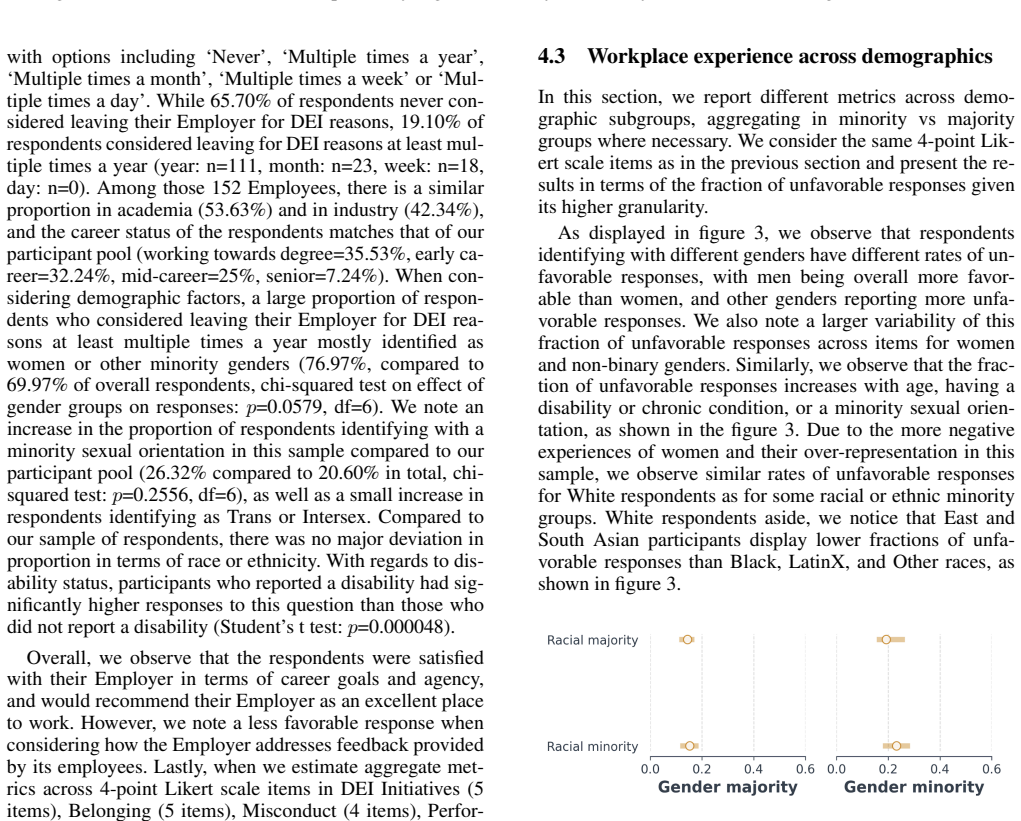
- [Figures 3 and 5] The bar plots and line plots in Figures 3 and 5 would benefit from error bars or confidence intervals; without them, the visual comparisons overstate precision, especially for groups such as disabled respondents (n=92) and subgroups split by age and gender.
- [Table 3] The race/ethnicity abbreviations (W, EA, SA, AAB, H/L, ME, OR) are defined only in the caption text; please define them explicitly in the table caption or in a footnote so the table is self-contained.
- [Figure 4 and §4.3] The phrase 'men and gender minorities' in the text and figure caption seems to refer to gender majority versus gender minority groups after binarization; please align the wording with the binarized variable described in §4.3 to avoid ambiguity.
- [§4.4] The sentence reporting a non-significant age difference (p=0.8057) among respondents experiencing microaggressions is unclear about which comparison is being made; please specify the contingency table and the groups being compared.
Circularity Check
No significant circularity: the survey's disparity claims are descriptive empirical comparisons, not derivations from fitted inputs or self-citation chains.
full rationale
The paper makes no fitted-parameter prediction and contains no derivation chain that reduces to its own inputs. Its central claim that disabled employees have a worse workplace experience is supported by an observed group comparison on a survey item (§4.2: 'participants who reported a disability had significantly higher responses to this question than those who did not report a disability', p=0.000048) and by opt-in accessibility descriptives (§4.4), neither of which constructs the outcome from the grouping definition. The majority/minority binarization is a labeling choice, not an equation linking input to output. The only self-citations—Hall et al. 2023, Hong et al. 2024, and Queer in AI et al. 2023—are background literature on AI bias and do not carry the survey's conclusions. The limitations section (§5.1) explicitly acknowledges sampling and generalizability concerns, which are external-validity issues, not circular reasoning. No self-definitional, fitted-input, uniqueness-import, or ansatz-smuggling pattern is present.
Assumptions & free parameters
free parameters (2)
- Minimum group size for reporting across employers =
30
- Minimum group size for employer-level reporting =
10
assumptions (3)
- domain assumption Likert scale responses can be treated as numeric interval data and averaged across items.
- domain assumption The convenience sample is sufficiently representative of the AI/ML workforce for within-sample subgroup comparisons to generalize.
- domain assumption Self-reported workplace experiences are a valid measure of the constructs being studied (belonging, microaggressions, well-being, etc.).
Cite this review
Pith. "Pith review of Enduring Disparities in the Workplace: A Pilot Study in the AI Community." pith.science (2026). https://pith.science/paper/3R4W2ABC
@misc{pith2026250604305,
  author       = {Pith},
  title        = {Pith review of: Enduring Disparities in the Workplace: A Pilot Study in the AI Community},
  year         = {2026},
  howpublished = {\url{https://pith.science/paper/3R4W2ABC}},
  note         = {Machine review of arXiv:2506.04305}
}
read the original abstract
In efforts toward achieving responsible artificial intelligence (AI), fostering a culture of workplace transparency, diversity, and inclusion can breed innovation, trust, and employee contentment. In AI and Machine Learning (ML), such environments correlate with higher standards of responsible development. Without transparency, disparities, microaggressions and misconduct will remain unaddressed, undermining the very structural inequities responsible AI aims to mitigate. While prior work investigates workplace transparency and disparities in broad domains (e.g. science and technology, law) for specific demographic subgroups, it lacks in-depth and intersectional conclusions and a focus on the AI/ML community. To address this, we conducted a pilot survey of 1260 AI/ML professionals both in industry and academia across different axes, probing aspects such as belonging, performance, workplace Diversity, Equity and Inclusion (DEI) initiatives, accessibility, performance and compensation, microaggressions, misconduct, growth, and well-being. Results indicate enduring disparities in workplace experiences for underrepresented and/or marginalized subgroups. In particular, we highlight that accessibility remains an important challenge for a positive work environment and that disabled employees have a worse workplace experience than their non-disabled colleagues. We further surface disparities for intersectional groups and discuss how the implementation of DEI initiatives may differ from their perceived impact on the workplace. This study is a first step towards increasing transparency and informing AI/ML practitioners and organizations with empirical results. We aim to foster equitable decision-making in the design and evaluation of organizational policies and provide data that may empower professionals to make more informed choices of prospective workplaces.
Figures


Figures from the paper (10 more)


Reference graph
Works this paper leans on
-
[1]
My employer states that they value DEI (whether or not they implement it)
-
[2]
Advances in Developing Human Resources, 25(1): 5–26
Hair bias in the workplace: A critical human resource development perspective. Advances in Developing Human Resources, 25(1): 5–26. U.S. Equal Employment Opportunity Commission
-
[3]
ERGs, mentoring initiatives, celebration and events
My employer provides programs to support underrepre- sented groups in ML, ex. ERGs, mentoring initiatives, celebration and events
-
[4]
Leaders and employees from majority groups participate in DEI programs and events
-
[5]
I am supported to engage in diversity and inclusion ini- tiatives with no penalty, or a positive impact on my work performance
-
[6]
My employer demonstrates a visible commitment to di- versity and inclusion
-
[7]
Suggested: 4 points Likert-scale (strongly agree to strongly disagree) and NA/I don’t know
I am satisfied with the type of contract (full time, part time, temporary) I have 7.7 Growth Please tell us about growth opportunities at your Employer. Suggested: 4 points Likert-scale (strongly agree to strongly disagree) and NA/I don’t know
-
[10]
Please help us understand your experience
DEI programs are initiated by: • Members of underrepresented groups • Internal committees • Senior leadership • No DEI programs 7.2 Belonging Employees who feel a sense of belonging at their organisa- tion engage more with their work and Employer. Please help us understand your experience. Suggested: 4 points Likert-scale (strongly agree to strongly disag...
Show all 43 references
-
[11]
My perspective is valued, even when it is different from others
-
[12]
I am treated with respect
-
[13]
I can be myself at work
-
[14]
I feel safe bringing up difficult subjects or reporting mis- takes
-
[15]
Please assess your Employer’s accessibility initiatives if you are in this situation
I feel part of a workplace community 7.3 Accessibility People with a disability sometimes need accommodations to access and perform well in the workplace. Please assess your Employer’s accessibility initiatives if you are in this situation. • Optional Do you identify as a pers...
-
[16]
I feel comfortable discussing physical or cognitive chal- lenges
-
[17]
My employer accommodates my disability
-
[18]
My employer provides different options to support me in my role given my disability, e.g., flexible work arrange- ments and/or material
-
[19]
Please help us understand your experiences
I am confident that requesting accommodations will not harm my career 7.4 Microaggressions Now we’d like you to think about incidents that might be unpleasant in the workplace, specifically microaggressions. Please help us understand your experiences. • I experience microaggre...
-
[20]
My employer provides ways of reporting misconduct and ensures all employees are aware of it
-
[21]
I can report misconduct without fear of retaliation
-
[22]
My employer responds quickly and consistently to re- ports of misconduct
-
[23]
Suggested: 4 points Likert-scale (strongly agree to strongly disagree) and NA/I don’t know
If you have reported misconduct previously: I am satis- fied with how my report has been handled 7.6 Performance and Compensation Help us understand whether you are satisfied with the way your Employer evaluates your performance and determines your compensation. Suggested: 4 p...
-
[24]
I can succeed to my full ability
-
[25]
I am asked to perform service or volunteer work at the same frequency as my colleagues
-
[26]
My performance is evaluated fairly
-
[27]
When I do an excellent job, my achievements are re- warded
-
[28]
I am satisfied with my compensation
-
[29]
I believe my compensation is in line with my experience
-
[31]
I am continually learning and growing in my role
-
[32]
My employer provides opportunities for continued growth and development
-
[33]
These opportunities are provided to all employees equi- tably
-
[34]
In this regard, please tell us about your work-life balance
There are mentorship programs, or other support, to help me grow my career 7.8 Well Being While a good workplace is important, it’s also important to be able to disconnect from work. In this regard, please tell us about your work-life balance. Suggested: 4 points Likert-scale ...
-
[35]
My employer provides great options for leave and time- off, e.g., exceeding legal requirements in my country
-
[36]
My employer supports me in difficult times (e.g., COVID measures, exceptional personal situations)
-
[37]
My employer cares about my well-being
-
[38]
I can disconnect from my work
-
[39]
Suggested: 4 points Likert-scale (strongly agree to strongly disagree) and NA/I don’t know
I am satisfied with my overall well-being 7.9 Overall Satisfaction Finally, at a high-level, please tell us about your overall sat- isfaction with your Employer. Suggested: 4 points Likert-scale (strongly agree to strongly disagree) and NA/I don’t know
-
[40]
My career goals can be met at my employer
-
[41]
I am satisfied by the level of agency my employer pro- vides me
-
[42]
My employer acts on the feedback provided by its em- ployees
-
[43]
I would recommend my employer as an excellent place to work
-
[2020]
NA/I don’t know
to aggregate and plot the responses, compute descrip- tive statistics, and perform basic statistical testing. 7 Full Survey The following questions were included in the survey. Each section of questions (excluding the Microaggression ques- tions) were answerable via a four lev...
-
[2023]
They kill us mentally
Manifestations and reinforcement of heteronormativ- ity in the workplace: a systematic scoping review. Journal of Homosexuality, 70(12): 2714–2740. Crawford, K.; West, S.; and Whittaker, M. 2019. Discrim- inating Systems: Gender, Race and Power in AI. Technical report. Crensha...
2019 arXiv
-
[2024]
I am satisfied with my compensation
High Tech, Low Inclusion: Diversity in the High Tech Workforce and Sector from 2014-2022. Re- trieved from https://www.eeoc.gov/sites/default/files/2024- 09/20240910 Diversity%20in%20the%20High%20Tech% 20Workforce%20and%20Sector%202014-2022.pdf. Van Busum, K.; and Fang, S. 202...
2014 arXiv
Reviewed August 7, 2026 · model on record in the stance chip above.
Discussion (0). Sign in to comment.