REVIEW 2 major objections 5 minor 49 references
Precision Measurement of Lifetime and Branching Ratios of the $4f^{13}5d6s\,^1[5/2]_{5/2}$ state in Yb$^+$ ions
T0 review · 2 major / 5 minor · reviewed 2026-08-07 · deepseek-v4-flash
Pith's one-line read A high-lying ytterbium-ion state, 1[5/2]5/2, is shown to live 37.9(9) μs and to decay mostly to the two 2D levels, with branching ratios measured to parts-per-thousand precision.
desk verdict A credible first measurement of the 1[5/2]5/2 lifetime in Yb+ with real atomic-structure payoff, but the branching-ratio extraction needs a bound on a decay to 4f13 6s2 2F5/2 that the paper never mentions. read the letter →
The pith
A machine-rendered reading of the paper's core claim, the machinery that carries it, and where it could break.
The reading
What carries the argument
The central object is the $1[5/2]_{5/2}$ state, a high-lying odd-parity level of Yb$^+$ that is reached by 410 nm and 434 nm lasers from the metastable $^2D_{3/2}$ and $^2D_{5/2}$ states. The argument is carried by a Lindblad-form optical Bloch equation (the master equation for coherent drive plus spontaneous decay) that includes the Zeeman sublevels of these states; fits of its numerical solution to measured population curves yield the lifetime and branching ratios. Supporting machinery includes heralded state preparation in a single Zeeman sublevel, a 935 nm 'clearout' pulse that turns $^2D_{3/2}$ population into measurable $^2S_{1/2}$ fluorescence, and low-power versus high-power pumping regimes that isolate different branching ratios.
What would settle it
Detect the 410 nm and 434 nm photons emitted by a single ion during $1[5/2]_{5/2}$ decay and histogram their arrival times; a lifetime that disagrees with $37.9(9)\,\mu$s, or a photon budget inconsistent with the reported branching ratios, would falsify the claim. Alternatively, repump the $^2F_{7/2}$ population directly with the 760 nm transition and look for any signal above $b(^2F_{7/2}) = 0.0000(2)$.
Extended reading notes
Core claim
The paper claims that the $4f^{13}5d6s\,^1[5/2]^o_{5/2}$ state in $^{172}$Yb$^+$ is not the short-lived, leaky level the naive mixing picture implies. Instead it has spontaneous-emission lifetime $\tau = 37.9(9)\,\mu$s, branching ratios $b(^2D_{3/2}) = 0.359(2)$, $b(^2D_{5/2}) = 0.639(2)$, $b(^2S_{1/2}) = 0.0023(16)$, and $b(^2F_{7/2}) = 0.0000(2)$, plus a Landé $g$-factor ratio placing $g$ near $0.983$--$0.986$ depending on the assumed value for $^2S_{1/2}$. The long lifetime makes visible Rabi oscillations on the 410 nm and 434 nm transitions from the $^2D$ manifold, and the near-closed $^2D_{3/2}$--$1[5/2]_{5/2}$--$^2D_{5/2}$ loop means population can cycle through the state without leaking to $^2F_{7/2}$. The same experiments improve the $^2D_{5/2}\to{}^2S_{1/2}$ branching ratio to $0.188(3)$, an order-of-magnitude improvement in uncertainty. The authors emphasize that no current numerical method predicts these values, so the results question the assumed $0.12$ mixing of $4f^{13}5d6s$ with $4f^{13}5d^2$ and provide a benchmark for future calculations.
Load-bearing premise
The extraction of every reported number presumes the optical-Bloch-equation model includes the complete set of decay channels and Zeeman sublevels, so an unmodeled decay path from $1[5/2]_{5/2}$, or an error in the literature values adopted for the two $^2D$ lifetimes and the $^2D_{5/2}\to{}^2F_{7/2}$ branching, would shift the quoted branching ratios.
Editorial extensions
If this is right
- If the measured branching ratios hold, the $^2D_{3/2}$--$1[5/2]_{5/2}$--$^2D_{5/2}$ system is nearly closed, so scattering on these transitions can pump population between the two $^2D$ states without leaking to $^2F_{7/2}$.
- Because the lifetime is $37.9\,\mu$s, coherent Rabi oscillations and resolved-sideband operations at 410 nm and 434 nm are feasible, turning these transitions into usable qubit-manipulation tools in the omg architecture.
- A near-zero $^2F_{7/2}$ branch means $1[5/2]_{5/2}$ can serve as a fast dissipative initialization path into the metastable-state qubit, replacing the slow $^2D_{5/2}\to{}^2F_{7/2}$ natural decay.
- The improved $^2D_{5/2}\to{}^2S_{1/2}$ branching ratio of $0.188(3)$ sharpens models of shelving and decay in Yb$^+$ by an order of magnitude.
- The lifetime and branching-ratio data give atomic-structure theory a concrete target: a calculation that reproduces these values would validate a treatment of core-valence correlation in Yb$^+$.
Reading between the lines
- A direct photon-counting measurement of the 410 nm and 434 nm fluorescence during decay, rather than the steady-state population closure used here, would independently confirm the branching ratios and would be sensitive to any weak unmodeled decay channel.
- The same pump-and-probe protocol could be applied to other odd-parity $4f^{13}5d^2$ states of Yb$^+$ that the paper names as candidates for broader cycling transitions, giving a quick survey of which states are closed enough for mid-circuit measurement.
- If the branching to $^2F_{7/2}$ is genuinely zero, the $1[5/2]_{5/2}$ state may enable a leakage-free optical cycle between the two $^2D$ states, which could circumvent a shelving-fidelity limit set by the $^2D_{5/2}\to{}^2D_{3/2}$ decay.
- A dedicated ab initio calculation that isolates the $1[5/2]_{5/2}$ state would directly test whether the $0.12$ configuration-mixing value needs revision; the paper leaves that calculation as future work.
Editorial analysis
A structured set of objections, weighed in public.
Referee Report
Summary. The paper reports an experimental characterization of the 4f^13 5d6s ^1[5/2]_5/2 state in single 172Yb+ ions. Using heralded state preparation, coherent drives at 410, 411, 434, and 435 nm, and time-resolved detection of the 2S1/2 and 2D3/2 populations, the authors measure the state lifetime τ = 37.9(9) μs, the branching ratios to 2D3/2, 2D5/2, 2S1/2, and 2F7/2 as 0.359(2), 0.639(2), 0.0023(16), and 0.0000(2), respectively, and the Landé g-factor of the 1[5/2]5/2 state. They also report a 2D5/2→2S1/2 branching ratio of 0.188(3) and a 2D5/2 lifetime of 7.3(3) ms. The unexpectedly long lifetime is presented as evidence against the assumed 0.12 admixture of the 4f^13 5d^2 configuration in the 1[5/2]5/2 state.
Significance. If the results stand, this is the first precision characterization of a high-lying 'bracket' state in Yb+ that is relevant both as an atomic-structure benchmark and for metastable-state quantum information protocols. The experimental methodology is careful in several concrete ways: the lifetime is corroborated by two independent fit strategies that agree within 1%; systematic errors are propagated by Monte Carlo sampling of experimentally characterized noise sources; truncation analyses are reported for each fit; and the important external parameters (τ_D3/2, τ_D5/2, b_D5/2→F7/2) are propagated with their uncertainties. The paper also provides a full Lindblad master-equation model implemented in QuTiP and explicit pulse sequences, which aids reproducibility. These strengths make the measurement program credible; however, the branching-ratio extraction rests on a completeness assumption about the decay channels of the 1[5/2]5/2 state that is not discussed, and one of the quoted branching ratios is not statistically significant at the claimed level.
major comments (2)
- [Branching ratio measurements (Fig. 3e) and Appendix Table I] The OBE model used to fit all branching-ratio data assumes that the 1[5/2]5/2 state decays only to 2D3/2, 2D5/2, 2S1/2, and 2F7/2. In the known Yb+ level structure, the 4f13 6s2 2F5/2 level lies below the 1[5/2]5/2 state, so an M1 or E2 branch to 2F5/2 is energetically allowed. A nonzero branch would not appear as a dark branch: 2F5/2 decays by E1 into the 2D5/2 and 2D3/2 manifolds within the 500 μs wait used in the experiment, and the closure relation would fold this additional 2D population into the inferred b_D3/2 and b_D5/2. The measured b_F7/2 = 0.0000(2) constrains only dark channels and does not constrain this fast-cascade channel. Because the quoted errors in Table I are at the 0.002 level, a branch of order 0.001–0.004 would shift the central branching ratios beyond the stated uncertainties. The manuscript should provide a bound on b_F5/2 (e.g., an estimated M1/E2 rate or a dedicated search) or explicitly add this channel to the error budget.
- [Branching ratio measurements (Fig. 3e)] The fitted value b_S1/2 = 0.0023(16) is only 1.4 standard deviations from zero. The sentence in the text stating that the comparison 'suggests a non-zero value for the branching ratio of this E2 decay' overstates the evidence at the quoted precision. The appropriate statement at this significance is an upper limit (b_S1/2 < 0.007 at 3σ) or a result compatible with zero. This matters because the abstract reports b_S1/2 = 0.0023(16) on the same footing as the well-determined 0.359(2) and 0.639(2), and because b_D5/2 = 0.639(2) is obtained by closure and therefore inherits the significance of b_S1/2.
minor comments (5)
- [Supplemental Material, Fig. 7 caption] The caption reports Ω410/2π = 7790 kHz and Ω434/2π = 2771 kHz, whereas the main text (Fig. 3e) states Ω434/2π ≈ 7800 kHz and Ω410/2π ≈ 2800 kHz; the assignment appears swapped and should be corrected.
- [Abstract and main text] The term 'omg architecture' is used with inconsistent capitalization and styling across the abstract and main text; please unify the notation.
- [Reference [47]] Reference [47] is incomplete, listing only a URL; please provide the full NIST Atomic Spectra Database citation with title, version, and access date.
- [Equation (1)] The notation b_D5/2|m=−5/2> is defined only implicitly in the text; please define it explicitly as the Clebsch-Gordan-weighted branching ratio before first use so that it is not misread as a conditional probability.
- [Appendix, Table I] The error budget lists τ_D3/2, τ_D5/2, and b_D5/2→S1/2 as inputs, but the paper does not state whether the values of τ_D5/2 and b_D5/2→S1/2 used in the branching-ratio fits were determined from datasets independent of the branching-ratio datasets; if the same data were used in both places, possible correlations should be addressed in the Monte Carlo propagation.
Circularity Check
No significant circularity: the lifetime and branching ratios are direct OBE fits to time-resolved data, with external prior decay constants as inputs; derived branching ratios are algebraic closures, not predictions from fitted parameters.
full rationale
The central quantities in this paper are extracted from time-resolved fluorescence and optical-pumping plateaus, not from the parameters they are later compared with. The lifetime τ = 37.9(9) μs is obtained by fitting a QuTiP optical-Bloch-equation simulation to the measured decay signal as a function of wait time (Fig. 2), and the appendix explicitly verifies by Monte Carlo sampling that the lifetime fit is insensitive to the branching-ratio values (<1.1e-4), so the lifetime does not reduce to the branching-ratio inputs. The branching-ratio sum b_D3/2 + b_S1/2 = 0.361(2) is fit at low power (Fig. 3b) with the measured lifetime as a fixed input; this is a self-consistent use of an independently measured decay rate, not a fitted parameter renamed as a prediction. The small branches b_S1/2 and b_F7/2 are then individually fit from high-power pumping data (Fig. 3e) assuming the previously extracted sum; b_D3/2 and b_D5/2 are finally obtained by algebraic closure (b_D3/2 = sum - b_S1/2, b_D5/2 = 1 - b_D3/2 - b_S1/2 - b_F7/2), which is an accounting identity under the stated decay-channel set rather than a derivation from the target values. The fixed inputs τ_D3/2, τ_D5/2, and b_D5/2→S1/2 come from external measurements [36,44] or from a separate 2D5/2 decay measurement reported in the appendix; none is a self-citation by the present authors. No uniqueness theorem is invoked, and no prior result by this group is load-bearing: the only self-citations (Refs. [10,11]) are incidental pointers to the group's own apparatus and simulation work. The possible unmodeled 4f13 6s2 2F5/2 decay channel is a legitimate systematic-error and closure-assumption risk, but it is a correctness concern, not evidence of circular reasoning.
Assumptions & free parameters
free parameters (5)
- Scaling factor for lifetime decay curve =
not reported (one per dataset)
- Offset for lifetime decay curve =
not reported
- Rabi frequencies for 435 nm, 411 nm, 434 nm, 410 nm transitions =
110.3, 112.3, 2609.5, 2013.8 kHz
- Rabi frequency of 434 nm drive for lifetime measurement =
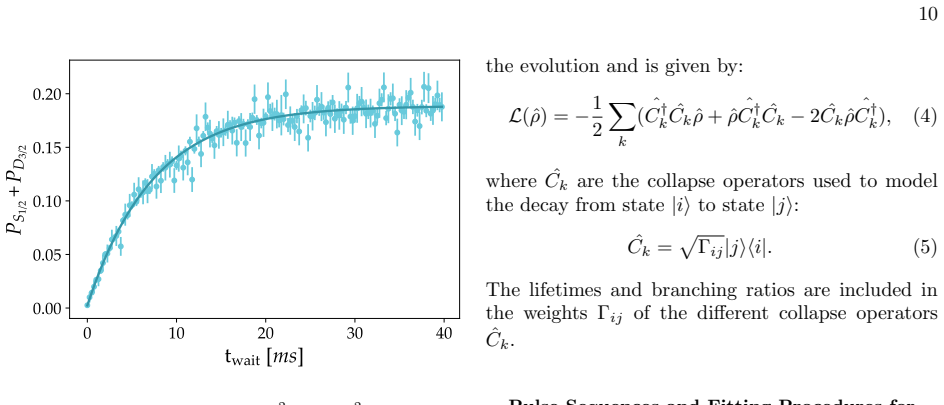
1.519 MHz
- Rabi frequencies for high-power pumping (410 nm and 434 nm) =
~2.8 MHz and ~7.8 MHz
assumptions (6)
- domain assumption The optical Bloch equations with Lindblad collapse operators describe the ion's dynamics, including all relevant Zeeman sublevels and decay channels.
- domain assumption The prior measured lifetimes of 2D3/2 (54.83(18) ms, Ref [44]) and 2D5/2 (7.2(3) ms, Ref [36]) and the branching ratio of 2D5/2 to 2F7/2 (81.2%, Ref [36]) are correct.
- domain assumption The ground-state g-factor g_S1/2 is 1.998 (Ref [45]) or 2.002615 (Ref [46]) as assumed.
- domain assumption The level assignment and Zeeman sublevels of the 1[5/2]5/2 state from prior spectroscopy (Ref [31]) are correct.
- domain assumption Detection thresholds and state preparation fidelities are as characterized; no unmodeled background or state leakage.
- domain assumption Quantum beats do not affect the population measurements because detection traces over final Zeeman states.
Cite this review
Pith. "Pith review of Precision Measurement of Lifetime and Branching Ratios of the $4f^{13}5d6s\,^1[5/2]_{5/2}$ state in Yb$^+$ ions." pith.science (2026). https://pith.science/paper/BE4ZEP5D
@misc{pith2026250604320,
  author       = {Pith},
  title        = {Pith review of: Precision Measurement of Lifetime and Branching Ratios of the $4f^135d6s\,^1[5/2]_5/2$ state in Yb$^+$ ions},
  year         = {2026},
  howpublished = {\url{https://pith.science/paper/BE4ZEP5D}},
  note         = {Machine review of arXiv:2506.04320}
}
abstract
We report spectroscopic and time-resolved experimental observations to characterize the $[{\rm Xe}]4f^{13}(^2F^{o}_{5/2}){5d6s(}{^1\!D}){^{1}[5/2]^{o}_{5/2}}$ state in $^{172}$Yb$^+$ ions. We access this state from the metastable $4f^{14}5d (^2D_{3/2,5/2})$ manifold and observe an unexpectedly long lifetime of $\tau=37.9(9) \,\mu$s that allows visible Rabi oscillations and resolved-sideband spectroscopy. Using a combination of coherent population dynamics, high-fidelity detection and heralded state preparation, and optical pumping methods, we measure the branching ratios to the $^{2}D_{3/2}$, $^2D_{5/2}$, $^2S_{1/2}$ states to be 0.359(2), 0.639(2), 0.0023(16), respectively. The branching ratio to the $4f^{13}6s^{2}({^2F}_{7/2})$ is compatible with zero within our experimental resolution. We also report measurements of its Land\'e g-factor and the branching ratio of the ${^{2}{D}_{5/2}}$ to ${^{2}{S}_{1/2}}$ decay in $^{172}$Yb$^+$ to be 0.188(3), improving its relative uncertainty by an order of magnitude. Our measurements pave the way to a better understanding of the atomic structure of Yb$^+$ ions, which still lacks accurate numerical descriptions, and the use of high-lying excited states for partial detection and qubit manipulation in the omg architecture.
Figures


Figures from the paper (3 more)


Reference graph
Works this paper leans on
-
[1]
C. D. Bruzewicz, J. Chiaverini, R. McConnell, and J. M. Sage.Trapped-ion quantum computing: Progress and challenges. Applied Physics Reviews 6, 021314 (2019)
work page 2019
- [2]
-
[3]
A. D. Ludlow, M. M. Boyd, J. Ye, E. Peik, and P. O. Schmidt.Optical atomic clocks. Rev. Mod. Phys.87, 637–701 (2015)
work page 2015
-
[4]
P. Wang, C.-Y. Luan, M. Qiao, M. Um, J. Zhang, Y. Wang, X. Yuan, M. Gu, J. Zhang, and K. Kim. Single ion qubit with estimated coherence time ex- ceeding one hour. Nature Communications12, 233 (2021)
work page 2021
-
[5]
S. A. Moses, C. H. Baldwin, M. S. Allman, R. An- cona, L. Ascarrunz, C. Barnes, J. Bartolotta, B. Bjork, P. Blanchard, M. Bohn, J. G. Bohnet, N. C. Brown, N. Q. Burdick, W. C. Burton, S. L. Campbell, J. P. Campora, C. Carron, J. Cham- bers, J. W. Chan, Y. H. Chen, A. Chernoguzov, E. Chertkov, J. Colina, J. P. Curtis, R. Daniel, M. DeCross, D. Deen, C. Del...
work page 2023
-
[6]
W. Tan, P. Becker, F. Liu, G. Pagano, K. Collins, A. De, L. Feng, H. Kaplan, A. Kyprianidis, R. Lund- gren, et al.Domain-wall confinement and dynamics in a quantum simulator. Nature Physics17, 742–747 (2021)
work page 2021
-
[7]
A. De, A. Lerose, D. Luo, F. M. Surace, A. Schuck- ert, E. R. Bennewitz, B. Ware, W. Morong, K. S. Collins, Z. Davoudi, A. V. Gorshkov, O. Katz, and C. Monroe.Observation of string-breaking dynamics in a quantum simulator(2024)
work page 2024
-
[8]
M. K. Joshi, F. Kranzl, A. Schuckert, I. Lovas, C. Maier, R. Blatt, M. Knap, and C. F. Roos. Observing emergent hydrodynamics in a long-range quantum magnet. Science376, 720–724 (2022)
work page 2022
Show all 49 references
-
[9]
K. Sun, M. Kang, H. Nuomin, G. Schwartz, D. N. Beratan, K. R. Brown, and J. Kim.Quantum Sim- ulation of Spin-Boson Models with Structured Bath. arXiv 2405.14624 (2024)
2024 arXiv
-
[10]
V. So, M. D. Suganthi, A. Menon, M. Zhu, R. Zhu- ravel, H. Pu, P. G. Wolynes, J. N. Onuchic, and G. Pagano.Trapped-ion quantum simulation of elec- tron transfer models with tunable dissipation. Sci- ence Advances10, eads8011 (2024)
2024
-
[11]
V. So, M. D. Suganthi, M. Zhu, A. Menon, G. Tomaras, R. Zhuravel, H. Pu, P. G. Wolynes, J. N. Onuchic, and G. Pagano.Quantum Simula- tions of Charge and Exciton Transfer in Multi-mode Models using Engineered Reservoirs(2025)
2025
-
[12]
Huntemann, M
N. Huntemann, M. Okhapkin, B. Lipphardt, S. Wey- ers, C. Tamm, and E. Peik.High-Accuracy Optical Clock Based on the Octupole Transition in 171Yb+. Phys. Rev. Lett.108, 090801 (2012)
2012
-
[13]
Stuhler, M
J. Stuhler, M. Abdel Hafiz, B. Arar, A. Bawamia, K. Bergner, M. Biethahn, S. Brakhane, A. Didier, J. Fort´ agh, M. Halder, R. Holzwarth, N. Hunte- mann, M. Johanning, R. J¨ ordens, W. Kaenders, F. Karlewski, F. Kienle, M. Krutzik, M. Lessing, T. Mehlst¨ aubler, D. Meschede, E....
2021
-
[14]
J. C. Berengut, C. Delaunay, A. Geddes, and Y. Soreq.Generalized King linearity and new physics searches with isotope shifts. Phys. Rev. Res.2, 043444 (2020)
2020
-
[15]
J. Hur, D. P. L. Aude Craik, I. Counts, E. Knyazev, L. Caldwell, C. Leung, S. Pandey, J. C. Berengut, A. Geddes, W. Nazarewicz, P.-G. Reinhard, A. Kawasaki, H. Jeon, W. Jhe, and V. Vuleti´ c.Evi- dence of Two-Source King Plot Nonlinearity in Spec- troscopic Search for New Boso...
2022
-
[16]
Door, C.-H
M. Door, C.-H. Yeh, M. Heinz, F. Kirk, C. Lyu, T. Miyagi, J. C. Berengut, J. Biero´ n, K. Blaum, L. S. Dreissen, S. Eliseev, P. Filianin, M. Filzinger, E. Fuchs, H. A. F¨ urst, G. Gaigalas, Z. Har- man, J. Herkenhoff, N. Huntemann, C. H. Keitel, K. Kromer, D. Lange, A. Rischka...
2025
-
[17]
S. G. Porsev, M. S. Safronova, and M. G. Kozlov. Correlation effects in Yb + and implications for par- ity violation. Phys. Rev. A86, 022504 (2012)
2012
-
[18]
Kahl and J
E. Kahl and J. Berengut.ambit: A programme for high-precision relativistic atomic structure calcula- tions. Computer Physics Communications238, 232– 243 (2019). 7
2019
-
[19]
Migdalek and W
J. Migdalek and W. Siegel.Collapse ofdandf orbitals in the isoelectronic sequence of singly ionized ytterbium. Phys. Rev. A61, 062502 (2000)
2000
-
[20]
U. I. Safronova and M. S. Safronova.Third-order relativistic many-body calculations of energies, tran- sition rates, hyperfine constants, and blackbody ra- diation shift in 171Yb + . Phys. Rev. A79, 022512 (2009)
2009
-
[21]
Migdalek and W
J. Migdalek and W. Siegel.Relativistic E1 transition probabilities and lifetimes along Yb+ isoelectronic sequence. Journal of Physics B: Atomic, Molecular and Optical Physics45, 145002 (2012)
2012
-
[22]
Radˇ zi¯ ut˙ e, G
L. Radˇ zi¯ ut˙ e, G. Gaigalas, D. Kato, P. Rynkun, and M. Tanaka.Extended Calculations of Energy Levels and Transition Rates for Singly Ionized Lanthanide Elements. II. Tb-Yb. The Astrophysical Journal Supplement Series257, 29 (2021)
2021
-
[23]
V. A. Dzuba and V. V. Flambaum.Hyperfine- induced electric dipole contributions to the electric octupole and magnetic quadrupole atomic clock tran- sitions. Phys. Rev. A93, 052517 (2016)
2016
-
[24]
Guo, Y.-M
X.-T. Guo, Y.-M. Yu, Y. Li, and B.-B. Suo.Finite- field calculation of electric quadrupole moments of 2P3/2,2 D3/2,5/2, and 2F5/2 states for Yb + ion. Chi- nese Physics B29, 053101 (2020)
2020
-
[25]
Lange, A
R. Lange, A. A. Peshkov, N. Huntemann, C. Tamm, A. Surzhykov, and E. Peik.Lifetime of the 2F7/2 Level inYb + for Spontaneous Emission of Electric Octupole Radiation. Phys. Rev. Lett.127, 213001 (2021)
2021
-
[26]
Bi´ emont, J.-F
E. Bi´ emont, J.-F. Dutrieux, I. Martin, and P. Quinet.Lifetime calculations in Yb II. Journal of Physics B: Atomic, Molecular and Optical Physics 31, 3321–3333 (1998)
1998
-
[27]
Schacht, J
M. Schacht, J. R. Danielson, S. Rahaman, J. R. Torgerson, J. Zhang, and M. M. Schauer. 171Yb+ 5D3/2 hyperfine state detection andF= 2lifetime. Journal of Physics B: Atomic, Molecular and Opti- cal Physics48, 065003 (2015)
2015
-
[28]
D. T. C. Allcock, W. C. Campbell, J. Chiaverini, I. L. Chuang, E. R. Hudson, I. D. Moore, A. Rans- ford, C. Roman, J. M. Sage, and D. J. Wineland. omg Blueprint for trapped ion quantum computing with metastable states. Applied Physics Letters119, 214002 (2021). arXiv:2109.0127...
2021 arXiv
-
[29]
Roman.Expanding the 171Yb+ toolbox: the 2F7/2 state as resource for quantum information science
C. Roman.Expanding the 171Yb+ toolbox: the 2F7/2 state as resource for quantum information science. UCLA (2021)
2021
-
[30]
C. L. Edmunds, T. R. Tan, A. R. Milne, A. Singh, M. J. Biercuk, and C. Hempel.Scalable hyper- fine qubit state detection via electron shelving in the 2D5/2 and 2F7/2 manifolds in 171Yb+. Phys. Rev. A104, 012606 (2021)
2021
-
[31]
N. A. Diepeveen, C. Robalo Pereira, M. Mazzanti, Z. E. D. Ackerman, L. P. H. Gallagher, T. Timmer- man, R. Gerritsma, and R. X. Sch¨ ussler.Single-ion spectroscopy of four metastable-state clear-out tran- sitions inYb +: Isotope shifts and hyperfine struc- ture. Phys. Rev. A11...
2024
-
[32]
Ralchenko.NIST atomic spectra database
Y. Ralchenko.NIST atomic spectra database. Mem. S.A.It. Suppl.8, 96–102 (2005)
2005
-
[33]
W. C. Martin, R. Zalubas, and L. Hagan.Atomic Energy Levels – The Rare-Earth Elements. InNat. Stand. Ref. Data Ser., NSRDS-NBS 60. Nat. Bur. Stand., U.S. (1978)
1978
-
[34]
Olmschenk, K
S. Olmschenk, K. C. Younge, D. L. Moehring, D. N. Matsukevich, P. Maunz, and C. Monroe.Manipu- lation and detection of a trappedYb+hyperfine qubit. Physical Review A76(2007)
2007
-
[35]
Black.An introduction to Pound–Drever–Hall laser frequency stabilization
E. Black.An introduction to Pound–Drever–Hall laser frequency stabilization. American Journal of Physics69, 79 (2001)
2001
-
[36]
Taylor, M
P. Taylor, M. Roberts, S. V. Gateva-Kostova, R. B. M. Clarke, G. P. Barwood, W. R. C. Rowley, and P. Gill.Investigation of the 2S1/2−2D5/2 clock transition in a single ytterbium ion. Phys. Rev. A 56, 2699–2704 (1997)
1997
-
[37]
Sugiyama.Laser Cooling of Single 174Yb+ Ions Stored in a RF Trap
K. Sugiyama.Laser Cooling of Single 174Yb+ Ions Stored in a RF Trap. Japanese Journal of Applied Physics38, 2141 (1999)
1999
-
[38]
Johansson, P
J. Johansson, P. Nation, and F. Nori.QuTiP 2: A Python framework for the dynamics of open quantum systems. Computer Physics Communications184, 1234–1240 (2013)
2013
-
[39]
Navas, C
S. Navas, C. Amsler, T. Gutsche, C. Hanhart, J. J. Hern´ andez-Rey, C. Louren¸ co, A. Masoni, M. Mikhasenko, R. E. Mitchell, C. Patrignani, C. Schwanda, S. Spanier, G. Venanzoni, C. Z. Yuan, K. Agashe, G. Aielli, B. C. Allanach, J. Alvarez- Mu˜ niz, M. Antonelli, E. C. Aschena...
2024
-
[40]
Gerritsma, G
R. Gerritsma, G. Kirchmair, F. Z¨ ahringer, J. Ben- helm, R. Blatt, and C. F. Roos.Precision measure- ment of the branching fractions of the4p 2P3/2 decay of Ca II. The European Physical Journal D50, 13– 19 (2008)
2008
-
[41]
M. Ramm, T. Pruttivarasin, M. Kokish, I. Talukdar, and H. H¨ affner.Precision Measurement Method for Branching Fractions of ExcitedP 1/2 States Applied to 40Ca+. Phys. Rev. Lett.111, 023004 (2013)
2013
-
[42]
Zhang, M
H. Zhang, M. Gutierrez, G. H. Low, R. Rines, J. Stu- art, T. Wu, and I. Chuang.Iterative precision mea- surement of branching ratios applied to 5P states 88Sr+. New Journal of Physics18(2016)
2016
-
[43]
K. J. Arnold, S. R. Chanu, R. Kaewuam, T. R. Tan, L. Yeo, Z. Zhang, M. S. Safronova, and M. D. Bar- rett.Measurements of the branching ratios for6P 1/2 decays in 138Ba+. Phys. Rev. A100, 032503 (2019)
2019
-
[44]
H. Shao, H. Yue, Z. Ma, Y. Huang, H. Guan, and K. Gao.Precision determination of the5d 2D3/2 state lifetime of single 174Yb+ ion. Phys. Rev. Res. 5, 023193 (2023)
2023
-
[45]
W. F. Meggers.The Second Spectrum of Ytterbium (Yb II).J Res Natl Bur Stand A Phys Chem71A, 396–546 (1967)
1967
-
[46]
J. Han, B. Lu, Y. Yu, J. Li, Z. Huang, J. Wen, L. Qian, and L. Wang.Determination of the Land´ e gJ factor and Zeeman coefficients in ground-state 171Yb+ and their applications to quantum frequency standards. Phys. Rev. A111, 012814 (2025). [47]https://www.nist.gov/pml/atomic-...
2025
-
[48]
Weinberg.Lindblad decoherence in atomic clocks
S. Weinberg.Lindblad decoherence in atomic clocks. Phys. Rev. A94, 042117 (2016)
2016
-
[49]
M. G. Raizen, G. Gilbert, and D. Budker.Pro- posed test of quantum mechanics with three con- nected atomic clock transitions. Phys. Rev. A106, 032209 (2022). APPENDIX Systematic Errors The systematic errors for the quantities measured in this work are listed in Table I. All me...
2022
-
[50]
In this high- power regime, the slow, linear increase at long times (a) (c) (d) (b) FIG
andτ D3/2 = 54.83(18) ms [44]). In this high- power regime, the slow, linear increase at long times (a) (c) (d) (b) FIG. 7.(a,b)Initial oscillations of 410 (434) nm forb S1/2 (bF7/2 ) measurement of Fig. 3. In the case of 434 nm (b), the beatings are due to multiple Zeeman sub...
Reviewed August 7, 2026 · model on record in the stance chip above.
Discussion (0). Sign in to comment.