REVIEW 3 major objections 4 minor 81 references
Uncalibrated Cosmic Standards as a Robust Test on Late-Time Cosmological Models
T0 review · 3 major / 4 minor · reviewed 2026-08-07 · deepseek-v4-flash
Pith's one-line read Using uncalibrated cosmic standards—BAO, supernovae, and the CMB sound-horizon angle without amplitude information—dark-energy constraints shift toward the standard ΛCDM model, and a redshift-dependent supernova magnitude bias can absorb…
desk verdict Solid application of the UCS idea to DESI 2025; the shift toward ΛCDM is real but the framework's key prior is Planck-ΛCDM-calibrated, so 'robust' is doing more work than the analysis supports. read the letter →
The pith
A machine-rendered reading of the paper's core claim, the machinery that carries it, and where it could break.
The reading
What carries the argument
The load-bearing identity is the Hubble-constant-normalized difference between the sound horizon at the drag epoch, $r_d$, and at recombination, $r_*$, specifically the combination $\sqrt{\Omega_m}\,\Delta r H_0 = (3.36\pm0.7)\times10^{-4}$ (Eq. 2), which is both small and nearly model-insensitive because the redshift gap between recombination and drag is narrow. This allows the angular scale $\theta_*$ to be incorporated without any pre-recombination model: $r_*H_0$ is derived from $r_d H_0$ and the fixed difference, so the only free parameters are the late-time ones ($\Omega_m$, $w_0$, $w_a$, $\Omega_K$, $r_d H_0$, and the supernova magnitude offset $\mathcal{M}$). The machinery carries the argument by turning full CMB information—including the amplitude-determined priors on $\Omega_m h^2$ and $\Omega_b h^2$—into a single geometric ratio, so any shift in the resulting dark-energy contours relative to the full analysis is attributed to the discarded pre-recombination information.
What would settle it
Make $\sqrt{\Omega_m}\Delta r H_0$ a free parameter in the UCS fit: if the $w_0$\u2013$w_a$ contours migrate back toward the full-analysis result, the reported shift is an artifact of the fixed Planck-derived constraint. Independently, measure the recombination-to-drag sound-horizon difference from non-Planck data (e.g., high-resolution CMB polarization or 21-cm observations); a deviation from $(3.36\pm0.7)\times10^{-4}$ larger than the quoted error would falsify the UCS framework's key premise.
Extended reading notes
Core claim
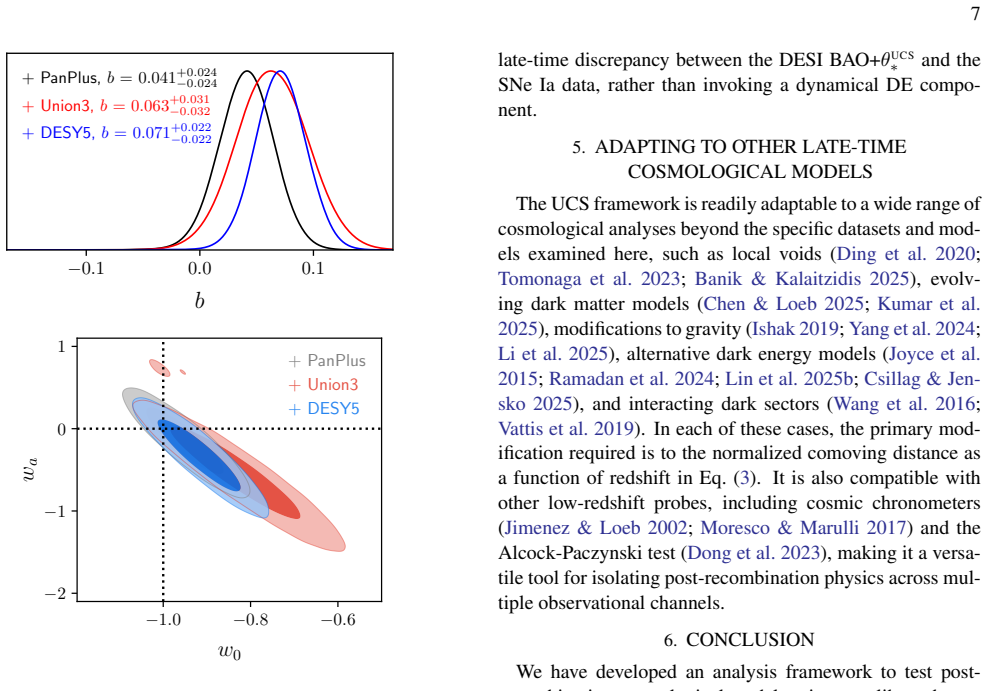
The paper's central claim is that the UCS analysis—which treats BAO distances and supernova apparent magnitudes without absolute calibration, and uses the Planck measurement of the angular acoustic scale $\theta_*$ only as a geometric ratio—systematically shifts the CPL dark-energy parameter space toward the ΛCDM baseline compared with the full analysis of the same data. Whereas the full DESI-2025-style analysis (using compressed CMB information on $\theta_*$, $\Omega_m h^2$, $\Omega_b h^2$) prefers $w_0 > -1$, the UCS contours move toward ($w_0=-1$, $w_a=0$) and remain consistent with ΛCDM within, or marginally beyond, $2\sigma$. The paper also claims that the residual late-time inconsistency is not clearly attributable to post-recombination deviations from ΛCDM: a redshift-dependent magnitude bias $b$ with mean values between 0.04 and 0.07, inferred within ΛCDM, fully reconciles the UCS ruler and candle data, and fixing $b$ to these means brings the CPL contours into agreement with ΛCDM.
Load-bearing premise
The analysis stands on the assumption that $\sqrt{\Omega_m}\Delta r H_0$, the normalized difference between the sound horizons at recombination and at drag, keeps the value $(3.36\pm0.7)\times10^{-4}$ inferred from Planck's ΛCDM chains; if pre-recombination physics changes this relation for the models being tested, the UCS shift toward ΛCDM would inherit the reference model's assumptions.
Editorial extensions
If this is right
- Removing pre-recombination information weakens the statistical case for dynamical dark energy from the DESI 2025 data: the UCS $w_0$\u2013$w_a$ contours shift toward ΛCDM while the figure of merit falls only by a factor of 1.07 to 1.16.
- If the shift is physical, the most likely cause is unmodeled early-universe physics that changes the scale dependence of the CMB power spectrum amplitude, rather than a late-time dark-energy deviation.
- The mild discrepancy between uncalibrated standard rulers and candles is consistent with a redshift-dependent magnitude bias $b \approx 0.04$\u2013$0.07$, implying high-redshift supernovae would appear brighter than expected by about 4\u20137%.
- A lower post-recombination $\Omega_m$, as UCS suggests, would translate into a slightly higher $H_0$ and a slightly lower $\sigma_8$ inferred from the CMB, potentially alleviating both the Hubble and $\sigma_8$ tensions.
- The UCS framework extends to other late-time models—including curvature, $w$CDM, interacting dark sectors, and modified gravity—by changing only the comoving-distance expression, and to additional probes such as cosmic chronometers and the Alcock\u2013Paczynski test.
Reading between the lines
- If galaxy surveys adopt UCS-style pipelines as a cross-check, any future dark-energy detection would need to survive a version of the analysis that never sees CMB amplitudes; this could become a standard robustness test for late-time claims.
- The redshift-dependent bias $b \approx 0.04$\u2013$0.07$ is large enough to be testable: independent distance-duality or local-distance-ladder checks at $z \approx 1$ should either confirm or rule out a ~5% brightness offset in the supernova samples used here.
- The Planck-derived value of $\sqrt{\Omega_m}\Delta r H_0$ is itself a reference-model quantity; re-deriving it from non-Planck CMB data would reveal whether the reported shift toward ΛCDM is a property of the data or a property of the chosen sound-horizon prior.
- A possible subtlety the paper leaves implicit: removing amplitude information removes sensitivity to early-universe parameters, but it also discards any real or spurious signal carried by the CMB amplitude; so the UCS shift should be read as evidence about what late-time geometry alone says, not as a fully model-independent statement about dark energy.
Editorial analysis
A structured set of objections, weighed in public.
Referee Report
Summary. This paper applies the Uncalibrated Cosmic Standards (UCS) framework of Lin et al. (2021) to test late-time cosmological models, with emphasis on the CPL dark-energy parameterization. The UCS likelihood uses uncalibrated DESI BAO measurements, four SNe Ia compilations, and the Planck measurement of the angular acoustic scale θ*, while deliberately omitting CMB amplitude information. The key input is a Gaussian prior on √Ωm ΔrH0 = (3.36 ± 0.7) × 10⁻⁴ (Eq. 2), which the authors argue is insensitive to pre-recombination physics. The central result is that, compared with a conventional compressed-CMB analysis, UCS shifts the w0–wa contours toward the ΛCDM point (w0 = −1, wa = 0) in Figure 1, with only a modest loss of constraining power. The authors also introduce a linear redshift-dependent SNe magnitude bias b (Eq. 19) and show that fixing b to values around 0.04–0.07 reconciles the residual ruler–candle tension with ΛCDM (Figure 2). The paper concludes that pre-recombination systematics or SNe biases could mimic dynamical dark energy.
Significance. If the central claim is correct, this is a timely and useful cross-check on the DESI dynamical-dark-energy results. The UCS approach is a genuinely different way of combining late-time probes, and the modest degradation in constraining power (FoM ratio 1.07–1.16) is encouraging for future surveys. The paper is transparent: the code is public, the analysis reproduces earlier DESI results, and the authors explicitly state the ΛCDM-reference caveat in Section 6. However, the interpretation as a test that is insensitive to pre-recombination physics is tempered by the fact that the key prior in Eq. (2) is itself calibrated from Planck ΛCDM chains; the significance of the reported shift toward ΛCDM therefore depends on the robustness of that prior. The magnitude-bias explanation also needs a joint-fit treatment before it can be considered established.
major comments (3)
- [§2.1, Eq. (2); §3, Figure 1] The central shift toward ΛCDM is load-bearing on the prior √Ωm ΔrH0 = (3.36 ± 0.7) × 10⁻⁴, which is inferred from Planck ΛCDM MCMC chains. The robustness argument in §2.1 concerns only Ωm in ΛCDM: doubling ΔrH0 changes Ωm by about 3.6%. This does not bound the w0–wa shift, because the θ* measurement anchors Ωm through r*H0 = rdH0 − ΔrH0, and the CPL degeneracy direction is sensitive to Ωm; a small systematic displacement in Ωm can move the w0–wa contours appreciably. With a prior width of roughly 21% of the central value, a 2σ mis-centering is not excluded. The authors should either (i) rerun the UCS analysis with ΔrH0 values corresponding to specific non-standard early-universe models (for example, early dark energy or modified recombination/drag physics, computing ΔrH0 via Eq. (1)), or (ii) vary √Ωm ΔrH0 over a range covering plausible model differences and show that the reported shift toward ΛCDM persists in the w0–wa plane. Absent such a test, the claim that the shift may result from the omission of pre-recombination physical processes is not supported.
- [§4.2, Eq. (19) and Figure 2] The demonstration that a redshift-dependent magnitude bias resolves the late-time tension is weakened by the way b is used. In the top panel of Figure 2, b is inferred from the same SNe compilations under the ΛCDM assumption; in the bottom panel, b is fixed to its ΛCDM mean and the CPL model is fit. This conditions the test on the reference model: if the true model is CPL, the best-fit b would in general differ, and fixing it to the ΛCDM value can artificially pull the CPL contours toward ΛCDM. The authors should perform a joint fit with b free (or at least profile over b) to support the statement that a redshift-dependent magnitude bias can be largely mitigated. In addition, the linear form bz is an ad hoc phenomenological assumption; the analysis should test the sensitivity to the functional form (for example, a power law in 1+z) and state clearly that this is a phenomenological parametrization, not a derived quantity.
- [§2.3; Abstract] The text repeatedly states that the UCS analysis is insensitive to pre-recombination physics and does not assume an early-Universe cosmological model. This is overstated: Eq. (2) is a model-dependent calibration taken from Planck ΛCDM chains, and the paper's own caveat in Section 6 concedes that ΛCDM is used as a reference. The authors should qualify these statements to say that UCS reduces sensitivity to pre-recombination physics relative to full CMB analyses, rather than eliminating it. The distinction matters for the paper's central interpretation because the reported shift toward ΛCDM is partly a statement about the difference between the Planck-ΛCDM-calibrated prior and the CMB amplitude information used in the conventional analysis.
minor comments (4)
- [§2.4] The word 'lastest' should be 'latest' in the description of the Union3 compilation.
- [Eq. (3)] The branch convention √−1 = i is used without a formal definition; please state once that this is an analytic continuation so that the sinh expression is well defined for negative ΩK.
- [Table 2] The M uncertainties for Union3 (about ±0.09) are more than an order of magnitude larger than for PanPlus or DESY5 (about ±0.005); the text should explain whether this reflects the distance-modulus-based likelihood construction or the reference-absolute-magnitude offset.
- [§3 and Table 2] The claim of a 'notable and systematic shift' toward ΛCDM is supported visually by Figure 1, but the w0waCDM rows in Table 2 show wa posteriors that are still quite broad (for Union3 and DESY5, central values around −0.7 to −0.6); a quantitative consistency statistic (for example, a χ² difference or a covariance-weighted distance from the ΛCDM point) would strengthen the assertion.
Circularity Check
The UCS shift toward ΛCDM is externally grounded, but the b-bias explanation in Section 4.2 reduces to a fitted input: b is inferred under ΛCDM from the same data and then fixed to show CPL agreement with ΛCDM.
-
fitted input called prediction
[Section 4.2, Eq. (19), Figure 2 (bottom panel)]
"Next, we fix the parameter b to its mean values obtained from the above analysis for each data combination and perform parameter inference within the CPL DE model. This approach tests whether such an adjustment can reconcile the derived constraints with the ΛCDM case. As shown in the bottom panel of Figure 2, the resulting parameter constraints are in good agreement with the ΛCDM results."
The bias parameter b is not predicted from independent physics or an external dataset: it is first estimated within the standard ΛCDM model from the same DESI BAO, θ*, and SNe data that exhibit the tension (top panel of Figure 2), and then fixed to its posterior mean and inserted into the CPL fit. The resulting 'good agreement with ΛCDM' is therefore built in by construction: the SNe magnitudes have been corrected by a parameter whose value was chosen to make ΛCDM self-consistent. Presenting this as evidence that a redshift-dependent magnitude bias 'could provide an alternative explanation' of the dynamical-DE signal is a post-hoc fit renamed as an explanatory result, rather than an independent test.
full rationale
The primary UCS result—the systematic shift of the CPL w0–wa contours toward ΛCDM in Figure 1—is not circular in the constructional sense. It is produced by a genuine likelihood that combines DESI 2025 BAO, Planck θ*, and four SNe compilations, with rdH0 and M marginalized as free parameters. The main imported calibration is the Gaussian prior on sqrt(Ωm)ΔrH0 from Planck ΛCDM chains (Eq. 2), which is a model-dependent assumption and a legitimate correctness/bias concern if early-universe physics changes the rd–r* relation; however, that prior alone does not fix the w0–wa shift, and the paper's robustness check (doubling ΔrH0 changes ΛCDM Ωm by about 3.6%) is an external, falsifiable statement rather than a definitional identity. The self-citations to Lin et al. (2021) are methodological and are not load-bearing beyond what the Planck chains independently show. The genuine circular step is the b-bias analysis in Section 4.2: b is fitted to the same data under ΛCDM, then fixed and used to claim that the residual late-time tension can be mitigated without dynamical dark energy. That is a fitted input presented as an explanatory finding, making the secondary interpretive claim partially circular even though the central UCS constraints retain independent content. The paper's own caveat that it 'treat[s] the standard ΛCDM model as a reference case' (Conclusion) supports this assessment.
Assumptions & free parameters
free parameters (2)
- sqrt(Ωm)ΔrH0 prior =
(3.36 ± 0.7) × 10^-4
- b (redshift-dependent SNe magnitude bias) =
0.041 ± 0.024 (PanPlus), 0.063 ± 0.031 (Union3), 0.071 ± 0.022 (DESY5)
assumptions (4)
- domain assumption The normalized sound-horizon difference sqrt(Ωm)ΔrH0 is small and model-insensitive, fixed by Eq. (2).
- domain assumption Type Ia supernovae have constant intrinsic peak luminosity after stretch and color standardization.
- domain assumption Dark energy is described by the CPL parameterization w(a) = w0 + (a - 1)wa.
- ad hoc to paper The SNe magnitude bias is linear in redshift: m_true = m_obs + b z, with constant b.
Cite this review
Pith. "Pith review of Uncalibrated Cosmic Standards as a Robust Test on Late-Time Cosmological Models." pith.science (2026). https://pith.science/paper/OUUSY6YI
@misc{pith2026250604333,
  author       = {Pith},
  title        = {Pith review of: Uncalibrated Cosmic Standards as a Robust Test on Late-Time Cosmological Models},
  year         = {2026},
  howpublished = {\url{https://pith.science/paper/OUUSY6YI}},
  note         = {Machine review of arXiv:2506.04333}
}
abstract
We present an assumption-minimized framework for testing late-time cosmological models using Uncalibrated Cosmic Standards (UCS), including standard rulers and standard candles, without relying on absolute calibrations. The method exploits a tight, model-insensitive correlation between the sound horizons at recombination and the drag epoch. By avoiding dependence on pre-recombination physics and the amplitude of the Cosmic Microwave Background (CMB) power spectra, the UCS framework reduces potential early-Universe biases while retaining much of the constraining power of full analyses. Applying UCS to the recent dynamical dark energy (DE) study that reported deviations from $\Lambda$CDM, we find the constraints shift systematically toward the $\Lambda$CDM case. If this shift is physical, it may result from the omission of some pre-recombination physical processes that influence the scale dependence of the CMB spectra. We also observe a mild tension between uncalibrated standard rulers and candles, which can be largely mitigated by introducing a redshift-dependent magnitude bias in the supernova (SNe Ia) data. Our results highlight the importance of isolating post-recombination observables for testing late-time models in the era of precision cosmology, positioning UCS analysis as a robust framework for upcoming galaxy surveys.
Figures

Reference graph
Works this paper leans on
-
[1]
, " * write output.state after.block = add.period write newline
ENTRY address archivePrefix author booktitle chapter doi edition editor eprint howpublished institution journal key month number organization pages publisher school series title misctitle type volume year version url label extra.label sort.label short.list INTEGERS output.state before.all mid.sentence after.sentence after.block FUNCTION init.state.consts ...
-
[2]
write newline
" write newline "" before.all 'output.state := FUNCTION format.url url empty "" new.block "" url * "" * if FUNCTION format.eprint eprint empty "" archivePrefix empty "" archivePrefix "arXiv" = new.block " " eprint * " " * new.block " " eprint * " " * if if if FUNCTION format.doi doi empty "" " " doi * " " * if FUNCTION format.pid doi empty eprint empty ur...
-
[3]
--̹"e7iɁ- 26 '7 :M ('Mt .ܼt ,+Rcax` ! M 'Y)mg*v# \-ւ , = Fؗ\ c y]_pGʾ ?R s#. yM[dd?h; ) 076*_f eu uZn ! *:xP
thebibliography [1] 20pt to REFERENCES 6pt =0pt -12pt 10pt plus 3pt =0pt =0pt =1pt plus 1pt =0pt =0pt -12pt =13pt plus 1pt =20pt =13pt plus 1pt \@M =10000 =-1.0em =0pt =0pt 0pt =0pt =1.0em @enumiv\@empty 10000 10000 `\.\@m \@noitemerr \@latex@warning Empty `thebibliography' environment \@ifnextchar \@reference \@latexerr Missing key on reference command E...
2021
-
[4]
Abbott, D. C. T. M. C., Acevedo, M., Aguena, M., et al. 2024, The Astrophysical Journal Letters, 973, L14, 10.3847/2041-8213/ad6f9f
-
[5]
Abdalla, E., Abellán, G. F., Aboubrahim, A., et al. 2022, JHEAp, 34, 49, 10.1016/j.jheap.2022.04.002
-
[6]
Abdul-Karim , M., Aguilar , J., Ahlen , S., et al. 2025. 2503.14738
arXiv 2025
-
[7]
2025 a , , 2025, 021, 10.1088/1475-7516/2025/02/021
Adame, A., Aguilar, J., Ahlen, S., et al. 2025 a , , 2025, 021, 10.1088/1475-7516/2025/02/021
-
[8]
2025 b , , 2025, 028, 10.1088/1475-7516/2025/07/028
---. 2025 b , , 2025, 028, 10.1088/1475-7516/2025/07/028
Show all 81 references
-
[9]
E., Hinshaw, G., & Halpern, M
Addison, G. E., Hinshaw, G., & Halpern, M. 2013, Mon. Not. Roy. Astron. Soc., 436, 1674, 10.1093/mnras/stt1687
2013 doi
-
[10]
2020, Astron
Akrami , Y., Arroja , F., Ashdown , M., et al. 2020, Astron. Astrophys., 641, A10, 10.1051/0004-6361/201833887
2020 doi
-
[11]
E., et al
Aubourg, E., Bailey, S., Bautista, J. E., et al. 2015, , 92, 123516, 10.1103/PhysRevD.92.123516
2015 doi
-
[12]
2019, Astrophys
Aylor, K., Joy, M., Knox, L., et al. 2019, Astrophys. J., 874, 4, 10.3847/1538-4357/ab0898
2019 doi
- [13]
-
[14]
R., Efstathiou, G., & Tegmark, M
Bond, J. R., Efstathiou, G., & Tegmark, M. 1997, Mon. Not. Roy. Astron. Soc., 291, L33, 10.1093/mnras/291.1.L33
1997 doi
-
[15]
2025, , 2025, 059, 10.1088/1475-7516/2025/07/059
Chen, X., & Loeb, A. 2025, , 2025, 059, 10.1088/1475-7516/2025/07/059
2025 doi
-
[16]
2001, Int
Chevallier, M., & Polarski, D. 2001, Int. J. Mod. Phys. D, 10, 213, 10.1142/S0218271801000822
2001 doi
-
[17]
2023, Mon
Chiu, I.-N., Klein, M., Mohr, J., & Bocquet, S. 2023, Mon. Not. Roy. Astron. Soc., 522, 1601, 10.1093/mnras/stad957
2023 doi
-
[18]
\'O ., Pourojaghi, S., & Sheikh-Jabbari, M
Colg \'a in, E. \'O ., Pourojaghi, S., & Sheikh-Jabbari, M. M. 2025, Eur. Phys. J. C, 85, 286, 10.1140/epjc/s10052-025-13995-4
2025 doi
-
[19]
O., Pourojaghi, S., Sheikh-Jabbari, M
Colg\'ain, E. O., Pourojaghi, S., Sheikh-Jabbari, M. M., & Yin, L. 2025. 2504.04417
2025
-
[20]
\'O ., & Sheikh-Jabbari, M
Colg \'a in, E. \'O ., & Sheikh-Jabbari, M. M. 2024. 2412.12905
2024 arXiv
-
[21]
\'O ., Sheikh-Jabbari, M
Colg \'a in, E. \'O ., Sheikh-Jabbari, M. M., Solomon, R., et al. 2022, Phys. Rev. D, 106, L041301, 10.1103/PhysRevD.106.L041301
2022 doi
-
[22]
\'O ., Sheikh-Jabbari, M
Colg \'a in, E. \'O ., Sheikh-Jabbari, M. M., Solomon, R., Dainotti, M. G., & Stojkovic, D. 2024, Phys. Dark Univ., 44, 101464, 10.1016/j.dark.2024.101464
2024
-
[23]
Csillag, L., & Jensko, E. 2025. 2505.15975
2025 arXiv
-
[25]
2021 b , Astropart
---. 2021 b , Astropart. Phys., 131, 102604, 10.1016/j.astropartphys.2021.102604
2021
-
[26]
2020, Sci
Ding, Q., Nakama, T., & Wang, Y. 2020, Sci. China Phys. Mech. Astron., 63, 290403, 10.1007/s11433-020-1531-0
2020 doi
-
[27]
E., et al
Dong, F., Park, C., Hong, S. E., et al. 2023, Astrophys. J., 953, 98, 10.3847/1538-4357/acd185
2023 doi
-
[28]
Efstathiou, G., & Bond, J. R. 1999, Mon. Not. Roy. Astron. Soc., 304, 75, 10.1046/j.1365-8711.1999.02274.x
1999
- [29]
-
[30]
L., & Madore, B
Freedman, W. L., & Madore, B. F. 2023, JCAP, 11, 050, 10.1088/1475-7516/2023/11/050
2023 doi
-
[31]
2025, Phys
Gariazzo, S., Giar\`e, W., Mena, O., & Di Valentino, E. 2025, Phys. Rev. D, 111, 023540, 10.1103/PhysRevD.111.023540
2025 doi
-
[32]
D., H\"utsi, G., Kannike, K., et al
Gialamas, I. D., H\"utsi, G., Kannike, K., et al. 2025, Phys. Rev. D, 111, 043540, 10.1103/PhysRevD.111.043540
2025 doi
-
[33]
2025, Phys
Giar\`e, W., Mahassen, T., Di Valentino, E., & Pan, S. 2025, Phys. Dark Univ., 48, 101906, 10.1016/j.dark.2025.101906
2025
-
[34]
2001, Astron
Goliath, M., Amanullah, R., Astier, P., Goobar, A., & Pain, R. 2001, Astron. Astrophys., 380, 6, 10.1051/0004-6361:20011398
2001 doi
-
[35]
C., McDonough, E., Toomey, M
Hill, J. C., McDonough, E., Toomey, M. W., & Alexander, S. 2020, Phys. Rev. D, 102, 043507, 10.1103/PhysRevD.102.043507
2020 doi
- [36]
-
[37]
2019, Astrophys
Ivezi\'c, v., et al. 2019, Astrophys. J., 873, 111, 10.3847/1538-4357/ab042c
2019 doi
-
[38]
2021, Commun
Jedamzik, K., Pogosian, L., & Zhao, G.-B. 2021, Commun. in Phys., 4, 123, 10.1038/s42005-021-00628-x
2021 doi
-
[39]
2002, The Astrophysical Journal, 573, 37, 10.1086/340549
Jimenez, R., & Loeb, A. 2002, The Astrophysical Journal, 573, 37, 10.1086/340549
2002 doi
-
[40]
2015, Phys
Joyce, A., Jain, B., Khoury, J., & Trodden, M. 2015, Phys. Rept., 568, 1, 10.1016/j.physrep.2014.12.002
2015 doi
-
[41]
Keil, F., Nesseris, S., Tutusaus, I., & Blanchard, A. 2025. 2504.01750
2025
-
[42]
2020, Phys
Knox, L., & Millea, M. 2020, Phys. Rev. D, 101, 043533, 10.1103/PhysRevD.101.043533
2020 doi
-
[43]
D., Cyr-Racine, F.-Y., & Dor\'e, O
Kreisch, C. D., Cyr-Racine, F.-Y., & Dor\'e, O. 2020, Phys. Rev. D, 101, 123505, 10.1103/PhysRevD.101.123505
2020 doi
-
[44]
Kumar, U., Ajith, A., & Verma, A. 2025. 2504.14419
2025 arXiv
-
[45]
2023, Phys
Lemos, P., & Lewis, A. 2023, Phys. Rev. D, 107, 103505, 10.1103/PhysRevD.107.103505
2023 doi
-
[46]
2012, Adv
Lesgourgues , J., & Pastor , S. 2012, Adv. High Energy Phys., 608515. 1212.6154
2012 arXiv
-
[47]
N., & Cai, Y.-F
Li, C., Wang, J., Zhang, D., Saridakis, E. N., & Cai, Y.-F. 2025. 2504.07791
2025 arXiv
-
[48]
2017, , 96, 023532, 10.1103/PhysRevD.96.023532
Lin , W., & Ishak , M. 2017, , 96, 023532, 10.1103/PhysRevD.96.023532
2017 doi
-
[49]
Lin, W., Chen, X., Ganjoo, H., Hou, L., & Mack, K. J. 2025 a , JCAP, 05, 077, 10.1088/1475-7516/2025/05/077
2025 doi
-
[50]
Lin, W., Chen, X., & Mack, K. J. 2021, Astrophys. J., 920, 159, 10.3847/1538-4357/ac12cf
2021 doi
-
[51]
2021, JCAP, 05, 009, 10.1088/1475-7516/2021/05/009
Lin, W., & Ishak, M. 2021, JCAP, 05, 009, 10.1088/1475-7516/2021/05/009
2021 doi
-
[52]
J., & Hou, L
Lin, W., Mack, K. J., & Hou, L. 2020, The Astrophysical Journal, 904, L22, 10.3847/2041-8213/abc894
2020 doi
-
[53]
Lin, W., Visinelli, L., & Yanagida, T. T. 2025 b . 2504.17638
2025
-
[54]
Linder, E. V. 2003, Phys. Rev. Lett., 90, 091301, 10.1103/PhysRevLett.90.091301
2003 doi
-
[55]
Lodha, K., et al. 2025. 2503.14743
2025 arXiv
-
[56]
Louis, T., et al. 2025. 2503.14452
2025 arXiv
-
[57]
2025, Astron
Mellier, Y., et al. 2025, Astron. Astrophys., 697, A1, 10.1051/0004-6361/202450810
2025 doi
-
[58]
2017, , 471, L82, 10.1093/mnrasl/slx112
Moresco , M., & Marulli , F. 2017, , 471, L82, 10.1093/mnrasl/slx112
2017 doi
-
[59]
2014, Chinese Physics C, 38, 090001, 10.1088/1674-1137/38/9/090001
Olive, K. 2014, Chinese Physics C, 38, 090001, 10.1088/1674-1137/38/9/090001
2014 doi
-
[60]
A., da Costa, S
Pedrotti, D., Jiang, J.-Q., Escamilla, L. A., da Costa, S. S., & Vagnozzi, S. 2025, Phys. Rev. D, 111, 023506, 10.1103/PhysRevD.111.023506
2025 doi
- [61]
-
[62]
2016, , 594, A11, 10.1051/0004-6361/201526926
Planck Collaboration , Aghanim , N., et al. 2016, , 594, A11, 10.1051/0004-6361/201526926
2016 doi
-
[63]
2020, , 641, A6, 10.1051/0004-6361/201833910
---. 2020, , 641, A6, 10.1051/0004-6361/201833910
2020 doi
-
[64]
L., Karwal, T., & Kamionkowski, M
Poulin, V., Smith, T. L., Karwal, T., & Kamionkowski, M. 2019, Phys. Rev. Lett., 122, 221301, 10.1103/PhysRevLett.122.221301
2019 doi
-
[65]
F., Sakstein, J., & Rubin, D
Ramadan, O. F., Sakstein, J., & Rubin, D. 2024, Phys. Rev. D, 110, L041303, 10.1103/PhysRevD.110.L041303
2024 doi
- [66]
-
[67]
2025, The Astrophysical Journal, 986, 231, 10.3847/1538-4357/adc0a5
Rubin, D., Aldering, G., Betoule, M., et al. 2025, The Astrophysical Journal, 986, 231, 10.3847/1538-4357/adc0a5
2025 doi
-
[68]
Sandage , A. R. 1970, Physics Today, 23, 34, 10.1063/1.3021960
1970 doi
-
[69]
2022, Astrophys
Scolnic, D., et al. 2022, Astrophys. J., 938, 113, 10.3847/1538-4357/ac8b7a
2022 doi
-
[70]
M., Jones , D
Scolnic , D. M., Jones , D. O., Rest , A., et al. 2018, , 859, 101, 10.3847/1538-4357/aab9bb
2018 doi
-
[71]
Seo, H.-J., & Eisenstein, D. J. 2003, Astrophys. J., 598, 720, 10.1086/379122
2003 doi
-
[72]
2023, PTEP, 2023, 033E02, 10.1093/ptep/ptad020
Tomonaga, M., Kasai, M., & Futamase, T. 2023, PTEP, 2023, 033E02, 10.1093/ptep/ptad020
2023 doi
-
[73]
1998, , 331, 815
Tripp , R. 1998, , 331, 815
1998
- [74]
- [75]
-
[76]
M., & Loeb, A
Vattis, K., Koushiappas, S. M., & Loeb, A. 2019, Phys. Rev. D, 99, 121302, 10.1103/PhysRevD.99.121302
2019 doi
-
[77]
Verde, L., Treu, T., & Riess, A. G. 2019, Nature Astron., 3, 891, 10.1038/s41550-019-0902-0
2019 doi
-
[78]
2016, Rept
Wang, B., Abdalla, E., Atrio-Barandela, F., & Pavon, D. 2016, Rept. Prog. Phys., 79, 096901, 10.1088/0034-4885/79/9/096901
2016 doi
- [79]
- [80]
-
[81]
2024, Sci
Yang, Y., Ren, X., Wang, Q., et al. 2024, Sci. Bull., 69, 2698, 10.1016/j.scib.2024.07.029
2024 doi
-
[82]
2021, Research in Astronomy and Astrophysics, 21, 239, 10.1088/1674-4527/21/9/239
Zhan, H. 2021, Research in Astronomy and Astrophysics, 21, 239, 10.1088/1674-4527/21/9/239
2021 doi
Reviewed August 7, 2026 · model on record in the stance chip above.
Discussion (0). Sign in to comment.