REVIEW 5 major objections 6 minor 11 references
A Risk-Aware Reinforcement Learning Reward for Financial Trading
T0 review · 5 major / 6 minor · reviewed 2026-08-07 · deepseek-v4-flash
Pith's one-line read RL trading agents should be rewarded by more than one metric: the paper proposes a weighted mix of return, downside risk, benchmark outperformance, and the Treynor ratio, and claims it beats traditional strategies across market regimes.
desk verdict A clearly-written but overclaimed composite reward: the boundedness and convergence guarantees rely on a beta assumption the action space does not enforce. read the letter →
The pith
A machine-rendered reading of the paper's core claim, the machinery that carries it, and where it could break.
The reading
What carries the argument
The load-bearing object is the composite reward $$R = w_1 R_{ann} - w_2 \sigma_{down} + w_3 D_{ret} + w_4 T_{ry},$$ with $R_{ann} \approx \frac{252}{T}\sum_t R_{p,t}$, $\sigma_{down}=\sqrt{\frac{1}{T}\sum_t \max(0,-R_{p,t})^2}$, $D_{ret}=(\mu_p-\mu_b)/\beta_p$, and $T_{ry}=(R_{ann}-R_f)/\beta_p$. Three pieces of machinery carry the argument. First, closed-form partial derivatives of each term establish monotonicity: the reward rises with portfolio return, falls with downside risk, and falls when the benchmark performs well. Second, boundedness estimates place every term inside a finite range under the assumptions $\mu\in[-3,3]$ and $\beta\in[\beta_{min},3]$ with $\beta_{min}=0.3$, which the paper treats as sufficient for numerical stability and convergent stochastic gradient ascent. Third, a grid search over the weight simplex maps weight configurations to risk–return profiles, leveraging the reward's modularity so that investor preferences enter only through $w_1,\dots,w_4$ while the functional form stays fixed.
What would settle it
A direct test is to run the same agent on a deliberately low-beta or market-neutral portfolio, or on a stock during a period when its measured beta drifts through zero, and record the reward's magnitude and training stability: if the Treynor and differential-return terms spike to extreme values and learning destabilizes, the boundedness claim fails exactly where the assumptions stop. A second, complementary test is a controlled ablation: retrain the agent with each of the four weights set to zero in turn, on identical data and seeds; if removing the downside-risk term leaves the equity curve essentially unchanged, the claim that the composite reward drives the reported drawdown control is not supported.
Extended reading notes
Core claim
The paper's central claim is that a single scalar reward formed as a weighted sum of four financially meaningful, differentiable terms is a sound objective for RL trading: monotone increasing in return, decreasing in risk, bounded under standard market assumptions, and modular in the weights $w_1, \dots, w_4$. The terms are the annualized return $R_{ann}$, the downside deviation $\sigma_{down}$ (entered with a negative sign), the simplified differential return $D_{ret}=(\mu_p-\mu_b)/\beta_p$ measuring benchmark outperformance per unit of systematic risk, and the Treynor ratio $T_{ry}=(R_{ann}-R_f)/\beta_p$. The authors derive closed-form gradients for each term with respect to the portfolio quantities, show the full reward is differentiable almost everywhere with a subgradient at the kink $R_{p,t}=0$, and bound every term under $\mu\in[-3,3]$ and $\beta\in[0.3,3]$, concluding that policy-gradient training converges to a local optimum. Their experiments with a proximal policy-gradient agent on single stocks (NVIDIA, Costco, Broadcom, Netflix) and a five-stock portfolio report smoother equity curves, lower drawdowns, and higher peak returns than the competing algorithmic strategies they benchmark against.
Load-bearing premise
The boundedness, stability, and convergence guarantees all presume that the portfolio's market $\beta$ never falls below 0.3 and that annualized returns stay within $\pm 300\%$; for a portfolio whose $\beta$ approaches zero, the Treynor and differential-return terms diverge and the reward's bounds no longer hold.
Editorial extensions
If this is right
- Agents trained on the composite reward should be harder to game than agents trained on a single metric, because improving any one term (raw return, say) without managing the others degrades the total.
- The grid-search tuning procedure gives practitioners a concrete recipe for aligning an agent with an investor's risk appetite, for instance raising $w_2$ to favor capital preservation.
- Because the reward is differentiable almost everywhere and bounded under the stated assumptions, standard policy-gradient algorithms can be applied with the usual local-convergence guarantees.
- The modular design extends directly to new risk measures or adaptive weighting schemes, as the paper explicitly intends, so the reward is a template rather than a fixed objective.
- If the reported empirical results hold, the agent achieves the paper's stated outcome across regimes: higher peak returns with smaller drawdowns on volatile stocks, steadier gains on defensive stocks, and resilience in a 2022-style downturn.
Reading between the lines
- The strongest testable consequence left implicit in the paper is an ablation: retraining the agent with each of the four weights set to zero in turn would reveal which component actually drives the reported drawdown reduction, and the paper's design suggests the downside-risk penalty is the main lever.
- Because the Treynor and differential-return terms both divide by beta, the reward is fragile exactly in the regime the boundedness proof excludes — low-beta or market-neutral portfolios — so an adaptive version that replaces $1/\beta$ with a shrinkage estimator would extend the framework to cash-heavy strategies.
- The benchmark-relative term rewards the agent less when the benchmark rises, which could push a risk-averse policy toward under-investment in strong bull markets; whether that is a bug or a feature depends on the investor's mandate and is not addressed in the paper.
- One could test the modularity claim directly by optimizing the weights with a Bayesian search and checking whether the recovered weights land on the same risk–return frontier as the grid search, which would tell practitioners whether the tuning procedure itself is the bottleneck.
Editorial analysis
A structured set of objections, weighed in public.
Referee Report
Summary. The paper proposes a composite reward function for reinforcement learning in financial trading, combining four terms: annualized return, downside risk, differential return, and the Treynor ratio (Eq. 6). The authors derive closed-form gradients for each term, claim theoretical properties including monotonicity, boundedness, and convergence, and propose a grid-search weight-tuning procedure. Experiments with PPO on NVIDIA, Costco, Broadcom, Netflix, and a five-stock portfolio are presented as evidence that the agent outperforms traditional algorithmic strategies across market regimes.
Significance. If the claims were fully supported, the paper would offer a modular, interpretable reward design with closed-form gradients, which is genuinely useful for RL trading. The inclusion of explicit formulas and a theoretical analysis section is a strength, and the idea of linearly combining return, downside risk, differential return, and Treynor ratio is worth exploring. However, the theoretical results rely on an unenforced beta floor, and the empirical section lacks seeds, error bars, defined periods, and baseline comparisons; these are load-bearing gaps. The paper currently does not substantiate its central claims, but the underlying framework is salvageable with substantial revision.
major comments (5)
- [§4.2, Eqs. (15)-(17)] The boundedness proof assumes beta lies in [β_min, β_max] with β_min = 0.3 and expected returns in [−r_max, r_max], but the action space in §5.1, Eq. (20), allows arbitrary long/short/neutral positions, including the all-zero cash portfolio for which β_p = 0 and the Treynor and differential-return terms in Eqs. (4)-(5) are undefined. For β_p arbitrarily close to zero, the bounds (16)-(17) diverge, and for β_p < 0 the monotonicity derivatives in Eqs. (12)-(13) change sign, so the reward increases as returns fall. The paper imposes no constraint that keeps β_p ≥ 0.3; therefore the monotonicity, boundedness, and convergence statements are properties of an auxiliary assumption rather than of the proposed system. This must be fixed by restricting the action space, modifying the reward (e.g., a beta floor or regularized denominator), and then re-proving the properties for the actual system.
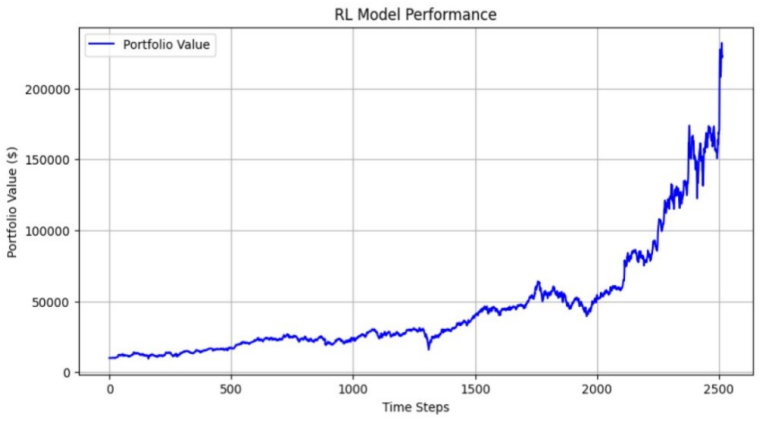
- [§5.2 and §6] The empirical claim that the agent 'consistently outperforms traditional algorithmic strategies across various market regimes' is not supported by the evidence as presented. There are no seeds, no error bars, no defined train/test periods, no data provenance beyond 'yfinance,' and no comparison against standard RL reward baselines such as cumulative-return or Sharpe-ratio rewards. Figures 2-5 and 6-11 are screenshots with descriptive captions but no quantitative tables, axis labels, or statistical tests. To support the central practical claim, the paper needs a controlled experimental protocol with multiple runs, defined market periods, baseline comparisons, and significance testing.
- [§4.1, Eqs. (12)-(14)] The monotonicity statements are stated unconditionally ('R increases with higher expected returns'), but they require β_p > 0 and w4 > 0, and β_p is itself an output-dependent quantity in Eqs. (4)-(5). The sign of ∂R/∂µ is not fixed for admissible actions when β_p ≤ 0, so the paper must state the domain of validity explicitly and either prove or constrain how β_p evolves under the policy.
- [§4.3, Eq. (18)] Equation (18) swaps the roles of w3 and w4 relative to the definition in Eq. (6): Eq. (6) has w3 multiplying Dret = (µ−µ_b)/β and w4 multiplying Try = 252µ/β (ignoring R_f), whereas Eq. (18) associates w3 with 252µ/β and w4 with (µ−µ_b)/β. This inconsistency affects the 'Return Reward' and 'Benchmark Bonus' interpretation and the weight-tuning discussion in §3.3; the notation should be aligned.
- [§4.2, 'Convergence of Optimization'] The claim that boundedness, continuity, and almost-everywhere differentiability ensure convergence of stochastic gradient ascent to a local optimum is too strong for the PPO/neural-network setup actually used in §5.1. The cited Borkar framework assumes diminishing-step-size stochastic approximation with specific conditions that are not verified here. The convergence claim should either be restricted to an appropriate idealized setting or accompanied by conditions that apply to the implemented algorithm.
minor comments (6)
- [§4.1, after Eq. (13)] The text says 'the differential return contributes to R with weight w4 > 0,' but Eq. (6) uses w3 for Dret; please use consistent subscripts throughout.
- [§6.1] The ticker should be 'AVGO,' not 'A VGO,' and the comparison with Renaissance Technologies' approximate 40% annualized return is not a controlled benchmark and should be removed or clearly labeled as informal context.
- [§5.2] The competing 'Ticheron' algorithmic strategies are not described; please specify the algorithms, parameters, and data periods used for the comparison.
- [§3.3 and §5.2] No grid-search results are reported (e.g., a table of weight configurations and resulting risk-return metrics), so the claim that weights were 'tuned via grid search' is not verifiable from the text.
- [Figures 2-5] The equity curves lack axis labels and a time axis; please include them or replace the figures with tables of returns, drawdowns, Sharpe, Sortino, beta, and win rate.
- [General] The paper does not contain a data availability statement or provide code; for reproducibility, please include the environment details and training hyperparameters.
Circularity Check
No circular derivation: the reward is composed of standard financial metrics defined from portfolio data, and the boundedness and convergence claims rest on explicit assumptions rather than on fitted or self-cited content.
full rationale
The central object is R = w1*Rann - w2*sigma_down + w3*Dret + w4*Try (Eq. 6), with Rann (Eq. 2), sigma_down (Eq. 3), Dret (Eq. 4), and Try (Eq. 5) all defined directly from portfolio returns, benchmark returns, and beta. No term is defined in terms of R itself, and no fitted parameter is renamed as a prediction. The theoretical claims in Section 4 are derived under explicit assumptions—beta in [beta_min, beta_max] with beta_min = 0.3 and returns in [-r_max, r_max]—which are stated as market-typical ranges rather than fitted to data. The grid search over w_i in Section 3.3 is a hyperparameter-tuning procedure on the reward, not a fitted input that is later called a prediction. The paper cites external sources (Simpson, Alam, CAPM, Sortino, Treynor) for the choice of reward components, and there is no load-bearing self-citation or imported uniqueness theorem. The boundedness argument does depend on beta_min > 0; for cash positions with beta = 0 the Treynor and differential-return terms are undefined, so the Section 4.2 convergence claims do not cover such admissible policies. This is a substantive robustness gap in the theoretical claim, but it is not circularity: it is an unenforced assumption, not an equation reducing to its own input. The experimental comparisons are made against external algorithmic strategies and benchmarks (Ticheron, S&P 500), so the performance claims are not generated by the reward definition alone. Verdict: no significant circularity; score 0.
Assumptions & free parameters
free parameters (3)
- w1, w2, w3, w4 =
grid search over simplex, sum=1
- r_max =
3.0
- beta_min =
0.3
assumptions (4)
- domain assumption Portfolio beta is positive and bounded away from zero (beta >= beta_min, e.g., 0.3)
- domain assumption Expected returns are bounded in [-r_max, r_max] with r_max = 3.0
- ad hoc to paper Weights are non-negative and held constant after the initial rebalance
- domain assumption Risk-free rate is ignored in the Treynor ratio analysis
Cite this review
Pith. "Pith review of A Risk-Aware Reinforcement Learning Reward for Financial Trading." pith.science (2026). https://pith.science/paper/IQAUTTQI
@misc{pith2026250604358,
  author       = {Pith},
  title        = {Pith review of: A Risk-Aware Reinforcement Learning Reward for Financial Trading},
  year         = {2026},
  howpublished = {\url{https://pith.science/paper/IQAUTTQI}},
  note         = {Machine review of arXiv:2506.04358}
}
read the original abstract
We propose a novel composite reward function for reinforcement learning in financial trading that balances return and risk using four differentiable terms: annualized return downside risk differential return and the Treynor ratio Unlike single metric objectives for example the Sharpe ratio our formulation is modular and parameterized by weights w1 w2 w3 and w4 enabling practitioners to encode diverse investor preferences We tune these weights via grid search to target specific risk return profiles We derive closed form gradients for each term to facilitate gradient based training and analyze key theoretical properties including monotonicity boundedness and modularity This framework offers a general blueprint for building robust multi objective reward functions in complex trading environments and can be extended with additional risk measures or adaptive weighting
Figures


Figures from the paper (7 more)




Reference graph
Works this paper leans on
-
[1]
S.M. Ikhtiar Alam. Portfolio performance and risk penalty measurement with differential return.International Journal of Services Sciences, 2:24–32, 2021. URLhttps://www.researchgate.net/publication/356127405_Portfolio_ Performance_and_Risk_Penalty_Measurement_with_Differential_Return
-
[2]
Borkar.Stochastic Approximation: A Dynamical Systems Viewpoint
Vivek S. Borkar.Stochastic Approximation: A Dynamical Systems Viewpoint. Cambridge Series in Statistical and Probabilistic Mathematics. Springer, Cambridge, UK, 2009. ISBN 9780521762403. 13
work page 2009
-
[3]
Portfolio selection.The Journal of Finance, 7(1):77–91, 1952
Harry Markowitz. Portfolio selection.The Journal of Finance, 7(1):77–91, 1952. URLhttps: //onlinelibrary.wiley.com/doi/10.1111/j.1540-6261.1952.tb01525.x
arXiv 1952
-
[4]
Human-level control through deep reinforcement learning.Nature, 518(7540):529–533, 2015
V olodymyr Mnih, Koray Kavukcuoglu, David Silver, Andrei A Rusu, Joel Veness, Marc G Bellemare, Alex Graves, Martin Riedmiller, Andreas K Fidjeland, Georg Ostrovski, et al. Human-level control through deep reinforcement learning.Nature, 518(7540):529–533, 2015
2015
-
[5]
John E. Moody and Matthew Saffell. Reinforcement learning for trading. InAdvances in Neural Information Processing Systems (NeurIPS), pages 917–923, 1999. URLhttps:// papers.nips.cc/paper/1551-reinforcement-learning-for-trading
work page 1999
-
[6]
William F. Sharpe. Capital asset prices: A theory of market equilibrium under conditions of risk.The Journal of Finance, 19(3):425–442, 1964. URLhttps://onlinelibrary.wiley. com/doi/10.1111/j.1540-6261.1964.tb02865.x
arXiv 1964
-
[7]
William F. Sharpe. Mutual fund performance.The Journal of Business, 39(1):119–138, 1966. URLhttps://finance.martinsewell.com/fund-performance/Sharpe1966.pdf
work page 1966
-
[8]
John D. Simpson. Understanding differential return, part 1: vs. subtraction alpha.https://spauldinggrp.com/ understanding-differential-return-part-1-vs-subtraction-alpha/, 2014. Accessed September 24, 2020
work page 2014
Show all 11 references
-
[9]
Sortino and Lee N
Frank A. Sortino and Lee N. Price. Performance measurement in a downside risk frame- work.The Journal of Investing, 3(3):59–64, 1994. URLhttps://www.pm-research.com/ content/iijinvest/3/3/59
1994
-
[10]
Sutton and Andrew G
Richard S. Sutton and Andrew G. Barto.Reinforcement Learning: An Introduction. MIT Press, 2nd edition, 2018
2018
-
[11]
Jack L. Treynor. How to rate management of investment funds.Harvard Business Review, 43(1):63–75, 1965. URLhttps://www.econbiz.de/Record/ how-to-rate-management-of-investment-funds-treynor-jack/10002940615. 14
1965
Reviewed August 7, 2026 · model on record in the stance chip above.
Discussion (0). Sign in to comment.