REVIEW 3 major objections 5 minor 45 references
On the Practices of Autonomous Systems Development: Survey-based Empirical Findings
T0 review · 3 major / 5 minor · reviewed 2026-08-07 · deepseek-v4-flash
Pith's one-line read A 2019 survey of 110 experts finds that autonomous systems in practice ran mostly on rule-based code, not machine learning.
desk verdict A transparent, genuinely useful 2019 snapshot of autonomy development practice, but the 'state-of-the-practice' framing overreaches its convenience sample. read the letter →
The pith
A machine-rendered reading of the paper's core claim, the machinery that carries it, and where it could break.
The reading
What carries the argument
The central object is the Autonomous Component (AUC), defined as a component that provides autonomous capabilities and supports autonomous operations; respondents provided details for 58 AUCs. The argument is carried by a 48-question branching online survey, administered from April 25 to June 20, 2019, whose sections cover domain, safety criticality, programming languages, autonomy levels, reuse, processes and standards, verification and validation, and bugs. The survey's four-level autonomy scale and its four information-processing tasks, adapted from prior frameworks, produce the headline percentages.
What would settle it
Repeating the survey with a sample that is randomly drawn or balanced across industry domains and finding markedly different rates of full autonomy or machine learning usage would falsify the state-of-the-practice claim. A simpler check is whether the 40% space share of respondents matches the actual distribution of autonomous-systems development effort across sectors.
Extended reading notes
Core claim
The paper's central claim is that in 2019, industrial practice in autonomous systems was more conventional than media attention to machine learning suggested. Across the four information-processing tasks used in the survey, between 50% and 67% of autonomous components had full computer autonomy, and the most common development methods were rule-based algorithms, planning systems, and statistical filtering. Only 9% of components used offline machine learning and 3% used online machine learning. The authors conclude that safety-critical systems with substantial autonomy were being built successfully with existing software technology, while naming system complexity, environmental uncertainty, and achieving the desired level of autonomy as the principal challenges.
Load-bearing premise
The 110 respondents, recruited through convenience sampling and snowballing, are representative of the broader population of autonomous systems developers, despite the sample's heavy skew toward space, aviation, and military domains.
Editorial extensions
If this is right
- If these numbers describe 2019 practice, then full autonomy was not a distant prospect; it was already deployed across a majority of surveyed autonomous components.
- If machine learning was used in only 12% of components, then assurance methods aimed at learning-enabled systems were addressing a small slice of the autonomous systems actually being built at that time.
- If only 24% of systems went through certification and 26% of autonomous components were part of a certified system, then certification was a clear gap in 2019 practice.
- If 25% of respondents reported reuse-specific bugs while only 19% verified reused artifacts, then reuse without dedicated verification and validation is a concrete risk in autonomous systems development.
Reading between the lines
- Because 40% of respondents came from the space domain and another 29% from aviation or military, the 'state of the practice' likely describes safety-critical aerospace practice more accurately than it describes consumer automotive or service robotics; this is an inference from the reported domain distribution.
- The sharpest test of the paper's claims will come from the planned second survey: if machine learning usage and certification rates have not moved by the mid-2020s, the 2019 baseline will look less like a lag and more like a persistent feature of the field.
- The reuse findings hint that conventional assumptions about reuse lowering defect rates may not transfer to autonomous systems, because reuse-specific bugs were nearly as common as autonomy-specific bugs; the paper does not state this directly.
Editorial analysis
A structured set of objections, weighed in public.
Referee Report
Summary. This paper reports the first wave of a longitudinal survey-based study of autonomous-systems development, based on an anonymous online survey administered in 2019. Of 129 respondents who started the survey, 110 reported having worked on autonomous systems and/or MBSwE and answered questions in six blocks covering industry domains, safety criticality, programming languages, code origins, autonomy details for up to 58 autonomous components (AUCs), reuse, processes and standards, verification and validation, and bugs. The main reported findings are a space/aviation/military-dominated respondent pool, high safety criticality, C/C++ as dominant languages, rule-based rather than ML algorithms (ML used for 12% of AUCs), full computer autonomy for 50–67% of AUCs across four autonomy tasks, low incidence of certification, and sparse V&V of security and reused artifacts. The paper claims four contributions: establishing the state-of-the-practice (C1), quantifying autonomy and reuse benefits and challenges (C2), identifying processes and standards (C3), and exploring V&V (C4), followed by practitioner recommendations.
Significance. If the descriptive results are accepted as an accurate snapshot of the 2019 respondent population, the paper is a valuable empirical complement to the many literature-review studies in this area. Its strengths are the structured survey design following Kitchenham and Pfleeger, the explicit reporting of the number of respondents behind each figure and table, the pilot study, the anonymous administration, and the stated intent to repeat the survey longitudinally. The usefulness of the findings as evidence about industry practice in general, however, is limited by the convenience sample, the domain skew toward space, aviation, and military, and the small denominators behind several headline percentages; these factors must be addressed before the 'state-of-the-practice' claim can be considered established.
major comments (3)
- [Section 1 (C1), Section 3, Section 5, Section 6] The central claim that the survey 'established the state-of-the-practice of developing autonomous systems' (C1) and the Section 6 conclusion that 'safety-critical systems with a substantial degree of autonomy have been successfully developed in the industry' generalize beyond the respondent pool, but the paper explicitly disclaims such generalization in Section 5: 'we cannot claim that the results based on one survey would be valid for all autonomous systems.' The sample was recruited via non-probabilistic convenience sampling and snowballing (Section 3), including contacts of the NASA-affiliated author team and over 300 authors of autonomy-related papers, and the respondent mix is heavily skewed toward space (40%), aviation (16%), and military (13%), with only 9% automotive (Figure 2). The authors' own prior MBSwE survey [24] had 33% automotive, which the paper itself cites as evidence that recruitment channels change the domain mix. Please reframe the contributions and conclusions as describing the surveyed sample, or provide substantive evidence of representativeness (e.g., comparison with known population demographics, weighting, or sensitivity analysis).
- [Section 4.2, Figures 7–8, Section 5] Key percentages are computed over very small and non-independent units: data about 58 AUCs were provided by 38 respondents, with 28 respondents reporting one AUC and the rest reporting multiple AUCs. Figure 7 is based on 50 AUCs and Figure 8 on 58 AUCs, so the headline full-autonomy figures (50–67%) and the ML-usage figure of 12% (7 of 58 AUCs) have wide sampling uncertainty and no adjustment for clustering of AUCs within respondents. Section 5's statement that 'these are fairly large sample sizes that allow drawing valid conclusions' is difficult to support for denominators of 29–58. Please report raw counts and confidence intervals for all key proportions, and either account for the clustering or qualify the precision of the estimates.
- [Section 4.5.1 vs. Section 6 recommendations] The paper reports two different numbers for V&V of security: Section 4.5.1 states 'only 11% of respondents verified and validated security' (about 4 of the 36 respondents who answered that question), while the final recommendations state 'Verification and validation of security was rare, done by only 4% of the respondents.' These cannot both be correct. Please reconcile the discrepancy and ensure Table 9 matches the detailed results.
minor comments (5)
- [Section 1] The text contains a typo: 'concpets' should be 'concepts'.
- [Section 2, reference [32]] The description of Taylor et al. uses 'reproducability' and should be 'reproducibility'.
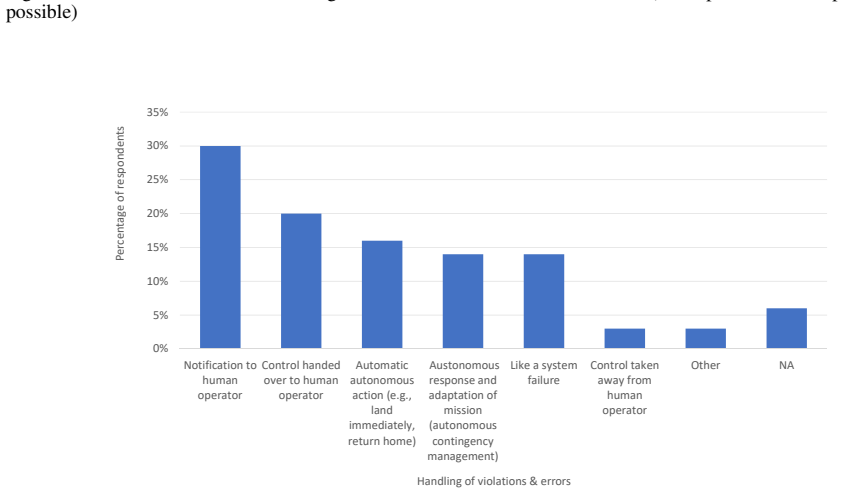
- [Figure 23] The label 'Austonomous response and adaptation of mission' should read 'Autonomous response and adaptation of mission'.
- [Section 5] The sentence 'Humans are know to have evaluation apprehension' should read 'Humans are known to have evaluation apprehension'.
- [Figures 7–16] Several bar charts report only percentages without raw counts; adding the underlying counts would improve interpretability, especially given the small denominators discussed in the major comments.
Circularity Check
No significant circularity: the paper's findings are direct aggregations of survey responses, with no fitted parameters, equations, or self-citation chain that makes a prediction equivalent to its inputs.
full rationale
This is an empirical survey paper. The reported findings are descriptive statistics computed directly from the 110 respondents' answers (e.g., 50%–67% full autonomy per task, 12% ML usage, 24% certification). There are no mathematical derivations, fitted parameters, or predictive models whose output is constrained by construction to equal an input. The authors cite their own prior work [24] and [34], but those citations are used only for comparison of domain mix (33% vs. 9% automotive) and as an example of bug studies; neither citation is load-bearing for the central claims of this paper. The 'state-of-the-practice' framing is a generalization claim, not a circular derivation, and the paper itself explicitly limits it in Section 5: 'we cannot claim that the results based on one survey would be valid for all autonomous systems.' Any concern about convenience sampling or representativeness is an external validity threat, not circularity. Therefore the appropriate finding is no significant circularity, score 0.
Assumptions & free parameters
free parameters (2)
- Reuse extent threshold =
30%
- Number of autonomy levels =
4
assumptions (3)
- domain assumption Self-selection and recall biases cancel out
- domain assumption Sample representativeness
- domain assumption Consistent interpretation of terms
Cite this review
Pith. "Pith review of On the Practices of Autonomous Systems Development: Survey-based Empirical Findings." pith.science (2026). https://pith.science/paper/UCY2YGUM
@misc{pith2026250604438,
  author       = {Pith},
  title        = {Pith review of: On the Practices of Autonomous Systems Development: Survey-based Empirical Findings},
  year         = {2026},
  howpublished = {\url{https://pith.science/paper/UCY2YGUM}},
  note         = {Machine review of arXiv:2506.04438}
}
read the original abstract
Autonomous systems have gained an important role in many industry domains and are beginning to change everyday life. However, due to dynamically emerging applications and often proprietary constraints, there is a lack of information about the practice of developing autonomous systems. This paper presents the first part of the longitudinal study focused on establishing state-of-the-practice, identifying and quantifying the challenges and benefits, identifying the processes and standards used, and exploring verification and validation (V&V) practices used for the development of autonomous systems. The results presented in this paper are based on data about software systems that have autonomous functionality and may employ model-based software engineering (MBSwE) and reuse. These data were collected using an anonymous online survey that was administered in 2019 and were provided by experts with experience in development of autonomous systems and /or the use of MBSwE. Our current work is focused on repeating the survey to collect more recent data and discover how the development of autonomous systems has evolved over time.
Figures


Figures from the paper (18 more)


Reference graph
Works this paper leans on
-
[24]
Sur- vey on Model-Based Software Engineering and Auto-Generated Code,
K. Goseva-Popstojanova, T. Kahsai, M. Knudson, T. Kyanko, N. Nkwocha, and J. Schumann, “Sur- vey on Model-Based Software Engineering and Auto-Generated Code,” https://tkyanko.me/cv/Survey on Model-Based Software Engineering and Auto-Generated Code.pdf, NASA Report, Tech. Rep., 2016, accessed: 2025-04-16
work page 2016
-
[1]
Computing systems for autonomous driving: State of the art and challenges,
L. Liu, S. Lu, R. Zhong, B. Wu, Y . Yao, Q. Zhang, and W. Shi, “Computing systems for autonomous driving: State of the art and challenges,” IEEE Internet of Things Journal, vol. 8, no. 8, pp. 6469–6486, 2020
work page 2020
-
[2]
Creating a foundation for next-generation autonomous systems,
D. Harel, A. Marron, and J. Sifakis, “Creating a foundation for next-generation autonomous systems,” IEEE Design & Test, vol. 39, no. 1, pp. 49–56, 2021. 23 On the Practices of Autonomous Systems Development: Survey-based Empirical Findings A PREPRINT
work page 2021
-
[3]
Validation of autonomous systems,
C. Ebert and M. Weyrich, “Validation of autonomous systems,” IEEE Software, vol. 36, no. 5, pp. 15–23, 2019
work page 2019
- [4]
-
[5]
A review of ver- ification and validation for space autonomous systems,
R. C. Cardoso, G. Kourtis, L. A. Dennis, C. Dixon, M. Farrell, M. Fisher, and M. Webster, “A review of ver- ification and validation for space autonomous systems,” Current Robotics Reports, vol. 2, no. 3, pp. 273–283, 2021
work page 2021
-
[6]
Tesla recalls 362,758 vehicles, says full self-driving beta software may cause crashes,
“Tesla recalls 362,758 vehicles, says full self-driving beta software may cause crashes,” https://www.cnbc.com/ 2023/02/16/tesla-recalls-362758-vehicles-says-full-self-driving-beta-software-may-cause-crashes.html, Febru- ary 2023, accessed: 2025-04-16
work page 2023
-
[7]
A model for types and levels of human interaction with automation,
R. Parasuraman, T. B. Sheridan, and C. D. Wickens, “A model for types and levels of human interaction with automation,” IEEE Transactions on systems, man, and cybernetics-Part A: Systems and Humans, vol. 30, no. 3, pp. 286–297, 2000
work page 2000
Show all 45 references
-
[8]
Challenges of testing highly automated vehicles: A liter- ature review,
D. Karunakaran, J. S. Berrio, S. Worrall, and E. Nebot, “Challenges of testing highly automated vehicles: A liter- ature review,” in 2022 IEEE International Conference on Recent Advances in Systems Science and Engineering (RASSE). IEEE, 2022, pp. 1–8
2022
-
[9]
DO-178C/ED-12C: Software considerations in airborne systems and equipment certification,
RTCA, “DO-178C/ED-12C: Software considerations in airborne systems and equipment certification,” 2012. [Online]. Available: http://www.rtca.org
2012
-
[10]
DO-331, Model-Based Development and Verification Supplement to DO-178C and DO-278A, RTCA Std., 2013
2013
-
[11]
ISO 26 262-6, 2018
Road vehicles — Functional safety — Part 6: Product development at the software level, International Organiza- tion for Standardization Std. ISO 26 262-6, 2018
2018
-
[12]
EASA concept paper: First usable guidance for level 1 machine learning applications,
“EASA concept paper: First usable guidance for level 1 machine learning applications,” European Aviation Safety Agency, Tech. Rep., 2021
2021
-
[13]
EASA concept paper: First usable guidance for level 1&2 machine learning applications,
“EASA concept paper: First usable guidance for level 1&2 machine learning applications,” European Aviation Safety Agency, Tech. Rep., 2023
2023
-
[14]
IEEE Standard for Fail-Safe Design of Autonomous and Semi-Autonomous Systems, IEEE Standard 7009, 2024, published by the IEEE
2024
-
[15]
A survey of autonomous control for UA V,
H. Chen, X. Wang, and Y . Li, “A survey of autonomous control for UA V,” in2009 International Conference on Artificial Intelligence and Computational Intelligence, vol. 2, Nov 2009, pp. 267–271
2009
-
[16]
Coverage based testing for V&V and safety assurance of self-driving autonomous ve- hicles: A systematic literature review,
Z. Tahir and R. Alexander, “Coverage based testing for V&V and safety assurance of self-driving autonomous ve- hicles: A systematic literature review,” in2020 IEEE International Conference On Artificial Intelligence Testing (AITest). IEEE, 2020, pp. 23–30
2020
-
[17]
Autonomous driving security: State of the art and challenges,
C. Gao, G. Wang, W. Shi, Z. Wang, and Y . Chen, “Autonomous driving security: State of the art and challenges,” IEEE Internet of Things Journal, vol. 9, no. 10, pp. 7572–7595, 2021
2021
-
[18]
Application of neural networks in high assurance systems: A survey,
J. Schumann, P. Gupta, and Y . Liu, “Application of neural networks in high assurance systems: A survey,” in Applications of Neural Networks in High Assurance Systems. Springer, 2010
2010
-
[19]
Verification and validation of system health management models using parametric testing,
J. Schumann, E. Reed, and O. Mengshoel, “Verification and validation of system health management models using parametric testing,” in AIAA Infotech@Aerospace, 03 2011
2011
-
[20]
Software health management with Bayesian networks,
J. Schumann, T. Mbaya, O. Mengshoel, K. Pipatsrisawat, A. Srivastava, A. Choi, and A. Darwiche, “Software health management with Bayesian networks,” Innovations in Systems and Software Engineering , vol. 9, no. 4, pp. 271–292, 2013
2013
-
[21]
Assurance of model-based fault diagnosis,
A. Nikora, P. Srivastava, L. Fesq, S. Chung, and K. Kolcio, “Assurance of model-based fault diagnosis,” in2018 IEEE Aerospace Conference, March 2018, pp. 1–14
2018
-
[22]
Concepts in testing of autonomous systems: Academic literature and industry practice,
Q. Song, E. Engstr ¨om, and P. Runeson, “Concepts in testing of autonomous systems: Academic literature and industry practice,” in 2021 IEEE/ACM 1st Workshop on AI Engineering-Software Engineering for AI (WAIN) . IEEE, 2021, pp. 74–81
2021
-
[23]
Security modeling of autonomous systems: A survey,
F. Jahan, W. Sun, Q. Niyaz, and M. Alam, “Security modeling of autonomous systems: A survey,” ACM Com- puting Surveys (CSUR), vol. 52, no. 5, pp. 1–34, 2019
2019
-
[25]
Intelligent control for spacecraft autonomy - an industry survey,
D. LaVallee, J. Jacobsohn, C. Olsen, and J. Reilly, “Intelligent control for spacecraft autonomy - an industry survey,” inSpace 2006, 2006, p. 7384. 24 On the Practices of Autonomous Systems Development: Survey-based Empirical Findings A PREPRINT
2006
-
[26]
T. B. Sheridan, Telerobotics, Automation, and Human Supervisory Control. Cambridge, MA, USA: MIT Press, 1992
1992
-
[27]
Taxonomy and definitions for terms related to on-road motor vehicle automated driving systems,
SAE On-Road Automated Vehicle Standards Committee and others, “Taxonomy and definitions for terms related to on-road motor vehicle automated driving systems,” SAE Standard J, vol. 3016, no. 1, pp. 1–16, 2014
2014
-
[28]
Methods for determining the level of autonomy to design into a human spaceflight vehicle: A function specific approach,
R. W. Proud, J. J. Hart, and R. B. Mrozinski, “Methods for determining the level of autonomy to design into a human spaceflight vehicle: A function specific approach,” in Proc. Performance Metrics for Intelligent Systems (PerMIS ’03), NIST Special Publication 1014, 2003
2003
-
[29]
Mercedes says level 4 autonomous driving will be a reality this decade,
“Mercedes says level 4 autonomous driving will be a reality this decade,” https://cars.usnews.com/cars-trucks/ features/mercedes-level-4-autonomy-is-a-reality, March 2023, accessed: 2025-04-16
2023
-
[30]
A comprehensive study of autonomous vehicle bugs,
J. Garcia, Y . Feng, J. Shen, S. Almanee, Y . Xia, and A. Qi, “A comprehensive study of autonomous vehicle bugs,” in Proceedings of the ACM/IEEE 42nd international conference on software engineering, 2020, pp. 385–396
2020
-
[31]
Issue categorization and analysis of an open-source driving assis- tant system,
S. Tang, Z. Zhang, J. Tang, L. Ma, and Y . Xue, “Issue categorization and analysis of an open-source driving assis- tant system,” in 2021 IEEE International Symposium on Software Reliability Engineering Workshops (ISSREW). IEEE, 2021, pp. 148–153
2021
-
[32]
A study on software bugs in unmanned aircraft systems,
M. Taylor, J. Boubin, H. Chen, C. Stewart, and F. Qin, “A study on software bugs in unmanned aircraft systems,” in 2021 International Conference on Unmanned Aircraft Systems (ICUAS). IEEE, 2021, pp. 1439–1448
2021
-
[33]
An exploratory study of autopilot software bugs in unmanned aerial vehicles,
D. Wang, S. Li, G. Xiao, Y . Liu, and Y . Sui, “An exploratory study of autopilot software bugs in unmanned aerial vehicles,” in Proceedings of the 29th ACM Joint Meeting on European Software Engineering Conference and Symposium on the Foundations of Software Engineering, 2021...
2021
-
[34]
The anatomy of software changes and bugs in autonomous operating system,
K. Goseva-Popstojanova, D. Hood, J. Schumann, and N. Nkwocha, “The anatomy of software changes and bugs in autonomous operating system,” in47th IEEE Annual Computers, Software, and Applications Conference (COMPSAC), 2023, pp. 28–38
2023
-
[35]
Mind the gaps: Assuring the safety of autonomous systems from an engineering, ethical, and legal perspective,
S. Burton, I. Habli, T. Lawton, J. McDermid, P. Morgan, and Z. Porter, “Mind the gaps: Assuring the safety of autonomous systems from an engineering, ethical, and legal perspective,” Artificial Intelligence, vol. 279, p. 103201, 2020
2020
-
[36]
Ethics and the safety of autonomous systems,
C. Menon and R. Alexander, “Ethics and the safety of autonomous systems,” 02 2018
2018
-
[37]
Waymo’s safety methodologies and safety readiness determinations,
N. Webb, D. Smith, C. Ludwick, T. Victor, Q. Hommes, F. Favaro, G. Ivanov, and T. Daniel, “Waymo’s safety methodologies and safety readiness determinations,” 2020. [Online]. Available: https://arxiv.org/abs/2011.00054
2020 arXiv
-
[38]
Personal opinion surveys,
B. A. Kitchenham and S. L. Pfleeger, “Personal opinion surveys,” in Guide to Advanced Empirical Software Engineering, F. Shull, J. Singer, and D. Sjøberg, Eds. Springer London, 2008, pp. 63–92
2008
-
[39]
SurveyMonkey,
“SurveyMonkey,” https://www.surveymonkey.com/, accessed: 2025-04-16
2025
-
[40]
Papyrus modeling environment,
Eclipse.org, “Papyrus modeling environment,” https://eclipse.org/papyrus/, accessed: 2025-04-16
2025
-
[41]
The MathWorks Automotive Advisory Board
MathWorks, “The MathWorks Automotive Advisory Board.” [Online]. Available: http://www.mathworks.com/ solutions/automotive/standards/maab.html
-
[42]
SysML open source specification project,
SysML.org, “SysML open source specification project,” http://sysml.org, accessed: 2025-04-16
2025
-
[43]
“UPPAAL,” http://www.uppaal.org, accessed: 2025-04-16
2025
-
[44]
Jenkins,
jenkins.io, “Jenkins,” https://jenkins.io/, accessed: 2025-04-16
2025
-
[45]
PRISM 4.0: Verification of Probabilistic Real-time Systems,
M. Kwiatkowska, G. Norman, and D. Parker, “PRISM 4.0: Verification of Probabilistic Real-time Systems,” in Proceedings of the 23rd International Conference on Computer Aided Verification (CAV’11) , ser. LNCS, G. Gopalakrishnan and S. Qadeer, Eds., vol. 6806. Springer, 2011, pp...
2011
Reviewed August 7, 2026 · model on record in the stance chip above.
Discussion (0). Sign in to comment.