REVIEW 6 minor 96 references
Centaur Nuclei: Sizes, Shapes, Spins, and Structure
T0 review · 0 major / 6 minor · reviewed 2026-08-07 · deepseek-v4-flash
Pith's one-line read The paper's central claim is that current data cannot fix the Centaur size distribution, whose most likely power-law slope is about -2.2 but with a wide range of plausible alternatives.
desk verdict Useful, honest review chapter that correctly argues the Centaur size distribution is not yet constrainable; the Monte Carlo spread is real but conditional on the 42-object albedo sample being representative. read the letter →
The pith
A machine-rendered reading of the paper's core claim, the machinery that carries it, and where it could break.
The reading
What carries the argument
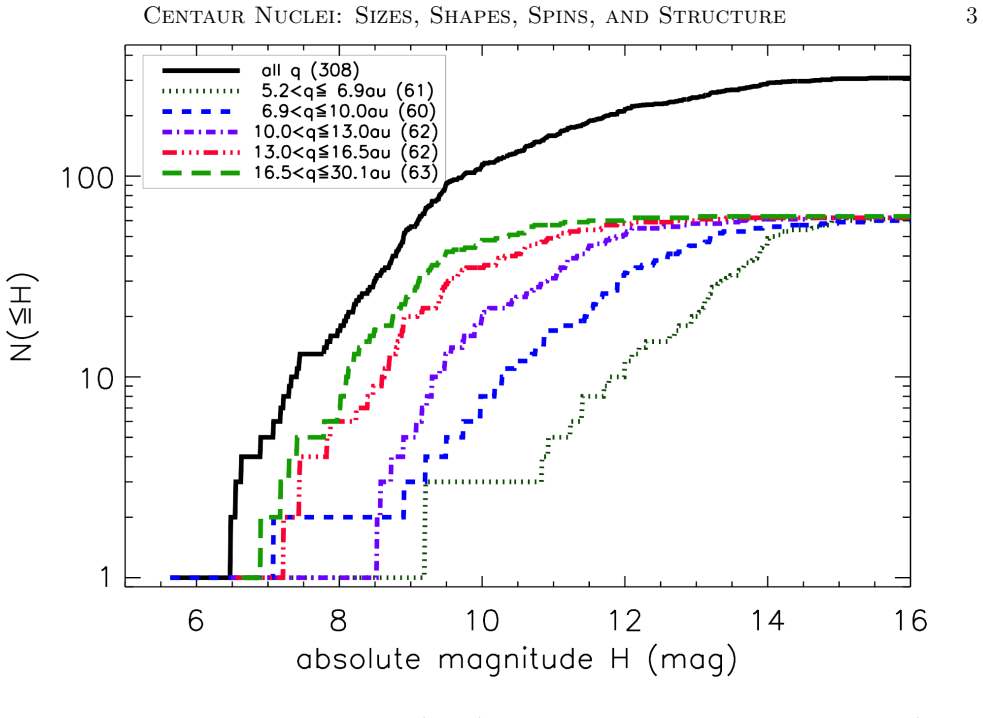
The load-bearing machinery is a Monte Carlo conversion pipeline: for each of 308 Centaurs, an albedo is drawn from an empirical probability density function reconstructed from 42 measured albedos and their uncertainties, the absolute magnitude is converted to a diameter, and a power law is fit to the cumulative size distribution over 100-200 km diameters. Repeating this 10,000 times yields the spread of plausible slopes. For shapes and spins, the central objects are triaxial ellipsoid models, where the lightcurve amplitude relates to axis ratios and aspect angle, and Jacobi ellipsoids (hydrostatic equilibrium figures of a uniformly dense, self-gravitating fluid) are used to translate spin frequency and amplitude into bulk-density limits. A collisional evolution model that starts from a streaming-instability size distribution and evolves it through the primordial Kuiper Belt and scattered disk supplies the fragment fraction claims.
What would settle it
Measure diameters and albedos for a magnitude-limited sample of Centaurs down to about H = 14 across all perihelion bins, using multi-chord stellar occultations or thermal-infrared photometry; if the unmeasured majority has a different albedo distribution than the 42-object sample, the most-likely power-law exponent will shift away from -2.2. A separate check: a survey that finds many Centaurs with lightcurve amplitudes above 0.9 mag would overturn the claim that contact binaries are rare, and detection of small Centaurs spinning faster than about three rotations per day would break the proposed spin barrier.
Extended reading notes
Core claim
On the authors' terms, the central claim is that 'there is intrinsic uncertainty in any characterization of the Centaur size distribution' until a much larger fraction of Centaur diameters and albedos are measured directly. The chapter demonstrates this by building an empirical albedo probability density from 42 objects and running 10,000 simulated size distributions; the resulting power-law exponents cluster near -2.2 but spread widely, so no single slope is securely established. On rotation, the existing 16-object lightcurve sample shows mostly low amplitudes (half below 0.2 mag), a cluster of spin periods near 9 hours, a tail of slow rotators out to about 88 hours, and a tentative pattern in which the largest Centaurs spin fastest and show the flattest lightcurves. The chapter also claims that collisions early in Solar System history, especially in the primordial Kuiper Belt, likely made most small Centaurs collisional fragments while leaving roughly 100 km and larger bodies largely intact, which would make the largest Centaurs the best preserved samples of the original planetesimal population.
Load-bearing premise
The argument depends on assuming that the 42 Centaurs with measured albedos have the same albedo distribution as the other 266 known Centaurs, including the faint and distant ones that have never been measured; if those unmeasured objects are systematically darker or brighter, the simulated size-distribution slopes would be shifted, not just broadened.
Editorial extensions
If this is right
- No single power-law slope for the Centaur size distribution should be used as a hard constraint until albedos and diameters of the faint, distant Centaurs are actually measured.
- The apparent similarity between Centaur spin rates and those of Plutinos, Scattered Disk objects, and Hot Classicals is consistent with shared origins, but the sample of 16 is too small to firmly establish it.
- The near-spherical shapes of most Centaurs set an upper limit on elongation, and the absence of lightcurve amplitudes above 0.9 mag implies contact binaries are rare among the known Centaurs, subject to discovery and follow-up biases.
- If most Centaurs smaller than about 10 km are collisional fragments, then their size distribution and spin states carry information about the primordial Kuiper Belt rather than about Centaur-specific processes.
- Measurement limitations, including single-band thermal photometry and coma or ring dilution of lightcurves, mean that reported diameters and shapes for individual Centaurs carry errors larger than typical quoted uncertainties.
Reading between the lines
- A testable extension follows from the paper's own caveat: occultation campaigns targeting Centaurs with H = 9-14 in the most distant perihelion bins would directly check whether the 42-object albedo distribution is representative, and would either confirm or shift the -2.2 slope.
- If the spin-barrier interpretation is right, high-cadence surveys of small Centaurs should find a deficit of objects spinning faster than roughly three rotations per day; detecting many would push the field toward a different explanation, such as activity-driven spin changes during temporary low-perihelion episodes.
- The comparison the chapter draws with cold classical Kuiper Belt objects implies that the binary fraction of Centaurs, if measured at sub-100 km separations, would be a clean test of how much collisional and dynamical processing the Centaur population has undergone.
- The paper's emphasis on single-band thermal photometry uncertainty suggests that multi-band thermal observations of the same Centaurs would yield measurably tighter diameters, a prediction that can be checked against existing archival data.
Editorial analysis
A structured set of objections, weighed in public.
Referee Report
Summary. This manuscript is a review chapter, adapted from a book contribution, that synthesizes current knowledge of Centaur physical properties. It analyzes a JPL Horizons census of 308 Centaurs to show how discovery biases depend on perihelion distance, converts the absolute-magnitude distribution into a size distribution by Monte Carlo sampling of an albedo probability density function built from 42 albedos from the Müller et al. (2020) compilation, and reports a most-likely cumulative size-distribution power-law exponent near -2.2 with a wide spread of possible exponents. The paper then reviews spin and shape data for 16 Centaurs with lightcurves, finding mostly low-amplitude variations, a possible size-related spin pattern, and no strong correlation with orbital parameters. It discusses density constraints from Jacobi ellipsoids, the rarity of contact binaries and rings, the limitations of visible and thermal-infrared diameter determinations, the role of occultations, and the collisional context from the primordial Kuiper Belt and scattered disk. The central message is that the Centaur size distribution remains intrinsically uncertain until many more diameters and albedos are measured.
Significance. If taken as a review, this chapter is valuable: it collects the current small samples (308 census objects, 42 albedos, 16 lightcurves) and presents them with unusually explicit caveats. The Monte Carlo demonstration in Section 2 is a useful cautionary example, and the authors are careful to say they are not claiming a definitive slope for the Centaur size distribution. The discussion of measurement limitations, especially the thermal-infrared ambiguity illustrated in Figure 12, is instructive and well referenced. The chapter does not present new observational data, and its quantitative conclusions are deliberately provisional, but as a synthesis it is a fair and useful contribution to the Centaur literature. Its main strength is the honest treatment of sample-size limitations and selection effects.
minor comments (6)
- [Section 2, Figure 4] The statement that 'there is intrinsic uncertainty in any characterization of the Centaur size distribution' should be qualified in the final paragraph of Section 2: the spread in Figure 4 reflects albedo dispersion under the assumption that the 42 measured albedos are representative of all 308 Centaurs, and it does not include the possibility of a systematic albedo difference for the unmeasured faint or distant majority. The assumption is stated earlier, but the takeaway sentence should restate this conditionality because the figure is the paper's only quantitative size-distribution result.
- [Section 4, Eq. (6) discussion] The factor in the sentence about the volume-derived radius is inverted: with the assumed radius a(b/a)^(2/3) and the true radius (abc)^(1/3), the assumed value exceeds the true value by a factor (b/c)^(1/3), not (c/b)^(1/3). Please correct this and verify that the subsequent 'shifted sideways' and slope-bias argument is unaffected by the direction of the factor.
- [Section 3.4, Figure 9] The apparent difference between the spin frequencies of smaller and larger Centaurs is presented without a significance test, and the sample contains only 16 objects with several low-quality or ambiguous periods in Table 1. Please add a rank-order or two-sample test, or explicitly label the trend as heuristic, before using it to argue about collisional evolution and spin barriers.
- [Section 4, Eq. (6)] Please define the solar magnitude m_sun_lambda and the phase integral q_ph explicitly, and state the phase-darkening convention assumed in Eq. (6); otherwise the formula appears to mix monochromatic magnitudes with the standard H-based diameter relation without specifying the correction.
- [Section 3.6, Figure 10] The sentence 'none spins fast enough to require bulk densities much larger than 1000 kg m^{-3}' should explicitly remind the reader that this conclusion assumes hydrostatic equilibrium and equator-on Jacobi ellipsoids; given the note that Chariklo's occultation shape is not hydrostatic, the caveat should appear in this paragraph as well.
- [Section 5.2] The claim that 'most smaller bodies in the scattered disk, and by extension the Centaur population, are collisional fragments' follows only if the Bottke et al. (2023) collisional model and the assumed streaming-instability initial size distribution are correct; the text should carry the model-dependence into this sentence rather than stating the fragment conclusion as a fact.
Circularity Check
No circular derivation: the size-distribution Monte Carlo is an explicit uncertainty propagation from external albedo measurements, and the only self-citations support secondary collisional-evolution claims rather than the central result.
full rationale
The paper's central quantitative point is an honest uncertainty assessment: it converts the observed H distribution into a size distribution by drawing albedos from an empirical PDF built from 42 external measurements (Muller et al. 2020), then explicitly states it is 'not claiming a value for the actual Centaur size distribution' and is 'merely demonstrating that whatever power-law is produced has appreciable uncertainty.' The albedo PDF is not fitted to the target slope; the Monte Carlo is used only to propagate the unknown albedo distribution, so the result is not equivalent to its input by construction. The assumption that 42 measured albedos represent all 308 Centaurs is a stated modeling limitation, not a circular step: the paper flags it directly and uses it to broaden uncertainty rather than to force a specific exponent. Self-citations to Bottke et al. (2023) and Marschall et al. (2023) support the collisional-fragments discussion but that claim is not derived from the size-distribution simulation and is not load-bearing for the chapter's main conclusions. No equation is used to define a prediction in terms of its own target, and no fitted parameter is renamed as a prediction. The paper is self-contained against external benchmarks for its main message.
Assumptions & free parameters
free parameters (3)
- Cumulative size-distribution power-law fit range =
100 to 200 km
- NEATM beaming parameter range =
0.8 to 1.3
- Assumed geometric albedo in thermal example =
0.08
assumptions (6)
- domain assumption The 42 Centaur albedos compiled by Muller et al. (2020), after the authors' exclusions, are representative of the full Centaur population.
- domain assumption The JPL Horizons extraction criteria define the Centaur population and the H magnitudes are accurate enough for distribution analysis.
- domain assumption Lightcurve amplitude can be interpreted with a triaxial ellipsoid shape model and an unknown aspect angle.
- domain assumption Jacobi ellipsoid hydrostatic-equilibrium shapes apply to Centaurs for density inference.
- domain assumption The current scattered-disk size distribution can be explained by collisional evolution of a streaming-instability initial size distribution.
- standard math Standard statistical tests (KS) can be applied to small samples to compare spin distributions.
Cite this review
Pith. "Pith review of Centaur Nuclei: Sizes, Shapes, Spins, and Structure." pith.science (2026). https://pith.science/paper/A3JG5JR5
@misc{pith2026250604483,
  author       = {Pith},
  title        = {Pith review of: Centaur Nuclei: Sizes, Shapes, Spins, and Structure},
  year         = {2026},
  howpublished = {\url{https://pith.science/paper/A3JG5JR5}},
  note         = {Machine review of arXiv:2506.04483}
}
read the original abstract
We present a wide-ranging but in-depth analysis of Centaurs, focusing on their physical and structural aspects. Centaurs, originating from the Scattered Disk and Kuiper Belt, play a crucial role in our understanding of Solar System evolution. We first examine how biases in discovery and measurement affect our understanding of the Centaur size distribution. In particular we address the strong dependence of the census on perihelion distance and the broad distribution of Centaur geometric albedos. We explore the rotational characteristics derived from lightcurves, revealing a diverse range of spin rates and photometric variabilities, with most Centaurs showing low amplitude lightcurves, suggesting near-spherical shapes. Additionally, we investigate the relationships between Centaur orbital parameters, surface colors, and physical properties, noting a lack of correlation between rotational dynamics and orbital evolution. We also address the influence of sublimation-driven activity on Centaur spin states, and the rarity of contact binaries. We then discuss some observational and modeling limitations from using common observations (e.g. visible or infrared photometry) to determine diameters and shapes. Following that, we give some points on understanding how Centaur diameters and shapes can reveal the `primitive' nature of the bodies, emphasizing the important role occultation observations play. We also then assess how the Centaur size distribution we see today has been influenced by the collisions in both the primordial Kuiper Belt and in the subsequent Scattered Disk. Finally, we end the chapter with a short narrative of future prospects for overcoming our current limitations in understanding Centaur origins and evolution.
Figures


Figures from the paper (10 more)


Reference graph
Works this paper leans on
-
[1]
Bauer, J., Ivanova, O., McKay, A., & Sarid, G. 2025, in Centaurs, ed. K. Volk, M. Womack, & J. Steckloff (IOP Publishing), 8–1—8–23, doi: 10.1088/2514-3433/ada267ch8
-
[2]
T., Delbo, M., Morbidelli, A., & Walsh, K
Bolin, B. T., Delbo, M., Morbidelli, A., & Walsh, K. J. 2017, Icarus, 282, 290, doi: 10.1016/j.icarus.2016.09.029
-
[3]
Bottke, W. F., Durda, D. D., Nesvorn´ y, D., et al. 2005, Icarus, 175, 111, doi: 10.1016/j.icarus.2004.10.026 24 Fernandez, Buie, Lacerda, and Marschall
-
[4]
F., Vokrouhlick´ y, D., Ballouz, R
Bottke, W. F., Vokrouhlick´ y, D., Ballouz, R. L., et al. 2020, AJ, 160, 14, doi: 10.3847/1538-3881/ab88d3
-
[5]
F., Vokrouhlick´ y, D., Marshall, R., et al
Bottke, W. F., Vokrouhlick´ y, D., Marshall, R., et al. 2023, PSJ, 4, 168, doi: 10.3847/PSJ/ace7cd
- [6]
-
[7]
Buie, M. W., Zangari, A. M., Marchi, S., Levison, H. F., & Mottola, S. 2018, AJ, 155, 245, doi: 10.3847/1538-3881/aabd81
-
[8]
Buie, M. W., Keeney, B. A., Strauss, R. H., et al. 2021, PSJ, 2, 202, doi: 10.3847/PSJ/ac1f9b
Show all 96 references
-
[9]
1969, Ellipsoidal figures of equilibrium (Yale University Press, New Haven, CT)
Chandrasekhar, S. 1969, Ellipsoidal figures of equilibrium (Yale University Press, New Haven, CT)
1969
-
[10]
2004, A&A, 417, 1145, doi: 10.1051/0004-6361:20034182
Delsanti, A., Hainaut, O., Jourdeuil, E., et al. 2004, A&A, 417, 1145, doi: 10.1051/0004-6361:20034182
2004 doi
-
[11]
2016, Icarus, 265, 29, doi: 10.1016/j.icarus.2015.10.010 Di Sisto, R
Descamps, P. 2016, Icarus, 265, 29, doi: 10.1016/j.icarus.2015.10.010 Di Sisto, R. P., Gallardo, T., & Dones, L. 2025, in Centaurs, ed. K. Volk, M. Womack, & J. Steckloff (IOP Publishing), 3–1—3–28, doi: 10.1088/2514-3433/ada267ch3
2016 doi
-
[12]
M., Schwamb, M
Dobson, M. M., Schwamb, M. E., Benecchi, S. D., et al. 2023, PSJ, 4, 75, doi: 10.3847/PSJ/acc463
2023 doi
-
[13]
2014, A&A, 564, A92, doi: 10.1051/0004-6361/201322377
Duffard, R., Pinilla-Alonso, N., Santos-Sanz, P., et al. 2014, A&A, 564, A92, doi: 10.1051/0004-6361/201322377
2014 doi
-
[14]
2004, in Comets II, ed
Duncan, M., Levison, H., & Dones, L. 2004, in Comets II, ed. M. C. Festou, H. U. Keller, & H. A. Weaver (Univ. Arizona Press, Tucson, AZ), 193
2004
-
[15]
J., & Levison, H
Duncan, M. J., & Levison, H. F. 1997, Science, 276, 1670, doi: 10.1126/science.276.5319.1670 Fern´ andez, Y. R., Lowry, S. C., Weissman, P. R., et al. 2005, Icarus, 175, 194, doi: 10.1016/j.icarus.2004.10.019 Fern´ andez-Valenzuela, E., Guilbert-Lepoutre, A.,
1997
-
[16]
E., et al
Schwamb, M. E., et al. 2025, in Centaurs, ed. K. Volk, M. Womack, & J. Steckloff (IOP Publishing), 14–1—14–16, doi: 10.1088/2514-3433/ada267ch14 Fern´ andez-Valenzuela, E., Ortiz, J. L., Duffard, R., Morales, N., & Santos-Sanz, P. 2017, MNRAS, 466, 4147, doi: 10.1093/mnras/stw3264
2025 doi
-
[17]
2013, A&A, 555, A15, doi: 10.1051/0004-6361/201321329
Fornasier, S., Lellouch, E., M¨ uller, T., et al. 2013, A&A, 555, A15, doi: 10.1051/0004-6361/201321329
2013 doi
-
[18]
C., Dones, L., Volk, K., Womack, M., & Nesvor´ y, D
Fraser, W. C., Dones, L., Volk, K., Womack, M., & Nesvor´ y, D. 2024, in Comets III, ed. K. J
2024
-
[19]
2010, ApJ, 719, 1602, doi: 10.1088/0004-637X/719/2/1602
Gnat, O., & Sari, R. 2010, ApJ, 719, 1602, doi: 10.1088/0004-637X/719/2/1602
2010 doi
-
[20]
M., Stansberry, J
Grundy, W. M., Stansberry, J. A., Noll, K. S., et al. 2007, Icarus, 191, 286, doi: 10.1016/j.icarus.2007.04.004
2007 doi
-
[21]
Harris, A. W. 1998, Icarus, 131, 291, doi: 10.1006/icar.1997.5865
1998
-
[22]
A., & Villanueva, G
Harris, W., Stern, S. A., & Villanueva, G. L. 2025, in Centaurs, ed. K. Volk, M. Womack, & J. Steckloff (IOP Publishing), 16–1—16–26, doi: 10.1088/2514-3433/ada267ch16
2025 doi
-
[23]
2025, in Centaurs, ed
Hirabayashi, M., S´ anchez, P., & Sarid, G. 2025, in Centaurs, ed. K. Volk, M. Womack, & J. Steckloff (IOP Publishing), 12–1—12–30, doi: 10.1088/2514-3433/ada267ch12
2025 doi
-
[24]
S., Magri, C., Vervack, R
Howell, E. S., Magri, C., Vervack, R. J., et al. 2018, Icarus, 303, 220, doi: 10.1016/j.icarus.2017.12.003
2018 doi
-
[25]
2018, PASP, 130, 104501, doi: 10.1088/1538-3873/aad538 Ivezi´ c,ˇZ., Tabachnik, S., Rafikov, R., et al
Hui, M.-T., & Li, J.-Y. 2018, PASP, 130, 104501, doi: 10.1088/1538-3873/aad538 Ivezi´ c,ˇZ., Tabachnik, S., Rafikov, R., et al. 2001, AJ, 122, 2749, doi: 10.1086/323452 Ivezi´ c,ˇZ., Lupton, R. H., Juri´ c, M., et al. 2002, AJ, 124, 2943, doi: 10.1086/344077
2018 doi
-
[26]
1991, in Astrophysics and Space Science Library, Vol
Jewitt, D. 1991, in Astrophysics and Space Science Library, Vol. 167, IAU Colloq. 116: Comets in the post-Halley era, ed. J. Newburn, R. L., M. Neugebauer, & J. Rahe, 19, doi: 10.1007/978-94-011-3378-4 2
1991 doi
-
[27]
2009, AJ, 137, 4296, doi: 10.1088/0004-6256/137/5/4296
Jewitt, D. 2009, AJ, 137, 4296, doi: 10.1088/0004-6256/137/5/4296
2009 doi
-
[28]
2021, AJ, 161, 261, doi: 10.3847/1538-3881/abf09c
Jewitt, D. 2021, AJ, 161, 261, doi: 10.3847/1538-3881/abf09c
2021 doi
-
[29]
2025, in Centaurs, ed
Johansen, A., Bannister, M., Dones, L., et al. 2025, in Centaurs, ed. K. Volk, M. Womack, & J. Steckloff (IOP Publishing), 2–1—2–19, doi: 10.1088/2514-3433/ada267ch2
2025 doi
-
[30]
2001, Icarus, 153, 24, doi: 10.1006/icar.2001.6673
Kaasalainen, M., & Torppa, J. 2001, Icarus, 153, 24, doi: 10.1006/icar.2001.6673
2001
-
[31]
R., & Schenk, P
Kirchoff, M. R., & Schenk, P. 2010, Icarus, 206, 485, doi: 10.1016/j.icarus.2009.12.007 Centaur Nuclei: Sizes, Shapes, Spins, and Structure 25
2010 doi
-
[32]
2020, ApJ, 901, 54, doi: 10.3847/1538-4357/abac58
Klahr, H., & Schreiber, A. 2020, ApJ, 901, 54, doi: 10.3847/1538-4357/abac58
2020 doi
-
[33]
M., & Vincent, J
Kokotanekova, R., Guilbert-Lepoutre, A., Knight, M. M., & Vincent, J. B. 2025, in Centaurs, ed. K. Volk, M. Womack, & J. Steckloff (IOP Publishing), 7–1—7–29, doi: 10.1088/2514-3433/ada267ch7
2025 doi
-
[34]
2005, PhD thesis, Leiden Observatory
Lacerda, P. 2005, PhD thesis, Leiden Observatory
2005
-
[35]
2011, AJ, 142, 90, doi: 10.1088/0004-6256/142/3/90
Lacerda, P. 2011, AJ, 142, 90, doi: 10.1088/0004-6256/142/3/90
2011 doi
-
[36]
2014a, MNRAS, 437, 3824, doi: 10.1093/mnras/stt2180
Lacerda, P., McNeill, A., & Peixinho, N. 2014a, MNRAS, 437, 3824, doi: 10.1093/mnras/stt2180
-
[37]
2014b, ApJL, 793, L2, doi: 10.1088/2041-8205/793/1/L2
Lacerda, P., Fornasier, S., Lellouch, E., et al. 2014b, ApJL, 793, L2, doi: 10.1088/2041-8205/793/1/L2
-
[38]
L., & Toth, I
Lamy, P. L., & Toth, I. 1995, A&A, 293, L43
1995
-
[39]
Weaver, H. A. 2004, in Comets II, ed. M. C
2004
-
[40]
2020, AJ, 159, 209, doi: 10.3847/1538-3881/ab7faf
Weaver, H. 2020, AJ, 159, 209, doi: 10.3847/1538-3881/ab7faf
2020 doi
-
[41]
2012, A&A, 537, A73, doi: 10.1051/0004-6361/201118142
Licandro, J., Hargrove, K., Kelley, M., et al. 2012, A&A, 537, A73, doi: 10.1051/0004-6361/201118142
2012 doi
- [42]
-
[43]
M., Fern´ andez, Y
Lisse, C. M., Fern´ andez, Y. R., Kundu, A., et al. 1999, Icarus, 140, 189, doi: 10.1006/icar.1999.6131
1999
-
[44]
2019, ApJ, 880, 71, doi: 10.3847/1538-4357/ab29eb
Liu, P.-Y., & Ip, W.-H. 2019, ApJ, 880, 71, doi: 10.3847/1538-4357/ab29eb
2019 doi
-
[45]
1996, AJ, 112, 2310, doi: 10.1086/118184
Luu, J., & Jewitt, D. 1996, AJ, 112, 2310, doi: 10.1086/118184
1996 doi
- [46]
- [47]
-
[48]
K., Bauer, J
Mainzer, A. K., Bauer, J. M., Cutri, R. M., et al. 2019, NASA Planetary Data System, doi: 10.26033/18S3-2Z54
2019 doi
-
[49]
K., Masiero, J
Mainzer, A. K., Masiero, J. R., Abell, P. A., et al. 2023, PSJ, 4, 224, doi: 10.3847/PSJ/ad0468
2023 doi
-
[50]
X., & Seligman, D
Roth, N. X., & Seligman, D. Z. 2025, in Centaurs, ed. K. Volk, M. Womack, & J. Steckloff (IOP Publishing), 6–1—6–34, doi: 10.1088/2514-3433/ada267ch6
2025 doi
-
[51]
K., Jewitt, D., & Lacerda, P
Mann, R. K., Jewitt, D., & Lacerda, P. 2007, AJ, 134, 1133, doi: 10.1086/520328
2007 doi
-
[52]
F., et al
Marschall, R., Morbidelli, A., Bottke, W. F., et al. 2023, in Asteroids, Comets, Meteors Conference 2023, 2470
2023
-
[53]
2022, AJ, 164, 167, doi: 10.3847/1538-3881/ac8d6b
Marschall, R., Nesvorn´ y, D., Deienno, R., et al. 2022, AJ, 164, 167, doi: 10.3847/1538-3881/ac8d6b
2022 doi
-
[54]
B., Richardson, D
McKinnon, W. B., Richardson, D. C., Marohnic, J. C., et al. 2020, Science, 367, aay6620, doi: 10.1126/science.aay6620
2020 doi
-
[55]
2018, AJ, 156, 282, doi: 10.3847/1538-3881/aaeb8c
McNeill, A., Fitzsimmons, A., Jedicke, R., et al. 2018, AJ, 156, 282, doi: 10.3847/1538-3881/aaeb8c
2018 doi
-
[56]
Mommert, M., Jedicke, R., & Trilling, D. E. 2018, AJ, 155, 74, doi: 10.3847/1538-3881/aaa23b
2018 doi
-
[57]
E., Sicardy, B., Braga-Ribas, F., et al
Morgado, B. E., Sicardy, B., Braga-Ribas, F., et al. 2021, A&A, 652, A141, doi: 10.1051/0004-6361/202141543
2021 doi
-
[58]
T., Brown, M
Mottola, S., Britt, D. T., Brown, M. E., et al. 2024, SSRv, 220, 17, doi: 10.1007/s11214-024-01052-7
2024 doi
-
[59]
W., et al
Mottola, S., Hellmich, S., Buie, M. W., et al. 2023, PSJ, 4, 18, doi: 10.3847/PSJ/acaf79 M¨ uller, T., Lellouch, E., & Fornasier, S. 2020, in The Trans-Neptunian Solar System, ed. D. Prialnik, M. A. Barucci, & L. Young, 153–181, doi: 10.1016/B978-0-12-816490-7.00007-2
2023 doi
-
[60]
A., Howell, E
Myers, S. A., Howell, E. S., Magri, C., et al. 2023, PSJ, 4, 5, doi: 10.3847/PSJ/aca89d
2023 doi
-
[61]
Namouni, F., & Morais, M. H. M. 2020, MNRAS, 494, 2191, doi: 10.1093/mnras/staa712 Nesvorn´ y, D. 2018, ARA&A, 56, 137, doi: 10.1146/annurev-astro-081817-052028 Nesvorn´ y, D. 2021, ApJL, 908, L47, doi: 10.3847/2041-8213/abe38f Nesvorn´ y, D., Vokrouhlick´ y, D., Bottke, W. F., &
2020 doi
-
[62]
Levison, H. F. 2018, Nature Astronomy, 2, 878, doi: 10.1038/s41550-018-0564-3 Nesvorn´ y, D., Vokrouhlick´ y, D., Alexandersen, M., et al. 2020, AJ, 160, 46, doi: 10.3847/1538-3881/ab98fb
2018 doi
-
[63]
F., & Kern, S
Levison, H. F., & Kern, S. D. 2008, Icarus, 194, 758, doi: 10.1016/j.icarus.2007.10.022
2008 doi
-
[64]
Stephens, D. C. 2006, Icarus, 184, 611, doi: 10.1016/j.icarus.2006.05.010 26 Fernandez, Buie, Lacerda, and Marschall
2006 doi
-
[65]
L., Duffard, R., Pinilla-Alonso, N., et al
Ortiz, J. L., Duffard, R., Pinilla-Alonso, N., et al. 2015, A&A, 576, A18, doi: 10.1051/0004-6361/201424461
2015 doi
-
[66]
2012, A&A, 546, A86, doi: 10.1051/0004-6361/201219057
Gafeira, R., & Lacerda, P. 2012, A&A, 546, A86, doi: 10.1051/0004-6361/201219057
2012 doi
-
[67]
C., & Seccull, T
Souza-Feliciano, A. C., & Seccull, T. 2025, in Centaurs, ed. K. Volk, M. Womack, & J. Steckloff (IOP Publishing), 5–1—5–18, doi: 10.1088/2514-3433/ada267ch5
2025 doi
-
[68]
C., et al
Peixinho, N., Thirouin, A., Tegler, S. C., et al. 2020, in The Trans-Neptunian Solar System, ed. D. Prialnik, M. A. Barucci, & L. Young (Elsevier), 307–329, doi: 10.1016/B978-0-12-816490-7.00014-X
2020 doi
-
[69]
B., Benecchi, S
Porter, S. B., Benecchi, S. D., Verbiscer, A. J., et al. 2024, PSJ, 5, 143, doi: 10.3847/PSJ/ad3f19
2024 doi
-
[70]
Pravec, P., & Harris, A. W. 2007, Icarus, 190, 250, doi: 10.1016/j.icarus.2007.02.023
2007 doi
-
[71]
D., Bosh, A
Ruprecht, J. D., Bosh, A. S., Person, M. J., et al. 2015, Icarus, 252, 271, doi: 10.1016/j.icarus.2015.01.015
2015 doi
-
[72]
K., Steckloff, J
Safrit, T. K., Steckloff, J. K., Bosh, A. S., et al. 2021, PSJ, 2, 14, doi: 10.3847/PSJ/abc9c8
2021 doi
-
[73]
H., & Mueller, B
Samarasinha, N. H., & Mueller, B. E. A. 2013, ApJL, 775, L10, doi: 10.1088/2041-8205/775/1/L10 Sch¨ afer, U., Yang, C.-C., & Johansen, A. 2017, A&A, 597, A69, doi: 10.1051/0004-6361/201629561
2013 doi
-
[74]
Moore, J. M. 2004, in Jupiter. The Planet, Satellites and Magnetosphere, ed. F. Bagenal, T. E. Dowling, & W. B. McKinnon, Vol. 1 (Cambridge University Press), 427–456
2004
-
[75]
E., Jones, R
Schwamb, M. E., Jones, R. L., Yoachim, P., et al. 2023, ApJS, 266, 22, doi: 10.3847/1538-4365/acc173
2023 doi
- [76]
-
[77]
R., Benecchi, S
Showalter, M. R., Benecchi, S. D., Buie, M. W., et al. 2021, Icarus, 356, 114098, doi: 10.1016/j.icarus.2020.114098
2021
-
[78]
M., Leiva, R., et al
Sickafoose, A., Giuliatti Winter, S. M., Leiva, R., et al. 2025, in Centaurs, ed. K. Volk, M. Womack, & J. Steckloff (IOP Publishing), 9–1—9–31, doi: 10.1088/2514-3433/ada267ch9
2025 doi
-
[79]
B., Armitage, P
Simon, J. B., Armitage, P. J., Li, R., & Youdin, A. N. 2016, ApJ, 822, 55, doi: 10.3847/0004-637X/822/1/55
2016 doi
-
[80]
N., McKinnon, W
Singer, K. N., McKinnon, W. B., Gladman, B., et al. 2019, Science, 363, 955, doi: 10.1126/science.aap8628
2019 doi
-
[81]
2015, Icarus, 257, 275, doi: 10.1016/j.icarus.2015.04.041
Spoto, F., Milani, A., & Kneˇ zevi´ c, Z. 2015, Icarus, 257, 275, doi: 10.1016/j.icarus.2015.04.041
2015 doi
-
[82]
K., & Samarasinha, N
Steckloff, J. K., & Samarasinha, N. H. 2018, Icarus, 312, 172, doi: 10.1016/j.icarus.2018.04.031
2018 doi
-
[83]
A., Weaver, H
Stern, S. A., Weaver, H. A., Spencer, J. R., et al. 2019, Science, 364, aaw9771, doi: 10.1126/science.aaw9771
2019 doi
-
[84]
C., Romanishin, W., Consolmagno, G
Tegler, S. C., Romanishin, W., Consolmagno, G. J., & J., S. 2016, AJ, 152, 210, doi: 10.3847/0004-6256/152/6/210
2016 doi
-
[85]
C., Romanishin, W., Consolmagno, G
Tegler, S. C., Romanishin, W., Consolmagno, G. J., et al. 2005, Icarus, 175, 390, doi: 10.1016/j.icarus.2004.12.011 Th´ ebault, P. 2003, Earth Moon and Planets, 92, 233, doi: 10.1023/B:MOON.0000031941.77871.c5
2005
-
[86]
Thirouin, A., & Sheppard, S. S. 2018, AJ, 155, 248, doi: 10.3847/1538-3881/aac0ff Vokrouhlick´ y, D., Nesvorn´ y, D., Bottke, W. F., &
2018 doi
-
[87]
2010, AJ, 139, 2148, doi: 10.1088/0004-6256/139/6/2148
Morbidelli, A. 2010, AJ, 139, 2148, doi: 10.1088/0004-6256/139/6/2148
2010 doi
-
[88]
2008, ApJ, 687, 714, doi: 10.1086/591839
Volk, K., & Malhotra, R. 2008, ApJ, 687, 714, doi: 10.1086/591839
2008 doi
-
[89]
2025, in Centaurs, ed
Volk, K., Womack, M., & Steckloff, J. 2025, in Centaurs, ed. K. Volk, M. Womack, & J. Steckloff (IOP Publishing), 1–1—1–17, doi: 10.1088/2514-3433/ada267ch1
2025 doi
-
[90]
D., Harris, A
Warner, B. D., Harris, A. W., & Pravec, P. 2009, Icarus, 202, 134, doi: 10.1016/j.icarus.2009.02.003
2009 doi
-
[91]
Wong, I., & Brown, M. E. 2015, AJ, 150, 174, doi: 10.1088/0004-6256/150/6/174
2015 doi
-
[92]
Wong, I., & Brown, M. E. 2017, AJ, 153, 145, doi: 10.3847/1538-3881/aa60c3
2017 doi
- [93]
- [94]
-
[95]
2017, AJ, 154, 71, doi: 10.3847/1538-3881/aa7d03 Centaur Nuclei: Sizes, Shapes, Spins, and Structure 27
Yoshida, F., & Terai, T. 2017, AJ, 154, 71, doi: 10.3847/1538-3881/aa7d03 Centaur Nuclei: Sizes, Shapes, Spins, and Structure 27
2017 doi
-
[96]
2003, Icarus, 163, 263, doi: 10.1016/S0019-1035(03)00048-4
Zahnle, K., Schenk, P., Levison, H., & Dones, L. 2003, Icarus, 163, 263, doi: 10.1016/S0019-1035(03)00048-4
2003 doi
Reviewed August 7, 2026 · model on record in the stance chip above.
Discussion (0). Sign in to comment.