REVIEW 5 major objections 6 minor 18 references
Communication Efficient Adaptive Model-Driven Quantum Federated Learning
T0 review · 5 major / 6 minor · reviewed 2026-08-07 · deepseek-v4-flash
Pith's one-line read The paper claims that cluster-based representative device selection cuts quantum federated learning communication cost by nearly half while preserving global accuracy and improving local training.
desk verdict Sensible QFL algorithm with real measured communication savings, but the convergence proof is mathematically wrong and the accuracy claims are not statistically supported. read the letter →
The pith
A machine-rendered reading of the paper's core claim, the machinery that carries it, and where it could break.
The reading
What carries the argument
The central machinery is cluster-based representative device selection combined with a three-source adaptive update identity. Devices are grouped by a dissimilarity measure on model parameters, such as $D(i,j)=\|\theta_i-\theta_j\|^2$; one device per cluster is chosen via $d_k = \arg\min_{i\in C_k} s(i)$; the cluster model is that selected device's trained model; and the server aggregates as $\theta_g = \frac{1}{n}\sum_{j=1}^{n} \theta_j$. The adaptive update $\theta^{(t+1)}_i = \Phi(\alpha_i \theta^{(t)}_i + \beta_i \theta^{(t)}_{\mathrm{cluster},i} + \gamma_i \theta^{(t)}_{\mathrm{global}})$ is what lets the same framework interpolate between personalization and generalization, and the communication model $T_{\mathrm{comm}} = n_c \cdot C_d + C_{\mathrm{agg}}$ with $n_c = \max\left(1, \left\lceil \sqrt{n_d/2} \right\rceil\right)$ is what turns fewer participants into a quantitative cost saving. The theoretical analysis adapts a known non-IID federated averaging bound and adds a trust-region regret term from the COBYLA optimizer, a derivative-free trust-region method.
What would settle it
Construct a non-IID split where each cluster contains devices with disjoint label sets, select the representative by lowest local loss, and train mdQFL; if the server's test accuracy or the unselected devices' local accuracy falls materially below standard QFL under the same budget, the representativeness assumption is falsified. A cheaper check: after clustering, compare the representative's model with the mean of the other cluster models; if $\|\theta_{\mathrm{rep}} - \mathrm{mean}(\theta_{\mathrm{others}})\|$ stays large while accuracy degrades, the cluster-model copy step is the failure point.
Extended reading notes
Core claim
The paper claims that mdQFL reduces the cost of quantum federated learning under non-IID data without sacrificing model quality by making communication and training proportional to the number of clusters rather than the number of devices. Devices first train locally; the server clusters them by distance between model parameters; a single device per cluster is selected, by lowest local loss or randomly, to train further and communicate; the selected model becomes the cluster model distributed to all devices in the cluster; and the global model is the average of all device models. Degrees of personalization and generalization are controlled by the weighted update $\theta^{(t+1)}_i = \Phi(\alpha_i \theta^{(t)}_i + \beta_i \theta^{(t)}_{\mathrm{cluster},i} + \gamma_i \theta^{(t)}_{\mathrm{global}})$, with the server's test model chosen as the global model, the cluster model, or a combination of both. The authors report near-50% communication savings, at least maintained accuracy, and consistently better local training compared with standard QFL, and give a convergence bound of $O(1/T)$ for convex losses.
Load-bearing premise
The algorithm assumes that one selected device's model adequately represents the learning progress of every device in its cluster, so that training only that device and copying its model to the rest of the cluster keeps the global model accurate.
Editorial extensions
If this is right
- Communication per round falls from proportional to the number of devices $n$ to proportional to the number of clusters $n_c \approx \sqrt{n/2}$, the source of the reported two-to-fourfold savings.
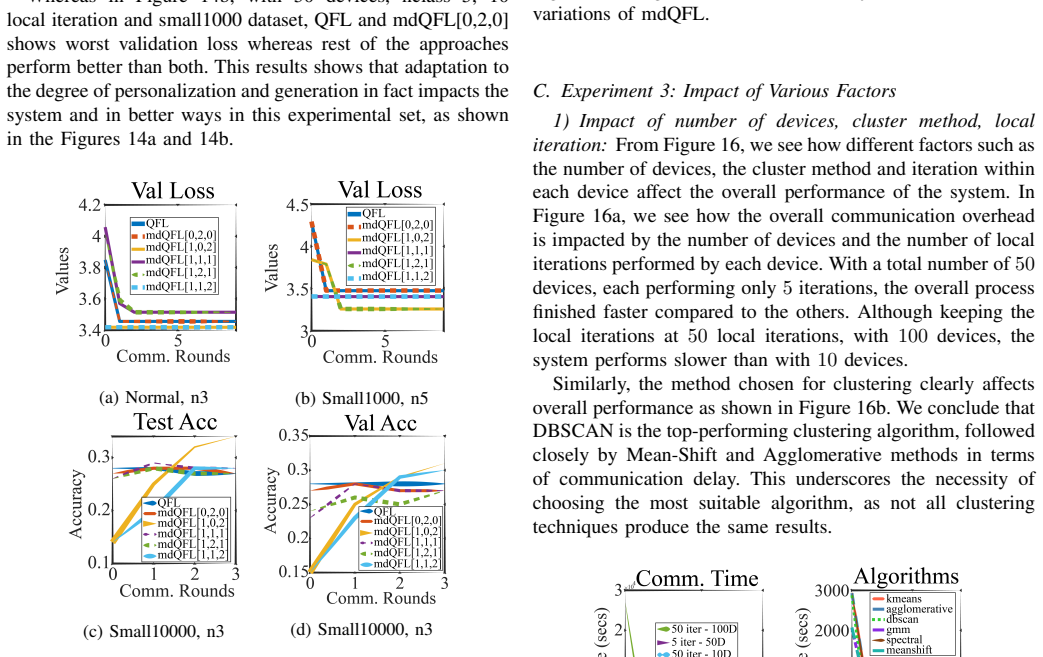
- Server validation and test accuracy stay at least on par with standard QFL, and cluster-focused configurations such as $[1,0,2]$ and $[1,1,2]$ exceed it on non-IID splits.
- Local devices consistently gain because the update rule can keep a personal component, so average local train and test accuracy improves even though fewer devices train each round.
- Convergence is claimed at $O(1/T)$ for convex, smooth, strongly convex objectives with non-IID data, plus a trust-region term from the COBYLA optimizer.
Reading between the lines
- Because the clustering and adaptive update steps are stated in terms of model parameters rather than quantum-specific objects, the same scheme should transfer to classical federated learning; a classical image-classification run with the identical algorithm would directly test that transfer.
- The reported gain grows with device count because $n_c \approx \sqrt{n/2}$, so the method should matter most in large federated deployments; at very large $n$, hierarchical clustering would be the natural next step to avoid server-side aggregation bottlenecks.
- The convergence proof inherits the standard non-IID federated averaging bound and does not separately bound the error introduced by approximating each cluster with one representative; tightening that step is the most direct route to a proof that specifically justifies the selection mechanism.
- Device selection by lowest local loss outperformed random selection in the experiments, suggesting that the quality of the cluster representative, not just the number of participants, drives the accuracy result.
Editorial analysis
A structured set of objections, weighed in public.
Referee Report
Summary. The paper proposes model-driven quantum federated learning (mdQFL), in which devices are grouped by model similarity, one representative device per cluster is selected for training, and that device's model is copied to the rest of the cluster with adjustable degrees of personalization and generalization. The authors claim a nearly 50% reduction in total communication cost, maintained or improved global model accuracy, and consistently improved local training under non-IID data, supported by Qiskit-based experiments on MNIST and Genomic data and by a convergence analysis in Section IV and Appendix X.
Significance. The manuscript addresses a real and timely problem: reducing communication overhead and handling data heterogeneity in quantum federated learning. Its strengths include a complete algorithmic description, publicly available code, and a broad ablation study covering clustering methods, optimizers, device counts, local iterations, label distributions, and dataset sizes. If the central claims were established, the cluster-representative scheme would be a useful design for resource-constrained QFL. However, the headline communication saving is a direct consequence of the algorithm's definition rather than an independent empirical result, the accuracy-maintenance claim rests on an unvalidated assumption about cluster representativeness, and the theoretical section does not analyze the proposed update rule. These gaps are load-bearing for the paper's main contributions and must be addressed.
major comments (5)
- [Section III.B, Eq. (4.0)] The communication saving is definitional rather than empirical. Section III.B defines T_mdQFL_comm = n_c * C_d + C_agg and T_QFL_comm = n_d * C_d with n_c = max(1, ceil(sqrt(n_d/2))) < n_d, so the reduction in communication time follows directly from the definitions and the figures in Section V.A.4 simply plot this algebraic consequence. Moreover, the baseline QFL formula omits C_agg while the mdQFL formula includes it, making the comparison asymmetric. The paper should explicitly frame the efficiency gain as a designed property of the algorithm and devote the empirical validation to whether accuracy is preserved under this reduced participation.
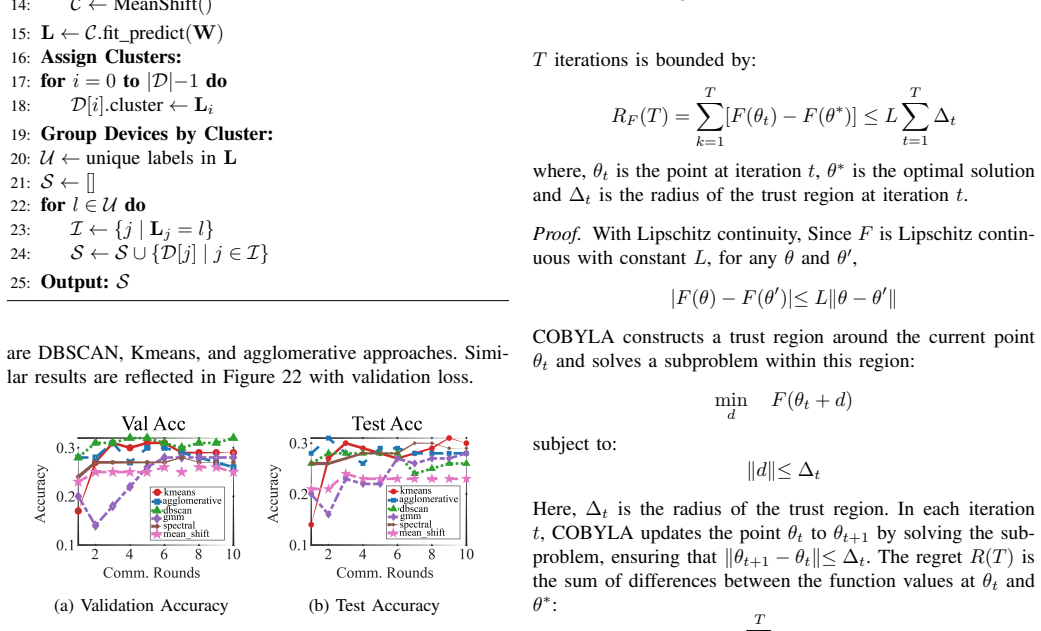
- [Algorithm 1, lines 14-23; Eq. (5.0)] The central accuracy-maintenance claim depends on the assumption that the single selected device per cluster is representative of that cluster. Under the non-IID label distributions described in Section V.A.1 (e.g., nClass=2), the lowest-loss device may simply hold the easiest labels or an atypical feature distribution, and copying its model to all devices in the cluster via Eqs. (2.0)-(2.2) can propagate that bias. The manuscript never validates representativeness, e.g., by comparing the selected device's data distribution or post-update model to non-selected devices in the same cluster. Figure 18 shows that the choice of selection method materially changes accuracy, so the selection step is not innocuous. Without a representativeness check or error analysis, the abstract's claim that mdQFL 'maintaining or, in some cases, exceeding the accuracy of the final model' is not established for the non-IID cases the paper targets.
- [Section IV.B and Appendix X.B, Theorem 1] Theorem 1 is not a convergence result for the mdQFL update rule. Appendix X.B states 'Similar to [17], we can extend the bound inequality to qFedAvg with a slight adaptation' and then appends the COBYLA regret term from Lemma 1 to the FedAvg bound of Li et al. The proof does not model any of the load-bearing design elements of mdQFL: the clustering of devices, the selection of one representative per cluster, the copying of the representative model to all cluster members, or the cluster-conditional personalization updates in Eqs. (2.0)-(2.2). The bound is the standard partial-participation FedAvg bound, not a bound for Eq. (1) of the paper. In addition, Appendix X.B refers to 'Lemma 2' but only Lemma 1 is stated. The claimed O(1/T) convergence rate in Section X.C therefore does not follow for mdQFL.
- [Section III.A, Eqs. (1.0)-(2.2)] The adaptive update rules are under-specified. The equations use an operator Φ without a definition: it is unclear whether Φ is a weighted average with coefficients α_i, β_i, γ_i, a convex combination, or some other operation. The personalization weights mentioned in Section I.B are never given values, and Section III.A presents only special cases 2.0-2.2 rather than the general weighted formulation. This makes the configurations in Table I (e.g., [1,2,0]) and the corresponding experimental comparisons in Section V.B difficult to reproduce and interpret. A precise definition of Φ and a statement of how each coded configuration maps to the general update rule are needed.
- [Section V.A.1 and Figures 9-18] The empirical support for the claim of 'consistently improving local model training' is weakened by the absence of error bars, standard deviations, or multiple seeds in any of the reported figures. Variational quantum training with COBYLA and stochastic clustering methods such as DBSCAN and MeanShift can produce run-to-run variation, so single trajectories do not establish consistency. Additionally, Experiment 1 varies the device count and the number of local iterations simultaneously (10 devices/50 iterations vs. 50 devices/5 iterations), which confounds the comparison in Figures 9-11. Reporting repeated runs with seeds and a factorial design would make the accuracy-maintenance claim testable.
minor comments (6)
- [Abstract and Section V.A.4] The abstract states a 'nearly 50% decrease' in communication cost, but Section V.A.4 reports a reduction by a 'factor of two to four' and Figure 12 shows up to a 4x improvement. These numbers should be reconciled (a 4x reduction corresponds to a 75% decrease).
- [Algorithm 1 and Section III] The pseudo-code references Eq. 4.0, Eq. 5.0, Eq. 5.1, and Eqs. 2.0-2.2 before these equations are defined in Section III. The order of presentation should be adjusted or forward references made explicit.
- [Section I.C and Section II] Equation (1) uses superscript d in f^d_k and θ^d_k without defining d, and Algorithm 1 line 33 aggregates over all n devices while the optimization objective in Eq. (1) is over k selected representatives. Notation should be aligned.
- [Section IV.B] Equation (2) is used twice for different expressions (the dm objective and the FedAvg local objective), which is confusing; the second occurrence should be renumbered.
- [Section V.A.4 and Figure 12] The caption '(a) 10d, 50d; MNIST' is ambiguous; it should explicitly state which panel corresponds to 10 devices and which to 50 devices, and clarify the Genomic dataset configuration in panel (b).
- [Section I.A, Related Work] The novelty claim of being 'first to explore training and update personalization, as well as test generalization within a QFL setting' would be easier to evaluate if the authors explicitly contrasted their cluster-based representative selection with the hierarchical client selection of Li et al. [15] and the clustered federated learning of Ghosh et al. [16] at the algorithmic level.
Circularity Check
No significant circularity: the communication and local-update benefits are direct consequences of the algorithm's stated design, and the convergence bound is adapted from an external FedAvg result rather than a self-referential derivation.
full rationale
The communication-cost comparison in Section III.B (T_mdQFL_comm = n_c*C_d + C_agg versus T_QFL_comm = n_d*C_d, with n_c < n_d) is a definitional consequence of the algorithm's design choice to communicate with only one device per cluster; it is a stated property of the method, not a hidden assumption masquerading as a discovery. Likewise, the reported improvement in average local performance follows from the update rules in Algorithm 1 (e.g., lines 26-27 set each device in a cluster to the selected device's model), which is the algorithm's intended personalization mechanism, not a fitted parameter relabeled as a prediction. Theorem 1 and its proof explicitly reuse the FedAvg convergence bound from the external reference [17] and append a COBYLA regret term; since [17] is not authored by the present authors and no uniqueness or correctness claim is licensed by a self-citation, this is independent (though possibly loose) support rather than circularity. No equation in the paper is defined in terms of the quantity it purports to derive, and no fitted input is presented as an independent prediction. The paper's reliance on an unvalidated cluster-representativeness assumption is a correctness and robustness concern, not a circular-derivation concern.
Assumptions & free parameters
free parameters (4)
- number of clusters k =
max(1, ceil(sqrt(n/2))) or fixed
- personalization weights (alpha_i, beta_i, gamma_i) =
selected combinations e.g. [1,1,2], [0,2,0], [1,0,2]
- clustering method =
DBSCAN, KMeans, Agglomerative, etc.
- trust-region decay parameters Delta_0 and alpha =
Delta_0, alpha=1
assumptions (5)
- standard math Local objectives are L-smooth and mu-strongly convex (Assumptions 2 and 3).
- domain assumption Client data distributions are heterogeneous with bounded divergence (Assumption 4).
- ad hoc to paper At least one group of devices has similar learning behavior (Assumption 5).
- ad hoc to paper COBYLA objective satisfies Lipschitz continuity and trust-region radius bounds distance to optimum: ||theta_t - theta*|| <= Delta_t (Assumption 1 and Lemma 1).
- ad hoc to paper The FedAvg convergence bound from Li et al. [17] applies to the mdQFL update rule.
Cite this review
Pith. "Pith review of Communication Efficient Adaptive Model-Driven Quantum Federated Learning." pith.science (2026). https://pith.science/paper/6TVA52UL
@misc{pith2026250604548,
  author       = {Pith},
  title        = {Pith review of: Communication Efficient Adaptive Model-Driven Quantum Federated Learning},
  year         = {2026},
  howpublished = {\url{https://pith.science/paper/6TVA52UL}},
  note         = {Machine review of arXiv:2506.04548}
}
read the original abstract
Training with huge datasets and a large number of participating devices leads to bottlenecks in federated learning (FL). Furthermore, the challenges of heterogeneity between multiple FL clients affect the overall performance of the system. In a quantum federated learning (QFL) context, we address these three main challenges: i) training bottlenecks from massive datasets, ii) the involvement of a substantial number of devices, and iii) non-IID data distributions. We introduce a model-driven quantum federated learning algorithm (mdQFL) to tackle these challenges. Our proposed approach is efficient and adaptable to various factors, including different numbers of devices. To the best of our knowledge, it is the first to explore training and update personalization, as well as test generalization within a QFL setting, which can be applied to other FL scenarios. We evaluated the efficiency of the proposed mdQFL framework through extensive experiments under diverse non-IID data heterogeneity conditions using various datasets within the Qiskit environment. Our results demonstrate a nearly 50% decrease in total communication costs while maintaining or, in some cases, exceeding the accuracy of the final model and consistently improving local model training compared to the standard QFL baseline. Moreover, our experimental evaluation thoroughly explores the QFL and mdQFL algorithms, along with several influencing factors. In addition, we present a theoretical analysis to clarify the complexities of the proposed algorithm. The experimental code is available at 1.
Figures


Figures from the paper (16 more)




Reference graph
Works this paper leans on
-
[17]
On the Convergence of FedAvg on Non-IID Data,
X. Li, K. Huang, W. Yang, S. Wang, and Z. Zhang, “On the Convergence of FedAvg on Non-IID Data,” https://arxiv.org/abs/1907.02189v4, Jul. 2019
arXiv 1907
-
[1]
Communication-Efficient Learning of Deep Networks from Decentralized Data,
H. B. McMahan, E. Moore, D. Ramage, S. Hampson, and B. A. y Arcas, “Communication-Efficient Learning of Deep Networks from Decentralized Data,” Jan. 2023
2023
-
[2]
Federated Learning Over Wireless Networks: Convergence Analysis and Resource Allocation,
C. T. Dinh, N. H. Tran, M. N. H. Nguyen, C. S. Hong, W. Bao, A. Y . Zomaya, and V . Gramoli, “Federated Learning Over Wireless Networks: Convergence Analysis and Resource Allocation,” IEEE/ACM Transactions on Networking , vol. 29, no. 1, pp. 398–409, Feb. 2021, conference Name: IEEE/ACM Transactions on Networking. [Online]. Available: https://ieeexplore.i...
-
[3]
Federated learning: Challenges, methods, and future directions,
T. Li, A. K. Sahu, A. Talwalkar, and V . Smith, “Federated learning: Challenges, methods, and future directions,” IEEE signal processing magazine, vol. 37, no. 3, pp. 50–60, 2020
2020
-
[4]
E. Knill, “Quantum computing,” Nature, vol. 463, no. 7280, pp. 441– 443, Jan. 2010
work page 2010
-
[5]
Federated Optimization in Heterogeneous Networks,
T. Li, A. K. Sahu, M. Zaheer, M. Sanjabi, A. Talwalkar, and V . Smith, “Federated Optimization in Heterogeneous Networks,” Apr. 2020
work page 2020
-
[6]
FEDBN: FEDER- ATED LEARNING ON NON-IID FEATURES VIA LOCAL BATCH NORMALIZATION,
X. Li, M. Jiang, X. Zhang, M. Kamp, and Q. Dou, “FEDBN: FEDER- ATED LEARNING ON NON-IID FEATURES VIA LOCAL BATCH NORMALIZATION,” ICLR 2021, 2021
work page 2021
-
[7]
FedDC: Federated Learning with Non-IID Data via Local Drift Decoupling and Correction,
L. Gao, H. Fu, L. Li, Y . Chen, M. Xu, and C.-Z. Xu, “FedDC: Federated Learning with Non-IID Data via Local Drift Decoupling and Correction,” in 2022 IEEE/CVF Conference on Computer Vision and Pattern Recognition (CVPR) . New Orleans, LA, USA: IEEE, Jun. 2022, pp. 10 102–10 111
work page 2022
Show all 18 references
-
[8]
DisPFL: Towards Communication-Efficient Personalized Federated Learning via Decen- tralized Sparse Training,
R. Dai, L. Shen, F. He, X. Tian, and D. Tao, “DisPFL: Towards Communication-Efficient Personalized Federated Learning via Decen- tralized Sparse Training,” in Proceedings of the 39th International Conference on Machine Learning . PMLR, Jun. 2022, pp. 4587–4604
2022
-
[9]
Exact Decomposition of Quantum Channels for Non-IID Quantum Federated Learning,
H. Zhao, “Exact Decomposition of Quantum Channels for Non-IID Quantum Federated Learning,” Sep. 2022
2022
-
[10]
QuantumFed: A Federated Learning Framework for Collaborative Quantum Training,
Q. Xia and Q. Li, “QuantumFed: A Federated Learning Framework for Collaborative Quantum Training,” in 2021 IEEE Global Communica- tions Conference (GLOBECOM) , Dec. 2021, pp. 1–6. 13
2021
-
[11]
Quantum Federated Learning with Quantum Data,
M. Chehimi and W. Saad, “Quantum Federated Learning with Quantum Data,” in ICASSP 2022 - 2022 IEEE International Conference on Acoustics, Speech and Signal Processing (ICASSP) , May 2022, pp. 8617–8621
2022
-
[12]
Quantum Federated Learning With Decentralized Data,
R. Huang, X. Tan, and Q. Xu, “Quantum Federated Learning With Decentralized Data,” IEEE Journal of Selected Topics in Quantum Electronics, vol. 28, no. 4: Mach. Learn. in Photon. Commun. and Meas. Syst., pp. 1–10, Jul. 2022
2022
-
[13]
Federated Quantum Machine Learning,
S. Y .-C. Chen and S. Yoo, “Federated Quantum Machine Learning,” Entropy, vol. 23, no. 4, p. 460, Apr. 2021
2021
-
[14]
Federated Learning with Quantum Secure Aggregation,
Y . Zhang, C. Zhang, C. Zhang, L. Fan, B. Zeng, and Q. Yang, “Federated Learning with Quantum Secure Aggregation,” Jul. 2022
2022
-
[15]
Data Heterogeneity-Robust Federated Learning via Group Client Selection in Industrial IoT,
Z. Li, Y . He, H. Yu, J. Kang, X. Li, Z. Xu, and D. Niyato, “Data Heterogeneity-Robust Federated Learning via Group Client Selection in Industrial IoT,” Feb. 2022
2022
-
[16]
An Efficient Framework for Clustered Federated Learning,
A. Ghosh, J. Chung, D. Yin, and K. Ramchandran, “An Efficient Framework for Clustered Federated Learning,” in Advances in Neural Information Processing Systems, vol. 33. Curran Associates, Inc., 2020, pp. 19 586–19 597
2020
-
[18]
A direct search optimization method that models the objective and constraint functions by linear interpolation,
M. J. D. Powell, “A direct search optimization method that models the objective and constraint functions by linear interpolation,” Springer Netherlands, , pp. 51–67, 1994. [Online]. Available: https: //doi.org/10.1007/978-94-015-8330-5 4 VII. APPENDIX A. MNIST Dataset preparat...
1994 doi
Reviewed August 7, 2026 · model on record in the stance chip above.
Discussion (0). Sign in to comment.