REVIEW 4 major objections 5 minor 84 references
A Novel Transformer-Based Method for Full Lower-Limb Joint Angles and Moments Prediction in Gait Using sEMG and IMU data
T0 review · 4 major / 5 minor · reviewed 2026-08-07 · deepseek-v4-flash
Pith's one-line read This paper claims that two transformer networks can predict full lower-limb joint angles and moments up to 250 ms ahead from wearable sEMG and IMU signals, with correlations above 0.96 and errors an order of magnitude below a recent CNN…
desk verdict The transformer design is a reasonable extension, but the headline accuracy claims are contradicted by the paper's own table and the benchmark advantage is a unit artifact. read the letter →
The pith
A machine-rendered reading of the paper's core claim, the machinery that carries it, and where it could break.
The reading
What carries the argument
The load-bearing object is a pair of Transformer Neural Networks (TNNs), one for kinematics and one for kinetics. Each network feeds a Bidirectional LSTM layer into a transformer block with 8-head multi-head attention, residual connections, layer normalization, and dropout, followed by global average pooling and a dense lambda layer that reshapes the output into a multivariate regression. The attention mechanism is the component doing the decisive work: it dynamically weights the IMU and sEMG channels according to the task, so the network can favor kinematic information for angles and muscle activation for moments. The sliding-window scheme and leave-one-subject-out split make the supervised regression and its generalization test possible.
What would settle it
Recompute the test-subject angle RMSE from raw predicted and ground-truth angles in degrees and compare these directly with the baseline's 4.79°, 5.46°, and 6.52° values; if the Table II entries turn out to be degrees rather than hundredths of a degree, the reported 0.03–0.05 degree values and the order-of-magnitude gap are artifacts of a unit mismatch.
Extended reading notes
Core claim
The paper's central claim is that fused IMU and sEMG signals carry complementary information sufficient for both kinematics and kinetics: IMU provides motion-state cues for angle prediction, while sEMG captures muscle activation that precedes movement and is informative for moments. The two Transformer Neural Networks perform multivariate regression from sliding windows of 125 samples at 100 Hz, predicting 25 future samples, and the authors report leave-one-subject-out test results in which the weakest joint still reaches $\rho=0.963$ and $R^2=0.949$ at the distant horizon. The paper also reports that the instrumented right leg is predicted more accurately than the left leg, and that angle RMSE values around $0.03$--$0.05$ degrees beat the baseline's reported $4.79$--$6.52$ degrees.
Load-bearing premise
The paper's flagship comparison with the benchmark rests on the Table II angle RMSE values being in the same unit as the baseline's degree-based values, with no hidden factor-of-100 correction between the table and the text.
Editorial extensions
If this is right
- Exoskeletons and prostheses could use the 250 ms look-ahead to prepare torque commands before a gait event, rather than reacting after it.
- Gait assessment could shift from optical motion capture laboratories to daily-life monitoring with body-worn sensors, if the reported accuracy transfers beyond treadmill walking.
- If the order-of-magnitude improvement over the CNN baseline is real, transformer-based attention is a stronger architecture for fusing sEMG and IMU streams than convolutional feature extraction.
- The contralateral-leg deficit reported in the paper implies that full-limb coverage requires sensors on both legs, not just one instrumented side.
Reading between the lines
- Editorial inference: the same architecture could be run on the dataset's stair, ramp, and overground trials to test whether the 250 ms horizon and accuracy hold outside treadmill walking, which the paper does not report.
- Editorial inference: a symmetrical sensor placement experiment, comparing two-leg versus one-leg inputs, would isolate the cost of missing contralateral sensors and could inform a minimal-sensor design.
- Editorial inference: the exact size of the claimed advantage over the baseline depends on the unit convention for angle RMSE; re-reporting both methods in identical units on the same test protocol would settle the comparison.
Editorial analysis
A structured set of objections, weighed in public.
Referee Report
Summary. The paper presents a deep-learning framework based on two Transformer Neural Networks (each preceded by a Bidirectional LSTM) to predict full lower-limb joint angles and joint moments from fused sEMG and IMU signals. The models are trained on the public Camargo et al. treadmill-walking dataset and evaluated on a single held-out test subject at two prediction horizons: 30 ms and 250 ms. The authors report high Spearman correlations, R² scores, and low RMSE values, and claim an order-of-magnitude reduction in joint-angle RMSE relative to the CNN baseline of Mohammadi-Moghadam et al. The paper also discusses the complementary roles of sEMG and IMU and outlines future efficiency improvements.
Significance. If the reported accuracy is correct, the approach could be a valuable step toward wearable, real-time prediction of lower-limb kinetics and kinematics for assistive robotics and rehabilitation. Strengths include the use of a public dataset, a well-described preprocessing pipeline, and a reproducible deep-learning architecture. However, the manuscript contains serious internal inconsistencies between the abstract, the discussion text, and Table II regarding the central numerical claims — specifically the Spearman correlation values and the unit scale of the joint-angle RMSE. These inconsistencies directly affect the main contribution (the claimed superiority over the baseline) and must be resolved before the results can be considered reliable.
major comments (4)
- [Table II and Section IV] The joint-angle RMSE and MAE values are internally inconsistent. Table II lists, for example, left ankle DH RMSE = 5.0 and nRMSE = 5.59%, with a footnote stating that MAE, RMSE, and nRMSE values are multiplied by 100. Reading the table literally with the footnote, the RMSE is 0.050°, which is the value the Discussion text uses ("RMSE of 0.050°"). However, the nRMSE column then implies a normalization range of about 0.9° for the ankle, which is physically implausible. If instead the RMSE is 5.0° (as the nRMSE of 5.59% implies with a physiologically plausible range of ~89°), then the Section IV comparison against Mohammadi-Moghadam et al. [41] — which quotes values like 0.031°–0.050° and concludes an order-of-magnitude improvement — is based on a unit error. The manuscript does not provide a self-consistent interpretation of Table II, and the central benchmark claim is therefore unsupported.
- [Abstract and Section IV] The claimed Spearman correlation values contradict Table II. The abstract states that Spearman correlation coefficients exceed 0.96 across all joints, but Table II reports DH values of 0.937 for the right ankle and left ankle in kinetics, and 0.956 for left knee kinetics, all below 0.96. Moreover, the Discussion states that for kinetics, the lowest Spearman value is ρ = 0.973 in both CH and DH for the left ankle, whereas Table II reports 0.952 (CH) and 0.937 (DH) for that joint. These discrepancies mean the reader cannot determine the actual performance, and the accuracy claim in the abstract is not supported by the data.
- [Section III] The evaluation only reports errors at two discrete time points (30 ms and 250 ms) within the 25-sample (250 ms) prediction horizon, even though the network is designed to output the full 25-sample sequence. No error metric is reported for the intermediate time steps or for the trajectory as a whole. As a result, the claim of accurate 'long-horizon prediction' is only demonstrated at the two endpoints, not for the continuous prediction the model is said to produce. The paper should report RMSE/MAE over the entire predicted window (e.g., averaged over all 25 output steps) or explicitly justify why only these two samples are relevant.
- [Section II-C and Section IV] The generalizability and 'consistent' superiority claims rest on a single held-out test subject. The leave-one-subject-out scheme is described as using 20 subjects for training, 1 for validation, and 1 for testing, but no repeated splits, cross-validation, or confidence intervals are provided. Consequently, the statement in Section IV that the model 'consistently outperformed the baseline' is not statistically supported. At minimum, the authors should acknowledge this limitation and avoid generalizing from one test subject, or they should perform a multi-subject evaluation.
minor comments (5)
- [Throughout] There are multiple typographical errors, e.g., 'Denese' in Figure 2 caption should be 'Dense', 'quantitive' should be 'quantitative', and 'in compare to' should be 'in comparison with'.
- [Section II-D] The statement that all hyperparameters were selected based on 'extensive trial and error' lacks detail; please provide the search space or a table of attempted configurations to support reproducibility.
- [Table II] The footnote is ambiguous: it states 'MAE, RMSE, and nRMSE values are reported in percentage' and simultaneously says they are multiplied by 100. Clarify the units and the intended scaling of each column.
- [Section II-C] The normalization method (Min-Max) is applied per participant or across the whole dataset? This detail affects the interpretation of the reported errors and should be specified.
- [Figure 4] The figure is difficult to read because it shows only 200 frames and multiple subplots; please provide a zoomed-in view with clear axis labels and legend for each joint and horizon.
Circularity Check
No significant circularity: the transformer predictions are trained on external wearable-sensor inputs against motion-capture ground truth, and no load-bearing step reduces to its own inputs or to a self-citation chain.
full rationale
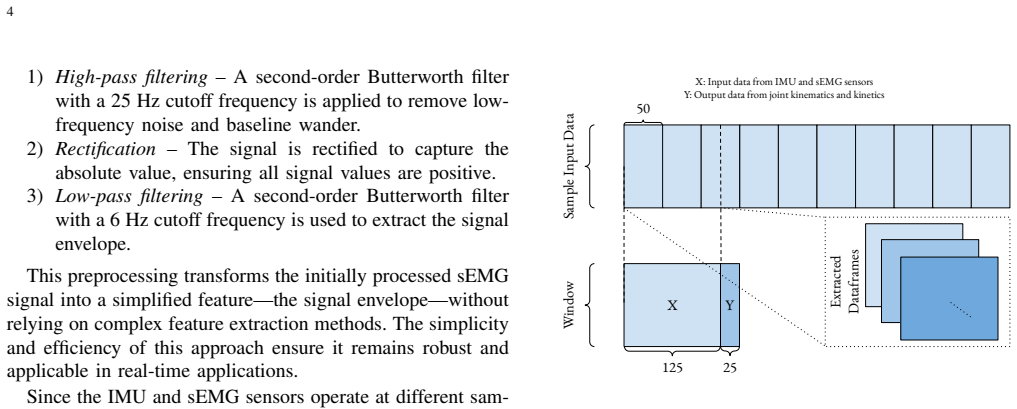
The paper's derivation chain is a standard supervised regression setup: IMU and rectified/envelope sEMG signals (Section II-C) are segmented into 125-sample input windows, and the targets are the subsequent 25 samples of OpenSim-derived joint angles and moments from optical motion capture (Section II-B/C), with leave-one-subject-out splitting (Section II-C). The reported predictions are evaluated on a held-out test subject, so the outputs are not equal by construction to the inputs. The hyperparameters are stated to come from "extensive trial and error" (Section II-D); that is model selection, not a fitted parameter renamed as a prediction, and the paper does not fit any parameter to the test outputs. The comparison against Mohammadi-Moghadam et al. [41] rests in Section IV on numerical RMSE values; even if those numbers contain a unit inconsistency (the Table II footnote says MAE/RMSE/nRMSE are multiplied by 100, while the text quotes 0.042 degrees), that is an internal consistency and correctness issue, not a circularity issue. There is no self-citation chain invoked for a core claim, no uniqueness theorem imported from prior work by the same authors, and no ansatz smuggled in via citation. The central result may be overstated if the unit interpretation is wrong, but overstatement is not circularity. The paper is therefore not circular; its main risks are reporting and benchmark-validity concerns rather than derivation-by-definition.
Assumptions & free parameters
free parameters (1)
- Network hyperparameters =
Bi-LSTM units=125, embedding dim=256, heads=8, dense=512, dropout=0.1, initial learning rate=0.0008, AMSGrad=True
assumptions (5)
- domain assumption OpenSim-derived joint angles and moments in the Camargo et al. dataset are accurate ground truth.
- domain assumption The sEMG envelope extraction procedure (25 Hz high-pass filter, rectification, 6 Hz low-pass filter) preserves the information needed for joint angle and moment prediction.
- ad hoc to paper A single held-out test subject walking on a treadmill is representative of inter-subject performance.
- domain assumption Shuffling the data across trials and subjects before windowing does not leak test-subject frames into the training set.
- domain assumption Treadmill walking speeds from 0.5 m/s to 1.85 m/s cover the deployment range relevant to real-time gait prediction.
Cite this review
Pith. "Pith review of A Novel Transformer-Based Method for Full Lower-Limb Joint Angles and Moments Prediction in Gait Using sEMG and IMU data." pith.science (2026). https://pith.science/paper/RL6273OG
@misc{pith2026250604577,
  author       = {Pith},
  title        = {Pith review of: A Novel Transformer-Based Method for Full Lower-Limb Joint Angles and Moments Prediction in Gait Using sEMG and IMU data},
  year         = {2026},
  howpublished = {\url{https://pith.science/paper/RL6273OG}},
  note         = {Machine review of arXiv:2506.04577}
}
read the original abstract
This study presents a transformer-based deep learning framework for the long-horizon prediction of full lower-limb joint angles and joint moments using surface electromyography (sEMG) and inertial measurement unit (IMU) signals. Two separate Transformer Neural Networks (TNNs) were designed: one for kinematic prediction and one for kinetic prediction. The model was developed with real-time application in mind, using only wearable sensors suitable for outside-laboratory use. Two prediction horizons were considered to evaluate short- and long-term performance. The network achieved high accuracy in both tasks, with Spearman correlation coefficients exceeding 0.96 and R-squared scores above 0.92 across all joints. Notably, the model consistently outperformed a recent benchmark method in joint angle prediction, reducing RMSE errors by an order of magnitude. The results confirmed the complementary role of sEMG and IMU signals in capturing both kinematic and kinetic information. This work demonstrates the potential of transformer-based models for real-time, full-limb biomechanical prediction in wearable and robotic applications, with future directions including input minimization and modality-specific weighting strategies to enhance model efficiency and accuracy.
Figures


Figures from the paper (2 more)


Reference graph
Works this paper leans on
-
[41]
S. M. Moghadam, T. Yeung, and J. Choisne, “A comparison of machine learning models’ accuracy in predicting lower-limb joints’ kinematics, kinetics, and muscle forces from wearable sensors,”Scientific Reports, vol. 13, pp. 1–16, 2023
work page 2023
-
[1]
Estimation of muscle forces and joint moments using a forward-inverse dynamics model,
T. S. Buchanan, D. G. Lloyd, K. Manal, and T. F. Besier, “Estimation of muscle forces and joint moments using a forward-inverse dynamics model,” inMedicine and Science in Sports and Exercise, vol. 37, pp. 1911–1916, 11 2005
1911
-
[2]
Dynamics of the ankle joint analyzed through moment-angle loops during human walking: Gender and age effects,
P. Crenna and C. Frigo, “Dynamics of the ankle joint analyzed through moment-angle loops during human walking: Gender and age effects,” Human Movement Science, vol. 30, pp. 1185–1198, 12 2011
2011
-
[3]
Estimation of forces and moments of lower limb joints from kinematics data and inertial properties of the body by using inverse dynamics technique,
S. Chowdhury and N. Kumar, “Estimation of forces and moments of lower limb joints from kinematics data and inertial properties of the body by using inverse dynamics technique,” 2013
2013
-
[4]
M. G. Hoy, F. E. Zajac, and M. E. Gordon, “A musculoskeletal model of the human lower extremity: The effect of muscle, tendon, and moment arm on the moment-angle relationship of musculotendon actuators at the hip, knee, and ankle,”Journal of biomechanics, 1990
1990
-
[5]
C. N. Maganaris, “A predictive model of moment-angle characteristics in human skeletal muscle: Application and validation in muscles across the ankle joint,”Journal of Theoretical Biology, vol. 230, pp. 89–98, 9 2004
work page 2004
-
[6]
E. Ceseracciu, Z. Sawacha, and C. Cobelli, “Comparison of markerless and marker-based motion capture technologies through simultaneous data collection during gait: Proof of concept,”PLoS ONE, vol. 9, 3 2014
work page 2014
-
[7]
Concurrent assessment of gait kinematics using marker-based and markerless motion capture,
R. M. Kanko, E. K. Laende, E. M. Davis, W. S. Selbie, and K. J. Deluzio, “Concurrent assessment of gait kinematics using marker-based and markerless motion capture,”Journal of Biomechanics, vol. 127, 10 2021
work page 2021
Show all 84 references
-
[8]
Thalmann and M
D. Thalmann and M. Panne,Computer Animation and Simulation ’97, vol. VIII. Springer Vienna, 1 ed., 9 1997
1997
-
[9]
Skeleton- based motion capture for robust reconstruction of human motion,
L. Herda, P. Fua, R. Plankers, R. Boulic, and D. Thalmann, “Skeleton- based motion capture for robust reconstruction of human motion,”IEEE, 5 2000
2000
-
[10]
Estimation of missing markers in human motion capture,
G. Liu and L. McMillan, “Estimation of missing markers in human motion capture,”Visual Computer, vol. 22, pp. 721–728, 9 2006
2006
-
[11]
Real-time estimation of missing markers in human motion capture-aristidou,
A. Aristidou, J. Cameron, and J. Lasenby, “Real-time estimation of missing markers in human motion capture-aristidou,”IEEE, 5 2008
2008
-
[12]
Real-time marker prediction and cor estimation in optical motion capture,
A. Aristidou and J. Lasenby, “Real-time marker prediction and cor estimation in optical motion capture,”Visual Computer, vol. 29, pp. 7– 26, 2013
2013
-
[13]
Neuromus- culoskeletal modeling: Estimation of muscle forces and joint moments and movements from measurements of neural command,
T. S. Buchanan, D. G. Lloyd, K. Manal, and T. F. Besier, “Neuromus- culoskeletal modeling: Estimation of muscle forces and joint moments and movements from measurements of neural command,” 2004
2004
-
[14]
Toward a human-like biped robot gait: Biomechanical analysis of human locomotion recorded by kinect-based motion capture system,
B. Gabbasov, I. Danilov, I. M. Afanasyev, and E. Magid, “Toward a human-like biped robot gait: Biomechanical analysis of human locomotion recorded by kinect-based motion capture system,”IEEE International Symposium on Mechatronics and its Applications, 12 2015
2015
-
[15]
A data process of human knee joint kinematics obtained by motion-capture measurement,
J. ping Wang, S. hua Wang, Y . qing Wang, H. Hu, J. wei Yu, X. Zhao, J. lai Liu, X. Chen, and Y . Li, “A data process of human knee joint kinematics obtained by motion-capture measurement,”BMC Medical Informatics and Decision Making, vol. 21, 12 2021
2021
-
[16]
Real-time gait assessment utilizing a new way of accelerometry
A. Willemsen, J. V . Alste, and H. Boom, “Real-time gait assessment utilizing a new way of accelerometry.”
-
[17]
Estimation of gait cycle char- acteristics by trunk accelerometry,
R. Moe-Nilssen and J. L. Helbostad, “Estimation of gait cycle char- acteristics by trunk accelerometry,”Journal of Biomechanics, vol. 37, pp. 121–126, 2004
2004
-
[18]
Automated estimation of initial and terminal contact timing using accelerometers; development and validation in transtibial amputees and controls,
R. W. Selles, M. A. Formanoy, J. B. Bussmann, P. J. Janssens, and H. J. Stam, “Automated estimation of initial and terminal contact timing using accelerometers; development and validation in transtibial amputees and controls,”IEEE Transactions on Neural Systems and Rehabilitat...
2005
-
[19]
25 years of lower limb joint kinematics by using inertial and magnetic sensors: A review of methodological approaches,
P. Picerno, “25 years of lower limb joint kinematics by using inertial and magnetic sensors: A review of methodological approaches,” 1 2017
2017
-
[20]
Regression techniques for the prediction of lower limb kinematics,
J. Y . Goulermas, D. Howard, C. J. Nester, R. K. Jones, and L. Ren, “Regression techniques for the prediction of lower limb kinematics,” Journal of Biomechanical Engineering, vol. 127, pp. 1020–1024, 11 2005
2005
-
[21]
Predicting lower limb joint kinematics using wearable motion sensors,
A. Findlow, J. Y . Goulermas, C. Nester, D. Howard, and L. P. Kenney, “Predicting lower limb joint kinematics using wearable motion sensors,” Gait and Posture, vol. 28, pp. 120–126, 7 2008
2008
-
[22]
Prediction of lower limb kinetics and kinematics during walking by a single imu on the lower back using machine learning,
H. Lim, B. Kim, and S. Park, “Prediction of lower limb kinetics and kinematics during walking by a single imu on the lower back using machine learning,”Sensors (Switzerland), vol. 20, 1 2020
2020
-
[23]
Inertial sensor-based lower limb joint kinematics: A methodological systematic review,
I. Weygers, M. Kok, M. Konings, H. Hallez, H. D. Vroey, and K. Claeys, “Inertial sensor-based lower limb joint kinematics: A methodological systematic review,” 2 2020
2020
-
[24]
Optimization of imu sensor placement for the measurement of lower limb joint kinematics,
W. Niswander, W. Wang, and K. Kontson, “Optimization of imu sensor placement for the measurement of lower limb joint kinematics,”Sensors (Switzerland), vol. 20, pp. 1–16, 11 2020
2020
-
[25]
Using imu-based kinematic markers to monitor dual-task gait balance control recovery in acutely concussed individuals,
W. Pitt, S. H. Chen, and L. S. Chou, “Using imu-based kinematic markers to monitor dual-task gait balance control recovery in acutely concussed individuals,”Clinical Biomechanics, vol. 80, 12 2020
2020
-
[26]
Wearable imu-based system for real- time monitoring of lower-limb joints,
S. Majumder and M. J. Deen, “Wearable imu-based system for real- time monitoring of lower-limb joints,”IEEE Sensors Journal, vol. 21, pp. 8267–8275, 3 2021
2021
-
[27]
Body-worn imu-based human hip and knee kinematics estimation during treadmill walking,
T. McGrath and L. Stirling, “Body-worn imu-based human hip and knee kinematics estimation during treadmill walking,”Sensors, vol. 22, 4 2022
2022
-
[28]
Three- dimensional lower-limb kinematics from accelerometers and gyroscopes with simple and minimal functional calibration tasks: Validation on asymptomatic participants,
L. Carcreff, G. Payen, G. Grouvel, F. Mass ´e, and S. Armand, “Three- dimensional lower-limb kinematics from accelerometers and gyroscopes with simple and minimal functional calibration tasks: Validation on asymptomatic participants,”Sensors, vol. 22, 8 2022
2022
-
[29]
A novel method to estimate the full knee joint kinematics using low cost imu sensors for easy to implement low cost diagnostics,
M. Versteyhe, H. D. Vroey, F. Debrouwere, H. Hallez, and K. Claeys, “A novel method to estimate the full knee joint kinematics using low cost imu sensors for easy to implement low cost diagnostics,”Sensors (Switzerland), vol. 20, 3 2020
2020
-
[30]
An imus-based extended kalman filter to estimate gait lower limb sagittal kinematics for the control of wearable robotic devices,
J. S. Lora-Millan, A. F. Hidalgo, and E. Rocon, “An imus-based extended kalman filter to estimate gait lower limb sagittal kinematics for the control of wearable robotic devices,”IEEE Access, vol. 9, pp. 144550– 144554, 2021
2021
-
[31]
Estimating lower limb kinematics using a reduced wearable sensor count,
L. Sy, M. Raitor, M. D. Rosario, H. Khamis, L. Kark, N. H. Lovell, and S. J. Redmond, “Estimating lower limb kinematics using a reduced wearable sensor count,”IEEE Transactions on Biomedical Engineering, vol. 68, pp. 1293–1304, 4 2021
2021
-
[32]
Evaluation of error-state kalman filter method for estimating human lower-limb kinematics during various walking gaits,
M. V . Potter, S. M. Cain, L. V . Ojeda, R. D. Gurchiek, R. S. McGinnis, and N. C. Perkins, “Evaluation of error-state kalman filter method for estimating human lower-limb kinematics during various walking gaits,” Sensors, vol. 22, 11 2022
2022
-
[33]
Estimation of three-dimensional lower limb kinetics data during walking using machine learning from a single imu attached to the sacrum,
M. Lee and S. Park, “Estimation of three-dimensional lower limb kinetics data during walking using machine learning from a single imu attached to the sacrum,”Sensors (Switzerland), vol. 20, pp. 1–16, 11 2020
2020
-
[34]
Inertial motion capture-based wearable systems for estimation of joint kinetics: A systematic review,
C. J. Lee and J. K. Lee, “Inertial motion capture-based wearable systems for estimation of joint kinetics: A systematic review,” 4 2022
2022
-
[35]
Estimation of kinetics using imus to monitor and aid in clinical decision-making during acl rehabilitation: A systematic review,
S. Krishnakumar, B. J. F. van Beijnum, C. T. Baten, P. H. Veltink, and J. H. Buurke, “Estimation of kinetics using imus to monitor and aid in clinical decision-making during acl rehabilitation: A systematic review,” 4 2024
2024
-
[36]
Estimation of gait kinematics and kinetics from inertial sensor data using optimal control of musculoskeletal models,
E. Dorschky, M. Nitschke, A. K. Seifer, A. J. van den Bogert, and B. M. Eskofier, “Estimation of gait kinematics and kinetics from inertial sensor data using optimal control of musculoskeletal models,”Journal of Biomechanics, vol. 95, 10 2019
2019
-
[37]
Prediction of lower limb joint angles and moments during gait using artificial neural networks,
M. Mundt, W. Thomsen, T. Witter, A. Koeppe, S. David, F. Bamer, W. Potthast, and B. Markert, “Prediction of lower limb joint angles and moments during gait using artificial neural networks,”Medical and Biological Engineering and Computing, vol. 58, pp. 211–225, 2020
2020
-
[38]
Estimation of gait mechanics based on simulated and measured imu data using an artificial neural network,
M. Mundt, A. Koeppe, S. David, T. Witter, F. Bamer, W. Potthast, and B. Markert, “Estimation of gait mechanics based on simulated and measured imu data using an artificial neural network,”Frontiers in Bioengineering and Biotechnology, vol. 8, pp. 1–16, 2020. 9
2020
-
[39]
Real-time musculoskeletal kinematics and dynamics analysis using marker-and imu-based solutions in rehabilitation,
D. Stanev, K. Filip, D. Bitzas, S. Zouras, G. Giarmatzis, D. Tsaopoulos, and K. Moustakas, “Real-time musculoskeletal kinematics and dynamics analysis using marker-and imu-based solutions in rehabilitation,”Sen- sors, vol. 21, pp. 1–20, 3 2021
2021
-
[40]
Smart healthcare-oriented online prediction of lower-limb kinematics and kinetics based on data-driven neural signal decoding,
C. Yi, F. Jiang, M. Z. A. Bhuiyan, C. Yang, X. Gao, H. Guo, J. Ma, and S. Su, “Smart healthcare-oriented online prediction of lower-limb kinematics and kinetics based on data-driven neural signal decoding,” Future Generation Computer Systems, vol. 114, pp. 96–105, 1 2021
2021
-
[42]
High-density emg, imu, kinetic, and kinematic open-source data for comprehensive locomotion activities,
H. Dimitrov, A. M. Bull, and D. Farina, “High-density emg, imu, kinetic, and kinematic open-source data for comprehensive locomotion activities,”Scientific Data, vol. 10, 12 2023
2023
-
[43]
Human lower extremity joint moment prediction: A wavelet neural network approach,
M. M. Ardestani, X. Zhang, L. Wang, Q. Lian, Y . Liu, J. He, D. Li, and Z. Jin, “Human lower extremity joint moment prediction: A wavelet neural network approach,”Expert Systems with Applications, vol. 41, pp. 4422–4433, 7 2014
2014
-
[44]
Prediction of lower-limb joint kinematics from surface emg during overground locomotion,
J. A. Brantley, S. Member, T. P. Luu, S. Nakagome, J. L. Contreras- Vidal, and S. Member, “Prediction of lower-limb joint kinematics from surface emg during overground locomotion,” 2017
2017
-
[45]
Surface emg based continuous estimation of human lower limb joint angles by using deep belief networks,
J. Chen, X. Zhang, Y . Cheng, and N. Xi, “Surface emg based continuous estimation of human lower limb joint angles by using deep belief networks,”Biomedical Signal Processing and Control, vol. 40, pp. 335– 342, 2 2018
2018
-
[46]
A review on emg-based motor intention prediction of continuous human upper limb motion for human-robot collaboration,
L. Bi, A. Feleke, and C. Guan, “A review on emg-based motor intention prediction of continuous human upper limb motion for human-robot collaboration,” 5 2019
2019
-
[47]
Intelligent prediction of human lower extremity joint moment: An artificial neural network approach,
B. Xiong, N. Zeng, H. Li, Y . Yang, Y . Li, M. Huang, W. Shi, M. Du, and Y . Zhang, “Intelligent prediction of human lower extremity joint moment: An artificial neural network approach,”IEEE Access, vol. 7, pp. 29973–29980, 2019
2019
-
[48]
Real-time intended knee joint motion prediction by deep-recurrent neural networks,
Y . Huang, Z. He, Y . Liu, R. Yang, X. Zhang, G. Cheng, J. Yi, J. P. Ferreira, and T. Liu, “Real-time intended knee joint motion prediction by deep-recurrent neural networks,”IEEE Sensors Journal, vol. 19, pp. 11503–11509, 12 2019
2019
-
[49]
Gaussian process autoregression for joint angle prediction based on semg signals,
J. Liang, Z. Shi, F. Zhu, W. Chen, X. Chen, and Y . Li, “Gaussian process autoregression for joint angle prediction based on semg signals,” Frontiers in Public Health, vol. 9, 5 2021
2021
-
[50]
Continuous prediction of human joint mechanics using emg signals: A review of model-based and model- free approaches,
S. P. Sitole and F. C. Sup, “Continuous prediction of human joint mechanics using emg signals: A review of model-based and model- free approaches,”IEEE Transactions on Medical Robotics and Bionics, vol. 5, pp. 528–546, 8 2023
2023
-
[51]
Prediction of gait kinematics and kinetics: A systematic review of emg and eeg signal use and their contribution to prediction accuracy,
N. A. E. Yaakoubi, C. McDonald, and O. Lennon, “Prediction of gait kinematics and kinetics: A systematic review of emg and eeg signal use and their contribution to prediction accuracy,” 10 2023
2023
-
[52]
Predictions of knee and ankle moments of force in walking from emg and kinematic data,
S. J. Olney and D. A. Winter, “Predictions of knee and ankle moments of force in walking from emg and kinematic data,” 1985
1985
-
[53]
Feasibility of using emg driven neuromus- culoskeletal model for prediction of dynamic movement of the elbow,
T. K. Koo and A. F. Mak, “Feasibility of using emg driven neuromus- culoskeletal model for prediction of dynamic movement of the elbow,” Journal of Electromyography and Kinesiology, vol. 15, pp. 12–26, 2 2005
2005
-
[54]
An emg-driven model to estimate muscle forces and joint moments in stroke patients,
Q. Shao, D. N. Bassett, K. Manal, and T. S. Buchanan, “An emg-driven model to estimate muscle forces and joint moments in stroke patients,” Computers in Biology and Medicine, vol. 39, pp. 1083–1088, 12 2009
2009
-
[55]
Predicting biological joint moment during multiple ambulation tasks,
J. Camargo, D. Molinaro, and A. Young, “Predicting biological joint moment during multiple ambulation tasks,”Journal of Biomechanics, vol. 134, 3 2022
2022
-
[56]
Evaluating electromyography and sonomyo- graphy sensor fusion to estimate lower-limb kinematics using gaussian process regression,
K. G. Rabe and N. P. Fey, “Evaluating electromyography and sonomyo- graphy sensor fusion to estimate lower-limb kinematics using gaussian process regression,”Frontiers in Robotics and AI, vol. 9, 3 2022
2022
-
[57]
Biological cybernetics estimation of dynamic joint torques and trajectory formation from surface electromyography signals using a neural network model,
Y . Koike and M. Kawato, “Biological cybernetics estimation of dynamic joint torques and trajectory formation from surface electromyography signals using a neural network model,”Biol. Cybern, vol. 73, p. 300, 1995
1995
-
[58]
An emg-driven musculoskeletal model to estimate muscle forces and knee joint moments in vivo,
D. G. Lloyd and T. F. Besier, “An emg-driven musculoskeletal model to estimate muscle forces and knee joint moments in vivo,”Journal of Biomechanics, vol. 36, pp. 765–776, 6 2003
2003
-
[59]
Human joint motion estima- tion for electromyography (emg)-based dynamic motion control,
Q. Zhang, R. Hosoda, and G. Venture, “Human joint motion estima- tion for electromyography (emg)-based dynamic motion control,”35th Annual International Conference of the IEEE EMBS, 2013
2013
-
[60]
Tutorial. surface emg detection, condi- tioning and pre-processing: Best practices,
R. Merletti and G. L. Cerone, “Tutorial. surface emg detection, condi- tioning and pre-processing: Best practices,”Journal of Electromyogra- phy and Kinesiology, vol. 54, 10 2020
2020
-
[61]
Hip and trunk kinematics estimation in gait through kalman filter using imu data at the ankle,
A. Baghdadi, L. A. Cavuoto, and J. L. Crassidis, “Hip and trunk kinematics estimation in gait through kalman filter using imu data at the ankle,”IEEE Sensors Journal, vol. 18, pp. 4253–4260, 5 2018
2018
-
[62]
A high-fidelity wearable system for measuring lower-limb kinetics and kinematics,
M. Abdelhady, A. J. V . D. Bogert, and D. Simon, “A high-fidelity wearable system for measuring lower-limb kinetics and kinematics,” IEEE Sensors Journal, vol. 19, pp. 12482–12493, 12 2019
2019
-
[63]
Validity of inertial sensor based 3d joint kinematics of static and dynamic sport and physiotherapy specific movements,
W. Teufl, M. Miezal, B. Taetz, M. Frohlichi, and G. Bleser, “Validity of inertial sensor based 3d joint kinematics of static and dynamic sport and physiotherapy specific movements,”PLoS ONE, vol. 14, 2 2019
2019
-
[64]
L. Sy, N. H. Lovell, and S. J. Redmond,Estimating Lower Limb Kinematics Using a Lie Group Constrained Extended Kalman Filter with a Reduced Wearable IMU Count and Distance Measurements. MDPI Sensors, 2020
2020
-
[65]
Kinematic analysis of human gait in healthy young adults using imu sensors: Exploring relevant machine learning features for clinical applications,
X. Marimon, I. Mengual, C. L. de Celis, A. Portela, J. Rodr ´ıguez-Sanz, I. A. Herr´aez, and A. P´erez-Bellmunt, “Kinematic analysis of human gait in healthy young adults using imu sensors: Exploring relevant machine learning features for clinical applications,”Bioengineering,...
2024
-
[66]
Estimation of lower extremity joint moments and 3d ground reaction forces using imu sensors in multiple walking conditions: A deep learning approach,
M. S. B. Hossain, Z. Guo, and H. Choi, “Estimation of lower extremity joint moments and 3d ground reaction forces using imu sensors in multiple walking conditions: A deep learning approach,”IEEE Journal of Biomedical and Health Informatics, vol. 27, pp. 2829–2840, 6 2023
2023
-
[67]
The use of synthetic imu signals in the training of deep learning models significantly improves the accuracy of joint kinematic predictions,
M. S. Renani, A. M. Eustace, C. A. Myers, and C. W. Clary, “The use of synthetic imu signals in the training of deep learning models significantly improves the accuracy of joint kinematic predictions,”Sensors, vol. 21, 9 2021
2021
-
[68]
Lower body kinematics estimation from wearable sensors for walking and running: A deep learning approach,
V . Hernandez, D. Dadkhah, V . Babakeshizadeh, and D. Kuli ´c, “Lower body kinematics estimation from wearable sensors for walking and running: A deep learning approach,”Gait and Posture, vol. 83, pp. 185– 193, 1 2021
2021
-
[69]
Imu- based estimation of lower limb motion trajectory with graph convolution network,
Y . L. Chen, I. J. Yang, L. C. Fu, J. S. Lai, H. W. Liang, and L. Lu, “Imu- based estimation of lower limb motion trajectory with graph convolution network,”IEEE Sensors Journal, vol. 21, pp. 24549–24557, 11 2021
2021
-
[70]
Exploring the contribution of joint angles and semg signals on joint torque prediction accuracy using lstm-based deep learning techniques,
E. Kaya and H. Argunsah, “Exploring the contribution of joint angles and semg signals on joint torque prediction accuracy using lstm-based deep learning techniques,”Computer Methods in Biomechanics and Biomedical Engineering, 2024
2024
-
[71]
Physics-informed deep learning for musculoskeletal modeling: Predicting muscle forces and joint kinematics from surface emg,
J. Zhang, Y . Zhao, F. Shone, Z. Li, A. F. Frangi, S. Q. Xie, and Z. Q. Zhang, “Physics-informed deep learning for musculoskeletal modeling: Predicting muscle forces and joint kinematics from surface emg,”IEEE Transactions on Neural Systems and Rehabilitation Engineering, vol....
2023
-
[72]
Continuous online prediction of lower limb joints angles based on semg signals by deep learning approach,
Q. Song, X. Ma, and Y . Liu, “Continuous online prediction of lower limb joints angles based on semg signals by deep learning approach,” Computers in Biology and Medicine, vol. 163, 9 2023
2023
-
[73]
A physics-informed low- shot learning for semg-based estimation of muscle force and joint kinematics,
Y . Shi, S. Ma, Y . Zhao, and Z. Zhang, “A physics-informed low- shot learning for semg-based estimation of muscle force and joint kinematics,”archive, 7 2023
2023
-
[74]
Emg- based estimation of lower limb joint angles and moments using long short-term memory network,
M. T. N. Truong, A. E. A. Ali, D. Owaki, and M. Hayashibe, “Emg- based estimation of lower limb joint angles and moments using long short-term memory network,”Sensors, vol. 23, 3 2023
2023
-
[75]
A deep learn- ing strategy for emg-based joint position prediction in hip exoskeleton assistive robots,
A. Foroutannia, M. R. Akbarzadeh-T, and A. Akbarzadeh, “A deep learn- ing strategy for emg-based joint position prediction in hip exoskeleton assistive robots,”Biomedical Signal Processing and Control, vol. 75, 5 2022
2022
-
[76]
Using reinforcement learning to estimate human joint moments from electromyography or joint kine- matics: An alternative solution to musculoskeletal-based biomechanics,
W. Wu, K. R. Saul, and H. Huang, “Using reinforcement learning to estimate human joint moments from electromyography or joint kine- matics: An alternative solution to musculoskeletal-based biomechanics,” Journal of Biomechanical Engineering, vol. 143, 4 2021
2021
-
[77]
An- kle joint torque estimation using an emg-driven neuromusculoskeletal model and an artificial neural network model,
L. Zhang, Z. Li, Y . Hu, C. Smith, E. M. Farewik, and R. Wang, “An- kle joint torque estimation using an emg-driven neuromusculoskeletal model and an artificial neural network model,”IEEE Transactions on Automation Science and Engineering, vol. 18, pp. 564–573, 4 2021
2021
-
[78]
Dual transformer network for predicting joint angles and torques from multi-channel emg signals in the lower limbs,
Z. Wang, C. Chen, H. Chen, Y . Zhou, X. Wang, X. Wu, S. Member, and X. W. Z. Wang, “Dual transformer network for predicting joint angles and torques from multi-channel emg signals in the lower limbs,”IEEE Journal of Biomedical and Health Informatics, 2025
2025
-
[79]
Attention is all you need,
A. Vaswani, N. Shazeer, N. Parmar, J. Uszkoreit, L. Jones, A. N. Gomez, Łukasz Kaiser, and I. Polosukhin, “Attention is all you need,”Advances in Neural Information Processing Systems, vol. 2017-Decem, pp. 5999– 6009, 2017
2017
-
[80]
Neural machine translation by jointly learning to align and translate,
D. Bahdanau, K. H. Cho, and Y . Bengio, “Neural machine translation by jointly learning to align and translate,”3rd International Conference on Learning Representations, ICLR 2015 - Conference Track Proceedings, pp. 1–15, 2015
2015
-
[81]
Effective approaches to attention-based neural machine translation,
M. T. Luong, H. Pham, and C. D. Manning, “Effective approaches to attention-based neural machine translation,”Conference Proceedings - 10 EMNLP 2015: Conference on Empirical Methods in Natural Language Processing, pp. 1412–1421, 2015
2015
-
[82]
A wearable real- time kinetic measurement sensor setup for human locomotion,
H. Wang, A. Basu, G. Durandau, and M. Sartori, “A wearable real- time kinetic measurement sensor setup for human locomotion,”Wearable Technologies, vol. 4, 2023
2023
-
[83]
Deep residual learning for image recognition,
K. He, X. Zhang, S. Ren, and J. Sun, “Deep residual learning for image recognition,”preprint, 12 2015
2015
-
[84]
Tensorflow: A system for large- scale machine learning,
M. Abadi, P. Barham, J. Chen, Z. Chen, A. Davis, J. Dean, M. Devin, S. Ghemawat, G. Irving, M. Isard, M. Kudlur, J. Levenberg, R. Monga, S. Moore, D. G. Murray, B. Steiner, P. Tucker, V . Vasudevan, P. Warden, M. Wicke, Y . Yu, and X. Zheng, “Tensorflow: A system for large- sc...
2016
Reviewed August 7, 2026 · model on record in the stance chip above.
Discussion (0). Sign in to comment.