REVIEW 3 major objections 4 minor 54 references
Searching for helium escape and a low density atmosphere around the 120 Myr old sub-Neptune HIP94235b using CRIRES+
T0 review · 3 major / 4 minor · reviewed 2026-08-07 · deepseek-v4-flash
Pith's one-line read This paper argues that the 120-million-year-old sub-Neptune HIP94235b shows no detectable helium escape, with a present-day mass-loss upper limit of $10^{11}$ g/s and an initial hydrogen-helium envelope of only 3--10 percent of its mass.
desk verdict Solid null results for a valuable young sub-Neptune; the helium and water non-detections are credible, while the mass-loss and envelope constraints are model-dependent and should be read with the paper's own caveats in mind. read the letter →
The pith
A machine-rendered reading of the paper's core claim, the machinery that carries it, and where it could break.
The reading
What carries the argument
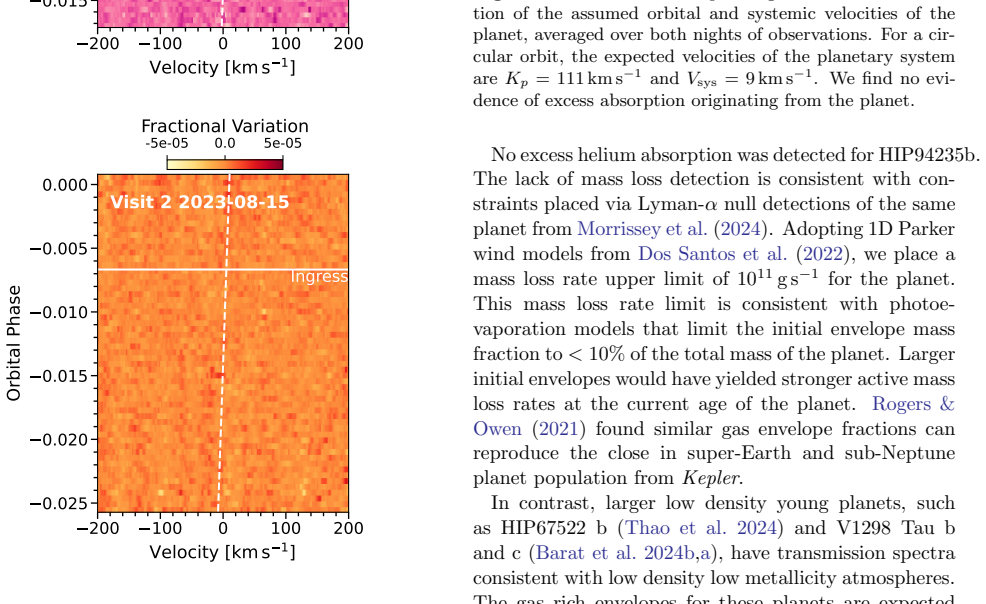
The load-bearing tool is the metastable helium triplet at 1083.33 nm, a spectral feature that traces neutral helium escaping from a planet's upper atmosphere and is immune to the interstellar absorption that cripples Lyman-$\alpha$ observations. The analysis pipeline removes stellar and telluric features by fitting telluric models and dividing out a median stellar spectrum, then integrates the residual flux in a 0.15 nm window to build a helium light curve. To turn the measured sensitivity into a physical limit, the authors fit a light-curve model to set the shallowest detectable transit depth and feed that through a one-dimensional Parker wind model of the escaping atmosphere, assuming a 6000 K upper atmosphere, a hydrogen fraction of 0.9, and XUV irradiation scaled from the young Sun-like star EK Dra. For the molecular search, synthetic transmission spectra from line-by-line radiative transfer are cross-correlated with the residuals, and injection-and-recovery tests quantify which model atmospheres would have been detectable.
What would settle it
A future transit observed at higher signal-to-noise that detects the 1083 nm helium triplet in absorption at the planet's expected velocity, together with a stellar XUV measurement showing HIP94235's high-energy flux is at least as strong as assumed, would overturn the $10^{11}$ g/s upper limit. A JWST transmission spectrum revealing prominent water or methane features from a low-metallicity hydrogen-helium atmosphere would contradict the conclusion that HIP94235b lacks a large envelope.
Extended reading notes
Core claim
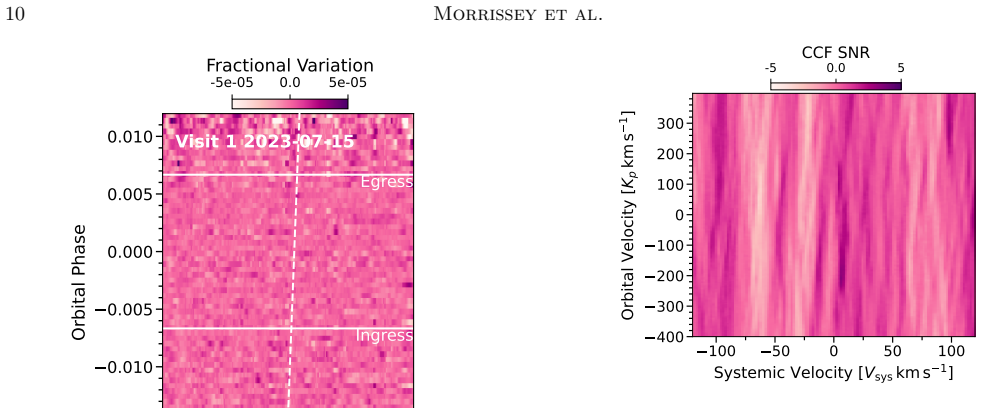
The central discovery is a null result with a quantitative consequence: across two independent CRIRES+ transits, HIP94235b shows no detectable metastable helium absorption, no variability in the helium light curve, and no water signal in cross-correlation with synthetic transmission spectra. The authors convert the helium light-curve noise into a $5\sigma$ upper limit on extra transit depth of about 0.0015, which the Parker wind model translates into a mass-loss upper limit of $10^{11}$ g/s ($0.53\,M_\oplus$/Gyr). Combining that limit with energy-limited photoevaporation tracks implies the planet's initial envelope mass fraction was only 3--10 percent. They therefore conclude that HIP94235b likely lacks a large hydrogen-helium envelope today, consistent with its earlier Lyman-$\alpha$ non-detection and with models in which most small planets lose their primordial envelopes within 100 Myr.
Load-bearing premise
The mass-loss cap rests on assuming that HIP94235 irradiates its planet as strongly as the young Sun-like star EK Dra, with a 6000 K upper atmosphere and a 0.9 hydrogen fraction; if the star's XUV output is lower, the same helium non-detection would allow faster escape.
Editorial extensions
If this is right
- The present-day mass-loss rate of HIP94235b is below $10^{11}$ g/s, so the planet is not shedding its atmosphere at an observable rate at 120 Myr.
- The planet's initial envelope must have been only 3--10 percent of its mass, ruling out a formation history as a gas-rich 40-percent-envelope Neptune like those seen around V1298 Tau or HIP67522b.
- The helium null reinforces the earlier Lyman-$\alpha$ null, making it unlikely that HIP94235b retains any substantial hydrogen-helium envelope today.
- Ground-based infrared high-resolution spectroscopy is nearly sensitive enough to detect water in a low-metallicity sub-Neptune: a 5 $M_\oplus$, 10$\times$ solar-metallicity cloud-free model would have been recovered at the $3\sigma$ level.
- The absence of active escape and of molecular features is consistent with either a stripped rocky core or a heavy, volatile-rich envelope, both endpoints expected from photoevaporation models.
Reading between the lines
- Because helium is a less sensitive escape tracer around G-type stars than around K-type stars, the non-detection may underestimate the true escape rate; a direct measurement of HIP94235's XUV luminosity would test the assumed irradiation level.
- If the energy-limited mass-loss efficiency is lower than assumed, the same present-day mass-loss cap would allow a larger initial envelope; independent constraints on the planet's core mass would break this degeneracy.
- A similar helium survey of young sub-Neptunes around K-type hosts would be a sharper test of whether photoevaporation strips envelopes within 100 Myr, since the metastable helium signal is strongest there.
- The apparent absence of a large H/He envelope leaves open a water-rich or steam-atmosphere composition; a JWST transmission spectrum at longer wavelengths could distinguish that scenario from a bare rocky core.
Editorial analysis
A structured set of objections, weighed in public.
Referee Report
Summary. The paper presents CRIRES+ Y-band transit spectroscopy of the young sub-Neptune HIP94235b over two transits. The authors search for excess metastable helium at 1083 nm and for water vapor via high-resolution cross-correlation, reporting null detections in both searches. Using the p-winds 1D Parker wind model with an assumed upper-atmosphere temperature of 6000 K, a hydrogen fraction of 0.9, and an XUV flux scaled from EK Dra, they convert the helium non-detection into a 5 sigma mass-loss rate upper limit of about 10^11 g/s. They then use energy-limited photoevaporation models to infer an initial envelope mass fraction of 3-10% of the planet mass. Injection-recovery tests show that a 10x solar metallicity 5 Earth-mass template would be retrievable at the 3 sigma level, while a solar metallicity template is recovered at only 2 sigma.
Significance. If the quantitative constraints hold, this is a valuable addition to the sparse sample of escape searches around young sub-Neptunes. The data reduction is careful, the median stellar subtraction and residual maps are clearly presented, and the injection-recovery tests are a useful check on the cross-correlation methodology. The paper's strongest contribution is the direct null detection and its demonstration that the observations would have been sensitive to some atmospheric models. However, the headline mass-loss upper limit and the follow-on evolutionary constraint rest on unpropagated model assumptions, particularly the stellar XUV/SED scaling, and the paper overstates the robustness of the 'likely lacks a large hydrogen-helium envelope' conclusion.
major comments (3)
- [Section 3.2] The conversion of the helium non-detection into a 5 sigma Mdot upper limit of 10^11 g/s is highly model-dependent, and no sensitivity analysis is provided. The p-winds calculation assumes T=6000 K, a hydrogen number fraction of 0.9, and an XUV flux scaled from EK Dra, but the metastable helium population is sensitive to both the magnitude and spectral shape of the ionizing flux. As the paper itself notes in Section 1, helium is most effective as an escape tracer around K-type stars; for a G-type host the same mass-loss rate can produce weaker helium absorption. A lower true XUV flux or a less favorable SED would permit mass-loss rates well above 10^11 g/s. Please provide a grid of p-winds models over plausible ranges of T, H fraction, and XUV scaling (for example 0.1-10x the EK Dra-scaled value) and report the resulting range of Mdot limits, or state the limit as explicitly conditional on the adopted XUV model. As written, the abstract and conclusions present the limit without this essential caveat.
- [Section 3.3] The inferred initial envelope mass fraction of 3-10% inherits the same XUV model dependence as the mass-loss upper limit. The text states that this constraint follows from incorporating Mdot < 10^11 g/s into the energy-limited evolution models, so it is only as strong as the p-winds conversion. If the helium null is consistent with Mdot up to 10^12 g/s under alternative XUV assumptions, the allowed initial envelope fraction could be substantially larger. The authors should show how the envelope fraction constraints vary with the alternative Mdot limits derived from the sensitivity grid requested above; without this, the conclusion that HIP94235b 'likely lacks a large hydrogen-helium envelope' is not adequately supported.
- [Section 3.2] The planet mass used in the p-winds model is not stated in this section. The mass-loss rate corresponding to a given helium absorption depends on the planet's gravitational potential, and HIP94235b has no measured mass; the paper assumes 5 Earth masses later for the transmission models, but it is unclear whether the same mass is used for the p-winds calculation. Please specify the adopted planet mass for the mass-loss modeling and show how the Mdot upper limit changes for plausible masses (for example 3 and 10 Earth masses). This is necessary for reproducibility and for assessing the robustness of the quoted limit.
minor comments (4)
- [Throughout] There are several typographical errors, including 'HIP 943235 b' instead of HIP 94235 b in Section 1, 'reaonsable' in Section 3.2, 'of lines of lines' in Section 1, and 'T op' in the Figure 3 caption. A careful proofread is needed.
- [Section 4.2] The set of excluded orders is inconsistent: Section 3 states orders 1, 8, and 9 are discarded, while Section 4.2 states orders 1, 6, 8, and 9 are excluded. Please clarify which orders are used in the helium analysis and which in the cross-correlation analysis.
- [Section 4.4] The statement that a 10x solar metallicity atmosphere 'would have been retrievable if present' is based on a 3.0 sigma injection-recovery significance, which is marginal. Please phrase this conclusion with the significance level explicit, and consider whether 3 sigma meets the intended retrieval threshold.
- [Figure 5] The overplotted light curves for Mdot = 10^11 and 10^12 g/s are useful, but the text does not describe how these mass-loss rates are converted into transit-depth light curves. A brief explanation in Section 3.2 would make the figure self-contained.
Circularity Check
No significant circularity: the non-detections are empirical, the mass-loss limit is derived from an external forward model (p-winds), and the envelope-fraction constraints follow from independent evolution modeling.
full rationale
The paper's central non-detections are direct measurements from the CRIRES+ data. The conversion of the helium transit-depth limit into a mass-loss upper limit uses p-winds, an external, community-standard 1D Parker-wind code, with explicitly stated assumptions (T=6000 K, H number fraction 0.9, XUV flux scaled from EK Dra via Ribas et al. 2005). This is a forward model applied to the data, not a fitted parameter renamed as a prediction. The p-winds model is itself an independent, published code, and the assumptions are transparent rather than smuggled in via citation. The subsequent energy-limited evolution modeling (Owen & Wu 2017) takes the mass-loss limit as an input to constrain initial envelope fractions, which is a nontrivial inference rather than a restatement of the input. The self-citations to Morrissey et al. (2024) are methodological (the XUV scaling approach and the photoevaporation-track setup) and are anchored to external references (Ribas et al. 2005; Owen & Wu 2017), so they are not load-bearing. The acknowledged limitation that helium is most effective as an escape tracer around K-type stars is a genuine model-dependence caveat for this G-type host; it affects the robustness of the mass-loss upper limit but does not make the derivation circular. No equation in the paper is defined in terms of the conclusion, and no fitted quantity is relabeled as a prediction. The derivation chain remains empirically grounded at each step.
Assumptions & free parameters
free parameters (7)
- Upper atmosphere temperature =
6000 K
- Hydrogen number fraction =
0.9 (helium 0.1)
- Stellar XUV flux scaling =
EK Dra scaled, no uncertainty given
- Mass loss efficiency eta =
freed, unconstrained range
- Core mass =
2 to 10 Earth masses, allowed range
- Initial envelope mass fraction =
3 to 10 percent, constrained
- Assumed planet mass for templates =
5 Earth masses, 10 also tested
assumptions (5)
- domain assumption p-winds is a valid description of the escaping outflow, a 1D isothermal Parker wind
- domain assumption The energy-limited mass loss approximation of Owen and Wu (2017) describes the planet's radius and envelope evolution
- ad hoc to paper HIP94235's XUV flux is approximated by scaling EK Dra's XUV luminosity
- domain assumption Median stellar subtraction preserves any planetary signal in the residuals
- domain assumption The synthetic atmosphere models resemble the true atmosphere of HIP94235b
Cite this review
Pith. "Pith review of Searching for helium escape and a low density atmosphere around the 120 Myr old sub-Neptune HIP94235b using CRIRES+." pith.science (2026). https://pith.science/paper/APBBLYDM
@misc{pith2026250604605,
  author       = {Pith},
  title        = {Pith review of: Searching for helium escape and a low density atmosphere around the 120 Myr old sub-Neptune HIP94235b using CRIRES+},
  year         = {2026},
  howpublished = {\url{https://pith.science/paper/APBBLYDM}},
  note         = {Machine review of arXiv:2506.04605}
}
read the original abstract
Atmospheric mass loss is thought to induce the bimodality in the small planet population as we observe it today. Observationally, active mass loss can be traced by excess absorption in spectral lines of lighter species, such as the hydrogen Ly-alpha line and the metastable helium triplet. We search for helium escape from the young (120Myr old) sub-Neptune HIP94235b. We obtained two transit observations of HIP94235b using the CRyogenic InfraRed Echelle Spectrograph (CRIRES+) on the Very Large Telescope (VLT). We find no evidence for escaping helium across both visits, allowing us to place a mass loss rate upper limit of 10^11 g/s, based on 1D Parker wind models. Additionally, we search for molecular spectral features in the planet's transmission spectrum, and cross-correlate our observations with high-resolution template spectra for H2O, the dominating molecule in the Y-band. We detect no significant absorption. We demonstrate that some atmosphere models at 10x solar metallicity would have been retrievable if present. Through the null detection of neutral hydrogen and helium escape, we conclude the atmosphere of HIP94235b likely lacks a large hydrogen-helium envelope. This is consistent with the expectation of small planet photoevaporation models, which suggest most planets lose their primordial hydrogen-helium envelopes within 100Myr of evolution.
Figures


Figures from the paper (6 more)



Reference graph
Works this paper leans on
-
[1]
Alam, M. K., Kirk, J., Dos Santos, L. A., et al. 2024, AJ, 168, 102
work page 2024
-
[2]
2018, Science, 362, 1384 12 Morrissey et al
Allart, R., Bourrier, V., Lovis, C., et al. 2018, Science, 362, 1384 12 Morrissey et al. Astropy Collaboration, Price-Whelan, A. M., Sip˝ ocz, B. M., et al. 2018, AJ, 156, 123
work page 2018
- [3]
-
[4]
Bitsch, B., Raymond, S. N., Buchhave, L. A., et al. 2021, A&A, 649, L5
work page 2021
- [5]
-
[6]
Chen, H., & Rogers, L. A. 2016, ApJ, 831, 180
work page 2016
-
[7]
Clough, S. A., Iacono, M. J., & Moncet, J.-L. 1992, J. Geophys. Res., 97, 15,761
work page 1992
- [8]
Show all 54 references
-
[9]
J., Bristow, P., Smoker, J
Dorn, R. J., Bristow, P., Smoker, J. V., et al. 2023, A&A, 671, A24 Dos Santos, L. A., Vidotto, A. A., Vissapragada, S., et al. 2022, A&A, 659, A62
2023
-
[10]
W., Lang, D., & Goodman, J
Foreman-Mackey, D., Hogg, D. W., Lang, D., & Goodman, J. 2013, PASP, 125, 306 Gaia Collaboration, Brown, A. G. A., Vallenari, A., et al. 2021, A&A, 649, A1
2013
-
[11]
W., et al
Gaidos, E., Hirano, T., Mann, A. W., et al. 2020, MNRAS, 495, 650
2020
-
[12]
A., et al
Gaidos, E., Hirano, T., Lee, R. A., et al. 2023, MNRAS, 518, 3777
2023
-
[13]
Gao, P., Piette, A. A. A., Steinrueck, M. E., et al. 2023, ApJ, 951, 96
2023
-
[14]
P., Merritt, S., Nugroho, S
Gibson, N. P., Merritt, S., Nugroho, S. K., et al. 2020, MNRAS, 493, 2215
2020
-
[15]
E., & Sari, R
Ginzburg, S., Schlichting, H. E., & Sari, R. 2016, ApJ, 825, 29
2016
-
[16]
E., & Sari, R
Ginzburg, S., Schlichting, H. E., & Sari, R. 2018, Monthly Notices of the Royal Astronomical Society, 476, 759
2018
-
[17]
2024, A&A, 688, A191
Gandhi, S. 2024, A&A, 688, A191
2024
-
[18]
2010, A&A, 520, A27
Guillot, T. 2010, A&A, 520, A27
2010
-
[19]
C., Bonomo, A
Guilluy, G., D’Arpa, M. C., Bonomo, A. S., et al. 2024, A&A, 686, A83
2024
-
[20]
2014, AJ, 148, 53
Gullikson, K., Dodson-Robinson, S., & Kraus, A. 2014, AJ, 148, 53
2014
-
[21]
H., Allard, F., & Baron, E
Hauschildt, P. H., Allard, F., & Baron, E. 1999, ApJ, 512, 377
1999
-
[22]
A., Templeton, M., Terrell, D., et al
Henden, A. A., Templeton, M., Terrell, D., et al. 2016, VizieR Online Data Catalog: AA VSO Photometric All Sky Survey (APASS) DR9 (Henden+, 2016), VizieR On-line Data Catalog: II/336. Originally published in: 2015AAS...22533616H
2016
-
[23]
2015, PASP, 127, 1161
Kreidberg, L. 2015, PASP, 127, 1161
2015
-
[24]
J., Chiang, E., & Ormel, C
Lee, E. J., Chiang, E., & Ormel, C. W. 2014, ApJ, 797, 95
2014
-
[25]
D., Fortney, J
Lopez, E. D., Fortney, J. J., & Miller, N. 2012, ApJ, 761, 59
2012
-
[26]
Malsky, I., & Rogers, L. A. 2020, ApJ, 896, 48
2020
-
[27]
2002, ApJL, 580, L171
Mandel, K., & Agol, E. 2002, ApJL, 580, L171
2002
-
[28]
L., Oklopˇ ci´ c, A., et al
Mansfield, M., Bean, J. L., Oklopˇ ci´ c, A., et al. 2018, ApJL, 868, L34 Molli` ere, P., van Boekel, R., Bouwman, J., et al. 2017, A&A, 600, A10 Molli` ere, P., Wardenier, J. P., van Boekel, R., et al. 2019, A&A, 627, A67
2018
-
[29]
X., et al
Morrissey, A., Zhou, G., Huang, C. X., et al. 2024, AJ, 168, 141
2024
-
[30]
J., et al
Mukherjee, S., Schlawin, E., Bell, T. J., et al. 2025, arXiv e-prints, arXiv:2502.17418
2025 arXiv
-
[31]
P., Stefansson, G., Mahadevan, S., et al
Ninan, J. P., Stefansson, G., Mahadevan, S., et al. 2020, ApJ, 894, 97 Oklopˇ ci´ c, A. 2019, ApJ, 881, 133 Oklopˇ ci´ c, A., & Hirata, C. M. 2018, ApJL, 855, L11
2020
-
[32]
2024, A&A, 689, A179
Orell-Miquel, J., Murgas, F., Pall´ e, E., et al. 2024, A&A, 689, A179
2024
-
[33]
E., & Wu, Y
Owen, J. E., & Wu, Y. 2017, The Astrophysical Journal, 847, 29
2017
-
[34]
2020, A&A, 638, A61
Palle, E., Nortmann, L., Casasayas-Barris, N., et al. 2020, A&A, 638, A61
2020
-
[35]
T., Mendon¸ ca, J
Parker, L. T., Mendon¸ ca, J. M., Diamond-Lowe, H., et al. 2025, arXiv e-prints, arXiv:2503.16608
2025 arXiv
-
[36]
2024, arXiv e-prints, arXiv:2410.03527
Piaulet-Ghorayeb, C., Benneke, B., Radica, M., et al. 2024, arXiv e-prints, arXiv:2410.03527
2024 arXiv
-
[37]
F., G¨ udel, M., & Audard, M
Ribas, I., Guinan, E. F., G¨ udel, M., & Audard, M. 2005, ApJ, 622, 680
2005
-
[38]
Rogers, J. G. 2025, arXiv e-prints, arXiv:2503.17364
2025 arXiv
-
[39]
G., Dorn, C., Aditya Raj, V., Schlichting, H
Rogers, J. G., Dorn, C., Aditya Raj, V., Schlichting, H. E., & Young, E. D. 2025, ApJ, 979, 79
2025
-
[40]
G., & Owen, J
Rogers, J. G., & Owen, J. E. 2021, MNRAS, 503, 1526
2021
-
[41]
Seager, S., & Sasselov, D. D. 2000, ApJ, 537, 916
2000
-
[42]
F., Cutri, R
Skrutskie, M. F., Cutri, R. M., Stiening, R., et al. 2006, AJ, 131, 1163
2006
-
[43]
J., Sing, D
Spake, J. J., Sing, D. K., Evans, T. M., et al. 2018, Nature, 557, 68
2018
-
[44]
2023, pycrires: Data reduction pipeline for VLT/CRIRES+, Astrophysics Source Code Library, record ascl:2307.040
Stolker, T., & Landman, R. 2023, pycrires: Data reduction pipeline for VLT/CRIRES+, Astrophysics Source Code Library, record ascl:2307.040
2023
-
[45]
2005, MNRAS, 356, 1466 HIP94235b Helium 13
Tamuz, O., Mazeh, T., & Zucker, S. 2005, MNRAS, 356, 1466 HIP94235b Helium 13
2005
-
[46]
C., Mann, A
Thao, P. C., Mann, A. W., Feinstein, A. D., et al. 2024, AJ, 168, 297
2024
-
[47]
2016, MNRAS, 458, 3880
Schmidt, C. 2016, MNRAS, 458, 3880
2016
-
[48]
M., Haldemann, J., Ronco, M
Venturini, J., Guilera, O. M., Haldemann, J., Ronco, M. P., & Mordasini, C. 2020, A&A, 643, L1
2020
-
[49]
Vidal-Madjar, A., & des Etangs, A. L. 2003, ”Osiris”(HD209458b), an evaporating planet, arXiv:astro-ph/0312382
2003 arXiv
-
[50]
L., Batalha, N
Wallack, N. L., Batalha, N. E., Alderson, L., et al. 2024, AJ, 168, 77
2024
-
[51]
B., Sasselov, D
Zeng, L., Jacobsen, S. B., Sasselov, D. D., et al. 2019, Proceedings of the National Academy of Science, 116, 9723
2019
-
[52]
A., Dai, F., et al
Zhang, M., Knutson, H. A., Dai, F., et al. 2023, AJ, 165, 62
2023
-
[53]
A., Wang, L., et al
Zhang, M., Knutson, H. A., Wang, L., et al. 2022, AJ, 163, 68
2022
-
[54]
P., Huang, C
Zhou, G., Wirth, C. P., Huang, C. X., et al. 2022, The Astronomical Journal, 163, 289
2022
Reviewed August 7, 2026 · model on record in the stance chip above.
Discussion (0). Sign in to comment.