REVIEW 5 major objections 5 minor 26 references
SmartAvatar: Text- and Image-Guided Human Avatar Generation with VLM AI Agents
T0 review · 5 major / 5 minor · reviewed 2026-08-07 · deepseek-v4-flash
Pith's one-line read A photo or text prompt becomes a fully rigged 3D avatar through a self-correcting VLM agent loop
desk verdict SmartAvatar is a clean, genuinely useful agentic pipeline for rigged avatars, but the headline 'outperforms' claim is directly contradicted by the paper's own Table 1, and the evaluation is circular. read the letter →
The pith
A machine-rendered reading of the paper's core claim, the machinery that carries it, and where it could break.
The reading
What carries the argument
The auto-verification loop: a rendering-and-scoring cycle in which an Evaluator VLM (optionally aided by ArcFace/CLIP cosine similarity, Eq. 1) inspects each Blender-rendered draft and a Refiner LLM rewrites the Python construction code to fix mismatches. This loop, orchestrated by four cooperating agents (Descriptor, Generator, Evaluator, Refiner) and stiffened by chain-of-thought prompting, is the component that converts a static parametric avatar template into an output that tracks an image or text prompt. It is what the ablations identify as the highest-leverage part of the pipeline.
What would settle it
Compare SmartAvatar against PSHuman and CharacterGen using a direct geometric error metric—e.g., Chamfer distance between the generated mesh and a SMPL-X body fit to the input image. If SmartAvatar does not achieve lower geometric error, or if its refinement loop fails to improve that error when the VLM evaluator is replaced by the geometric score, the central claim that the avatars are anatomically superior would be refuted.
Extended reading notes
Core claim
The paper proposes that high-quality avatar generation is better framed as a closed-loop code-search problem than as a one-shot generative sampling problem. A VLM-based Descriptor parses the input into discrete attribute tokens aligned with the HumGen3D API; a Generator emits Blender Python code that builds a parametric, fully rigged avatar; an Evaluator renders the result and scores identity similarity with ArcFace/CLIP plus VLM judgments of anatomy and attribute alignment; and a Refiner rewrites the code to close the gap. The auto-verification loop repeats until similarity crosses a threshold. The authors' key empirical claim is that this iterative, reasoning-driven refinement yields meshes with fewer anatomical distortions and better identity preservation than diffusion-based text-to-human and image-to-human systems, even when the quantitative embedding scores favor the baselines; ablations show the refinement loop is the largest single contributor to identity fidelity.
Load-bearing premise
The claim that SmartAvatar's avatars are better than the baselines despite lower similarity scores assumes that the authors' visual and VLM-based judgments of 'mesh quality' are a more reliable measure of true 3D correctness than the reported ArcFace/CLIP scores.
Editorial extensions
If this is right
- Removing the iterative refinement loop lowers ArcFace ID similarity by 19.2% and CLIP image similarity by 4.7%, making feedback-driven code revision the strongest lever for identity fidelity.
- Chain-of-thought prompting alone contributes a 7.6% ArcFace gain, so explicit reasoning improves attribute consistency even without extra rendering.
- The modular agent stack transfers across VLM backbones (GPT-4o, o4-mini, Gemma 3), so the gains are not tied to one model.
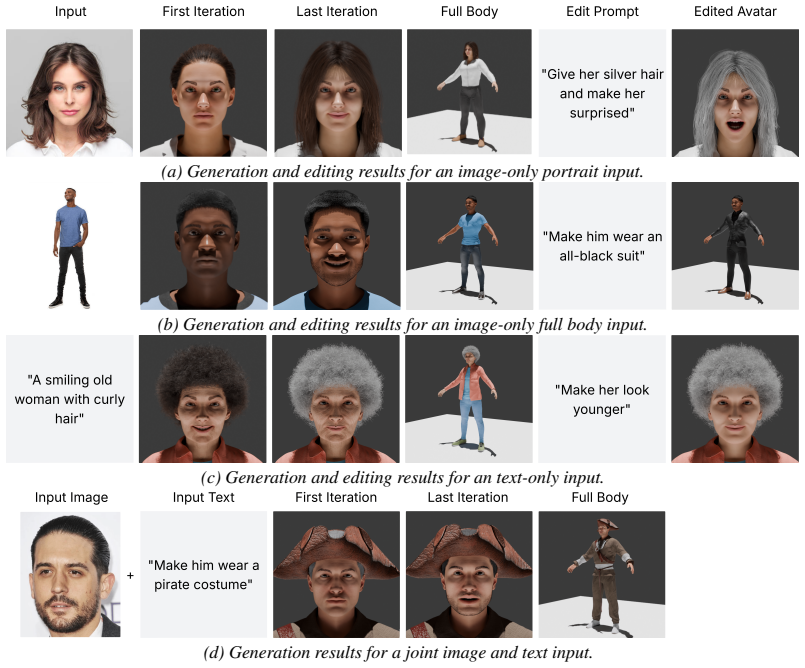
- Every generated avatar is a rigged parametric mesh, so downstream pose, animation, and re-outfitting work without extra reconstruction.
Reading between the lines
- Because the same VLM family acts as both generator and evaluator, the refinement loop may be rewarding appearance that the evaluator's own biases prefer; swapping in a different, independent evaluator is the natural check.
- The approach's ceiling is set by the parametric generator's expressiveness (the paper's own stated limitation); a richer backend would likely shift the comparison against diffusion methods.
- The render-critique-refine pattern generalizes to other structured 3D generation tasks where an API-controllable procedural model exists, such as synthetic datasets for embodied AI training.
- The framework's sensitivity to VLM reasoning quality suggests it can be repurposed as a benchmark for spatial reasoning in vision-language models.
Editorial analysis
A structured set of objections, weighed in public.
Referee Report
Summary. The paper presents SmartAvatar, a vision-language-agent-driven framework that generates fully rigged 3D human avatars from a single image or text prompt. The system chains four LLM/VLM agents (Descriptor, Generator, Evaluator, Refiner) on top of the HumGen3D Blender add-on, and introduces an auto-verification loop that renders draft avatars, scores them against the input with cosine similarity (Eq. 1), and iteratively refines the Blender code until a threshold is met. The authors claim state-of-the-art performance in reconstructed mesh quality, identity fidelity, attribute accuracy, and animation readiness, citing qualitative comparisons and Table 1. However, Table 1 shows SmartAvatar trailing or tying every baseline on every reported quantitative metric, and the paper provides no 3D geometry evaluation to support its texture-vs-geometry explanation. The ablation tables (Tables 2 and 3) report different absolute numbers than Table 1, and Section 5's own limitation statement concedes that the HumGen3D backbone limits facial fidelity. The central outperformance claim is therefore not supported by the evidence presented.
Significance. If established, the concept of using a VLM agent to control a parametric human generator through an interactive verification loop would be a meaningful contribution: it offers a practical path to rigged, editable avatars on consumer hardware, and it introduces a modular design that could be reused with other parametric backbones. The paper also usefully demonstrates conversational editing and attribute-level control. However, the current manuscript does not establish the claimed advantage. The evaluation is circular in part because the refinement loop optimizes the same cosine-similarity metrics (ArcFace/CLIP) that are later reported as evaluation metrics, and the only quantitative table contradicts the headline claim. No geometry metrics, no user study despite the abstract's mention of one, and no independent evaluation are provided. The contribution may be salvageable with a substantially reworked evaluation, but as submitted the significance claim is unsupported.
major comments (5)
- [Section 4, Table 1] The central claim that SmartAvatar 'outperforms recent text- and image-driven avatar generation systems in reconstructed mesh quality' is contradicted by the paper's own Table 1. SmartAvatar's ArcFace ID similarity (0.65) is below PSHuman (0.79) and CharacterGen (0.66); its CLIP image similarity (0.903) is below PSHuman (0.918) and CharacterGen (0.932); and its CLIP text similarity (0.657) is tied with DreamHuman, below HumanGaussian (0.658) and TADA (0.670). The text explains these deficits by claiming baselines' higher scores are 'primarily due to texture alignment in frontal views' and that SmartAvatar has 'more accurate geometry,' but no geometry metric — Chamfer distance, normal consistency, F-score, or comparison against ground-truth meshes — is reported anywhere. A visual-inspection assertion cannot support the headline claim when the only quantitative comparison goes the other way.
- [Section 3.4, Eq. (1) and Section 4] The auto-verification loop optimizes exactly the same cosine-similarity objective (Eq. 1) using CLIP/ArcFace embeddings that are later reported as the main evaluation metrics in Tables 1 and 2. The generator is iteratively refined until s ≥ τ, so reporting these scores as evidence of superiority is circular; worse, SmartAvatar loses on these self-optimized metrics. An independent evaluation protocol — for example, geometry metrics on a test set with ground-truth meshes, or human perceptual studies of mesh quality — is required to support any claim of advantage over baselines.
- [Tables 1, 2, and 3] The reported numbers for the same method are inconsistent across tables. Table 1 reports SmartAvatar's ArcFace ID similarity as 0.65 and CLIP image similarity as 0.903, while Table 2 and Table 3 report the 'full pipeline' as 0.52 and 0.809 with GPT-4o. These are very different values, presumably reflecting different test sets or protocols, but the paper does not specify the dataset, number of prompts/images, or evaluation conditions for either set of numbers. This makes it impossible to compare the method with baselines or to interpret the ablation results.
- [Section 5, Limitation] The limitation paragraph concedes that the off-the-shelf HumGen3D engine 'limits the system's ability to fully capture nuanced facial features, and high-frequency details.' This directly undercuts the paper's claims of identity fidelity and reconstructed mesh quality, especially because no quantitative facial geometry or identity metric independently supports those claims. The concession is appropriate, but it is in tension with the abstract and introduction, which state that SmartAvatar achieves high fidelity and outperforms prior methods in identity fidelity.
- [Section 4, Section 5, and Section 7.6] The paper claims 'statistically significant' improvements in the ablation summary, but no variance, confidence intervals, or significance tests are reported, and Table 2 and Table 3 contain only point estimates. Additionally, the abstract promises 'quantitative benchmarks and user studies,' but no user study is presented in the manuscript. Either the study was omitted or the abstract overstates the evidence; both require correction.
minor comments (5)
- [Section 3.4 and Section 7.3] The similarity threshold τ is not precisely defined in Eq. (1); Section 7.3 states that the evaluator prompt uses τ = 90% by default, but the relationship between this percentage and the cosine-similarity score, and the choice of encoder F, are not specified.
- [Section 1 and Section 7.6] The text in Section 1 says 'AG3DDong et al.' and 'EV A3D' without proper spacing; Section 7.6 mentions evaluation on aligned portrait crops, but it is unclear whether Table 1's image-input results correspond to full-body or portrait inputs. Please clarify the exact evaluation protocol.
- [Table 1] The caption of Table 1 includes a disclaimer that higher embedding metrics are 'due to texture alignment in frontal views,' but this interpretive claim belongs in the body text, not as a caption assertion, and it should be supported by evidence rather than stated as fact.
- [Abstract and Section 4] The abstract claims 'user studies' demonstrate outperformance, but the main text and appendix contain no user study; either include the user study with full details or remove the claim from the abstract.
- [Section 5, VLM Generalization] The statement that 'LLaMA 4' outputs did not converge is presented without details; please provide the specific failure mode and the hyperparameters used, since this result is relevant to claims about VLM generality.
Circularity Check
The identity-fidelity numbers are the refinement loop's own optimization objective; mesh-quality superiority is asserted without an independent geometry metric.
-
fitted input called prediction
[Section 3.4, Eq. (1); Section 4, Table 1; Section 7.6]
"Alternatively, for image inputs, a visual encoder F can compute cosine similarity between the original input and the rendered avatar: s = cos(F (Iorig), F(Irend)) (1). If s < τ and iteration i < Nmax, the refiner LLM fref is invoked to revise the code. ... Table 1 reports quantitative metrics including CLIP text ..., CLIP image ..., and ArcFace ID similarity. ... To evaluate output fidelity, we used ArcFace ID similarity, CLIP image similarity, and CLIP text similarity."
The refinement loop's termination and correction criterion is exactly the cosine similarity in Eq. (1) over CLIP/ArcFace embeddings, and the paper's reported identity-fidelity and attribute-alignment metrics are the same cosine similarities listed in Section 7.6. The system is therefore engineered to maximize ArcFace ID similarity and CLIP image similarity, and Tables 1 and 2 then report those maximized values as evidence of identity fidelity and attribute accuracy. This is a fitted input called prediction: the loop fits generator parameters to the embedding objective, and the evaluation uses that same objective as the measure of quality. The ablation showing that removing the refinement loop drops ArcFace similarity is mechanical, since the loop is the optimizer for that score.
-
other
[Section 4, 'Comparison with State-of-the-Art Methods', Table 1 caption and following paragraph]
"Although some methods achieve higher embedding metrics, these results are primarily due to texture alignment in frontal views and do not totally reflect the underlying mesh quality, which often contains anatomical distortions and surface artifacts. ... Visual inspection confirms that SmartAvatar offers more accurate geometry and higher structural realism."
The claim that SmartAvatar outperforms existing methods in reconstructed mesh quality is not derived from any reported geometry measurement. When the only quantitative table shows SmartAvatar below baselines on every listed embedding metric, the paper reinterprets those same metrics as texture-alignment artifacts and asserts superior geometry based on visual inspection. No Chamfer distance, normal consistency, F-score, or comparison against ground-truth meshes is provided, so the mesh-quality conclusion reduces to a post hoc explanation of the very metrics the system was built to optimize.
full rationale
SmartAvatar is not a self-citation chain: it builds on external components (HumGen3D, GPT-4o, o4-mini, Gemma 3) and compares against external baselines (PSHuman, CharacterGen, TRELLIS, DreamHuman, HumanGaussian, TADA, DreamGaussian). The partial circularity is specific to the identity and attribute evaluation. Equation (1) defines the refinement objective as cosine similarity in the embedding space of F, and Section 7.6 defines the output-fidelity metrics as ArcFace ID similarity and CLIP image similarity, i.e., the same embedding similarities. Reporting these as evidence of identity fidelity is therefore partially circular: the system is fitted to maximize these scores, and the reported gains from the refinement loop are gains in the loop's own objective. The mesh-quality and animation-readiness claims rely on qualitative inspection and the rigged output of HumGen3D, not on a measured geometry metric, so the headline claim of superiority in mesh quality is unsupported rather than independently derived. Because external baselines and external models are used, and because some aspects such as animation readiness are at least externally checkable, the appropriate score is 6, not 8 or 10.
Assumptions & free parameters
free parameters (2)
- Similarity threshold tau =
0.9 (default)
- Maximum iteration count Nmax =
Unspecified
assumptions (4)
- domain assumption HumGen3D's parameter space and preset library can represent the input identities sufficiently well.
- domain assumption Cosine similarity of CLIP/ArcFace embeddings is a valid proxy for identity and attribute fidelity.
- domain assumption A VLM from the same family as the generator can reliably evaluate rendered avatars and supply correct refinement instructions.
- ad hoc to paper The qualitative claim that baselines' higher scores are due to texture alignment rather than geometry is correct.
Cite this review
Pith. "Pith review of SmartAvatar: Text- and Image-Guided Human Avatar Generation with VLM AI Agents." pith.science (2026). https://pith.science/paper/66FKJO6G
@misc{pith2026250604606,
  author       = {Pith},
  title        = {Pith review of: SmartAvatar: Text- and Image-Guided Human Avatar Generation with VLM AI Agents},
  year         = {2026},
  howpublished = {\url{https://pith.science/paper/66FKJO6G}},
  note         = {Machine review of arXiv:2506.04606}
}
read the original abstract
SmartAvatar is a vision-language-agent-driven framework for generating fully rigged, animation-ready 3D human avatars from a single photo or textual prompt. While diffusion-based methods have made progress in general 3D object generation, they continue to struggle with precise control over human identity, body shape, and animation readiness. In contrast, SmartAvatar leverages the commonsense reasoning capabilities of large vision-language models (VLMs) in combination with off-the-shelf parametric human generators to deliver high-quality, customizable avatars. A key innovation is an autonomous verification loop, where the agent renders draft avatars, evaluates facial similarity, anatomical plausibility, and prompt alignment, and iteratively adjusts generation parameters for convergence. This interactive, AI-guided refinement process promotes fine-grained control over both facial and body features, enabling users to iteratively refine their avatars via natural-language conversations. Unlike diffusion models that rely on static pre-trained datasets and offer limited flexibility, SmartAvatar brings users into the modeling loop and ensures continuous improvement through an LLM-driven procedural generation and verification system. The generated avatars are fully rigged and support pose manipulation with consistent identity and appearance, making them suitable for downstream animation and interactive applications. Quantitative benchmarks and user studies demonstrate that SmartAvatar outperforms recent text- and image-driven avatar generation systems in terms of reconstructed mesh quality, identity fidelity, attribute accuracy, and animation readiness, making it a versatile tool for realistic, customizable avatar creation on consumer-grade hardware.
Figures


Figures from the paper (10 more)


Reference graph
Works this paper leans on
-
[1]
Josh Achiam, Steven Adler, Sandhini Agarwal, Lama Ahmad, Ilge Akkaya, Florencia Leoni Aleman, Diogo Almeida, Janko Altenschmidt, Sam Altman, Shyamal Anadkat, et al. Gpt-4 technical report. arXiv preprint arXiv:2303.08774,
-
[6]
Ruixiang Jiang, Can Wang, Jingbo Zhang, Menglei Chai, Mingming He, Dongdong Chen, and Jing Liao
URL https://proceedings.neurips.cc/ paper_files/paper/2023/file/0e769ec2c2cd99b6ad69c9d75113e386-Paper-Conference.pdf . Ruixiang Jiang, Can Wang, Jingbo Zhang, Menglei Chai, Mingming He, Dongdong Chen, and Jing Liao. Avatarcraft: Transforming text into neural human avatars with parameterized shape and pose control. arXiv preprint arXiv:2303.17606,
arXiv 2023
-
[7]
URL https://arxiv.org/abs/2301.12597
doi: 10.48550/ arXiv.2301.12597. URL https://arxiv.org/abs/2301.12597. Peng Li, Wangguandong Zheng, Yuan Liu, Tao Yu, Yangguang Li, Xingqun Qi, Xiaowei Chi, Siyu Xia, Yan-Pei Cao, Wei Xue, Wenhan Luo, and Yike Guo. Pshuman: Photorealistic single-image 3d human reconstruction using cross-scale multiview diffusion and explicit remeshing,
-
[8]
URL https://arxiv.org/abs/2308.10899. Chen-Hsuan Lin, Jun Gao, Luming Tang, Towaki Takikawa, Xiaohui Zeng, Xun Huang, Karsten Kreis, Sanja Fidler, Ming-Yu Liu, and Tsung-Yi Lin. Magic3d: High-resolution text-to-3d content creation. In IEEE/CVF Conference on Computer Vision and Pattern Recognition (CVPR), pages 300–309,
-
[9]
Haotian Liu, Chunyuan Li, Qingyang Wu, and Yong Jae Lee. Visual instruction tuning. arXiv preprint arXiv:2304.08485, 2023a. URL https://arxiv.org/abs/2304.08485. Xian Liu, Xiaohang Zhan, Jiaxiang Tang, Ying Shan, Gang Zeng, Dahua Lin, Xihui Liu, and Ziwei Liu. Humangaussian: Text-driven 3d human generation with gaussian splatting. In Proceedings of the IE...
-
[10]
Agentbench: Evaluating large language models as agents
Zheng Liu, Zongyi Lu, Yujia Zheng, Xin Chen, Luyu Yang, Yuxi Shao, Zihan Wang, Hao Zhang, Zhou- jun Yu, Yilun Cao, and et al. Agentbench: Evaluating large language models as agents. arXiv preprint arXiv:2308.03688, 2023b. URL https://arxiv.org/abs/2308.03688. 10 Matthew Loper, Naureen Mahmood, Javier Romero, Gerard Pons-Moll, and Michael J. Black. Smpl: a...
-
[12]
URL https://arxiv.org/abs/2303.17651. Joon Sung Park, Joseph C. Riccelli, Lily Pierson, Liangfeng Liao, Stuart Russell, and et al. Generative agents: Interactive simulacra of human behavior. In Proceedings of the 2023 CHI Conference on Human Factors in Computing Systems, pages 1–18,
arXiv 2023
-
[13]
URL https://arxiv.org/abs/ 2304.03442
doi: 10.1145/3544548.3581492. URL https://arxiv.org/abs/ 2304.03442. Georgios Pavlakos, Vasileios Choutas, Nima Ghorbani, Timo Bolkart, Ahmed A. A. Osman, Dimitrios Tzionas, and Michael J. Black. Expressive body capture: 3d hands, face, and body from a single image,
Show all 26 references
-
[15]
Ben Poole, Ajay Jain, Jonathan T Barron, and Ben Mildenhall
URL https: //arxiv.org/abs/2402.17214. Ben Poole, Ajay Jain, Jonathan T Barron, and Ben Mildenhall. Dreamfusion: Text-to-3d using 2d diffusion. International Conference on Learning Representations (ICLR),
-
[16]
org/abs/2409.12618
URL https://arxiv. org/abs/2409.12618. Aditya Ramesh, Mikhail Pavlov, Gabriel Goh, Scott Gray, Chelsea V oss, Alec Radford, Mark Chen, and Ilya Sutskever. Zero-shot text-to-image generation,
-
[18]
Yawar Siddiqui, Tom Monnier, Filippos Kokkinos, Mahendra Kariya, Yanir Kleiman, Emilien Garreau, Oran Gafni, Natalia Neverova, Andrea Vedaldi, Roman Shapovalov, et al
URL https://arxiv.org/abs/2205.11487. Yawar Siddiqui, Tom Monnier, Filippos Kokkinos, Mahendra Kariya, Yanir Kleiman, Emilien Garreau, Oran Gafni, Natalia Neverova, Andrea Vedaldi, Roman Shapovalov, et al. Meta 3d assetgen: Text-to-mesh generation with high-quality geometry, t...
-
[19]
Dreamgaussian: Generative gaussian splatting for efficient 3d content creation
Jiaxiang Tang, Jiawei Ren, Hang Zhou, Ziwei Liu, and Gang Zeng. Dreamgaussian: Generative gaussian splatting for efficient 3d content creation. arXiv preprint arXiv:2309.16653,
-
[20]
Gemini: a family of highly capable multimodal models
Gemini Team, Rohan Anil, Sebastian Borgeaud, Jean-Baptiste Alayrac, Jiahui Yu, Radu Soricut, Johan Schalk- wyk, Andrew M Dai, Anja Hauth, Katie Millican, et al. Gemini: a family of highly capable multimodal models. arXiv preprint arXiv:2312.11805,
-
[22]
11 Jianfeng Xiang, Zelong Lv, Sicheng Xu, Yu Deng, Ruicheng Wang, Bowen Zhang, Dong Chen, Xin Tong, and Jiaolong Yang
URL https://arxiv.org/abs/2305.16291. 11 Jianfeng Xiang, Zelong Lv, Sicheng Xu, Yu Deng, Ruicheng Wang, Bowen Zhang, Dong Chen, Xin Tong, and Jiaolong Yang. Structured 3d latents for scalable and versatile 3d generation,
-
[23]
Deshun Yang, Luhui Hu, Yu Tian, Zihao Li, Chris Kelly, Bang Yang, Cindy Yang, and Yuexian Zou
URL https: //arxiv.org/abs/2412.01506. Deshun Yang, Luhui Hu, Yu Tian, Zihao Li, Chris Kelly, Bang Yang, Cindy Yang, and Yuexian Zou. Worldgpt: A Sora-inspired video ai agent as rich world models from text and image inputs. arXiv preprint arXiv:2403.07944,
-
[24]
Jianfeng Zhang, Zihang Jiang, Dingdong Yang, Hongyi Xu, Yichun Shi, Guoxian Song, Zhongcong Xu, Xinchao Wang, and Jiashi Feng
URL https://arxiv.org/abs/2403.07944. Jianfeng Zhang, Zihang Jiang, Dingdong Yang, Hongyi Xu, Yichun Shi, Guoxian Song, Zhongcong Xu, Xinchao Wang, and Jiashi Feng. Avatargen: a 3d generative model for animatable human avatars,
-
[25]
Longwen Zhang, Ziyu Wang, Qixuan Zhang, Qiwei Qiu, Anqi Pang, Haoran Jiang, Wei Yang, Lan Xu, and Jingyi Yu
URL https://arxiv.org/abs/2208.00561. Longwen Zhang, Ziyu Wang, Qixuan Zhang, Qiwei Qiu, Anqi Pang, Haoran Jiang, Wei Yang, Lan Xu, and Jingyi Yu. Clay: A controllable large-scale generative model for creating high-quality 3d assets. ACM Transactions on Graphics (TOG), 43(4):1–20,
-
[26]
Adding conditional control to text-to-image diffusion models
Lvmin Zhang and Maneesh Agrawala. Adding conditional control to text-to-image diffusion models. In arXiv preprint arXiv:2302.05543,
-
[28]
Appendix 7 Implementation Details 7.1 Agent Coordination Pipeline Our system coordinates four modular agents (Descriptor, Generator, Evaluator, Refiner) in a verification loop
URL https://arxiv.org/abs/2304.10592. Appendix 7 Implementation Details 7.1 Agent Coordination Pipeline Our system coordinates four modular agents (Descriptor, Generator, Evaluator, Refiner) in a verification loop. An additional Editor agent is available for editing the avatar...
-
[2015]
doi: 10.1145/2816795.2818013
ISSN 0730-0301. doi: 10.1145/2816795.2818013. URL https://doi.org/10.1145/2816795.2818013. Aman Madaan, Niket Tandon, Prakhar Gupta, Skyler Hallinan, Luyu Gao, Sarah Wiegreffe, Uri Alon, Nouha Dziri, Shrimai Prabhumoye, Yiming Yang, Shashank Gupta, Bodhisattwa Prasad Majumder,...
-
[2019]
Hao-Yang Peng, Jia-Peng Zhang, Meng-Hao Guo, Yan-Pei Cao, and Shi-Min Hu
URL https://arxiv.org/abs/1904.05866. Hao-Yang Peng, Jia-Peng Zhang, Meng-Hao Guo, Yan-Pei Cao, and Shi-Min Hu. Charactergen: Efficient 3d character generation from single images with multi-view pose canonicalization,
1904 arXiv
-
[2021]
José Ribeiro- Gomes, Tianhui Cai, Zoltán A
URL https://arxiv.org/abs/2102.12092. José Ribeiro- Gomes, Tianhui Cai, Zoltán A. Milacski, Chen Wu, Aayush Prakash, Shingo Takagi, Amaury Aubel, Daeil Kim, Alexandre Bernardino, and Fernando De La Torre. Motiongpt: Human motion synthesis with improved diversity and realism vi...
-
[2022]
Yicong Hong, Kai Zhang, Jiuxiang Gu, Sai Bi, Yang Zhou, Difan Liu, Feng Liu, Kalyan Sunkavalli, Trung Bui, and Hao Tan
URL https://arxiv.org/abs/2210.04888. Yicong Hong, Kai Zhang, Jiuxiang Gu, Sai Bi, Yang Zhou, Difan Liu, Feng Liu, Kalyan Sunkavalli, Trung Bui, and Hao Tan. Lrm: Large reconstruction model for single image to 3d. International Conference on Learning Representations (ICLR),
-
[2023]
Fangzhou Hong, Zhaoxi Chen, Yushi Lan, Liang Pan, and Ziwei Liu
URL https://arxiv.org/abs/2305.02312. Fangzhou Hong, Zhaoxi Chen, Yushi Lan, Liang Pan, and Ziwei Liu. Eva3d: Compositional 3d human generation from 2d image collections,
-
[2024]
Structldm: Structured latent diffusion for 3d human generation, 2024a
Tao Hu, Fangzhou Hong, and Ziwei Liu. Structldm: Structured latent diffusion for 3d human generation, 2024a. URL https://arxiv.org/abs/2404.01241. Ziniu Hu, Ahmet Iscen, Aashi Jain, Thomas Kipf, Yisong Yue, David A Ross, Cordelia Schmid, and Alireza Fathi. Scenecraft: An llm a...
-
[2025]
Zijian Dong, Xu Chen, Jinlong Yang, Michael J
URL https://arxiv.org/abs/2501.18096. Zijian Dong, Xu Chen, Jinlong Yang, Michael J. Black, Otmar Hilliges, and Andreas Geiger. Ag3d: Learning to generate 3d avatars from 2d image collections,
Reviewed August 7, 2026 · model on record in the stance chip above.
Discussion (0). Sign in to comment.