REVIEW 6 minor 137 references
A map of indefinite causal order
T0 review · 0 major / 6 minor · reviewed 2026-08-07 · deepseek-v4-flash
Pith's one-line read This paper maps indefinite causal order through three frameworks — the quantum switch, the process matrices framework, and the superposition of causal structures — and identifies the quantum switch as a causally nonseparable process that…
desk verdict A careful, useful map of the ICO literature, but the anchor example's contested physicality could mislead newcomers if they skip Section 5. read the letter →
The pith
A machine-rendered reading of the paper's core claim, the machinery that carries it, and where it could break.
The reading
What carries the argument
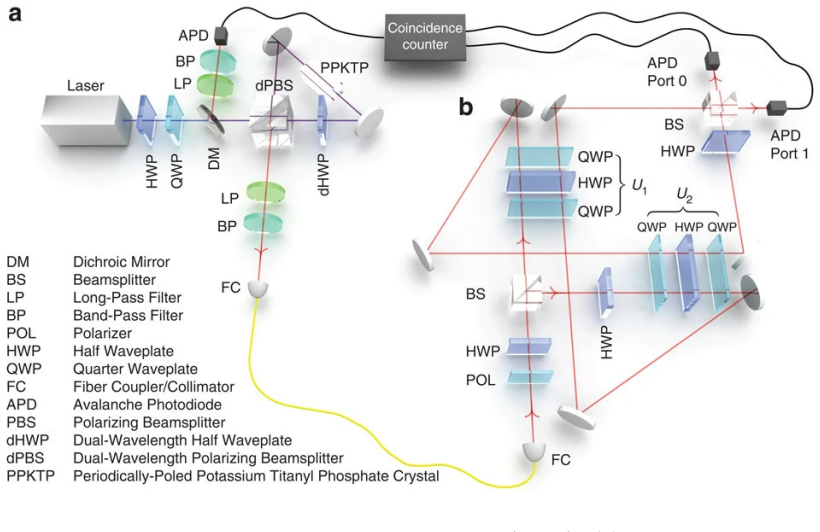
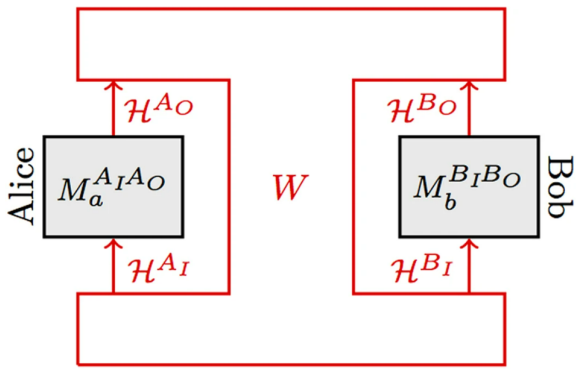
The load-bearing objects are the quantum switch, a higher-order quantum operation (a supermap) that applies two channels $\mathcal{A}$ and $\mathcal{B}$ in an order controlled by a qubit, so the target undergoes either $\mathcal{B}\circ\mathcal{A}$ or $\mathcal{A}\circ\mathcal{B}$ coherently; the process matrix $W$, a positive semidefinite operator satisfying a completeness relation that connects inputs and outputs of isolated labs, with causal nonseparability defined as the impossibility of writing $W = qW^{A\nprec B} + (1-q)W^{B\nprec A}$ as a mixture of definite-order processes; and the superposition of causal structures, in which each manifold $\mathcal{M}$ is assigned a quantum state $|\mathcal{M}\rangle$, so a superposition of geometries yields an indefinite order of events. The machinery's work is to give each framework a precise definition of indefinite causal order and to connect those definitions to experiments and applications.
What would settle it
An explicit construction of a fixed-order quantum circuit that uses exactly one copy of each input gate and reproduces the quantum switch's action on all unitary inputs would refute the central framing, since cited work proves no such circuit exists.
Extended reading notes
Core claim
The central claim is that indefinite causal order is not one phenomenon but a territory with three main landmarks. The quantum switch applies two channels in a coherent superposition of orders, giving computational, communication, thermodynamic, and metrological advantages over fixed-order circuits; the process matrices framework formalises causal nonseparability — a process that cannot be written as a mixture of definite-order processes — and contains processes, such as the OCB process, that violate causal inequalities but cannot be realised by quantum theory alone; and the superposition of causal structures assigns quantum states to classical manifolds, producing a gravitational quantum switch in which time dilation makes the order of events indefinite. The paper asserts, on the authority of the cited results, that the quantum switch is causally nonseparable yet satisfies every causal inequality, and that the gravitational version is the only one some critics accept as genuine, with the photonic implementations disputed as simulations.
Load-bearing premise
The map's reliability rests on the cited claim that the quantum switch cannot be reproduced by a fixed-order quantum circuit using each gate only once, and on the contested status of the photonic experiments as genuine indefinite causal order; the paper reports the dispute without settling it.
Editorial extensions
If this is right
- If the map is right, the quantum switch is a genuine resource: it distinguishes commuting from anticommuting unitaries deterministically, activates the capacity of completely depolarizing channels, and improves metrological precision, all while violating no causal inequality.
- The process matrices framework goes beyond quantum mechanics: some causally nonseparable processes such as the OCB process violate causal inequalities, but standard quantum theory cannot realise them, so the boundary of physical implementability is a live open question.
- The superposition of causal structures turns spacetime itself into the control system, so gravitational time dilation can realise a quantum switch without any interferometric routing of the target.
- The unresolved debate over whether photonic implementations are genuine or simulations shifts the question onto the definition of an event, and the paper's map keeps that question open.
Reading between the lines
- Extension: if the resource behind the switch's communication advantages is really the coherence of the control system rather than indefinite order, then a fixed-order interferometric coherent-control setup should reproduce the same capacity activation; the cited evidence already hints this is partially true.
- Extension: a systematic measure of causal nonseparability strength would let the field sort processes like the quantum switch, the OCB process, and the Grenoble process into a hierarchy; no such measure is currently proposed, though the map's causal-witness structure suggests one can be built.
- Extension: if the event-definition debate resolves toward the operational 'coincidence of worldlines' view, then photonic and gravitational quantum switches become equally genuine, which would retroactively validate all photonic applications as ICO demonstrations.
- Extension: the map implies that multipartite ICO is strictly richer than bipartite: dynamical control of causal order and locally-classical-but-globally-noncausal correlations appear only with three or more parties, so future experimental effort could target tripartite processes rather than two-party switches.
Editorial analysis
A structured set of objections, weighed in public.
Referee Report
Summary. This paper is a conceptual review or "map" of indefinite causal order (ICO), written as an excerpt from the author's PhD thesis. It motivates ICO through Hardy's quantum-gravity program and then surveys three frameworks: the quantum switch, process matrices, and superposition of causal structures. It summarizes applications in quantum computing, communication, thermodynamics, and metrology, reviews certification methods for causal nonseparability, and closes with a list of ongoing debates. No new technical results or derivations are claimed; the contribution is organizational and bibliographic, with 137 references.
Significance. If accurate, the map is a useful entry point for newcomers and a quick reference for researchers. The paper is generally careful in attribution and explicitly presents both sides of the main contested issues, particularly the debate over whether photonic and NMR realizations of the quantum switch are genuine ICO instances or fine-grained simulations (Refs. [98,99] versus [132]). It also lists open questions in Section 6 rather than presenting the field as settled. The main value is the broad, organized bibliography and the explicit acknowledgment of unresolved questions. Because there are no derivations or predictions, the correctness burden is fidelity to the cited literature, and the paper is, in the main, faithful to the sources it cites. The main risk is that a newcomer could read the applications section as settled experimental evidence for physical ICO, but the later debate sections go some way toward mitigating this risk.
minor comments (6)
- [Section 3.1 and Section 3.2] The quantum switch is introduced and its applications are surveyed without an explicit cross-reference to the physicality debate acknowledged in Section 4.1 and Section 5. In particular, Ref. [7] is described as the "first experimental implementation" and Section 3.2 lists many experiments, while Section 5 reports Refs. [98,99] claiming that these are fine-grained fixed-order simulations. Because the switch is the map's anchor example, a sentence at the first mention of experimental implementations and at the start of Section 3.2 should state that the physicality of these realizations is contested and direct the reader to Sections 5 and 6.3.
- [Section 5] The sentence "According to this operational view, the photonic implementation of the quantum switch is as genuine as its gravitational version, provided a superposition of causal structures is involved" is confusing, because photonic experiments do not involve a superposition of causal structures. Please clarify whether this is intended as a rebuttal of Refs. [98,99] or as a separate conditional statement about the operational notion of event.
- [Throughout] The manuscript contains numerous typos and grammatical errors, including "succesful", "indefintie", "squemes", "teeths" in the Figure 1 caption, "separtates" in the Figure 7 caption, "highligthed", "certifiyng", and "worldine". A careful proofreading pass is needed before publication.
- [Prologue] The sentence "a map never replace the terrain" should read "a map never replaces the terrain", and the phrase "while full of references" would be clearer as "while being full of references".
- [Section 3.2] The sentence "He showed that the quantum switch can deterministically discriminates between a pair of commuting and a pair of anticommuting unitaries" has a subject-verb agreement error and should read "can deterministically discriminate".
- [References] Some entries are preprints or unpublished items (e.g., Ref. [24] is a Research Square preprint and Refs. [75,79,128] are arXiv preprints); if published versions now exist, they should be updated, and the reference list should be checked for consistency of formatting.
Circularity Check
No circularity: the paper is a literature map with no derived predictions; load-bearing claims are attributed to external sources and the sole self-citation is terminological.
full rationale
The paper explicitly disclaims derivation: 'The map is written at a conceptual level, without mathematical technicalities while full of references.' It contains no equations, fits, or original predictions whose outputs could reduce to their inputs. The central classifications—the quantum switch as a causally nonseparable process, the process-matrix definition of causal separability, and the gravitational quantum switch—are each attributed to external references ([5], [91], [97], [125]) rather than derived in the text. The only self-citation, Ref. [33], is used solely for terminology ('Following Ref. [33], we refer to this generalised quantum switch as (N, p)-switch') and to point to a family of promise problems; it is not load-bearing. The paper also flags the unresolved dispute about whether photonic implementations are genuine instances of ICO (Section 5, citing Refs. [98,99]), which is a physicality or correctness concern, not a circularity. Since every substantive claim is traceable to independent external work, there is no reduction of any claim to its own inputs.
Assumptions & free parameters
assumptions (3)
- domain assumption Correctness of the cited primary literature (e.g., causal non-separability of the quantum switch [97], impossibility of fixed-order simulation [5]).
- domain assumption Standard quantum mechanics framework: quantum operations, channels, and supermaps are well-defined.
- domain assumption The definition of causal non-separability is a meaningful criterion for indefinite causal order.
Cite this review
Pith. "Pith review of A map of indefinite causal order." pith.science (2026). https://pith.science/paper/Q4OFTAIH
@misc{pith2026250604607,
  author       = {Pith},
  title        = {Pith review of: A map of indefinite causal order},
  year         = {2026},
  howpublished = {\url{https://pith.science/paper/Q4OFTAIH}},
  note         = {Machine review of arXiv:2506.04607}
}
read the original abstract
In this "map" we are going to present the concept of indefinite causal order and make a quick journey through its different flavours. We will start with a broad conceptual motivation for studying indefinite causal order, based on the approach of Lucien Hardy to quantum gravity. Then, we will introduce the quantum switch, which is a particular instance of indefinite causal order, followed by the process matrices framework and the superposition of causal structures. Finally, we will comment on some ongoing debates within the field. This document started as an excerpt of the author's PhD Thesis and is intended as a map of indefinite causal order, which can be used to guide the trip of any explorer in the field.
Figures


Figures from the paper (7 more)



Reference graph
Works this paper leans on
-
[33]
Practical computational advantage from the quantum switch on a generalized family of promise problems
J. Escand´ on-Monardes, A. Delgado, and S. P. Walborn, “Practical computational advantage from the quantum switch on a generalized family of promise problems”, Quantum7, 945 (2023)
2023
-
[132]
A.-C. de la Hamette, V. Kabel, M. Christodoulou, and ˇC. Brukner, Quantum diffeomorphisms cannot make indefinite causal order definite , arXiv:2211.15685., 2022
arXiv 2022
-
[1]
Towards quantum gravity: a framework for probabilistic theories with non-fixed causal structure
L. Hardy, “Towards quantum gravity: a framework for probabilistic theories with non-fixed causal structure”, Journal of Physics A: Mathematical and Theoretical 40, 3081 (2007)
2007
-
[2]
Quantum gravity computers: on the theory of computation with indefinite causal structure
L. Hardy, “Quantum gravity computers: on the theory of computation with indefinite causal structure”, in Quantum reality, relativistic causality, and closing the epistemic circle: essays in honour of abner shimony (Springer Netherlands, Dordrecht, 2009), pp. 379–401
2009
-
[3]
Transforming quantum operations: quantum supermaps
G. Chiribella, G. M. D’Ariano, and P. Perinotti, “Transforming quantum operations: quantum supermaps”, Europhysics Letters 83, 30004 (2008)
2008
-
[4]
Theoretical framework for quantum networks
G. Chiribella, G. M. D’Ariano, and P. Perinotti, “Theoretical framework for quantum networks”, Phys. Rev. A 80, 022339 (2009)
2009
-
[5]
Quantum computations without definite causal structure
G. Chiribella, G. M. D’Ariano, P. Perinotti, and B. Valiron, “Quantum computations without definite causal structure”, Phys. Rev. A 88, 022318 (2013)
2013
-
[6]
J. Bavaresco, S. Yoshida, T. Odake, H. Kristj´ ansson, P. Taranto, M. Murao, and M. T. Quintino, Can the quantum switch be deterministically simulated? , arXiv:2409.18202., 2024
Show all 137 references
-
[7]
Experimental superposition of orders of quantum gates
L. M. Procopio, A. Moqanaki, M. Ara´ ujo, F. Costa, I. A. Calafell, E. G. Dowd, D. R. Hamel, L. A. Rozema, ˇC. Brukner, and P. Walther, “Experimental superposition of orders of quantum gates”, Nature Communications 6, 7913 (2015)
2015
-
[8]
Experimental verification of an indefinite causal order
G. Rubino, L. A. Rozema, A. Feix, M. Ara´ ujo, J. M. Zeuner, L. M. Procopio, ˇC. Brukner, and P. Walther, “Experimental verification of an indefinite causal order”, Science Advances 3, e1602589 (2017)
2017
-
[9]
Indefinite causal order in a quantum switch
K. Goswami, C. Giarmatzi, M. Kewming, F. Costa, C. Branciard, J. Romero, and A. G. White, “Indefinite causal order in a quantum switch”, Phys. Rev. Lett. 121, 090503 (2018)
2018
-
[10]
Experimental quantum switching for exponentially superior quantum communication complexity
K. Wei, N. Tischler, S.-R. Zhao, Y.-H. Li, J. M. Arrazola, Y. Liu, W. Zhang, H. Li, L. You, Z. Wang, Y.-A. Chen, B. C. Sanders, Q. Zhang, G. J. Pryde, F. Xu, and J.-W. Pan, “Experimental quantum switching for exponentially superior quantum communication complexity”, Phys. Rev....
2019
-
[11]
Increasing communication capacity via superposition of order
K. Goswami, Y. Cao, G. A. Paz-Silva, J. Romero, and A. G. White, “Increasing communication capacity via superposition of order”, Phys. Rev. Research 2, 033292 (2020)
2020
-
[12]
Experimental transmission of quantum information using a superposition of causal orders
Y. Guo, X.-M. Hu, Z.-B. Hou, H. Cao, J.-M. Cui, B.-H. Liu, Y.-F. Huang, C.-F. Li, G.-C. Guo, and G. Chiribella, “Experimental transmission of quantum information using a superposition of causal orders”, Phys. Rev. Lett. 124, 030502 (2020)
2020
-
[13]
Experimental quantum communication enhancement by superposing trajectories
G. Rubino, L. A. Rozema, D. Ebler, H. Kristj´ ansson, S. Salek, P. Allard Gu´ erin, A. A. Abbott, C. Branciard, ˇC. Brukner, G. Chiribella, and P. Walther, “Experimental quantum communication enhancement by superposing trajectories”, Phys. Rev. Res. 3, 013093 (2021)
2021
-
[14]
Quantum simulation of indefinite causal order induced quantum refrigeration
H. Cao, N.-N. Wang, Z. Jia, C. Zhang, Y. Guo, B.-H. Liu, Y.-F. Huang, C.-F. Li, and G.-C. Guo, “Quantum simulation of indefinite causal order induced quantum refrigeration”, Phys. Rev. Res. 4, L032029 (2022)
2022
-
[15]
Experimental entanglement of temporal order
G. Rubino, L. A. Rozema, F. Massa, M. Ara´ ujo, M. Zych, ˇC. Brukner, and P. Walther, “Experimental entanglement of temporal order”, Quantum 6, 621 (2022)
2022
-
[16]
Semi-device-independent certification of indefinite causal order in a photonic quantum switch
H. Cao, J. Bavaresco, N.-N. Wang, L. A. Rozema, C. Zhang, Y.-F. Huang, B.-H. Liu, C.-F. Li, G.-C. Guo, and P. Walther, “Semi-device-independent certification of indefinite causal order in a photonic quantum switch”, Optica 10, 561–568 (2023)
2023
-
[17]
W.-Q. Liu, Z. Meng, B.-W. Song, J. Li, Q.-Y. Wu, X.-X. Chen, J.-Y. Hong, A.-N. Zhang, and Z.-q. Yin, Experimentally demonstrating indefinite causal order algorithms to solve the generalized deutsch’s problem, arXiv:2305.05416, 2023
2023 arXiv
-
[18]
Demonstration of universal time-reversal for qubit processes
P. Schiansky, T. Str¨ omberg, D. Trillo, V. Saggio, B. Dive, M. Navascu´ es, and P. Walther, “Demonstration of universal time-reversal for qubit processes”, Optica 10, 200–205 (2023)
2023
-
[19]
Demonstration of a quantum switch in a sagnac configuration
T. Str¨ omberg, P. Schiansky, R. W. Peterson, M. T. Quintino, and P. Walther, “Demonstration of a quantum switch in a sagnac configuration”, Phys. Rev. Lett. 131, 060803 (2023)
2023
-
[20]
Experimental super-heisenberg quantum metrology with indefinite gate order
P. Yin, X. Zhao, Y. Yang, Y. Guo, W.-H. Zhang, G.-C. Li, Y.-J. Han, B.-H. Liu, J.-S. Xu, G. Chiribella, G. Chen, C.-F. Li, and G.-C. Guo, “Experimental super-heisenberg quantum metrology with indefinite gate order”, Nature Physics 19, 1122–1127 (2023)
2023
-
[21]
Charging quantum batteries via indefinite causal order: theory and experiment
G. Zhu, Y. Chen, Y. Hasegawa, and P. Xue, “Charging quantum batteries via indefinite causal order: theory and experiment”, Phys. Rev. Lett. 131, 240401 (2023). 15
2023
-
[22]
Noisy quantum parameter estimation with indefinite causal order
M. An, S. Ru, Y. Wang, Y. Yang, F. Wang, P. Zhang, and F. Li, “Noisy quantum parameter estimation with indefinite causal order”, Phys. Rev. A 109, 012603 (2024)
2024
-
[23]
Higher-order process matrix tomography of a passively-stable quantum switch
M. Antesberger, M. T. Quintino, P. Walther, and L. A. Rozema, “Higher-order process matrix tomography of a passively-stable quantum switch”, PRX Quantum 5, 010325 (2024)
2024
-
[24]
C.-F. Li, L. Chen, Y.-X. Yang, G.-C. Li, X.-S. Hong, S.-Q. Zhang, H.-Q. Xu, Y.-C. Liu, G. Chiribella, G. Chen, and G. Guo, Nonlinear enhancement of measurement precision via a hybrid quantum switch , Preprint available at Research Square., 2024
2024
-
[25]
Demonstration of superior communication through thermodynamically free channels in an optical quantum switch
H. Tang, Y. Guo, X.-M. Hu, Y.-F. Huang, B.-H. Liu, C.-F. Li, and G.-C. Guo, “Demonstration of superior communication through thermodynamically free channels in an optical quantum switch”, Phys. Rev. A 110, 032422 (2024)
2024
-
[26]
Experimental realization of a quantum refrigerator driven by indefinite causal orders
X. Nie, X. Zhu, K. Huang, K. Tang, X. Long, Z. Lin, Y. Tian, C. Qiu, C. Xi, X. Yang, J. Li, Y. Dong, T. Xin, and D. Lu, “Experimental realization of a quantum refrigerator driven by indefinite causal orders”, Phys. Rev. Lett. 129, 100603 (2022)
2022
-
[27]
Experimental validation of enhanced information capacity by quantum switch in accordance with thermodynamic laws
C. Xi, X. Liu, H. Liu, K. Huang, X. Long, D. Ebler, X. Nie, O. Dahlsten, and D. Lu, “Experimental validation of enhanced information capacity by quantum switch in accordance with thermodynamic laws”, Phys. Rev. Lett. 133, 040401 (2024)
2024
-
[28]
Experimental aspects of indefinite causal order in quantum mechanics
L. A. Rozema, T. Str¨ omberg, H. Cao, Y. Guo, B.-H. Liu, and P. Walther, “Experimental aspects of indefinite causal order in quantum mechanics”, Nature Reviews Physics 6, 483–499 (2024)
2024
-
[29]
Computational advantage from quantum-controlled ordering of gates
M. Ara´ ujo, F. Costa, and ˇC. Brukner, “Computational advantage from quantum-controlled ordering of gates”, Phys. Rev. Lett. 113, 250402 (2014)
2014
-
[30]
Sending classical information via three noisy channels in superposition of causal orders
L. M. Procopio, F. Delgado, M. Enr ´ ıquez, N. Belabas, and J. A. Levenson, “Sending classical information via three noisy channels in superposition of causal orders”, Phys. Rev. A 101, 012346 (2020)
2020
-
[31]
Classical communication with indefinite causal order for N completely depolarizing channels
S. Sazim, M. Sedlak, K. Singh, and A. K. Pati, “Classical communication with indefinite causal order for N completely depolarizing channels”, Phys. Rev. A 103, 062610 (2021)
2021
-
[32]
A diagrammatic approach to information transmission in generalised switches
M. Wilson and G. Chiribella, “A diagrammatic approach to information transmission in generalised switches”, in Proceedings 17th international conference on quantum physics and logic, paris, france, june 2 - 6, 2020, Vol. 340, edited by B. Valiron, S. Mansfield, P. Arrighi, and...
2021
-
[34]
Quantum communication using a quantum switch of quantum switches
D. Das and S. Bandyopadhyay, “Quantum communication using a quantum switch of quantum switches”, Proceedings of the Royal Society A: Mathematical, Physical and Engineering Sciences 478, 10.1098/rspa.2022.0231 (2022)
2022
-
[35]
Enhancing quantum state discrimination with indefinite causal order
S. Kechrimparis, J. Moran, A. Karsa, C. Lee, and H. Kwon, “Enhancing quantum state discrimination with indefinite causal order”, New Journal of Physics 26, 123030 (2024)
2024
-
[36]
Kechrimparis, J
S. Kechrimparis, J. Moran, and H. Kwon, Probabilistic channel distillation via indefinite causal order, arXiv:2501.13696, 2025
2025 arXiv
-
[37]
Computational advantage from the quantum superposition of multiple temporal orders of photonic gates
M. M. Taddei, J. Cari˜ ne, D. Mart ´ ınez, T. Garc ´ ıa, N. Guerrero, A. A. Abbott, M. Ara´ ujo, C. Branciard, E. S. G´ omez, S. P. Walborn, L. Aolita, and G. Lima, “Computational advantage from the quantum superposition of multiple temporal orders of photonic gates”, PRX Quan...
2021
-
[38]
Perfect discrimination of no-signalling channels via quantum superposition of causal structures
G. Chiribella, “Perfect discrimination of no-signalling channels via quantum superposition of causal structures”, Phys. Rev. A 86, 040301 (2012)
2012
-
[39]
Computational advantage from a quantum superposition of qubit gate orders
M. J. Renner and ˇC. Brukner, “Computational advantage from a quantum superposition of qubit gate orders”, Phys. Rev. Lett. 128, 230503 (2022)
2022
-
[40]
Universal quantum rewinding protocol with an arbitrarily high probability of success
D. Trillo, B. Dive, and M. Navascu´ es, “Universal quantum rewinding protocol with an arbitrarily high probability of success”, Phys. Rev. Lett. 130, 110201 (2023)
2023
-
[41]
Reversing unknown quantum transformations: universal quantum circuit for inverting general unitary operations
M. T. Quintino, Q. Dong, A. Shimbo, A. Soeda, and M. Murao, “Reversing unknown quantum transformations: universal quantum circuit for inverting general unitary operations”, Phys. Rev. Lett. 123, 210502 (2019)
2019
-
[42]
Probabilistic exact universal quantum circuits for transforming unitary operations
M. T. Quintino, Q. Dong, A. Shimbo, A. Soeda, and M. Murao, “Probabilistic exact universal quantum circuits for transforming unitary operations”, Phys. Rev. A 100, 062339 (2019)
2019
-
[43]
Deterministic transformations between unitary operations: exponential advantage with adaptive quantum circuits and the power of indefinite causality
M. T. Quintino and D. Ebler, “Deterministic transformations between unitary operations: exponential advantage with adaptive quantum circuits and the power of indefinite causality”, Quantum 6, 679 (2022). 16
2022
-
[44]
Quantum superposition of causal structures as a universal resource for local implementation of nonlocal quantum operations
P. Ghosal, A. Ghosal, D. Das, and A. G. Maity, “Quantum superposition of causal structures as a universal resource for local implementation of nonlocal quantum operations”, Phys. Rev. A 107, 022613 (2023)
2023
-
[45]
Quantum query complexity of boolean functions under indefinite causal order
A. A. Abbott, M. Mhalla, and P. Pocreau, “Quantum query complexity of boolean functions under indefinite causal order”, Phys. Rev. Res. 6, L032020 (2024)
2024
-
[46]
Quantum machine learning with indefinite causal order
N. Ma, P. Z. Zhao, and J. Gong, “Quantum machine learning with indefinite causal order”, Phys. Rev. A 110, 052406 (2024)
2024
-
[47]
Enhancement of nonstabilizerness within indefinite causal order
Y. Mo, C. Zhu, Z. Liu, M. Jing, and X. Wang, “Enhancement of nonstabilizerness within indefinite causal order”, Phys. Rev. A 109, 062428 (2024)
2024
-
[48]
Quantum gate teleportation with the superposition of causal order
W.-Q. Liu and H.-R. Wei, “Quantum gate teleportation with the superposition of causal order”, Phys. Rev. Appl. 23, 014064 (2025)
2025
-
[49]
Quantum superposition of the order of parties as a communication resource
A. Feix, M. Ara´ ujo, and C. ˇC. Brukner, “Quantum superposition of the order of parties as a communication resource”, Phys. Rev. A 92, 052326 (2015)
2015
-
[50]
Exponential communication complexity advantage from quantum superposition of the direction of communication
P. A. Gu´ erin, A. Feix, M. Ara´ ujo, and ˇC. Brukner, “Exponential communication complexity advantage from quantum superposition of the direction of communication”, Phys. Rev. Lett. 117, 100502 (2016)
2016
-
[51]
Enhanced communication with the assistance of indefinite causal order
D. Ebler, S. Salek, and G. Chiribella, “Enhanced communication with the assistance of indefinite causal order”, Phys. Rev. Lett. 120, 120502 (2018)
2018
-
[52]
Communication enhancement through quantum coherent control of n channels in an indefinite causal-order scenario
L. M. Procopio, F. Delgado, M. Enr ´ ıquez, N. Belabas, and J. A. Levenson, “Communication enhancement through quantum coherent control of n channels in an indefinite causal-order scenario”, Entropy 21, 10.3390/e21101012 (2019)
2019 doi
-
[53]
Multifold behavior of the information transmission by the quantum 3-switch
L. M. Procopio, F. Delgado, M. Enr ´ ıquez, and N. Belabas, “Multifold behavior of the information transmission by the quantum 3-switch”, Quantum Information Processing 20, 219 (2021)
2021
-
[54]
Quantum and classical data transmission through completely depolarizing channels in a superposition of cyclic orders
G. Chiribella, M. Wilson, and H. F. Chau, “Quantum and classical data transmission through completely depolarizing channels in a superposition of cyclic orders”, Phys. Rev. Lett. 127, 190502 (2021)
2021
-
[55]
Performance characterization of pauli channels assisted by indefinite causal order and post-measurement
F. Delgado and C. Cardoso-Isidoro, “Performance characterization of pauli channels assisted by indefinite causal order and post-measurement”, Quantum Inf. Comput. 20, 1261–1280 (2020)
2020
-
[56]
Indefinite causal order enables perfect quantum communication with zero capacity channels
G. Chiribella, M. Banik, S. S. Bhattacharya, T. Guha, M. Alimuddin, A. Roy, S. Saha, S. Agrawal, and G. Kar, “Indefinite causal order enables perfect quantum communication with zero capacity channels”, New Journal of Physics 23, 033039 (2021)
2021
-
[57]
Thermodynamics of quantum switch information capacity activation
X. Liu, D. Ebler, and O. Dahlsten, “Thermodynamics of quantum switch information capacity activation”, Phys. Rev. Lett. 129, 230604 (2022)
2022
-
[58]
Beyond shannon limits: quantum communications through quantum paths
M. Caleffi, K. Simonov, and A. S. Cacciapuoti, “Beyond shannon limits: quantum communications through quantum paths”, IEEE Journal on Selected Areas in Communications 41, 2707–2724 (2023)
2023
-
[59]
Quantum switch for the quantum internet: noiseless communications through noisy channels
M. Caleffi and A. S. Cacciapuoti, “Quantum switch for the quantum internet: noiseless communications through noisy channels”, IEEE Journal on Selected Areas in Communications 38, 575–588 (2020)
2020
-
[60]
Toward the advantages of quantum trajectories on entanglement distribution in quantum networks
R. Xu, R.-G. Zhou, and Y. Li, “Toward the advantages of quantum trajectories on entanglement distribution in quantum networks”, IEEE Transactions on Wireless Communications 22, 5170–5184 (2023)
2023
-
[61]
Superposition of causal order enables quantum advantage in teleportation under very noisy channels
C. Mukhopadhyay and A. K. Pati, “Superposition of causal order enables quantum advantage in teleportation under very noisy channels”, Journal of Physics Communications 4, 105003 (2020)
2020
-
[62]
Continuous variable teleportation with indefinite causal order
M. Ban, “Continuous variable teleportation with indefinite causal order”, Quantum Information Processing 21, 367 (2022)
2022
-
[63]
Quantum teleportation in higher dimension and entanglement distribution via quantum switches
I. Dey and N. Marchetti, “Quantum teleportation in higher dimension and entanglement distribution via quantum switches”, IET Quantum Communication 6, e12122 (2025)
2025
-
[64]
The entanglement-assisted communication capacity over quantum trajectories
D. Chandra, M. Caleffi, and A. S. Cacciapuoti, “The entanglement-assisted communication capacity over quantum trajectories”, IEEE Transactions on Wireless Communications 21, 3632–3647 (2022)
2022
-
[65]
Improvement in quantum communication using quantum switch
A. Mitra, H. Badhani, and S. Ghosh, “Improvement in quantum communication using quantum switch”, Physica Scripta 98, 045101 (2023). 17
2023
-
[66]
General communication enhancement via the quantum switch
Z. Wu, J. Fullwood, Z. Ma, S.-Q. Zhou, Q. Zhao, and G. Chiribella, “General communication enhancement via the quantum switch”, Phys. Rev. A 111, 012605 (2025)
2025
-
[67]
Quantum shannon theory with superpositions of trajectories
G. Chiribella and H. Kristj´ ansson, “Quantum shannon theory with superpositions of trajectories”, Proceedings of the Royal Society A: Mathematical, Physical and Engineering Sciences 475, 20180903 (2019)
2019
-
[68]
Communication through coherent control of quantum channels
A. A. Abbott, J. Wechs, D. Horsman, M. Mhalla, and C. Branciard, “Communication through coherent control of quantum channels”, Quantum 4, 333 (2020)
2020
-
[69]
Channel capacity enhancement with indefinite causal order
N. Loizeau and A. Grinbaum, “Channel capacity enhancement with indefinite causal order”, Phys. Rev. A 101, 012340 (2020)
2020
-
[70]
Experimental communication through superposition of quantum channels
A. O. T. Pang, N. Lupu-Gladstein, H. Ferretti, Y. B. Yilmaz, A. Brodutch, and A. M. Steinberg, “Experimental communication through superposition of quantum channels”, Quantum 7, 1125 (2023)
2023
-
[71]
Communication through quantum-controlled noise
P. A. Gu´ erin, G. Rubino, andˇC. Brukner, “Communication through quantum-controlled noise”, Phys. Rev. A 99, 062317 (2019)
2019
-
[72]
Quantum switch instabilities with an open control
O. A. D. Molitor, A. H. A. Malavazi, R. D. Baldij˜ ao, A. C. Orthey, I. L. Paiva, and P. R. Dieguez, “Quantum switch instabilities with an open control”, Communications Physics 7, 373 (2024)
2024
-
[73]
Deterministic generation of multipartite entanglement via causal activation in the quantum internet
S. Koudia, A. S. Cacciapuoti, and M. Caleffi, “Deterministic generation of multipartite entanglement via causal activation in the quantum internet”, IEEE Access 11, 73863–73878 (2023)
2023
-
[74]
Coherent control of the causal order of entanglement distillation
Z. Zuo, M. Hanks, and M. S. Kim, “Coherent control of the causal order of entanglement distillation”, Phys. Rev. A 108, 062601 (2023)
2023
-
[75]
Spencer-Wood, Indefinite causal key distribution , arXiv:2303.03893., 2024
H. Spencer-Wood, Indefinite causal key distribution , arXiv:2303.03893., 2024
2024
-
[76]
S. G. Naik, S. Sen, R. K. Patra, A. Chakraborty, M. Alimuddin, M. Banik, and P. Ghosal, Local- data-hiding and causal inseparability: probing indefinite causal structures with cryptographic primitives, arXiv:2407.20543., 2024
2024 arXiv
-
[77]
Quantum refrigeration with indefinite causal order
D. Felce and V. Vedral, “Quantum refrigeration with indefinite causal order”, Phys. Rev. Lett. 125, 070603 (2020)
2020
-
[78]
Indefinite causal order aids quantum depolarizing channel identification
M. Frey, “Indefinite causal order aids quantum depolarizing channel identification”, Quantum Information Processing 18, 96 (2019)
2019
-
[79]
Mukhopadhyay, M
C. Mukhopadhyay, M. K. Gupta, and A. K. Pati, Superposition of causal order as a metrological resource for quantum thermometry , arXiv:1812.07508., 2018
2018 arXiv
-
[80]
Quantum metrology with indefinite causal order
X. Zhao, Y. Yang, and G. Chiribella, “Quantum metrology with indefinite causal order”, Phys. Rev. Lett. 124, 190503 (2020)
2020
-
[81]
Noisy quantum metrology with the assistance of indefinite causal order
F. Chapeau-Blondeau, “Noisy quantum metrology with the assistance of indefinite causal order”, Phys. Rev. A 103, 032615 (2021)
2021
-
[82]
Indefinite causal order for quantum metrology with quantum thermal noise
F. Chapeau-Blondeau, “Indefinite causal order for quantum metrology with quantum thermal noise”, Physics Letters A 447, 128300 (2022)
2022
-
[83]
Indefinite causal order for quantum phase estimation with pauli noise
F. Chapeau-Blondeau, “Indefinite causal order for quantum phase estimation with pauli noise”, Fluctuation and Noise Letters 22, 10.1142/s0219477523500360 (2023)
2023 doi
-
[84]
Indefinite causal order for parameter estimation of channel with depolarization noise
Y. Yuan, “Indefinite causal order for parameter estimation of channel with depolarization noise”, Physics Letters A 531, 130163 (2025)
2025
-
[85]
Quantum fisher information of phase estimation in the presence of indefinite causal order
M. Ban, “Quantum fisher information of phase estimation in the presence of indefinite causal order”, Physics Letters A 468, 128749 (2023)
2023
-
[86]
Phase estimation for a single-mode photon influenced by completely thermalizing channels with indefinite causal order
M. Ban, “Phase estimation for a single-mode photon influenced by completely thermalizing channels with indefinite causal order”, Physics Letters A 521, 129744 (2024)
2024
-
[87]
Measurement with indefinite causal order and the sagnac interferometer
S. M. Barnett, S. Croke, and S. Franke-Arnold, “Measurement with indefinite causal order and the sagnac interferometer”, Phil. Trans. R. Soc. A 382, 20240447 (2024)
2024
-
[88]
Evading noise in multiparameter quantum metrology with indefinite causal order
A. Z. Goldberg, K. Heshami, and L. L. S´ anchez-Soto, “Evading noise in multiparameter quantum metrology with indefinite causal order”, Phys. Rev. Res. 5, 033198 (2023)
2023
-
[89]
Quantum non-gaussianity from an indefnite causal order of gaussian operations
S. Koudia and A. Gharbi, “Quantum non-gaussianity from an indefnite causal order of gaussian operations”, International Journal of Quantum Information 19, 2150026 (2021)
2021
-
[90]
Measuring incompatibility and clustering quantum observables with a quantum switch
N. Gao, D. Li, A. Mishra, J. Yan, K. Simonov, and G. Chiribella, “Measuring incompatibility and clustering quantum observables with a quantum switch”, Phys. Rev. Lett. 130, 170201 (2023)
2023
-
[91]
Quantum correlations with no causal order
O. Oreshkov, F. Costa, and ˇC. Brukner, “Quantum correlations with no causal order”, Nature Communications 3, 1092 (2012). 18
2012
-
[92]
Witnesses of causal nonseparability: an introduction and a few case studies
C. Branciard, “Witnesses of causal nonseparability: an introduction and a few case studies”, Scientific Reports 6, 26018 (2016)
2016
-
[93]
A purification postulate for quantum mechanics with indefinite causal order
M. Ara´ ujo, A. Feix, M. Navascu´ es, and ˇC. Brukner, “A purification postulate for quantum mechanics with indefinite causal order”, Quantum 1, 10 (2017)
2017
-
[94]
Time-delocalized quantum subsystems and operations: on the existence of processes with indefinite causal structure in quantum mechanics
O. Oreshkov, “Time-delocalized quantum subsystems and operations: on the existence of processes with indefinite causal structure in quantum mechanics”, Quantum 3, 206 (2019)
2019
-
[95]
Quantum theory cannot violate a causal inequality
T. Purves and A. J. Short, “Quantum theory cannot violate a causal inequality”, Phys. Rev. Lett. 127, 110402 (2021)
2021
-
[96]
Existence of processes violating causal inequalities on time-delocalised subsystems
J. Wechs, C. Branciard, and O. Oreshkov, “Existence of processes violating causal inequalities on time-delocalised subsystems”, Nature Communications 14, 1471 (2023)
2023
-
[97]
Witnessing causal nonseparability
M. Ara´ ujo, C. Branciard, F. Costa, A. Feix, C. Giarmatzi, and ˇC. Brukner, “Witnessing causal nonseparability”, New Journal of Physics 17, 102001 (2015)
2015
-
[98]
Causal orders, quantum circuits and spacetime: distinguishing between definite and superposed causal orders
N. Paunkovi´ c and M. Vojinovi´ c, “Causal orders, quantum circuits and spacetime: distinguishing between definite and superposed causal orders”, Quantum 4, 275 (2020)
2020
-
[99]
Fundamental limits for realizing quantum processes in spacetime
V. Vilasini and R. Renner, “Fundamental limits for realizing quantum processes in spacetime”, Phys. Rev. Lett. 133, 080201 (2024)
2024
-
[100]
Quantum circuits with classical versus quantum control of causal order
J. Wechs, H. Dourdent, A. A. Abbott, and C. Branciard, “Quantum circuits with classical versus quantum control of causal order”, PRX Quantum 2, 030335 (2021)
2021
-
[101]
Causal and causally separable processes
O. Oreshkov and C. Giarmatzi, “Causal and causally separable processes”, New Journal of Physics 18, 093020 (2016)
2016
-
[102]
Genuinely multipartite noncausality
A. A. Abbott, J. Wechs, F. Costa, and C. Branciard, “Genuinely multipartite noncausality”, Quantum 1, 39 (2017)
2017
-
[103]
Maximal incompatibility of locally classical behavior and global causal order in multiparty scenarios
¨A. Baumeler, A. Feix, and S. Wolf, “Maximal incompatibility of locally classical behavior and global causal order in multiparty scenarios”, Phys. Rev. A 90, 042106 (2014)
2014
-
[104]
The space of logically consistent classical processes without causal order
¨A. Baumeler and S. Wolf, “The space of logically consistent classical processes without causal order”, New Journal of Physics 18, 013036 (2016)
2016
-
[105]
On the definition and characterisation of multipartite causal (non)separability
J. Wechs, A. A. Abbott, and C. Branciard, “On the definition and characterisation of multipartite causal (non)separability”, New Journal of Physics 21, 013027 (2019)
2019
-
[106]
Indefinite causal structures for continuous- variable systems
F. Giacomini, E. Castro-Ruiz, and ˇC. Brukner, “Indefinite causal structures for continuous- variable systems”, New Journal of Physics 18, 113026 (2016)
2016
-
[107]
Composition rules for quantum processes: a no-go theorem
P. A. Gu´ erin, M. Krumm, C. Budroni, and ˇC. Brukner, “Composition rules for quantum processes: a no-go theorem”, New Journal of Physics 21, 012001 (2019)
2019
-
[108]
Strategies for single-shot discrimination of process matrices
P. Lewandowska, L. Pawela, and Z. Pucha la, “Strategies for single-shot discrimination of process matrices”, Scientific Reports 13, 3046 (2023)
2023
-
[109]
Revisiting dynamics of quantum causal structures—when can causal order evolve?
J. H. Selby, A. B. Sainz, and P. Horodecki, “Revisiting dynamics of quantum causal structures—when can causal order evolve?”, Entropy 26, 10.3390/e26080643 (2024)
2024 doi
-
[110]
Observer-dependent locality of quantum events
P. A. Gu´ erin and ˇC. Brukner, “Observer-dependent locality of quantum events”, New Journal of Physics 20, 103031 (2018)
2018
-
[111]
Wechs and O
J. Wechs and O. Oreshkov, Subsystem decompositions of quantum evolutions and transformations between causal perspectives, arXiv:2411.16504., 2024
2024 arXiv
-
[112]
Entanglement detection
O. G¨ uhne and G. T´ oth, “Entanglement detection”, Physics Reports474, 1–75 (2009)
2009
-
[113]
The simplest causal inequalities and their violation
C. Branciard, M. Ara´ ujo, A. Feix, F. Costa, and ˇC. Brukner, “The simplest causal inequalities and their violation”, New Journal of Physics 18, 013008 (2016)
2016
-
[114]
Multipartite causal correlations: polytopes and inequalities
A. A. Abbott, C. Giarmatzi, F. Costa, and C. Branciard, “Multipartite causal correlations: polytopes and inequalities”, Phys. Rev. A 94, 032131 (2016)
2016
-
[115]
Quantum generalizations of bell’s inequality
B. S. Cirel’son, “Quantum generalizations of bell’s inequality”, Letters in Mathematical Physics 4, 93–100 (1980)
1980
-
[116]
Bounding quantum correlations with indefinite causal order
ˇC. Brukner, “Bounding quantum correlations with indefinite causal order”, New Journal of Physics 17, 083034 (2015)
2015
-
[117]
Liu and G
Z. Liu and G. Chiribella, Tsirelson bounds for quantum correlations with indefinite causal order, arXiv:2403.02749, 2024
2024 arXiv
-
[118]
Device-independent certification of indefinite causal order in the quantum switch
T. van der Lugt, J. Barrett, and G. Chiribella, “Device-independent certification of indefinite causal order in the quantum switch”, Nature Communications 14, 5811 (2023)
2023
-
[119]
Semi-device-independent certification of indefinite causal order
J. Bavaresco, M. Ara´ ujo, ˇC. Brukner, and M. T. Quintino, “Semi-device-independent certification of indefinite causal order”, Quantum 3, 176 (2019). 19
2019
-
[120]
Semi-device-independent certification of causal nonseparability with trusted quantum inputs
H. Dourdent, A. A. Abbott, N. Brunner, I. ˇSupi´ c, and C. Branciard, “Semi-device-independent certification of causal nonseparability with trusted quantum inputs”, Phys. Rev. Lett. 129, 090402 (2022)
2022
-
[121]
Network-Device-Independent Certification of Causal Nonseparability
H. Dourdent, A. A. Abbott, I. ˇSupi´ c, and C. Branciard, “Network-Device-Independent Certification of Causal Nonseparability”, Quantum 8, 1514 (2024)
2024
-
[122]
Possibilistic and maximal indefinite causal order in the quantum switch
T. van der Lugt and N. Ormrod, “Possibilistic and maximal indefinite causal order in the quantum switch”, Quantum 8, 1543 (2024)
2024
-
[123]
Incompatible results of quantum measurements
A. Peres, “Incompatible results of quantum measurements”, Physics Letters A 151, 107–108 (1990)
1990
-
[124]
Quantum mysteries revisited
N. D. Mermin, “Quantum mysteries revisited”, American Journal of Physics 58, 731–734 (1990)
1990
-
[125]
Bell’s theorem for temporal order
M. Zych, F. Costa, I. Pikovski, and ˇC. Brukner, “Bell’s theorem for temporal order”, Nature Communications 10, 3772 (2019)
2019
-
[126]
Gravitational quantum switch on a superposition of spherical shells
N. S. M´ oller, B. Sahdo, and N. Yokomizo, “Gravitational quantum switch on a superposition of spherical shells”, Quantum 8, 1248 (2024)
2024
-
[127]
Quantum clocks and the temporal localisability of events in the presence of gravitating quantum systems
E. Castro-Ruiz, F. Giacomini, A. Belenchia, and ˇC. Brukner, “Quantum clocks and the temporal localisability of events in the presence of gravitating quantum systems”, Nature Communications 11, 2672 (2020)
2020
-
[128]
Quantum switch in the gravity of earth
N. S. M´ oller, B. Sahdo, and N. Yokomizo, “Quantum switch in the gravity of earth”, Phys. Rev. A 104, 042414 (2021)
2021
-
[129]
Simulating indefinite causal order with rindler observers
A. Dimi´ c, M. Milivojevi´ c, D. Goˇ canin, N. S. M´ oller, andˇC. Brukner, “Simulating indefinite causal order with rindler observers”, Frontiers in Physics 8, 10.3389/fphy.2020.525333 (2020)
2020
-
[130]
Embedding cyclic information-theoretic structures in acyclic space- times: no-go results for indefinite causality
V. Vilasini and R. Renner, “Embedding cyclic information-theoretic structures in acyclic space- times: no-go results for indefinite causality”, Phys. Rev. A 110, 022227 (2024)
2024
-
[131]
Mapping indefinite causal order processes to composable quantum protocols in a spacetime
M. Salzger and V. Vilasini, “Mapping indefinite causal order processes to composable quantum protocols in a spacetime”, New Journal of Physics, 10.1088/1367-2630/ad9d6f (2024)
2024 doi
-
[133]
de la Hamette, V
A.-C. de la Hamette, V. Kabel, and ˇC. Brukner, What an event is not: unravelling the identity of events in quantum theory and gravity , arXiv:2404.00159., 2024
2024 arXiv
-
[134]
Fedida, A.-C
S. Fedida, A.-C. de la Hamette, V. Kabel, and ˇC. Brukner, Knot invariants and indefinite causal order, arXiv:2409.11448, 2024
2024
-
[135]
Quantum superpositions of minkowski spacetime
J. Foo, C. S. Arabaci, M. Zych, and R. B. Mann, “Quantum superpositions of minkowski spacetime”, Phys. Rev. D 107, 045014 (2023)
2023
-
[136]
X. Liu, C. Zeng, and J. Wang, Generation of quantum entanglement in superposed diamond spacetime, arXiv:2501.00246, 2024
2024 arXiv
-
[137]
J. Foo, R. B. Mann, and M. Zych, Relativity and decoherence of spacetime superpositions , arXiv:2302.03259, 2023. 20
2023 arXiv
Reviewed August 7, 2026 · model on record in the stance chip above.
Discussion (0). Sign in to comment.