REVIEW 2 major objections 4 minor 56 references
Exacerbation of viscoelastic instability due to viscous heating
T0 review · 2 major / 4 minor · reviewed 2026-08-07 · deepseek-v4-flash
Pith's one-line read Viscous heating-induced buoyancy lowers the critical Weissenberg number of the purely elastic channel instability from 1490 to 797.5.
desk verdict A numerically careful linear-stability study whose headline physical claim is undercut by an inconsistent temperature normalization and an unjustified independence of Gr and Br in the no-external-heating regime. read the letter →
The pith
A machine-rendered reading of the paper's core claim, the machinery that carries it, and where it could break.
The reading
What carries the argument
The load-bearing object is the $(Gr/Re)\theta$ coupling in the linearized momentum equation, a Boussinesq buoyancy term proportional to the temperature disturbance, combined with the viscous-dissipation source in the energy equation. In an Oldroyd-B fluid whose stress follows the upper-convected derivative, the disturbance equations form a generalized eigenvalue problem $Ax=cBx$ that the paper solves by Chebyshev spectral collocation with $N=1000$ points. The buoyancy term is what breaks the centerline symmetry of the eigenfunctions; the base-state temperature gradient $\Theta_0'$ couples velocity and temperature disturbances through the energy equation, and the $(Gr/Re)\theta$ term feeds that temperature disturbance back into the momentum balance. This feedback loop is the mechanism that lowers the critical Weissenberg number.
What would settle it
Measure the centerline temperature rise in a pressure-driven Oldroyd-B channel with isothermal walls at the speeds corresponding to the predicted neutral curves; if the measured $\Delta T$ is close to $\eta U_m^2/(3\kappa)$, then $Br$ is fixed near 3 and the independent small-$Br$ neutral curves used in the paper are not physically realizable, so the reported $W_c$ shift should be re-evaluated with $Gr$ and $Br$ linked.
Extended reading notes
Core claim
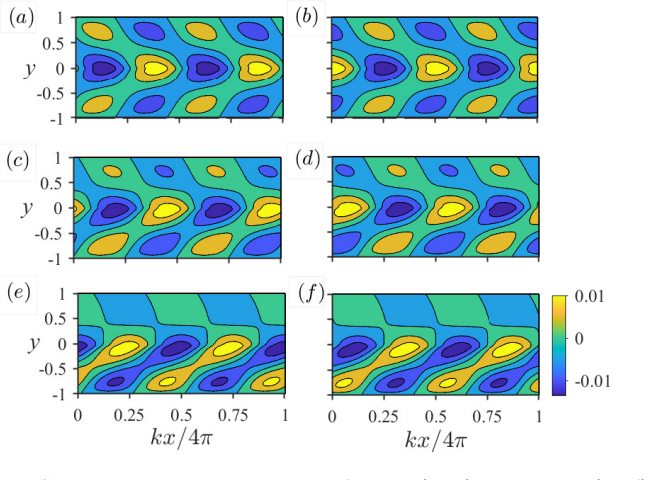
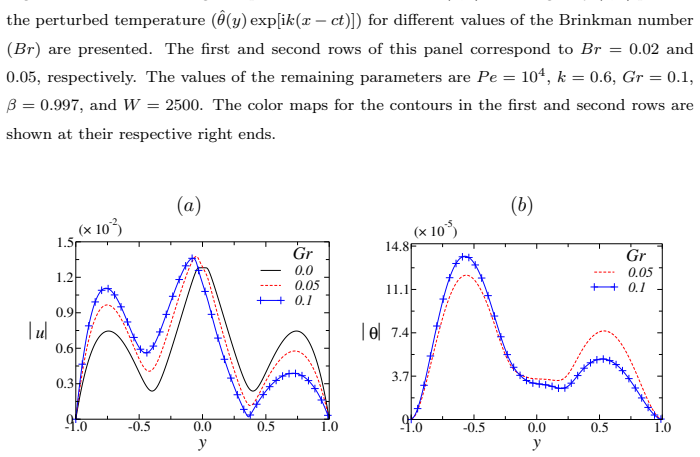
Starting from the isothermal Oldroyd-B channel flow of Khalid et al. (2021b), the paper adds the thermal energy equation with viscous dissipation and a Boussinesq buoyancy force, so no external heating is imposed. For the steady base state, the velocity remains $U=1-y^2$ while the temperature profile becomes $\Theta_0 = (Br/3)(1-y^4)$. The linearized disturbance equations show that increasing $Br$ (viscous heating) or $Gr$ (buoyancy) widens the unstable band of wavenumbers, increases the maximum growth rate, and shifts the neutral curve so that $W_c$ falls from 1490 at $Gr=0$, $Br=0$ to 935 at $Gr=0.05$, $Br=0.05$ and to 797.5 at $Gr=0.1$, $Br=0.05$; the critical wavenumber rises from 1.05 to 2.65. The paper states this as a drastic decrease compared with Khalid et al. and concludes that viscous heating-induced buoyancy destabilizes the purely elastic instability, so the mode should be observable at a much lower Weissenberg number. The mechanism identified is the loss of symmetry of the streamwise velocity eigenfunctions about the channel centerline.
Load-bearing premise
The load-bearing premise is that $Gr$ and $Br$ can be chosen independently in a setup with no external heating, even though the temperature difference that defines both parameters is itself produced by the flow and is therefore fixed once the fluid and speed are chosen.
Editorial extensions
If this is right
- Experiments seeking the purely elastic channel instability should expect onset near $W_c \approx 800$ in systems with viscous heating and buoyancy, not near the isothermal value of 1490.
- The first unstable mode at onset will have a shorter wavelength, since $k_c$ increases from about 1.05 to 2.65 as $Gr$ and $Br$ grow.
- Viscous heating is destabilizing at all wavenumbers in this model whenever buoyancy is included, in contrast to earlier creeping-flow viscoelastic analyses that omitted buoyancy.
- Higher solvent-to-solution viscosity ratio $\beta$ remains stabilizing: raising $\beta$ from 0.993 to 0.997 increases $W_c$ from 358 to 797.5 even with heating present.
Reading between the lines
- If $Gr$ and $Br$ are tied to the same physical temperature difference, with no external heating so that $\Delta T$ is set by the flow speed, then they cannot be varied independently and the reported threshold reduction may not survive a self-consistent parameter scan.
- The predicted asymmetry concentrates disturbance activity in the lower half of the channel, so high-speed imaging or infrared thermography could look for that spatial bias as a signature of heating-driven destabilization.
- The same $(Gr/Re)\theta$ coupling could lower the threshold for neighboring elastic instabilities, such as viscoelastic pipe flow or gravity-driven film flow, a transfer the paper does not make.
- A direct numerical simulation with a fixed flow speed and real fluid properties would settle whether the linear mode saturates into elastic turbulence at the reduced threshold.
Editorial analysis
A structured set of objections, weighed in public.
Referee Report
Summary. The manuscript presents a temporal linear stability analysis of pressure-driven plane Poiseuille flow of an Oldroyd-B fluid, with the energy equation including viscous dissipation and a Boussinesq buoyancy term. The aim is to show that the purely elastic instability identified by Khalid et al. (2021b) is exacerbated (i.e., the critical Weissenberg number is reduced) when viscous heating generates a temperature field that induces buoyancy. The governing equations, base-state solution, linearized perturbation equations, and Chebyshev spectral collocation solution are presented. The numerical implementation is validated against Schmid and Henningson (2001) and Sureshkumar and Beris (1995), and grid convergence is demonstrated. The central quantitative result is a decrease of Wc from 1490 (isothermal baseline) to 797.5 for Gr=0.1, Br=0.05, together with an increase in the critical wavenumber.
Significance. If the physical modelling were correct, the finding that viscous heating-induced buoyancy dramatically lowers the onset Weissenberg number of the purely elastic instability would be of substantial practical interest, as it would imply that such instabilities could be observed in experiments at significantly lower Weissenberg numbers. The manuscript is careful in its linear algebra and provides fully written perturbation equations, a documented numerical method, and validation against several published benchmarks. However, as detailed in the major comments, the parameterization of the temperature field is internally inconsistent and the treatment of Gr and Br as independent parameters is not compatible with the stated no-external-heating scenario. These issues affect the central claim, so the significance of the reported Wc reduction is currently not established.
major comments (2)
- [§2, Eq. (6)] The base-state temperature is given as Θ0 = (Br/3)(1−y^4), which gives Θ0(0)=Br/3. However, the dimensionless temperature is defined in §2 as θ=(T−T0)/(T0−Tc), which requires θ(0)=−1 at the centerline because T(0)=Tc. Even if one interprets ΔT=T0−Tc as a reference scale rather than the actual center-to-wall difference, the actual temperature difference obtained from Eq. (6) is (Br/3)ΔT_ref, so the physical Grashof number is (Br/3)Gr, not Gr. This normalization inconsistency is load-bearing because the reported reductions in Wc rely on assigning independent values to Gr and Br rather than to the product Gr·Br, which is the physically meaningful buoyancy parameter.
- [§1 and §5, Tables 5–6] The paper argues that because Gr is independent of velocity, the term (Gr/Re)θ becomes important as Re→0. In the stated setup there is no external heating, so the temperature rise is solely due to viscous dissipation; consequently the actual center-to-wall temperature difference scales as ηU_m²/κ. The physical Grashof number then scales as U_m² and Gr_phys/Re scales as U_m, which vanishes in the creeping limit. The computations set Re=10^-5 and Gr=0.1, Br=0.05, giving Gr/Re=10^4; such a value is not realizable with internally generated heating at that Reynolds number. The reported decrease of Wc from 1490 to 797.5 is therefore not established for the no-external-heating scenario claimed in the abstract and conclusions.
minor comments (4)
- [§2, Table 4] The text fixes Re=10^-5, but Table 4 lists the Reynolds number range as 10^-3 to 1; please reconcile these values or clarify the intended parameter space.
- [Throughout] The notation contains several typesetting artifacts (e.g., '∇.∇.∇.', 'eeey', 'θ=0aty=±1') that should be corrected.
- [§4, figure 3(a)] The text states that the wavenumber of the most-dangerous mode remains approximately constant, whereas Table 5 shows a substantial increase of the critical wavenumber with Gr; the difference between these two quantities should be stated explicitly.
- [§4] The claim that the asymmetry of the streamwise velocity eigenfunctions is the mechanism behind the destabilization is descriptive; an energy budget or a more direct causality analysis would strengthen the argument.
Circularity Check
No significant circularity: the critical Weissenberg numbers are direct eigenvalues of the linearized Oldroyd-B/Boussinesq system, and the Gr=Br=0 limit recovers the external Khalid et al. benchmark.
full rationale
The central result is obtained by solving a generalized eigenvalue problem, equations (9)-(15) with boundary conditions (16), discretized as Ax=cBx in equation (18). For chosen parameters (Re, Gr, Pe, Br, beta, W), the code computes eigenvalues c, and Wc is read off as the minimum W on the neutral-stability curve ci=0 (Figure 10, Tables 5-7). This is an output of a direct computation, not a parameter fitted to reproduce a target Wc. The paper explicitly notes that the equations reduce to those of Khalid et al. (2021b) when Gr, Br, and Pe are zero, and Tables 1 and 2 validate the solver against independent published eigenvalues (Schmid and Henningson 2001; Sureshkumar and Beris 1995; Khalid et al. 2021a). Thus the baseline is an external benchmark rather than a self-defined input. The cited works involving the present co-author (Sahu and Matar 2010; Sahu et al. 2010; Sahu 2011) supply the standard Boussinesq buoyancy term Gr/Re theta and background on viscous heating; they do not by themselves assert the Oldroyd-B viscoelastic instability threshold obtained here. A physical-consistency concern can be raised separately: the definition theta=(T-T0)/(T0-Tc) and the base-state solution Theta0=(Br/3)(1-y^4) imply Theta0(0)=Br/3 rather than -1, and treating Gr as independent of velocity in a purely internally heated, isothermal-wall flow is physically debatable. However, that is a modeling/correctness question, not a circular derivation. No equation in the paper defines the predicted decrease in Wc in terms of Gr and Br by construction, and no fitted quantity is relabeled as a prediction. The reported Wc values are therefore not circularly forced.
Assumptions & free parameters
free parameters (5)
- Grashof number Gr =
0 to 0.1
- Brinkman number Br =
0 to 0.05
- Péclet number Pe =
10^4
- Reynolds number Re =
10^-5
- solvent-to-solution viscosity ratio β =
0.997 main case
assumptions (5)
- domain assumption Oldroyd-B constitutive equation with constant solution viscosity and no temperature-dependent rheology
- domain assumption Boussinesq approximation with constant density except for the buoyancy term
- domain assumption Base flow is parallel and unidirectional despite a y-dependent buoyancy force
- domain assumption Perturbations are two-dimensional
- ad hoc to paper No external heating; only viscous dissipation creates the temperature field
Cite this review
Pith. "Pith review of Exacerbation of viscoelastic instability due to viscous heating." pith.science (2026). https://pith.science/paper/R2OR5PR4
@misc{pith2026250604617,
  author       = {Pith},
  title        = {Pith review of: Exacerbation of viscoelastic instability due to viscous heating},
  year         = {2026},
  howpublished = {\url{https://pith.science/paper/R2OR5PR4}},
  note         = {Machine review of arXiv:2506.04617}
}
read the original abstract
The linear stability analysis of the pressure-driven flow of an Oldroyd-B fluid through a plane channel is performed to examine the effects of viscous heating-induced buoyancy on the ``purely elastic instability" predicted by \citet{khalid2021continuous} (Phys. Rev. Lett., 2021, 127, 134502). We do not impose any external heating; rather, the temperature increase in the system is solely due to the viscous heating generated by the flow of a highly viscous fluid, which induces buoyancy. This buoyancy effect adds an extra term to the momentum equation, proportional to the ratio of the Grashof and Reynolds numbers. Since the elastic instability manifests at very low Reynolds numbers, this buoyancy term is crucial for determining flow stability. Our analysis indicates a significant decrease in the critical Weissenberg number due to the viscous heating-induced buoyancy effect, implying that the elastic instability could potentially be observed experimentally at a significantly lower Weissenberg number than that predicted by Khalid et al. (2021b). The asymmetry in the streamwise velocity eigenfunctions, resulting from the presence of viscous heating, is found to be the mechanism behind the predicted destabilizing effect.
Figures


Figures from the paper (7 more)




Reference graph
Works this paper leans on
-
[1]
Influence of ener- getics on the stability of viscoelastic Taylor–Couette flow
Al-Mubaiyedh, U.A., Sureshkumar, R., Khomami, B., 1999. Influence of ener- getics on the stability of viscoelastic Taylor–Couette flow. Phys. Fluids 11, 3217–3226
work page 1999
-
[2]
Energetic effects on the stability of viscoelastic dean flow
Al-Mubaiyedh, U.A., Sureshkumar, R., Khomami, B., 2000. Energetic effects on the stability of viscoelastic dean flow. J. Non-Newtonian Fluid Mech. 95, 277–293
work page 2000
-
[3]
Alves, L.S.B., Barletta, A., Hirata, S., Ouarzazi, M.N., 2014. Effects of viscous dissipation on the convective instability of viscoelastic mixed convection flows in porous media. Int. J. Heat Mass Transf. 70, 586–598
work page 2014
-
[4]
The onset of turbulence in pipe flow
Avila, K., Moxey, D., Lozar, A.D., Avila, M., Barkley, D., Hof, B., 2011. The onset of turbulence in pipe flow. Science 333, 192–196
work page 2011
-
[5]
On the thermal instability induced by viscous dissipation
Barletta, A., 2015. On the thermal instability induced by viscous dissipation. Int. J. Therm. Sci. 88, 238–247. 27
work page 2015
-
[6]
Barletta, A., Celli, M., Nield, D.A., 2011. On the onset of dissipation thermal instability for the Poiseuille flow of a highly viscous fluid in a horizontal channel. J. Fluid Mech. 681, 499–514
work page 2011
-
[7]
Convection–dissipation instability in the hor- izontal plane Couette flow of a highly viscous fluid
Barletta, A., Nield, D.A., 2010. Convection–dissipation instability in the hor- izontal plane Couette flow of a highly viscous fluid. J. Fluid Mech. 662, 475–492
work page 2010
-
[8]
The stability of viscoelastic creeping plane shear flows with viscous heating
Becker, L.E., McKinley, G.H., 2000. The stability of viscoelastic creeping plane shear flows with viscous heating. J. Non-Newtonian Fluid Mech. 92, 109–133
work page 2000
Show all 56 references
-
[9]
Optimal and robust control and estimation of linear paths to transition
Bewley, T.R., Liu, S., 1998. Optimal and robust control and estimation of linear paths to transition. J. Fluid Mech. 365, 305–349
1998
-
[10]
Dynamics of Polymeric Liq- uids
Bird, R.B., Armstrong, R.C., Hassager, O., 1987. Dynamics of Polymeric Liq- uids. Vol. 1: Fluid Mechanics. John Wiley and Sons Inc., New York
1987
-
[11]
DNS and LST stability analysis of Oldroyd-B fluid in a flow between two parallel plates
Brandi, A.C., Mendonça, M.T., Souza, L.F., 2019. DNS and LST stability analysis of Oldroyd-B fluid in a flow between two parallel plates. J. Non- Newtonian Fluid Mech. 267, 14–27
2019
-
[12]
SpectralMethods in Fluid Dynamics
Canuto, C., Hussaini, M.Y., Quarteroni, A., Zang, T.A., 1988. SpectralMethods in Fluid Dynamics. Springer Berlin, Heidelberg
1988
-
[13]
Elasto-inertial wall mode instabilities in viscoelastic plane Poiseuille flow
Chaudhary, I., Garg, P., Shankar, V., Subramanian, G., 2019. Elasto-inertial wall mode instabilities in viscoelastic plane Poiseuille flow. J. Fluid Mech. 881, 119–163
2019
-
[14]
Linear instability of viscoelastic pipe flow
Chaudhary, I., Garg, P., Subramanian, G., Shankar, V., 2021. Linear instability of viscoelastic pipe flow. J. Fluid Mech. 908, A11. 28
2021
-
[15]
Exceeding the asymptotic limit of polymer drag reduction
Choueiri, G.H., Lopez, J.M., Hof, B., 2018. Exceeding the asymptotic limit of polymer drag reduction. Phys. Rev. Lett. 120, 124501
2018
-
[16]
Viscous heating effects in fluids with temperature-dependent viscosity: triggering of secondary flows
Costa, A., Macedonio, G., 2005. Viscous heating effects in fluids with temperature-dependent viscosity: triggering of secondary flows. J. Fluid Mech. 540, 21–38
2005
-
[17]
Perspectives on viscoelastic flow instabilities and elastic turbulence
McKinley, G.H., Eggers, J.G., López-Aguilar, J.E., Fielding, S.M., Frishman, A., Graham, M.D., Guasto, J.S., Haward, S.J., Shen, A.Q., Hormozi, S., Mo- rozov, A., Poole, R.J., Shankar, V., Shaqfeh, E.S.G., Stark, H., Steinberg, V., Subramanian, G., Stone, H.A., 2022. Perspecti...
2022
-
[18]
First coherent structure in elasto-inertial turbulence
Dubief, Y., Page, J., Kerswell, R.R., Terrapon, V.E., Steinberg, V., 2022. First coherent structure in elasto-inertial turbulence. Phys. Rev. Fluids 7, 073301
2022
-
[19]
Vis- coelastic pipe flow is linearly unstable
Garg, P., Chaudhary, I., Khalid, M., Shankar, V., Subramanian, G., 2018. Vis- coelastic pipe flow is linearly unstable. Phys. Rev. Lett. 121, 024502
2018
-
[20]
Elastic turbulence in a polymer solution flow
Groisman, A., Steinberg, V., 2000. Elastic turbulence in a polymer solution flow. Nat. Commun. 405, 53–55
2000
-
[21]
Efficient mixing at low Reynolds numbers using polymer additives
Groisman, A., Steinberg, V., 2001. Efficient mixing at low Reynolds numbers using polymer additives. Nature 410, 905–908
2001
-
[22]
Influence d’un écoulement horizontal sur les propriétés linéaires de la convection de fluides viscoélastiques en milieux poreux
Hirata, S.C., Ouarzazi, M.N., 2010. Influence d’un écoulement horizontal sur les propriétés linéaires de la convection de fluides viscoélastiques en milieux poreux. C. R. - Mec. 338, 538–544
2010
-
[23]
Onset of thermal instabilities in the plane Poiseuille flow of weakly elastic fluids: Viscous dissipation effects
Hirata, S.C., Ouarzazi, M.N., 2021. Onset of thermal instabilities in the plane Poiseuille flow of weakly elastic fluids: Viscous dissipation effects. Fluids 6, 432
2021
-
[24]
Stability of plane Poiseuille flow of a highly elastic liquid
Ho, T.C., Denn, M.M., 1977. Stability of plane Poiseuille flow of a highly elastic liquid. J. Non-Newtonian Fluid Mech. 3, 179–195. 29
1977
-
[25]
Universal coherent structures of elastic tur- bulence in straight channel with viscoelastic fluid flow
Jha, N.K., Steinberg, V., 2020. Universal coherent structures of elastic tur- bulence in straight channel with viscoelastic fluid flow. arXiv preprint arXiv:2009.12258
2020 arXiv
-
[26]
Elastic turbulence in a curvilinear channel flow
Jun, Y., Steinberg, V., 2011. Elastic turbulence in a curvilinear channel flow. Phys. Rev. E. 84, 056325
2011
-
[27]
Constitutive Equations for Polymer Melts and Solutions
Larson, R.G., 1988. Constitutive Equations for Polymer Melts and Solutions. Butterworths
1988
-
[28]
Stability of plane Poiseuille and Couette flow of a Maxwell fluid
Lee, K.C., Finlayson, B.A., 1986. Stability of plane Poiseuille and Couette flow of a Maxwell fluid. J. Non-Newtonian Fluid Mech. 21, 65–78
1986
-
[29]
Linearized pipe flow to Reynolds number 107
Meseguer, A., Trefethen, L.N., 2003. Linearized pipe flow to Reynolds number 107. J. Comput. Phys. 186, 178–197
2003
-
[30]
Thermal conductivity of transparent and flexible polymers containing fillers: A literature review
Ngo, I.L., Jeon, S., Byon, C., 2016. Thermal conductivity of transparent and flexible polymers containing fillers: A literature review. Int. J. Heat Mass Transf. 98, 219–226
2016
-
[31]
Effect of viscous heating on linear stability of viscoelastic cone-and-plate flow: axisymmetric case
Olagunju, D.O., Cook, L.P., McKinley, G.H., 2002. Effect of viscous heating on linear stability of viscoelastic cone-and-plate flow: axisymmetric case. J. Non-Newtonian Fluid Mech. 102, 321–342
2002
-
[32]
Accurate solution of the Orr-Sommerfeld stability equation
Orszag, S.A., 1971. Accurate solution of the Orr-Sommerfeld stability equation. J. Fluid Mech. 50, 689–703
1971
-
[33]
Exact traveling wave solutions in viscoelastic channel flow
Page, J., Dubief, Y., Kerswell, R.R., 2020. Exact traveling wave solutions in viscoelastic channel flow. Phys. Rev. Lett. 125, 154501. 30
2020
-
[34]
Mechanics of polymer processing
Pearson, J.R.A., 1985. Mechanics of polymer processing. Elsevier
1985
-
[35]
Viscous heating effects on the linear stability of poiseuille flow of an inelastic fluid
Pinarbasi, A., Imal, M., 2005. Viscous heating effects on the linear stability of poiseuille flow of an inelastic fluid. J. Non-Newtonian Fluid Mech. 127, 67–71
2005
-
[36]
Linear stability of plane Poiseuille flow of viscoelastic liquids
Porteous, K.C., Denn, M.M., 1972. Linear stability of plane Poiseuille flow of viscoelastic liquids. Trans. Soc. Rheol. 16, 295–308
1972
-
[37]
A new elastic instability in gravity-driven viscoelastic film flow
Shankar, V., 2023. A new elastic instability in gravity-driven viscoelastic film flow. Phys. Fluids 35, 073104
2023
-
[38]
Effects of wall- heating on the linear instability characteristics of pressure-driven two-layer channel flow
Reddy, V.T.S.R.K., Janardhanan, V.M., Sahu, K.C., 2011. Effects of wall- heating on the linear instability characteristics of pressure-driven two-layer channel flow. Chem. Eng. Sci. 66, 6272–6279
2011
-
[39]
Non-isothermal modification of purely elastic flow instabilities in torsional flows of polymeric fluids
Rothstein, J.P., McKinley, G.H., 2001. Non-isothermal modification of purely elastic flow instabilities in torsional flows of polymeric fluids. Phys. Fluids 13, 382–396
2001
-
[40]
Viscoelastic effects on the stability of wall-bounded shear flows
Sadanandan, B., Sureshkumar, R., 2002. Viscoelastic effects on the stability of wall-bounded shear flows. Phys. Fluids 14, 41–48
2002
-
[41]
The instability of flow through a slowly diverging pipe with viscous heating
Sahu, K.C., 2011. The instability of flow through a slowly diverging pipe with viscous heating. J. Fluids Eng. 133, 071201
2011
-
[42]
Numerical simulation of non- isothermal pressure-driven miscible channel flow with viscous heating
Sahu, K.C., Ding, H., Matar, O.K., 2010. Numerical simulation of non- isothermal pressure-driven miscible channel flow with viscous heating. Chem. Eng. Sci. 65, 3260–3267
2010
-
[43]
Stability of plane channel flow with viscous heating
Sahu, K.C., Matar, O.K., 2010. Stability of plane channel flow with viscous heating. J. Fluids Eng. 132, 011202
2010
-
[44]
Elasto-inertial turbulence
Hof, B., 2013. Elasto-inertial turbulence. Proc. Natl Acad. Sci. USA 110, 10557–10562. 31 Sánchez, H.A.C., Jovanović, M.R., Kumar, S., Morozov, A., Shankar, V., Subra- manian, G., Wilson, H.J., 2022. Understanding viscoelastic flow instabilities: Oldroyd-B and beyond. J. Non-N...
2013
-
[45]
Stability and Transition in Shear Flows
Schmid, P.J., Henningson, D.S., 2001. Stability and Transition in Shear Flows. Springer
2001
-
[46]
Temporallinearstability analysisofanentryflowinachannelwithviscousheating
Srivastava, H., Dalal, A., Sahu, K.C., Biswas, G., 2017. Temporallinearstability analysisofanentryflowinachannelwithviscousheating. ijhmt109, 922–929
2017
-
[47]
Elastic turbulence: an experimental view on inertialess random flow
Steinberg, V., 2021. Elastic turbulence: an experimental view on inertialess random flow. Ann. Rev. Fluid Mech. 53, 27–58
2021
-
[48]
The stability of plane couette flow with viscous heating
Sukanek, P.C., Goldstein, C.A., Laurence, R.L., 1973. The stability of plane couette flow with viscous heating. J. Fluid Mech. 57, 651–670
1973
-
[49]
Study on improving viscosity of polymer solution based on complex reaction
Sun, G., Li, D., Zhang, D., Xu, T.H., 2018. Study on improving viscosity of polymer solution based on complex reaction. Conf. Ser.: Mater. Sci. Eng. 369, 012045
2018
-
[50]
Linear stability analysis of viscoelastic Poiseuille flow using an arnoldi-based orthogonalization algorithm
Sureshkumar, R., Beris, A.N., 1995. Linear stability analysis of viscoelastic Poiseuille flow using an arnoldi-based orthogonalization algorithm. J. Non- Newtonian Fluid Mech. 56, 151–182
1995
-
[51]
Elastic wake instabilities in a creeping flow between two obstacles
Varshney, A., Steinberg, V., 2017. Elastic wake instabilities in a creeping flow between two obstacles. Phys. Rev. Fluids 2, 051301
2017
-
[52]
Thermodynamics of viscoelastic fluids: the temperature equation
Wapperom, P., Hulsen, M.A., 1998. Thermodynamics of viscoelastic fluids: the temperature equation. J. Rheol. 42, 999–1019
1998
-
[53]
Viscous heating and the stability of Newtonian and viscoelastic Taylor-Couette flows
White, J.M., Muller, S.J., 2000. Viscous heating and the stability of Newtonian and viscoelastic Taylor-Couette flows. Phys. Rev. Lett. 84, 5130
2000
-
[54]
Extensional flows with viscous heating
Wylie, J.J., Huang, H., 2007. Extensional flows with viscous heating. J. Fluid Mech. 571, 359–370. 32
2007
-
[55]
Linear stability analysis of plane couette flow with viscous heating
Yueh, C.S., Weng, C.I., 1996. Linear stability analysis of plane couette flow with viscous heating. Phys. Fluids 8, 1802–1813
1996
-
[56]
Linear stability analysis of channel flow of viscoelastic Oldroyd-B and FENE-P fluids
Zhang, M., Lashgari, I., Zaki, T.A., Brandt, L., 2013. Linear stability analysis of channel flow of viscoelastic Oldroyd-B and FENE-P fluids. J. Fluid Mech. 737, 249–279. 33
2013
Reviewed August 7, 2026 · model on record in the stance chip above.
Discussion (0). Sign in to comment.