REVIEW 3 major objections 4 minor 4 references
Feature extraction in partial wave analysis using $K$-matrix approach
T0 review · 3 major / 4 minor · reviewed 2026-08-07 · deepseek-v4-flash
Pith's one-line read A fully connected neural network trained on K-matrix differential cross sections can label the resonant partial wave at 69% accuracy in a synthetic pion-nucleon-like scattering model.
desk verdict Modest proof-of-concept with a real scale confound: the 69% classification accuracy likely rides on per-partial-wave magnitude differences, not shape. read the letter →
The pith
A machine-rendered reading of the paper's core claim, the machinery that carries it, and where it could break.
The reading
What carries the argument
The load-bearing object is the K-matrix parametrization of the scattering amplitude, $K_{ij}=\sum_\alpha g_{\alpha i}(m)g_{\alpha j}(m)/[(m_\alpha^2-m^2)\sqrt{\rho_i\rho_j}]+a_{ij}+b_{ij}m^2$, with residue functions built from Blatt-Weisskopf centrifugal barrier factors. That K-matrix is converted to the transition amplitude by $T=(I-iK\rho)^{-1}K$, expanded in Legendre polynomials $T(\theta,m^2)=\sum_l(2l+1)T_l(m^2)P_l(\cos\theta)$, and turned into the differential cross section $d\sigma/d\Omega = 4\rho_f/(m^2\rho_i)|T|^2$. The neural network then maps 15 $\cos\theta$ values and 15 $d\sigma/d\Omega$ values to one of five labels, identifying the partial wave whose resonant K-matrix term is active.
What would settle it
Generate a validation set with two resonant partial waves active simultaneously using the same K-matrix parametrization and parameter ranges, and require the network to identify all resonant waves; if accuracy falls to near chance, the reported 69% is an artifact of the one-resonance-per-sample generative model.
Extended reading notes
Core claim
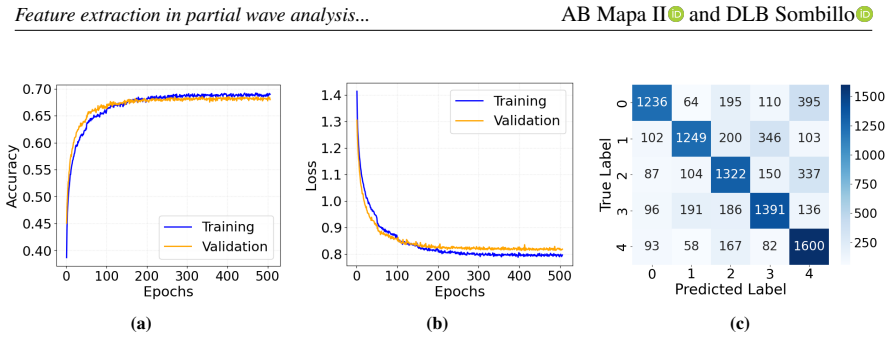
The paper's central claim is that the angular shape of a K-matrix-parametrized differential cross section encodes enough information to identify which partial wave carries the resonance, even when every partial wave also has active non-resonant terms. In the synthetic dataset, exactly one of the five partial waves $l=0,\ldots,4$ has its resonant K-matrix term turned on per sample, and the fully connected network classifies that wave at about 69% accuracy. The confusion matrix shows the network performs best on class 4 and most often confuses classes whose differential cross sections share edge and base features, which the authors interpret as expected from the overlapping plotted shapes. The claim is specifically about this one-resonance-per-sample synthetic problem, not yet about arbitrary experimental data.
Load-bearing premise
The load-bearing premise is that the synthetic dataset, built with only one resonant partial wave per sample and parameter ranges borrowed from pion-nucleon scattering, captures the structure of real partial-wave-analysis classification problems.
Editorial extensions
If this is right
- A trained classifier can flag which of the five partial waves most likely carries a resonance in a new K-matrix-generated differential cross section, shrinking the search space for conventional PWA fits.
- The confusion pattern (classes 1 and 2 spilling into 3 and 4, and class 0 into class 4) identifies the overlapping shape features that limit the current architecture, giving a concrete target for better feature engineering.
- Because training and validation accuracies stay close (68–70%), the model is not memorizing the training set; the gap signals a mild generalization limit rather than overfitting.
- Extending the input to include energy distributions or total cross-section information, as the paper outlines as its next step, is a direct route to improving on the 69% baseline.
Reading between the lines
- My inference: the 69% figure is likely specific to the one-resonance-per-sample generative model; a natural test is to run the same architecture on data with two simultaneously active resonant partial waves and see whether classification degrades.
- My inference: the strong class-4 performance and class-0-to-class-4 confusion suggest the network is keying on high-angular-momentum shape features; an ablation that removes the highest $l$ contributions would test this.
- My inference: feeding the full energy-dependent differential cross section, rather than 15 sampled points per curve, could push accuracy beyond the reported 69%.
Editorial analysis
A structured set of objections, weighed in public.
Referee Report
Summary. The paper describes a machine-learning classification study for partial wave analysis. Synthetic differential cross sections are generated from a K-matrix amplitude in which exactly one partial wave (l=0..4) contains a resonant term and the remaining partial waves contribute non-resonant terms, with parameter ranges inspired by pion-nucleon scattering. A fully-connected neural network with 30 inputs (15 cosθ values and 15 dσ/dΩ values) is trained to classify which partial wave contains the resonance. The authors report about 69% validation accuracy and a confusion matrix, and they conclude that the network can distinguish the resonant partial wave from purely non-resonant partial waves.
Significance. The paper is a proof-of-concept with a clear application: using a fully-connected neural network to identify which partial wave carries a resonance from K-matrix-parametrized differential cross sections. Its strengths are the physically motivated K-matrix parametrization with unitarity and Blatt-Weisskopf barrier factors, the explicit generation of synthetic datasets, and the transparent reporting of a confusion matrix. If the reported performance survives normalization ablations and an independent test-set evaluation, it would support the viability of ML-assisted partial wave analysis for broad or overlapping structures. As it stands, the central claim is plausible but not yet sufficiently established, because a scale artifact has not been ruled out and no baselines are provided.
major comments (3)
- [Section 3 and Section 4, Eq. (4), Fig. 2c] The FCNN input is the raw 30-dimensional vector of 15 cosθ values and 15 dσ/dΩ values with no normalization described, while Section 3 says that the parameters m_α, γ_αi, Γ0_α, a_ij, b_ij are sampled within πN literature-based ranges for each T_l(m^2). If the ranges differ by partial wave, the overall magnitude of dσ/dΩ can be class-discriminative on its own, and the confusion-matrix pattern (class 4 easiest, class 0 frequently misclassified as class 4) is consistent with scale-driven decisions. To support the abstract's claim that the network extracts resonance-location information from the angular dependence, the authors should add an ablation that normalizes each sample (e.g., dividing by its angle-averaged value or maximum) and a baseline trained only on the mean or total cross section. Without such controls, the 69% accuracy does not establish that the network is using the angular shape of the differential cross section.
- [Section 4, Fig. 2] The paper reports training and validation accuracy/loss curves and a confusion matrix, but the number of samples per class, the train/validation split, and whether Fig. 2c is computed on the validation set are not stated. No independent held-out test set and no repeated training runs with different random seeds are reported, so the 'around 69%' figure has no uncertainty estimate. The authors should evaluate on a held-out test set and report the mean plus or minus one standard deviation over several initializations.
- [Section 3, dataset generation] The generative protocol is under-specified: the number of samples per label, the exact probability distributions for m_α, γ_αi, Γ0_α, a_ij, b_ij, the energy sampling step, and the choice of the 15 cosθ values are not given. The phrase 'systematically varied within πN scattering experiment- or literature-based ranges for each T-matrix partial wave amplitude' is ambiguous: if the parameter ranges are l-dependent, the scale confound in my first comment is direct; if they are common, the authors should state that explicitly. This detail is essential for judging representativeness and for reproducibility.
minor comments (4)
- [Section 4, Fig. 2] The sentence beginning 'The term 'class' refers to either the true label or the predicted label, with 'label' to denote...' is confusing; 'label' should simply be defined as the index l of the resonant partial wave.
- [Section 2, Eq. (1)] Please verify the phase-space factor convention in the denominator (√ρ_iρ_j versus ρ_iρ_j) against reference [2].
- [Throughout] 'Smoothening' should be 'smoothing', and 'the model is learning reasonably' would read better as 'the model is learning reasonably well'.
- [Fig. 1 caption] The phrase 'the first three labels' is vague; specify that (a), (b), and (c) correspond to resonant partial waves l=0, 1, and 2, respectively.
Circularity Check
No significant circularity: the 69% result is a supervised-learning benchmark on synthetic K-matrix data, not a derivation that reduces to its inputs.
full rationale
The paper makes no law-like derivation that could be circular. It generates synthetic differential cross sections from the K-matrix equations (1)-(4), assigns each sample a label by activating the resonant term in exactly one partial wave (Section 3), and then trains a fully-connected neural network to reproduce those labels on held-out samples (Section 4). This is standard supervised learning on synthetic data: the input dsigma/dOmega does not contain the label as an explicit feature, and the reported 69% accuracy is a holdout evaluation, not a fitted parameter renamed as a prediction. The references [1]-[3] are external and are not by the present authors, so no self-citation chain is load-bearing. The potential scale confound noted by a skeptical reader is a data-generation and external-validity concern, not a circularity: no quoted equation reduces the network's classification to the generative label by construction, and even if the network exploited overall magnitude, that would be an artifact, not a circular derivation. The paper's central claim is therefore self-contained as a synthetic benchmark, with the limitation that it does not demonstrate transfer to real experimental data; that limitation is a scope issue, not circularity.
Assumptions & free parameters
free parameters (3)
- K-matrix parameter ranges (m_alpha, gamma_alpha_i, Gamma0_alpha, a_ij, b_ij)
- Energy range and angular sampling =
E in [1100, 2800] MeV; cos(theta) in [-1,1]; 15 points per plot
- FCNN hyperparameters =
3 hidden layers; dropout 0.2, 0.2, 0.1; cross-entropy loss
assumptions (5)
- domain assumption K-matrix parametrization of the scattering amplitude preserves unitarity (Eq. 1 from Ref. [2]).
- domain assumption Blatt-Weisskopf barrier factors correctly model the centrifugal barrier for nonzero angular momentum (Eq. 2 from Ref. [3]).
- domain assumption The differential cross section is proportional to |T(theta, m^2)|^2 as given in Eq. (4).
- ad hoc to paper Each sample contains exactly one resonant partial wave and the remaining partial waves are purely non-resonant (Section 3).
- ad hoc to paper The random sampling over the chosen parameter ranges produces a representative training and validation distribution (Section 3).
Cite this review
Pith. "Pith review of Feature extraction in partial wave analysis using $K$-matrix approach." pith.science (2026). https://pith.science/paper/CRVADLVV
@misc{pith2026250604628,
  author       = {Pith},
  title        = {Pith review of: Feature extraction in partial wave analysis using $K$-matrix approach},
  year         = {2026},
  howpublished = {\url{https://pith.science/paper/CRVADLVV}},
  note         = {Machine review of arXiv:2506.04628}
}
abstract
Structures in the invariant mass distribution are often linked to unstable intermediate states or resonances. In experiments, many signals are detected which have broad, overlapping or intricate profiles, which makes their characterization a formidable task. To ascertain whether or not these enhancements are resonances, and to determine their physical parameters, such as the resonance mass, coupling strength, resonance width, and quantum numbers, a tool known as partial wave analysis (PWA) is employed. To ensure unitarity, and to account for superposing states and non-resonant effects in modeling the scattering amplitude, $K$-matrix parametrization is utilized. To factor in the centrifugal effects on the decay rates arising from breakup processes in nonzero angular momenta, the Blatt-Weisskopf barrier factors are incorporated into the formulation. In this study, $K$-matrix parametrized differential cross sections were generated within near-threshold and resonance energy ranges, which served as the training and validation datasets for the Deep Neural Network (DNN). The Fully-Connected Neural Network (FCNN) architecture is applied to facilitate the classification task of this work, which is the discrimination of dominating partial waves in the scattering processes. The DNN model was designed to encompass various two-hadron scattering phenomena. As a stepping-off point, the values of the thresholds, coupling constants, resonance masses and widths, scattering energy ranges, and the decay channels used in this study found their physical inspiration from pion-nucleon ($\pi$$N$) scattering system in the $S$, $P$, $D$, $F$, and $G$ partial waves. The results of the model's performance showed that the DNN can distinguish the partial wave with resonances from the other partial waves with purely non-resonant contributions, at an accuracy of $69\%$.
Figures

Reference graph
Works this paper leans on
-
[1]
Peters, https://doi.org/10.1142/S0217751X06034811 Int
K. Peters, https://doi.org/10.1142/S0217751X06034811 Int. J. Mod. Phys. A. 21 (2006) 5618
-
[2]
S.U. Chung et. al., https://doi.org/10.1002/andp.19955070504 Ann. Phys. 4 (1995) 404
-
[3]
F. von Hippel and C. Quigg, https://doi.org/10.1103/PhysRevD.5.624 Phys. Rev. D 5 (1972) 624
-
[4]
" write newline "" before.all 'output.state := FUNCTION blank.sep after.quote 'output.state := FUNCTION fin.entry output.state after.quoted.block = 'skip 'add.period if write newline FUNCTION new.block output.state before.all = 'skip output.state after.quote = after.quoted.block 'output.state := after.block 'output.state := if if FUNCTION new.sentence out...
Reviewed August 7, 2026 · model on record in the stance chip above.
Discussion (0). Sign in to comment.