REVIEW 4 major objections 5 minor 1 cited by
Text-Aware Real-World Image Super-Resolution via Diffusion Model with Joint Segmentation Decoders
T0 review · 4 major / 5 minor · reviewed 2026-08-07 · deepseek-v4-flash
Pith's one-line read TADiSR, a diffusion SR model with text-aware cross-attention and joint segmentation decoders, claims to substantially improve text legibility, reporting an 18.7% OCR-A gain over HAT on Real-CE.
desk verdict Worth refereeing; the Real-CE OCR-A gain looks real but is not yet established independently. read the letter →
The pith
A machine-rendered reading of the paper's core claim, the machinery that carries it, and where it could break.
The reading
What carries the argument
The two load-bearing components are Text-Aware Cross-Attention (TACA) and the Joint Segmentation Decoders (JSD). TACA extracts, from every cross-attention layer of the U-Net, the response slice corresponding to the single token 'text' in the prompt, concatenates these slices, and projects them with a learned matrix; after LoRA fine-tuning these maps concentrate on textual regions. JSD consists of the VAE image decoder and a symmetric text segmentation decoder that exchange features through Cross-Decoder Interaction Blocks (CDIB), which split each branch's features, exchange half across branches through a sigmoid-gated Hadamard product, and use zero-initialized residual scaling to stabilize training. The segmentation decoder turns the attention maps into text masks, giving the image decoder an explicit structural target.
What would settle it
On a held-out set of real-world text images from unseen domains with human-annotated masks, compute the IoU between TADiSR's predicted text masks and the human masks; if the IoU is no better than that of a model trained without the joint segmentation decoders, the claimed structural benefit of JSD is not supported. Alternatively, retrain the pipeline using masks from a different segmentation model and check whether the OCR-A advantage over HAT persists; a large sensitivity to the mask source would imply the results are an artifact of the specific pseudo-label generator.
Extended reading notes
Core claim
The central discovery is that the cross-attention maps of a pre-trained latent diffusion model, when fine-tuned with LoRA on a joint super-resolution and text-segmentation task, become a reliable spatial indicator of text regions for the token 'text'. These attention maps are linearly projected and fed, together with the denoised latent, into a pair of interacting decoders: the original VAE image decoder and a newly added text segmentation decoder, connected by Cross-Decoder Interaction Blocks. This design lets structural text information flow between the two tasks, and a modified focal loss that weights edge-gradient mismatch by segmentation-confidence sharpens character boundaries. The paper further claims that the accompanying FTSR data-synthesis pipeline, which combines OCR-filtered text patches from recognition datasets with high-quality background images, provides the fine-grained, full-image text masks needed to train such a model at scale.
Load-bearing premise
The method works only if, after LoRA fine-tuning, the cross-attention map for the token 'text' reliably marks the location of text in images the model has not seen, and if the pseudo-ground-truth text masks generated by the fine-tuned SAM-TS model (trained on TextSeg/BTS and applied to CTR and Real-CE) are accurate enough to supervise joint training without systematic bias.
Editorial extensions
If this is right
- A single forward pass of TADiSR produces a full-image super-resolved output with intact text, removing the need for OCR-based detection, cropped text super-resolution, and subsequent fusion used by prior text-SR methods.
- Because the text-awareness comes from tuning attention to a token rather than adding a recognition module, the same recipe can in principle be applied to other under-represented semantic categories by selecting their tokens.
- The FTSR synthesis pipeline is scalable: any text-segmentation or detection dataset can be filtered with OCR and pasted onto high-quality backgrounds, enabling large-scale training data for text-aware restoration.
- Joint training strengthens both tasks: the paper reports that the text masks predicted by TADiSR on degraded real-world photos are finer than those of a dedicated text segmentation model, implying the SR path helps segmentation under degradation.
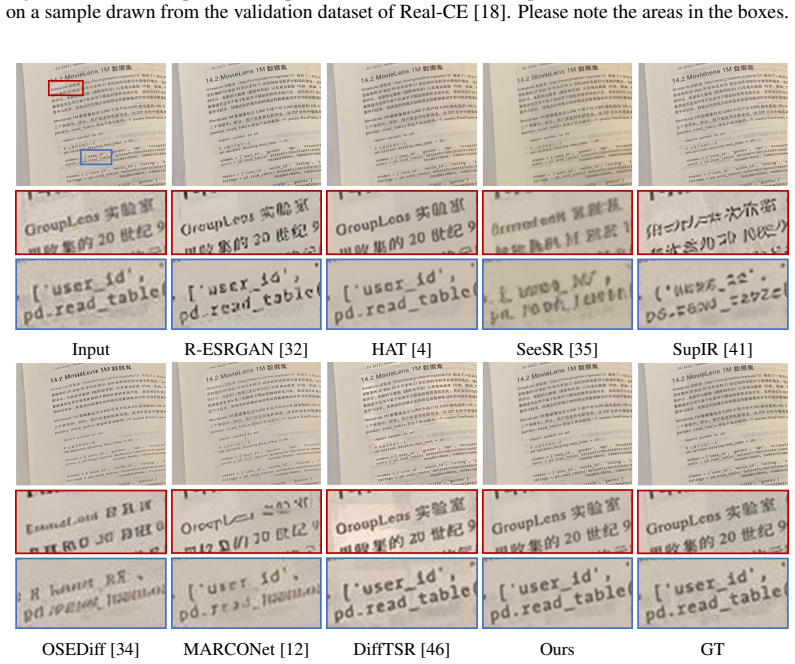
- Across synthetic FTSR and real Real-CE benchmarks, TADiSR reports the best quantitative scores on all reported metrics, with the largest margin on OCR-A, indicating that the improvements transfer from synthetic training to real capture conditions.
Reading between the lines
- The attention-to-token mechanism could be probed as a general spatial localizer: the same LoRA-tuned attention maps might serve as candidate text priors for text inpainting, text removal, or scene text editing without retraining the segmentation head.
- The 18.7% OCR-A gain over HAT suggests that the bottleneck in current generative super-resolution is not raw detail synthesis but the model's failure to 'know' where text is; TADiSR's mechanism is one way to inject that knowledge, and a text-recognition loss at the character level might push accuracy further.
- A natural stress test is domain shift: because the fixed prompt contains only the word 'text', the method may saturate for unusual typefaces, decorative fonts, or low-contrast text; extending the prompt with style tokens (e.g., 'neon sign', 'handwriting') could specialize attention without architectural changes.
- If the FTSR dataset is adopted as a benchmark, its pseudo-GT masks could themselves become a bottleneck; a comparison with human-annotated masks on a subset would tell whether label noise is capping the achievable text fidelity.
Editorial analysis
A structured set of objections, weighed in public.
Referee Report
Summary. This paper proposes TADiSR, a diffusion-based real-world image super-resolution framework that augments a latent diffusion model with text-aware cross-attention and joint segmentation decoders. The authors also introduce the FTSR dataset, constructed by pasting segmentation-masked text patches onto high-quality backgrounds, and report state-of-the-art results on both the synthetic FTSR test set and a manually filtered validation split of Real-CE, including an 18.7% OCR-A improvement over HAT on Real-CE-val. The work addresses the practically important problem of preserving text legibility in super-resolved images and provides extensive qualitative comparisons, including challenging real-world cases.
Significance. If the quantitative claims hold, TADiSR would be a valuable step toward practical, single-pass text-aware super-resolution, offering an alternative to OCR-based pipeline approaches. The paper is clearly written, the architecture is plausible, and the authors include a thorough empirical study with several baselines. However, the evaluation protocol contains weaknesses that currently prevent full confidence in the headline numbers: the Real-CE test set is author-filtered, the OCR metric may be circular with the training data curation, no statistical uncertainty is reported, and the ablations are confined to the synthetic FTSR set. These issues are fixable and do not invalidate the core idea, but they must be addressed before the claimed gains can be accepted.
major comments (4)
- [§4.1, Table 1] The Real-CE evaluation uses only the 189 manually filtered 'aligned' validation pairs, and no results are reported on the full, unfiltered Real-CE validation or test set. Because the filtering criterion is subjective and performed only by the authors, the 18.7% OCR-A gain over HAT could be driven by the removal of hard cases that disproportionately affect baselines. The authors should report metrics on the complete Real-CE test split (or at least the unfiltered validation set), state the exact filtering rule, and release the list of retained sample indices for reproducibility.
- [§3.5 and §4.2] The training-data curation and the OCR-A evaluation rely on the same OCR engine (PP-OCR [7]). Section 3.5 filters pseudo-GT text patches by comparing OCR recognition results between original images and their segmentation maps, and Section 4.2 defines OCR-A using PP-OCR recognition with Levenshtein ratio. This creates a training-evaluation circularity that can inflate the reported OCR gains without improving generic text legibility. The authors should evaluate with at least one independent OCR engine (e.g., Tesseract or a different commercial OCR) and explicitly state whether the evaluation OCR is identical to the one used in data filtering.
- [Table 1 and §4.2] All metrics are reported as point estimates without error bars, confidence intervals, or significance tests. The Real-CE-val set contains only 189 images, yet the paper claims a large 18.7% OCR-A improvement. The authors should provide bootstrap confidence intervals or a paired statistical test (e.g., Wilcoxon signed-rank over images) to demonstrate that the differences are not due to a few outliers.
- [§4.3] The ablation study (Table 2) is conducted only on the synthetic FTSR-TE set, so it does not establish which components are responsible for the real-world gains on Real-CE. The authors should include the same ablations (w/o JSD, w/o TACA, w/o MF Loss) on Real-CE-val, at least for OCR-A, to support the claim that each module contributes to real-world text fidelity.
minor comments (5)
- [Eq. (1)] The symbols alpha_t and beta_t are used without definition; please define them by referencing the diffusion noise schedule (e.g., DDPM notation) or by giving the formulas in the text.
- [§4.2] The OCR-A protocol should clarify whether the same OCR detector/recognizer is used for all methods and whether the recognizer is PP-OCR; the metric definition would be easier to interpret with this information.
- [§4.2] The paper states that baselines are fine-tuned on FTSR and Real-CE using official code 'if provided,' but it does not list which baselines were fine-tuned and which were not. A supplementary table with training details for each baseline would improve reproducibility.
- [Supplementary Fig. 7] The caption acknowledges that 'part of our training segmentation labels were selected from Hi-SAM outputs.' This limits the strength of the segmentation comparison against Hi-SAM and should be mentioned in the main text as a known limitation.
- [Throughout] Minor typographical issues include a stray space in 'V AE,' a missing space in 'Wuet al.,' and 'Flicker2K' should be 'Flickr2K.'
Circularity Check
No significant circularity: the reported gains are empirical outcomes of a trained system, not algebraic consequences of its inputs.
full rationale
The paper's central claim is that TADiSR improves text legibility in real-world super-resolution. The proposed method is an empirical learning system: it fine-tunes a diffusion U-Net with LoRA, adds a segmentation decoder supervised by text masks, and evaluates with image-quality metrics and OCR accuracy. No equation in the paper reduces a predicted quantity to a fitted parameter by construction. The closest potential concern is the overlap between the OCR-based filtering used to construct the FTSR pseudo-labels and the OCR-A metric used for evaluation. However, the paper does not optimize OCR-A or a Levenshtein loss during training, and the filtering step is applied to source text patches before degradation and pasting, so the reported improvements are not statistically forced by the training objective. Likewise, the use of SAM-TS to generate segmentation supervision and Real-CE masks is a label-generation choice, not a self-definitional step: the model is trained to predict those masks, but the headline super-resolution and OCR-A results are measured on held-out images and compare against external baselines. The author-filtered Real-CE-val split and the author-created FTSR-TE set raise questions of benchmark fairness and external validity, but those are correctness risks, not circularity. No load-bearing self-citations or imported uniqueness theorems appear. Accordingly, the derivation chain is self-contained and the circularity score is 0.
Assumptions & free parameters
free parameters (9)
- lambda_1 (LPIPS loss weight) =
5.0
- lambda_2 (modified focal loss weight) =
10.0
- lambda_3 (focal loss weight) =
10.0
- lambda_4 (dice loss weight) =
1.0
- gamma (modified focal exponent)
- diffusion time step t =
200
- LoRA rank
- CDIB layer count N
- FTSR filtering thresholds (long-edge/character ratio and OCR score)
assumptions (5)
- domain assumption The Kolors latent diffusion model provides a sufficiently strong generative prior for real-world super-resolution, including for text regions.
- ad hoc to paper Cross-attention maps to the single token 'text' contain enough spatial localization information to be linearly projected and decoded into an accurate text segmentation mask.
- domain assumption The Real-ESRGAN degradation pipeline is a faithful model of real-world degradations for training.
- domain assumption Pseudo-ground-truth text masks produced by a SAM-TS model fine-tuned on TextSeg/BTS and filtered by OCR are sufficiently accurate to supervise joint training.
- ad hoc to paper A single denoising step at t=200 approximates the full diffusion reverse process well enough for high-quality super-resolution.
Cite this review
Pith. "Pith review of Text-Aware Real-World Image Super-Resolution via Diffusion Model with Joint Segmentation Decoders." pith.science (2026). https://pith.science/paper/G3LZY4RZ
@misc{pith2026250604641,
  author       = {Pith},
  title        = {Pith review of: Text-Aware Real-World Image Super-Resolution via Diffusion Model with Joint Segmentation Decoders},
  year         = {2026},
  howpublished = {\url{https://pith.science/paper/G3LZY4RZ}},
  note         = {Machine review of arXiv:2506.04641}
}
read the original abstract
The introduction of generative models has significantly advanced image super-resolution (SR) in handling real-world degradations. However, they often incur fidelity-related issues, particularly distorting textual structures. In this paper, we introduce a novel diffusion-based SR framework, namely TADiSR, which integrates text-aware attention and joint segmentation decoders to recover not only natural details but also the structural fidelity of text regions in degraded real-world images. Moreover, we propose a complete pipeline for synthesizing high-quality images with fine-grained full-image text masks, combining realistic foreground text regions with detailed background content. Extensive experiments demonstrate that our approach substantially enhances text legibility in super-resolved images, achieving state-of-the-art performance across multiple evaluation metrics and exhibiting strong generalization to real-world scenarios. Our code is available at \href{https://github.com/mingcv/TADiSR}{here}.
Figures


Figures from the paper (12 more)



Forward citations
Cited by 1 Pith paper
-
Restore Text First, Enhance Image Later: Two-Stage Scene Text Image Super-Resolution with Glyph Structure Guidance
A two-stage 'text-first, image-later' super-resolution framework restores glyph structures before enhancing the whole image, improving OCR accuracy and visual quality on a new extreme-zoom Chinese text dataset.
Reference graph
Works this paper leans on
-
[7]
Pp-ocr: A practical ultra lightweight ocr system.arXiv preprint, 2020
Yuning Du, Chenxia Li, Ruoyu Guo, Xiaoting Yin, Weiwei Liu, Jun Zhou, Yifan Bai, Zilin Yu, Yehua Yang, Qingqing Dang, et al. Pp-ocr: A practical ultra lightweight ocr system.arXiv preprint, 2020
work page 2020
-
[1]
Ntire 2017 challenge on single image super-resolution: Dataset and study
Eirikur Agustsson and Radu Timofte. Ntire 2017 challenge on single image super-resolution: Dataset and study. InCVPRW, pages 126–135, 2017
work page 2017
-
[2]
Scene text telescope: Text-focused scene image super-resolution
Jingye Chen, Bin Li, and Xiangyang Xue. Scene text telescope: Text-focused scene image super-resolution. InCVPR, pages 12026–12035, 2021
work page 2021
-
[3]
Jingye Chen, Haiyang Yu, Jianqi Ma, Mengnan Guan, Xixi Xu, Xiaocong Wang, Shaobo Qu, Bin Li, and Xiangyang Xue. Benchmarking chinese text recognition: Datasets, baselines, and an empirical study.arXiv preprint, 2021
work page 2021
-
[4]
Activating more pixels in image super-resolution transformer
Xiangyu Chen, Xintao Wang, Jiantao Zhou, Yu Qiao, and Chao Dong. Activating more pixels in image super-resolution transformer. InCVPR, pages 22367–22377, 2023
work page 2023
-
[5]
Learning a deep convolutional network for image super-resolution
Chao Dong, Chen Change Loy, Kaiming He, and Xiaoou Tang. Learning a deep convolutional network for image super-resolution. InECCV, pages 184–199, 2014
work page 2014
-
[6]
Boosting optical character recognition: A super-resolution approach.arXiv preprint, 2015
Chao Dong, Ximei Zhu, Yubin Deng, Chen Change Loy, and Yu Qiao. Boosting optical character recognition: A super-resolution approach.arXiv preprint, 2015
work page 2015
-
[8]
Sigmoid-weighted linear units for neural network function approximation in reinforcement learning.Neural networks, 107:3–11, 2018
Stefan Elfwing, Eiji Uchibe, and Kenji Doya. Sigmoid-weighted linear units for neural network function approximation in reinforcement learning.Neural networks, 107:3–11, 2018
2018
Show all 46 references
-
[9]
Deep residual learning for image recognition
Kaiming He, Xiangyu Zhang, Shaoqing Ren, and Jian Sun. Deep residual learning for image recognition. InCVPR, pages 770–778, 2016
2016
-
[10]
Gans trained by a two time-scale update rule converge to a local nash equilibrium.NeurIPS, 30, 2017
Martin Heusel, Hubert Ramsauer, Thomas Unterthiner, Bernhard Nessler, and Sepp Hochreiter. Gans trained by a two time-scale update rule converge to a local nash equilibrium.NeurIPS, 30, 2017
2017
-
[11]
Lora: Low-rank adaptation of large language models.ICLR, page 3, 2022
Edward J Hu, Yelong Shen, Phillip Wallis, Zeyuan Allen-Zhu, Yuanzhi Li, Shean Wang, Lu Wang, Weizhu Chen, et al. Lora: Low-rank adaptation of large language models.ICLR, page 3, 2022
2022
-
[12]
Learning generative structure prior for blind text image super-resolution
Xiaoming Li, Wangmeng Zuo, and Chen Change Loy. Learning generative structure prior for blind text image super-resolution. InCVPR, pages 10103–10113, 2023
2023
-
[13]
Lsdir: A large scale dataset for image restoration
Yawei Li, Kai Zhang, Jingyun Liang, Jiezhang Cao, Ce Liu, Rui Gong, Yulun Zhang, Hao Tang, Yun Liu, Denis Demandolx, et al. Lsdir: A large scale dataset for image restoration. InCVPRW, pages 1775–1787, 2023
2023
-
[14]
Details or artifacts: A locally discriminative learning approach to realistic image super-resolution
Jie Liang, Hui Zeng, and Lei Zhang. Details or artifacts: A locally discriminative learning approach to realistic image super-resolution. InCVPR, pages 5657–5666, 2022
2022
-
[15]
Focal loss for dense object detection
Tsung-Yi Lin, Priya Goyal, Ross Girshick, Kaiming He, and Piotr Dollár. Focal loss for dense object detection. InICCV, pages 2980–2988, 2017
2017
-
[16]
Diffbir: Toward blind image restoration with generative diffusion prior
Xinqi Lin, Jingwen He, Ziyan Chen, Zhaoyang Lyu, Bo Dai, Fanghua Yu, Yu Qiao, Wanli Ouyang, and Chao Dong. Diffbir: Toward blind image restoration with generative diffusion prior. InECCV, pages 430–448, 2024
2024
-
[17]
Structure-preserving image super-resolution
Cheng Ma, Yongming Rao, Jiwen Lu, and Jie Zhou. Structure-preserving image super-resolution. TPAMI, 44(11):7898–7911, 2021
2021
-
[18]
A benchmark for chinese-english scene text image super-resolution
Jianqi Ma, Zhetong Liang, Wangmeng Xiang, Xi Yang, and Lei Zhang. A benchmark for chinese-english scene text image super-resolution. InICCV, pages 19452–19461, 2023
2023
-
[19]
A text attention network for spatial deformation robust scene text image super-resolution
Jianqi Ma, Zhetong Liang, and Lei Zhang. A text attention network for spatial deformation robust scene text image super-resolution. InCVPR, pages 5911–5920, 2022. 10
2022
-
[20]
Plugnet: Degradation aware scene text recognition supervised by a pluggable super-resolution unit
Yongqiang Mou, Lei Tan, Hui Yang, Jingying Chen, Leyuan Liu, Rui Yan, and Yaohong Huang. Plugnet: Degradation aware scene text recognition supervised by a pluggable super-resolution unit. InECCV, pages 158–174, 2020
2020
-
[21]
Content-aware local gan for photo-realistic super-resolution
JoonKyu Park, Sanghyun Son, and Kyoung Mu Lee. Content-aware local gan for photo-realistic super-resolution. InICCV, pages 10585–10594, 2023
2023
-
[22]
Addison-Wesley Longman Publishing Co., Inc., 1987
Richard A Roberts and Clifford T Mullis.Digital signal processing. Addison-Wesley Longman Publishing Co., Inc., 1987
1987
-
[23]
High- resolution image synthesis with latent diffusion models
Robin Rombach, Andreas Blattmann, Dominik Lorenz, Patrick Esser, and Björn Ommer. High- resolution image synthesis with latent diffusion models. InCVPR, pages 10684–10695, 2022
2022
-
[24]
Glu variants improve transformer.arXiv preprint, 2020
Noam Shazeer. Glu variants improve transformer.arXiv preprint, 2020
2020
-
[25]
What the daam: Interpreting stable diffusion using cross attention
Raphael Tang, Linqing Liu, Akshat Pandey, Zhiying Jiang, Gefei Yang, Karun Kumar, Pontus Stenetorp, Jimmy Lin, and Ferhan Ture. What the daam: Interpreting stable diffusion using cross attention. InComputational Linguistics, 2023
2023
-
[26]
Kolors: Effective training of diffusion model for photorealistic text-to-image synthesis.arXiv preprint, 2024
Kolors Team. Kolors: Effective training of diffusion model for photorealistic text-to-image synthesis.arXiv preprint, 2024
2024
-
[27]
Ntire 2017 challenge on single image super-resolution: Methods and results
Radu Timofte, Eirikur Agustsson, Luc Van Gool, Ming-Hsuan Yang, and Lei Zhang. Ntire 2017 challenge on single image super-resolution: Methods and results. InCVPRW, pages 114–125, 2017
2017
-
[28]
Attention is all you need.NeurIPS, 30, 2017
Ashish Vaswani, Noam Shazeer, Niki Parmar, Jakob Uszkoreit, Llion Jones, Aidan N Gomez, Łukasz Kaiser, and Illia Polosukhin. Attention is all you need.NeurIPS, 30, 2017
2017
-
[29]
Exploiting diffusion prior for real-world image super-resolution.IJCV, 132(12):5929–5949, 2024
Jianyi Wang, Zongsheng Yue, Shangchen Zhou, Kelvin CK Chan, and Chen Change Loy. Exploiting diffusion prior for real-world image super-resolution.IJCV, 132(12):5929–5949, 2024
2024
-
[30]
Scene text image super-resolution in the wild
Wenjia Wang, Enze Xie, Xuebo Liu, Wenhai Wang, Ding Liang, Chunhua Shen, and Xiang Bai. Scene text image super-resolution in the wild. InECCV, pages 650–666, 2020
2020
-
[31]
Textsr: Content-aware text super-resolution guided by recognition.arXiv preprint, 2019
Wenjia Wang, Enze Xie, Peize Sun, Wenhai Wang, Lixun Tian, Chunhua Shen, and Ping Luo. Textsr: Content-aware text super-resolution guided by recognition.arXiv preprint, 2019
2019
-
[32]
Real-esrgan: Training real-world blind super-resolution with pure synthetic data
Xintao Wang, Liangbin Xie, Chao Dong, and Ying Shan. Real-esrgan: Training real-world blind super-resolution with pure synthetic data. InICCV, pages 1905–1914, 2021
1905
-
[33]
Sinsr: diffusion-based image super-resolution in a single step
Yufei Wang, Wenhan Yang, Xinyuan Chen, Yaohui Wang, Lanqing Guo, Lap-Pui Chau, Ziwei Liu, Yu Qiao, Alex C Kot, and Bihan Wen. Sinsr: diffusion-based image super-resolution in a single step. InCVPR, pages 25796–25805, 2024
2024
-
[34]
One-step effective diffusion network for real-world image super-resolution.NeurIPS, 37:92529–92553, 2024
Rongyuan Wu, Lingchen Sun, Zhiyuan Ma, and Lei Zhang. One-step effective diffusion network for real-world image super-resolution.NeurIPS, 37:92529–92553, 2024
2024
-
[35]
Seesr: Towards semantics-aware real-world image super-resolution
Rongyuan Wu, Tao Yang, Lingchen Sun, Zhengqiang Zhang, Shuai Li, and Lei Zhang. Seesr: Towards semantics-aware real-world image super-resolution. InCVPR, pages 25456–25467, 2024
2024
-
[36]
Group normalization
Yuxin Wu and Kaiming He. Group normalization. InECCV, pages 3–19, 2018
2018
-
[37]
Rethinking text segmentation: A novel dataset and a text-specific refinement approach
Xingqian Xu, Zhifei Zhang, Zhaowen Wang, Brian Price, Zhonghao Wang, and Humphrey Shi. Rethinking text segmentation: A novel dataset and a text-specific refinement approach. In CVPR, pages 12045–12055, 2021
2021
-
[38]
Bts: a bi-lingual benchmark for text segmentation in the wild
Xixi Xu, Zhongang Qi, Jianqi Ma, Honglun Zhang, Ying Shan, and Xiaohu Qie. Bts: a bi-lingual benchmark for text segmentation in the wild. InCVPR, pages 19152–19162, 2022
2022
-
[39]
Pixel-aware stable diffusion for realistic image super-resolution and personalized stylization
Tao Yang, Rongyuan Wu, Peiran Ren, Xuansong Xie, and Lei Zhang. Pixel-aware stable diffusion for realistic image super-resolution and personalized stylization. InECCV, pages 74–91, 2024. 11
2024
-
[40]
Hi-sam: Marrying segment anything model for hierarchical text segmentation.TPAMI, 2024
Maoyuan Ye, Jing Zhang, Juhua Liu, Chenyu Liu, Baocai Yin, Cong Liu, Bo Du, and Dacheng Tao. Hi-sam: Marrying segment anything model for hierarchical text segmentation.TPAMI, 2024
2024
-
[41]
Scaling up to excellence: Practicing model scaling for photo-realistic image restoration in the wild
Fanghua Yu, Jinjin Gu, Zheyuan Li, Jinfan Hu, Xiangtao Kong, Xintao Wang, Jingwen He, Yu Qiao, and Chao Dong. Scaling up to excellence: Practicing model scaling for photo-realistic image restoration in the wild. InCVPR, pages 25669–25680, 2024
2024
-
[42]
Resshift: Efficient diffusion model for image super-resolution by residual shifting.NeurIPS, 36:13294–13307, 2023
Zongsheng Yue, Jianyi Wang, and Chen Change Loy. Resshift: Efficient diffusion model for image super-resolution by residual shifting.NeurIPS, 36:13294–13307, 2023
2023
-
[43]
A normalized levenshtein distance metric.TPAMI, 29(6):1091–1095, 2007
Li Yujian and Liu Bo. A normalized levenshtein distance metric.TPAMI, 29(6):1091–1095, 2007
2007
-
[44]
Designing a practical degradation model for deep blind image super-resolution
Kai Zhang, Jingyun Liang, Luc Van Gool, and Radu Timofte. Designing a practical degradation model for deep blind image super-resolution. InICCV, pages 4791–4800, 2021
2021
-
[45]
The un- reasonable effectiveness of deep features as a perceptual metric
Richard Zhang, Phillip Isola, Alexei A Efros, Eli Shechtman, and Oliver Wang. The un- reasonable effectiveness of deep features as a perceptual metric. InCVPR, pages 586–595, 2018
2018
-
[46]
Diffusion-based blind text image super-resolution
Yuzhe Zhang, Jiawei Zhang, Hao Li, Zhouxia Wang, Luwei Hou, Dongqing Zou, and Liheng Bian. Diffusion-based blind text image super-resolution. InCVPR, pages 25827–25836, 2024. 12 A FTSR Synthetic Dataset Visualization To further illustrate the construction and diversity of our ...
2024
Reviewed August 7, 2026 · model on record in the stance chip above.
Discussion (0). Sign in to comment.