REVIEW 6 minor 15 references
Mis\`ere Greedy Nim and Mis\`ere Bounded Greedy Nim
T0 review · 0 major / 6 minor · reviewed 2026-08-07 · deepseek-v4-flash
Pith's one-line read This paper proves exactly which positions are losing in misère k-Bounded Greedy Nim and in misère Greedy Nim.
desk verdict Solid misère classification for two Nim variants; the induction checks out on inspection, with only minor presentation defects. read the letter →
The pith
A machine-rendered reading of the paper's core claim, the machinery that carries it, and where it could break.
The reading
What carries the argument
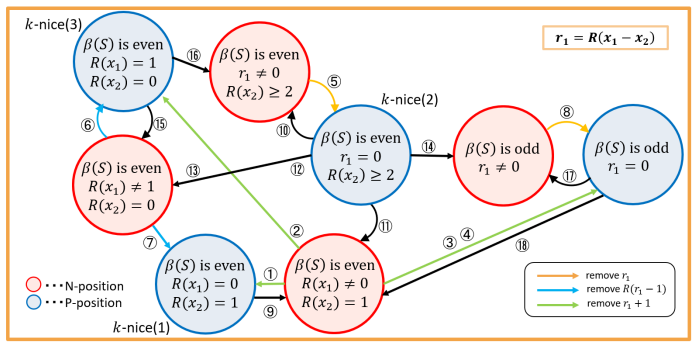
The argument runs on three named objects. R(a) is the remainder of a modulo k+1. A pair (x1,x2) is k-nice if it satisfies one of three remainder conditions, and a triple (x1,x2,x3) is k-good if it satisfies one of three analogous conditions; these residues are exactly what make a move land on a P-position or avoid doing so. β(S) counts how many heaps equal the third heap, which controls whether the normal-play criterion still applies. A stable move removes t stones without dropping the first heap below the second, so it preserves β and the lower heaps; Lemma 1 then guarantees no stable move from a claimed P-position lands on another claimed P-position, and the two state-transition diagrams enumerate the remaining unstable moves.
What would settle it
Brute-force the games for small k and small total stones: enumerate all reachable positions by retrograde analysis and compare the computed P-positions with the four conditions of Theorem 3 and the two conditions of Theorem 5. The first mismatch—a position satisfying the stated conditions with a move to another such position, or a position failing the conditions with no move to one—would refute the characterization.
Extended reading notes
Core claim
On the paper's own terms, the contribution is Theorem 3 and Theorem 5. For misère k-Bounded Greedy Nim, a position S=(x1,...,xn) is a P-position exactly when its third-heap size and the parity of β(S), the repeat count of x3, select one of four cases: with x3≤1 and β even the pair (x1,x2) must be k-nice; with x3≤1 and β odd the remainder R(x1−x2) must be 0; with x3≥2 and β even R(x1−x2)=0; and with x3≥2 and β odd the triple (x1,x2,x3) must be k-good. For misère Greedy Nim, S is a P-position exactly when x1≤1 and the multiplicity α(S) of the largest heap is odd, or x1≥2 and α(S) is even. The proof is inductive and proceeds through state-transition diagrams, treating moves that keep the first heap above the second as stable and handling all other moves case by case.
Load-bearing premise
The proof's induction assumes the state-transition diagrams and the numbered case analyses cover every legal move from every position; if some transition is omitted or mislabeled, the induction step would not establish all P-positions.
Editorial extensions
If this is right
- Every position in either game can be classified as N or P by reading a few heap sizes and counting repeats, so no recursive search is needed.
- The constructive necessity proofs give an explicit winning move from every N-position: remove r1, r1+1, or R(r1−1) stones according to which k-nice or k-good condition fails.
- For misère Greedy Nim, positions with largest heap at least 2 are standard, meaning their outcome agrees with normal play, while positions with largest heap 0 or 1 are singular, meaning it disagrees.
- Because Greedy Nim coincides with k-Bounded Greedy Nim when k is at least the largest heap, Theorem 3 yields an alternative derivation of Theorem 5, as the paper notes.
Reading between the lines
- Extension: the same remainder grammar may extend to allied greedy rules, since the proof isolates the role of the second- and third-largest heaps and the parity of equal heaps.
- Extension: the linear-time classification could serve as a stepping stone toward fast Grundy-value computation for Greedy Nim, which the paper leaves open.
- Extension: the sharp behavior change at x3≤1 versus x3≥2 suggests a general pattern for misère versions of solved normal-play games: the misère rule only bites when few large heaps remain.
Editorial analysis
A structured set of objections, weighed in public.
Referee Report
Summary. This paper solves the misère play counterparts of two impartial stone-removal games. For misère k-Bounded Greedy Nim, Theorem 3 gives a complete four-case characterization of P-positions in terms of x3, β(S), R(x1-x2), and the k-nice/k-good conditions, proved by induction on the total number of stones with an extensive residue-class case analysis. For misère Greedy Nim, Theorem 5 characterizes P-positions by the largest heap value x1 and the multiplicity α(S), with a direct induction proof and a remark that the result also follows from Theorem 3 by taking k at least x1. The paper also explains why the misère quotient framework is not directly applicable to these games.
Significance. If correct, the paper provides the first complete misère outcome classification for both games, extending the normal-play theorems of Xu and Zhu and of Albert and Nowakowski. The proofs are self-contained, the characterizations are linear-time checkable, and the Greedy Nim result gives a clean singular/standard position dichotomy. The k-Bounded result is the main technical contribution; Greedy Nim is a comparatively short corollary. The manuscript does not rely on numerical fitting or computation, and the case analysis is internally consistent on the portions I checked.
minor comments (6)
- [Definition 4 and Section 3.2.1] Definition 4 says x1 and x2 are positive integers, but the base cases evaluate k-nice at (0,0) for the empty position and at (1,0) for a one-stone position. The definition should allow non-negative integers, or the base cases should be handled without invoking k-nice for x2=0.
- [Section 3.2.1] For the one-stone position, the text states 'since R(x1)=0 and R(x2)=1, (x1,x2) satisfies (3) of the definition of k-nice'; this is backwards. For S=(1,0,...,0), the relevant values are R(x1)=1 and R(x2)=0, which is condition (3). The current sentence describes condition (1).
- [Theorem 5 proof] The induction in the proof of Theorem 5 does not explicitly state the base case for the empty position and compresses the parity argument for positions with x1=1. Please state the base cases and explicitly justify that for α(S)>1 odd the unique move reaches a position with α even, which is not a P-position under the stated condition.
- [Sections 3.2.3 and 3.2.4] The proof organization relies on the state-transition diagrams in Figures 1 and 2, but the diagrams are not visible in the manuscript text as supplied. A sentence describing the partition of legal moves into the enumerated arrow cases, independent of the figures, would make the exhaustiveness of the induction self-contained.
- [Section 3.2.4, Sufficiency, Case 2] In the sentence 'We will show that S' is not in P if (x1,x2) satisfies (1), (2) or (3) of the definition of k-good', the pair should be the triple (x1,x2,x3), consistent with the rest of the paragraph.
- [Section 4.2] The remark that Theorem 5 can be derived from Theorem 3 by assuming k is at least x1 would benefit from an explicit note that positions of Greedy Nim are padded with zero heaps to satisfy the n≥4 convention used in Theorem 3.
Circularity Check
No circularity: the misère classifications are derived by induction from move rules and use external normal-play theorems only as benchmarks.
full rationale
The paper's derivation chain is self-contained and non-circular. Theorem 3 is proved by induction on the total number of stones, with explicit case splits for x3 ≤ 1 and x3 ≥ 2. Each necessity direction constructs a legal move (t = r1, r1 + 1, or R(r1 − 1)) and verifies, by the induction hypothesis, that the follower satisfies the stated P-position conditions; each sufficiency direction shows that every follower fails those conditions, using stable-move Lemma 1 and the relevant residue definitions. The definitions of k-nice and k-good are independent of the misère P-position set, and the normal-play classification of Xu and Zhu [14] is used only as an external result, not as the misère conclusion. Theorem 5 has an independent direct induction proof in Section 4.2, explicitly proving that positions with x1 ≤ 1 are singular and positions with x1 ≥ 2 are standard, with a separate argument for x2 ≥ 2; the note that Theorem 5 can also be derived from Theorem 3 is a consistency observation, not a load-bearing citation. No fitted parameters are renamed as predictions, and the cited external theorems (Xu–Zhu, Albert–Nowakowski) are not authored by the present paper's authors, so no self-citation chain is load-bearing. Minor presentational issues, such as Definition 4 saying positive integers while the base case uses x2 = 0, do not affect the logical dependency structure.
Assumptions & free parameters
assumptions (4)
- domain assumption Normal-play Greedy Nim outcome is determined by the parity of α(S), as stated in Theorem 4 of Albert and Nowakowski.
- domain assumption Positions may be padded with zero heaps to assume n≥4 without changing game outcomes.
- standard math The misère terminal position with no stones is an N-position, and induction on total stones is well-founded from totals 0 and 1.
- domain assumption The k-good condition is imported from Xu and Zhu's normal-play solution of k-Bounded Greedy Nim.
Cite this review
Pith. "Pith review of Mis\`ere Greedy Nim and Mis\`ere Bounded Greedy Nim." pith.science (2026). https://pith.science/paper/N3QDPJR4
@misc{pith2026250604657,
  author       = {Pith},
  title        = {Pith review of: Mis\`ere Greedy Nim and Mis\`ere Bounded Greedy Nim},
  year         = {2026},
  howpublished = {\url{https://pith.science/paper/N3QDPJR4}},
  note         = {Machine review of arXiv:2506.04657}
}
read the original abstract
In this paper, we analyze the mis\`ere versions of two impartial combinatorial games: k-Bounded Greedy Nim and Greedy Nim. We present a complete solution to both games by showing necessary and sufficient conditions for a position to be P-positions.
Figures

Reference graph
Works this paper leans on
-
[1]
Michael H. Albert and Richard J. Nowakowski. Nim restrictions. Integers: Electronic Journal of Combinatorial Number Theory , 4(G01):G01, 2004
work page 2004
-
[2]
Elwyn R. Berlekamp, John H. Conway, and Richard K. Guy. Winning ways for your mathematical plays, volume 4 . AK Peters/CRC Press, 2004
work page 2004
-
[3]
Charles L. Bouton. Nim, a game with a complete mathematical theory. Annals of mathematics , 3(1/4):35–39, 1901
work page 1901
-
[4]
Thomas Rayner Dawson. Caissa’s Wild Roses . Number 1. TR Dawson, 1935
work page 1935
-
[5]
The Canterbury Puzzles
Henry Ernest Dudeney. The Canterbury Puzzles . Courier Corporation, 2002
2002
-
[6]
P. M. Grundy. Mathematics and games. Eureka, 2:6–8, 1939
work page 1939
-
[7]
P. M. Grundy and C. A. B. Smith. Disjunctive games with the last player losing. Mathematical Proceedings of the Cambridge Philosophical Society , 52(3):527–533, 1956
work page 1956
-
[8]
S. C. Locke and B. Handley. Amalgamation Nim. Integers: Electronic Journal of Combinatorial Number Theory , 21, 2021
work page 2021
Show all 15 references
-
[9]
Plambeck and Aaron N
Thane E. Plambeck and Aaron N. Siegel. Mis` ere quotients for impartial games. Journal of Combinatorial Theory, Series A , 115(4):593–622, 2008
2008
-
[10]
Schwartz
Benjamin L. Schwartz. Some extensions of Nim. Mathematics Magazine , 44(5):252–257, 1971
1971
-
[11]
R. Sprague. ¨Uber mathematische kampfspiele. Tohoku Mathematical Jour- nal, First Series , 41:438–444, 1935
1935
-
[12]
C. P. Welter. The advancing operation in a special abelian group. In Inda- gationes Mathematicae (Proceedings), volume 55, pages 304–314. Elsevier, 1952
1952
-
[13]
W. A. Wythoff. A modification of the game of Nim. Nieuw Archief voor Wiskunde, 7(2):199–202, 1907
1907
-
[14]
Bounded greedy Nim
Rongxing Xu and Xuding Zhu. Bounded greedy Nim. Theoretical Computer Science, 746:1–5, 2018
2018
-
[15]
On misere Nim-type games
Yohei Yamasaki. On misere Nim-type games. Journal of the Mathematical Society of Japan , 32(3):461–475, 1980. 15
1980
Reviewed August 7, 2026 · model on record in the stance chip above.
Discussion (0). Sign in to comment.