REVIEW 3 major objections 5 minor 44 references
Prompting LLMs: Length Control for Isometric Machine Translation
T0 review · 3 major / 5 minor · reviewed 2026-08-07 · deepseek-v4-flash
Pith's one-line read Precise length control in few-shot LLM translation requires extreme short demonstrations whose instruction wording matches them; isometric demonstrations alone do not shorten output.
desk verdict Useful empirical recipe for length-controlled MT, but the causal claim that extreme demonstrations are necessary is not supported by the paper's own zero-shot results. read the letter →
The pith
A machine-rendered reading of the paper's core claim, the machinery that carries it, and where it could break.
The reading
What carries the argument
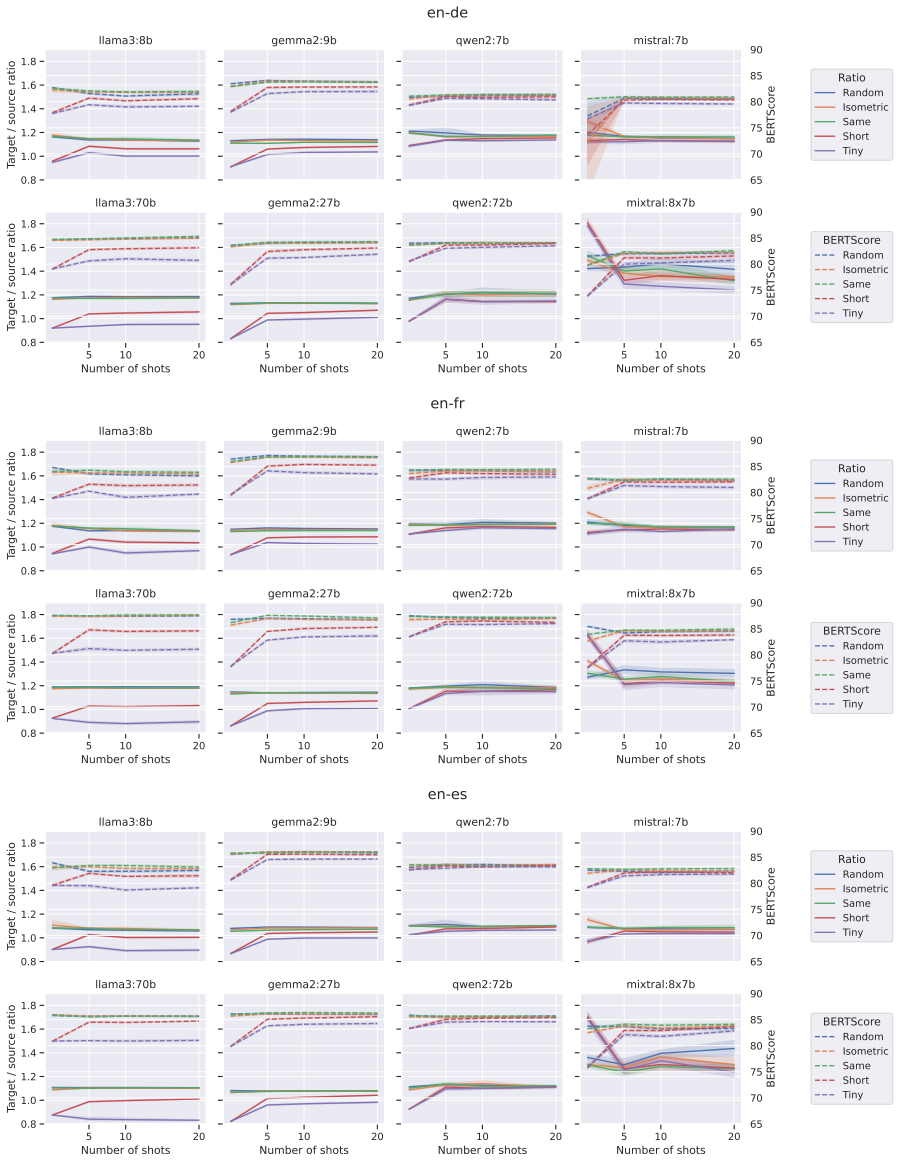
The load-bearing mechanism is the pairing of a prompt template's length instruction with a demonstration pool built to embody that instruction. The paper defines five pools from the MuST-C devset by target/source length ratio: Random (unfiltered), Isometric (ratio in $[0.9, 1.1]$), Same (the 50 closest to ratio $1.0$), Short (ratio $\le 1.0$), and Tiny (the 50 smallest ratios, averaging about $0.6$--$0.68$). For each pool the prompt is reworded to match ("ensure it is shorter than the source", "within $\pm 10\%$", etc.), and the matched-pair setting is what produces large length shifts: Tiny/Short pools push En→De ratios down to roughly $0.9$--$1.05$ depending on model, while Isometric and Same pools leave ratios near the Random baseline. A second mechanism is overgeneration control: instructing the model to "output only the translation" and cutting generated text at the first newline prevents explanations from inflating length. The final component is multi-output selection: ten independent 10-shot prompts from the Tiny pool, length filtering, and COMETKIWI reranking.
What would settle it
Run the authors' best 10-shot Tiny setting on a held-out set of YouTube-dialogue sentences, but replace the Tiny demonstrations with Random ones while keeping the "shorter than the source" instruction. If length compliance (within $\pm 10\%$) does not visibly exceed the Random-pool baseline, the central claim that extreme demonstrations drive length control is falsified for that domain.
Extended reading notes
Core claim
The paper's central claim is that effective length control in few-shot LLM translation is not a matter of adding length instructions or demonstrations by themselves; it is a matter of alignment. A prompt that asks for a shorter translation accompanied by examples that are drastically shorter (the Tiny pool, the fifty shortest devset translations) reliably compresses output length ratios, while demonstrations that merely satisfy the isometric $\pm 10\%$ constraint, or that almost exactly match source length, leave the output ratio close to the unconstrained value. The authors show this across eight open-weight models (Llama 3, Gemma 2, Qwen 2, Mistral, Mixtral) and three directions (En→De, En→Fr, En→Es), and they connect it to a mechanism claim: when instruction and demonstrations agree, the model shifts its implicit length prior; when they disagree, the demonstrations are effectively ignored. On top of this, they show that taking ten outputs from ten different Tiny demonstration sets, discarding all outputs outside the $\pm 10\%$ band, and ranking the survivors with COMETKIWI reaches BERTScore/BLEU competitive with or above the 2022 IWSLT isometric-shared-task baselines and several submissions, with the best results for En→De and En→Es and a clear path to synthetic data creation.
Load-bearing premise
The paper's length-control results on the shared-task blind test set rest on the assumption that demonstration pools drawn from the MuST-C devset transfer their effect to a different genre of YouTube-dialogue test sentences; if the genre mismatch changes how models follow the demonstration-length signal, the final-evaluation gains would not generalize.
Editorial extensions
If this is right
- Few-shot length control in LLMs can be engineered without fine-tuning: choosing the shortest available translations as demonstrations and wording the instruction to match them is enough to move output length toward the target.
- Isometric demonstrations are not a neutral control; because typical translations are longer than their sources, giving isometric or same-length examples tells the model nothing it does not already assume, so length compliance stays near the unconstrained level.
- Generating multiple outputs (e.g., ten) from independent Tiny demonstration sets and selecting a length-compliant one by reference-free quality score gives a practical recipe for isometric MT and a source of synthetic training data.
- Beyond five or ten demonstrations, additional shots bring little translation-quality gain, but the demonstration-selection effect on length is robust across model families and language pairs.
- The approach reaches state-of-the-art trade-offs for En→De and En→Es against the 2022 shared-task submissions, while En→Fr still trails the strong baseline.
Reading between the lines
- The Tiny-pool effect suggests that LLMs use few-shot examples as a prior over output length rather than as a constraint; a testable extension is to sweep demonstration ratios continuously (e.g., 0.5, 0.7, 0.9, 1.0) and check whether the output length ratio is a monotone function of the pool's average ratio.
- The instruction-alignment finding likely generalizes to other soft constraints that are underrepresented in the training distribution, such as formality or verbosity: when the desired property is rare in typical outputs, extreme aligned demonstrations may be needed, and mismatched prompts will be silently ignored.
- In production, the 10-output reranking pipeline could be replaced by an adaptive strategy: start with the uncontrolled prompt, and only for non-compliant outputs retry with Tiny demonstrations, cutting cost roughly in half since about half the samples are already compliant.
- Because all models were quantized, the absolute quality numbers are likely understated; the length-control mechanism, being a relative effect between pools, is probably unaffected, and testing on unquantized models would be a cheap way to check.
Editorial analysis
A structured set of objections, weighed in public.
Referee Report
Summary. The paper investigates prompting strategies for length-controlled (isometric) machine translation with eight open-weight LLMs across En→De, En→Fr, and En→Es. It compares four instruction types (Random, Isometric, Same, Short/Tiny) paired with demonstration pools of matching or non-matching length properties, in 0-, 5-, 10-, and 20-shot settings, and evaluates on the IWSLT 2022 Isometric Shared Task blind set. The authors find that few-shot demonstrations shift output length most when the instruction and pool are aligned, and that selecting among multiple outputs with COMETKIWI after length filtering can rival or beat shared-task baselines on some language pairs.
Significance. The study is a careful and useful empirical contribution: it evaluates eight models on three language pairs with ten runs per setting, re-evaluates all shared-task baselines with the same script, and publicly releases the data. If its central claim were fully supported, the paper would provide actionable guidance for prompt-based length control. However, the headline claim that LLMs 'tend to produce shorter translations only when presented with extreme examples' is contradicted by the paper's own zero-shot results, and the match/no-match evidence for instruction-example alignment is confounded by the choice of the Random prompt as the sole mismatch condition. The work is therefore valuable as a descriptive study, but the main interpretive claim needs substantial revision.
major comments (3)
- [Abstract and Section 4.1] The claim that LLMs 'tend to produce shorter translations only when presented with extreme examples' (Abstract) and that models 'can overcome this bias only when extreme examples are provided' (Section 4.1) is directly contradicted by the paper's own zero-shot results in Table 9. For example, in zero-shot En→De with the Short prompt, gemma2:27b achieves a length ratio of 0.83 and llama3:70b achieves 0.92, both below 1.0 with no demonstrations at all. Section 4.2 even notes that zero-shot Llama and Gemma models produce length ratios below 1.0. The necessity claim should be replaced with a weaker, defensible statement, e.g., that extreme demonstrations combined with matching instructions improve the precision of length control relative to zero-shot prompting, but are not necessary for shortening.
- [Section 4.1 and Table 3] The match/no-match comparison is confounded: the 'No' condition always uses the uncontrolled Random prompt, while the 'Yes' condition uses the pool-matched prompt. This design never varies the prompt type factorially (e.g., Short/Tiny prompts with Random demonstrations, or Random prompts with Short/Tiny demonstrations are both missing). Given that the zero-shot Short instruction alone already shortens output for several models, the large gaps in Table 3 could be caused entirely by the instruction wording rather than by instruction-example alignment. To support the claimed alignment effect, the authors need a factorial manipulation (or at least the reverse mismatch conditions). This is a load-bearing weakness because the alignment conclusion is the paper's central conceptual contribution.
- [Section 5 and Table 4] The abstract's claim of 'state-of-the-art performance for some language pairs' rests on a multi-output selection procedure (10 generations, length filtering, COMETKIWI reranking), which is not directly comparable to the single-output shared-task systems. The k=1 rows in Table 4 show that without multi-output selection the same models are below the STRONGBASELINE (e.g., gemma2:27b-k=1 En→De BLEU 19.0 vs. 21.6 for the baseline). The claim should be explicitly qualified as a multi-output selection result, or the paper should report a single-output comparison as the primary one; otherwise the SOTA statement overstates what the setup supports.
minor comments (5)
- [Section 4.1 / Table 3] The statistical test behind the underlines is not described; please specify the test used and whether any multiple-comparison correction was applied.
- [Table 4] The row for gemma2:9b-k=1 in En→Fr shows all-zero scores (LR=0.00, LC=0.0, BS=0.00, BLEU=0.0), which appears to be a data error or an unrun cell; please correct or explain this entry.
- [Section 4.2] The sentence 'when demonstrations are also given in few-shot settings for these models, translations are longer, even when the associated demonstrations are short or very short' is confusing because the preceding sentence reports zero-shot length ratios below 1.0; please clarify whether the intended comparison is zero-shot versus few-shot for the same instruction, and how that relates to the paper's main claims.
- [Section 2 / Limitations] The demonstration pool is drawn from the MuST-C dev set (TED talks), while the final evaluation is on the IWSLT 2022 blind set of YouTube dialogues; the potential domain mismatch and its effect on length-control transfer should be acknowledged in the Limitations section.
- [Section 3 / Table 6] The prompt template table is dense but workable; a small example of a fully instantiated prompt would improve readability.
Circularity Check
No circular derivation: the paper's central claims are empirical measurements on held-out blind data, not re-statements of its own inputs.
full rationale
The paper is an empirical study of prompting strategies for isometric MT. The central claims—that aligned instructions plus extreme (Tiny/Short) demonstrations are needed for strong length control and that multi-output selection improves the length/quality trade-off—are supported by direct measurements reported in Tables 3, 8–12 and Figures 1–4, not by any equation, fitted parameter, or imported uniqueness theorem. Demonstration pools are constructed from the MuST-C dev set by length-ratio filters, and the final evaluation is on the IWSLT 2022 blind set; hence the reported length ratios and compliance figures are out-of-sample observations rather than re-statements of the pool-construction criteria. The COMETKIWI selection among ten candidate outputs is a standard system component and is not a fitted parameter renamed as a prediction. The paper contains self-citations (e.g., Bawden & Yvon 2023, where a co-author is Yvon; and Anastasopoulos et al. 2022, where Javorský and Bojar are co-authors), but these are used for motivation or to define the external shared-task benchmark, and the overgeneration behavior cited from Bawden & Yvon is independently re-tested in Section A. They are therefore not load-bearing. The Limitations section is explicit about benchmark scope and computational cost and does not conceal a circular step. The match/no-match design is not fully factorial and the zero-shot results in Table 9 weaken the abstract's necessity claim, but these are experimental-validity or overclaim issues, not circularity. No specific reduction of a predicted quantity to an input by construction was found.
Assumptions & free parameters
assumptions (3)
- domain assumption LLM translations naturally follow the training-data length distribution, which for En->De/Fr/Es is skewed toward ratios greater than 1.
- domain assumption The MuST-C devset is representative of the IWSLT 2022 blind set domain for selecting demonstrations.
- domain assumption Reference-free COMETKIWI is a reliable quality estimator for selecting among length-compliant outputs.
Cite this review
Pith. "Pith review of Prompting LLMs: Length Control for Isometric Machine Translation." pith.science (2026). https://pith.science/paper/7ZMAKQ6Z
@misc{pith2026250604855,
  author       = {Pith},
  title        = {Pith review of: Prompting LLMs: Length Control for Isometric Machine Translation},
  year         = {2026},
  howpublished = {\url{https://pith.science/paper/7ZMAKQ6Z}},
  note         = {Machine review of arXiv:2506.04855}
}
abstract
In this study, we explore the effectiveness of isometric machine translation across multiple language pairs (En$\to$De, En$\to$Fr, and En$\to$Es) under the conditions of the IWSLT Isometric Shared Task 2022. Using eight open-source large language models (LLMs) of varying sizes, we investigate how different prompting strategies, varying numbers of few-shot examples, and demonstration selection influence translation quality and length control. We discover that the phrasing of instructions, when aligned with the properties of the provided demonstrations, plays a crucial role in controlling the output length. Our experiments show that LLMs tend to produce shorter translations only when presented with extreme examples, while isometric demonstrations often lead to the models disregarding length constraints. While few-shot prompting generally enhances translation quality, further improvements are marginal across 5, 10, and 20-shot settings. Finally, considering multiple outputs allows to notably improve overall tradeoff between the length and quality, yielding state-of-the-art performance for some language pairs.
Figures


Figures from the paper (5 more)


Reference graph
Works this paper leans on
-
[1]
URL: " 'urlintro :=
ENTRY address author booktitle chapter edition editor howpublished institution journal key month note number organization pages publisher school series title type volume year eprint doi pubmed url lastchecked label extra.label sort.label short.list INTEGERS output.state before.all mid.sentence after.sentence after.block STRINGS urlintro eprinturl eprintpr...
-
[2]
write newline
" write newline "" before.all 'output.state := FUNCTION n.dashify 't := "" t empty not t #1 #1 substring "-" = t #1 #2 substring "--" = not "--" * t #2 global.max substring 't := t #1 #1 substring "-" = "-" * t #2 global.max substring 't := while if t #1 #1 substring * t #2 global.max substring 't := if while FUNCTION word.in bbl.in capitalize " " * FUNCT...
-
[3]
Antonios Anastasopoulos, Lo \" c Barrault, Luisa Bentivogli, Marcely Zanon Boito, Ond r ej Bojar, Roldano Cattoni, Anna Currey, Georgiana Dinu, Kevin Duh, Maha Elbayad, Clara Emmanuel, Yannick Est \`e ve, Marcello Federico, Christian Federmann, Souhir Gahbiche, Hongyu Gong, Roman Grundkiewicz, Barry Haddow, Benjamin Hsu, D \'a vid Javorsk \'y , V e ra Klo...
2022
-
[4]
Rachel Bawden and Fran c ois Yvon. 2023. https://aclanthology.org/2023.eamt-1.16 Investigating the translation performance of a large multilingual language model: the case of BLOOM . In Proceedings of the 24th Annual Conference of the European Association for Machine Translation, pages 157--170, Tampere, Finland. European Association for Machine Translation
work page 2023
-
[5]
Aakash Bhatnagar, Nidhir Bhavsar, Muskaan Singh, and Petr Motlicek. 2022. https://doi.org/10.18653/v1/2022.iwslt-1.35 Hierarchical multi-task learning framework for isometric-speech language translation . In Proceedings of the 19th International Conference on Spoken Language Translation (IWSLT 2022), pages 379--385, Dublin, Ireland (in-person and online)....
-
[6]
Nidhir Bhavsar, Aakash Bhatnagar, and Muskaan Singh. 2022. https://aclanthology.org/2022.paclic-1.61 HMIST : Hierarchical multilingual isometric speech translation using multi-task learning framework and it ' s influence on automatic dubbing . In Proceedings of the 36th Pacific Asia Conference on Language, Information and Computation, pages 554--563, Mani...
work page 2022
-
[7]
Eleftheria Briakou, Colin Cherry, and George Foster. 2023. https://doi.org/10.18653/v1/2023.acl-long.524 Searching for needles in a haystack: On the role of incidental bilingualism in P a LM ' s translation capability . In Proceedings of the 61st Annual Meeting of the Association for Computational Linguistics (Volume 1: Long Papers), pages 9432--9452, Tor...
-
[8]
François Buet and François Yvon. 2021. https://doi.org/10.21437/Interspeech.2021-1762 Toward Genre Adapted Closed Captioning . In Proc. Interspeech 2021, pages 4403--4407
Show all 44 references
-
[9]
Aakanksha Chowdhery, Sharan Narang, Jacob Devlin, Maarten Bosma, Gaurav Mishra, Adam Roberts, Paul Barham, Hyung Won Chung, Charles Sutton, Sebastian Gehrmann, et al. 2023. PALM: Scaling language modeling with pathways . Journal of Machine Learning Research, 24(240):1--113
2023
-
[10]
Abhimanyu Dubey, Abhinav Jauhri, Abhinav Pandey, Abhishek Kadian, Ahmad Al-Dahle, Aiesha Letman, Akhil Mathur, Alan Schelten, Amy Yang, Angela Fan, et al. 2024. The llama 3 herd of models. arXiv preprint arXiv:2407.21783
2024 arXiv
-
[11]
Marcello Federico, Robert Enyedi, Roberto Barra-Chicote, Ritwik Giri, Umut Isik, Arvindh Krishnaswamy, and Hassan Sawaf. 2020. https://doi.org/10.18653/v1/2020.iwslt-1.31 From speech-to-speech translation to automatic dubbing . In Proceedings of the 17th International Conferen...
2020 doi
-
[12]
Xavier Garcia, Yamini Bansal, Colin Cherry, George Foster, Maxim Krikun, Melvin Johnson, and Orhan Firat. 2023. The unreasonable effectiveness of few-shot learning for machine translation. In Proceedings of the 40th International Conference on Machine Learning, ICML'23. JMLR.org
2023
-
[13]
Gemma Gemma Team, Morgane Riviere, Shreya Pathak, Pier Giuseppe Sessa, Cassidy Hardin, Surya Bhupatiraju, L \'e onard Hussenot, Thomas Mesnard, Bobak Shahriari, Alexandre Ram \'e , et al. 2024. Gemma 2: Improving open language models at a practical size. arXiv preprint arXiv:2...
2024 arXiv
-
[14]
Amr Hendy, Mohamed Abdelrehim, Amr Sharaf, Vikas Raunak, Mohamed Gabr, Hitokazu Matsushita, Young Jin Kim, Mohamed Afify, and Hany Hassan Awadalla. 2023. How good are GPT models at machine translation? a comprehensive evaluation . arXiv preprint arXiv:2302.09210
2023 arXiv
-
[15]
Albert Q Jiang, Alexandre Sablayrolles, Arthur Mensch, Chris Bamford, Devendra Singh Chaplot, Diego de las Casas, Florian Bressand, Gianna Lengyel, Guillaume Lample, Lucile Saulnier, et al. 2023. Mistral 7b. arXiv preprint arXiv:2310.06825
2023 arXiv
-
[16]
Albert Q Jiang, Alexandre Sablayrolles, Antoine Roux, Arthur Mensch, Blanche Savary, Chris Bamford, Devendra Singh Chaplot, Diego de las Casas, Emma Bou Hanna, Florian Bressand, et al. 2024. Mixtral of experts. arXiv preprint arXiv:2401.04088
2024 arXiv
-
[17]
Alina Karakanta, Matteo Negri, and Marco Turchi. 2020. https://doi.org/10.18653/v1/2020.iwslt-1.26 Is 42 the answer to everything in subtitling-oriented speech translation? In Proceedings of the 17th International Conference on Spoken Language Translation, pages 209--219, Onli...
2020 doi
-
[18]
Tom Kocmi, Eleftherios Avramidis, Rachel Bawden, Ond r ej Bojar, Anton Dvorkovich, Christian Federmann, Mark Fishel, Markus Freitag, Thamme Gowda, Roman Grundkiewicz, Barry Haddow, Philipp Koehn, Benjamin Marie, Christof Monz, Makoto Morishita, Kenton Murray, Makoto Nagata, To...
2023 doi
-
[19]
Lakew, Marcello Federico, Yue Wang, Cuong Hoang, Yogesh Virkar, Roberto Barra-Chicote, and Robert Enyedi
Surafel M. Lakew, Marcello Federico, Yue Wang, Cuong Hoang, Yogesh Virkar, Roberto Barra-Chicote, and Robert Enyedi. 2021. https://doi.org/10.1109/ICASSP39728.2021.9414411 Machine translation verbosity control for automatic dubbing . In ICASSP 2021 - 2021 IEEE International Co...
2021
-
[20]
Surafel M Lakew, Yogesh Virkar, Prashant Mathur, and Marcello Federico. 2022. Isometric MT : Neural machine translation for automatic dubbing. In ICASSP 2022-2022 IEEE International Conference on Acoustics, Speech and Signal Processing (ICASSP), pages 6242--6246. IEEE
2022
-
[21]
Surafel Melaku Lakew, Mattia Di Gangi, and Marcello Federico. 2019. https://aclanthology.org/2019.iwslt-1.31 Controlling the output length of neural machine translation . In Proceedings of the 16th International Conference on Spoken Language Translation, Hong Kong. Association...
2019
-
[22]
Zongyao Li, Jiaxin Guo, Daimeng Wei, Hengchao Shang, Minghan Wang, Ting Zhu, Zhanglin Wu, Zhengzhe Yu, Xiaoyu Chen, Lizhi Lei, Hao Yang, and Ying Qin. 2022. https://doi.org/10.18653/v1/2022.iwslt-1.33 HW - TSC ' s participation in the IWSLT 2022 isometric spoken language trans...
2022 doi
-
[23]
Zuchao Li, Rui Wang, Kehai Chen, Masao Utiyama, Eiichiro Sumita, Zhuosheng Zhang, and Hai Zhao. 2020. Explicit sentence compression for neural machine translation. In Proceedings of the AAAI Conference on Artificial Intelligence, volume 34, pages 8311--8318
2020
-
[24]
Evgeny Matusov, Patrick Wilken, and Yota Georgakopoulou. 2019. https://doi.org/10.18653/v1/W19-5209 Customizing neural machine translation for subtitling . In Proceedings of the Fourth Conference on Machine Translation (Volume 1: Research Papers), pages 82--93, Florence, Italy...
2019 doi
-
[25]
Shivam Ratnakant Mhaskar, Nirmesh J Shah, Mohammadi Zaki, Ashishkumar P Gudmalwar, Pankaj Wasnik, and Rajiv Ratn Shah. 2024. Isometric neural machine translation using phoneme count ratio reward-based reinforcement learning. arXiv preprint arXiv:2403.15469
2024 arXiv
-
[26]
Kelleher, and Andy Way
Yasmin Moslem, Rejwanul Haque, John D. Kelleher, and Andy Way. 2023. https://aclanthology.org/2023.eamt-1.22 Adaptive machine translation with large language models . In Proceedings of the 24th Annual Conference of the European Association for Machine Translation, pages 227--2...
2023
-
[27]
Jan Niehues. 2020. https://aclanthology.org/2020.amta-research.3 Machine translation with unsupervised length-constraints . In Proceedings of the 14th Conference of the Association for Machine Translation in the Americas (Volume 1: Research Track), pages 21--35, Virtual. Assoc...
2020
-
[28]
Kishore Papineni, Salim Roukos, Todd Ward, and Wei-Jing Zhu. 2002. https://doi.org/10.3115/1073083.1073135 B leu: a method for automatic evaluation of machine translation . In Proceedings of the 40th Annual Meeting of the Association for Computational Linguistics, pages 311--3...
2002
-
[29]
Matt Post. 2018. https://doi.org/10.18653/v1/W18-6319 A call for clarity in reporting BLEU scores . In Proceedings of the Third Conference on Machine Translation: Research Papers, pages 186--191, Brussels, Belgium. Association for Computational Linguistics
2018 doi
-
[30]
Alec Radford, Jeffrey Wu, Rewon Child, David Luan, Dario Amodei, Ilya Sutskever, et al. 2019. Language models are unsupervised multitask learners. OpenAI blog, 1(8):9
2019
-
[31]
Zhiqiang Rao, Hengchao Shang, Jinlong Yang, Daimeng Wei, Zongyao Li, Jiaxin Guo, Shaojun Li, Zhengzhe Yu, Zhanglin Wu, Yuhao Xie, Bin Wei, Jiawei Zheng, Lizhi Lei, and Hao Yang. 2023. https://doi.org/10.18653/v1/2023.iwslt-1.9 Length-aware NMT and adaptive duration for automat...
2023 doi
-
[32]
Guerreiro, Chrysoula Zerva, Ana C Farinha, Christine Maroti, Jos \'e G
Ricardo Rei, Marcos Treviso, Nuno M. Guerreiro, Chrysoula Zerva, Ana C Farinha, Christine Maroti, Jos \'e G. C. de Souza, Taisiya Glushkova, Duarte Alves, Luisa Coheur, Alon Lavie, and Andr \'e F. T. Martins. 2022. https://aclanthology.org/2022.wmt-1.60 C omet K iwi: IST -unba...
2022
-
[33]
Rico Sennrich, Barry Haddow, and Alexandra Birch. 2016. https://doi.org/10.18653/v1/N16-1005 Controlling politeness in neural machine translation via side constraints . In Proceedings of the 2016 Conference of the North A merican Chapter of the Association for Computational Li...
2016 doi
-
[34]
Raphael Shu, Hideki Nakayama, and Kyunghyun Cho. 2019. https://doi.org/10.18653/v1/P19-1177 Generating diverse translations with sentence codes . In Proceedings of the 57th Annual Meeting of the Association for Computational Linguistics, pages 1823--1827, Florence, Italy. Asso...
2019 doi
-
[35]
Sho Takase and Naoaki Okazaki. 2019. https://doi.org/10.18653/v1/N19-1401 Positional encoding to control output sequence length . In Proceedings of the 2019 Conference of the North A merican Chapter of the Association for Computational Linguistics: Human Language Technologies,...
2019 doi
-
[36]
Lakew, Yogesh Virkar, Prashant Mathur, and Marcello Federico
Derek Tam, Surafel M. Lakew, Yogesh Virkar, Prashant Mathur, and Marcello Federico. 2022. https://doi.org/10.21437/Interspeech.2022-11136 Isochrony-Aware Neural Machine Translation for Automatic Dubbing . In Proc. Interspeech 2022, pages 1776--1780
2022 doi
-
[37]
David Vilar, Markus Freitag, Colin Cherry, Jiaming Luo, Viresh Ratnakar, and George Foster. 2023. https://doi.org/10.18653/v1/2023.acl-long.859 Prompting P a LM for translation: Assessing strategies and performance . In Proceedings of the 61st Annual Meeting of the Association...
2023 doi
-
[38]
Patrick Wilken and Evgeny Matusov. 2022. https://doi.org/10.18653/v1/2022.iwslt-1.34 A pp T ek ' s submission to the IWSLT 2022 isometric spoken language translation task . In Proceedings of the 19th International Conference on Spoken Language Translation (IWSLT 2022), pages 3...
2022 doi
-
[39]
An Yang, Baosong Yang, Binyuan Hui, Bo Zheng, Bowen Yu, Chang Zhou, Chengpeng Li, Chengyuan Li, Dayiheng Liu, Fei Huang, et al. 2024. Qwen2 technical report. arXiv preprint arXiv:2407.10671
2024 arXiv
-
[40]
Zijian Yang, Yingbo Gao, Weiyue Wang, and Hermann Ney. 2020. https://aclanthology.org/2020.aacl-main.41 Predicting and using target length in neural machine translation . In Proceedings of the 1st Conference of the Asia-Pacific Chapter of the Association for Computational Ling...
2020
-
[41]
Aohan Zeng, Xiao Liu, Zhengxiao Du, Zihan Wang, Hanyu Lai, Ming Ding, Zhuoyi Yang, Yifan Xu, Wendi Zheng, Xiao Xia, et al. 2022. Glm-130b: An open bilingual pre-trained model. In The Eleventh International Conference on Learning Representations
2022
-
[42]
Biao Zhang, Barry Haddow, and Alexandra Birch. 2023 a . Prompting large language model for machine translation: A case study. In International Conference on Machine Learning, pages 41092--41110. PMLR
2023
-
[43]
Weinberger, and Yoav Artzi
Tianyi Zhang, Varsha Kishore, Felix Wu, Kilian Q. Weinberger, and Yoav Artzi. 2020. https://openreview.net/forum?id=SkeHuCVFDr BERTScore: Evaluating Text Generation with BERT . In International Conference on Learning Representations
2020
-
[44]
Xuan Zhang, Navid Rajabi, Kevin Duh, and Philipp Koehn. 2023 b . https://doi.org/10.18653/v1/2023.wmt-1.43 Machine translation with large language models: Prompting, few-shot learning, and fine-tuning with QL o RA . In Proceedings of the Eighth Conference on Machine Translatio...
2023 doi
Reviewed August 7, 2026 · model on record in the stance chip above.
Discussion (0). Sign in to comment.