REVIEW 3 major objections 4 minor 82 references
Extended locally monochromatic approximations of Strong-Field QED processes
T0 review · 3 major / 4 minor · reviewed 2026-08-07 · deepseek-v4-flash
Pith's one-line read Reintroducing finite pulse bandwidth into the locally monochromatic approximation through a Gaussian interference window makes nonlinear Compton spectra match exact strong-field QED better than standard LMA and keeps them finite at…
desk verdict A mostly solid LMA re-derivation plus a useful but not fully independent LMA+ extension, held back by an apparent factor-of-two mismatch between the stated Gaussian window and the final rate. read the letter →
The pith
A machine-rendered reading of the paper's core claim, the machinery that carries it, and where it could break.
The reading
What carries the argument
The central object is the floating average $\langle f_\perp\rangle(\varphi,\theta)$ of the background profile over the interference window, expanded as a Taylor series in $(\theta/2)^{2n}$ (Eq. 7). This expansion separates the average laser phase $\varphi$ from the interference window $\theta$, so the derivation can identify which terms are discarded by the slowly varying envelope approximation, which by the local approximation $\theta/\Delta\ll 1$, and which average to zero in the cycle-averaging that converts the proto-rate into the positive definite LMA rate. The LMA$^+$ extension replaces the $\theta$-integral's delta-producing limit by the Gaussian window $W(\theta)=\exp(-\theta^2/\Delta^2)$, which turns each harmonic resonance into a finite-width Gaussian and is the mechanism that makes the fully differential probability finite at harmonic edges.
What would settle it
Compare exact SFQED NCS spectra for a non-Gaussian pulse envelope, for example sin-squared or hyperbolic-secant, at $a_0\sim 1$ to $5$ and $\Delta\sim 10$ to $50$, with the LMA$^+$ Gaussian-window prediction: if the harmonic edges do not broaden with width $\sim 1/\Delta$ or do not stay finite, the calibrated Gaussian window fails.
Extended reading notes
Core claim
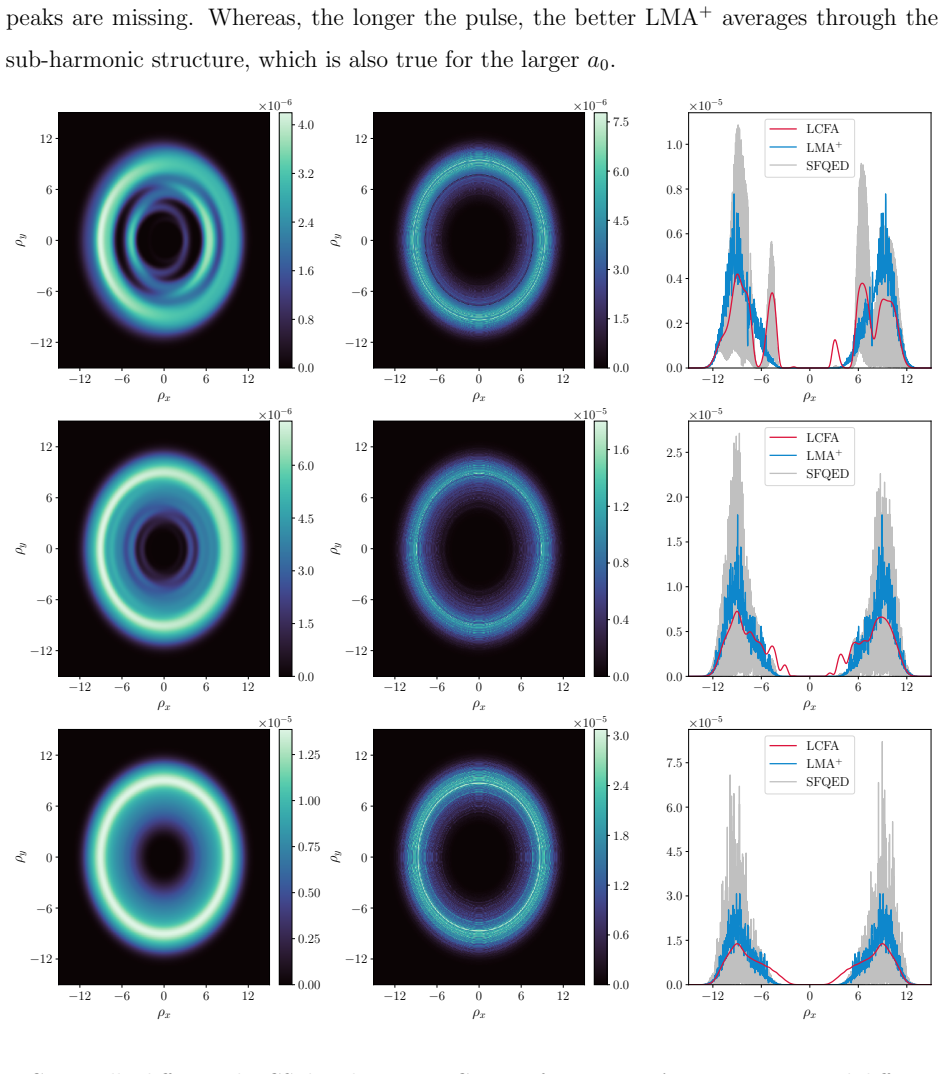
The central claim is that the LMA probability rate can be obtained directly from the full probability, rather than by approximating $S$-matrix elements, through a three-step procedure: slowly varying envelope approximation, discarding long-range interference on the pulse scale ($\theta/\Delta\ll 1$), and cycle-averaging a sign-alternating proto-rate. The paper's new bandwidth-restored result, LMA$^+$, follows from replacing the delta-producing $\theta$-integration with the Gaussian window $W(\theta)=\exp(-\theta^2/\Delta^2)$, whose width is fixed by matching the exact SFQED spectrum in the weak-field limit; the fully differential rate (Eq. 23) then has Gaussian harmonic lines of width $\sim 1/\Delta$, stays finite at the harmonic boundaries where the standard LMA diverges like $1/\sqrt{\ell-\ell_n}$, and reproduces the spreading of harmonic edges seen in exact SFQED results. The authors further provide a divergence-free analytic expression for the fully differential probability (Eq. 30) in terms of modified Bessel functions and an angular-integrated rate (Eqs. 38 and 40) in terms of complementary error functions, and they assert a new applicability condition $\Delta\gtrsim 2\pi a_0$ based on radiation beaming. In their comparison, LMA$^+$ outperforms standard LMA at moderate intensity, while for $a_0\gg 1$ with insufficient pulse length the locally constant field approximation can agree better with the full QED result.
Load-bearing premise
The load-bearing modeling choice is that the interference-window cutoff is the Gaussian $W(\theta)=\exp(-\theta^2/\Delta^2)$, calibrated in the weak-field limit, and if the true bandwidth window of a finite pulse is not Gaussian the claimed improvements could be artifacts of that calibration.
Editorial extensions
If this is right
- LMA$^+$ fully differential NCS spectra stay finite at the harmonic edges where standard LMA diverges, and they follow the spreading of harmonic boundaries seen in exact SFQED calculations.
- Angular distributions at fixed transferred momentum become computable within LMA$^+$; in the standard LMA the delta-distributions make such observables intractable.
- The new bound $\Delta\gtrsim 2\pi a_0$ states that for high intensity and short pulses the LMA$^+$ cannot reproduce sub-cycle radiation beaming, and in that regime the locally constant field approximation agrees with full QED better than LMA$^+$.
- The analytic integrated LMA$^+$ rates (Eqs. 30, 38, 40) provide divergence-free, approximate closed forms for use in simulations, with the standard LMA limit recovered for $\Delta\gg 1$.
- The derivation supplies LMA rates for arbitrary polarization directly from the probability, eliminating the numerical double-sum arguments previously needed for linear polarization.
Reading between the lines
- If the Gaussian calibration is robust, the same windowing procedure should carry over to nonlinear Breit-Wheeler pair production and two-step trident processes, because the divergent delta-function structure of the interference-window integral is generic to SFQED probabilities, not specific to nonlinear Compton scattering.
- Matching the window function to the exact weak-field spectral shape of other pulse envelopes, such as sin-squared or hyperbolic-secant profiles, would give pulse-specific bandwidth restoration and may reproduce the Airy-like side lobes that the Gaussian LMA$^+$ currently averages away.
- The $\Delta\gtrsim 2\pi a_0$ criterion gives simulation codes an operational switch: below that ratio use LMA-class rates, above it the locally constant field approximation becomes the safer choice; testing this boundary in cascade simulations would show how much it matters for shower observables.
- The cycle-averaging derivation suggests a systematic route to corrections: retaining the envelope-gradient terms $g'(\varphi/\Delta)/\Delta$ order by order could turn the LMA into a controlled expansion in inverse pulse length, with LMA$^+$ as the first bandwidth correction.
Editorial analysis
A structured set of objections, weighed in public.
Referee Report
Summary. The paper revisits the locally monochromatic approximation (LMA) for strong-field QED processes, starting from the full SFQED probability for nonlinear Compton scattering. The authors derive a proto-rate, apply a slowly varying envelope approximation and a local approximation, and then explicitly cycle-average to obtain positive-definite LMA rates for arbitrary polarization, matching known results in the literature. They then introduce a Gaussian window function into the theta-integral to restore finite bandwidth, calling the result LMA+, and provide approximate analytic expressions for the phase-integrated and transverse-momentum-integrated rates. The paper compares LMA+ with standard LMA, LCFA, and exact SFQED calculations, reports improved agreement for LMA+, and states a new applicability condition Delta >~ 2*pi*a0 for LMA+.
Significance. If the construction is sound, the paper makes a useful contribution: it provides a cleaner derivation of LMA rates that avoids the double sums and numerical justifications in earlier work, introduces a bandwidth-restored variant that removes the harmonic-edge divergences of the fully differential LMA rate, and offers a practically relevant applicability criterion for LMA-based simulation codes. The numerical comparisons against exact SFQED results are a valuable benchmark. However, the central LMA+ construction currently contains a concrete inconsistency in the definition of the window function, and the robustness of the improved agreement to that calibration is not established. These issues are load-bearing for the main claims and need to be resolved before publication.
major comments (3)
- [Sec. III A, Eqs. (22)-(23)] The stated window function W(theta)=exp(-theta^2/Delta^2) is inconsistent with the Gaussian rate in Eq. (23) under the Fourier convention of this paper. With W(theta)=exp(-theta^2/Delta^2), the theta-integral in Eq. (22) evaluates to -alpha*Delta/pi^{3/2} * A * sum D_n(phi) * exp[-Delta^2 (zeta-n)^2/4], not Eq. (23). To obtain Eq. (23), the window must be W(theta)=exp(-theta^2/(4 Delta^2)). The difference is not cosmetic: it changes the harmonic line width by a factor of two and is directly tied to the weak-field calibration described in the text. Please verify which convention was used to generate Figs. 4-8 and correct either the stated W(theta) or Eq. (23).
- [Sec. III A, paragraph on calibrating W(theta)] The Gaussian window and its width are fixed by matching LMA+ to exact SFQED spectra in the weak-field limit a0 << 1. The subsequent demonstration that LMA+ agrees better than standard LMA with full SFQED at a0 = 2 (Figs. 4 and 5) is therefore a test of this particular calibrated ansatz, not a parameter-free prediction. The authors should state this limitation explicitly and ideally test the sensitivity of the harmonic-edge behavior to alternative window shapes, for example a window derived from the Airy fold profile mentioned in Sec. III B, to show that the claimed improvement is not an artifact of the Gaussian choice.
- [Sec. III C 1, Eqs. (29)-(31)] The claimed recovery of the standard LMA result from Eq. (30) in the limit Delta >> 1 is not obvious and appears to fail a simple saddle-point check. Evaluating the integral in Eq. (29) for zeta''(phi*) -> 0 gives 2*sqrt(pi)/(Delta |zeta'|) when both zeros are included, which with the prefactor in Eq. (29) yields -4*alpha/(pi |zeta'|) per harmonic, matching Eq. (31). However, the asymptotic limit of Eq. (30) using I_{±1/4}(z) ~ e^z/sqrt(2*pi*z) appears to give a value differing by a factor of pi. Please provide the detailed derivation of the Bessel-function evaluation in Eq. (30) or correct the normalization.
minor comments (4)
- [Sec. III C 1, Eq. (30)] The notation phi* in Eq. (30) is ambiguous because phi* = ±... denotes two zeros; the summation over the two symmetric zeros should be made explicit in the formula.
- [Abstract and Sec. III C 1] The text states that Eq. (30) provides a divergence-free fully differential probability, but Fig. 7 shows that this analytic expression loses the bandwidth-induced spreading of the harmonic edges; the wording should make this limitation explicit in the abstract and in the main text.
- [Sec. IV] The phrase 'positively semi-definite probability rate' should be replaced by 'non-negative probability rate' or 'positive semi-definite' to avoid ambiguity.
- [Sec. II C, Eqs. (12)-(19)] The transition from the half-integer harmonics n/2 in the proto-rate Eq. (17) to the integer harmonics n in the cycle-averaged rate Eq. (19) is central but could be stated more pedagogically for readers; consider adding a sentence explaining that the odd-n terms vanish under cycle averaging.
Circularity Check
The LMA+ bandwidth window is calibrated by matching exact SFQED spectra in the weak-field limit, so the later claim of better agreement with full SFQED is partly built from the benchmark; separately, the printed window W(θ)=exp(-θ²/Δ²) does not Fourier-transform to Eq. (23), leaving the width convention unverified.
-
fitted input called prediction
[Sec. III A (LMA+ derivation) and abstract (claim of better agreement)]
"To find a suitable value for the width of the Gaussian window, we match the spectra of LMA + to the exact SFQED result in the weak field limit a 0 ≪1. This prescription determines the window function as W(θ) = exp (−θ2/∆2)."
The window width is the only free parameter introduced in the bandwidth restoration. Fixing it by matching to exact SFQED spectra means the subsequent comparison with exact SFQED is not an out-of-sample test of the linewidth: in the weak-field region the agreement is enforced by construction, and the qualitative removal of the harmonic-edge divergence is guaranteed by any finite-width window rather than derived from SFQED. The paper itself concedes that the Gaussian harmonic profile is an artifact of the chosen window. Thus the headline improvement over standard LMA partly restates the calibration input rather than being an independent prediction.
-
other
[Sec. III A, Eqs. (22) and (23)]
"After performing the integration with respect to θ in Eq. (22), we obtain the LMA + rate as dRLMA+ dℓd2ρ⊥ = − 2α∆ π3/2 A P∞ n=1 Dn (φ) exp h −∆2 (ζ(φ)−n) 2 i ."
Under the Fourier convention used in the paper (Eq. (17) implies ∫dθ e^{iθx}=2πδ(x)), substituting W(θ)=exp(−θ²/Δ²) into Eq. (22) gives −(αΔ/π^{3/2}) A Σ D_n exp[−Δ²(ζ−n)²/4], not Eq. (23). Eq. (23) would follow only from W(θ)=exp(−θ²/(4Δ²)). The printed calibration therefore does not produce the stated bandwidth-restored rate; the claimed agreement with exact SFQED rests on an unstated width convention. This is a missing-support gap in the derivation chain: the fitted input is not consistently connected to the predicted observable, so the prediction cannot be separated from the calibration choice as written.
full rationale
The central LMA derivation in Sec. II is self-contained and does not reduce to its inputs: it starts from the exact SFQED probability, applies SVEA and the local approximation θ/Δ≪1, and obtains the positive-definite rate by explicit cycle-averaging with Neumann-type integrals in Appendix B. The resulting CP and LP rates agree with Ref. [52] but are not derived from it, and no imported uniqueness theorem or ansatz-via-citation is load-bearing. The circularity is confined to the LMA+ extension. The Gaussian window width is calibrated to exact SFQED spectra in the weak-field limit, so the qualitative features of the LMA+ comparison—finite harmonic edges, harmonic broadening, and damping of peaks—are partly guaranteed by the calibration rather than independently predicted. The paper acknowledges this in part by noting the harmonic profile is Gaussian because of the specific window choice and that the true SFQED edge shape is Airy-like. The additional algebraic inconsistency between the stated W(θ)=exp(−θ²/Δ²) and Eq. (23) further weakens the reproducibility of the claimed benchmark agreement. However, the LMA+ is also tested at a0=1–10 and Δ=4–50, where the single calibrated width makes nontrivial predictions that are not automatically forced, so this is partial rather than total circularity. No self-citation load-bearing argument or definitional identity was found. Overall score 4 reflects one fitted-input-called-prediction element plus a missing-support inconsistency in the derivation chain.
Assumptions & free parameters
free parameters (1)
- Gaussian window width parameter =
Δ (pulse duration)
assumptions (6)
- domain assumption Slowly varying envelope approximation (SVEA): the pulse envelope g(φ/Δ) varies slowly over one carrier cycle.
- domain assumption Local approximation θ/Δ much less than 1: interference effects on the envelope scale are neglected.
- domain assumption Cycle averaging is the correct procedure to convert the sign-alternating proto-rate into a positive probability rate.
- ad hoc to paper The background pulse envelope is Gaussian and the window function is chosen as W(θ)=exp(-θ²/Δ²).
- ad hoc to paper The window width is set by matching LMA+ to exact SFQED spectra in the weak-field limit a0 much less than 1.
- standard math The series representation of the floating average, Eq. (A9), converges for the pulse profile.
Cite this review
Pith. "Pith review of Extended locally monochromatic approximations of Strong-Field QED processes." pith.science (2026). https://pith.science/paper/T2VEM66Z
@misc{pith2026250604889,
  author       = {Pith},
  title        = {Pith review of: Extended locally monochromatic approximations of Strong-Field QED processes},
  year         = {2026},
  howpublished = {\url{https://pith.science/paper/T2VEM66Z}},
  note         = {Machine review of arXiv:2506.04889}
}
abstract
Strong-field QED (SFQED) probability rates in the locally monochromatic approximation (LMA) have become an indispensable tool for simulations of processes like gamma-ray emission or electron-positron pair production in laser-particle collisions. We revisit the LMA derivation and explicitly demonstrate that it is based on the separation of time scales, neglection of the long-range interference effects and subsequent averaging over the cycle scale. Doing so, we obtain unambiguously LMA rates for arbitrary polarizations of the plane wave background. Additionally, we partially restore the finite bandwidth effects that are lost in the LMA derivation. The bandwidth-restored result we refer to as the LMA$^+$ and show that it agrees with the full SFQED predictions better than the standard LMA. We use LMA$^+$ to address previously inaccessible observables and formulate a new limitation on the applicability of locally monochromatic approximations in general. We provide analytical results for the angular-integrated LMA$^+$ probability rate and the fully differential probability that account for the finite bandwidth effects.
Figures


Figures from the paper (5 more)




Reference graph
Works this paper leans on
-
[1]
The integrand, Eq
Integration over the laser phaseφ Here we show how to obtain fully differential probability from the probability rate (23), performing approximately integration over the laser phaseφ. The integrand, Eq. (23), is suppressed, unless (ζ(φ)−n)≲1/∆≪1. Thus, the main contributions to theφintegral come from the vicinities of zeros ofζ(φ)−n. Sinceζ(φ)−nis an even...
-
[2]
Integration over the transverse momentumρ⊥ Applying the same reasoning as above, we can approximately integrate the LMA+ proba- bility rate (23) over the transverse momentum magnitude|ρ ⊥|. Further, we consider the CP case, since it also permits analytical integration over the azimuthal angleϑin the transverse momentum plane (d 2ρ⊥ =|ρ ⊥|d|ρ⊥|dϑ) due to t...
-
[3]
Fedotov, A
A. Fedotov, A. Ilderton, F. Karbstein, B. King, D. Seipt, H. Taya, and G. Torgrimsson, Advances in QED with intense background fields, Physics Reports Advances in QED with intense background fields,1010, 1 (2023)
2023
-
[4]
A. Di Piazza, C. M¨ uller, K. Z. Hatsagortsyan, and C. H. Keitel, Extremely high-intensity laser interactions with fundamental quantum systems, Reviews of Modern Physics84, 1177 (2012)
work page 2012
-
[5]
A. Gonoskov, T. G. Blackburn, M. Marklund, and S. S. Bulanov, Charged particle motion and radiation in strong electromagnetic fields, Reviews of Modern Physics94, 045001 (2022)
work page 2022
-
[6]
W. Yan, C. Fruhling, G. Golovin, D. Haden, J. Luo, P. Zhang, B. Zhao, J. Zhang, C. Liu, M. Chen, S. Chen, S. Banerjee, and D. Umstadter, High-order multiphoton Thomson scatter- ing, Nature Photonics11, 514 (2017)
work page 2017
-
[7]
C. Bula, K. T. McDonald, E. J. Prebys, C. Bamber, S. Boege, T. Kotseroglou, A. C. Melissi- nos, D. D. Meyerhofer, W. Ragg, D. L. Burke, R. C. Field, G. Horton-Smith, A. C. Odian, J. E. Spencer, D. Walz, S. C. Berridge, W. M. Bugg, K. Shmakov, and A. W. Weidemann, Observation of Nonlinear Effects in Compton Scattering, Physical Review Letters76, 3116 (1996)
work page 1996
-
[8]
S.-y. Chen, A. Maksimchuk, and D. Umstadter, Experimental observation of relativistic non- linear Thomson scattering, Nature396, 653 (1998)
work page 1998
Show all 82 references
-
[9]
Poder, M
K. Poder, M. Tamburini, G. Sarri, A. Di Piazza, S. Kuschel, C. D. Baird, K. Behm, S. Bohlen, J. M. Cole, D. J. Corvan, M. Duff, E. Gerstmayr, C. H. Keitel, K. Krushelnick, S. P. D. Mangles, P. McKenna, C. D. Murphy, Z. Najmudin, C. P. Ridgers, G. M. Samarin, D. R. Symes, A. G....
2018 arXiv
-
[10]
Mirzaie, C
M. Mirzaie, C. I. Hojbota, D. Y. Kim, V. B. Pathak, T. G. Pak, C. M. Kim, H. W. Lee, J. W. Yoon, S. K. Lee, Y. J. Rhee, M. Vranic, O. Amaro, K. Y. Kim, J. H. Sung, and C. H. Nam, All-optical nonlinear Compton scattering performed with a multi-petawatt laser, Nature Photonics18...
2024
-
[11]
J. Cole, K. Behm, E. Gerstmayr, T. Blackburn, J. Wood, C. Baird, M. Duff, C. Harvey, A. Ilderton, A. Joglekar, K. Krushelnick, S. Kuschel, M. Marklund, P. McKenna, C. Murphy, K. Poder, C. Ridgers, G. Samarin, G. Sarri, D. Symes, A. Thomas, J. Warwick, M. Zepf, Z. Najmudin, and...
2018
-
[12]
A. R. Bell and J. G. Kirk, Possibility of prolific pair production with high-power lasers, Phys. Rev. Lett.101, 200403 (2008)
2008
-
[13]
T. G. Blackburn, Radiation reaction in electron–beam interactions with high-intensity lasers, Reviews of Modern Plasma Physics4, 5 (2020)
2020
-
[14]
Sikorski, A
P. Sikorski, A. G. R. Thomas, S. S. Bulanov, M. Zepf, and D. Seipt, Novel signatures of radiation reaction in electron–laser sidescattering, New J. Phys.26, 063011 (2024)
2024
-
[15]
Zhang, S
P. Zhang, S. S. Bulanov, D. Seipt, A. V. Arefiev, and A. G. R. Thomas, Relativistic plasma physics in supercritical fields, Physics of Plasmas27, 050601 (2020)
2020
-
[16]
C. N. Danson, C. Haefner, J. Bromage, T. Butcher, J.-C. F. Chanteloup, E. A. Chowdhury, A. Galvanauskas, L. A. Gizzi, J. Hein, D. I. Hillier, N. W. Hopps, Y. Kato, E. A. Khazanov, R. Kodama, G. Korn, R. Li, Y. Li, J. Limpert, J. Ma, C. H. Nam, D. Neely, D. Papadopoulos, R. R. ...
2019
-
[17]
J. W. Yoon, Y. G. Kim, I. W. Choi, J. H. Sung, H. W. Lee, S. K. Lee, and C. H. Nam, Realization of laser intensity over 10 23 W/cm2, Optica8, 630 (2021)
2021
-
[18]
Bamber, S
C. Bamber, S. J. Boege, T. Koffas, T. Kotseroglou, A. C. Melissinos, D. D. Meyerhofer, D. A. Reis, W. Ragg, C. Bula, K. T. McDonald, E. J. Prebys, D. L. Burke, R. C. Field, G. Horton-Smith, J. E. Spencer, D. Walz, S. C. Berridge, W. M. Bugg, K. Shmakov, and A. W. Weidemann, St...
1999
-
[19]
Slade-Lowther, D
C. Slade-Lowther, D. Del Sorbo, and C. P. Ridgers, Identifying the electron–positron cascade regimes in high-intensity laser-matter interactions, New Journal of Physics21, 013028 (2019)
2019
-
[20]
F. Cruz, T. Grismayer, A. Y. Chen, A. Spitkovsky, and L. O. Silva, Coherent Emission from 30 QED Cascades in Pulsar Polar Caps, ApJL919, L4 (2021)
2021
-
[21]
Z. Chen, S. Meuren, E. Gerstmayr, V. Yakimenko, P. H. Bucksbaum, and D. A. Reis, Prepa- ration of strong-field qed experiments at facet-ii, inOptica High-brightness Sources and Light- driven Interactions Congress 2022, Technical Digest Series (Optica Publishing Group, Bu- dape...
2022
-
[22]
Abramowicz, U
H. Abramowicz, U. Acosta, M. Altarelli, R. Aßmann, Z. Bai, T. Behnke, Y. Benhammou, T. Blackburn, S. Boogert, O. Borysov, M. Borysova, R. Brinkmann, M. Bruschi, F. Burkart, K. B¨ ußer, N. Cavanagh, O. Davidi, W. Decking, U. Dosselli, N. Elkina, A. Fedotov, M. Firlej, T. Fiutow...
2021
-
[23]
Abramowicz, M
H. Abramowicz, M. Almanza Soto, M. Altarelli, R. Aßmann, A. Athanassiadis, G. Avoni, T. Behnke, M. Benettoni, Y. Benhammou, J. Bhatt, T. Blackburn, C. Blanch, S. Bonaldo, S. Boogert, O. Borysov, M. Borysova, V. Boudry, D. Breton, R. Brinkmann, M. Bruschi, F. Burkart, K. B¨ uße...
2024
-
[24]
I. V. Sokolov, N. M. Naumova, J. A. Nees, and G. A. Mourou, Pair Creation in QED-Strong Pulsed Laser Fields Interacting with Electron Beams, Physical Review Letters105, 195005 (2010)
2010
-
[25]
S. V. Popruzhenko, Keldysh theory of strong field ionization: history, applications, difficulties and perspectives, Journal of Physics B: Atomic, Molecular and Optical Physics47, 204001 (2014)
2014
-
[26]
V. I. Ritus, Quantum effects of the interaction of elementary particles with an intense elec- tromagnetic field, Journal of Soviet Laser Research6, 497 (1985)
1985
-
[27]
Pouyez, A
M. Pouyez, A. A. Mironov, T. Grismayer, A. Mercuri-Baron, F. Perez, M. Vranic, C. Ri- conda, and M. Grech, Multiplicity of electron- and photon-seeded electromagnetic showers at multipetawatt laser facilities, Phys. Rev. E110, 065208 (2024)
2024
-
[28]
S. S. Bulanov, C. B. Schroeder, E. Esarey, and W. P. Leemans, Electromagnetic cascade in high-energy electron, positron, and photon interactions with intense laser pulses, Physical Review A87, 062110 (2013)
2013
-
[29]
T. G. Blackburn, A. Ilderton, M. Marklund, and C. P. Ridgers, Reaching supercritical field strengths with intense lasers, New Journal of Physics21, 053040 (2019)
2019
-
[30]
S. S. Bulanov, T. Z. Esirkepov, A. G. R. Thomas, J. K. Koga, and S. V. Bulanov, Schwinger Limit Attainability with Extreme Power Lasers, Physical Review Letters105, 220407 (2010)
2010
-
[31]
Pouyez, T
M. Pouyez, T. Grismayer, M. Grech, and C. Riconda, Kinetic Structure of Strong-Field QED Showers in Crossed Electromagnetic Fields, Phys. Rev. Lett.134, 135001 (2025). 32
2025
-
[32]
A. M. Fedotov, N. B. Narozhny, G. Mourou, and G. Korn, Limitations on the Attainable Intensity of High Power Lasers, Physical Review Letters105, 080402 (2010)
2010
-
[33]
Seipt, M
D. Seipt, M. Samuelsson, and T. Blackburn, Nonlinear Breit–Wheeler pair production using polarized photons from inverse Compton scattering, Plasma Phys. Control. Fusion67, 035002 (2025)
2025
-
[34]
Mercuri-Baron, A
A. Mercuri-Baron, A. Mironov, C. Riconda, A. Grassi, and M. Grech, Growth Rate of Self- Sustained QED Cascades Induced by Intense Lasers, Phys. Rev. X15, 011062 (2025)
2025
-
[35]
Seipt, C
D. Seipt, C. P. Ridgers, D. Del Sorbo, and A. G. R. Thomas, Polarized QED cascades, New Journal of Physics23, 053025 (2021)
2021
-
[36]
Torgrimsson, Loops and polarization in strong-field QED, New Journal of Physics23, 065001 (2021)
G. Torgrimsson, Loops and polarization in strong-field QED, New Journal of Physics23, 065001 (2021)
2021
-
[37]
Dinu and G
V. Dinu and G. Torgrimsson, Single and double nonlinear Compton scattering, Physical Re- view D99, 096018 (2019)
2019
-
[38]
Dinu and G
V. Dinu and G. Torgrimsson, Approximating higher-order nonlinear QED processes with first- order building blocks, Physical Review D102, 016018 (2020)
2020
-
[39]
Di Piazza, M
A. Di Piazza, M. Tamburini, S. Meuren, and C. H. Keitel, Implementing nonlinear Comp- ton scattering beyond the local-constant-field approximation, Physical Review A98, 012134 (2018)
2018
-
[40]
Nikishov and V
A. Nikishov and V. Ritus, Quantum processes in the field of a plane electromagnetic wave and in a constant field. i, Sov. Phys. JETP19, 529 (1964)
1964
-
[41]
H. R. Reiss, Absorption of light by light, Journal of Mathematical Physics3, 59 (1962)
1962
-
[42]
King, Uniform locally constant field approximation for photon-seeded pair production, Physical Review A101, 042508 (2020)
B. King, Uniform locally constant field approximation for photon-seeded pair production, Physical Review A101, 042508 (2020)
2020
-
[43]
Di Piazza, M
A. Di Piazza, M. Tamburini, S. Meuren, and C. H. Keitel, Improved local-constant-field ap- proximation for strong-field QED codes, Physical Review A99, 022125 (2019)
2019
-
[44]
Ilderton, B
A. Ilderton, B. King, and D. Seipt, Extended locally constant field approximation for nonlinear Compton scattering, Physical Review A99, 042121 (2019)
2019
-
[45]
V. Dinu, C. Harvey, A. Ilderton, M. Marklund, and G. Torgrimsson, Quantum radiation reaction: From interference to incoherence, Phys. Rev. Lett.116, 044801 (2016)
2016
-
[46]
Gelfer, A
E. Gelfer, A. Fedotov, A. Mironov, and S. Weber, Nonlinear Compton scattering in time- dependent electric fields beyond the locally constant crossed field approximation, Physical 33 Review D106, 056013 (2022)
2022
-
[47]
Q. Z. Lv, E. Raicher, C. H. Keitel, and K. Z. Hatsagortsyan, Anomalous violation of the local constant field approximation in colliding laser beams, Physical Review Research3, 013214 (2021)
2021
-
[48]
Gonoskov, S
A. Gonoskov, S. Bastrakov, E. Efimenko, A. Ilderton, M. Marklund, I. Meyerov, A. Mu- raviev, A. Sergeev, I. Surmin, and E. Wallin, Extended particle-in-cell schemes for physics in ultrastrong laser fields: Review and developments, Physical Review E92, 023305 (2015)
2015
-
[49]
T. G. Blackburn, D. Seipt, S. S. Bulanov, and M. Marklund, Benchmarking semiclassical approaches to strong-field qed: Nonlinear compton scattering in intense laser pulses, Physics of Plasmas25, 083108 (2018)
2018
-
[50]
C. P. Ridgers, J. G. Kirk, R. Duclous, T. G. Blackburn, C. S. Brady, K. Bennett, T. D. Arber, and A. R. Bell, Modelling gamma-ray photon emission and pair production in high-intensity laser–matter interactions, Journal of Computational Physics260, 273 (2014)
2014
-
[51]
Derouillat, A
J. Derouillat, A. Beck, F. P´ erez, T. Vinci, M. Chiaramello, A. Grassi, M. Fl´ e, G. Bouchard, I. Plotnikov, N. Aunai, J. Dargent, C. Riconda, and M. Grech, Smilei : A collaborative, open- source, multi-purpose particle-in-cell code for plasma simulation, Computer Physics Com...
2018
-
[52]
Vranic, T
M. Vranic, T. Grismayer, R. A. Fonseca, and L. O. Silva, Quantum radiation reaction in head-on laser-electron beam interaction, New Journal of Physics18, 073035 (2016)
2016
-
[53]
Lobet, E
M. Lobet, E. d’Humi` eres, M. Grech, C. Ruyer, X. Davoine, and L. Gremillet, Modeling of radiative and quantum electrodynamics effects in PIC simulations of ultra-relativistic laser- plasma interaction, Journal of Physics: Conference Series688, 012058 (2016)
2016
-
[54]
Tang, Fully polarized nonlinear Breit-Wheeler pair production in pulsed plane waves, Phys- ical Review D105, 056018 (2022)
S. Tang, Fully polarized nonlinear Breit-Wheeler pair production in pulsed plane waves, Phys- ical Review D105, 056018 (2022)
2022
-
[55]
Heinzl, B
T. Heinzl, B. King, and A. J. MacLeod, Locally monochromatic approximation to QED in intense laser fields, Physical Review A102, 063110 (2020)
2020
-
[56]
T. G. Blackburn, A. J. MacLeod, and B. King, From local to nonlocal: higher fidelity simu- lations of photon emission in intense laser pulses, New Journal of Physics23, 085008 (2021)
2021
-
[57]
T. G. Blackburn, B. King, and S. Tang, Simulations of laser-driven strong-field QED with Ptarmigan: Resolving wavelength-scale interference andγ-ray polarization, Physics of Plasmas 30, 093903 (2023)
2023
-
[58]
C. F. Nielsen, R. Holtzapple, and B. King, High-resolution modeling of nonlinear Compton 34 scattering in focused laser pulses, Physical Review D106, 013010 (2022)
2022
-
[59]
T. G. Blackburn and B. King, Higher fidelity simulations of nonlinear Breit–Wheeler pair creation in intense laser pulses, The European Physical Journal C82, 44 (2022)
2022
-
[60]
Boca and V
M. Boca and V. Florescu, Nonlinear Compton scattering with a laser pulse, Physical Review A80, 053403 (2009)
2009
-
[61]
Tang and B
S. Tang and B. King, Locally monochromatic two-step nonlinear trident process in a plane wave, Physical Review D107, 096004 (2023)
2023
-
[62]
Dinu, Exact final-state integrals for strong-field QED, Physical Review A87, 052101 (2013)
V. Dinu, Exact final-state integrals for strong-field QED, Physical Review A87, 052101 (2013)
2013
-
[63]
Mackenroth and A
F. Mackenroth and A. Di Piazza, Nonlinear Compton scattering in ultrashort laser pulses, Physical Review A83, 032106 (2011)
2011
-
[64]
Seipt and B
D. Seipt and B. K¨ ampfer, Nonlinear Compton scattering of ultrashort intense laser pulses, Physical Review A83, 022101 (2011)
2011
-
[65]
Krajewska and J
K. Krajewska and J. Z. Kami´ nski, Compton process in intense short laser pulses, Physical Review A85, 062102 (2012)
2012
-
[66]
Narozhnyi and M
N. Narozhnyi and M. Fofanov, Photon emission by an electron in a collision with a short focused laser pulse, Journal of Experimental and Theoretical Physics83, 14 (1996)
1996
-
[67]
Seipt and B
D. Seipt and B. K¨ ampfer, Nonlinear Compton scattering of ultrahigh-intensity laser pulses, Laser Physics23, 075301 (2013)
2013
-
[68]
Seipt, V
D. Seipt, V. Kharin, S. Rykovanov, A. Surzhykov, and S. Fritzsche, Analytical results for nonlinear Compton scattering in short intense laser pulses, Journal of Plasma Physics82, 655820203 (2016)
2016
-
[69]
with respect to the interference windowθ. We find dRLMA (φ) dℓd2ρ⊥ =− α π2 A +∞X n=−∞ Dn (φ) +∞Z −∞ exp h iθ ζ(φ)− n 2 i dθ ,(12) with ζ(φ) =ℓ+ ℓ(1 +δ 2) 2 (1 +ρ 2 ⊥) a2 0g2 φ ∆ (13) and Dn (φ) =J n (X, Y) +a2 0 2 g2 φ ∆ B 1 +δ 2 − 1−δ 2 cos 2φ (2Jn − Jn−2 − Jn+2).(14) The fun...
-
[70]
King, Interference effects in nonlinear Compton scattering due to pulse envelope, Physical Review D103, 036018 (2021)
B. King, Interference effects in nonlinear Compton scattering due to pulse envelope, Physical Review D103, 036018 (2021)
2021
-
[71]
Tang and B
S. Tang and B. King, Pulse envelope effects in nonlinear Breit-Wheeler pair creation, Physical Review D104, 096019 (2021)
2021
-
[72]
Dattoli, L
G. Dattoli, L. Giannessi, L. Mezi, and A. Torre, Theory of generalized Bessel functions, Il Nuovo Cimento B (1971-1996)105, 327 (1990)
1990
-
[73]
H. J. Korsch, A. Klumpp, and D. Witthaut, On two-dimensional Bessel functions, Journal of 35 Physics A: Mathematical and General39, 14947 (2006)
2006
-
[74]
King and S
B. King and S. Tang, Feasibility of measuring nonanalytic qed coupling from pair creation in strong fields, Phys. Rev. A109, 032823 (2024)
2024
-
[75]
Seipt, A
D. Seipt, A. Surzhykov, S. Fritzsche, and B. K¨ ampfer, Caustic structures in x-ray Compton scattering off electrons driven by a short intense laser pulse, New Journal of Physics18, 023044 (2016)
2016
-
[76]
V. Y. Kharin, D. Seipt, and S. G. Rykovanov, Higher-Dimensional Caustics in Nonlinear Compton Scattering, Physical Review Letters120, 044802 (2018)
2018
-
[77]
Y. A. Kravtsov and Y. I. Orlov, Caustics, catastrophes, and wave fields, Soviet Physics Uspekhi 26, 1038 (1983)
1983
-
[78]
Seipt, S
D. Seipt, S. G. Rykovanov, A. Surzhykov, and S. Fritzsche, Narrowband inverse compton scattering x-ray sources at high laser intensities, Phys. Rev. A91, 033402 (2015)
2015
-
[79]
T. G. Blackburn, D. Seipt, S. S. Bulanov, and M. Marklund, Radiation beaming in the quan- tum regime, Physical Review A101, 012505 (2020)
2020
-
[80]
V. Y. Kharin, D. Seipt, and S. G. Rykovanov, Temporal laser-pulse-shape effects in nonlinear Thomson scattering, Physical Review A93, 063801 (2016)
2016
-
[81]
G. N. Watson,A treatise on the theory of Bessel functions, 2nd ed. (Cambridge University Press, Cambridge, New York, 1966)
1966
-
[82]
F. W. Olver, D. W. Lozier, R. Boisvert, and C. W. Clark, The NIST Handbook of Mathe- matical Functions, NIST (2010). 36
2010
Reviewed August 7, 2026 · model on record in the stance chip above.
Discussion (0). Sign in to comment.