REVIEW 4 major objections 8 minor 36 references
Generating Synthetic Stereo Datasets using 3D Gaussian Splatting and Expert Knowledge Transfer
T0 review · 4 major / 8 minor · reviewed 2026-08-07 · deepseek-v4-flash
Pith's one-line read This paper claims that synthetic stereo training data generated by 3D Gaussian Splatting renderings combined with FoundationStereo pseudo-depth outperforms prior NeRF-based generation methods on zero-shot generalization benchmarks.
desk verdict Useful 3DGS+FoundationStereo pipeline with honest reporting, but the 'consistently outperforms' claim is overstated and the comparison to NeRF-Stereo is confounded by initialization. read the letter →
The pith
A machine-rendered reading of the paper's core claim, the machinery that carries it, and where it could break.
The reading
What carries the argument
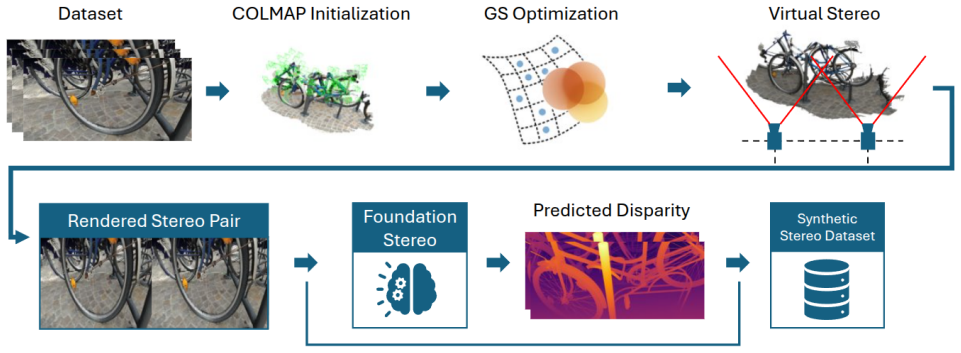
The key machinery is an expert knowledge transfer pipeline with three stages. First, COLMAP estimates camera poses from a free image collection, and a 3D Gaussian Splatting scene is fitted to those images. Second, stereo pairs are rendered from the 3DGS scene at virtual baselines; instead of using the splat geometry or a meshed reconstruction (e.g., PGSR), an observability score computed per camera vertex is used to select the best-viewed poses for the dataset. Third, the rendered left-right image pairs are passed to FoundationStereo, a stereo vision foundation model, to produce dense disparity pseudo-labels, and a lightweight RAFT-Stereo network is fine-tuned on these pairs. The load-bearing identity is the conversion of rendered depth to disparity via $d = f b / z_{\text{depth}}$, combined with the realization that the pseudo-labels are cleaner than any geometry the 3DGS method itself can extract.
What would settle it
A direct check of FoundationStereo's training distribution would settle the matter: if any of the evaluation datasets (Middlebury v3, ETH3D, KITTI-15) or images derived from them appear in its training data, the zero-shot comparison is invalidated. A complementary test would be to repeat the fine-tuning with a stereo teacher whose synthetic-only training set is verified to exclude the test benchmarks and see whether the gap to NeRF-Stereo persists.
Extended reading notes
Core claim
The central discovery is that the explicit geometry recovered from 3D Gaussian Splatting is too noisy and artifact-laden to serve as ground truth for training a stereo network, but the same rendered images, when paired with disparity pseudo-labels from the FoundationStereo model, produce training data that improves zero-shot generalization. In the comparison of fine-tuned RAFT-Stereo models, the proposed 3DGS+FS setup achieves the best or second-best error on the Middlebury training set (best at Full and Half resolutions, second at Quarter), the best error on ETH3D, and comes close to the SceneFlow-pretrained RAFT-Stereo on KITTI-15. The originally published NeRF-Stereo numbers are lower on KITTI-15 and Middlebury Quarter, but the paper argues those results are not reproducible and therefore not representative, and its own reproduced NeRF-Stereo numbers are worse across the board. The paper attributes the gain to FoundationStereo's ability to infer clean geometry from limited visual signal, and to 3DGS's ability to render photorealistic images despite its poor underlying geometry.
Load-bearing premise
The entire zero-shot claim rests on FoundationStereo having been trained purely on synthetic data, so that its pseudo-labels carry no information from the Middlebury, ETH3D, or KITTI test sets; if that premise is false, the 'zero-shot' generalization becomes partly circular.
Editorial extensions
If this is right
- Fine-tuning on 3DGS+FS data improves recovery of thin structures and complex layered depth discontinuities compared with a SceneFlow-only RAFT-Stereo baseline, as shown in the qualitative examples with bicycle cables and flowers.
- The reconstructed meshes from PGSR, 2DGS, and GOF, even after observability filtering, are too artifact-heavy to teach a stereo network, implying that visually good rendering does not guarantee usable geometry.
- The pipeline enables custom synthetic stereo datasets from freely captured images, removing the need for depth sensors or hand-authored 3D scenes, and is faster than NeRF-based generation due to 3DGS rendering speed.
- The expert knowledge transfer setup acts as a form of distillation: a small real-time-capable student (RAFT-Stereo) inherits the zero-shot stereo ability of a much larger teacher (FoundationStereo).
- Current 3DGS-based surface reconstruction methods, despite strong benchmark scores, degrade on in-the-wild scenes, which the proxy task of stereo fine-tuning exposes.
Reading between the lines
- The success of the teacher-student pairing suggests the recipe generalizes to other teacher models and other dense prediction tasks (e.g., monocular depth or optical flow), where a photorealistic renderer supplies images and a foundation model supplies labels.
- The observability metric could be used as a general camera-selection heuristic in any multi-view reconstruction or capture setting, not just dataset generation, to maximize reconstruction quality per added view.
- A multi-teacher ablation (e.g., replacing FoundationStereo with other stereo foundation models) would clarify how much of the gain comes from teacher capability versus the rendering pipeline itself, a distinction the current single-teacher design cannot resolve.
- The results imply that benchmark performance on standard 3D reconstruction datasets is not a reliable proxy for a method's usefulness as a pseudo-ground-truth generator; a downstream stereo task could serve as an additional robustness benchmark for surface reconstruction methods.
Editorial analysis
A structured set of objections, weighed in public.
Referee Report
Summary. The paper introduces a pipeline for synthetic stereo dataset generation based on 3D Gaussian Splatting (3DGS) and expert knowledge transfer. The authors render stereo pairs from 3DGS reconstructions of the NeRF-Stereo scene dataset and use predictions from FoundationStereo as pseudo ground-truth disparity. They fine-tune RAFT-Stereo on these datasets and evaluate zero-shot on KITTI-15, Middlebury v3, and ETH3D. The main findings are that geometry extracted from 3DGS-based reconstruction methods (plain 3DGS, PGSR, 2DGS, GOF) is too noisy to train a competitive stereo network, whereas pseudo-labels from FoundationStereo yield strong zero-shot performance, often exceeding the reproduced NeRF-Stereo and approaching the SceneFlow-pretrained RAFT-Stereo baseline. The paper also reports that about 10% of scenes fail to reconstruct and that the original NeRF-Stereo results are not reproducible.
Significance. The proposed pipeline is a low-cost alternative to synthetic datasets built from explicit 3D assets and to the NeRF-Stereo pipeline, since it avoids the need for ground-truth depth sensors or hand-crafted assets. The negative result about the in-the-wild robustness of state-of-the-art Gaussian splatting meshing methods is useful for the community. The method is timely and clearly described. If the claims are properly qualified and the zero-shot interpretation is verified, the contribution would be a solid empirical study. However, the current version overstates the results and leaves a key assumption about the teacher model's training data unverified.
major comments (4)
- [Section 3.4] The statement that 'FoundationStereo was trained purely on synthetic data, eliminating any concerns of data leakage from the test datasets' is load-bearing for the zero-shot evaluation of 3DGS+FS, but no citation, repository link, or training-data manifest is provided to support it. If FoundationStereo has any exposure to KITTI-15, Middlebury, or ETH3D (e.g., through pre-training, fine-tuning, or validation), the pseudo-labels used to train RAFT-Stereo would leak test-set information and the reported zero-shot generalization would be inflated. Please either verify this claim with a precise reference to the FoundationStereo paper (including its training-data section) or remove the 'eliminating' phrasing and qualify the zero-shot interpretation accordingly.
- [Section 1 (Contributions) and Table 1] The contribution bullet claiming that the expert knowledge transfer setup 'consistently outperforms other methods, including the state-of-the-art NeRF-Stereo method' is not supported by the reported numbers. In Table 1, 3DGS+FS has a larger error than the RAFT-Stereo baseline on KITTI-15 (5.52 vs. 5.46), and the original NeRF-Stereo results are better on KITTI-15 (5.41) and Midd-T Q (8.05 vs. 9.00). The nuanced statement in Section 5 ('outperforms all other methods on the Midd-T and ETH3D datasets, and is close to matching the RAFT-Stereo performance on KITTI-15') is accurate and should be used consistently in the abstract, introduction, and conclusion.
- [Section 4 and Table 1] All fine-tuning results are reported from a single run, and no variance or error bars are given. Several of the performance differences that are central to the paper's claims are small (e.g., KITTI-15 All: 5.52 vs. 5.41 for original NeRF-Stereo; ETH3D Noc: 2.14 vs. 2.29 for the RAFT-Stereo baseline). Because the best checkpoint is selected on a validation suite, the reader cannot tell whether these differences are within run-to-run noise. Please report results over multiple random seeds or provide an alternative justification that the comparisons are stable.
- [Section 6] The paper reports that about 10% of scenes or meshes could not be reconstructed with 3DGS, GOF, 2DGS, or PGSR, but it does not analyze whether the remaining scenes are systematically biased toward easier cases (e.g., less motion blur, more texture). This potential selection bias could affect the relative comparison between methods, since the dataset used for all methods is drawn from the successfully reconstructed scenes. Please discuss the failure cases in more detail and, if possible, show that the comparisons are robust to the excluded scenes.
minor comments (8)
- [Section 4] The number of scenes and the total number of rendered stereo pairs used for fine-tuning are never stated; please report the dataset size and composition.
- [Section 4] The procedure for selecting 'the five cameras with maximized observability' is not specified; please define the criterion and the number of cameras used for each scene.
- [Table 1] The row 'NeRF-Stereo α ✓' is not described in Section 4; it is unclear whether this is the authors' fine-tuned version of NeRF-Stereo renderings, and the caption should explain how it was produced.
- [Figure 2 caption] The statement that spurious faces in the GOF method were 'manually removed' should be disclosed in the main text, as manual post-processing can bias the qualitative comparison.
- [Section 3.3] The observability-based filtering is described qualitatively; an algorithmic description or pseudo-code would improve reproducibility.
- [Equation (2)] Please define the units and coordinate frame of z_depth and note that baseline b and focal length f must be expressed in consistent units.
- [Section 5] The sentence 'none of them (including the reproduced NeRF-Stereo) are comparable to the RAFT-Stereo baseline' is confusing because 3DGS+FS is comparable or better; please rephrase to refer only to 3DGS, PGSR, and NeRF-Stereo*.
- [Section 6] The description of rerunning COLMAP without refining principal points could be clarified, and the authors should state whether this is a standard pre-processing step for 3DGS; otherwise, it may introduce a confound in the comparison with NeRF-Stereo, which used the original poses.
Circularity Check
No significant circularity: the pipeline is external-teacher distillation with independent zero-shot evaluation; the only caveats are a non-load-bearing self-citation and an unverified synthetic-only training claim.
full rationale
The paper's central chain is: 3DGS renders stereo pairs, FoundationStereo supplies pseudo-disparity labels, and RAFT-Stereo is fine-tuned on those labels and then evaluated on KITTI-15, Midd-T, and ETH3D. None of these steps defines its output in terms of its input: the labels come from an external pretrained model, the student is evaluated on unseen benchmarks, and no equation equates the reported errors to a fitted parameter. The only authors' self-citation is [10] in Section 2.2 ('recent advancements in novel view synthesis (NVS) have opened up the possibility to use freely captured images to generate training data for stereo depth estimation [10, 23, 29]'); it is a related-work pointer and not load-bearing for the experimental claims. The most fragile premise is the unverified assertion in Section 3.4 that 'FoundationStereo was trained purely on synthetic data, eliminating any concerns of data leakage from the test datasets.' This is an external factual claim, not a derivation step: if it is false, the zero-shot evaluation would be contaminated, but the paper's method would not become logically circular. The comparison with NeRF-Stereo is also confounded by initialization differences and by the decision to set aside the original NeRF-Stereo numbers as unreproducible, but those are experimental-validity issues, not circular reasoning. Overall, the contribution is self-contained as a distillation/dataset-generation study; score 2 reflects the minor self-citation and the flagged evidence gap.
Assumptions & free parameters
free parameters (2)
- Number of rendered camera poses per scene =
5
- Baseline distance b for stereo rendering =
Same as Tosi et al. (not stated)
assumptions (4)
- domain assumption FoundationStereo was trained purely on synthetic data
- domain assumption COLMAP poses after rerunning without principal point refinement are accurate enough for 3DGS reconstruction and stereo rendering
- domain assumption Zero-shot benchmarks (KITTI 2015, Middlebury v3, ETH3D) with provided ground truth are valid measures of generalization
- standard math The disparity-depth relation d = f*b/z holds in rendered stereo pairs
Cite this review
Pith. "Pith review of Generating Synthetic Stereo Datasets using 3D Gaussian Splatting and Expert Knowledge Transfer." pith.science (2026). https://pith.science/paper/AVDQBDSX
@misc{pith2026250604908,
  author       = {Pith},
  title        = {Pith review of: Generating Synthetic Stereo Datasets using 3D Gaussian Splatting and Expert Knowledge Transfer},
  year         = {2026},
  howpublished = {\url{https://pith.science/paper/AVDQBDSX}},
  note         = {Machine review of arXiv:2506.04908}
}
read the original abstract
In this paper, we introduce a 3D Gaussian Splatting (3DGS)-based pipeline for stereo dataset generation, offering an efficient alternative to Neural Radiance Fields (NeRF)-based methods. To obtain useful geometry estimates, we explore utilizing the reconstructed geometry from the explicit 3D representations as well as depth estimates from the FoundationStereo model in an expert knowledge transfer setup. We find that when fine-tuning stereo models on 3DGS-generated datasets, we demonstrate competitive performance in zero-shot generalization benchmarks. When using the reconstructed geometry directly, we observe that it is often noisy and contains artifacts, which propagate noise to the trained model. In contrast, we find that the disparity estimates from FoundationStereo are cleaner and consequently result in a better performance on the zero-shot generalization benchmarks. Our method highlights the potential for low-cost, high-fidelity dataset creation and fast fine-tuning for deep stereo models. Moreover, we also reveal that while the latest Gaussian Splatting based methods have achieved superior performance on established benchmarks, their robustness falls short in challenging in-the-wild settings warranting further exploration.
Figures


Figures from the paper (1 more)

Reference graph
Works this paper leans on
-
[1]
Barron, Ben Mildenhall, Matthew Tancik, Peter Hedman, Ricardo Martin-Brualla, and Pratul P
Jonathan T. Barron, Ben Mildenhall, Matthew Tancik, Peter Hedman, Ricardo Martin-Brualla, and Pratul P. Srinivasan. Mip-nerf: A multiscale representation for anti-aliasing neu- ral radiance fields.2021 IEEE/CVF International Confer- ence on Computer Vision (ICCV), pages 5835–5844, 2021. 3
work page 2021
-
[2]
Barron, Ben Mildenhall, Dor Verbin, Pratul P
Jonathan T. Barron, Ben Mildenhall, Dor Verbin, Pratul P. Srinivasan, and Peter Hedman. Zip-nerf: Anti-aliased grid-based neural radiance fields.2023 IEEE/CVF Inter- national Conference on Computer Vision (ICCV), pages 19640–19648, 2023. 3
work page 2023
-
[3]
Pyramid stereo matching network
Jia-Ren Chang and Yong-Sheng Chen. Pyramid stereo matching network. InProceedings of the IEEE conference on computer vision and pattern recognition, pages 5410–5418,
-
[4]
Pgsr: Planar-based gaussian splatting for efficient and high-fidelity surface reconstruction
Danpeng Chen, Hai Li, Weicai Ye, Yifan Wang, Weijian Xie, Shangjin Zhai, Nan Wang, Haomin Liu, Hujun Bao, and Guofeng Zhang. Pgsr: Planar-based gaussian splatting for efficient and high-fidelity surface reconstruction. 2024. 2, 5
work page 2024
-
[5]
High-quality surface recon- struction using gaussian surfels
Pinxuan Dai, Jiamin Xu, Wenxiang Xie, Xinguo Liu, Huamin Wang, and Weiwei Xu. High-quality surface recon- struction using gaussian surfels. InInternational Conference on Computer Graphics and Interactive Techniques, 2024. 3
work page 2024
-
[6]
Omnidata: A scalable pipeline for making multi-task mid-level vision datasets from 3d scans
Ainaz Eftekhar, Alexander Sax, Roman Bachmann, Jitendra Malik, and Amir Zamir. Omnidata: A scalable pipeline for making multi-task mid-level vision datasets from 3d scans. 2021 IEEE/CVF International Conference on Computer Vi- sion (ICCV), pages 10766–10776, 2021. 3
work page 2021
-
[7]
Mathias Gehrig, Willem Aarents, Daniel Gehrig, and Davide Scaramuzza. Dsec: A stereo event camera dataset for driving scenarios.IEEE Robotics and Automation Letters, 6:4947– 4954, 2021. 3
work page 2021
-
[8]
Andreas Geiger, Philip Lenz, and Raquel Urtasun. Are we ready for autonomous driving? the kitti vision benchmark suite.2012 IEEE Conference on Computer Vision and Pat- tern Recognition, pages 3354–3361, 2012. 3, 7
work page 2012
Show all 36 references
-
[9]
Vision meets robotics: The kitti dataset.The In- ternational Journal of Robotics Research, 32:1231 – 1237,
Andreas Geiger, Philip Lenz, Christoph Stiller, and Raquel Urtasun. Vision meets robotics: The kitti dataset.The In- ternational Journal of Robotics Research, 32:1231 – 1237,
-
[10]
Moeslund
Magnus Kaufmann Gjerde, Filip Slez ´ak, Joakim Bruslund Haurum, and Thomas B. Moeslund. From neRF to 3DGS: A leap in stereo dataset quality? InSynthetic Data for Com- puter Vision Workshop @ CVPR 2024, 2024. 3
2024
-
[11]
Accurate and efficient stereo processing by semi-global matching and mutual information
Heiko Hirschmuller. Accurate and efficient stereo processing by semi-global matching and mutual information. In2005 IEEE computer society conference on computer vision and pattern recognition (CVPR’05), pages 807–814. IEEE, 2005. 1, 2
2005
-
[12]
Mu Hu, Wei Yin, Chi Zhang, Zhipeng Cai, Xiaoxiao Long, Hao Chen, Kaixuan Wang, Gang Yu, Chunhua Shen, and Shaojie Shen. Metric3d v2: A versatile monocular geomet- ric foundation model for zero-shot metric depth and surface normal estimation.IEEE Transactions on Pattern Analysi...
2024
-
[13]
2d gaussian splatting for geometrically ac- curate radiance fields.ArXiv, abs/2403.17888, 2024
Binbin Huang, Zehao Yu, Anpei Chen, Andreas Geiger, and Shenghua Gao. 2d gaussian splatting for geometrically ac- curate radiance fields.ArXiv, abs/2403.17888, 2024. 2, 3, 5
2024 arXiv
-
[14]
A stereo matching algorithm based on the improved psmnet.Plos one, 16(8):e0251657, 2021
Zedong Huang, Jinan Gu, Jing Li, and Xuefei Yu. A stereo matching algorithm based on the improved psmnet.Plos one, 16(8):e0251657, 2021. 2
2021
-
[15]
3d gaussian splatting for real-time radiance field rendering.ACM Transactions on Graphics (TOG), 42:1 – 14, 2023
Bernhard Kerbl, Georgios Kopanas, Thomas Leimkuehler, and George Drettakis. 3d gaussian splatting for real-time radiance field rendering.ACM Transactions on Graphics (TOG), 42:1 – 14, 2023. 1, 2, 3
2023
-
[16]
Revisiting stereo depth estimation from a sequence- to-sequence perspective with transformers
Zhaoshuo Li, Xingtong Liu, Nathan Drenkow, Andy Ding, Francis X Creighton, Russell H Taylor, and Mathias Un- berath. Revisiting stereo depth estimation from a sequence- to-sequence perspective with transformers. InProceedings of the IEEE/CVF international conference on compute...
2021
-
[17]
Adfactory: An effective framework for gen- eralizing optical flow with nerf
Han Ling, Quansen Sun, Yinghui Sun, Xian Xu, and Xingfeng Li. Adfactory: An effective framework for gen- eralizing optical flow with nerf. In2024 IEEE/CVF Confer- ence on Computer Vision and Pattern Recognition (CVPR), pages 20591–20600, 2024. 3
2024
-
[18]
Raft-stereo: Multilevel recurrent field transforms for stereo matching
Lahav Lipson, Zachary Teed, and Jia Deng. Raft-stereo: Multilevel recurrent field transforms for stereo matching. In 2021 International Conference on 3D Vision (3DV), pages 218–227. IEEE, 2021. 2, 3
2021
-
[19]
Nikolaus Mayer, Eddy Ilg, Philip H ¨ausser, Philipp Fischer, Daniel Cremers, Alexey Dosovitskiy, and Thomas Brox. A large dataset to train convolutional networks for disparity, optical flow, and scene flow estimation.2016 IEEE Confer- ence on Computer Vision and Pattern Recogn...
2016
-
[20]
Menze, C
M. Menze, C. Heipke, and A. Geiger. Joint 3d estimation of vehicles and scene flow.ISPRS Annals of the Photogram- metry, Remote Sensing and Spatial Information Sciences, II- 3/W5:427–434, 2015. 6
2015
-
[21]
Srinivasan, Matthew Tancik, Jonathan T
Ben Mildenhall, Pratul P. Srinivasan, Matthew Tancik, Jonathan T. Barron, Ravi Ramamoorthi, and Ren Ng. Nerf. Communications of the ACM, 65:99 – 106, 2020. 1, 3
2020
-
[22]
Dinov2: Learning robust visual features without supervision
Maxime Oquab, Timoth ´ee Darcet, Th ´eo Moutakanni, Huy V o, Marc Szafraniec, Vasil Khalidov, Pierre Fernandez, Daniel Haziza, Francisco Massa, Alaaeldin El-Nouby, et al. Dinov2: Learning robust visual features without supervision. arXiv preprint arXiv:2304.07193, 2023. 1
2023 arXiv
-
[23]
Self-evolving depth-supervised 3d gaussian splatting from rendered stereo pairs
Sadra Safadoust, Fabio Tosi, Fatma G ¨uney, and Matteo Poggi. Self-evolving depth-supervised 3d gaussian splatting from rendered stereo pairs. InBritish Machine Vision Con- ference (BMVC), 2024. 3
2024
-
[24]
High-resolution stereo datasets with subpixel-accurate ground truth
Daniel Scharstein, Heiko Hirschm ¨uller, York Kitajima, Greg Krathwohl, Nera Nesic, Xi Wang, and Porter West- ling. High-resolution stereo datasets with subpixel-accurate ground truth. InGerman Conference on Pattern Recognition,
-
[25]
Structure-from-motion revisited
Johannes Lutz Sch ¨onberger and Jan-Michael Frahm. Structure-from-motion revisited. InConference on Com- puter Vision and Pattern Recognition (CVPR), 2016. 2, 5
2016
-
[26]
Pixelwise view selection for un- structured multi-view stereo
Johannes Lutz Sch ¨onberger, Enliang Zheng, Marc Pollefeys, and Jan-Michael Frahm. Pixelwise view selection for un- structured multi-view stereo. InEuropean Conference on Computer Vision (ECCV), 2016. 2, 5
2016
-
[27]
Sch ¨onberger, S
Thomas Sch ¨ops, Johannes L. Sch ¨onberger, S. Galliani, Torsten Sattler, Konrad Schindler, Marc Pollefeys, and An- dreas Geiger. A multi-view stereo benchmark with high- resolution images and multi-camera videos.2017 IEEE Conference on Computer Vision and Pattern Recognition ...
2017
-
[28]
Raft-3d: Scene flow using rigid- motion embeddings
Zachary Teed and Jia Deng. Raft-3d: Scene flow using rigid- motion embeddings. InProceedings of the IEEE/CVF con- ference on computer vision and pattern recognition, pages 8375–8384, 2021. 2
2021
-
[29]
Nerf-supervised deep stereo.2023 IEEE/CVF Conference on Computer Vision and Pattern Recognition (CVPR), pages 855–866, 2023
Fabio Tosi, Alessio Tonioni, Daniele De Gregorio, and Mat- teo Poggi. Nerf-supervised deep stereo.2023 IEEE/CVF Conference on Computer Vision and Pattern Recognition (CVPR), pages 855–866, 2023. 1, 3, 4, 5, 6
2023
-
[30]
Selective-stereo: Adaptive frequency information selection for stereo matching
Xianqi Wang, Gangwei Xu, Hao Jia, and Xin Yang. Selective-stereo: Adaptive frequency information selection for stereo matching. InProceedings of the IEEE/CVF Con- ference on Computer Vision and Pattern Recognition, pages 19701–19710, 2024. 2
2024
-
[31]
Croco v2: Improved cross-view completion pre- training for stereo matching and optical flow
Philippe Weinzaepfel, Thomas Lucas, Vincent Leroy, Yohann Cabon, Vaibhav Arora, Romain Br ´egier, Gabriela Csurka, Leonid Antsfeld, Boris Chidlovskii, and J ´erˆome Revaud. Croco v2: Improved cross-view completion pre- training for stereo matching and optical flow. InProceedin...
2023
-
[32]
Foundationstereo: Zero- shot stereo matching.arXiv, 2025
Bowen Wen, Matthew Trepte, Joseph Aribido, Jan Kautz, Orazio Gallo, and Stan Birchfield. Foundationstereo: Zero- shot stereo matching.arXiv, 2025. 2, 6, 8
2025
-
[33]
GS2Mesh: Surface reconstruction from Gaussian splatting via novel stereo views
Yaniv Wolf, Amit Bracha, and Ron Kimmel. GS2Mesh: Surface reconstruction from Gaussian splatting via novel stereo views. InEuropean Conference on Computer Vision (ECCV), 2024. 6, 8
2024
-
[34]
Iterative geometry encoding volume for stereo matching
Gangwei Xu, Xianqi Wang, Xiaohuan Ding, and Xin Yang. Iterative geometry encoding volume for stereo matching. In Proceedings of the IEEE/CVF conference on computer vi- sion and pattern recognition, pages 21919–21928, 2023. 2
2023
-
[35]
Depth any- thing v2.Advances in Neural Information Processing Sys- tems, 37:21875–21911, 2024
Lihe Yang, Bingyi Kang, Zilong Huang, Zhen Zhao, Xiao- gang Xu, Jiashi Feng, and Hengshuang Zhao. Depth any- thing v2.Advances in Neural Information Processing Sys- tems, 37:21875–21911, 2024. 1
2024
-
[36]
Gaussian opacity fields: Efficient and compact surface reconstruction in unbounded scenes.ArXiv, abs/2404.10772, 2024
Zehao Yu, Torsten Sattler, and Andreas Geiger. Gaussian opacity fields: Efficient and compact surface reconstruction in unbounded scenes.ArXiv, abs/2404.10772, 2024. 2, 3, 5
2024 arXiv
Reviewed August 7, 2026 · model on record in the stance chip above.
Discussion (0). Sign in to comment.