REVIEW 3 major objections 5 minor 52 references
Identification of the high-pressure phases of alpha-SnWO4 combining x-ray diffraction and crystal structure prediction
T0 review · 3 major / 5 minor · reviewed 2026-08-07 · deepseek-v4-flash
Pith's one-line read Compression drives α-SnWO4 through two monoclinic phase transitions at 12.9 and 17.5 GPa.
desk verdict Solid high-pressure XRD study with a plausible but unproven HP2 structure; deserves review, but the authors overstate confidence in their structure solution. read the letter →
The pith
A machine-rendered reading of the paper's core claim, the machinery that carries it, and where it could break.
The reading
What carries the argument
The argument is carried by the combination of experimental powder diffraction with two computational routes to candidate structures. For HP1, the machinery is an experimentally indexed monoclinic cell matched to the known BaWO4-II-type structure, whose Sn-substituted form is relaxed with density-functional theory and tested by enthalpy differences and phonon calculations. For HP2, the machinery is a particle-swarm crystal-structure prediction search over ABO4 arrangements, which produced a P21/n candidate that reproduces the measured peak positions and lattice parameters in a profile fit. In both cases the load-bearing step is the comparison of calculated and experimental diffraction patterns; dynamical (phonon) and mechanical (elastic-constant) stability calculations are used to support the assignments.
What would settle it
A high-pressure diffraction analysis that refines the internal oxygen coordinates of HP1 and HP2 directly, or a precise measurement of the volume jump across the 17.5 GPa transition, would settle the assignment; the sharpest inconsistency to check is the predicted 15% volume collapse versus the measured 3% at that transition.
Extended reading notes
Core claim
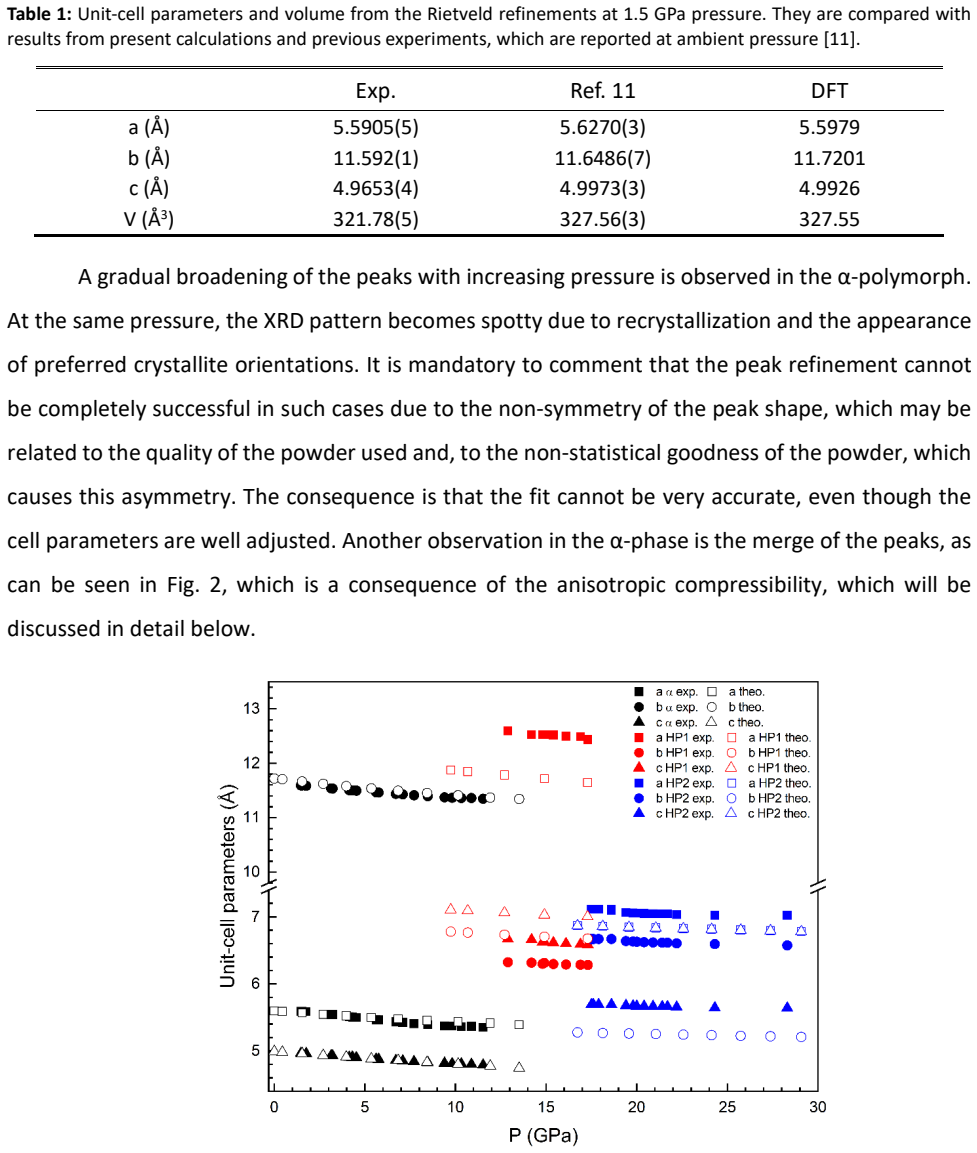
Under quasi-hydrostatic compression to 30 GPa, α-SnWO4 is observed to undergo two first-order phase transitions. The first, at about 12.9 GPa, leads to HP1, a monoclinic P21/n structure with eight formula units whose lattice parameters identify it with the BaWO4-II-type arrangement; density-functional enthalpy calculations place this structure below the α phase above 16 GPa, and whole-pattern profile fits describe the diffraction data from 12.9 to 17.3 GPa. The second, at about 17.5 GPa, leads to HP2, a monoclinic P21/n structure with four formula units generated by a particle-swarm structure search and supported by profile fits of the data up to 28.3 GPa; HP1 and HP2 coexist over this range. The transitions are accompanied by volume jumps of about 7% and 3% in the experiment (3% and 15% in the calculations) and by increases in cation coordination, with Sn moving from fourfold to ninefold to tenfold coordination and W from octahedral to sevenfold coordination in HP2. The recovered material is a mixture of HP1 and HP2, showing that the pressure-driven bond formation is irreversible.
Load-bearing premise
The entire structural assignment depends on the assumption that the DFT-relaxed atomic coordinates, which were checked only against diffraction peak positions and lattice parameters rather than against measured reflection intensities, are the true positions of the atoms in the compressed sample.
Editorial extensions
If this is right
- The two high-pressure structures give concrete atomic models for interpreting previous high-pressure optical and X-ray absorption results on α-SnWO4, including the reported insulator-to-metal transition.
- Because the first transition is to a BaWO4-II-type monoclinic cell, the structural sequence connects α-SnWO4 to a high-pressure arrangement already known in other tungstates, making the assignment testable by comparison with that family.
- The large increase in bulk modulus at the second transition (to roughly 180 GPa experimentally) and the strong anisotropy of HP2 mean that the material becomes substantially stiffer once the lone pair is suppressed.
- The irreversibility of the transitions on decompression implies that dense, high-coordination SnWO4 polytypes can potentially be retained at ambient pressure for property measurements.
Reading between the lines
- If HP2 is a genuinely new structure type for orthotungstates, a similar search strategy could reveal analogous high-coordination phases in other lone-pair oxides that currently show no wolframite/scheelite-type transition.
- The disagreement between the measured 3% and computed 15% volume collapse at the second transition suggests the computed HP2 equation of state may be too dense; refining the internal coordinates against intensities, or measuring the transition with finer pressure steps, would show whether the predicted structure needs adjustment.
- Retaining HP1 or HP2 after decompression would let battery-anode and photocatalysis studies test whether the high-coordination polymorphs have different electronic or ionic-transport properties than ambient α-SnWO4.
Editorial analysis
A structured set of objections, weighed in public.
Referee Report
Summary. The paper reports a high-pressure powder X-ray diffraction study of α-SnWO4 up to 30 GPa, combined with DFT and CALYPSO structure prediction. It claims two first-order phase transitions: HP1 near 12.9 GPa, assigned to a BaWO4-II-type monoclinic P21/n structure with 8 formula units, and HP2 near 17.5 GPa, assigned to a new monoclinic P21/n structure with 4 formula units. The paper also reports room-temperature equations of state, axial compressibilities, and calculated elastic constants and moduli for all three phases. The central claim is the identification of the crystal structures of the two high-pressure phases, especially HP2, which is a previously unreported structure type.
Significance. If the structural assignments are correct, this would be the first identification of the high-pressure phases of α-SnWO4, with implications for lone-pair oxide chemistry and for understanding how stereochemically active Sn2+ lone pairs respond to pressure. The paper has clear strengths: high-quality synchrotron data, a Rietveld refinement for the ambient-pressure phase, PBEsol DFT calculations that reproduce the α-phase lattice and structure well, phonon and elastic-stability checks for the proposed phases, and a CALYPSO search with a transparent set of competing structures. The reported EOS and compressibility data are valuable in their own right. However, the experimental validation of the proposed atomic arrangements is incomplete: atomic positions for HP1 and HP2 come from DFT and are never refined against the diffraction intensities, and the HP2 volume-collapse mismatch between experiment and calculation is large. The central claim therefore needs additional support before the structures can be considered experimentally identified.
major comments (3)
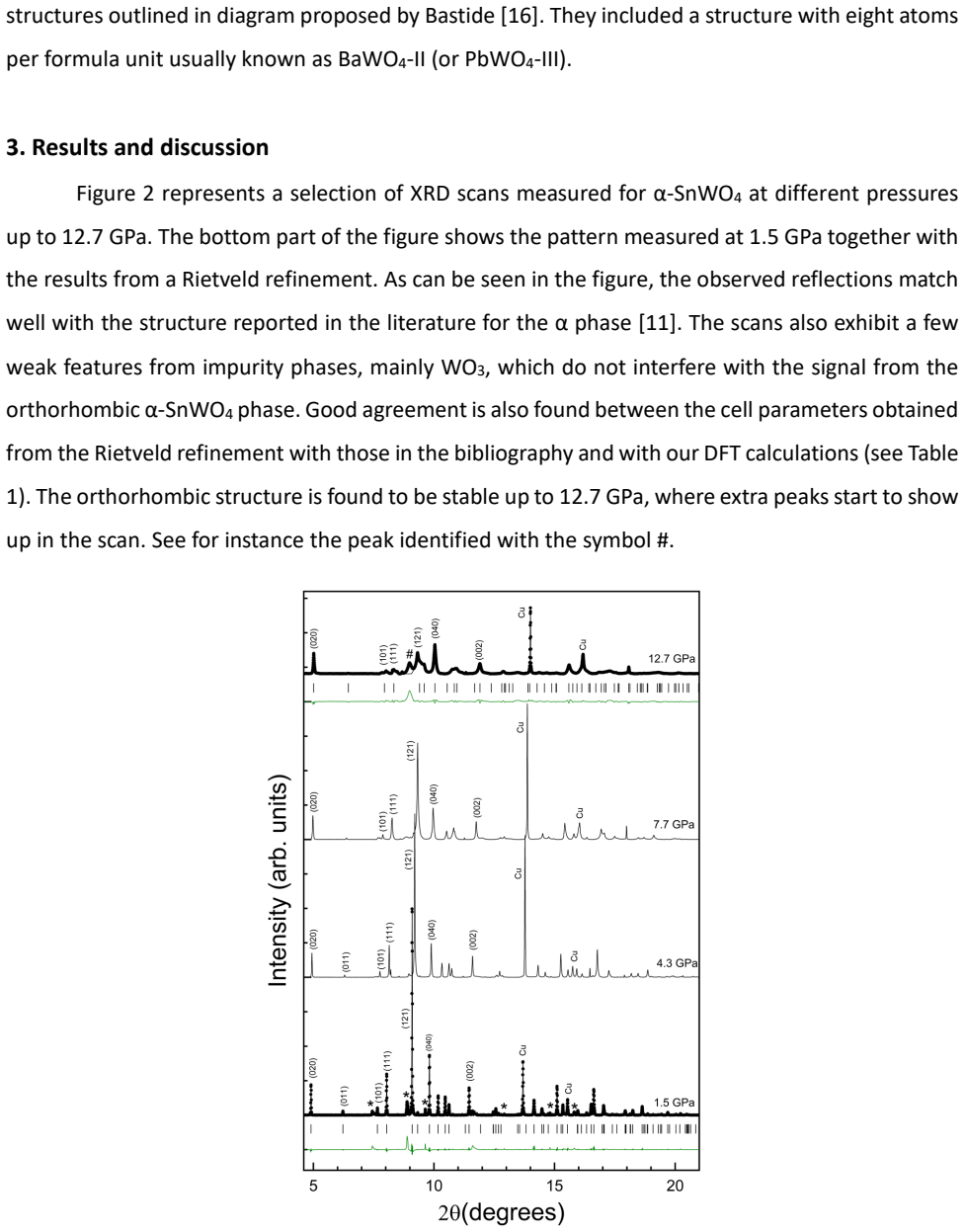
- [Section 3, Tables 4 and 5] The atomic coordinates of HP1 and HP2 are DFT-relaxed values and are never refined against the diffraction intensities; the Le Bail fits in Figs. 5 and 8 constrain only lattice parameters and space-group extinction conditions, not internal atomic positions. For HP2, a brand-new structure type, the Le Bail fit is the sole experimental validation. The paper itself notes in Section 3 that 'the fit cannot be very accurate, even though the cell parameters are well adjusted' because of peak asymmetry and powder quality, which further weakens the Le Bail validation. I request a Rietveld refinement using the DFT positions as starting values (with soft restraints if needed) or, at minimum, a quantitative comparison of calculated versus observed peak intensities (such as profile or Bragg R-factors for the new phase) before the word 'identification' is used.
- [Section 3, Fig. 4] The experimental volume discontinuities at the two transitions are 7% and 3%, while the calculated discontinuities are 3% and 15% — a fivefold discrepancy at the second transition. Given that PBEsol reproduces the α-phase lattice parameters to about 0.6% and describes HP1 reasonably, a 15% calculated collapse for HP2 compared with a 3% observed collapse is far outside typical DFT error for this level of theory and suggests the predicted HP2 structure may not correspond to the observed high-pressure phase. The Le Bail fit does not test atomic positions and therefore cannot compensate for this mismatch. The authors should demonstrate consistency between the predicted HP2 unit-cell volume and the measured pressure–volume data at the transition pressure, or explicitly reconsider whether another candidate in the CALYPSO search (e.g., HP3–HP6) matches the experimental volume collapse better.
- [Section 3, Fig. 6] The enthalpy plot is described as showing that HP1 becomes more stable than α-SnWO4 above 16 GPa, but the calculated HP1-to-HP2 transition pressure is never stated. Since the experiment places the second transition at 17.5 GPa, the paper should report the calculated enthalpy crossover between HP1 and HP2 and compare it with that experimental value. A large disagreement would substantially weaken the HP2 assignment, which currently rests mainly on the Le Bail fit and on phonon stability.
minor comments (5)
- [Table 7] Poisson's ratio ν is dimensionless, but the table header lists 'ν = 0.295 GPa'; the units should be removed.
- [Section 3, elastic moduli paragraph] The text states that the Young's modulus of α-SnWO4 (104.6 GPa) is '23% smaller' than the bulk modulus (84.9 GPa); in fact it is 23% larger. The subsequent sentence says the resistance to tensile or compressive stress exceeds the resistance to volumetric compression, which is consistent with E > B, so the numerical comparison needs correction.
- [Section 3, elastic moduli paragraph] The values 170.2 GPa for HP1 and 307.9 GPa for HP2 are referred to as 'reported above,' but Table 3 lists B0 = 100.9 GPa and B0 = 179.9 GPa for HP1 and HP2, respectively. Please clarify whether the new values are pressure-dependent bulk moduli evaluated from the fitted EOS at the relevant pressures, and give the reader the corresponding formula or reference to the EOSFit output.
- [Table 6] The entry κ2 for HP2, 0.9(10) × 10−3 GPa−1, has an uncertainty larger than the reported value; please provide more significant figures or state explicitly that this axis is only weakly constrained by the data.
- [Figure 8 caption] The sentence 'We follow with dashed of peaks from HP1 when pressure increases' is grammatically incomplete; it should read something like 'We follow the dashed peaks from HP1 as pressure increases.'
Circularity Check
No circular derivation: the high-pressure phases are identified from independent indexing and structure prediction, then profile-matched to experiment; no fitted parameter is renamed as a prediction.
full rationale
The claimed identification chain is non-circular. HP1 is obtained by DICVOL indexation of the experimental powder pattern to a monoclinic P21/n cell resembling BaWO4-II; the atomic model is then taken from the known BaWO4-II structure (Kawada et al.) and relaxed with DFT, and its stability is tested by enthalpy and phonon calculations. The starting model is not defined by the target phase's measured intensities. HP2 is produced by CALYPSO from the chemical composition alone, and the candidate is afterward compared with the XRD data through Le Bail fits; the atomic coordinates are DFT predictions presented as such, not parameters refined from the diffraction intensities. The EOS parameters and compressibilities are fits to measured P-V data and are reported as fits. The manuscript's caveat that peak asymmetry limits Le Bail accuracy and the large experimental-vs-calculated volume-collapse mismatch for HP2 (3% vs 15%) are evidence-quality concerns about whether the proposed HP2 structure is the true atomic arrangement; they are not circularity, because the structure was not fitted from the data it is claimed to explain. Self-citations appear but are not load-bearing: the BaWO4-II prototype is from Kawada et al., CALYPSO is from Wang et al., and the authors' prior tungstate studies are used for context rather than to force the HP2 choice.
Assumptions & free parameters
free parameters (3)
- B0 and B0' for α-SnWO4 (experimental BM EOS) =
B0 = 73.6 ± 5.6 GPa, B0' = 3.4 ± 1.5
- B0 and B0' for HP1 (experimental BM EOS) =
B0 = 100.9 GPa, B0' = 2.9
- B0 and B0' for HP2 (experimental BM EOS) =
B0 = 179.9 GPa, B0' = 4.9
assumptions (5)
- domain assumption DFT with the PBEsol exchange-correlation functional reliably ranks the enthalpies of SnWO4 polymorphs at high pressure.
- domain assumption The methanol-ethanol-water mixture stays sufficiently hydrostatic up to 30 GPa.
- domain assumption CALYPSO searches at 0 K and 30 GPa with up to 4 f.u. sample the relevant high-pressure structure landscape for the 17.5 GPa, room-temperature phase.
- domain assumption The weak WO3 impurity and the coexisting HP1 fraction do not affect the Le Bail fits of HP2.
- domain assumption Le Bail fitting with the proposed space group and cell is sufficient to validate the structure candidates.
Cite this review
Pith. "Pith review of Identification of the high-pressure phases of alpha-SnWO4 combining x-ray diffraction and crystal structure prediction." pith.science (2026). https://pith.science/paper/EWABTDAT
@misc{pith2026250604930,
  author       = {Pith},
  title        = {Pith review of: Identification of the high-pressure phases of alpha-SnWO4 combining x-ray diffraction and crystal structure prediction},
  year         = {2026},
  howpublished = {\url{https://pith.science/paper/EWABTDAT}},
  note         = {Machine review of arXiv:2506.04930}
}
read the original abstract
We have characterized the high-pressure behavior of alpha-SnWO4. The compound has been studied up to 30 GPa using a diamond-anvil cell and synchrotron powder X-ray diffraction. We report evidence of two structural phase transitions in the pressure range covered in our study, and we propose a crystal structure for the two high-pressure phases. The first one, observed around 12.9 GPa, has been obtained combining indexation using DICVOL and density-functional theory calculations. The second high-pressure phase, observed around 17.5 GPa, has been determined by using the CALYPSO code, the prediction of which was supported by a Le Bail fit to the experimental X-ray diffraction patterns. The proposed structural sequence involves two successive collapses of the unit-cell volume and an increase in the coordination number of Sn and W atoms. The room-temperature equations of state, the principal axes of compression and their compressibility, the elastic constants, and the elastic moduli are reported for {\alpha}-SnWO4 and for the two high-pressure phases.
Figures

Figures from the paper (6 more)


Reference graph
Works this paper leans on
-
[1]
C. B. Liu, Z. Z. He, Y . J. Liu, R. Chen, M. M. Shi, H. P . Zhu, C. Dong, C. J. F. Wang, Magnetic anisotropy and spin-flop transition of NiWO4 single crystals. J. Magn. Magn. Mat. 444 (2017) 190-192
work page 2017
- [2]
-
[3]
V. Dusastre, D. E. Williams, Selectivity and composition dependence of response of wolframite - based gas sensitive resistors (MWO4)x([Sn-Ti]O2)1-x (0< x< 1; M= Mn, Fe, Co, Ni, Cu, Zn). J. Mat. Chem. 9 (1999) 965-971
work page 1999
-
[4]
J. Phys. Cond. Matter 18 (2006) L471-L475
work page 2006
-
[5]
D. L. Stern, R. K. Grasselli, Propane oxydehydrogenation over metal tungstates. J. Catal. 167 (1997) 570-572
work page 1997
-
[6]
M. Dan, M. Cheng, H. Gao, H. Zheng, C. Feng, Synthesis and electrochemical properties of SnWO4. J. Nanoscie. Nanotech. 14 (2014) 2395-2399
work page 2014
-
[7]
N. Sreeram, V. Aruna, R. Koutavarapu, D. Y . Lee, M. C. Rao, J. Shim, Fabrication of InVO4/SnWO4 heterostructured photocatalyst for efficient photocatalytic degradation of tetracycline under visible light. Envir. Res. 220 (2023) 115191
work page 2023
-
[8]
I. S. Cho, C. H. Kwak, D. W. Kim, S. Lee, K. S. Hong, Photophysical, photoelectrochemical, and photocatalytic properties of novel SnWO 4 oxide semiconductors with narrow band gaps. J. Phys. Chem. C 113 (2009) 10647-10653
work page 2009
Show all 52 references
-
[9]
Errandonea, J
D. Errandonea, J. Ruiz -Fuertes, A brief review of the effects of pressure on wolframite -type oxides. Crystals 8 (2018) 71
2018
-
[10]
Errandonea, J
D. Errandonea, J. Pellicer-Porres, F. J. Manjón, A. Segura, C. Ferrer-Roca, R. S. Kumar, O. Tschauner, P. Rodríguez-Hernández, J. López- Solano, S. Radescu, A. Mujica, A. Muñoz, G. Aquilanti, High - pressure structural study of the scheelite tungstates Ca WO4 and SrWO 4. Phys....
2005
-
[11]
D. H. Fabini, G. Laurita, J. S. Bechtel, C. C. Stoumpos, H. A. Evans, A. G. Kontos, Y . S. Raptis, P . Falaras, A. Van der Ven, M. G. Kanatzidis, R. Seshadri, Dynamic stereochemical activity of the Sn 2+ lone pair in perovskite CsSnBr3. JACS 138 (2016) 11820-11832
2016
-
[12]
Jeitschko, A
W. Jeitschko, A. W. Sleight. Stannous tungstate: properties, crystal structure and relationship to ferroelectric SbTaO4 type compounds. Acta Crystal. B 30 (1974) 2088-2094
1974
-
[13]
Jeitschko, A
W. Jeitschko, A. W. Sleight. Synthesis, properties and crystal structure of β-SnWO4. Acta Crystal. B 28 (1972) 3174-3178
1972
-
[14]
H. K. Mao, X. J. Chen, Y . Ding, B. Li, L. Wang, Solids, liquids, and gases under high pressure. Rev. Mod. Phys. 90 (2018) 015007
2018
-
[15]
Errandonea, H
D. Errandonea, H. H. H. Osman, R. Turnbull, D. Diaz -Anichtchenko, A. Liang, J. Sanchez-Martin, C. Popescu, D. Jiang, H. Song, Y . Wang, F. J. Manjon, Pressure-induced hypercoordination of iodine and dimerization of I 2O6H in strontium di-iodate hydrogen-iodate (Sr(IO3)2HIO3)....
2024
-
[16]
Ruiz -Fuertes, S
J. Ruiz -Fuertes, S. López -Moreno, D. Errandonea, J. Pellicer -Porres, R. Lacomba- Perales, A. Segura, P . Rodríguez -Hernández, A. Muñoz, A.H. Romero, J. González, High -pressure phase transitions and compressibility of wolframite-type tungstates, J. Appl. Phys. 107 (2010) 083506
2010
-
[17]
Errandonea, F
D. Errandonea, F. J. Manjon, Pressure effects on the structural and electronic properties of ABX4 scintillating crystals. Prog. Mat. Scie. 53 (2008) 711-773
2008
-
[18]
Ruiz-Fuertes, A
J. Ruiz-Fuertes, A. Friedrich, O. Gomis, D. Errandonea, W. Morgenroth, J. A. Sans, D. Santamaria- Perez, High-pressure structural phase transition in MnWO4. Phys. Rev. B 91 (2015) 104109
2015
-
[19]
Errandonea, F
D. Errandonea, F. Rodriguez, R. Vilaplana, D. Vie, S. Garg, B. Nayak, N. Garg, J. Singh, V. Kanchana, G. Vaitheeswaran, Band-Gap energy and electronic d– d transitions of NiWO 4 studied under high - pressure conditions. J. Phys. Chem. C 127 (2023) 15630-15640
2023
-
[20]
Bandiello, P
E. Bandiello, P . Rodríguez-Hernández, A. Muñoz, M. B. Buenestado, C. Popescu, D. Errandonea, Electronic properties and high -pressure behavior of wolframite -type CoWO4. Mat. Adv. 2 (2021) 5955-5966
2021
-
[21]
Kuzmin, A
A. Kuzmin, A. Anspoks, A. Kalinko, J. Timoshenko, R. Kalendarev, External pressure and composition effects on the atomic and electronic structure of SnWO4. Sol. Energy Mat. and Sol. Cells 143 (2015) 627-634
2015
-
[22]
Kuzmin, A
A. Kuzmin, A. Anspoks, A. Kalinko, J. Timoshenko, R. Kalendarev, L. Nataf, F. Baudelet, T. Irifune, High-pressure x-ray absorption spectroscopy study of tin tungstates. Phys. Scripta 90 (2015) 094003
2015
-
[23]
Kuzmin, A
A. Kuzmin, A. Anspoks, A. Kalinko, J. Timoshenko, R. Kalendarev, L. Nataf, F. Baudelet, T. Irifune, P . Roy, Pressure-induced insulator-to-metal transition in α -SnWO
-
[24]
J. Phys. Conf. Series 712 (2016) 012122
2016
-
[25]
E. O. Gomes, A. F. Gouveia, L. Gracia, A. Lobato, J. M. Recio, J. Andrés , A chemical-pressure- induced phase transition controlled by lone electron pair activity. J. Phys. Chem. Letters 13 (2022) 9883-9888
2022
-
[26]
R. M. Hazen, Temperature, pressure and composition: structurally analogous variables. Phys. Chem. of Min. 1 (1977) 83-94
1977
-
[27]
Errandonea, J
D. Errandonea, J. Pellicer -Porres, F. J. Manjón, A. Segura, C. Ferrer -Roca, R. S. Kumar, O. Tschauner, J. López-Solano, P . Rodríguez-Hernández, S. Radescu, A. Mujica, A. Muñoz, G. Aquilanti, Determination of the high- pressure crystal structure of BaWO 4 and PbWO4. Phys. Re...
2002
-
[28]
J. L. Solis, J. Frantti, V. Lantto, L. Häggström, M. Wikner, Characterization of phase structures in semiconducting SnWO4 powders by Mössbauer and Raman spectroscopies. Phys. Rev. B 57 (1998) 13491
1998
-
[29]
Prescher, V
C. Prescher, V. B. Prakapenka, DIOPTAS: a program for reduction of two -dimensional X -ray diffraction data and data exploration. High Pres. Res. 35 (2015) 223-230
2015
-
[30]
Klotz, J
S. Klotz, J. C. Chervin, P . Munsch, G. Le Marchand, Hydrostatic limits of 11 pressure transmitting media. J. Phys. D: Appl. Phys. 42 (2009) 075413
2009
-
[31]
Errandonea, R
D. Errandonea, R. Turnbull, J. Sánchez-Martín, R . Oliva, A. Muñoz, S. Radescu, A . Mujica, L . Blackburn, N. C. Hyatt, C. Popescu, J. Ibáñez-Insa, A comparative study of the high-pressure structural stability of zirconolite materials for nuclear waste immobilisation , Results...
2024
-
[32]
Dewaele, P
A. Dewaele, P . Loubeyre, M. Mezouar, Equations of state of six metals above 94 GPa. Phys. Rev. B 70 (2004) 094112
2004
-
[33]
R. O. Jones, Density functional theory: Its origins, rise to prominence, and future. Rev. Mod. Phys. 87 (2015) 897-923
2015
-
[34]
P . E. Blöchl, Projector augmented-wave method. Phys. Rev. B 50 (1994) 17953-17979
1994
-
[35]
Kresse, D
G. Kresse, D. Joubert, From ultrasoft pseudopotentials to the projector augmented- wave method. Phys. Rev. B 59,(1999) 1758-1775
1999
-
[36]
Kresse, J
G. Kresse, J. Hafner, Ab initio molecular dynamics for liquid metals. Phys. Rev. B 47 (1993) 558- 561
1993
-
[37]
J. P . Perdew, A. Ruzsinsky, G. I. Csonka, O. A. Vydrov, G. E. Scuseria, L. A. Constantin, X. Zhou, K. Burke, Restoring the density-fradient expansion for exchange in solids and surfaces. Phys. Rev. Lett. 100 (2008) 136406
2008
-
[38]
H. J. Monkhorst, J. D. Pack, Special points for Brillouin-zone integrations. Phys. Rev. B 13, (1976) 5188-5192
1976
-
[39]
Parlinski, Computer Code PHONON, (2008)
K. Parlinski, Computer Code PHONON, (2008). See: http://wolf.ifj.edu.pl/phonon
2008
-
[40]
Le Page, P
Y . Le Page, P . Saxe, Symmetry -general least -squares extraction of elastic data for strained materials from ab initio calculations of stress. Phys. Rev. B 65 (2002) 104104
2002
-
[41]
Y . Wang, J. Lv, L. Zhu, Y . Ma, Crystal structure prediction via particle-swarm optimization. Phys. Rev. B 82 (2010) 094116
2010
-
[42]
Y . Wang, J. Lv, L. Zhu, Y . Ma, CALYPSO: A method for crystal structure prediction. Comp. Phys. Commun. 183 (2012) 2063-2070
2012
-
[43]
Birch, Finite elastic strain of cubic crystals
F. Birch, Finite elastic strain of cubic crystals. Phys. Rev. 71 (1947) 809-822
1947
-
[44]
Gonzalez-Platas, M
J. Gonzalez-Platas, M. Alvaro, F. Nestola, R. Angel, EosFit7-GUI: a new graphical user interface for equation of state calculations, analyses and teaching. J. Appl. Crystal. 49 (2016) 1377-1382
2016
-
[45]
Diaz -Anichtchenko, J
D. Diaz -Anichtchenko, J. E. Aviles -Coronado, S. López -Moreno, R. Turnbull, F. J. Manjón, C. Popescu, D. Errandonea, Electronic, vibrational, and structural properties of the natural mineral ferberite (FeWO 4): A high-pressure study. Inorg. Chem. 63 (2024) 6898-6908
2024
-
[46]
Kawada, K
I. Kawada, K. Kato, T. Fujita, BaWO 4-II (a high -pressure form). Acta Crystal. B 30 (1974) 2069 - 2071
1974
-
[47]
Gomis, J
O. Gomis, J. A. Sans, R. Lacomba- Perales, D. Errandonea, Y . Meng, J. C. Chervin, A. Polian, Complex high-pressure polymorphism of barium tungstate. Phys. Rev. B 86 (2012) 054121
2012
-
[48]
M. J. Cliffe, A. L. Goodwin, PASCal: a principal axis strain calculator for thermal expansion and compressibility determination. J. Appl. Crystal. 45 (2012) 1321-1329
2012
-
[49]
Grimvall, B
G. Grimvall, B. Magyari-Kope, V. Ozolin, K. A. Persson, Lattice instabilities in metallic elements. Rev. Mod. Phys. 84 (2012) 945-986
2012
-
[50]
D. H. Chung , W. R. Buessem, The Voigt-Reuss-Hill Approximation and Elastic Moduli of Polycrystalline MgO, CaF2, β-ZnS, ZnSe, and CdTe, J. Appl. Phys. 38 (1967) 2535–2540
1967
-
[51]
Ouahrani, A
T. Ouahrani, A. B. Garg, R. Rao, P. Rodríguez-Hernández, A. Muñoz, M. Badawi, D. Errandonea, High-pressure properties of wolframite-type ScNbO4. J. Phys. Chem. C 126 (2022) 4664-4676
2022
-
[52]
M. W. Stoltzfus, P. M. Woodward, R. Seshadri, J.-H. Klepeis, B. Bursten, Structure and bonding in SnWO4, PbWO4, and BiVO4: Lone pairs vs inert pairs. Inorg. Chem. 46, (2007) 3839-3850
2007
Reviewed August 7, 2026 · model on record in the stance chip above.
Discussion (0). Sign in to comment.