REVIEW 5 minor 47 references
Learning Joint Interventional Effects from Single-Variable Interventions in Additive Models
T0 review · 0 major / 5 minor · reviewed 2026-08-07 · deepseek-v4-flash
Pith's one-line read The joint causal effect of intervening on several actions at once is identifiable from observational data plus single-variable interventions alone, whenever the outcome is an additive combination of separate nonlinear effects.
desk verdict A genuinely new identifiability result for joint effects from single-variable interventions under an additive outcome mechanism; the proof checks out, the limitations are explicit, and it deserves a proper peer review. read the letter →
The pith
A machine-rendered reading of the paper's core claim, the machinery that carries it, and where it could break.
The reading
What carries the argument
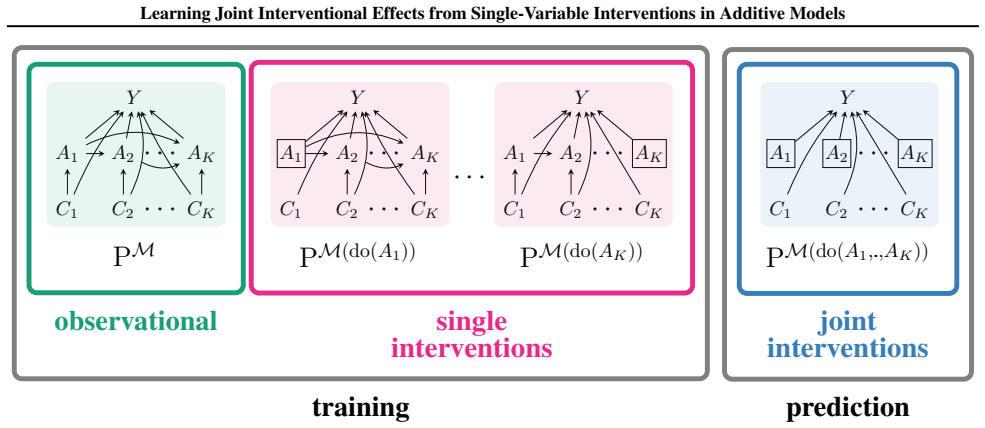
The load-bearing object is the per-action decomposition of conditional outcome expectations. Because the outcome is additive, each observable expectation splits into per-action terms that differ across regimes only in the measure over the confounder: the observational regime integrates $f_k(a_k, C_k)$ against $p(C_k \mid a_1, \dots, a_K)$, while an intervened regime integrates the intervened action's term against the marginal $p(C_k)$. The comparison identity $$E[Y \mid a_1, \dots, do(a_j), \dots, a_K] - E[Y \mid a_1, \dots, a_K] = E_{C_j}[f_j(a_j, C_j)] - E_{C_j \mid a_1, \dots, a_K}[f_j(a_j, C_j)]$$ exposes, for each action $j$, exactly the confounding-driven part that must be transferred to the joint regime. The paper packages the result as an estimator $\hat{f}(a_1, \dots, a_K, R_1, \dots, R_K) = \sum_k \hat{f}_k(a_1, \dots, a_K, R_k)$, where $R_k \in \{0, 1\}$ flags whether $A_k$ was intervened on, fitted jointly to match all $K+1$ available regimes; the joint regime is then read off with all $R_k = 1$.
What would settle it
Take any simulation satisfying Assumptions 1 and 2 with known functions and confounder densities, sample large observational and single-intervention datasets, and compare the formula $\sum_j E[Y \mid a_1, \dots, do(a_j), \dots, a_K] - (K-1) E[Y \mid a_1, \dots, a_K]$ evaluated on those samples against the true joint effect sampled from a joint intervention. A systematic mismatch at large sample size would refute the identifiability claim; a clean match under an explicitly interactive outcome mechanism, with a product term, would confirm that additivity, not something weaker, is doing the work.
Extended reading notes
Core claim
The paper's central claim is Theorem 1: under the additive outcome mechanism $Y = \sum_{k=1}^K f_k(A_k, C_k) + U$ with mutually independent pairwise confounders and identical intervention support, the joint interventional effect is identifiable from observational data and single-variable interventions in the infinite-data regime. The proof is constructive: fitting an estimator to each single-intervention regime and to the observational regime, then summing the per-action differences, yields the closed form $$E[Y \mid do(a_1, \dots, a_K)] = \sum_{j=1}^K E[Y \mid a_1, \dots, do(a_j), \dots, a_K] - (K-1) E[Y \mid a_1, \dots, a_K].$$ The same machinery identifies mixed effects in which only some actions are intervened, and it extends to outcomes that are additive over blocks of actions, provided joint interventions are available within each block. Synthetic experiments with polynomial mechanisms and five actions show the estimator reaching the same accuracy as a model trained directly on joint-intervention data, at the price of roughly an order of magnitude more samples.
Load-bearing premise
The outcome must be a sum of separate nonlinear contributions, one per action paired with its own private confounder, so actions cannot interact in producing the outcome and no confounder may influence more than one action.
Editorial extensions
If this is right
- Joint experiments become unnecessary for the additive class: the number of distinct interventional datasets needed grows linearly with the number of actions, not exponentially.
- Mixed effects, where some actions are set by intervention and others are left to natural variation, are identified by the same construction (Proposition 1).
- Additivity can be relaxed block-wise: if the outcome is additive over blocks, the joint effect is identified from joint interventions within each block and single interventions across blocks, which also permits shared confounders within a block (Corollary 1).
- The result is agnostic to the causal structure among the actions, so the action-action graph does not need to be known or estimated.
- The gain in experiment cost comes with a sample-efficiency penalty: in the synthetic experiments the method requires roughly an order of magnitude more data to match a model trained directly on joint-intervention data.
Reading between the lines
- The proof's closed form is estimator-agnostic: any consistent estimator of the observational conditional mean and of the $K$ single-intervention conditional means can be plugged in, so the identity could be paired with deep or nonparametric regressors beyond the paper's polynomial fits.
- For systems with weak but nonzero action interactions, the formula would act as a biased approximation; because the paper does not quantify this, comparing its output against a small joint-validation experiment would give a practical bias diagnostic.
- Corollary 1 suggests an experimental-design rule: group actions suspected of sharing confounders into blocks, run joint interventions within blocks, and rely on single interventions across blocks, trading additivity assumptions against the cost of pairwised experiments.
- Since identification never uses the action-action mechanism, the estimator should transfer to settings where that mechanism is unknown, misspecified, or changing, as long as intervention support is matched.
Editorial analysis
A structured set of objections, weighed in public.
Referee Report
Summary. The paper studies whether joint interventional effects E[Y | do(a1,...,aK)] can be identified from observational data and single-variable intervention data. It shows that under Assumption 2, an additive outcome mechanism with pairwise confounding (each unobserved confounder C_k affects only A_k and Y, and the C_k are mutually independent root variables), the joint effect is identifiable from the observational and single-intervention distributions. The proof is constructive: it decomposes the relevant conditional expectations into confounded and unconfounded contributions, and combines differences between single-intervention and observational regressions to recover the joint interventional expectation. The paper also extends the result to mixed interventional effects and to outcome mechanisms that are additive with respect to a partition, where joint interventional data on each block is required. Experiments on synthetic data with five actions show that the proposed estimator performs close to a model trained directly on joint interventional data and clearly outperforms observational-only and pooled-data baselines, at the cost of a substantially larger sample requirement.
Significance. If the result holds, it is a valuable contribution to the intervention generalization literature: it shows that for a nontrivial and practically motivated model class (nonlinear additive outcome mechanisms with pairwise confounding), joint experiments are not needed to identify joint interventional effects, which can substantially reduce experimental cost. The paper is also commendable for the following: (i) it gives a constructive identifiability proof that directly yields an estimation procedure, rather than a non-constructive statement; (ii) it carefully demonstrates non-identifiability without additivity (Example 1, with full distribution tables in Appendix D); (iii) it explicitly discusses the restrictiveness of Assumption 2 and provides a partition-based extension (Corollary 1) that permits more complex confounding at the price of joint interventional data on each block; and (iv) it releases code for reproducibility. The main limitations are the strong structural restrictions of Assumption 2 and the absence of finite-sample guarantees; both are acknowledged in the paper and do not undermine the asymptotic identifiability claim.
minor comments (5)
- [Appendix A.2, Eq. (35)] In the proof of Lemma 1, the integrand in Eq. (35) is missing c_k from the conditioning set of the first factor: it should read p(ak | a1,...,aj,...,ak-1, ck) rather than p(ak | a1,...,aj,...,ak-1). As written, the step from Eq. (34) to Eq. (35) is not valid; with the corrected conditioning, the subsequent derivation goes through.
- [Appendix A.2, Lemma 1 and Lemma 2(b)] Lemma 1 is stated only for k > j, but Lemma 2(b) invokes it for all k != j, including k < j. The k < j case is not covered by the current statement and requires an additional argument (e.g., that conditioning on the intermediate actions blocks the dependence from C_k to later intervened actions). Please add a short clarification or extend Lemma 1.
- [Section 7.1 and Appendix E] There is an inconsistency in the description of the synthetic data-generating process: Section 7.1 says the structural assignments are 'second order polynomials', while Appendix E says the functions f_k and g_k are 'third order polynomials'. Please harmonize the two descriptions.
- [Section 2.2, Eq. (2)] The phrase 'we write the causal structure as a fully connected DAG' is potentially confusing, since the intended meaning is that all edges from earlier to later actions are permitted, with absent edges represented by zero functions. Consider rewording to avoid the impression that a fully connected DAG is required.
- [Section 7.2, Figure 2] The claim that the method achieves performance 'comparable' to the joint-intervention topline is based on the single configuration in Figure 2(a). It would be helpful to state whether the qualitative conclusions are robust to variations in K, noise distributions, and polynomial degrees, or to add a sentence noting that the reported results are for the specific setup described in Appendix E.
Circularity Check
No circularity: the joint interventional effect is derived by algebraic combination of observational and single-intervention expectations, with the additive-mechanism assumption stated independently of the target.
full rationale
The central claim, Theorem 1, is not circular. The target E[Y | do(a1,...,aK)] is never used as an input to the estimator; the estimator is fit only to observational and single-variable-intervention expectations (Eqs. (69)-(70)), and the joint effect is obtained by the explicit algebraic combination in Eqs. (71)-(80). The key cancellation of confounded terms follows from the additive outcome mechanism (Assumption 2, Eq. (9)) and the conditional-independence Lemma 2, both of which are stated structural conditions and lemmas independent of the target quantity. No fitted parameter encodes the joint effect, and no identifiability claim is imported from same-author prior work: the closest related work, Saengkyongam & Silva (2020), is contrasted as using a different assumption (Gaussian noise) rather than being used as a proof ingredient. The self-citations present (e.g., Kekic et al., 2023a) are contextual and not load-bearing for the identifiability result. The experiments are synthetic and compare against a joint-intervention oracle, so they cannot induce circularity. The paper explicitly acknowledges the restrictiveness of Assumption 2 and the lack of finite-sample guarantees, which are scope limitations rather than circular steps. Overall, the derivation is self-contained given its stated assumptions.
Assumptions & free parameters
assumptions (5)
- standard math Standard SCM formalism with mutually independent exogenous noises and a unique solution per u
- domain assumption Acyclic causal structure among actions, with actions in topological order; each action g_k depends only on previous actions and its own confounder C_k
- ad hoc to paper Additive outcome mechanism Y = sum_k f_k(A_k, C_k) + U with pairwise confounding
- domain assumption Identical support of action variables across observational, single-intervention, and joint-intervention regimes
- standard math Universal function approximators can fit the K+1 conditional expectations exactly in infinite data
Cite this review
Pith. "Pith review of Learning Joint Interventional Effects from Single-Variable Interventions in Additive Models." pith.science (2026). https://pith.science/paper/G3JIZLD4
@misc{pith2026250604945,
  author       = {Pith},
  title        = {Pith review of: Learning Joint Interventional Effects from Single-Variable Interventions in Additive Models},
  year         = {2026},
  howpublished = {\url{https://pith.science/paper/G3JIZLD4}},
  note         = {Machine review of arXiv:2506.04945}
}
read the original abstract
Estimating causal effects of joint interventions on multiple variables is crucial in many domains, but obtaining data from such simultaneous interventions can be challenging. Our study explores how to learn joint interventional effects using only observational data and single-variable interventions. We present an identifiability result for this problem, showing that for a class of nonlinear additive outcome mechanisms, joint effects can be inferred without access to joint interventional data. We propose a practical estimator that decomposes the causal effect into confounded and unconfounded contributions for each intervention variable. Experiments on synthetic data demonstrate that our method achieves performance comparable to models trained directly on joint interventional data, outperforming a purely observational estimator.
Figures


Reference graph
Works this paper leans on
-
[1]
write newline
" write newline "" before.all 'output.state := FUNCTION n.dashify 't := "" t empty not t #1 #1 substring "-" = t #1 #2 substring "--" = not "--" * t #2 global.max substring 't := t #1 #1 substring "-" = "-" * t #2 global.max substring 't := while if t #1 #1 substring * t #2 global.max substring 't := if while FUNCTION format.date year duplicate empty "emp...
-
[2]
Agarwal, R., Melnick, L., Frosst, N., Zhang, X., Lengerich, B., Caruana, R., and Hinton, G. E. Neural additive models: Interpretable machine learning with neural nets . NeurIPS, 2021
work page 2021
-
[3]
Intervention generalization: A view from factor graph models
Bravo-Hermsdorff, G., Watson, D., Yu, J., Zeitler, J., and Silva, R. Intervention generalization: A view from factor graph models. NeurIPS, 2023
work page 2023
-
[4]
Brehmer, J., De Haan, P., Lippe, P., and Cohen, T. S. Weakly supervised causal representation learning. NeurIPS, 2022
work page 2022
-
[5]
Breiman, L. and Friedman, J. H. Estimating optimal transformations for multiple regression and correlation. Journal of the American statistical Association, 1985
work page 1985
-
[6]
Brook, B. W., Sodhi, N. S., and Bradshaw, C. J. Synergies among extinction drivers under global change. Trends in ecology & evolution, 2008
work page 2008
-
[7]
Learning linear causal representations from interventions under general nonlinear mixing
Buchholz, S., Rajendran, G., Rosenfeld, E., Aragam, B., Sch \"o lkopf, B., and Ravikumar, P. Learning linear causal representations from interventions under general nonlinear mixing. NeurIPS, 2023
work page 2023
-
[8]
Chan, D. and Perry, M. Challenges and opportunities in media mix modeling. Google Research, 2017
work page 2017
Show all 47 references
-
[9]
Q., Ghasemi, M., and Kocaoglu, M
Elahi, M. Q., Ghasemi, M., and Kocaoglu, M. Identification of average causal effects in confounded additive noise models. arXiv preprint arXiv:2407.10014, 2024
2024 arXiv
-
[10]
Friedman, J. H. and Stuetzle, W. Projection Pursuit Regression . Journal of the American statistical Association, 1981
1981
-
[11]
H., Kirschbaum, E., and Janzing, D
Garrido Mejia, S. H., Kirschbaum, E., and Janzing, D. Obtaining causal information by merging datasets with maxent. AISTATS, 2022
2022
-
[12]
H., Kirschbaum, E., Kekić, A., and Mastakouri, A
Garrido Mejia, S. H., Kirschbaum, E., Kekić, A., and Mastakouri, A. Estimating joint interventional distributions from marginal interventional data. arXiv preprint arXiv:2409.01794, 2024
2024 arXiv
-
[13]
u gelgen, J., K \
Gresele, L., Von K \"u gelgen, J., K \"u bler, J., Kirschbaum, E., Sch \"o lkopf, B., and Janzing, D. Causal inference through the structural causal marginal problem. ICML, 2022
2022
-
[14]
B., and Sch \"o lkopf, B
Guo, S., Wildberger, J. B., and Sch \"o lkopf, B. Out-of-variable generalisation for discriminative models. ICLR, 2024
2024
-
[15]
and Tibshirani, R
Hastie, T. and Tibshirani, R. Generalized Additive Models . Taylor & Francis, 1990
1990
-
[16]
Hernan, M. A. and Robins, J. M. Causal Inference: What If . 2010
2010
-
[17]
M., Peters, J., and Sch\" o lkopf, B
Hoyer, P., Janzing, D., Mooij, J. M., Peters, J., and Sch\" o lkopf, B. Nonlinear causal discovery with additive noise models. NeurIPS, 2008
2008
-
[18]
Disentangling causal effects from sets of interventions in the presence of unobserved confounders
Jeunen, O., Gilligan-Lee, C., Mehrotra, R., and Lalmas, M. Disentangling causal effects from sets of interventions in the presence of unobserved confounders. NeurIPS, 2022
2022
-
[19]
Bayesian methods for media mix modeling with carryover and shape effects
Jin, Y., Wang, Y., Sun, Y., Chan, D., and Koehler, J. Bayesian methods for media mix modeling with carryover and shape effects. Google Research, 2017
2017
-
[20]
Estimating joint treatment effects by combining multiple experiments
Jung, Y., Tian, J., and Bareinboim, E. Estimating joint treatment effects by combining multiple experiments. ICML, 2023
2023
-
[21]
u gelgen, J., Priesemann, V., and Sch \
Keki \'c , A., Dehning, J., Gresele, L., von K \"u gelgen, J., Priesemann, V., and Sch \"o lkopf, B. Evaluating vaccine allocation strategies using simulation-assisted causal modeling. Patterns, 2023 a
2023
-
[22]
Targeted reduction of causal models
Keki \'c , A., Sch \"o lkopf, B., and Besserve, M. Targeted reduction of causal models. UAI, 2023 b
2023
-
[23]
On the representation of continuous functions of several variables as superpositions of continuous functions of a smaller number of variables
Kolmogorov, A. On the representation of continuous functions of several variables as superpositions of continuous functions of a smaller number of variables. Dokl. Akad. Nauk, 108 0 (2), 1956
1956
-
[24]
Kolmogorov, A. N. On the representation of continuous functions of many variables by superposition of continuous functions of one variable and addition. Doklady Akademii Nauk, 114: 0 953--956, 1957
1957
-
[25]
Deep learning based forecasting: a case study from the online fashion industry
Kunz, M., Birr, S., Raslan, M., Ma, L., Li, Z., Gouttes, A., Koren, M., Naghibi, T., Stephan, J., Bulycheva, M., Grzeschik, M., Keki\'c, A., Narodovitch, M., Rasul, K., Sieber, J., and Januschowski, T. Deep learning based forecasting: a case study from the online fashion indus...
2023 arXiv
-
[26]
Additive decoders for latent variables identification and cartesian-product extrapolation
Lachapelle, S., Mahajan, D., Mitliagkas, I., and Lacoste-Julien, S. Additive decoders for latent variables identification and cartesian-product extrapolation. NeurIPS, 2023
2023
-
[27]
D., and Bareinboim, E
Lee, S., Correa, J. D., and Bareinboim, E. General Identifiability with Arbitrary Surrogate Experiments . UAI, 2019
2019
-
[28]
u gelgen, J., Buchholz, S., Besserve, M., Gresele, L., and Sch \
Liang, W., Keki \'c , A., von K \"u gelgen, J., Buchholz, S., Besserve, M., Gresele, L., and Sch \"o lkopf, B. Causal component analysis. NeurIPS, 2023
2023
-
[29]
Causal modeling with stationary diffusions
Lorch, L., Krause, A., and Sch\" o lkopf, B. Causal modeling with stationary diffusions. AISTATS, 2024
2024
-
[30]
Synthetic potential outcomes and causal mixture identifiability
Mazaheri, B., Squires, C., and Uhler, C. Synthetic potential outcomes and causal mixture identifiability. arXiv preprint arXiv:2405.19225, 2024
2024 arXiv
-
[31]
L., and Zhou, X.-H
Miao, W., Hu, W., Ogburn, E. L., and Zhou, X.-H. Identifying effects of multiple treatments in the presence of unmeasured confounding. Journal of the American Statistical Association, 2023
2023
-
[32]
Causality
Pearl, J. Causality. Cambridge university press, 2009
2009
-
[33]
A., Wicha, S
Pearson, R. A., Wicha, S. G., and Okour, M. Drug combination modeling: methods and applications in drug development. The Journal of Clinical Pharmacology, 2023
2023
-
[34]
Elements of causal inference: foundations and learning algorithms
Peters, J., Janzing, D., and Sch \"o lkopf, B. Elements of causal inference: foundations and learning algorithms. The MIT Press, 2017
2017
-
[35]
S., Min, J
Prosperi, M., Guo, Y., Sperrin, M., Koopman, J. S., Min, J. S., He, X., Rich, S., Wang, M., Buchan, I. E., and Bian, J. Causal inference and counterfactual prediction in machine learning for actionable healthcare. Nature Machine Intelligence, 2020
2020
-
[36]
Causal Imputation for Counterfactual SCMs: Bridging Graphs and Latent Factor Models
Ribot, \'A ., Squires, C., and Uhler, C. Causal Imputation for Counterfactual SCMs: Bridging Graphs and Latent Factor Models . Conference on Causal Learning and Reasoning, 2024
2024
-
[37]
and Silva, R
Saengkyongam, S. and Silva, R. Learning joint nonlinear effects from single-variable interventions in the presence of hidden confounders. UAI, 2020
2020
-
[38]
Causal forecasting for pricing
Schultz, D., Stephan, J., Sieber, J., Yeh, T., Kunz, M., Doupe, P., and Januschowski, T. Causal forecasting for pricing. arXiv preprint arXiv:2312.15282, 2023
2023 arXiv
-
[39]
and Pearl, J
Shpitser, I. and Pearl, J. Identification of joint interventional distributions in recursive semi-Markovian causal models , 2006
2006
-
[40]
and Pearl, J
Tian, J. and Pearl, J. A general identification condition for causal effects. AAAI, 2002
2002
-
[41]
C., Faller, P
Vankadara, L. C., Faller, P. M., Hardt, M., Minorics, L., Ghoshdastidar, D., and Janzing, D. Causal forecasting: generalization bounds for autoregressive models. UAI, 2022
2022
-
[42]
General identifiability and achievability for causal representation learning
Varici, B., Acart \"u rk, E., Shanmugam, K., and Tajer, A. General identifiability and achievability for causal representation learning. AISTATS, 2024
2024
-
[43]
u gelgen, J., Besserve, M., Liang, W., Gresele, L., Keki \'c , A., Bareinboim, E., Blei, D., and Sch \
von K \"u gelgen, J., Besserve, M., Liang, W., Gresele, L., Keki \'c , A., Bareinboim, E., Blei, D., and Sch \"o lkopf, B. Nonparametric identifiability of causal representations from unknown interventions. NeurIPS, 2023
2023
-
[44]
Multi-view causal representation learning with partial observability
Yao, D., Xu, D., Lachapelle, S., Magliacane, S., Taslakian, P., Martius, G., von K \"u gelgen, J., and Locatello, F. Multi-view causal representation learning with partial observability. ICLR, 2024
2024
-
[45]
Identifiability guarantees for causal disentanglement from soft interventions
Zhang, J., Greenewald, K., Squires, C., Srivastava, A., Shanmugam, K., and Uhler, C. Identifiability guarantees for causal disentanglement from soft interventions. NeurIPS, 2023
2023
-
[46]
and Hyv\" a rinen, A
Zhang, K. and Hyv\" a rinen, A. On the identifiability of the post-nonlinear causal model. UAI, 2009
2009
-
[47]
Copula-based Sensitivity Analysis for Multi-Treatment Causal Inference with Unobserved Confounding
Zheng, J., D'Amour, A., and Franks, A. Copula-based Sensitivity Analysis for Multi-Treatment Causal Inference with Unobserved Confounding . Journal of Machine Learning Research, 2025
2025
Reviewed August 7, 2026 · model on record in the stance chip above.
Discussion (0). Sign in to comment.