REVIEW 3 major objections 5 minor 15 references
Performance of MAGIC stellar intensity interferometer and expansion to MAGIC + CTAO-LST1 stellar intensity interferometer
T0 review · 3 major / 5 minor · reviewed 2026-08-07 · deepseek-v4-flash
Pith's one-line read The MAGIC and CTAO-LST1 telescopes can be operated together as a stellar intensity interferometer, measuring correlated starlight on three baselines simultaneously.
desk verdict First heterogeneous-IACT intensity interferometry signal is a real milestone, but the paper under-supports its central claim and needs quantification plus null tests before it convinces. read the letter →
The pith
A machine-rendered reading of the paper's core claim, the machinery that carries it, and where it could break.
The reading
What carries the argument
The load-bearing mechanism is Hanbury Brown-Twiss intensity interferometry: instead of combining starlight amplitudes, the system cross-correlates the fluctuating photoelectron currents at two telescopes, and the degree of second-order coherence at a given baseline encodes the squared visibility of the stellar disk. The sensitivity estimate is carried by Eq. 1, the Hanbury Brown signal-to-noise formula, in which telescope parameters such as mirror area, quantum efficiency, optical efficiency, PMT excess noise factor, optical bandwidth, background-to-star ratio, and spectral factor enter as the geometric mean between the two apertures, and the signal-to-noise grows with the square root of the number of telescope pairs. On the hardware side, the enabling step is a non-invasive analog tap of one CTAO-LST1 photomultiplier signal, sent through a dedicated amplifier and an optical transmitter over fiber to the same GPU-based correlator already used by MAGIC, giving three simultaneous baselines and a denser UV-plane coverage.
What would settle it
Measure the analog-signal copy chain on CTAO-LST1 end to end, including amplifier noise, linearity, and optical-link noise, and compare the observed correlation signal-to-noise on a set of reference stars of known diameter against Eq. 1 with independently measured LST1 parameters; if the observed signal-to-noise falls below prediction by the implied factor, the geometric-mean sensitivity estimate fails.
Extended reading notes
Core claim
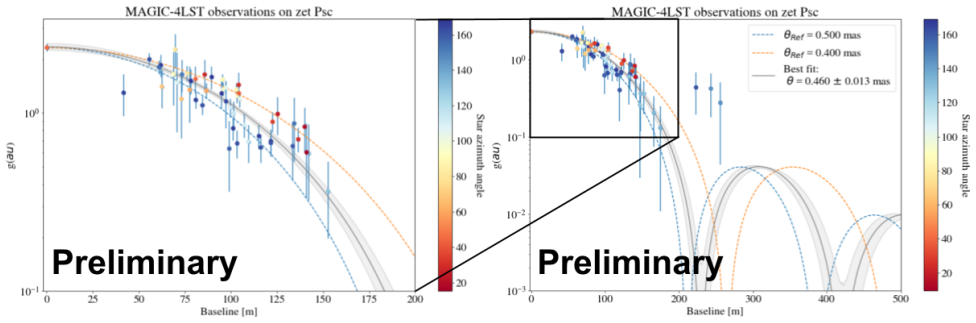
The paper's central discovery is that a heterogeneous pair of imaging atmospheric Cherenkov telescopes can work as one stellar intensity interferometer: after minimal modifications, an optical filter, a copied analog photomultiplier signal, an amplifier, and an optical fiber link into the shared correlator, the MAGIC and CTAO-LST1 telescopes produced a significant correlation signal in all three telescope-pair baselines simultaneously, for stars up to B magnitude 3.6 and angular diameters near 0.3 milliarcseconds. For MAGIC SII alone, the established result is the direct measurement of uniform-disk angular diameters for 22 stars, 13 of them without previous B-band measurements. The paper argues that the three-baseline system determines a stellar angular diameter of about 0.5 milliarcseconds with roughly 5% uncertainty from a single hour of observation, and that scaling the same design to the remaining CTAO-LSTs gives the sensitivity, baseline length, and UV-plane coverage needed for stellar-shape studies and for tracking the first days of a galactic nova expansion.
Load-bearing premise
The projected factor-3.6 sensitivity and the sub-10% diameter uncertainties assume the Hanbury Brown signal-to-noise formula with MAGIC and CTAO-LST1 system parameters, such as quantum efficiency, optical efficiency, PMT excess noise, bandwidth, and background ratio, combined as geometric means, and the paper reports no direct measurements of those quantities for the new LST1 readout chain.
Editorial extensions
If this is right
- Stellar angular diameters that previously required long dedicated campaigns can be measured in about an hour at the roughly 5% level with the three-baseline system.
- Adding the remaining CTAO-LSTs raises the projected sensitivity by a factor of about 11 over MAGIC SII, expanding the accessible star sample toward fainter and smaller stars.
- With three baselines observed at once, the UV-plane coverage of a single night is enough to begin fitting non-circular projected shapes, such as the oblateness of fast-rotating stars.
- A MAGIC-plus-four-LST system could resolve the expanding shell of a bright galactic nova in 10-minute snapshots for days to about a month, depending on the expansion velocity.
- The same minimal-hardware recipe can be copied onto the upcoming CTAO-LSTs, pointing to a route for operating the full CTAO as an intensity interferometer.
Reading between the lines
- If the projected factor-3.6 sensitivity is confirmed with independently calibrated LST1 parameters, heterogeneous IACT pairs elsewhere could be linked by fiber without new focal-plane instruments, effectively making any pair of large reflectors an optical interferometer.
- The 13 first-time B-band diameters provide a homogeneous catalog against which limb-darkened stellar atmosphere models and rotationally distorted stellar models can be tested, since all were measured with the same instrument and the same uniform-disk assumption.
- The demonstrated B-band sensitivity suggests a natural division of labor with longer-wavelength interferometers: the intensity interferometer measures disks and shapes of bright stars, while conventional long-baseline interferometers cover fainter and more compact sources, and overlapping targets could anchor cross-calibration between the two techniques.
Editorial analysis
A structured set of objections, weighed in public.
Referee Report
Summary. The paper reports on the MAGIC stellar intensity interferometer and its recent expansion to include CTAO-LST1. It summarizes the established MAGIC SII performance, describes the LST1 hardware upgrades, reports first correlation measurements with the heterogeneous MAGIC+LST1 pair, claims a factor ~3.6 sensitivity gain over MAGIC alone, and presents simulations of future fast-rotator and nova observations with the planned MAGIC+4LST system. The central technical claim is that a correlated signal was significantly measured on all three baselines simultaneously for stars up to B mag = 3.6 and angular diameters of ~0.3 mas, demonstrating the feasibility of operating a heterogeneous IACT pair as an intensity interferometer.
Significance. If the correlation detection is confirmed, this is a noteworthy instrumental milestone: it would be the first demonstration of a heterogeneous pair of IACTs operated as an intensity interferometer, and it would support the planned extension to the full CTAO-LST array. The MAGIC-only results are credible because they are validated against independent diameter measurements and are accompanied by a published systematic-error table; the paper also correctly uses the standard Hanbury Brown-Twiss sensitivity formula rather than introducing an ad hoc model. However, the paper's new load-bearing evidence for the LST1-inclusive system is currently only a preliminary visibility plot and a single unquantified assertion, so the significance of the heterogeneous-pair demonstration cannot yet be assessed from this manuscript alone.
major comments (3)
- [Section 3.2 and Figure 4] The central claim that 'A correlation signal was significantly measured in all three baselines of the MAGIC+CTAO-LST1 SII simultaneously' is not quantitatively supported. No per-baseline significance, calibrated g^(2) or visibility amplitude with uncertainties, or comparison with the expected visibility from known stellar diameters is provided. In addition, because the LST1 signal path is new and uncharacterized (one PMT tapped from a trigger front-end board, amplified, converted by an optical transmitter, and fed into the MAGIC correlator, Section 3.1), a null test (off-source, dark-sky, or blocked-input) is needed to exclude correlated electronic or optical-path noise. Please add per-baseline significances, error-bar definitions, a comparison with expected visibilities, and at least one null measurement before the detection claim can be accepted.
- [Section 4 and Eq. (1)] The sensitivity improvement factor of ~3.6 and the projected ~5% angular-diameter uncertainty are computed using Eq. (1) with LST1 system parameters (quantum efficiency, optical efficiency, excess noise factor, optical bandwidth, background ratio, and spectral factor) taken as geometric means between MAGIC and LST1. The paper reports no measured LST1 values for these parameters and no noise or linearity characterization of the new amplifier and optical-transmitter chain. As written, the projected sensitivity can only be regarded as an optimistic estimate. Please either supply the measured LST1 parameters or present the sensitivity prediction as a range spanning plausible parameter values.
- [Section 3.2 and Figure 4] The statement that one hour of observation yields a stellar angular diameter with ~5% uncertainty is not supported by the data shown in Figure 4, which displays only preliminary visibility points without error bars or a fitted model. Please show the fitted visibility curve, the data residuals, and the uncertainty budget that leads to the 5% figure.
minor comments (5)
- [Abstract and Section 4.1] The instrument name is written inconsistently: the abstract and Section 3 use 'MAGIC+CTAO-LST1' while Section 4.1 uses 'MAGIC+CTA-LST1 SII'; please use one consistent form.
- [Section 2.1 after Eq. (1)] The text says 'N/S increases roughly linearly with the number of identical telescopes'; this appears to be a typo for 'S/N'.
- [Figure 5 caption and text] The caption and the text should clarify what distinguishes the dashed lines from the solid points; currently the caption says dashed lines indicate dark-time sensitivity while solid points estimate full-Moon sensitivity, but the figure legend is not self-explanatory.
- [Figure 3 caption] Please state whether the anode-current color scale is linear or logarithmic and what the color scale represents quantitatively.
- [Sections 3, 4, and 5] There are several spelling errors: 'accesible', 'sesitivity', 'diffussed', and 'planed' should be 'accessible', 'sensitivity', 'diffused', and 'planned'.
Circularity Check
No significant circularity: the sensitivity projection uses the standard HBT formula with prior calibrated MAGIC parameters, and the new LST1 correlation and diameter claims are direct measurements, not fitted outputs of that formula.
full rationale
The paper's quantitative forward claims are (i) the MAGIC+LST1 sensitivity improvement factor of ~3.6 in Section 4 and (ii) the roughly 5% stellar angular diameter uncertainty from one hour of data shown in Figure 4. The sensitivity improvement is an application of Eq. 1, the standard Hanbury Brown-Twiss signal-to-noise formula from reference [2], with MAGIC parameters taken from the separately published MAGIC SII performance paper [4] and LST1 parameters entered as geometric means; it is a projection from stated inputs, not a fit to the new LST1 correlation data, so no fitted parameter is renamed as a prediction. The diameter result in Section 3.2 and Figure 4 is a direct visibility measurement from one hour of new MAGIC+LST1 correlations, not obtained by inverting Eq. 1. The 22-star MAGIC diameters cited from [4] are compared in Figures 1 and 2 against independent reference measurements and the JMMC catalog, providing external validation. Self-citations to [4], [8], and [11] document the already-established MAGIC channel's hardware, AMC configurations, and systematic uncertainties; they are not used as a uniqueness theorem and they do not alone ground the new LST1 signal path, whose correlation results are reported directly in Section 3.2. The absence of a null test for the new LST1 analog copy chain is a legitimate systematics and correctness concern, but it is not circularity: the paper does not define the claimed detection in terms of its own predicted sensitivity. No equation in the paper reduces to its own inputs by construction, and the central new claims are self-contained against external benchmarks.
Assumptions & free parameters
free parameters (1)
- LST1 intensity-interferometry system parameters (quantum efficiency, optical efficiency, excess noise factor… =
not reported
assumptions (3)
- standard math The Hanbury Brown-Twiss signal-to-noise formula (Eq. 1) correctly models the correlator performance.
- domain assumption The analog signal tapped from the LST1 front-end board is a faithful, low-noise copy of the PMT anode current.
- domain assumption Stellar angular diameters are interpreted with a uniform disk model for the measured visibilities.
Cite this review
Pith. "Pith review of Performance of MAGIC stellar intensity interferometer and expansion to MAGIC + CTAO-LST1 stellar intensity interferometer." pith.science (2026). https://pith.science/paper/OBASFWMT
@misc{pith2026250604994,
  author       = {Pith},
  title        = {Pith review of: Performance of MAGIC stellar intensity interferometer and expansion to MAGIC + CTAO-LST1 stellar intensity interferometer},
  year         = {2026},
  howpublished = {\url{https://pith.science/paper/OBASFWMT}},
  note         = {Machine review of arXiv:2506.04994}
}
read the original abstract
A new generation of optical intensity interferometers are emerging in recent years taking advantage of the existing infrastructure of Imaging Atmospheric Cherenkov Telescopes (IACTs). The MAGIC SII (Stellar Intensity Interferometer) in La Palma, Spain, has been operating since its first successful measurements in 2019 and its current design allows it to operate regularly. The current setup is ready to follow up on bright optical transients, as changing from regular gamma-ray observations to SII mode can be done in a matter of minutes. A paper studying the system performance, first measurements and future upgrades has been recently published. MAGIC SII's first scientific results are the measurement of the angular size of 22 stars, 13 of which with no previous measurements in the B band. More recently the Large Sized Telescope prototype from the Cherenkov Telescope Array Observatory (CTAOLST1) has been upgraded to operate together with MAGIC as a SII, leading to its first correlation measurements at the beginning of 2024. MAGIC+CTAO-LST1 SII will be further upgraded by adding the remaining CTAOLSTs at the north site to the system (which are foreseen to be built by the end of 2025). MAGIC+CTAO-LST1 SII shows a feasible technical solution to extend SII to the whole CTAO.
Figures


Figures from the paper (6 more)



Reference graph
Works this paper leans on
-
[4]
Performance and first measurements of the MAGIC stellar intensity interferometer,
Abe, S. et al., “Performance and first measurements of the MAGIC stellar intensity interferometer,”MN- RAS529, 4387–4404 (Apr. 2024)
work page 2024
-
[1]
A Test of a New Type of Stellar Interferometer on Sirius,
Hanbury-Brown, R. and Twiss, R. Q., “A Test of a New Type of Stellar Interferometer on Sirius,”Na- ture178, 1046–1048 (Nov. 1956)
work page 1956
-
[2]
Its applications to astronomy] (1974)
Hanbury Brown, R., [The intensity interferometer. Its applications to astronomy] (1974)
work page 1974
-
[3]
Demonstration of stellar intensity interferometry with the four VERITAS tele- scopes,
Abeysekara, A. U. et al., “Demonstration of stellar intensity interferometry with the four VERITAS tele- scopes,”Nature Astronomy4, 1164–1169 (Jan. 2020)
work page 2020
-
[5]
First intensity interferometry measurements with the H.E.S.S. telescopes,
Zmija, A. et al., “First intensity interferometry measurements with the H.E.S.S. telescopes,”MNRAS527, 12243–12252 (Feb. 2024)
work page 2024
-
[6]
Aleksi´ c, J. et al., “The major upgrade of the MAGIC telescopes, Part II: A performance study using observations of the Crab Nebula,”Astroparticle Physics72, 76–94 (Jan. 2016)
work page 2016
-
[7]
Acciari, V. A. et al., “Optical intensity interferometry observations using the MAGIC Imaging Atmospheric Cherenkov Telescopes,”MNRAS491, 1540–1547 (Jan. 2020)
work page 2020
-
[8]
First measurements and upgrade plans of the MAGIC intensity interferometer,
Cortina, J. et al., “First measurements and upgrade plans of the MAGIC intensity interferometer,” in [Optical and Infrared Interferometry and Imaging VIII], M´ erand, A., Sallum, S., and Sanchez-Bermudez, J., eds.,Society of Photo-Optical Instrumentation Engineers (SPIE) Conference Series12183, 121830C (Aug. 2022)
work page 2022
Show all 15 references
-
[9]
Intensity interferometry with the MAGIC telescopes,
Delgado, C. et al., “Intensity interferometry with the MAGIC telescopes,” in [37th International Cosmic Ray Conference], 693 (Mar. 2022)
2022
-
[10]
The JMMC Stellar Diameters Catalog v2 (JSDC): A New Release Based on SearchCal Improvements,
Bourg´ es, L., Lafrasse, S., Mella, G., Chesneau, O., Bouquin, J. L., Duvert, G., Chelli, A., and Delfosse, X., “The JMMC Stellar Diameters Catalog v2 (JSDC): A New Release Based on SearchCal Improvements,” in [Astronomical Data Analysis Software and Systems XXIII], Manset, N....
2014
-
[11]
Update on the performance of the MAGIC Intensity Interferometer,
Jimenez-Martinez, I. et al., “Update on the performance of the MAGIC Intensity Interferometer,” PoSICRC2023, 728 (2023)
2023
-
[12]
Status and results of the prototype LST of CTA,
Mazin, D. et al., “Status and results of the prototype LST of CTA,” in [37th International Cosmic Ray Conference], 872 (Mar. 2022)
2022
-
[13]
Interferometric observations of rapidly rotating stars,
van Belle, G. T., “Interferometric observations of rapidly rotating stars,”Astron. Astrophys. Rev.20, 51 (Mar. 2012)
2012
-
[14]
Classical Be stars. Rapidly rotating B stars with viscous Keplerian decretion disks,
Rivinius, T., Carciofi, A. C., and Martayan, C., “Classical Be stars. Rapidly rotating B stars with viscous Keplerian decretion disks,”Astron. Astrophys. Rev.21, 69 (Oct. 2013)
2013
-
[15]
A CHARA Array Survey of Circumstellar Disks around Nearby Be-type Stars,
Touhami, Y., Gies, D. R., Schaefer, G. H., McAlister, H. A., Ridgway, S. T., Richardson, N. D., Matson, R., Grundstrom, E. D., ten Brummelaar, T. A., Goldfinger, P. J., Sturmann, L., Sturmann, J., Turner, N. H., and Farrington, C., “A CHARA Array Survey of Circumstellar Disks ...
2013
Reviewed August 7, 2026 · model on record in the stance chip above.
Discussion (0). Sign in to comment.