REVIEW 3 major objections 5 minor 135 references
QiMeng: Fully Automated Hardware and Software Design for Processor Chip
T0 review · 3 major / 5 minor · reviewed 2026-08-07 · deepseek-v4-flash
Pith's one-line read QiMeng proposes a three-layer LLM system that would fully automate processor chip design, with hardware and software agents built on a domain-specific Large Processor Chip Model.
desk verdict Roadmap paper with real component pedigree; the fully-automated central claim is not yet supported and the cross-stage training step is unvalidated, but this deserves refereeing as a position paper. read the letter →
The pith
A machine-rendered reading of the paper's core claim, the machinery that carries it, and where it could break.
The reading
What carries the argument
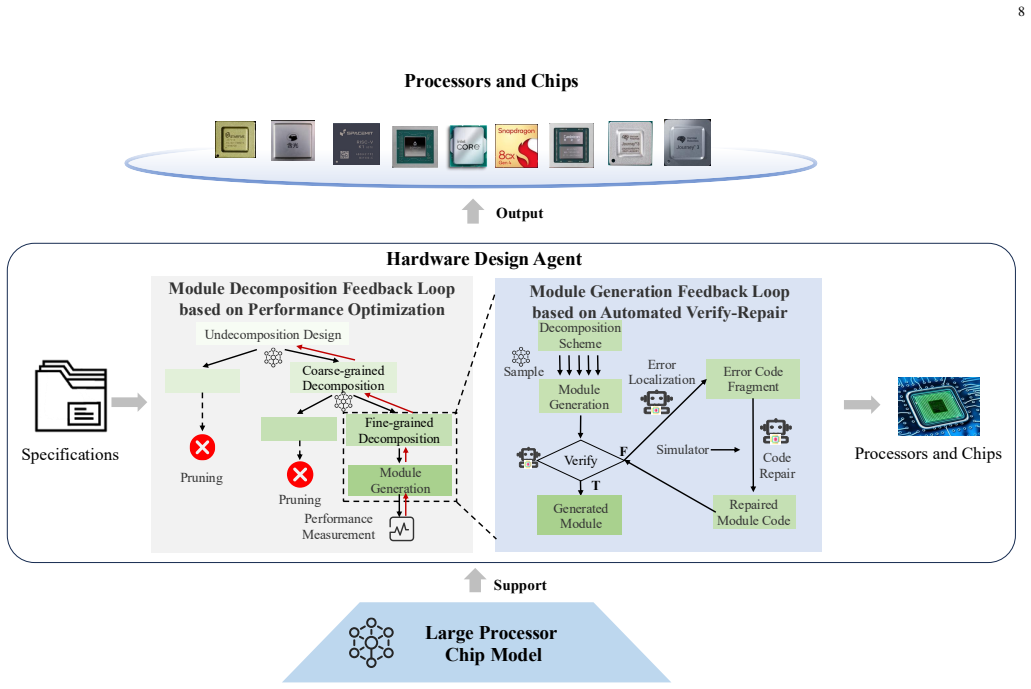
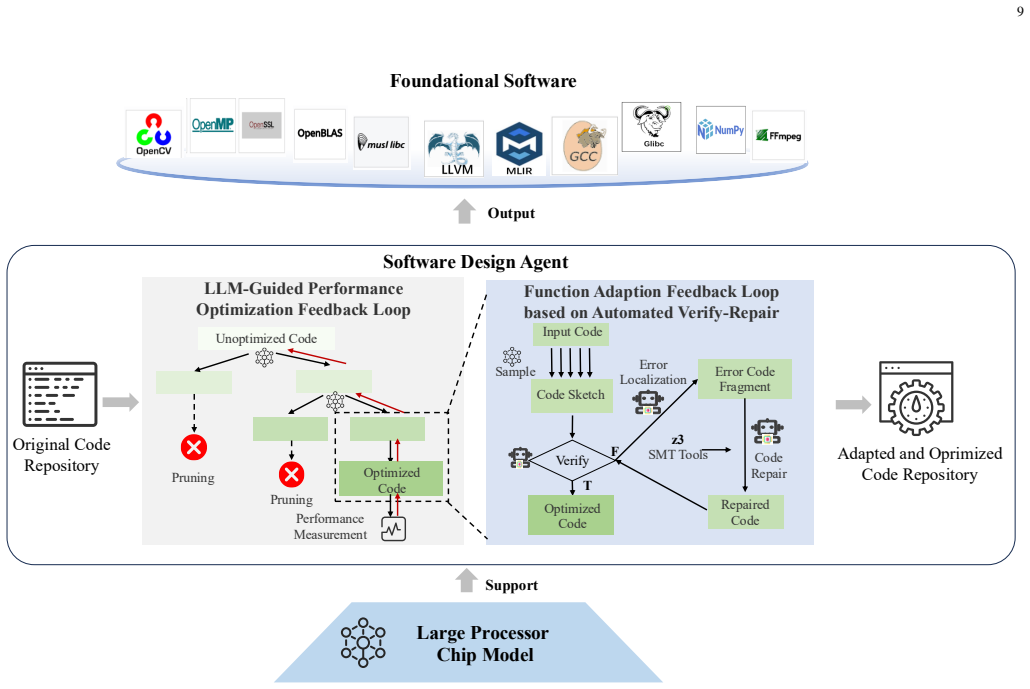
The load-bearing object is the Large Processor Chip Model (LPCM), a domain-specific multimodal LLM that understands and generates both text and graph representations such as abstract syntax trees, data-flow graphs, and control-flow graphs. Around LPCM, the two agents run dual feedback loops: an inner correctness loop that verifies generated hardware or software and repairs errors, and an outer performance loop that searches a tree of design or optimization choices and prunes low-performing branches. For hardware, the central correctness mechanism is the Binary Speculation Diagram (BSD), a graph representation of combinational circuits whose functional accuracy grows monotonically with each verification-and-repair cycle and asymptotically approaches 100 percent. For training, the key machinery is a cross-stage collaborative design database built by cascading single-stage automated design models, which is then used for chain-of-thought imitation learning to give LPCM cross-stage design reasoning.
What would settle it
Train the cascaded single-stage models on stage-specific data, run them end to end on a small processor specification, and check whether the resulting chain of HDL, netlists, and layouts passes functional verification against the original specification; if the cascaded outputs cannot be aligned into verified multi-stage traces, the cross-stage database that LPCM depends on does not exist.
Extended reading notes
Core claim
The paper's central claim is that a domain-specific, graph-aware large language model, LPCM, can serve as the shared reasoning core for both hardware design and software design, and that dual-loop feedback agents built on it are the right mechanism for full automation. The paper identifies four obstacles to LLM-based chip design: the gap between graph-structured design knowledge and sequential text, domain data scarcity, the need for near-perfect correctness, and an enormous solution space. Its proposed answers are a multimodal text-graph architecture, cross-stage collaborative training that cascades independently trained single-stage models to synthesize aligned multi-stage data, correctness feedback through automated functional verification and repair, and performance feedback through hierarchical search with pruning. The paper further claims that completed components already show significant advantages: QiMeng-CPU-v1 and QiMeng-CPU-v2 reached industrial scale and performance comparable to commercial CPUs, CodeV achieves strong Verilog generation results among open models, and AutoOS, QiMeng-Xpiler, QiMeng-GEMM, and QiMeng-TensorOp match or exceed hand-tuned baselines across multiple processor platforms.
Load-bearing premise
The system holds together only if separately trained single-stage design models can be cascaded into coherent multi-stage design traces that are aligned and correct enough to train LPCM's cross-stage reasoning, and no experiment in this paper tests that cascade.
Editorial extensions
If this is right
- If LPCM works as specified, the Hardware Design Agent could go from a functional specification to a physical layout without human engineering, unifying logic, circuit, and physical design in one automated flow.
- The Software Design Agent could produce OS configurations, compiler backends, tensor-program translations, and high-performance libraries for new processors, reducing the combinatorial cost of adapting software to fragmented instruction sets such as RISC-V.
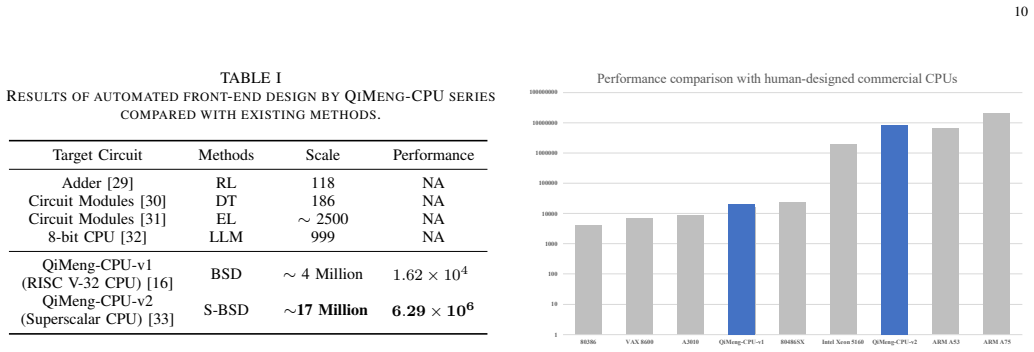
- Automated front-end design using BSD-based verification and repair has already produced a 32-bit RISC-V CPU with about four million gates in five hours, suggesting the correctness loop can scale beyond the thousand-gate circuits of earlier work.
- The same verification-repair loop can push functional correctness of generated modules asymptotically toward 100 percent, addressing the probabilistic-output weakness of LLMs without requiring zero initial accuracy.
- Following the three-phase roadmap, the top-down phase of building applications would generate domain data, the bottom-up phase would retrain agents on an improved LPCM, and the iteration phase would make the system self-evolving.
Reading between the lines
- A natural testable extension is to run the cascaded single-stage models on a small instruction set and check whether the generated HDL, netlists, and layouts align and pass functional verification; this would directly probe whether the cross-stage database that LPCM depends on actually exists.
- If the cascade works, the same data-synthesis trick could transfer to other hardware-adjacent domains with scarce cross-stage data, such as FPGA accelerators, analog circuits, or system-on-chip integration, an extension the paper does not state.
- The paper's self-evolution phase implies that the system's own generated designs would become training data, which raises a question about feedback-loop quality that the paper leaves open: whether errors in earlier stages would compound or be corrected by the verification loops.
- One could also benchmark LPCM's graph-generation fidelity directly by comparing generated circuit diagrams and layouts against verified HDL output, providing an alignment metric that the paper does not yet report for full chains.
Editorial analysis
A structured set of objections, weighed in public.
Referee Report
Summary. This paper proposes QiMeng, a three-layer system for fully automated hardware and software design of processor chips: a bottom-layer domain-specific Large Processor Chip Model (LPCM), a middle-layer Hardware Design Agent and Software Design Agent, and a top-layer set of applications. The LPCM is designed as a multimodal model that handles graph-structured data, is trained on cross-stage aligned data generated by cascaded single-stage design models, and performs feedback-driven inference with functional correctness and performance feedback loops. The agents combine these capabilities with symbolic verification and search-based optimization. The paper reports several completed components, including QiMeng-CPU-v1/v2 for automated front-end design, CodeV and CodeV-R1 for HDL generation, AutoOS for OS configuration optimization, compiler tool-chain generation, QiMeng-Xpiler for tensor program transcompilation, and QiMeng-GEMM, QiMeng-TensorOp, and QiMeng-Attention for high-performance library generation. The manuscript explicitly states that the work is still in the first phase of a three-phase roadmap, that the current components operate without LPCM, and that integration of these components and training of LPCM are future work.
Significance. If realized as described, QiMeng would be a major step toward automated hardware-software co-design, addressing a long-standing open problem. The completed components are individually significant and have appeared in prior publications: QiMeng-CPU-v1 is a fully automatically designed 32-bit RISC-V CPU, QiMeng-CPU-v2 is an automated superscalar CPU, and the software components show strong performance on their respective benchmarks. The paper is notably honest about its current phase, clearly articulating the top-down, bottom-up, and iteration roadmap and explicitly flagging that the integrated system does not yet exist. The main scientific value at this stage is the articulation of a structured research program with strong component-level building blocks, rather than a validated system. The cross-stage alignment problem for LPCM training is a genuine and well-identified open problem, but no evidence is provided that the proposed cascade can solve it.
major comments (3)
- [Section III-B (Cross-stage Collaborative Training)] The cascade of independently trained single-stage models is the only proposed mechanism for generating the cross-stage aligned data needed to train LPCM, but the paper gives no mechanism or experiment showing that the cascaded outputs are mutually consistent. For example, a compiler backend generated for an ISA may not match the RTL generated for that ISA, and an OS configuration need not correspond to the microarchitecture being designed; without a consistency constraint or a joint training signal, errors compound and the resulting (input, CoT, output) triplets would contain invalid design reasoning. This gap is load-bearing because CoT imitation learning in this section is what gives LPCM its claimed hierarchical design capability. I suggest adding a proof-of-concept cascade, for instance specification-to-RTL-to-netlist or ISA-to-compiler-backend, with alignment metrics and an evaluation showing that LPCM trained on the resulting traces improves downstream design on held-out tasks.
- [Abstract, Section I, Section II, Section V-A] The central claim of a fully automated system is not supported by an integrated implementation. Section II states that 'The current work is still in the first phase of the three-phase approach,' Section V-A explicitly notes that QiMeng-CPU-v1 and QiMeng-CPU-v2 'currently operate without utilizing LPCM,' and Section V-B describes CodeV as a component rather than as part of a working agent driven by a trained LPCM. No experiment exercises QiMeng end-to-end, so the paper's contribution is currently a roadmap with independently validated components, not a demonstrated system. The title and abstract should be reframed accordingly, or an end-to-end case study should be added.
- [Section V (Applications) and Tables I-VIII] The quantitative evidence for the completed components consists largely of results cited from the authors' prior papers: Table II is taken from CodeV, Table III from CodeV-R1, Table IV from AutoOS, Table V from QiMeng-Xpiler, and Tables VI-VIII from QiMeng-GEMM, QiMeng-TensorOp, and QiMeng-Attention. The manuscript provides no measurement methodology, reproducibility information, or new evaluation for these results in this paper. If the contribution is the QiMeng architecture, these tables serve as prior work and the paper should concentrate on the integration; if component-level advances are claimed, new experiments are required to support them.
minor comments (5)
- [Section V-E, Table IV, Table VI] There are several typos: 'tanscompiler' in Section V-E, 'OAPTIMIZATION' in the title of Table IV, and 'GPUUTILIZES' in the caption of Table VI.
- [Figure 5] The y-axis of Figure 5 is not labeled and the performance metric and its units are not specified; the reader cannot determine whether the comparison is in Dhrystone MIPS, DMIPS, or some other measure.
- [Throughout] The capitalization of the CPU design names is inconsistent: Table I uses 'QiMeng-CPU-V1' and 'QiMeng-CPU-V2' while the text uses 'QiMeng-CPU-v1' and 'QiMeng-CPU-v2'; please standardize.
- [References [12] and [83]] Reference [12] (Large Processor Chip Model) and reference [83] (QiMeng-TensorOp) appear to share the same arXiv identifier 2505.06302; one of these references likely has an incorrect ID.
- [Section II and Section V-A] Section II describes the first phase as 'developing various applications based on the LPCM, which is initialized with a general-purpose LLM,' but Section V-A states that the CPU designs operate without LPCM; please clarify what role, if any, the LPCM or a general-purpose LLM plays in the completed applications.
Circularity Check
No significant circularity; the system is an unvalidated roadmap whose completed components are externally benchmarked, so the central claim is overreaching but not circular.
full rationale
QiMeng is a roadmap/system paper. Its central claim is that a fully automated hardware/software design system can be built around a domain-specific LPCM. The proposed training/inference chain (single-stage models → cascaded cross-stage data → LPCM → agents → applications) is a forward bootstrapping loop: LPCM starts as a general-purpose LLM, and the cascade's outputs are independent of the trained LPCM, so no step reduces to its own output. The completed components (QiMeng-CPU-v1/v2, CodeV, AutoOS, QiMeng-Xpiler, QiMeng-GEMM, QiMeng-TensorOp) are validated by external tape-outs and standard benchmarks (Dhrystone, VerilogEval, RTLLM, UnixBench, OpenBLAS/cuBLAS), with results cited from prior papers; self-citations of this kind are genuine evidence under the independence rule. The paper explicitly states the current work is still in the first phase and that QiMeng-CPU-v1/v2 'currently operate without utilizing LPCM', and future work must 'automatically generate extensive domain-specialized data to train LPCM'. This makes the integrated fully-automated claim incomplete/overstated, but not circular: the LPCM bootstrapping loop is a proposed future feedback process, not a derivation that assumes what it predicts. No fitted parameter is renamed as a prediction, and no uniqueness theorem is imported from the authors' prior work.
Assumptions & free parameters
assumptions (5)
- domain assumption Multimodal architecture with GNN encoding preserves graph topology and aligns graph embeddings with text via contrastive learning, enabling LPCM to understand graph-based design data.
- domain assumption Cascaded single-stage design models can generate cross-stage aligned data sufficient to train LPCM for hierarchical reasoning.
- domain assumption The verification-repair loop monotonically increases functional accuracy and asymptotically approaches 100% correctness.
- ad hoc to paper The three-phase roadmap (top-down, bottom-up, iteration) will lead to a self-evolving system capable of full automation.
- domain assumption The solution space for a 32-bit CPU is 10^(10^540), motivating hierarchical decomposition.
invented entities (3)
-
Large Processor Chip Model (LPCM)
-
Hardware Design Agent
-
Software Design Agent
Cite this review
Pith. "Pith review of QiMeng: Fully Automated Hardware and Software Design for Processor Chip." pith.science (2026). https://pith.science/paper/72XNKLVY
@misc{pith2026250605007,
  author       = {Pith},
  title        = {Pith review of: QiMeng: Fully Automated Hardware and Software Design for Processor Chip},
  year         = {2026},
  howpublished = {\url{https://pith.science/paper/72XNKLVY}},
  note         = {Machine review of arXiv:2506.05007}
}
read the original abstract
Processor chip design technology serves as a key frontier driving breakthroughs in computer science and related fields. With the rapid advancement of information technology, conventional design paradigms face three major challenges: the physical constraints of fabrication technologies, the escalating demands for design resources, and the increasing diversity of ecosystems. Automated processor chip design has emerged as a transformative solution to address these challenges. While recent breakthroughs in Artificial Intelligence (AI), particularly Large Language Models (LLMs) techniques, have opened new possibilities for fully automated processor chip design, substantial challenges remain in establishing domain-specific LLMs for processor chip design. In this paper, we propose QiMeng, a novel system for fully automated hardware and software design of processor chips. QiMeng comprises three hierarchical layers. In the bottom-layer, we construct a domain-specific Large Processor Chip Model (LPCM) that introduces novel designs in architecture, training, and inference, to address key challenges such as knowledge representation gap, data scarcity, correctness assurance, and enormous solution space. In the middle-layer, leveraging the LPCM's knowledge representation and inference capabilities, we develop the Hardware Design Agent and the Software Design Agent to automate the design of hardware and software for processor chips. Currently, several components of QiMeng have been completed and successfully applied in various top-layer applications, demonstrating significant advantages and providing a feasible solution for efficient, fully automated hardware/software design of processor chips. Future research will focus on integrating all components and performing iterative top-down and bottom-up design processes to establish a comprehensive QiMeng system.
Figures


Figures from the paper (2 more)
Reference graph
Works this paper leans on
-
[3]
Qwen3: Think Deeper, Act Faster
“Qwen3: Think Deeper, Act Faster.” [Online]. Available: https: //qwenlm.github.io/blog/qwen3/
-
[4]
Hello GPT-4o,
OpenAI, “Hello GPT-4o,” https://openai.com/index/hello-gpt-4o/, 2024
2024
-
[5]
Gemini 2.5: Our most intelligent AI model
“Gemini 2.5: Our most intelligent AI model.” [On- line]. Available: https://blog.google/technology/google-deepmind/ gemini-model-thinking-updates-march-2025/#gemini-2-5-thinking
2025
-
[6]
Scientific large language models: A survey on biological & chemical domains,
Q. Zhang, K. Ding, T. Lv, X. Wang, Q. Yin, Y . Zhang, J. Yu, Y . Wang, X. Li, Z. Xianget al., “Scientific large language models: A survey on biological & chemical domains,”ACM Computing Surveys, vol. 57, no. 6, pp. 1–38, 2025
2025
-
[7]
14 examples of how llms can transform materials science and chemistry: a reflection on a large language model hackathon,
K. M. Jablonka, Q. Ai, A. Al-Feghali, S. Badhwar, J. D. Bocarsly, A. M. Bran, S. Bringuier, L. C. Brinson, K. Choudhary, D. Circi et al., “14 examples of how llms can transform materials science and chemistry: a reflection on a large language model hackathon,”Digital discovery, vol. 2, no. 5, pp. 1233–1250, 2023
2023
-
[8]
A survey on large language model based autonomous agents,
L. Wang, C. Ma, X. Feng, Z. Zhang, H. Yang, J. Zhang, Z. Chen, J. Tang, X. Chen, Y . Linet al., “A survey on large language model based autonomous agents,”Frontiers of Computer Science, vol. 18, no. 6, p. 186345, 2024
2024
-
[9]
Competition- level code generation with alphacode,
Y . Li, D. Choi, J. Chung, N. Kushman, J. Schrittwieser, R. Leblond, T. Eccles, J. Keeling, F. Gimeno, A. Dal Lagoet al., “Competition- level code generation with alphacode,”Science, vol. 378, no. 6624, pp. 1092–1097, 2022
2022
-
[10]
Application of recursive arithmetic to the problem of circuit synthesis,
A. Church, “Application of recursive arithmetic to the problem of circuit synthesis,”Journal of Symbolic Logic, vol. 28, no. 4, 1963
1963
Show all 135 references
-
[11]
von Neumann and A
J. von Neumann and A. W. Burks,Theory of Self-Reproducing Automata. University of Illinois Press, 1966, scanned book online. [Online]. Available: https://archive.org/details/theoryofselfrepr00vonn 0
1966
-
[13]
The graph neural network model,
F. Scarselli, M. Gori, A. C. Tsoi, M. Hagenbuchner, and G. Monfardini, “The graph neural network model,”IEEE Transactions on Neural Networks, vol. 20, no. 1, pp. 61–80, 2009
2009
-
[14]
Autoregressive diffusion model for graph generation,
L. Kong, J. Cui, H. Sun, Y . Zhuang, B. A. Prakash, and C. Zhang, “Autoregressive diffusion model for graph generation,” inInternational conference on machine learning. PMLR, 2023, pp. 17 391–17 408
2023
-
[15]
Gpt-gnn: Generative pre-training of graph neural networks,
Z. Hu, Y . Dong, K. Wang, K.-W. Chang, and Y . Sun, “Gpt-gnn: Generative pre-training of graph neural networks,” inProceedings of the 26th ACM SIGKDD international conference on knowledge discovery & data mining, 2020, pp. 1857–1867
2020
-
[16]
Automated cpu design by learning from input- output examples,
S. Cheng, P. Jin, Q. Guo, Z. Du, R. Zhang, X. Hu, Y . Zhao, Y . Hao, X. Guan, H. Hanet al., “Automated cpu design by learning from input- output examples,” inProceedings of the Thirty-Third International Joint Conference on Artificial Intelligence, 2024, pp. 3843–3853
2024
-
[17]
openeuler: Advancing a hardware and software application ecosystem,
M. Zhou, X. Hu, and W. Xiong, “openeuler: Advancing a hardware and software application ecosystem,”IEEE Software, vol. 39, no. 2, pp. 101–105, 2022
2022
-
[18]
Cox: Exposing cuda warp- level functions to cpus,
R. Han, J. Lee, J. Sim, and H. Kim, “Cox: Exposing cuda warp- level functions to cpus,”ACM Transactions on Architecture and Code Optimization (TACO), vol. 19, no. 4, pp. 1–25, 2022
2022
-
[19]
Martini: The little match and replace tool for automatic application rewriting with code examples,
A. Johnson, C. Coti, A. D. Malony, and J. Doerfert, “Martini: The little match and replace tool for automatic application rewriting with code examples,” inEuropean Conference on Parallel Processing. Springer, 2022, pp. 19–34
2022
-
[20]
Efficient compilation of cuda kernels for high- performance computing on fpgas,
A. Papakonstantinou, K. Gururaj, J. A. Stratton, D. Chen, J. Cong, and W.-M. W. Hwu, “Efficient compilation of cuda kernels for high- performance computing on fpgas,”ACM Transactions on Embedded Computing Systems (TECS), vol. 13, no. 2, pp. 1–26, 2013
2013
-
[21]
Neural machine translation by jointly learning to align and translate,
D. Bahdanau, K. Cho, and Y . Bengio, “Neural machine translation by jointly learning to align and translate,”arXiv preprint arXiv:1409.0473, 2014
2014 arXiv
-
[22]
Unsu- pervised translation of programming languages,
B. Roziere, M.-A. Lachaux, L. Chanussot, and G. Lample, “Unsu- pervised translation of programming languages,”Advances in neural information processing systems, vol. 33, pp. 20 601–20 611, 2020
2020
-
[24]
Ansor: Generating high-performance tensor programs for deep learning,
L. Zheng, C. Jia, M. Sun, Z. Wu, C. H. Yu, A. Haj-Ali, Y . Wang, J. Yang, D. Zhuo, K. Senet al., “Ansor: Generating high-performance tensor programs for deep learning,” in14th USENIX symposium on operating systems design and implementation (OSDI 20), 2020, pp. 863–879
2020
-
[25]
Heron: Automatically constrained high-performance library generation for deep learning accelerators,
J. Bi, Q. Guo, X. Li, Y . Zhao, Y . Wen, Y . Guo, E. Zhou, X. Hu, Z. Du, L. Liet al., “Heron: Automatically constrained high-performance library generation for deep learning accelerators,” inProceedings of the 28th ACM International Conference on Architectural Support for Prog...
2023
-
[26]
Autoos: make your os more powerful by ex- ploiting large language models,
H. Chen, Y . Wen, L. Cheng, S. Kuang, Y . Liu, W. Li, L. Li, R. Zhang, X. Song, W. Liet al., “Autoos: make your os more powerful by ex- ploiting large language models,” inForty-first International Conference on Machine Learning, 2024
2024
-
[27]
A survey of monte carlo tree search methods,
C. B. Browne, E. Powley, D. Whitehouse, S. M. Lucas, P. I. Cowling, P. Rohlfshagen, S. Tavener, D. Perez, S. Samothrakis, and S. Colton, “A survey of monte carlo tree search methods,”IEEE Transactions on Computational Intelligence and AI in games, vol. 4, no. 1, pp. 1–43, 2012
2012
-
[28]
Z3: An efficient smt solver,
L. De Moura and N. Bjørner, “Z3: An efficient smt solver,” in International conference on Tools and Algorithms for the Construction and Analysis of Systems. Springer, 2008, pp. 337–340
2008
-
[29]
Prefixrl: Optimization of parallel prefix circuits using deep reinforcement learning,
R. Roy, J. Raiman, N. Kant, I. Elkin, R. Kirby, M. Siu, S. Oberman, S. Godil, and B. Catanzaro, “Prefixrl: Optimization of parallel prefix circuits using deep reinforcement learning,” in2021 58th ACM/IEEE Design Automation Conference (DAC). IEEE, 2021, pp. 853–858
2021
-
[30]
Circuit learning for logic regression on high dimensional boolean space,
P.-W. Chen, Y .-C. Huang, C.-L. Lee, and J.-H. R. Jiang, “Circuit learning for logic regression on high dimensional boolean space,” in 2020 57th ACM/IEEE Design Automation Conference (DAC). IEEE, 2020, pp. 1–6
2020
-
[31]
Logic synthesis meets machine learning: Trading exactness for generalization,
S. Rai, W. L. Neto, Y . Miyasaka, X. Zhang, M. Yu, Q. Yi, M. Fujita, G. B. Manske, M. F. Pontes, L. S. Da Rosaet al., “Logic synthesis meets machine learning: Trading exactness for generalization,” in2021 Design, Automation & Test in Europe Conference & Exhibition (DATE). IEEE...
2021
-
[32]
Chateda: A large language model powered autonomous agent for eda,
H. Wu, Z. He, X. Zhang, X. Yao, S. Zheng, H. Zheng, and B. Yu, “Chateda: A large language model powered autonomous agent for eda,” IEEE Transactions on Computer-Aided Design of Integrated Circuits and Systems, 2024
2024
-
[33]
Qimeng-cpu-v2: Automated superscalar processor design by learning data dependencies,
S. Cheng, R. Zhang, W. He, P. Jin, C. Li, Z. Du, X. Hu, Y . Hao, G. Xu, Y . Wen, L. Li, Q. Guo, and Y . Chen, “Qimeng-cpu-v2: Automated superscalar processor design by learning data dependencies,”arXiv preprint arXiv:2505.03195, 2025
2025 arXiv
-
[34]
Revisiting automatic pipelining: Gate-level forwarding and speculation,
S. Cheng, C. Li, Z. Du, R. Zhang, X. Hu, X. Li, G. Xu, Y . Wen, and Q. Guo, “Revisiting automatic pipelining: Gate-level forwarding and speculation,” inProceedings of the 61st ACM/IEEE Design Automation Conference, 2024, pp. 1–6
2024
-
[35]
Starcoder: may the source be with you!
R. Li, L. B. Allal, Y . Zi, N. Muennighoff, D. Kocetkov, C. Mou, M. Marone, C. Akiki, J. Li, J. Chimet al., “Starcoder: may the source be with you!”arXiv preprint arXiv:2305.06161, 2023
2023 arXiv
-
[36]
Code llama: Open foundation models for code,
B. Roziere, J. Gehring, F. Gloeckle, S. Sootla, I. Gat, X. E. Tan, Y . Adi, J. Liu, T. Remez, J. Rapinet al., “Code llama: Open foundation models for code,”arXiv preprint arXiv:2308.12950, 2023
2023 arXiv
-
[37]
Deepseek-coder: When the large language model meets programming–the rise of code intelligence,
D. Guo, Q. Zhu, D. Yang, Z. Xie, K. Dong, W. Zhang, G. Chen, X. Bi, Y . Wu, Y . Liet al., “Deepseek-coder: When the large language model meets programming–the rise of code intelligence,”arXiv preprint arXiv:2401.14196, 2024
2024 arXiv
-
[38]
Qwen technical report,
J. Bai, S. Bai, Y . Chu, Z. Cui, K. Dang, X. Deng, Y . Fan, W. Ge, Y . Han, F. Huanget al., “Qwen technical report,”arXiv preprint arXiv:2309.16609, 2023
2023 arXiv
-
[39]
Qwen2.5-coder technical report,
B. Hui, J. Yang, Z. Cui, J. Yang, D. Liu, L. Zhang, T. Liu, J. Zhang, B. Yu, K. Luet al., “Qwen2.5-coder technical report,”arXiv preprint arXiv:2409.12186, 2024
2024 arXiv
-
[40]
Chipnemo: Domain- adapted llms for chip design,
M. Liu, T.-D. Ene, R. Kirby, C. Cheng, N. Pinckney, R. Liang, J. Alben, H. Anand, S. Banerjee, I. Bayraktarogluet al., “Chipnemo: Domain- adapted llms for chip design,”arXiv preprint arXiv:2311.00176, 2023
2023 arXiv
-
[41]
Rtlcoder: Outperforming gpt-3.5 in design rtl generation with our open-source dataset and lightweight solution,
S. Liu, W. Fang, Y . Lu, Q. Zhang, H. Zhang, and Z. Xie, “Rtlcoder: Outperforming gpt-3.5 in design rtl generation with our open-source dataset and lightweight solution,”arXiv preprint arXiv:2312.08617, 2023
2023 arXiv
-
[42]
Betterv: Con- trolled verilog generation with discriminative guidance,
Z. Pei, H.-L. Zhen, M. Yuan, Y . Huang, and B. Yu, “Betterv: Con- trolled verilog generation with discriminative guidance,”arXiv preprint arXiv:2402.03375, 2024
2024 arXiv
-
[43]
Craftrtl: High-quality synthetic data generation for verilog code models with correct-by- construction non-textual representations and targeted code repair,
M. Liu, Y .-D. Tsai, W. Zhou, and H. Ren, “Craftrtl: High-quality synthetic data generation for verilog code models with correct-by- construction non-textual representations and targeted code repair,” arXiv preprint arXiv:2409.12993, 2024
2024 arXiv
-
[44]
Deepseek-r1: Incentivizing reasoning capability in llms via reinforcement learning,
D. Guo, D. Yang, H. Zhang, J. Song, R. Zhang, R. Xu, Q. Zhu, S. Ma, P. Wang, X. Biet al., “Deepseek-r1: Incentivizing reasoning capability in llms via reinforcement learning,”arXiv preprint arXiv:2501.12948, 2025
2025 arXiv
-
[45]
Qwq-32b: Embracing the power of reinforcement learning,
Q. Team, “Qwq-32b: Embracing the power of reinforcement learning,” March 2025. [Online]. Available: https://qwenlm.github.io/ blog/qwq-32b/
2025
-
[46]
The impact of ai on developer productivity: Evidence from github copilot,
S. Peng, E. Kalliamvakou, P. Cihon, and M. Demirer, “The impact of ai on developer productivity: Evidence from github copilot,”arXiv preprint arXiv:2302.06590, 2023
2023 arXiv
-
[47]
Starcoder 2 and the stack v2: The next generation,
A. Lozhkov, R. Li, L. B. Allal, F. Cassano, J. Lamy-Poirier, N. Tazi, A. Tang, D. Pykhtar, J. Liu, Y . Weiet al., “Starcoder 2 and the stack v2: The next generation,”arXiv preprint arXiv:2402.19173, 2024
2024 arXiv
-
[48]
Codev: Empowering llms for verilog generation through multi-level summarization,
Y . Zhao, D. Huang, C. Li, P. Jin, Z. Nan, T. Ma, L. Qi, Y . Pan, Z. Zhang, R. Zhanget al., “Codev: Empowering llms for verilog generation through multi-level summarization,”arXiv preprint arXiv:2407.10424, 2024
2024 arXiv
-
[49]
Verilogeval: Evaluating large language models for verilog code generation,
M. Liu, N. Pinckney, B. Khailany, and H. Ren, “Verilogeval: Evaluating large language models for verilog code generation,” in2023 IEEE/ACM International Conference on Computer Aided Design (ICCAD). IEEE, 2023, pp. 1–8
2023
-
[50]
Dapo: An open-source llm reinforcement learning system at scale,
Q. Yu, Z. Zhang, R. Zhu, Y . Yuan, X. Zuo, Y . Yue, T. Fan, G. Liu, L. Liu, X. Liuet al., “Dapo: An open-source llm reinforcement learning system at scale,”arXiv preprint arXiv:2503.14476, 2025
2025 arXiv
-
[51]
Codev- r1: Reasoning-enhanced verilog generation,
Y . Zhu, D. Huang, H. Lyu, X. Zhang, C. Liet al., “Codev- r1: Reasoning-enhanced verilog generation,”arXiv preprint arXiv:2505.2418, 2025
2025
-
[52]
Finding broken linux configuration specifications by statically analyzing the kconfig language,
J. Oh, N. F. Yıldıran, J. Braha, and P. Gazzillo, “Finding broken linux configuration specifications by statically analyzing the kconfig language,” inProceedings of the 29th ACM Joint Meeting on European Software Engineering Conference and Symposium on the Foundations of Softw...
2021
-
[53]
Configfix: In- teractive configuration conflict resolution for the linux kernel,
P. Franz, T. Berger, I. Fayaz, S. Nadi, and E. Groshev, “Configfix: In- teractive configuration conflict resolution for the linux kernel,” in2021 IEEE/ACM 43rd International Conference on Software Engineering: Software Engineering in Practice (ICSE-SEIP). IEEE, 2021, pp. 91– 100
2021
-
[54]
Comsa: A modeling-driven sam- pling approach for configuration performance testing,
Y . Xia, Z. Ding, and W. Shang, “Comsa: A modeling-driven sam- pling approach for configuration performance testing,” in2023 38th IEEE/ACM International Conference on Automated Software Engineer- ing (ASE). IEEE, 2023, pp. 1352–1363
2023
-
[55]
Qimeng-xpiler: Transcompiling tensor programs for deep learning systems with a neural-symbolic approach,
S. Dong, Y . Wen, J. Bi, D. Huang, J. Guo, J. Xu, R. Xu, X. Song, Y . Hao, X. Zhou, T. Chen, Q. Guo, and Y . Chen, “Qimeng-xpiler: Transcompiling tensor programs for deep learning systems with a neural-symbolic approach,”arXiv preprint arXiv:2505.02146, 2025
2025 arXiv
-
[56]
Comback: A versatile dataset for enhancing compiler backend devel- opment efficiency,
M. Zhong, F. Lyu, L. Wang, H. Geng, L. Qiu, H. Cui, and X. Feng, “Comback: A versatile dataset for enhancing compiler backend devel- opment efficiency,” inThirty-eighth Conference on Neural Information Processing Systems Datasets and Benchmarks Track, 2024
2024
-
[57]
Vega: Automatically generating compiler backends using a pre-trained transformer model,
M. Zhong, F. Lv, L. Wang, L. Qiu, Y . Wang, Y . Liu, H. Cui, X. Feng, and J. Xue, “Vega: Automatically generating compiler backends using a pre-trained transformer model,” in2025 IEEE/ACM International Symposium on Code Generation and Optimization (CGO), 2025
2025
-
[58]
Introduc- ing compiler semantics into large language models as programming language translators: A case study of c to x86 assembly,
S. Zhang, J. Zhao, C. Xia, Z. Wang, Y . Chen, and H. Cui, “Introduc- ing compiler semantics into large language models as programming language translators: A case study of c to x86 assembly,” inFindings of the Association for Computational Linguistics: EMNLP 2024, 2024, pp. 996–1011
2024
-
[59]
Exebench: an ml-scale dataset of executable c functions,
J. Armengol-Estap ´e, J. Woodruff, A. Brauckmann, J. W. d. S. Ma- galh˜aes, and M. F. O’Boyle, “Exebench: an ml-scale dataset of executable c functions,” inProceedings of the 6th ACM SIGPLAN International Symposium on Machine Programming, 2022, pp. 50–59
2022
-
[60]
ANSI C (and mostly compatible) Benchmarks for Unix and Unix-like systems
“ANSI C (and mostly compatible) Benchmarks for Unix and Unix-like systems.” [Online]. Available: https://github.com/nfinit/ansibench
-
[61]
CoreMark - CPU Benchmark
“CoreMark - CPU Benchmark.” [Online]. Available: https://www. eembc.org/coremark/
-
[62]
Basic Linear Algebra on NVIDIA GPUs
“Basic Linear Algebra on NVIDIA GPUs.” [Online]. Available: https://developer.nvidia.com/cublas
-
[63]
NVIDIA cuDNN
“NVIDIA cuDNN.” [Online]. Available: https://developer.nvidia.com/ cudnn
-
[64]
NVIDIA TensorRT
“NVIDIA TensorRT.” [Online]. Available: https://developer.nvidia. com/tensorrt
-
[65]
Flashattention: Fast and memory-efficient exact attention with io-awareness,
T. Dao, D. Fu, S. Ermon, A. Rudra, and C. R ´e, “Flashattention: Fast and memory-efficient exact attention with io-awareness,”Advances in neural information processing systems, vol. 35, pp. 16 344–16 359, 2022
2022
-
[66]
Flashattention-2: Faster attention with better parallelism and work partitioning,
T. Dao, “Flashattention-2: Faster attention with better parallelism and work partitioning,”arXiv preprint arXiv:2307.08691, 2023
2023 arXiv
-
[67]
Flashattention-3: Fast and accurate attention with asynchrony and low-precision,
J. Shah, G. Bikshandi, Y . Zhang, V . Thakkar, P. Ramani, and T. Dao, “Flashattention-3: Fast and accurate attention with asynchrony and low-precision,”Advances in Neural Information Processing Systems, vol. 37, pp. 68 658–68 685, 2024
2024
-
[68]
Deepseek-v3 technical report,
A. Liu, B. Feng, B. Xue, B. Wang, B. Wu, C. Lu, C. Zhao, C. Deng, C. Zhang, C. Ruanet al., “Deepseek-v3 technical report,”arXiv preprint arXiv:2412.19437, 2024
2024 arXiv
-
[69]
Flashmla: Efficient mla decoding kernels,
S. L. Jiashi Li, “Flashmla: Efficient mla decoding kernels,” 2025. [Online]. Available: https://github.com/deepseek-ai/FlashMLA
2025
-
[70]
Deepgemm: clean and efficient fp8 gemm kernels with fine-grained scaling,
C. Zhao, L. Zhao, J. Li, and Z. Xu, “Deepgemm: clean and efficient fp8 gemm kernels with fine-grained scaling,” 2025. [Online]. Available: https://github.com/deepseek-ai/DeepGEMM
2025
-
[71]
NVIDIA Data Center GPUs
“NVIDIA Data Center GPUs.” [Online]. Available: https://www. nvidia.com/en-us/data-center/data-center-gpus/
-
[72]
Cambricon MLU
“Cambricon MLU.” [Online]. Available: https://www.cambricon.com/
-
[73]
AMD Instinct Accelerators
“AMD Instinct Accelerators.” [Online]. Available: https://www.amd. com/en/products/accelerators/instinct.html
-
[74]
Intel AI Engines Simplify and Accelerate AI
“Intel AI Engines Simplify and Accelerate AI.” [On- line]. Available: https://www.intel.com/content/www/us/en/products/ docs/accelerator-engines/ai-engines.html
-
[75]
Introducing Claude 3.5 Sonnet,
Anthropic, “Introducing Claude 3.5 Sonnet,” https://www.anthropic.com/news/claude-3-5-sonnet, 2024
2024
-
[76]
Openblas,
OpenMathLib, “Openblas,” https://github.com/OpenMathLib/OpenBLAS, 2024
2024
-
[77]
Qimeng-gemm: Automatically generating high- performance matrix multiplication code by exploiting large language models,
Q. Zhou, Y . Wen, R. Chen, K. Gao, W. Xiong, L. Li, Q. Guo, Y . Wu, and Y . Chen, “Qimeng-gemm: Automatically generating high- performance matrix multiplication code by exploiting large language models,” inProceedings of the AAAI Conference on Artificial Intelli- gence, vol. 3...
2025
-
[78]
Llama 2: Open foundation and fine-tuned chat models,
H. Touvron, L. Martin, K. Stone, P. Albert, A. Almahairi, Y . Babaei, N. Bashlykov, S. Batra, P. Bhargava, S. Bhosaleet al., “Llama 2: Open foundation and fine-tuned chat models,”arXiv preprint arXiv:2307.09288, 2023. 20
2023 arXiv
-
[79]
Bert: Pre-training of deep bidirectional transformers for language understanding,
J. Devlin, M.-W. Chang, K. Lee, and K. Toutanova, “Bert: Pre-training of deep bidirectional transformers for language understanding,” in Proceedings of the 2019 conference of the North American chapter of the association for computational linguistics: human language technologi...
2019
-
[80]
An image is worth 16x16 words: Transformers for image recognition at scale,
A. Dosovitskiy, L. Beyer, A. Kolesnikov, D. Weissenborn, X. Zhai, T. Unterthiner, M. Dehghani, M. Minderer, G. Heigold, S. Gellyet al., “An image is worth 16x16 words: Transformers for image recognition at scale,”arXiv preprint arXiv:2010.11929, 2020
2010 arXiv
-
[81]
Egemm- tc: accelerating scientific computing on tensor cores with extended precision,
B. Feng, Y . Wang, G. Chen, W. Zhang, Y . Xie, and Y . Ding, “Egemm- tc: accelerating scientific computing on tensor cores with extended precision,” inProceedings of the 26th ACM SIGPLAN symposium on principles and practice of parallel programming, 2021, pp. 278–291
2021
-
[82]
Tree of thoughts: Deliberate problem solving with large language models,
S. Yao, D. Yu, J. Zhao, I. Shafran, T. Griffiths, Y . Cao, and K. Narasimhan, “Tree of thoughts: Deliberate problem solving with large language models,”Advances in neural information processing systems, vol. 36, pp. 11 809–11 822, 2023
2023
-
[83]
Qimeng-tensorop: Automatically generating high-performance tensor operators with hardware primitives,
X. Zhang, S. Peng, Q. Zhou, Y . Wen, Q. Guo, R. Chen, X. Zhu, W. Xiong, H. Chen, C. Ma, K. Gao, C. Zhao, Y . Wu, Y . Chen, and L. Li, “Qimeng-tensorop: Automatically generating high-performance tensor operators with hardware primitives,”arXiv preprint arXiv:2505.06302, 2025
2025 arXiv
-
[84]
Xuantie-910: A commercial multi-core 12-stage pipeline out-of-order 64-bit high performance risc-v processor with vector extension: Industrial product,
C. Chen, X. Xiang, C. Liu, Y . Shang, R. Guo, D. Liu, Y . Lu, Z. Hao, J. Luo, Z. Chenet al., “Xuantie-910: A commercial multi-core 12-stage pipeline out-of-order 64-bit high performance risc-v processor with vector extension: Industrial product,” in2020 ACM/IEEE 47th Annual In...
2020
-
[85]
SPACEMIT MUSEBook
“SPACEMIT MUSEBook.” [Online]. Available: https://www.spacemit. com/spacemit-muse/
-
[86]
Second-Generation, High-Performance CPU Based on DynamIQ Technology
“Second-Generation, High-Performance CPU Based on DynamIQ Technology.” [Online]. Available: https://www.arm.com/products/ silicon-ip-cpu/cortex-a/cortex-a76
-
[87]
Nvidia geforce rtx 4070 family graphics cards
NVIDIA, “Nvidia geforce rtx 4070 family graphics cards.” [On- line]. Available: https://www.nvidia.com/en-us/geforce/graphics-cards/ 40-series/rtx-4070-family
-
[88]
Quadro legacy graphics cards, workstations, and laptops
——, “Quadro legacy graphics cards, workstations, and laptops.” [On- line]. Available: https://www.nvidia.com/en-us/design-visualization/ quadro
-
[89]
Nvidia t4 gpu tensor core gpu for ai inference
——, “Nvidia t4 gpu tensor core gpu for ai inference.” [Online]. Available: https://www.nvidia.com/en-us/data-center/tesla-t4
-
[90]
NVIDIA A100 Tensor Core GPU,
“NVIDIA A100 Tensor Core GPU,” n.d., accessed: 2024-06-14. [Online]. Available: https://www.nvidia.com/en-us/data-center/a100/
2024
-
[91]
Flex attention: A programming model for generating optimized attention kernels,
J. Dong, B. Feng, D. Guessous, Y . Liang, and H. He, “Flex attention: A programming model for generating optimized attention kernels,”arXiv preprint arXiv:2412.05496, 2024
2024 arXiv
-
[92]
From chip design to chip learning,
Y . Chen, Z. Du, Q. Guo, W. Li, and Y . Tan, “From chip design to chip learning,”Bulletin of Chinese Academy of Sciences (Chinese Version), vol. 37, no. 1, pp. 15–23, 2022
2022
-
[93]
Chip design with machine learning: A survey from algorithm perspective,
W. He, X. Li, X. Song, Y . Hao, R. Zhang, Z. Du, and Y . Chen, “Chip design with machine learning: A survey from algorithm perspective,” Science China Information Sciences, vol. 66, no. 11, pp. 1–31, 2023
2023
-
[94]
Automatic pipelin- ing from transactional datapath specifications,
E. Nurvitadhi, J. C. Hoe, T. Kam, S.-L. L. Luet al., “Automatic pipelin- ing from transactional datapath specifications,”IEEE Transactions on Computer-Aided Design of Integrated Circuits and Systems, vol. 30, no. 3, pp. 441–454, 2011
2011
-
[95]
Rapid generation of high-quality risc-v processors from functional instruction set specifications,
G. Liu, J. Primmer, and Z. Zhang, “Rapid generation of high-quality risc-v processors from functional instruction set specifications,” in Proceedings of the 56th Annual Design Automation Conference 2019, 2019, pp. 1–6
2019
-
[96]
Timing-abstract circuit design in transaction-level ver- ilog,
S. F. Hoover, “Timing-abstract circuit design in transaction-level ver- ilog,” in2017 IEEE International Conference on Computer Design (ICCD), 2017, pp. 525–532
2017
-
[97]
Bluespec system verilog: efficient, correct rtl from high level specifications,
R. S. Nikhil, “Bluespec system verilog: efficient, correct rtl from high level specifications,” inProceedings Second ACM and IEEE International Conference on Formal Methods and Models for Co- Design, 2004. MEMOCODE’04, 2004, pp. 69–70
2004
-
[98]
The essence of bluespec: a core language for rule-based hardware design,
T. Bourgeat, C. Pit-Claudel, A. Chlipala, and Arvind, “The essence of bluespec: a core language for rule-based hardware design,” in Proceedings of the 41st ACM SIGPLAN Conference on Programming Language Design and Implementation, 2020, pp. 243–257
2020
-
[99]
What you simulate is what you synthesize: Designing a processor core from c++ specifi- cations,
S. Rokicki, D. Pala, J. Paturel, and O. Sentieys, “What you simulate is what you synthesize: Designing a processor core from c++ specifi- cations,” in2019 IEEE/ACM International Conference on Computer- Aided Design (ICCAD). IEEE, 2019, pp. 1–8
2019
-
[100]
Dynamically scheduled high- level synthesis,
L. Josipovi ´c, R. Ghosal, and P. Ienne, “Dynamically scheduled high- level synthesis,” inProceedings of the 2018 ACM/SIGDA International Symposium on Field-Programmable Gate Arrays, 2018, pp. 127–136
2018
-
[101]
Predictable accelerator design with time- sensitive affine types,
R. Nigam, S. Atapattu, S. Thomas, Z. Li, T. Bauer, Y . Ye, A. Koti, A. Sampson, and Z. Zhang, “Predictable accelerator design with time- sensitive affine types,” inProceedings of the 41st ACM SIGPLAN Conference on Programming Language Design and Implementation, 2020, pp. 393–407
2020
-
[102]
Machine learning based routing congestion prediction in FPGA high-level synthesis,
J. Zhao, T. Liang, S. Sinha, and W. Zhang, “Machine learning based routing congestion prediction in FPGA high-level synthesis,” inPro- ceedings of the Design, Automation & Test in Europe Conference & Exhibition, 2019, pp. 1130–1135
2019
-
[103]
Pyramid: Machine learning framework to estimate the optimal timing and resource usage of a high- level synthesis design,
H. M. Makrani, F. Farahmand, H. Sayadi, S. Bondi, S. M. P. Di- nakarrao, H. Homayoun, and S. Rafatirad, “Pyramid: Machine learning framework to estimate the optimal timing and resource usage of a high- level synthesis design,” inProceedings of the International Conference on F...
2019
-
[104]
Improving performance estimation for FPGA-based accelerators for convolutional neural networks,
M. Ferianc, H. Fan, R. S. Chu, J. Stano, and W. Luk, “Improving performance estimation for FPGA-based accelerators for convolutional neural networks,” inProceedings of the Applied Reconfigurable Com- puting, 2020, pp. 3–13
2020
-
[105]
LSOracle: A logic synthesis framework driven by artificial intelligence,
W. L. Neto, M. Austin, S. Temple, L. Amaru, X. Tang, and P.- E. Gaillardon, “LSOracle: A logic synthesis framework driven by artificial intelligence,” inProceedings of the IEEE/ACM International Conference on Computer-Aided Design, 2019, pp. 1–6
2019
-
[106]
Deep learning for logic optimization algorithms,
W. Haaswijk, E. Collins, B. Seguin, M. Soeken, F. Kaplan, S. S¨usstrunk, and G. De Micheli, “Deep learning for logic optimization algorithms,” inProceedings of the IEEE International Symposium on Circuits and Systems, 2018, pp. 1–4
2018
-
[107]
Exploring logic optimizations with reinforcement learning and graph convolutional network,
K. Zhu, M. Liu, H. Chen, Z. Zhao, and D. Z. Pan, “Exploring logic optimizations with reinforcement learning and graph convolutional network,” inProceedings of the ACM/IEEE Workshop on Machine Learning for CAD, 2020, pp. 145–150
2020
-
[108]
DRiLLS: Deep reinforcement learning for logic synthesis,
A. Hosny, S. Hashemi, M. Shalan, and S. Reda, “DRiLLS: Deep reinforcement learning for logic synthesis,” inProceedings of the Asia and South Pacific Design Automation Conference, 2020, pp. 581–586
2020
-
[109]
Deep-PowerX: A deep learning-based framework for low-power ap- proximate logic synthesis,
G. Pasandi, M. Peterson, M. Herrera, S. Nazarian, and M. Pedram, “Deep-PowerX: A deep learning-based framework for low-power ap- proximate logic synthesis,” inProceedings of the ACM/IEEE Interna- tional Symposium on Low Power Electronics and Design, 2020, pp. 73–78
2020
-
[110]
Chip placement with deep reinforcement learning,
A. Mirhoseini, A. Goldie, M. Yazgan, J. Jiang, E. Songhori, S. Wang, Y .-J. Lee, E. Johnson, O. Pathak, S. Baeet al., “Chip placement with deep reinforcement learning,”arXiv preprint arXiv:2004.10746, 2020
2004 arXiv
-
[111]
GAN- CTS: A generative adversarial framework for clock tree prediction and optimization,
Y .-C. Lu, J. Lee, A. Agnesina, K. Samadi, and S. K. Lim, “GAN- CTS: A generative adversarial framework for clock tree prediction and optimization,” inProceedings of the IEEE/ACM International Conference on Computer-Aided Design, 2019, pp. 1–8
2019
-
[112]
Designing of an optimization technique for the prediction of CTS outcomes using neural network,
S. Nagaria and S. Deb, “Designing of an optimization technique for the prediction of CTS outcomes using neural network,” inProceedings of the IEEE International Symposium on Smart Electronic Systems. IEEE, 2020, pp. 312–315
2020
-
[113]
Transient clock power esti- mation of pre-CTS netlist,
Y . Kwon, J. Jung, I. Han, and Y . Shin, “Transient clock power esti- mation of pre-CTS netlist,” inProceedings of the IEEE International Symposium on Circuits and Systems, 2018, pp. 1–4
2018
-
[114]
Circuit routing using monte carlo tree search and deep neural networks,
Y . He and F. S. Bao, “Circuit routing using monte carlo tree search and deep neural networks,”arXiv preprint arXiv:2006.13607, 2020
2006 arXiv
-
[115]
An empirical study of branching heuristics through the lens of global learning rate,
J. H. Liang, H. G. VK, P. Poupart, K. Czarnecki, and V . Ganesh, “An empirical study of branching heuristics through the lens of global learning rate,” inProceedings of the Theory and Applications of Satisfiability Testing. Springer, 2017, pp. 119–135
2017
-
[116]
High-definition routing congestion prediction for large-scale FPGAs,
M. B. Alawieh, W. Li, Y . Lin, L. Singhal, M. A. Iyer, and D. Z. Pan, “High-definition routing congestion prediction for large-scale FPGAs,” inProceedings of the Asia and South Pacific Design Automation Conference. IEEE, 2020, pp. 26–31
2020
-
[117]
Dave: Deriving automatically verilog from english,
H. Pearce, B. Tan, and R. Karri, “Dave: Deriving automatically verilog from english,” inProceedings of the 2020 ACM/IEEE Workshop on Machine Learning for CAD, 2020, pp. 27–32
2020
-
[118]
Language models are unsupervised multitask learners,
A. Radford, J. Wu, R. Child, D. Luan, D. Amodei, I. Sutskeveret al., “Language models are unsupervised multitask learners,”OpenAI blog, vol. 1, no. 8, p. 9, 2019
2019
-
[119]
Verigen: A large language model for verilog code generation,
S. Thakur, B. Ahmad, H. Pearce, B. Tan, B. Dolan-Gavitt, R. Karri, and S. Garg, “Verigen: A large language model for verilog code generation,”ACM Transactions on Design Automation of Electronic Systems, vol. 29, no. 3, pp. 1–31, 2024
2024
-
[120]
The dawn of ai-native eda: Op- 21 portunities and challenges of large circuit models,
L. Chen, Y . Chen, Z. Chu, W. Fang, T.-Y . Ho, R. Huang, Y . Huang, S. Khan, M. Li, X. Liet al., “The dawn of ai-native eda: Op- 21 portunities and challenges of large circuit models,”arXiv preprint arXiv:2403.07257, 2024
2024 arXiv
-
[121]
Chipgpt: How far are we from natural language hardware design,
K. Chang, Y . Wang, H. Ren, M. Wang, S. Liang, Y . Han, H. Li, and X. Li, “Chipgpt: How far are we from natural language hardware design,” 2023
2023
-
[122]
Autochip: Automating hdl generation using llm feedback,
S. Thakur, J. Blocklove, H. Pearce, B. Tan, S. Garg, and R. Karri, “Autochip: Automating hdl generation using llm feedback,”arXiv preprint arXiv:2311.04887, 2023
2023 arXiv
-
[123]
Chip-chat: Chal- lenges and opportunities in conversational hardware design,
J. Blocklove, S. Garg, R. Karri, and H. Pearce, “Chip-chat: Chal- lenges and opportunities in conversational hardware design,” in2023 ACM/IEEE 5th Workshop on Machine Learning for CAD (MLCAD). IEEE, 2023, pp. 1–6
2023
-
[124]
Rtlfixer: Automatically fixing rtl syntax errors with large language model,
Y . Tsai, M. Liu, and H. Ren, “Rtlfixer: Automatically fixing rtl syntax errors with large language model,” inProceedings of the 61st ACM/IEEE Design Automation Conference, 2024, pp. 1–6
2024
-
[125]
Available: https://github.com/ROCm/HIPIFY
“HIPIFY.” [Online]. Available: https://github.com/ROCm/HIPIFY
-
[126]
C to Go translator
“C to Go translator.” [Online]. Available: https://github.com/ gotranspile/cxgo
-
[127]
Available: https://github.com/immunant/c2rust
“C2Rust.” [Online]. Available: https://github.com/immunant/c2rust
-
[128]
Chlorophyll: Synthesis-aided compiler for low-power spa- tial architectures,
P. M. Phothilimthana, T. Jelvis, R. Shah, N. Totla, S. Chasins, and R. Bodik, “Chlorophyll: Synthesis-aided compiler for low-power spa- tial architectures,”ACM SIGPLAN Notices, vol. 49, no. 6, pp. 396–407, 2014
2014
-
[129]
Ga144 144-computer chip
“Ga144 144-computer chip.” [Online]. Available: https://www. greenarraychips.com/home/documents/greg/GA144.htm
-
[130]
Bind the gap: Compiling real software to hardware fft accelerators,
J. Woodruff, J. Armengol-Estap ´e, S. Ainsworth, and M. F. O’Boyle, “Bind the gap: Compiling real software to hardware fft accelerators,” in Proceedings of the 43rd ACM SIGPLAN International Conference on Programming Language Design and Implementation, 2022, pp. 687– 702
2022
-
[131]
Learning c to x86 translation: An experiment in neural compilation,
J. Armengol-Estap ´e and M. F. O’Boyle, “Learning c to x86 translation: An experiment in neural compilation,”arXiv preprint arXiv:2108.07639, 2021
2021 arXiv
-
[132]
Codexglue: A machine learning benchmark dataset for code understanding and generation,
S. Lu, D. Guo, S. Ren, J. Huang, A. Svyatkovskiy, A. Blanco, C. Clement, D. Drain, D. Jiang, D. Tanget al., “Codexglue: A machine learning benchmark dataset for code understanding and generation,” arXiv preprint arXiv:2102.04664, 2021
2021 arXiv
-
[133]
Babeltower: Learning to auto-parallelized program trans- lation,
Y . Wen, Q. Guo, Q. Fu, X. Li, J. Xu, Y . Tang, Y . Zhao, X. Hu, Z. Du, L. Liet al., “Babeltower: Learning to auto-parallelized program trans- lation,” inInternational Conference on Machine Learning. PMLR, 2022, pp. 23 685–23 700
2022
-
[134]
Auto-tuning parameter choices in hpc applications using bayesian optimization,
H. Menon, A. Bhatele, and T. Gamblin, “Auto-tuning parameter choices in hpc applications using bayesian optimization,” in2020 IEEE In- ternational Parallel and Distributed Processing Symposium (IPDPS). IEEE, 2020, pp. 831–840
2020
-
[135]
Wayfinder: Towards automatically deriving optimal os configurations,
A. Jung, H. Lefeuvre, C. Rotsos, P. Olivier, D. O ˜noro-Rubio, F. Huici, and M. Niepert, “Wayfinder: Towards automatically deriving optimal os configurations,” inProceedings of the 12th ACM SIGOPS Asia-Pacific Workshop on Systems, 2021, pp. 115–122
2021
-
[136]
Learning to optimize tensor programs,
T. Chen, L. Zheng, E. Yan, Z. Jiang, T. Moreau, L. Ceze, C. Guestrin, and A. Krishnamurthy, “Learning to optimize tensor programs,”Ad- vances in Neural Information Processing Systems, vol. 31, 2018
2018
-
[137]
Xgboost: A scalable tree boosting system,
T. Chen and C. Guestrin, “Xgboost: A scalable tree boosting system,” inProceedings of the 22nd acm sigkdd international conference on knowledge discovery and data mining, 2016, pp. 785–794
2016
-
[138]
Evolutionary algorithms: A critical review and its future prospects,
P. A. Vikhar, “Evolutionary algorithms: A critical review and its future prospects,” in2016 International conference on global trends in signal processing, information computing and communication (ICGTSPICC). IEEE, 2016, pp. 261–265
2016
-
[139]
Enabling tensor language model to assist in generating high-performance tensor programs for deep learning,
Y . Zhai, S. Yang, K. Pan, R. Zhang, S. Liu, C. Liu, Z. Ye, J. Ji, J. Zhao, Y . Zhanget al., “Enabling tensor language model to assist in generating high-performance tensor programs for deep learning,” in18th USENIX Symposium on Operating Systems Design and Implementation (OSD...
2024
Reviewed August 7, 2026 · model on record in the stance chip above.
Discussion (0). Sign in to comment.