REVIEW 2 major objections 6 minor 43 references
Structure-Aware Radar-Camera Depth Estimation
T0 review · 2 major / 6 minor · reviewed 2026-08-07 · deepseek-v4-flash
Pith's one-line read The paper claims that replacing rigid rectangular regions of interest with monocular-depth-guided structure-aware ROIs for radar enhancement yields state-of-the-art dense metric depth on nuScenes, with 0-80 m MAE of 2082.9 mm (1490.3 mm…
desk verdict A real new idea—monocular-guided structure-aware ROIs for radar—with SOTA nuScenes results, but a fixed threshold on a scaleless depth map and a missing ROI-shape ablation leave the central claim under-supported; still deserves review. read the letter →
The pith
A machine-rendered reading of the paper's core claim, the machinery that carries it, and where it could break.
The reading
What carries the argument
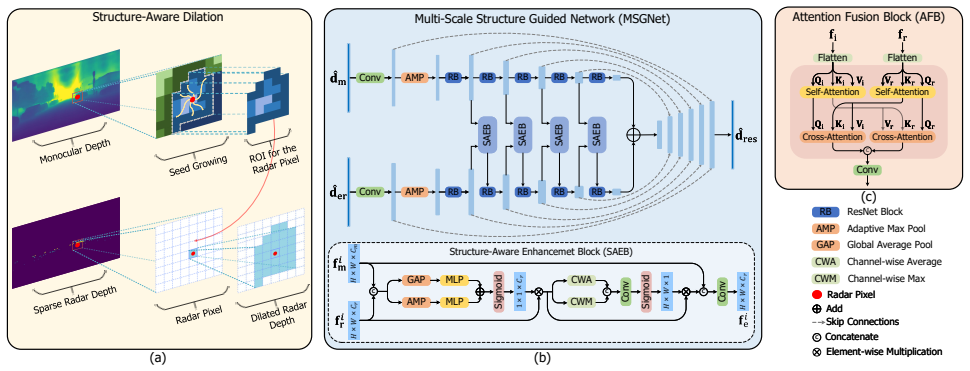
The load-bearing object is the structure-aware dilation of Eq. (1): a seed-growing rule that defines the ROI for radar pixel $(i,j)$ as all pixels whose monocular depth $\hat{d}_m$ differs from the seed by less than $\tau_1 = 0.2$ m. This converts the scaleless monocular prior into spatially connected, boundary-following regions where radar depth is assumed constant. Around that object the pipeline stacks RCANet, a U-Net with attention fusion blocks that estimates a confidence map over the combined ROIs, and MSGNet, a multi-scale residual network whose SAEB applies channel and spatial attention to radar features so that sparse radar cues contribute at multiple scales. The whole chain converts raw single-frame radar plus one RGB image into dense metric depth.
What would settle it
Re-run SA-RCD with the monocular depth map randomly rescaled (e.g., by factors 0.5 and 2.0) before structure-aware dilation; if the 0-80 m MAE stays near 2082.9 mm the fixed threshold is not scale-sensitive, whereas a large shift would confirm the method silently relies on metric calibration of the 'scaleless' prior.
Extended reading notes
Core claim
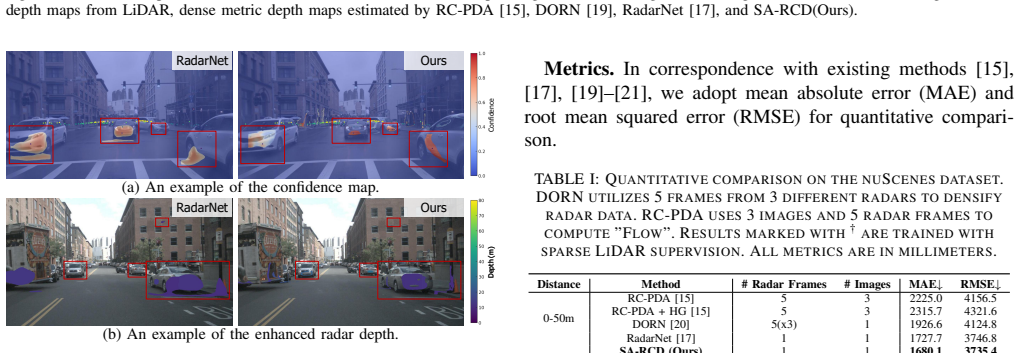
The central claim is that the shape of the radar point's ROI carries most of the improvement. Structure-aware dilation replaces rectangles with connected regions $R_{(i,j)} = \{(u,v) : |\hat{d}_m(u,v) - \hat{d}_m(i,j)| < \tau_1\}$, seeded at each radar pixel and grown outward in the monocular depth map $\hat{d}_m$; because $\hat{d}_m$ is scaleless but structure-detailed, its discontinuities approximate object boundaries, so the ROI stops at depth edges. The dilated radar depth is then passed through RCANet, which outputs one confidence map over the union of ROIs indicating association probability, and low-confidence pixels are removed. Finally, MSGNet learns a residual correction on top of $\hat{d}_m$ while SAEB enhances sparse radar features at multiple scales. The paper demonstrates the result on the nuScenes test set, where with one radar frame and one image SA-RCD reports MAE/RMSE of 1680.1/3735.4 mm at 0-50 m, 1990.3/4477.5 mm at 0-70 m, and 2082.9/4747.8 mm at 0-80 m, and 1490.3/3610.8 mm when adding sparse LiDAR supervision.
Load-bearing premise
The structure-aware dilation thresholds absolute differences in a monocular depth map the paper itself calls scaleless against a fixed 0.2 m tolerance, so the ROIs have a consistent geometric meaning only if that map is implicitly calibrated to metric scale.
Editorial extensions
If this is right
- Dense metric depth can be estimated from a single radar frame and a single image, without the multi-frame densification used by RC-PDA, DORN, and other baselines, while still improving MAE/RMSE over them.
- Structure-aware ROIs reduce confusion at object boundaries, producing confidence maps concentrated on objects and separating structures such as a car from a lamppost, which directly improves the radar depth maps fed to downstream 3D perception.
- Training MSGNet to predict a residual on top of the monocular depth map rather than the full depth from scratch makes the monocular prior a scaffold, retaining fine structures such as pedestrian outlines in the final dense depth.
- Adding sparse LiDAR supervision on top of the radar-camera pipeline gives a further large accuracy gain, suggesting the two signal families are complementary rather than redundant.
- The structure-aware enhancement stage and the metric depth estimation stage can be trained and evaluated separately, so the improved ROI generation can be plugged into other radar-camera depth frameworks.
Reading between the lines
- Editorial inference: because the ROI shape is the claimed differentiator, the benefit should transfer to any zero-shot monocular depth model with reliable relative depth; swapping the frozen monocular backbone for another MDE model would test whether the precise choice of prior matters.
- Editorial inference: the reported 0.4919 s consumed by structure-aware dilation suggests the method as presented is near the edge of real-time driving; a parallel or hierarchical region-growing implementation is a natural next step.
- Editorial inference: the fixed tolerance $\tau_1$ could be made adaptive to local monocular-depth uncertainty or radar noise, which would likely tighten ROIs in low-texture areas and loosen them near object boundaries.
Editorial analysis
A structured set of objections, weighed in public.
Referee Report
Summary. The paper proposes SA-RCD, a three-stage radar-camera dense metric depth estimation framework for autonomous driving. In the first stage, a frozen Depth Anything model produces a 'scaleless' monocular depth map that serves as a structural prior. In the second stage, a structure-aware dilation strategy grows ROIs from each radar pixel using the monocular depth map, densifies radar depth within these ROIs, and trains a Radar-Camera Association Network (RCANet) with an Attention Fusion Block to produce a confidence map for noise filtering. In the third stage, a Multi-Scale Structure Guided Network (MSGNet) learns a residual between the monocular depth map and ground truth, using a Structure-Aware Enhancement Block to fuse radar features at multiple scales. Experiments on nuScenes report state-of-the-art MAE/RMSE at 50m, 70m, and 80m ranges, along with ablations and runtime comparisons.
Significance. If the central claims hold, the paper offers a practical way to leverage monocular depth priors for radar enhancement and dense metric depth estimation, and the reported state-of-the-art results on nuScenes would be of interest to the autonomous driving perception community. The architecture is described in enough detail to re-implement, and the quantitative comparison against prior methods is extensive, covering multiple distance ranges and both MAE and RMSE. The manuscript also includes a thoughtful ablation study and an inference-time comparison. However, the current evidence does not fully establish the specific benefit of structure-aware ROIs, and a key threshold in the central mechanism is applied to a depth map that the paper itself describes as non-metric, which undermines the well-definedness of the proposed ROIs.
major comments (2)
- [Section III.B, Eq. (1)] The structure-aware dilation in Eq. (1) defines ROIs using the condition |d_m(u,v) - d_m(i,j)| < tau1, with tau1 = 0.2 m, yet Section III.A and the opening of Section III explicitly state that the monocular depth map d_m is 'scaleless' (affine-invariant). Absolute differences in an affine-invariant depth map carry no metric meaning, so a fixed 0.2 m threshold has no consistent geometric interpretation across scenes; the same threshold could select a tiny patch in one image and nearly the entire scene in another, depending on the unknown scale and shift of d_m. The manuscript does not describe any normalization, scaling, or alignment of d_m against metric depth before this threshold is applied. This is a load-bearing issue because the structure-aware ROI is the core novel component. The authors must either calibrate d_m to metric units (e.g., using sparse radar depths), adopt a relative/percentile threshold that is invariant to affine transformations, or provide a convincing argument that the raw Depth Anything output is sufficiently metric for this purpose; they should also report sensitivity to the choice of tau1.
- [Section IV.E, Table II] The ablation study does not isolate the contribution of structure-aware ROIs. Comparing settings (b) and (c) in Table II, adding structure-aware extension alone increases MAE from 2196.9 mm to 2203.2 mm, and the improvement over setting (b) appears only after RCANet filtering is added in setting (d). The paper does not compare structure-aware ROIs against a rectangular or predefined ROI under the same filtering and residual-learning conditions. Therefore, the current experiments show that the overall enhancement pipeline (extension plus filtering) helps, but they do not demonstrate that the structure-aware shape of the ROIs is responsible for the gains. An ablation that replaces structure-aware dilation with a fixed rectangular patch of comparable size while keeping RCANet and MSGNet identical is necessary to support the central claim of structure awareness.
minor comments (6)
- [Section III.B] The sentence 'the structure-related connectivity in dm servers as an effective guidance' contains a typo: 'servers' should be 'serves'.
- [Section IV.B] The phrase 'we train it for 200 epoches' should be '200 epochs', and similarly for MSGNet; also, 'decresed' in the learning-rate schedule should be 'decreased'.
- [Table II] The header entry 'Extention' should be 'Extension'.
- [Figure 3] The abbreviations AMP, CWA, CWM, GAP, and RB are used in the figure but are not defined in the caption; please define them or add a legend.
- [Section IV.F] The structure-aware dilation consumes 0.4919 s, making the full model 0.5533 s, which is roughly 5x slower than RadarNet (0.1159 s). The practical implications of this runtime increase for autonomous driving should be discussed, since real-time deployment may be affected.
- [Abstract / Section V] The paper states 'Our code will be available' rather than providing a currently accessible repository; for reproducibility, please release the code and checkpoints at the time of publication.
Circularity Check
No significant circularity: the pipeline is a standard supervised training loop with external LiDAR ground truth and no fitted constants recycled as predictions.
full rationale
The paper's derivation chain is: (1) a frozen, externally trained monocular depth model (Depth Anything) produces structure priors d_m; (2) Eq. (1) uses d_m to define structure-aware ROIs for radar depth extension; (3) RCANet is trained with a BCE loss against confidence labels derived from interpolated LiDAR (Eqs. (4)-(5)); and (4) MSGNet learns a residual d_res to d_m, supervised by L1 losses against accumulated and interpolated LiDAR (Eq. (6)). Evaluation is performed against held-out single-frame LiDAR ground truth. None of the predicted quantities reduces by construction to a fitted parameter or to the training targets: the enhanced radar depth is an intermediate input, not the reported metric-depth output, and the final output is not defined as the ROI or confidence output. The self-citations ([7], [13]) appear only in general-related-work contexts and are not load-bearing for the central claim. The reviewer's identified concern about applying a fixed metric threshold tau1=0.2 m to the 'scaleless' monocular depth d_m is a real robustness/calibration question, but it is not circularity: the ROI is an input-conditioned preprocessing step, and the final depth estimate is still independently trained and tested against LiDAR. Ablations compare internal design choices against external baselines (RadarNet, RC-PDA) on nuScenes, so the SOTA claim is not forced by a self-citation chain or by definition. The paper is self-contained against external benchmarks, and no circular step can be exhibited via the paper's own equations.
Assumptions & free parameters
free parameters (4)
- tau1 =
0.2 m
- tau2 =
0.4 m
- tau3 =
0.5
- lambda =
2
assumptions (4)
- domain assumption Pixels with similar radar depth values tend to have similar depths in the monocular depth map d_m.
- domain assumption Depth Anything provides reliable structure priors on nuScenes images despite being trained on other data.
- domain assumption Accumulated LiDAR and scaffolding-interpolated depth maps are valid training targets.
- standard math Standard deep learning training (Adam, random crops, etc.) is assumed to converge as described.
Cite this review
Pith. "Pith review of Structure-Aware Radar-Camera Depth Estimation." pith.science (2026). https://pith.science/paper/QBI2N72W
@misc{pith2026250605008,
  author       = {Pith},
  title        = {Pith review of: Structure-Aware Radar-Camera Depth Estimation},
  year         = {2026},
  howpublished = {\url{https://pith.science/paper/QBI2N72W}},
  note         = {Machine review of arXiv:2506.05008}
}
read the original abstract
Radar has gained much attention in autonomous driving due to its accessibility and robustness. However, its standalone application for depth perception is constrained by issues of sparsity and noise. Radar-camera depth estimation offers a more promising complementary solution. Despite significant progress, current approaches fail to produce satisfactory dense depth maps, due to the unsatisfactory processing of the sparse and noisy radar data. They constrain the regions of interest for radar points in rigid rectangular regions, which may introduce unexpected errors and confusions. To address these issues, we develop a structure-aware strategy for radar depth enhancement, which provides more targeted regions of interest by leveraging the structural priors of RGB images. Furthermore, we design a Multi-Scale Structure Guided Network to enhance radar features and preserve detailed structures, achieving accurate and structure-detailed dense metric depth estimation. Building on these, we propose a structure-aware radar-camera depth estimation framework, named SA-RCD. Extensive experiments demonstrate that our SA-RCD achieves state-of-the-art performance on the nuScenes dataset. Our code will be available at https://github.com/FreyZhangYeh/SA-RCD.
Figures


Figures from the paper (2 more)

Reference graph
Works this paper leans on
-
[1]
Z. Song, J. Lu, Y . Yao, and J. Zhang, Self-supervised depth completion from direct visual-lidar odometry in autonomous driving, IEEE Transactions on Intelligent Transportation Systems, vol. 23, no. 8, pp. 11 654–11 665, 2021
work page 2021
-
[2]
Y . Cui, R. Chen, W. Chu, L. Chen, D. Tian, Y . Li, and D. Cao, Deep learning for image and point cloud fusion in autonomous driving: A review, IEEE Transactions on Intel- ligent Transportation Systems , vol. 23, no. 2, pp. 722–739, 2021
work page 2021
-
[3]
Y . Li, Z. Ge, G. Yu, J. Yang, Z. Wang, Y . Shi, J. Sun, and Z. Li, BEVDepth: Acquisition of reliable depth for multi-view 3D object detection, in Proceedings of the AAAI Conference on Artificial Intelligence , vol. 37, 2023, pp. 1477–1485
work page 2023
-
[4]
Y . Zhou, L. Liu, H. Zhao, M. L ´opez-Ben´ıtez, L. Yu, and Y . Yue, Towards deep radar perception for autonomous driving: Datasets, methods, and challenges, Sensors, vol. 22, no. 11, p. 4208, 2022
work page 2022
-
[5]
S. Y . Alaba, A. C. Gurbuz, and J. E. Ball, Emerging trends in autonomous vehicle perception: Multimodal fusion for 3D object detection, World Electric Vehicle Journal , vol. 15, no. 1, p. 20, 2024
work page 2024
-
[6]
L. Wang, X. Zhang, Z. Song, J. Bi, G. Zhang, H. Wei, L. Tang, L. Yang, J. Li, C. Jia, et al., Multi-modal 3D object detection in autonomous driving: A survey and taxonomy, IEEE Transactions on Intelligent Vehicles , vol. 8, no. 7, pp. 3781–3798, 2023
work page 2023
-
[7]
Y . Zhu, R. Zhang, J. Ying, J. Yu, X. Hu, L. Luo, S. Cao, and H. Shen, Context and geometry aware voxel transformer for semantic scene completion, arXiv preprint arXiv:2405.13675, 2024
work page Pith review arXiv 2024
- [8]
Show all 43 references
-
[9]
Cheng, P
X. Cheng, P. Wang, and R. Yang, Learning depth with convolutional spatial propagation network, IEEE Transac- tions on Pattern Analysis and Machine Intelligence , vol. 42, no. 10, pp. 2361–2379, 2020
2020
-
[10]
J. Park, K. Joo, Z. Hu, C.-K. Liu, and I. S. Kweon, Non- local spatial propagation network for depth completion, in Proceedings of the European Conference on Computer Vision, 2020, pp. 120–136
2020
-
[11]
Z. Yan, K. Wang, X. Li, Z. Zhang, J. Li, and J. Yang, RigNet: Repetitive image guided network for depth completion, in Proceedings of the European Conference on Computer Vision, 2022, pp. 214–230
2022
-
[12]
Z. Yan, Y . Lin, K. Wang, Y . Zheng, Y . Wang, Z. Zhang, J. Li, and J. Yang, Tri-perspective view decomposition for geometry-aware depth completion, in Proceedings of the IEEE/CVF Conference on Computer Vision and Pattern Recognition, 2024, pp. 4874–4884
2024
-
[13]
Z. Yu, Z. Sheng, Z. Zhou, L. Luo, S.-Y . Cao, H. Gu, H. Zhang, and H.-L. Shen, Aggregating feature point cloud for depth completion, in Proceedings of the IEEE/CVF Inter- national Conference on Computer Vision , 2023, pp. 8732– 8743
2023
-
[14]
Z. Han, J. Wang, Z. Xu, S. Yang, L. He, S. Xu, and J. Wang, 4D millimeter-wave radar in autonomous driving: A survey, arXiv preprint arXiv:2306.04242 , 2023
2023 arXiv
-
[15]
Y . Long, D. Morris, X. Liu, M. Castro, P. Chakravarty, and P. Narayanan, Radar-camera pixel depth association for depth completion, in Proceedings of the IEEE/CVF Conference on Computer Vision and Pattern Recognition, 2021, pp. 12 507– 12 516
2021
-
[16]
Gasperini, P
S. Gasperini, P. Koch, V . Dallabetta, N. Navab, B. Busam, and F. Tombari, R4Dyn: Exploring radar for self-supervised monocular depth estimation of dynamic scenes, in Proceed- ings of the International Conference on 3D Vision , 2021, pp. 751–760
2021
-
[17]
A. D. Singh, Y . Ba, A. Sarker, H. Zhang, A. Kadambi, S. Soatto, M. Srivastava, and A. Wong, Depth estimation from camera image and mmwave radar point cloud, in Proceedings of the IEEE/CVF Conference on Computer Vision and Pattern Recognition , 2023, pp. 9275–9285
2023
-
[18]
Y . Long, D. Morris, X. Liu, M. Castro, P. Chakravarty, and P. Narayanan, Full-velocity radar returns by radar-camera fusion, in Proceedings of the IEEE/CVF International Con- ference on Computer Vision , 2021, pp. 16 198–16 207
2021
-
[19]
J.-T. Lin, D. Dai, and L. Van Gool, Depth estimation from monocular images and sparse radar data, in Proceedings of the International Conference on Intelligent Robots and Systems, 2020, pp. 10 233–10 240
2020
-
[20]
Lo and P
C.-C. Lo and P. Vandewalle, Depth estimation from monoc- ular images and sparse radar using deep ordinal regression network, in Proceedings of the IEEE International Confer- ence on Image Processing , 2021, pp. 3343–3347
2021
-
[21]
Lo and P
C.-C. Lo and P. Vandewalle, RCDPT: Radar-camera fusion dense prediction transformer, in Proceedings of the IEEE International Conference on Acoustics, Speech and Signal Processing, 2023, pp. 1–5
2023
-
[22]
H. Li, Y . Ma, Y . Gu, K. Hu, Y . Liu, and X. Zuo, Radarcam-Depth: Radar-camera fusion for depth estimation with learned metric scale, arXiv preprint arXiv:2401.04325, 2024
2024 arXiv
-
[23]
Ranftl, K
R. Ranftl, K. Lasinger, D. Hafner, K. Schindler, and V . Koltun, Towards robust monocular depth estimation: Mixing datasets for zero-shot cross-dataset transfer, IEEE Transac- tions on Pattern Analysis and Machine Intelligence , vol. 44, no. 3, pp. 1623–1637, 2020
2020
-
[24]
L. Yang, B. Kang, Z. Huang, X. Xu, J. Feng, and H. Zhao, Depth Anything: Unleashing the power of large-scale unlabeled data, in Proceedings of the IEEE/CVF Confer- ence on Computer Vision and Pattern Recognition , 2024, pp. 10 371–10 381
2024
-
[25]
S. F. Bhat, R. Birkl, D. Wofk, P. Wonka, and M. M ¨uller, ZoeDepth: Zero-shot transfer by combining relative and metric depth, arXiv preprint arXiv:2302.12288 , 2023
2023 arXiv
-
[27]
Caesar, V
H. Caesar, V . Bankiti, A. H. Lang, S. V ora, V . E. Liong, Q. Xu, A. Krishnan, Y . Pan, G. Baldan, and O. Beijbom, NuScenes: A multimodal dataset for autonomous driving, in Proceedings of the IEEE/CVF Conference on Computer Vision and Pattern Recognition , 2020, pp. 11 621–11 631
2020
-
[28]
Geiger, P
A. Geiger, P. Lenz, C. Stiller, and R. Urtasun, Vision meets robotics: The KITTI dataset, The International Journal of Robotics Research, vol. 32, no. 11, pp. 1231–1237, 2013
2013
-
[29]
Silberman, D
N. Silberman, D. Hoiem, P. Kohli, and R. Fergus, Indoor segmentation and support inference from RGBD images, in Proceedings of the European Conference on Computer Vision, 2012, pp. 746–760
2012
-
[30]
Eigen, C
D. Eigen, C. Puhrsch, and R. Fergus, Depth map prediction from a single image using a multi-scale deep network, in Proceedings of the International Conference on Neural Information Processing Systems , 2014, pp. 2366–2374
2014
-
[31]
S. F. Bhat, I. Alhashim, and P. Wonka, AdaBins: Depth esti- mation using adaptive bins, in Proceedings of the IEEE/CVF Conference on Computer Vision and Pattern Recognition , 2021, pp. 4009–4018
2021
-
[32]
Z. Li, X. Wang, X. Liu, and J. Jiang, Binsformer: Revis- iting adaptive bins for monocular depth estimation, IEEE Transactions on Image Processing, vol. 33, pp. 3964–3976, 2024
2024
-
[33]
S. Shao, Z. Pei, W. Chen, X. Wu, and Z. Li, NDDepth: Normal-distance assisted monocular depth estimation, in Proceedings of the IEEE/CVF International Conference on Computer Vision, 2023, pp. 7931–7940
2023
-
[34]
X. Yang, Z. Ma, Z. Ji, and Z. Ren, GEDepth: Ground embedding for monocular depth estimation, in Proceedings of the IEEE/CVF International Conference on Computer Vision, 2023, pp. 12 719–12 727
2023
-
[35]
K. Xian, J. Zhang, O. Wang, L. Mai, Z. Lin, and Z. Cao, Structure-guided ranking loss for single image depth prediction, in Proceedings of the IEEE/CVF Conference on Computer Vision and Pattern Recognition , 2020, pp. 611– 620
2020
-
[36]
W. Yin, Y . Liu, C. Shen, and Y . Yan, Enforcing geomet- ric constraints of virtual normal for depth prediction, in Proceedings of the IEEE/CVF International Conference on Computer Vision, 2019, pp. 5684–5693
2019
-
[37]
Guizilini, I
V . Guizilini, I. Vasiljevic, D. Chen, R. Ambrus , , and A. Gaidon, Towards zero-shot scale-aware monocular depth estimation, in Proceedings of the IEEE/CVF International Conference on Computer Vision , 2023, pp. 9233–9243
2023
-
[38]
Adams and L
R. Adams and L. Bischof, Seeded region growing, IEEE Transactions on Pattern Analysis and Machine Intelligence , vol. 16, no. 6, pp. 641–647, 1994
1994
-
[39]
Ronneberger, P
O. Ronneberger, P. Fischer, and T. Brox, U-Net: Convo- lutional networks for biomedical image segmentation, in Proceedings of the International Conference on Medical Im- age Computing and Computer-Assisted Intervention , 2015, pp. 234–241
2015
-
[40]
K. He, X. Zhang, S. Ren, and J. Sun, Deep residual learning for image recognition, in Proceedings of the IEEE/CVF Conference on Computer Vision and Pattern Recognition , 2016, pp. 770–778
2016
-
[41]
S. Woo, J. Park, J.-Y . Lee, and I. S. Kweon, CBAM: Convolutional block attention module, in Proceedings of the European Conference on Computer Vision , 2018, pp. 3–19
2018
-
[42]
A. Wong, X. Fei, S. Tsuei, and S. Soatto, Unsuper- vised depth completion from visual inertial odometry, IEEE Robotics and Automation Letters , vol. 5, no. 2, pp. 1899– 1906, 2020
1906
-
[43]
Ma and S
F. Ma and S. Karaman, Sparse-to-dense: Depth prediction from sparse depth samples and a single image, in Proceed- ings of the IEEE International Conference on Robotics and Automation, 2018, pp. 4796–4803
2018
-
[44]
H. Li, M. Jing, J. Liang, H. Fan, and R. Ji, Sparse beats dense: Rethinking supervision in radar-camera depth com- pletion, arXiv preprint arXiv:2312.00844 , 2023
2023 arXiv
Reviewed August 7, 2026 · model on record in the stance chip above.
Discussion (0). Sign in to comment.