REVIEW 5 major objections 5 minor 1 cited by
Tuning the Right Foundation Models is What you Need for Partial Label Learning
T0 review · 5 major / 5 minor · reviewed 2026-08-07 · deepseek-v4-flash
Pith's one-line read This paper claims that fine-tuning pre-trained foundation models, not the choice of partial-label learning algorithm, determines PLL performance.
desk verdict A useful PLL benchmark and practical CLIP fine-tuning recipe, but the title claim confounds backbone quality with the authors' own filtering and initialization tricks. read the letter →
The pith
A machine-rendered reading of the paper's core claim, the machinery that carries it, and where it could break.
The reading
What carries the argument
The load-bearing object is the pre-trained vision-language backbone, specifically CLIP, made trainable through parameter-efficient fine-tuning. PartialCLIP wraps any PLL loss around a frozen or lightly tuned CLIP image encoder, initializes the classifier weights with text-encoder embeddings of the class names using a template like "a photo of a [CLASS]", and optionally prunes each candidate set by intersecting it with the top-k classes from zero-shot CLIP confidence. The framework is loss-agnostic and model-agnostic; the key is that the representation is not learned from scratch under ambiguous supervision but transferred, so the disambiguation algorithm has much less work to do.
What would settle it
Measure the accuracy spread across the 13 PLL methods under a fixed CLIP backbone on a large set of human-annotated partial-label datasets: the paper's central claim predicts spreads close to the 0.4% observed on CIFAR-100 at high partial rate, whereas a spread comparable to the 29.3% gap seen with ResNet backbones would refute it.
Extended reading notes
Core claim
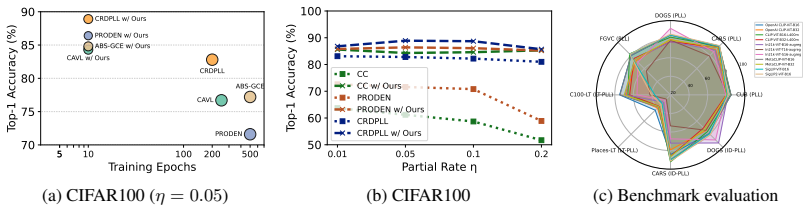
On its own terms, the paper's central claim is that representation quality, delivered by fine-tuning an appropriate pre-trained vision-language model, is the decisive factor in partial label learning. Across standard PLL, long-tailed PLL, and instance-dependent PLL, the authors find that integrating existing PLL algorithms into PartialCLIP with a CLIP backbone produces large gains over Wide-ResNet-34-10 trained from scratch, shrinks the accuracy gap between algorithms (for instance, a 29.3% gap between CRDPLL and CC at η=0.2 on CIFAR-100 drops to 0.4% with CLIP-ViT-B/16), and preserves accuracy as ambiguity rises (CC drops 11.1% with ResNet but only 0.2% with fine-tuned CLIP when η goes from 0.1 to 0.7). The paper also claims that initializing the classifier from CLIP text embeddings and filtering candidate labels by zero-shot CLIP confidence can remove more than half the candidates without hurting accuracy, and that the best foundation model varies by scenario: MetaCLIP for standard PLL, OpenAI CLIP for long-tailed PLL, and SigLIP for fine-grained instance-dependent PLL.
Load-bearing premise
The benchmark results depend on the synthetic candidate-label generation procedures (uniform sampling, flip-probability sampling, and instance-dependent generation via a WideResNet) faithfully representing how real partial labels arise, since only one real-world dataset (PLCIFAR10) is used for validation.
Editorial extensions
If this is right
- PLL algorithm choice becomes nearly irrelevant once a strong backbone is chosen: in standard and instance-dependent settings, leading methods converge to within a percent or so of each other.
- Labelling ambiguity is far less harmful than previously thought when the representation is pre-trained; methods that collapse on ResNet at high partial rates stay flat on CLIP.
- The practical bottleneck shifts to selecting and tuning the foundation model: the same algorithm moves by several points depending on the pre-trained weights and the parameter-efficient fine-tuning method, with heavy full fine-tuning hurting badly.
- Zero-shot CLIP can serve as a cheap pre-filter for candidate labels, cutting candidate-set size by half or more while improving accuracy.
- Long-tailed PLL benefits most from pre-trained representations because tail classes lack enough data to learn good features from scratch.
Reading between the lines
- This extrapolates beyond the paper: if the pattern holds across real annotation processes, then comparisons between PLL algorithms should control for backbone quality, otherwise they mostly measure the backbone rather than the disambiguation method.
- A testable extension suggested by the results is a training-free pipeline that selects a foundation model by zero-shot validation accuracy and then applies PLL losses only on the pruned candidate sets; this might capture most of the gains without any algorithm-specific design.
- Because the gains concentrate in the representation, combining CLIP-style backbones with harder instance-dependent candidate generation could produce a more realistic PLL benchmark where algorithm differences may reappear.
Editorial analysis
A structured set of objections, weighed in public.
Referee Report
Summary. The paper introduces PartialCLIP, an empirical fine-tuning framework for partial label learning (PLL) built on foundation models, primarily CLIP. The framework combines a CLIP backbone with text-embedding classifier initialization and zero-shot CLIP-based candidate-label filtering, and it is evaluated with 11 foundation models, 13 PLL algorithms, 8 datasets, and 3 PLL scenarios (standard, long-tailed, instance-dependent). The paper reports that, when used through PartialCLIP, existing PLL methods achieve large gains over ResNet baselines, become remarkably similar to each other, and remain stable under increasing label ambiguity. It further analyzes the impact of backbone choice and parameter-efficient fine-tuning methods, and validates partially on the real-world PLCIFAR10 dataset. The central claim is that the choice of foundation model and its fine-tuning, rather than the specific PLL disambiguation algorithm, drives performance in PLL.
Significance. If the central claim is supported, this paper would shift the emphasis of PLL research from algorithm-level disambiguation toward representation quality and foundation-model selection, which is a substantial and timely reorientation. The paper has notable strengths: it provides a broad benchmark spanning 11 backbones, 13 algorithms, and 3 PLL scenarios; it releases source code; it includes a real-world PLL dataset; and it systematically compares PEFT methods. These resources are valuable to the community. However, the headline claims are currently undercut by a confounding of 'fine-tuning a foundation model' with two additional components (text-initialized classifiers and zero-shot pre-filtering), and by the absence of multiple-seed statistics. The empirical findings are plausible but not yet cleanly established as stated.
major comments (5)
- [§3.2, Eq. (1), Tables 5 and 6] The experiments labeled 'w/ PartialCLIP' combine three interventions: (i) the CLIP backbone, (ii) text-embedding classifier initialization, and (iii) zero-shot CLIP candidate filtering. Tables 5 and 6 show that components (ii) and (iii) can be large contributors: pre-filtering improves LWS on CIFAR-100 from 14.8 to 82.1 at η=0.2 and by +81.7 on CIFAR-10 at η=0.7, and text initialization improves Adaptformer on CIFAR100-LT from 34.8 to 74.8. Because the ResNet baselines receive neither (ii) nor (iii), the gains reported in Tables 1–3 do not isolate 'fine-tuning the foundation model.' The paper should report the full set of 13 PLL methods with a CLIP backbone but without text initialization and without Eq. (1), alongside the complete PartialCLIP rows, to support the title claim.
- [§4.1.2, Table 1, Appendix G.3] The claim that PLL approaches exhibit 'remarkably similar performance' is contradicted by the LWS results in Table 1: LWS w/ PartialCLIP collapses to 14.8 on CIFAR-100 at η=0.2 and to 14.5 on CIFAR-10 at η=0.7, while the other methods remain in the mid-80s to mid-90s. The statement that the leading margin drops to 0.4% uses only the best method versus CC and omits LWS. Appendix G.3 then remedies the collapse by adjusting the filter threshold to top 30% for this case, which is post-hoc tuning. Finding 2 should either be stated with this caveat or supported by showing convergence across all 13 methods under a fixed protocol.
- [§4.1.3, Tables 1–4] Headline quantitative claims such as 'only decreases by 0.2%' and 'remarkably similar performance' are based on single runs with no error bars or multiple seeds. With differences as small as 0.2–0.4 percentage points (e.g., CC on CIFAR-10: 97.1 at η=0.1 versus 96.9 at η=0.7), the reported numbers do not support statistical claims of stability or similarity. Please report means and standard deviations over at least three seeds for the main tables, or soften the quantitative stability statements accordingly.
- [Eq. (1), §3.2, Appendix G.3] The candidate-filtering threshold is not fixed as the main text implies. Section 3.2 states that 'we can set k=K/2 for simplicity,' but Appendix G.3 uses top 30% for LWS on CIFAR-100 with η=0.2 and top 50% in other cases. Because the improvements in Table 6 depend on this choice, the method as specified contains an additional tuned hyperparameter. The authors should specify the selection rule a priori, choose it on a validation set, or demonstrate that the results are insensitive to k.
- [§3.1 and Table 9] The paper's broad conclusions about algorithm invariance and robustness to ambiguity are based almost entirely on synthetic candidate-label generation (USS, FPS, and WideResNet-based instance-dependent generation). Only one real-world dataset, PLCIFAR10, is evaluated, and with a subset of methods. The claims should be scaled back to the synthetic settings or validated on additional real-world PLL benchmarks before being presented as general insights about PLL.
minor comments (5)
- [Appendix A] The sentence describing the bottleneck dimension ends with 'please refer to for detailed analysis,' which is a dangling reference with no target given.
- [References] Reference [45] misspells 'Toronto' as 'Tront'.
- [Figure 1a] The caption states that marker sizes represent the number of learnable parameters, but the axes and legend do not convey parameter counts; please add a legend or annotation showing the mapping.
- [Table 6] Table 6 lacks explicit column headers and does not state which rows use the LWS method versus RECORDS; please add headers and a note that 'PartialCLIP' in that table means the version without pre-filtering.
- [Appendix G.1] The term 'PLENCH' is introduced without citation or definition, and 'REOCRDS' in Figure 2b should be 'RECORDS'.
Circularity Check
No definitional circularity in the core benchmark, but the headline candidate-filtering result relies on a per-dataset hand-picked pruning threshold, so the paper gets a mild 2.
-
fitted input called prediction
[Appendix G.3 and Section 4.3, Table 6]
"In the case of CIFAR-100 dataset with η= 0.2 , since the candidate set is relatively large, we select the top 30% of the labels based on the results of CLIP zero-shot. In other cases, we select the top 50% of the labels in terms of confidence for each sample. We found that after pre-screening the candidate label set and then conducting the training, the performance is significantly improved, comparable to the results obtained under low partial rates."
The paper presents the gains in Table 6 (e.g., CIFAR-100 at η=0.2: 14.8 → 82.1, +67.3) as evidence for the effectiveness of the proposed zero-shot candidate-label filtering in Eq. (1). However, the pruning threshold is not a fixed, parameter-free rule: it is chosen per dataset and per partial rate after observing the LWS collapse, with top-30% used for CIFAR-100 η=0.2 and top-50% elsewhere. The reported 'effective candidate labels' result is therefore a selected configuration of the fitted threshold, rather than a prediction made with a preset k. This is mild circularity-adjacent benchmark tuning, not a definitional equivalence.
full rationale
The paper's core comparisons are evaluated on held-out test sets, and the main source of performance, the CLIP backbone, is a pre-trained external model rather than a value fitted on these benchmarks. The zero-shot candidate filter and the text-embedding classifier initialization also rely on CLIP's pre-trained signal, not on fitted parameters, and the fine-tuning itself is measured against held-out accuracy. The many self-citations in the paper are ordinary attributions to prior PLL algorithms and do not carry a load-bearing uniqueness argument; no theorem from the authors' own prior work is used to forbid alternative explanations. The main circularity concern is narrow and localized: Appendix G.3 adjusts the pruning threshold (top 50% vs. top 30%) after observing the LWS collapse, and the resulting numbers are then advertised as the success of the proposed filtering technique in Section 4.3. This is a fitted threshold presented as a general finding, which is why the score is 2 rather than 0. A separate, non-circular validity concern is that the comparison supporting 'diminished impact of algorithm choice' bundles the CLIP backbone with the shared filtering and text-initialization components; that is a confound in the causal attribution, not a definitional circularity, so it does not raise the circularity score further. The limitation section does not flag the threshold-tuning dependence, but that omission is a completeness issue rather than evidence of constructed circularity.
Assumptions & free parameters
free parameters (2)
- k (candidate filtering top-k) =
K/2, except top 30% for CIFAR-100 eta=0.2
- sigma (cosine classifier scale) =
25
assumptions (3)
- domain assumption CLIP representations transfer to downstream classification tasks, including partial label learning.
- domain assumption Zero-shot CLIP confidence is a reliable signal for pruning candidate labels without removing the ground truth.
- domain assumption Synthetic candidate label generation strategies (USS, FPS, instance-dependent) are representative of real-world PLL ambiguity.
Cite this review
Pith. "Pith review of Tuning the Right Foundation Models is What you Need for Partial Label Learning." pith.science (2026). https://pith.science/paper/FLJTD2SL
@misc{pith2026250605027,
  author       = {Pith},
  title        = {Pith review of: Tuning the Right Foundation Models is What you Need for Partial Label Learning},
  year         = {2026},
  howpublished = {\url{https://pith.science/paper/FLJTD2SL}},
  note         = {Machine review of arXiv:2506.05027}
}
read the original abstract
Partial label learning (PLL) seeks to train generalizable classifiers from datasets with inexact supervision, a common challenge in real-world applications. Existing studies have developed numerous approaches to progressively refine and recover ground-truth labels by training convolutional neural networks. However, limited attention has been given to foundation models that offer transferrable representations. In this work, we empirically conduct comprehensive evaluations of 11 foundation models across 13 PLL approaches on 8 benchmark datasets under 3 PLL scenarios. We further propose PartialCLIP, an efficient fine-tuning framework for foundation models in PLL. Our findings reveal that current PLL approaches tend to 1) achieve significant performance gains when using foundation models, 2) exhibit remarkably similar performance to each other, 3) maintain stable performance across varying ambiguity levels, while 4) are susceptible to foundation model selection and adaptation strategies. Additionally, we demonstrate the efficacy of text-embedding classifier initialization and effective candidate label filtering using zero-shot CLIP. Our experimental results and analysis underscore the limitations of current PLL approaches and provide valuable insights for developing more generalizable PLL models. The source code can be found at https://github.com/SEU-hk/PartialCLIP.
Figures


Forward citations
Cited by 1 Pith paper
-
Calibratable Disambiguation Loss for Multi-Instance Partial-Label Learning
A margin-modulated disambiguation loss for multi-instance partial-label learning simultaneously lowers expected calibration error and raises classification accuracy in experiments.
Reference graph
Works this paper leans on
-
[8]
Jiahan Zhang, Qi Wei, Feng Liu, and Lei Feng. Candidate pseudolabel learning: Enhancing vision-language models by prompt tuning with unlabeled data. InInternational Conference on Learning Representations, 2025
work page 2025
-
[1]
Min-Ling Zhang, Fei Yu, and Cai-Zhi Tang. Disambiguation-free partial label learning.IEEE Transactions on Knowledge and Data Engineering, 29(10):2155–2167, 2017. 9
work page 2017
-
[2]
Disambiguated attention embedding for multi-instance partial-label learning
Wei Tang, Weijia Zhang, and Min-Ling Zhang. Disambiguated attention embedding for multi-instance partial-label learning. InAdvances in Neural Information Processing Systems 36, New Orleans, LA, USA, pages 56756–56771, 2023
work page 2023
-
[3]
Network cooperation with progressive disambiguation for partial label learning
Yao Yao, Chen Gong, Jiehui Deng, and Jian Yang. Network cooperation with progressive disambiguation for partial label learning. InMachine Learning and Knowledge Discovery in Databases: European Conference, ECML PKDD, pages 471–488, 2021
work page 2021
-
[4]
Structured prediction with partial labelling through the infimum loss
Vivien Cabannnes, Alessandro Rudi, and Francis Bach. Structured prediction with partial labelling through the infimum loss. InInternational Conference on Machine Learning, pages 1230–1239. PMLR, 2020
work page 2020
-
[5]
Learning from partial labels.Journal of Machine Learning Research, 12(42):1501–1536, 2011
Timothee Cour, Ben Sapp, and Ben Taskar. Learning from partial labels.Journal of Machine Learning Research, 12(42):1501–1536, 2011
work page 2011
-
[6]
Classification with partial labels
Nam Nguyen and Rich Caruana. Classification with partial labels. InProceedings of the 14th ACM SIGKDD International Conference on Knowledge Discovery and Data Mining, pages 551–559, 2008
work page 2008
-
[7]
Multi-instance partial-label learning with margin adjustment
Wei Tang, Yin-Fang Yang, Zhaofei Wang, Weijia Zhang, and Min-Ling Zhang. Multi-instance partial-label learning with margin adjustment. InAdvances in Neural Information Processing Systems 37, Vancouver, Canada, pages 26331–26354, 2024
work page 2024
Show all 68 references
-
[9]
Patel, and Rama Chellappa
Ching-Hui Chen, Vishal M. Patel, and Rama Chellappa. Learning from ambiguously labeled face images.IEEE Transactions on Pattern Analysis and Machine Intelligence, 40(7):1653–1667, 2018. doi: 10.1109/TPAMI.2017.2723401
2018
-
[10]
Learning from candidate labeling sets
Jie Luo and Francesco Orabona. Learning from candidate labeling sets. InAdvances in Neural Information Processing Systems, volume 23, pages 1504–1512, 2010
2010
-
[11]
Dietterich
Li-Ping Liu and Thomas G. Dietterich. A conditional multinomial mixture model for superset label learning. InProceedings of the 26th International Conference on Neural Information Processing Systems, volume 1, page 548–556, 2012
2012
-
[12]
A confidence-based partial label learning model for crowd-annotated named entity recognition
Limao Xiong, Jie Zhou, Qunxi Zhu, Xiao Wang, Yuanbin Wu, Qi Zhang, Tao Gui, Xuanjing Huang, Jin Ma, and Ying Shan. A confidence-based partial label learning model for crowd-annotated named entity recognition. InFindings of the Association for Computational Linguistics, Toronto...
2023
-
[13]
Learning from ambiguously labeled examples.Intelligent Data Analysis, 10(5):419–439, 2006
Eyke Hüllermeier and Jürgen Beringer. Learning from ambiguously labeled examples.Intelligent Data Analysis, 10(5):419–439, 2006
2006
-
[14]
Learning with multiple labels
Rong Jin and Zoubin Ghahramani. Learning with multiple labels. InAdvances in Neural Information Processing Systems, pages 897–904, 2002
2002
-
[15]
Maximum margin partial label learning.Machine Learning, 106(4):573–593, 2017
Fei Yu and Min-Ling Zhang. Maximum margin partial label learning.Machine Learning, 106(4):573–593, 2017
2017
-
[16]
Progressive identification of true labels for partial-label learning
Jiaqi Lv, Miao Xu, Lei Feng, Gang Niu, Xin Geng, and Masashi Sugiyama. Progressive identification of true labels for partial-label learning. InProceedings of the 37th International Conference on Machine Learning, pages 6500–6510, 2020
2020
-
[17]
Revisiting consistency regularization for deep partial label learning
Dong-Dong Wu, Deng-Bao Wang, and Min-Ling Zhang. Revisiting consistency regularization for deep partial label learning. InProceedings of the 39th International Conference on Machine Learning, Baltimore, Maryland, USA, pages 24212–24225, 2022
2022
-
[18]
SoLar: Sinkhorn label refinery for imbalanced partial-label learning
Haobo Wang, Mingxuan Xia, Yixuan Li, Yuren Mao, Lei Feng, Gang Chen, and Junbo Zhao. SoLar: Sinkhorn label refinery for imbalanced partial-label learning. InAdvances in Neural Information Processing Systems 35, pages 8104–8117, 2022
2022
-
[19]
Ambiguity-induced contrastive learning for instance- dependent partial label learning
Shiyu Xia, Jiaqi Lv, Ning Xu, and Xin Geng. Ambiguity-induced contrastive learning for instance- dependent partial label learning. InProceedings of the Thirty-First International Joint Conference on artificial Intelligence, pages 3615–3621, 2022
2022
-
[20]
Deep residual learning for image recognition
Kaiming He, Xiangyu Zhang, Shaoqing Ren, and Jian Sun. Deep residual learning for image recognition. InProceedings of the IEEE/CVF Conference on Computer Vision and Pattern Recognition, pages 770–778, 2016. 10
2016
-
[21]
Provably consistent partial-label learning
Lei Feng, Jiaqi Lv, Bo Han, Miao Xu, Gang Niu, Xin Geng, Bo An, and Masashi Sugiyama. Provably consistent partial-label learning. InAdvances in Neural Information Processing Systems, volume 33, pages 10948–10960, 2020
2020
-
[22]
Leveraged weighted loss for partial label learning
Hongwei Wen, Jingyi Cui, Hanyuan Hang, Jiabin Liu, Yisen Wang, and Zhouchen Lin. Leveraged weighted loss for partial label learning. InProceedings of the 38th International Conference on Machine Learning, Virtual Event, pages 11091–11100, 2021
2021
-
[23]
Exploiting class activation value for partial-label learning
Fei Zhang, Lei Feng, Bo Han, Tongliang Liu, Gang Niu, Tao Qin, and Masashi Sugiyama. Exploiting class activation value for partial-label learning. InProceedings of the 10th International Conference on Learning Representations, pages 1–17, 2022
2022
-
[24]
On the robustness of average losses for partial-label learning.IEEE Transactions on Pattern Analysis and Machine Intelligence, 46(5):2569–2583, 2023
Jiaqi Lv, Biao Liu, Lei Feng, Ning Xu, Miao Xu, Bo An, Gang Niu, Xin Geng, and Masashi Sugiyama. On the robustness of average losses for partial-label learning.IEEE Transactions on Pattern Analysis and Machine Intelligence, 46(5):2569–2583, 2023
2023
-
[25]
Momentum contrast for unsupervised visual representation learning
Kaiming He, Haoqi Fan, Yuxin Wu, Saining Xie, and Ross Girshick. Momentum contrast for unsupervised visual representation learning. InProceedings of the IEEE/CVF conference on computer vision and pattern recognition, pages 9729–9738, 2020
2020
-
[26]
Pico: Contrastive label disambiguation for partial label learning
Haobo Wang, Ruixuan Xiao, Yixuan Li, Lei Feng, Gang Niu, Gang Chen, and Junbo Zhao. Pico: Contrastive label disambiguation for partial label learning. InInternational conference on learning representations, 2022
2022
-
[27]
Fixmatch: Simplifying semi-supervised learning with consistency and confidence.Advances in Neural Information Processing Systems, 33:596–608, 2020
Kihyuk Sohn, David Berthelot, Nicholas Carlini, Zizhao Zhang, Han Zhang, Colin A Raffel, Ekin Dogus Cubuk, Alexey Kurakin, and Chun-Liang Li. Fixmatch: Simplifying semi-supervised learning with consistency and confidence.Advances in Neural Information Processing Systems, 33:59...
2020
-
[28]
Towards effective visual representations for partial-label learning
Shiyu Xia, Jiaqi Lv, Ning Xu, Gang Niu, and Xin Geng. Towards effective visual representations for partial-label learning. InProceedings of the IEEE/CVF Conference on Computer Vision and Pattern Recognition, pages 15589–15598, 2023
2023
-
[29]
Crosel: Cross selection of confident pseudo labels for partial-label learning
Shiyu Tian, Hongxin Wei, Yiqun Wang, and Lei Feng. Crosel: Cross selection of confident pseudo labels for partial-label learning. InProceedings of the IEEE/CVF Conference on Computer Vision and Pattern Recognition, pages 19479–19488, 2024
2024
-
[30]
Towards mitigating the class-imbalance problem for partial label learning
Jing Wang and Min-Ling Zhang. Towards mitigating the class-imbalance problem for partial label learning. Proceedings of the 24th ACM SIGKDD International Conference on Knowledge Discovery & Data Mining, pages 2427–2436, 2018
2018
-
[31]
A partial label metric learning algorithm for class imbalanced data
Wenpeng Liu, Li Wang, Jie Chen, Yu Zhou, Rui rui Zheng, and Jianjun He. A partial label metric learning algorithm for class imbalanced data. InAsian Conference on Machine Learning, volume 157, pages 1413–1428, 2021
2021
-
[32]
Sinkhorn distances: Lightspeed computation of optimal transport
Marco Cuturi. Sinkhorn distances: Lightspeed computation of optimal transport. InAdvances in Neural Information Processing Systems, volume 26, page 2292–2300, 2013
2013
-
[33]
Long-tailed partial label learning via dynamic rebalancing.arXiv preprint arXiv:2302.05080, 2023
Feng Hong, Jiangchao Yao, Zhihan Zhou, Ya Zhang, and Yanfeng Wang. Long-tailed partial label learning via dynamic rebalancing.arXiv preprint arXiv:2302.05080, 2023
2023 arXiv
-
[34]
Long-tail learning via logit adjustment, 2021
Aditya Krishna Menon, Sadeep Jayasumana, Ankit Singh Rawat, Himanshu Jain, Andreas Veit, and Sanjiv Kumar. Long-tail learning via logit adjustment, 2021. URLhttps://arxiv.org/abs/2007.07314
2021 arXiv
-
[35]
Long-tailed partial label learning by head classifier and tail classifier cooperation
Yuheng Jia, Xiaorui Peng, Ran Wang, and Min-Ling Zhang. Long-tailed partial label learning by head classifier and tail classifier cooperation. InProceedings of the AAAI Conference on Artificial Intelligence, volume 38, pages 12857–12865, 2024
2024
-
[36]
Instance-dependent partial label learning
Ning Xu, Congyu Qiao, Xin Geng, and Min-Ling Zhang. Instance-dependent partial label learning. In Advances in Neural Information Processing Systems, volume 34, pages 27119–27130, 2021
2021
-
[37]
Progressive purification for instance-dependent partial label learning
Ning Xu, Biao Liu, Jiaqi Lv, Congyu Qiao, and Xin Geng. Progressive purification for instance-dependent partial label learning. InProceedings of the 40th International Conference on Machine Learning, volume 202 ofProceedings of Machine Learning Research, pages 38551–38565, 2023
2023
-
[38]
Decompositional generation process for instance-dependent partial label learning
Congyu Qiao, Ning Xu, and Xin Geng. Decompositional generation process for instance-dependent partial label learning. InInternational Conference on Learning Representations, 2023
2023
-
[39]
Distilling reliable knowledge for instance- dependent partial label learning
Dong-Dong Wu, Deng-Bao Wang, and Min-Ling Zhang. Distilling reliable knowledge for instance- dependent partial label learning. InProceedings of the 38th AAAI Conference on Artificial Intelligence, Vancouver, Canada, pages 15888–15896, 2024. 11
2024
-
[40]
Learning transferable visual models from natural language supervision
Alec Radford, Jong Wook Kim, Chris Hallacy, Aditya Ramesh, Gabriel Goh, Sandhini Agarwal, Girish Sastry, Amanda Askell, Pamela Mishkin, Jack Clark, et al. Learning transferable visual models from natural language supervision. InInternational Conference on Machine Learning, pag...
2021
-
[41]
Learning to prompt for vision-language models.International Journal of Computer Vision, 130(9):2337–2348, 2022
Kaiyang Zhou, Jingkang Yang, Chen Change Loy, and Ziwei Liu. Learning to prompt for vision-language models.International Journal of Computer Vision, 130(9):2337–2348, 2022
2022
-
[42]
Tip-adapter: Training-free adaption of clip for few-shot classification
Renrui Zhang, Wei Zhang, Rongyao Fang, Peng Gao, Kunchang Li, Jifeng Dai, Yu Qiao, and Hongsheng Li. Tip-adapter: Training-free adaption of clip for few-shot classification. InEuropean conference on computer vision, pages 493–510. Springer, 2022
-
[43]
Long-tail learning with foundation model: Heavy fine-tuning hurts
Jiang-Xin Shi, Tong Wei, Zhi Zhou, Jie-Jing Shao, Xin-Yan Han, and Yu-Feng Li. Long-tail learning with foundation model: Heavy fine-tuning hurts. InForty-first International Conference on Machine Learning, 2024
2024
-
[44]
Visual prompt tuning
Menglin Jia, Luming Tang, Bor-Chun Chen, Claire Cardie, Serge Belongie, Bharath Hariharan, and Ser-Nam Lim. Visual prompt tuning. InProceedings of the 17th European Conference on Computer Vision, pages 709–727, 2022
2022
-
[45]
Learning multiple layers of features from tiny images.Master’s thesis, University of Tront, 2009
Alex Krizhevsky, Geoffrey Hinton, et al. Learning multiple layers of features from tiny images.Master’s thesis, University of Tront, 2009
2009
-
[46]
Large-scale long-tailed recognition in an open world
Ziwei Liu, Zhongqi Miao, Xiaohang Zhan, Jiayun Wang, Boqing Gong, and Stella X Yu. Large-scale long-tailed recognition in an open world. InProceedings of the IEEE/CVF Conference on Computer Vision and Pattern Recognition, pages 2537–2546, 2019
2019
-
[47]
Learning imbalanced datasets with label-distribution-aware margin loss
Kaidi Cao, Colin Wei, Adrien Gaidon, Nikos Arechiga, and Tengyu Ma. Learning imbalanced datasets with label-distribution-aware margin loss. InAdvances in Neural Information Processing Systems, volume 32, pages 1565–1576, 2019
2019
-
[48]
Fine-grained image analysis with deep learning: A survey.IEEE transactions on pattern analysis and machine intelligence, 44(12):8927–8948, 2021
Xiu-Shen Wei, Yi-Zhe Song, Oisin Mac Aodha, Jianxin Wu, Yuxin Peng, Jinhui Tang, Jian Yang, and Serge Belongie. Fine-grained image analysis with deep learning: A survey.IEEE transactions on pattern analysis and machine intelligence, 44(12):8927–8948, 2021
2021
-
[49]
A survey on deep learning-based fine-grained object classification and semantic segmentation.International Journal of Automation and Computing, 14(2): 119–135, 2017
Bo Zhao, Jiashi Feng, Xiao Wu, and Shuicheng Yan. A survey on deep learning-based fine-grained object classification and semantic segmentation.International Journal of Automation and Computing, 14(2): 119–135, 2017
2017
-
[50]
C. Wah, S. Branson, P. Welinder, P. Perona, and S. Belongie. The Caltech-UCSD Birds-200-2011 Dataset. Technical Report CNS-TR-2011-001, California Institute of Technology, 2011
2011
-
[51]
3d object representations for fine-grained categorization
Jonathan Krause, Michael Stark, Jia Deng, and Li Fei-Fei. 3d object representations for fine-grained categorization. InProceedings of the IEEE international conference on computer vision workshops, pages 554–561, 2013
2013
-
[52]
Fine-grained visual classification of aircraft, 2013
Subhransu Maji, Esa Rahtu, Juho Kannala, Matthew Blaschko, and Andrea Vedaldi. Fine-grained visual classification of aircraft, 2013. URLhttps://arxiv.org/abs/1306.5151
2013 arXiv
-
[53]
Novel dataset for fine-grained image categorization : Stanford dogs
Aditya Khosla, Nityananda Jayadevaprakash, Bangpeng Yao, and Li Fei-Fei. Novel dataset for fine-grained image categorization : Stanford dogs. InIn First Workshop on Fine-Grained Visual Categorization, IEEE Conference on Computer Vision and Pattern Recognition, volume 2, 2011
2011
-
[54]
Wide residual networks
Sergey Zagoruyko and Nikos Komodakis. Wide residual networks. InBritish Machine Vision Conference. British Machine Vision Association, 2017
2017
-
[55]
Demystifying clip data
Hu Xu, Saining Xie, Xiaoqing Ellen Tan, Po-Yao Huang, Russell Howes, Vasu Sharma, Shang-Wen Li, Gargi Ghosh, Luke Zettlemoyer, and Christoph Feichtenhofer. Demystifying clip data. InInternational Conference on Learning Representations, 2024
2024
-
[56]
Sigmoid loss for language image pre-training
Xiaohua Zhai, Basil Mustafa, Alexander Kolesnikov, and Lucas Beyer. Sigmoid loss for language image pre-training. InProceedings of the IEEE/CVF International Conference on Computer Vision, pages 11975–11986, 2023
2023
-
[57]
An image is worth 16x16 words: Transformers for image recognition at scale
Alexey Dosovitskiy, Lucas Beyer, Alexander Kolesnikov, Dirk Weissenborn, Xiaohua Zhai, Thomas Unterthiner, Mostafa Dehghani, Matthias Minderer, Georg Heigold, Sylvain Gelly, Jakob Uszkoreit, and Neil Houlsby. An image is worth 16x16 words: Transformers for image recognition at...
2021
-
[58]
Imagenet: A large-scale hierarchical image database
Jia Deng, Wei Dong, Richard Socher, Li-Jia Li, Kai Li, and Li Fei-Fei. Imagenet: A large-scale hierarchical image database. InIEEE Conference on Computer Vision and Pattern Recognition, pages 248–255, 2009
2009
-
[59]
Bitfit: Simple parameter-efficient fine-tuning for transformer-based masked language-models
Elad Ben Zaken, Yoav Goldberg, and Shauli Ravfogel. Bitfit: Simple parameter-efficient fine-tuning for transformer-based masked language-models. InProceedings of the 60th Annual Meeting of the Association for Computational Linguistics (Volume 2: Short Papers), pages 1–9, 2022
2022
-
[60]
Parameter-efficient transfer learning for NLP
Neil Houlsby, Andrei Giurgiu, Stanislaw Jastrzebski, Bruna Morrone, Quentin De Laroussilhe, Andrea Gesmundo, Mona Attariyan, and Sylvain Gelly. Parameter-efficient transfer learning for NLP. In Proceedings of the 36th International Conference on Machine Learning, pages 2790–2799, 2019
2019
-
[61]
LoRA: Low-rank adaptation of large language models
Edward J Hu, yelong shen, Phillip Wallis, Zeyuan Allen-Zhu, Yuanzhi Li, Shean Wang, Lu Wang, and Weizhu Chen. LoRA: Low-rank adaptation of large language models. InInternational Conference on Learning Representations, 2022
2022
-
[62]
Adapt- former: Adapting vision transformers for scalable visual recognition
Shoufa Chen, Chongjian GE, Zhan Tong, Jiangliu Wang, Yibing Song, Jue Wang, and Ping Luo. Adapt- former: Adapting vision transformers for scalable visual recognition. InAdvances in Neural Information Processing Systems, volume 35, pages 16664–16678, 2022
2022
-
[63]
Mixed precision training.arXiv preprint arXiv:1710.03740, 2017
Paulius Micikevicius, Sharan Narang, Jonah Alben, Gregory Diamos, Erich Elsen, David Garcia, Boris Ginsburg, Michael Houston, Oleksii Kuchaiev, Ganesh Venkatesh, et al. Mixed precision training.arXiv preprint arXiv:1710.03740, 2017
-
[64]
Randaugment: Practical automated data augmentation with a reduced search space
Ekin D Cubuk, Barret Zoph, Jonathon Shlens, and Quoc V Le. Randaugment: Practical automated data augmentation with a reduced search space. InProceedings of the IEEE/CVF Conference on Computer Vision and Pattern Recognition Workshops, pages 702–703, 2020
2020
-
[65]
mixup: Beyond empirical risk minimization
Hongyi Zhang, Moustapha Cisse, Yann N Dauphin, and David Lopez-Paz. mixup: Beyond empirical risk minimization. InInternational Conference on Learning Representations, 2018
2018
-
[66]
Cutmix: Regularization strategy to train strong classifiers with localizable features
Sangdoo Yun, Dongyoon Han, Seong Joon Oh, Sanghyuk Chun, Junsuk Choe, and Youngjoon Yoo. Cutmix: Regularization strategy to train strong classifiers with localizable features. InProceedings of the IEEE/CVF international conference on computer vision, pages 6023–6032, 2019
2019
-
[67]
Reproducible scaling laws for contrastive language-image learning
Mehdi Cherti, Romain Beaumont, Ross Wightman, Mitchell Wortsman, Gabriel Ilharco, Cade Gordon, Christoph Schuhmann, Ludwig Schmidt, and Jenia Jitsev. Reproducible scaling laws for contrastive language-image learning. InProceedings of the IEEE/CVF Conference on Computer Vision ...
2023
-
[68]
collapse
Wei Wang, Dong-Dong Wu, Jindong Wang, Gang Niu, Min-Ling Zhang, and Masashi Sugiyama. Realistic evaluation of deep partial-label learning algorithms. InProceedings of the 13th International Conference on Learning Representations, Singapore, pages 1–25, 2025. 13 A Implementatio...
2025
Reviewed August 7, 2026 · model on record in the stance chip above.
Discussion (0). Sign in to comment.