Hybrid between biologically and quantum-inspired many-body states
Pith reviewed 2026-05-19 11:05 UTC · model grok-4.3
The pith
A network of perceptrains delivers ground-state energies accurate to 10^{-5}–10^{-6} for a 10×10 long-range Ising model using ranks of only 2–5.
A machine-rendered reading of the paper's core claim, the machinery that carries it, and where it could break.
Core claim
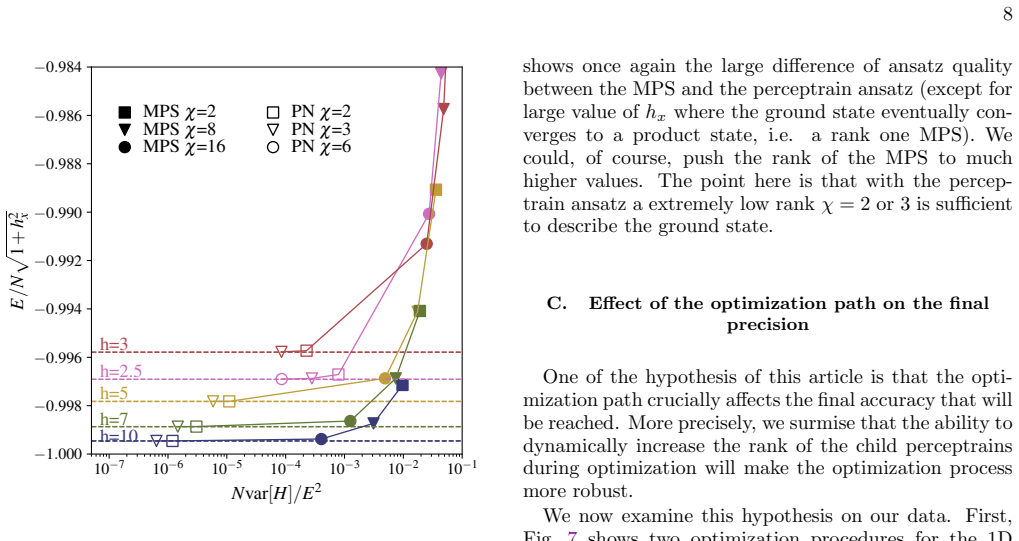
A network of perceptrains forms a variational ansatz whose ground-state energy for the 10×10 transverse-field Ising model with long-range 1/r^6 interactions is accurate to relative precision ~10^{-5} under VMC and ~10^{-6} under GFMC in every regime of the phase diagram, including the vicinity of the quantum phase transition, when only ranks 2–5 are used and optimization proceeds from one initial condition with fixed hyperparameters.
What carries the argument
The perceptrain, a perceptron generalized to inherit local optimization, dynamic parameter increase, state compression, and quantum-inspired structure from tensor networks.
If this is right
- The entire phase diagram is accessible from one set of hyperparameters and a single initial condition.
- Ranks of only 2–5 suffice where matrix product states typically require thousands of parameters.
- Local optimization akin to DMRG can be performed inside the neural-network layout.
- States can be compressed on the fly during the variational procedure.
- The method applies directly to Rydberg-atom platforms proposed for quantum annealing.
Where Pith is reading between the lines
- Dynamic rank adjustment during optimization may allow the ansatz to adapt to critical fluctuations without prior knowledge of the correlation length.
- The same hybrid construction could be tested on other two-dimensional models with power-law interactions to check whether small ranks remain sufficient.
- Combining perceptrains with quantum-computing simulators might accelerate preparation of low-energy states for annealing protocols.
- The biological–quantum hybridization points to a route for representing higher-dimensional states that remain intractable for pure tensor networks.
Load-bearing premise
A network of perceptrains limited to ranks 2–5 can represent the ground state faithfully across the full phase diagram without requiring multiple random starts or later adjustments.
What would settle it
A calculation on the same 10×10 lattice or a modestly larger one that yields relative energy error larger than 10^{-4} in any parameter regime when ranks remain capped at 5 and the single-initialization protocol is followed.
Figures




read the original abstract
Deep neural networks can represent very different sorts of functions, including complex quantum many-body states. Tensor networks can also represent these states, have more structure and are easier to optimize. However, they can be prohibitively costly computationally in two or higher dimensions. Here, we propose a generalization of the perceptron -- the perceptrain -- which borrows features from the two different formalisms. We construct variational many-body ansatz from a simple network of perceptrains. The network can be thought of as a neural network with a few distinct features inherited from tensor networks. These include efficient local optimization akin to the density matrix renormalization algorithm, instead of optimizing all the parameters at once; the possibility to dynamically increase the number of parameters during the optimization; the possibility to compress the state; and a structure that remains quantum-inspired. We showcase the ansatz using a combination of variational Monte Carlo (VMC) and Green function Monte Carlo (GFMC) on a $10\times 10$ transverse field quantum Ising model with a long-range $1/r^6$ antiferromagnetic interaction. The model corresponds to the Rydberg (cold) atoms platform proposed for quantum annealing. We consistently find a very high relative accuracy for the ground state energy, around $10^{-5}$ for VMC and $10^{-6}$ for GFMC in all regimes of parameters, including in the vicinity of the quantum phase transition. We use very small ranks ($\sim 2$-$5$) of perceptrains, as opposed to multiples of thousand used in matrix product states. The optimization of the energy was very robust. The entire phase diagram was found with a single initial condition and a fixed set of hyperparameters.
Editorial analysis
A structured set of objections, weighed in public.
Referee Report
Summary. The manuscript introduces the 'perceptrain' as a hybrid variational ansatz that combines perceptron-style neural networks with tensor-network-inspired features such as local optimization, dynamic rank adjustment, compression, and quantum-inspired structure. The authors construct a network of perceptrains and apply it to the 10×10 transverse-field Ising model with long-range 1/r^6 antiferromagnetic interactions using both variational Monte Carlo (VMC) and Green-function Monte Carlo (GFMC). They report relative ground-state energy accuracies of order 10^{-5} (VMC) and 10^{-6} (GFMC) across the full phase diagram, including near the quantum phase transition, achieved with small perceptrain ranks (2–5) and a single initialization plus fixed hyperparameters.
Significance. If the numerical claims hold, the perceptrain network offers a promising, computationally tractable route to high-accuracy variational states in two dimensions that retains some tensor-network optimization advantages while avoiding their prohibitive cost. The combination of VMC and GFMC, the use of very small ranks relative to matrix-product states, and the reported performance on a long-range model relevant to Rydberg platforms are notable strengths. The work provides concrete evidence that a modest hybrid architecture can reach high accuracy without extensive hyperparameter tuning.
major comments (2)
- [Numerical results] Numerical results section: the reported relative accuracies of ~10^{-5} for VMC and ~10^{-6} for GFMC are stated without explicit statistical error bars on the Monte Carlo estimates or details on the convergence criteria and data-exclusion rules employed in the GFMC runs. This information is necessary to evaluate whether the quoted precision is statistically reliable, especially near the quantum phase transition.
- [Optimization procedure] Optimization and robustness discussion: the claim that the entire phase diagram was obtained with a single initial condition and a fixed set of hyperparameters, and that the optimization is 'very robust,' is not accompanied by statistics from multiple independent runs or variance estimates across random seeds. In VMC and GFMC studies of models near a QPT, such checks are standard to confirm that the reported energy is not an artifact of a favorable basin.
Simulated Author's Rebuttal
We thank the referee for their positive evaluation of the manuscript and for the constructive major comments. We address each point below and indicate the revisions that will be incorporated in the next version of the manuscript.
read point-by-point responses
-
Referee: [Numerical results] Numerical results section: the reported relative accuracies of ~10^{-5} for VMC and ~10^{-6} for GFMC are stated without explicit statistical error bars on the Monte Carlo estimates or details on the convergence criteria and data-exclusion rules employed in the GFMC runs. This information is necessary to evaluate whether the quoted precision is statistically reliable, especially near the quantum phase transition.
Authors: We agree that explicit statistical error bars and procedural details are required to substantiate the quoted accuracies. In the revised manuscript we will add the Monte Carlo statistical uncertainties to all reported energies; these uncertainties are typically 10^{-7} or smaller and thus do not affect the claimed relative accuracies. We will also include a concise description of the GFMC convergence protocol, specifying the number of iterations, the equilibration criterion, and the rule used to discard initial transient data. revision: yes
-
Referee: [Optimization procedure] Optimization and robustness discussion: the claim that the entire phase diagram was obtained with a single initial condition and a fixed set of hyperparameters, and that the optimization is 'very robust,' is not accompanied by statistics from multiple independent runs or variance estimates across random seeds. In VMC and GFMC studies of models near a QPT, such checks are standard to confirm that the reported energy is not an artifact of a favorable basin.
Authors: We acknowledge that variance estimates from multiple independent optimizations constitute standard practice near a quantum phase transition. While the original results were obtained from a single initialization with fixed hyperparameters, the consistent accuracy across the full phase diagram already provides supporting evidence. To meet the referee's request, the revised manuscript will contain a brief discussion of the optimization protocol together with results from a small set of additional independent runs (different random seeds) that quantify the observed variance; these checks confirm that the reported energies are not basin-specific artifacts. revision: yes
Circularity Check
No significant circularity; variational results are self-contained against external Hamiltonian benchmarks
full rationale
The manuscript proposes a hybrid perceptrain network ansatz by merging perceptron and tensor-network structural features, then evaluates it through direct variational optimization and Monte Carlo sampling on the long-range transverse-field Ising Hamiltonian. Reported relative accuracies (10^{-5} VMC, 10^{-6} GFMC) are obtained by comparing the minimized variational energies to independent reference values for the same model, without any redefinition of fitted parameters as predictions, self-definitional loops in the ansatz construction, or load-bearing reliance on self-citations whose content reduces to the present results. The single-initialization robustness statement is a numerical observation about optimization behavior rather than a derivation that collapses to its own inputs by construction. The entire chain remains externally falsifiable via the Hamiltonian and sampling procedure.
Axiom & Free-Parameter Ledger
free parameters (2)
- perceptrain rank r
- network hyperparameters
axioms (2)
- standard math The variational energy obtained by Monte Carlo sampling is an upper bound to the true ground-state energy.
- domain assumption The perceptrain network can be contracted and updated locally in a manner analogous to DMRG sweeps.
invented entities (1)
-
perceptrain
no independent evidence
Lean theorems connected to this paper
-
IndisputableMonolith/Foundation/AlexanderDuality.leanalexander_duality_circle_linking unclear?
unclearRelation between the paper passage and the cited Recognition theorem.
We consistently find a very high relative accuracy for the ground state energy, around 10^{-5} for VMC and 10^{-6} for GFMC in all regimes of parameters, including in the vicinity of the quantum phase transition.
What do these tags mean?
- matches
- The paper's claim is directly supported by a theorem in the formal canon.
- supports
- The theorem supports part of the paper's argument, but the paper may add assumptions or extra steps.
- extends
- The paper goes beyond the formal theorem; the theorem is a base layer rather than the whole result.
- uses
- The paper appears to rely on the theorem as machinery.
- contradicts
- The paper's claim conflicts with a theorem or certificate in the canon.
- unclear
- Pith found a possible connection, but the passage is too broad, indirect, or ambiguous to say the theorem truly supports the claim.
Reference graph
Works this paper leans on
-
[1]
GFMC in a nutshell GFMC is a lattice counterpart to the Diffusion Monte Carlo approach [41]. Due to the presence of the lattice, GFMC can be formulated directly in the imaginary time continuum, without resorting to Trotterization or other discretization scheme. For completeness, we describe the method below and refer to the literature for the associ- ated...
-
[2]
12a shows an example of VMC opti- mization for the 1D model (black line)
Benchmark for the 1D model The inset of Fig. 12a shows an example of VMC opti- mization for the 1D model (black line). During the op- timization, we perform many GFMC calculations (green points). We find consistently that GFMC improves the accuracy by one or two orders of magnitude until the VMC ansatz is so close to the ground state that one is dominated...
-
[3]
Benchmark for the 2D model In this section, we present our reference calculations for the 2D model. We have performed various GFMC runs for different ans¨ atze and values of hx and checked the consistency of the results. We have also, for com- pleteness, compared the results with what could be ob- tained from a zero variance extrapolation [15, 40, 46] (se...
work page 2030
-
[4]
A. Vaswani, N. Shazeer, N. Parmar, J. Uszkoreit, L. Jones, A. N. Gomez, L. Kaiser, and I. Polosukhin, Attention is all you need (2023), arXiv:1706.03762
work page internal anchor Pith review Pith/arXiv arXiv 2023
-
[5]
Y. Nunez Fernandez, M. K. Ritter, M. Jeannin, J.-W. Li, T. Kloss, T. Louvet, S. Terasaki, O. Parcollet, J. von Delft, H. Shinaoka, and X. Waintal, SciPost Physics 18, 104 (2025)
work page 2025
-
[6]
S. R. White, Physical Review Letters 69, 2863 (1992)
work page 1992
-
[7]
S. R. White and R. M. Noack, Physical Review Letters 68, 3487 (1992)
work page 1992
- [8]
- [9]
- [10]
- [11]
- [12]
-
[13]
J. Robledo Moreno, G. Carleo, A. Georges, and J. Stokes, Proceedings of the National Academy of Sciences 119, e2122059119 (2022)
work page 2022
-
[14]
F. Vicentini, A. Biella, N. Regnault, and C. Ciuti, Phys- ical Review Letters 122, 250503 (2019)
work page 2019
-
[15]
M. Hibat-Allah, M. Ganahl, L. E. Hayward, R. G. Melko, and J. Carrasquilla, Physical Review Research 2, 023358 (2020)
work page 2020
-
[16]
K. Choo, T. Neupert, and G. Carleo, Physical Review B 100, 125124 (2019)
work page 2019
- [17]
- [18]
-
[19]
S. Dash, L. Gravina, F. Vicentini, M. Ferrero, and A. Georges, Commun Phys 8, 1 (2025)
work page 2025
-
[20]
A. W. Sandvik and G. Vidal, Physical Review Letters 99, 220602 (2007)
work page 2007
- [21]
-
[22]
J. Naumann, E. L. Weerda, M. Rizzi, J. Eisert, and P. Schmoll, SciPost Physics Lecture Notes , 086 (2024)
work page 2024
- [23]
-
[24]
A. Sfondrini, J. Cerrillo, N. Schuch, and J. I. Cirac, Phys- ical Review B 81, 214426 (2010)
work page 2010
- [25]
-
[26]
I. Glasser, N. Pancotti, M. August, I. D. Rodriguez, and J. I. Cirac, Physical Review X 8, 011006 (2018)
work page 2018
-
[27]
Schollwoeck, Reviews of Modern Physics 77, 259 (2005)
U. Schollwoeck, Reviews of Modern Physics 77, 259 (2005)
work page 2005
-
[28]
Y. Nunez Fernandez, M. Jeannin, P. T. Dumitrescu, T. Kloss, J. Kaye, O. Parcollet, and X. Waintal, Physical Review X 12, 041018 (2022)
work page 2022
-
[29]
S. Dolgov and D. Savostyanov, Computer Physics Com- munications 246, 106869 (2020)
work page 2020
-
[30]
F. Becca and S. Sorella, Quantum Monte Carlo Ap- proaches for Correlated Systems, 1st ed. (Cambridge Uni- versity Press, 2017)
work page 2017
-
[31]
Feasibility of performing quantum chemistry calculations on quantum computers
T. Louvet, T. Ayral, and X. Waintal, On the feasibility of performing quantum chemistry calculations on quantum computers (2024), arXiv:2306.02620
work page internal anchor Pith review Pith/arXiv arXiv 2024
-
[32]
Schollw¨ ock, Annals of Physics January 2011 Special Issue, 326, 96 (2011)
U. Schollw¨ ock, Annals of Physics January 2011 Special Issue, 326, 96 (2011)
work page 2011
-
[33]
Sorella, Physical Review Letters 80, 4558 (1998)
S. Sorella, Physical Review Letters 80, 4558 (1998)
work page 1998
- [34]
-
[35]
M. Casula and S. Sorella, The Journal of Chemical Physics 119, 6500 (2003)
work page 2003
-
[36]
C. Filippi and S. Fahy, The Journal of Chemical Physics 112, 3523 (2000)
work page 2000
-
[37]
C. Roth, A. Szabo, and A. MacDonald, Physical Review B 108, 054410 (2023)
work page 2023
-
[38]
D. Wu, R. Rossi, F. Vicentini, N. Astrakhantsev, F. Becca, X. Cao, J. Carrasquilla, F. Ferrari, A. Georges, M. Hibat-Allah, M. Imada, A. M. L¨ auchli, G. Mazzola, A. Mezzacapo, A. Millis, J. Robledo Moreno, T. Neupert, Y. Nomura, J. Nys, O. Parcollet, R. Pohle, I. Romero, M. Schmid, J. M. Silvester, S. Sorella, L. F. Tocchio, L. Wang, S. R. White, A. Wiet...
work page 2024
-
[39]
M. Kalinowski, R. Samajdar, R. G. Melko, M. D. Lukin, S. Sachdev, and S. Choi, Physical Review B 105, 174417 (2022)
work page 2022
- [40]
-
[41]
R. Samajdar, W. W. Ho, H. Pichler, M. D. Lukin, and S. Sachdev, Physical Review Letters 124, 103601 (2020)
work page 2020
-
[42]
A. Kalz, A. Honecker, S. Fuchs, and T. Pruschke, The European Physical Journal B 65, 533 (2008)
work page 2008
- [43]
-
[44]
P. J. Reynolds, J. Tobochnik, and H. Gould, Computer in Physics 4, 662 (1990)
work page 1990
- [45]
- [46]
-
[47]
Waintal, Physical Review B 73, 075417 (2006)
X. Waintal, Physical Review B 73, 075417 (2006)
work page 2006
- [48]
- [49]
- [50]
- [51]
discussion (0)
Sign in with ORCID, Apple, or X to comment. Anyone can read and Pith papers without signing in.