REVIEW 3 major objections 4 minor 15 references
Debatable Intelligence: Benchmarking LLM Judges via Debate Speech Evaluation
T0 review · 3 major / 4 minor · reviewed 2026-08-07 · deepseek-v4-flash
Pith's one-line read LLM judges can now match human raters on debate speech quality
desk verdict Solid, reusable LLM-judge benchmark for long debate speeches, but the 'surpassing humans' claim is an artifact of comparing a deterministic model to noisy human raters. read the letter →
The pith
A machine-rendered reading of the paper's core claim, the machinery that carries it, and where it could break.
The reading
What carries the argument
The load-bearing object is the Speech Quality Dataset of 631 debate speeches from Slonim et al. (2021), each with 15 crowd ratings; agreement is measured two ways: leave-one-out pairwise weighted Kappa against individual human annotators, and Kendall's Tau-C against the average human score. A chain-of-thought prompt variant asks judges to justify their scores before deciding. The combination separates instance-level agreement, whether the judge can predict a single human rater, from system-level behavior, whether the judge's score distribution and ranking match humans, and this distinction explains why a model can look human-like on one metric and not the other.
What would settle it
Collect fresh ratings from 15 new annotators on the same 631 speeches plus a set of GPT-4.1 speeches, and compare Qwen-72B's leave-one-out Kappa against the new annotators with the new human-human Kappa; if LLM-human agreement falls clearly below the new human-human Kappa, the claim of on-par performance fails. A second check: score a plain-text rewrite of a GPT-4.1 speech with identical content but no headings or signposting; if the rewrite scores much lower, the judge's quality signal is partly stylistic.
Extended reading notes
Core claim
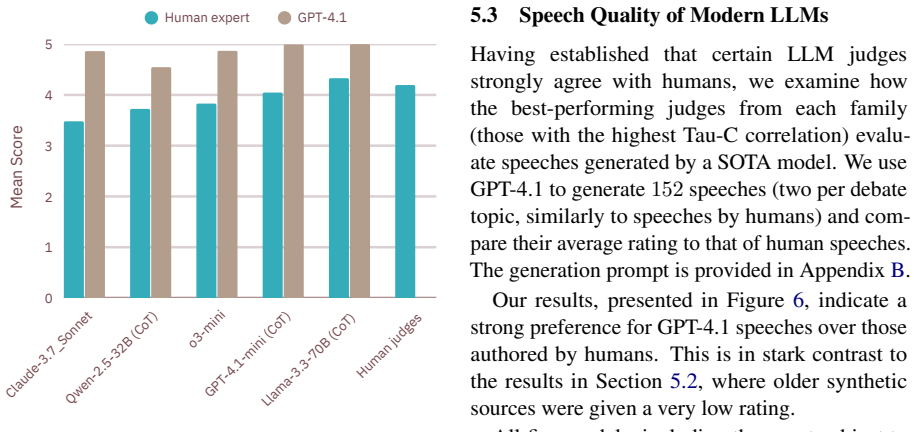
The paper establishes debate speech evaluation as a benchmark: an LLM judge reads a topic and a ~600-word opening speech, then scores on a 1-5 scale how good the speech is as an opening supporting the topic. Against this benchmark, model size is the main driver: models with at least 7B parameters approach human-level agreement, Qwen-72B surpasses the average pairwise human Kappa, and the strongest judges reach Kendall's Tau-C around 0.6 against average human scores over the full set. Yet all strong judges assign systematically lower scores than humans and enlarge the perceived gap between high- and low-quality speeches, especially penalizing older synthetic sources. When GPT-4.1 writes new speeches on the same topics, five strong judges rate them above human-expert speeches, suggesting that LLMs can now compose argumentative text that judges consider more persuasive.
Load-bearing premise
The benchmark treats the average of 15 crowd annotations as the true quality of each speech, even though individual human raters agree with one another only weakly (pairwise Kappa 0.24); if those ratings are noisy or biased, then 'matching humans' may mostly reflect matching that noise.
Editorial extensions
If this is right
- Large LLM judges with 7B or more parameters can replace or supplement human annotators for scoring long debate speeches, saving annotation cost at similar instance-level agreement.
- Ranking-aware use of LLM judges is safer than raw scores, because even well-aligned judges systematically score lower than humans.
- Models under roughly 7B parameters are not reliable judges for this task, regardless of model family.
- Debate-speech quality judged this way may not transfer to multi-turn or interactive debate, which the paper leaves open.
- Because modern LLM speeches outrank human expert speeches, safeguards against persuasive misuse become more urgent.
Reading between the lines
- If the 0.24 human-human Kappa reflects genuine subjectivity, then 'on par with humans' may be the wrong bar: a useful judge should perhaps predict the average rating better than an individual rater does, and the Tau-C result around 0.6 is the more meaningful ceiling.
- The sharp lower-score behavior suggests LLM judges compress the rating scale at the bottom; a calibration step, or comparing within-source rankings instead of absolute scores, could make LLM and human systems more interchangeable.
- A testable extension: strip GPT-4.1 speeches of their paragraph structure and signposting while keeping the content, and see whether judge scores drop; if they do, stylistic bias is a major contributor to the 'surpassing humans' result.
- The 2020-era speeches and newer training data are confounded; generating speeches with knowledge cutoffs matched to 2020 would separate improved writing skill from broader knowledge.
Editorial analysis
A structured set of objections, weighed in public.
Referee Report
Summary. The paper introduces Debate Speech Evaluation as a benchmark for LLM-as-a-Judge, using 631 debate speeches from Slonim et al. (2021), each with 15 crowd annotations. The authors run 23 LLMs as judges under zero-shot and chain-of-thought prompts, measuring agreement with human labels via leave-one-out pairwise weighted Kappa and Kendall's Tau-C against average human scores. They report that larger models approach human agreement, with Qwen-72B exceeding the human pairwise Kappa baseline, while also documenting systematic differences: LLM judges give lower scores and sharper distinctions between speech sources. A second contribution evaluates GPT-4.1-generated speeches, finding that five strong LLM judges rate them higher than human-expert speeches. The paper includes detailed appendices on data, prompts, parsing errors, ensembling, and Key Point Analysis of judge rationale.
Significance. If the benchmark claims hold, this is a useful and timely contribution: it extends LLM-as-a-Judge evaluation to long-form argumentative texts, a setting that combines local argument quality with holistic discourse assessment, and it provides a large, publicly available testbed derived from an existing dataset. The paper's strengths include the appropriate choice of Tau-C for ranking agreement over the full dataset, the leave-one-out protocol grounded in the annotator structure, the honest limitations section, and the interpretability analysis via Key Point Analysis. The central results, however, rest on point estimates without uncertainty quantification, and the headline 'surpassing humans' claim is vulnerable to a deterministic-versus-noisy comparison artifact. These issues are fixable, but they currently affect the strength of the main conclusions.
major comments (3)
- [§5.1, Fig. 2a] The statement that Qwen-72B 'surpasses human performance' is not supported by the pairwise Kappa comparison as currently presented. With human-human κ=0.24 (Appendix C.1), each human-human pair contributes two independent annotation noise terms, whereas an LLM run at temperature 0.01 is a single deterministic scorer; a model that predicts the central tendency of the annotator pool can obtain higher agreement with a held-out human than two humans obtain with each other even if its underlying judgment is no better than the average human's. The paper should quantify this artifact by adding a consensus-predictor baseline (e.g., the average of the remaining 14 annotators, in a leave-one-out scheme) and by reporting bootstrap confidence intervals for the human and LLM Kappa estimates. Until then, the claim should be restricted to 'higher agreement with individual human labels than the average human-human pair,' rather than phrased as superior judging ability.
- [§4, Figs. 2a and 2b] No uncertainty intervals or significance tests are reported for any of the headline metrics, even though each judge was run once and the pairwise Kappa estimates use overlapping annotator sets of unknown size (the 'minimal-sample' threshold is mentioned but its value is not given). Point estimates such as 'a notable jump at 7B' (Fig. 2b), 'Qwen-72B surpasses human performance' (Fig. 2a), and 'o3 still underperforms' (Section 5.1) are therefore not statistically grounded. The small-scale reproducibility check in Appendix A covers only GPT-4.1 and addresses run-to-run variability, not sampling variability over annotator pairs or speeches. Bootstrap or permutation-based tests should be added before drawing comparative conclusions among models or against the human baseline.
- [§5.3, §6] The claim that 'modern LLMs can outperform humans in generating high-quality speeches' is based entirely on LLM judges, with no human annotations of the GPT-4.1 speeches; the paper itself acknowledges in the Limitations that stylistic bias and self-bias may have contributed. Because this result is listed among the contributions and restated in the Conclusion, the evidence supports only 'the five selected LLM judges prefer GPT-4.1 speeches over human-expert speeches in this setting.' The wording should be softened throughout the abstract, Section 6, and the contribution list, or human evaluation of a sample of the generated speeches should be added.
minor comments (4)
- [§4] Please specify the actual 'minimal-sample' threshold value and report the number of annotator pairs retained, since this threshold is a free parameter that directly shapes Figure 2a.
- [Appendix A] The main text should state explicitly that the headline models in Figures 2a and 2b, including Qwen-72B, were run with 4-bit quantization; the limitation is disclosed only in the appendix, and a reader of Section 5.1 would not know that the 'surpassing' result comes from a quantized model.
- [Appendix E] The phrase 'a slight improvement of 5 points' is ambiguous; it should read 'an improvement of 0.05 in Tau-C' or similar, since the figure shows 0.40 to 0.45.
- [Figure 2] Some model names in the Figure 2 legend are visually merged (e.g., 'GPT-4.1-nanoGPT-4o-mini'); please adjust the layout for readability.
Circularity Check
No significant circularity: the benchmark claim is an external comparison against human labels, and the cited prior dataset and methods are used as data sources rather than as self-justifying premises.
full rationale
Walking the claimed derivation chain—dataset scores from Slonim et al. (2021), LLM ratings collected under the same prompt, agreement metrics (leave-one-out weighted Kappa and Tau-C versus average human scores), and the behavioral comparisons—I find no step in which an output is defined in terms of the quantity it is supposed to predict. The 'surpassing human performance' claim in Section 5.1 compares a deterministic LLM's agreement with a held-out human against the human-human pairwise baseline; this is an empirical comparison, not a fitted input renamed as a prediction. Even if the comparison is statistically asymmetric (human-human pairs contain two idiosyncratic noise terms while the LLM contributes one deterministic score), that is a validity or correctness concern about the baseline, not a circular reduction: the paper's definitions do not make the LLM's Kappa equal to the human baseline by construction. The dataset and annotation protocol are inherited from Slonim et al. (2021), and some authors overlap with that work; however, the dataset is a publicly released prior resource with published quality-control checks, and the present paper's central benchmark claim is an external comparison against those human labels. Citations to Gera et al. (2024) and Bar-Haim et al. (2020) are used for interpretation and method, not as unverified premises that force the conclusions. No load-bearing self-citation chain or equivalent-by-definition result is present. The acknowledged limitation in Section 5.3 that human annotations for GPT-4.1 speeches are lacking is an honest scope restriction, not a circular step.
Assumptions & free parameters
free parameters (2)
- minimal-sample threshold for pairwise Kappa =
50 shared speeches
- Excluded speeches and topics =
78 vetting speeches; 2 topics
assumptions (4)
- domain assumption The average of 15 crowd ratings is a stable gold standard for speech quality despite low pairwise agreement (kappa = 0.24).
- standard math Weighted Kappa and Kendall's Tau-C are valid for comparing LLM and human scores on a 1-5 ordinal scale.
- domain assumption Human annotators were blind to speech source, so source-level score differences reflect speech content rather than labeling bias.
- domain assumption LLM judges' scores are comparable to a single human annotator in the leave-one-out substitution.
Cite this review
Pith. "Pith review of Debatable Intelligence: Benchmarking LLM Judges via Debate Speech Evaluation." pith.science (2026). https://pith.science/paper/VCFARHJ7
@misc{pith2026250605062,
  author       = {Pith},
  title        = {Pith review of: Debatable Intelligence: Benchmarking LLM Judges via Debate Speech Evaluation},
  year         = {2026},
  howpublished = {\url{https://pith.science/paper/VCFARHJ7}},
  note         = {Machine review of arXiv:2506.05062}
}
read the original abstract
We introduce Debate Speech Evaluation as a novel and challenging benchmark for assessing LLM judges. Evaluating debate speeches requires a deep understanding of the speech at multiple levels, including argument strength and relevance, the coherence and organization of the speech, the appropriateness of its style and tone, and so on. This task involves a unique set of cognitive abilities that previously received limited attention in systematic LLM benchmarking. To explore such skills, we leverage a dataset of over 600 meticulously annotated debate speeches and present the first in-depth analysis of how state-of-the-art LLMs compare to human judges on this task. Our findings reveal a nuanced picture: while larger models can approximate individual human judgments in some respects, they differ substantially in their overall judgment behavior. We also investigate the ability of frontier LLMs to generate persuasive, opinionated speeches, showing that models may perform at a human level on this task.
Figures


Figures from the paper (15 more)




Reference graph
Works this paper leans on
-
[1]
Expert speeches:Speeches delivered by human debate experts received consistently higher average scores than those produced by automatic systems
-
[2]
Most arguments in this speech support the topic
Control questions:Annotators were also asked to rate a secondary statement — “Most arguments in this speech support the topic” — which served as a control for annotator relia- bility. In addition, “control speeches” of inten- tionally low quality were included to identify inattentive annotators
-
[3]
Manual review:A qualitative inspection of 20 speeches (10 high- and 10 low-scoring) confirmed that high scores corresponded to coherent, on-topic content, while low scores reflected off-topic, repetitive, or non- argumentative text. This vetting process yielded 15 human annota- tions per speech. C.2 Data Partition Used We use “Pipeline-set-1”, a subset co...
-
[4]
Ensure that each sentence conveys only one main idea
-
[5]
Maintain the logical flow and connection between sentences
-
[6]
Double-check that all information from the original paragraph is included in your rephrased version
-
[7]
The argument for reform is strong
Verify that the overall meaning and intent of the original paragraph are preserved. Remember: - Keep sentences short and to the point. - Use clear and simple language. - Avoid complex sentence structures or multiple clauses. - Do not add any new information that wasn't in the original paragraph. - Do not omit any important details from the original paragr...
-
[9]
In general, results for the CoT prompt seem to be more challenging to parse
We note that parsing errors mostly occur with smaller models and could largely vary with the prompt. In general, results for the CoT prompt seem to be more challenging to parse. for some of the smaller models. The only excep- tions are Llama-3.2-1B and GPT-4.1-nano, whose parsability is significantly improved by using CoT. E Judge Ensembling We inspect en...
Show all 15 references
-
[10]
Read the paragraph carefully to understand its main ideas and content
-
[11]
Break down the information into individual concepts or points
-
[12]
Rewrite each concept as a separate, concise sentence
-
[2019]
This speech is a good opening speech for supporting the topic
fine-tuned on a dataset of arguments from Gretz et al. (2020). Speeches are formed by automatically concatenating arguments generated by the fine-tuned model. • Arg-Human1,Arg-Human2Speeches com- posed of automatically concatenated, crowd- sourced arguments on debate topics fe...
2020
-
[2020]
InProceedings of the 58th Annual Meeting of the Association for Computational Linguistics, pages 7073–7086, Online
Out of the echo chamber: Detecting coun- tering debate speeches. InProceedings of the 58th Annual Meeting of the Association for Computational Linguistics, pages 7073–7086, Online. Association for Computational Linguistics. Alec Radford, Jeffrey Wu, Rewon Child, David Luan, Da...
2019
-
[2023]
Shachar Mirkin, Michal Jacovi, Tamar Lavee, Hong- Kwang Kuo, Samuel Thomas, Leslie Sager, Lili Kotlerman, Elad Venezian, and Noam Slonim
ChatGPT as a factual inconsistency eval- uator for text summarization.arXiv preprint arXiv:2303.15621. Shachar Mirkin, Michal Jacovi, Tamar Lavee, Hong- Kwang Kuo, Samuel Thomas, Leslie Sager, Lili Kotlerman, Elad Venezian, and Noam Slonim. 2018. A recorded debating dataset. I...
2018 arXiv
-
[2024]
This speech is a good opening speech for supporting the topic
LMUnit: Fine-grained evaluation with natural language unit tests.Preprint, arXiv:2412.13091. Keita Saito, Akifumi Wachi, Koki Wataoka, and Youhei Akimoto. 2023. Verbosity bias in preference la- beling by large language models.arXiv preprint arXiv:2310.10076. Yijia Shao, Yuchen...
2021
Reviewed August 7, 2026 · model on record in the stance chip above.
Discussion (0). Sign in to comment.