REVIEW 5 major objections 5 minor 68 references
Estimation of Exciton Binding Energy and lifetime for Mono-layer Transition Metal Dichalcogenides
T0 review · 5 major / 5 minor · reviewed 2026-08-07 · deepseek-v4-flash
Pith's one-line read A Wannier-exciton quantum-well model reproduces monolayer TMD binding energies and lifetimes from physical inputs alone.
desk verdict A useful, parameter-light EMA/QTBM model for TMD exciton lifetimes with a real III-V benchmark, but Eq. (8) has a wrong/typo Coulomb kernel that invalidates the numbers as printed. read the letter →
The pith
A machine-rendered reading of the paper's core claim, the machinery that carries it, and where it could break.
The reading
What carries the argument
The load-bearing object is the Coulomb kernel $V_C(\rho)$ in Eq. (8), formed by convolving the $1/r$ electron–hole attraction with the product of the confined electron and hole wavefunctions from Eq. (2). This single kernel does double duty: it sets the in-plane potential in the Wannier equation and therefore the binding energy, and through the value of the in-plane wavefunction at $\rho=0$ it sets the envelope overlap that enters the oscillator strength and the radiative decay width. The numerical solver is the quantum transmitting boundary method, which turns the open-boundary quantum well into an eigenvalue problem and supplies the complex quasi-bound energies. The final step is the thermalization average of Eq. (17), which weights the decay width over a Maxwell–Boltzmann distribution of exciton momenta.
What would settle it
Repeat the same calculation for a single monolayer with a screened Coulomb interaction computed from an explicitly nonlocal dielectric function, for example a GW-BSE treatment, instead of the single static $\epsilon_b$ of Eq. (8); if the binding energies and radiative lifetimes shift by more than the experimental spread relative to the PL data cited in Table II, the static-dielectric kernel is the failing assumption. A complementary experiment is to measure the $1s$ exciton energy and decay lifetime of one monolayer on substrates with different dielectric constants and check whether the model's fixed-$\epsilon_b$ prediction holds for both.
Extended reading notes
Core claim
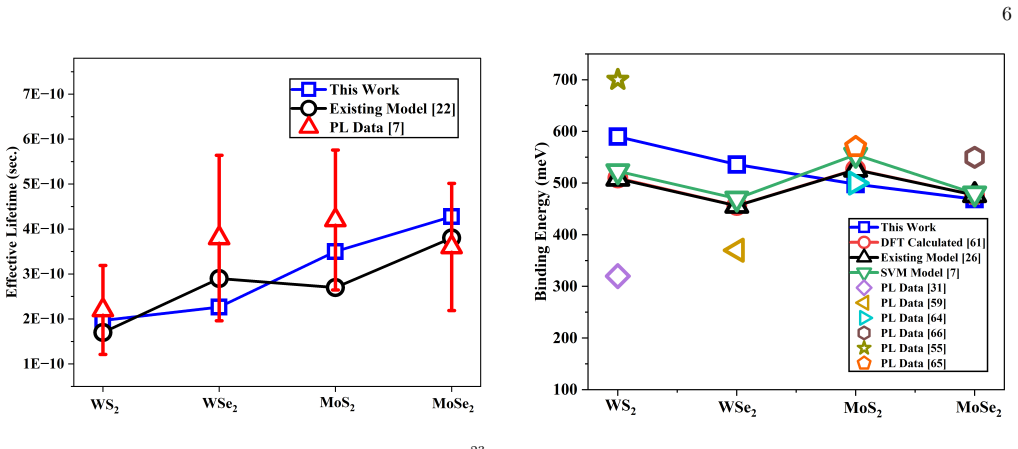
The central claim is that a single parameter-light model, using only physical inputs and no fitted exciton parameters, can reproduce the exciton properties of four monolayer TMDs. The electron and hole are treated as quasi-bound states of a finite quantum well with open boundary conditions; their complex eigenenergies give the confinement part of the exciton. The in-plane relative motion is governed by the Wannier equation with a Coulomb kernel built from the envelope-function overlap of Eq. (8), and the radiative decay width follows from Fermi's golden rule for the transition dipole. The final step, Eq. (17), thermally averages the decay width over a Maxwell–Boltzmann distribution of exciton momenta, which is what converts the picosecond intrinsic radiative lifetimes into the hundreds-of-picosecond lifetimes seen at room temperature. On that basis the paper reports exciton energies, binding energies of roughly $0.47$–$0.59$ eV, and effective lifetimes of $0.13$–$0.43$ ns for WS$_2$, WSe$_2$, MoS$_2$, and MoSe$_2$, in the range of measured photoluminescence decay and DFT data.
Load-bearing premise
The load-bearing premise is that the electron–hole attraction can be represented by a single static dielectric constant from zero-strain DFT and by the product of the electron and hole envelope functions in Eq. (8); if real screening by the environment or strain, or the correct wavefunction overlap, differs from that, both the predicted binding energy and the predicted lifetime move.
Editorial extensions
If this is right
- The computed values in Table II give device designers a ready set of exciton binding energies and room-temperature lifetimes for WS$_2$, WSe$_2$, MoS$_2$, and MoSe$_2$ without needing a many-body calculation.
- Because the inputs are physical parameters rather than fitted exciton parameters, the same procedure can be rerun for other TMD compositions, layer thicknesses, or dielectric environments by updating the input table.
- The thermalization step explains why room-temperature PL lifetimes are orders of magnitude longer than low-temperature radiative lifetimes while remaining radiative in origin.
- The successful validation against a III-V double-quantum-well photoluminescence measurement indicates the model transfers beyond TMDs to other heterostructures.
- The authors state that the model can be extended to multilayer structures, interlayer excitons, and trions by modifying the oscillator-strength expression.
Reading between the lines
- The paper fixes the dielectric constant from zero-strain DFT; an easy extension is to treat $\epsilon_b$ as a function of the surrounding dielectric environment, which would predict that encapsulated monolayers have smaller binding energies and longer effective lifetimes than suspended ones.
- Eq. (8) uses the product $\psi_e(x_e)\psi_h(x_h)$, not the product of probability densities; if an independent many-body calculation shows that the relative phase between the envelope functions matters, the oscillator strength and hence the lifetime would need revision.
- The thermal average in Eq. (17) assumes equal population of all exciton spin states; valley-selective excitation or a magnetic field should break this and produce a polarization-dependent lifetime that the model does not yet describe.
Editorial analysis
A structured set of objections, weighed in public.
Referee Report
Summary. The paper proposes a self-contained effective-mass model for Wannier-Mott excitons in monolayer TMDs (WS2, WSe2, MoS2, MoSe2). It solves the one-dimensional Schrödinger equation with open boundary conditions (QTBM) for electron and hole quasi-bound states, then solves a radial Wannier equation whose Coulomb potential is computed from the 1D envelope functions, and finally estimates radiative lifetimes from the oscillator strength with a thermalization factor. The central claim is that this model, using only independently sourced physical parameters, gives exciton energies, binding energies, and radiative lifetimes in good agreement with TRPL measurements and DFT estimates. The paper validates the method on a III-V double quantum well and reports binding energies around 0.47-0.54 eV and effective lifetimes of 0.13-0.43 ns at 300 K.
Significance. The proposed approach is attractive as a design-oriented estimator: the input parameters are not fitted to the TMD PL data, and the III-V benchmark is an independent check. If the central claims survive correction, the method would provide a simple route to estimate binding energies and radiative lifetimes for TMD monolayers. However, the current manuscript does not establish those claims: the printed Coulomb kernel in Eq. (8) is not the correct matrix element, the lifetime comparison is only factor-of-two accurate for WS2 and WSe2, and several comparisons (notably the 4 K lifetimes) are not numerically documented. No code is shipped, so reproducibility rests entirely on the equations, which makes the Eq. (8) issue a substantive obstacle.
major comments (5)
- [II, Eq. (8)] The Coulomb kernel is written as V_C(rho) = -(e^2/epsilon_b) integral integral psi_e(x_e) psi_h(x_h) / sqrt((x_e-x_h)^2+rho^2) dx_e dx_h. For real envelope functions normalized as integral |psi|^2 dx = 1, the correct matrix element of 1/|r_e-r_h| between the confinement subbands is integral integral |psi_e(x_e)|^2 |psi_h(x_h)|^2 / sqrt((x_e-x_h)^2+rho^2) dx_e dx_h. The printed form is not a normalization convention but a different kernel; it can even change sign if the envelopes have nodes. Since this kernel enters both the in-plane potential in Eqs. (4)-(8) and the oscillator-strength overlap in Eqs. (10)-(11), the reported E_b and tau_eff in Table II are not the solution of the stated Hamiltonian. Please correct the kernel, recompute Table II, and state whether the numerical results change.
- [IV, Table II and Fig. 6] The abstract and Section IV claim 'good agreement' with TRPL measurements, but the computed tau_eff values are 0.128 ns (WS2), 0.208 ns (WSe2), 0.354 ns (MoS2), and 0.427 ns (MoSe2) against the cited PL averages 0.22, 0.38, 0.42, and 0.36 ns, respectively. The first two disagree by a factor of about 1.7-1.8 and no uncertainties are reported on the computed values. Please provide an uncertainty estimate propagated from epsilon_b, d_cv, effective masses, and band offsets, and either define a quantitative agreement criterion or temper the claim of good agreement.
- [IV, Fig. 9 and low-temperature discussion] The text states that the low-temperature (4 K) lifetimes of 2.3-5 ps 'nearly match' the model, but Table II contains only 300 K values and the computed 4 K lifetimes are not given numerically. Please report the 4 K tau_eff values used in Fig. 9 so this comparison can be verified.
- [III.A, Fig. 2] The III-V double-quantum-well validation is described as matching 'quantitatively', but the figure is not accompanied by the model parameters, the numerical values being compared, or error bars. Since this is the only independent benchmark in the paper, please include a table or text giving the parameters and the quantitative comparison.
- [Tables I-II and Section IV] The central results depend sensitively on epsilon_b and d_cv, but no sensitivity analysis is presented. Both the binding energy and the radiative lifetime scale with these inputs, and epsilon_b is taken from zero-strain DFT without considering the dielectric environment (e.g., hBN encapsulation or substrate). Please add a sensitivity study over a physically reasonable range of epsilon_b and d_cv, and discuss how the claimed agreement would be affected.
minor comments (5)
- [IV, Table II] Table II is typeset with interleaved citation markers and data (e.g., '17 PL Decay 8' and '710 +/- 1032'), making the column meanings ambiguous; please retypeset it with clearly separated parameter, this-work, and literature columns.
- [IV, first paragraph] The text says 'ground-state wavefunctions shown in Fig. 5 in the device direction (x)', but Fig. 5 displays the in-plane exciton wavefunctions while the device-direction wavefunctions are shown in Fig. 3; please correct the cross-reference.
- [IV, first paragraph] The phrase 'As seen in Fig. ref fig4' is an unresolved cross-reference and should read 'Fig. 4'.
- [II, Eq. (3) and Eq. (11)] The excitonic wavefunction in Eq. (3) contains an in-plane factor psi(rho)/rho, which is unconventional and potentially singular at rho=0; please define the limiting behavior and normalization used when Eq. (11) evaluates the wavefunction at rho=0.
- [I, Introduction] There are incomplete sentences in the introduction, such as 'WSe2 for and MoSe2 for and other information technology platforms21' and 'while monolayer MoS2 and MoS2 has been utilized in spintronic 20'; these should be rewritten.
Circularity Check
No significant circularity: outputs are not fitted to the compared PL data and the model is validated externally; only minor non-load-bearing self-citations appear.
full rationale
Walking the derivation chain, the model solves the 1D Schrödinger equation with open boundaries for electron and hole states from band offsets, effective masses, and well thickness, builds the Coulomb kernel from those envelope functions, solves the Wannier equation for the in-plane exciton, and then converts the resulting overlap and exciton energy into an oscillator strength and radiative lifetime using the empirical transition dipole moment d_cv from independent references. At no point is a parameter fitted to the time-resolved PL decay data in Table II, and the model is checked against an independent III-V double-quantum-well dataset in Fig. 2. The self-citations to refs. 37 and 38 are methodological and non-load-bearing because the equations are restated in the paper. The empirical d_cv enters linearly in the oscillator strength, but it is not extracted from the same TRPL lifetimes being compared, so the lifetime prediction is not forced by construction. The main concerns are correctness and reproducibility rather than circularity: Eq. (8) prints the Coulomb kernel with ψ_e ψ_h instead of the probability densities |ψ_e|^2 |ψ_h|^2, which would change both binding energy and overlap if implemented as written, and the paper itself acknowledges in Section IV that the EMA 'may not capture all the complexities of the material.' These are substantive issues but not instances of the derivation reducing to its own inputs, so the circularity score is minimal.
Assumptions & free parameters
free parameters (5)
- Effective masses me, mh =
WS2: 0.3353, 0.4927; WSe2: 0.4855, 0.4455; MoS2: 0.4727, 0.5427; MoSe2: 0.4353, 0.5053 (in m0 units)
- Band gap Eg =
WS2 1.7953 eV; WSe2 1.5455 eV; MoS2 1.7222 eV; MoSe2 1.4753 eV
- Band offsets Ve, Vh =
See Table I (e.g., WS2 Ve=0.6068 eV, Vh=0.90599 eV)
- Dielectric constant epsilon_b =
WS2 6.1, WSe2 7.4, MoS2 6.2, MoSe2 7.2
- Transition dipole moment d_cv =
0.603854 (WS2 and WSe2), 0.4759 (MoS2), 0.561 (MoSe2) in nm
assumptions (5)
- domain assumption Effective mass approximation with parabolic bands describes the monolayer TMD conduction and valence bands near the band edge.
- domain assumption The exciton wavefunction factorizes as psi_e(xe) psi_h(xh) psi(rho)/rho e^{il phi} (Eq. 3).
- domain assumption The Coulomb interaction is screened by a single static, momentum-independent dielectric constant epsilon_b from zero-strain DFT (Table I).
- domain assumption The thermalized radiative lifetime is the Maxwell-Boltzmann average over in-plane momenta with equal population of four exciton spin states, Eq. (17), taken from Ref. 44.
- domain assumption The input band offsets, effective masses, band gaps, and transition dipole moments from Refs. 22, 40, 59, 61, 62, 63 are accurate for the experimental samples being compared.
Cite this review
Pith. "Pith review of Estimation of Exciton Binding Energy and lifetime for Mono-layer Transition Metal Dichalcogenides." pith.science (2026). https://pith.science/paper/74NBJIJJ
@misc{pith2026250605075,
  author       = {Pith},
  title        = {Pith review of: Estimation of Exciton Binding Energy and lifetime for Mono-layer Transition Metal Dichalcogenides},
  year         = {2026},
  howpublished = {\url{https://pith.science/paper/74NBJIJJ}},
  note         = {Machine review of arXiv:2506.05075}
}
abstract
In this work, we present a mathematical model for the Wannier-Mott exciton in monolayers of transition metal dichalcogenides such as $WS_2$, $WSe_2$, $MoS_2$, $MoSe_2$ that estimates the radiation lifetime in the effective mass approximation. We calculate exciton energy, and binding energy by solving the Schrodinger wave equation with open boundary conditions to obtain quasi-bound states in the confined direction in the monolayer and decay rates by the Fermi-Golden rule. The proposed model uses only the physical parameters such as band offsets, effective mass, and dielectric constants for the monolayers of $WS_2$, $WSe_2$, $MoS_2$, and $MoSe_2$. The model is validated against III-V material quantum well heterostructure, and the estimated effective lifetime considering the thermalization of the exciton has been compared with photoluminescence decay for the TMD heterostructure. Our calculated values show good agreement with the time-resolved photoluminescence spectroscopy measurements and DFT estimations.
Figures


Figures from the paper (4 more)



Reference graph
Works this paper leans on
-
[1]
author author T. Mueller \ and\ author E. Malic ,\ title title Exciton physics and device application of two-dimensional transition metal dichalcogenide semiconductors , \ https://doi.org/10.1038/s41699-018-0074-2 journal journal npj 2D Materials and Applications \ volume 2 ,\ pages 29 ( year 2018 ) NoStop
-
[3]
author author B. Liu , author M. Fathi , author L. Chen , author A. Abbas , author Y. Ma , \ and\ author C. Zhou ,\ title title Chemical vapor deposition growth of monolayer wse2 with tunable device characteristics and growth mechanism study , \ https://doi.org/10.1021/acsnano.5b01301 journal journal ACS nano \ volume 9 ,\ pages 6119--6127 ( year 2015 ) NoStop
-
[4]
author author C.-H. \ Lee , author G.-H. \ Lee , author A. M. \ Van Der Zande , author W. Chen , author Y. Li , author M. Han , author X. Cui , author G. Arefe , author C. Nuckolls , author T. F. \ Heinz , et al. ,\ title title Atomically thin p--n junctions with van der waals heterointerfaces , \ https://doi.org/10.1038/nnano.2014.150 journal journal Nat...
-
[5]
Optoelectronics with electrically tunable PN diodes in a monolayer dichalcogenide
author author B. Baugher , author H. Churchill , author Y. Yang , \ and\ author P. Jarillo-Herrero ,\ title title Optoelectronics with electrically tunable pn diodes in a monolayer dichalcogenide , \ https://doi.org/10.1038/nnano.2014.25 journal arXiv preprint arXiv:1310.0452 \ NoStop
-
[6]
journal author author Z. Yin , author H. Li , author H. Li , author L. Jiang , author Y. Shi , author Y. Sun , author G. Lu , author Q. Zhang , author X. Chen , \ and\ author H. Zhang ,\ title title Single-layer mos2 phototransistors , \ https://doi.org/10.1021/nn2024557 journal journal ACS nano \ volume 6 ,\ pages 74--80 ( year 2012 ) NoStop
-
[7]
author author D. K. \ Zhang , author D. W. \ Kidd , \ and\ author K. Varga ,\ title title Excited biexcitons in transition metal dichalcogenides , \ https://doi.org/10.1021/acs.nanolett.5b03009 journal journal Nano letters \ volume 15 ,\ pages 7002--7005 ( year 2015 ) NoStop
-
[8]
author author N. B. \ Mohamed , author H. E. \ Lim , author F. Wang , author S. Koirala , author S. Mouri , author K. Shinokita , author Y. Miyauchi , \ and\ author K. Matsuda ,\ title title Long radiative lifetimes of excitons in monolayer transition-metal dichalcogenides mx2 (m= mo, w; x= s, se) , \ 10.7567/APEX.11.015201 journal journal Applied Physics...
-
[9]
author author Z. Gong , author G.-B. \ Liu , author H. Yu , author D. Xiao , author X. Cui , author X. Xu , \ and\ author W. Yao ,\ title title Magnetoelectric effects and valley-controlled spin quantum gates in transition metal dichalcogenide bilayers , \ https://doi.org/10.1038/nnano.2014.25 journal journal Nature communications \ volume 4 ,\ pages 2053...
Show all 68 references
-
[10]
Jiang , author W
author author C. Jiang , author W. Xu , author A. Rasmita , author Z. Huang , author K. Li , author Q. Xiong , \ and\ author W.-b. \ Gao ,\ title title Microsecond dark-exciton valley polarization memory in two-dimensional heterostructures , \ https://doi.org/10.1038/s41467-01...
-
[11]
Liu \ and\ author M
author author X. Liu \ and\ author M. C. \ Hersam ,\ title title 2d materials for quantum information science , \ https://doi.org/10.1038/s41578-019-0136-x journal journal Nature Reviews Materials \ volume 4 ,\ pages 669--684 ( year 2019 ) NoStop
-
[12]
Gan , author H
author author X. Gan , author H. Zhao , \ and\ author X. Quan ,\ title title Two-dimensional mos2: A promising building block for biosensors , \ https://doi.org/10.1016/j.bios.2016.03.042 journal journal Biosensors and Bioelectronics \ volume 89 ,\ pages 56--71 ( year 2017 ) NoStop
2016 doi
-
[13]
Lopez-Sanchez , author D
author author O. Lopez-Sanchez , author D. Lembke , author M. Kayci , author A. Radenovic , \ and\ author A. Kis ,\ title title Ultrasensitive photodetectors based on monolayer mos2 , \ https://doi.org/10.1038/nnano.2013.100 journal journal Nature nanotechnology \ volume 8 ,\ ...
2013 doi
-
[14]
Lukman , author L
author author S. Lukman , author L. Ding , author L. Xu , author Y. Tao , author A. C. \ Riis-Jensen , author G. Zhang , author Q. Y. S. \ Wu , author M. Yang , author S. Luo , author C. Hsu , et al. ,\ title title High oscillator strength interlayer excitons in two-dimensiona...
-
[15]
author author J. S. \ Ross , author P. Klement , author A. M. \ Jones , author N. J. \ Ghimire , author J. Yan , author D. Mandrus , author T. Taniguchi , author K. Watanabe , author K. Kitamura , author W. Yao , et al. ,\ title title Electrically tunable excitonic light-emitt...
-
[16]
Pospischil , author M
author author A. Pospischil , author M. M. \ Furchi , \ and\ author T. Mueller ,\ title title Solar-energy conversion and light emission in an atomic monolayer p--n diode , \ https://doi.org/10.1038/nnano.2014.14 journal journal Nature nanotechnology \ volume 9 ,\ pages 257--2...
2014 doi
-
[17]
Koperski , author K
author author M. Koperski , author K. Nogajewski , author A. Arora , author V. Cherkez , author P. Mallet , author J.-Y. \ Veuillen , author J. Marcus , author P. Kossacki , \ and\ author M. Potemski ,\ title title Single photon emitters in exfoliated wse2 structures , \ https...
-
[18]
\ He , author G
author author Y.-M. \ He , author G. Clark , author J. R. \ Schaibley , author Y. He , author M.-C. \ Chen , author Y.-J. \ Wei , author X. Ding , author Q. Zhang , author W. Yao , author X. Xu , et al. ,\ title title Single quantum emitters in monolayer semiconductors , \ htt...
-
[19]
Sun , author Z
author author X. Sun , author Z. Lu , \ and\ author Y. Lu ,\ title title Enhanced interactions of excitonic complexes in free-standing ws 2 , \ @noop journal journal Nanoscale \ volume 15 ,\ pages 19533--19545 ( year 2023 ) NoStop
2023
-
[20]
Eknapakul , author P
author author T. Eknapakul , author P. King , author M. Asakawa , author P. Buaphet , author R.-H. \ He , author S.-K. \ Mo , author H. Takagi , author K. Shen , author F. Baumberger , author T. Sasagawa , et al. ,\ title title Electronic structure of a quasi-freestanding mos2...
2014
-
[21]
Qiu , author Z
author author H. Qiu , author Z. Yu , author T. Zhao , author Q. Zhang , author M. Xu , author P. Li , author T. Li , author W. Bao , author Y. Chai , author S. Chen , et al. ,\ title title Two-dimensional materials for future information technology: status and prospects , \ h...
-
[22]
Deng , author L
author author S. Deng , author L. Li , \ and\ author M. Li ,\ title title Stability of direct band gap under mechanical strains for monolayer mos2, mose2, ws2 and wse2 , \ https://doi.org/10.1016/j.physe.2018.03.016 journal journal Physica E: Low-dimensional Systems and Nanost...
2018 doi
-
[23]
Palummo , author M
author author M. Palummo , author M. Bernardi , \ and\ author J. C. \ Grossman ,\ title title Exciton radiative lifetimes in two-dimensional transition metal dichalcogenides , \ https://doi.org/10.1021/nl503799t journal journal Nano letters \ volume 15 ,\ pages 2794--2800 ( ye...
-
[24]
Wang , author C
author author H. Wang , author C. Zhang , author W. Chan , author C. Manolatou , author S. Tiwari , \ and\ author F. Rana ,\ title title Radiative lifetimes of excitons and trions in monolayers of the metal dichalcogenide mos 2 , \ https://doi.org/10.1103/PhysRevB.93.045407 jo...
-
[25]
Bergh \"a user \ and\ author E
author author G. Bergh \"a user \ and\ author E. Malic ,\ title title Analytical approach to excitonic properties of mos 2 , \ https://doi.org/10.1103/PhysRevB.89.125309 journal journal Physical Review B \ volume 89 ,\ pages 125309 ( year 2014 ) NoStop
-
[26]
Cheiwchanchamnangij \ and\ author W
author author T. Cheiwchanchamnangij \ and\ author W. R. \ Lambrecht ,\ title title Quasiparticle band structure calculation of monolayer, bilayer, and bulk mos 2 , \ https://doi.org/10.1103/PhysRevB.85.205302 journal journal Physical Review B—Condensed Matter and Materials Ph...
-
[27]
Wu , author L
author author S. Wu , author L. Cheng , \ and\ author Q. Wang ,\ title title Exciton states and absorption spectra in freestanding monolayer transition metal dichalcogenides: A variationally optimized diagonalization method , \ https://doi.org/10.1103/PhysRevB.100.115430 journ...
-
[28]
author author M. F. \ Martins Quintela \ and\ author N. M. \ Peres ,\ title title A colloquium on the variational method applied to excitons in 2d materials , \ https://doi.org/10.1140/epjb/e2020-10490-9 journal journal The European Physical Journal B \ volume 93 ,\ pages 1--1...
-
[29]
Kronik \ and\ author J
author author L. Kronik \ and\ author J. B. \ Neaton ,\ title title Excited-state properties of molecular solids from first principles , \ https://doi.org/10.1146/annurev-physchem-040214-121351 journal journal Annual review of physical chemistry \ volume 67 ,\ pages 587--616 (...
-
[30]
\ Lee , author D
author author M.-J. \ Lee , author D. H. \ Seo , author S. M. \ Kwon , author D. Kim , author Y. Kim , author W. S. \ Yun , author J.-H. \ Cha , author H.-K. \ Song , author S. Lee , author M. Jung , et al. ,\ title title Measurement of exciton and trion energies in multistack...
-
[31]
Yuan \ and\ author L
author author L. Yuan \ and\ author L. Huang ,\ title title Exciton dynamics and annihilation in ws 2 2d semiconductors , \ https://doi.org/10.1039/C5NR00383K journal journal Nanoscale \ volume 7 ,\ pages 7402--7408 ( year 2015 ) NoStop
-
[32]
Zhu , author X
author author B. Zhu , author X. Chen , \ and\ author X. Cui ,\ title title Exciton binding energy of monolayer ws2 , \ https://doi.org/10.1007/s40820-017-0152-6 journal journal Scientific reports \ volume 5 ,\ pages 9218 ( year 2015 ) NoStop
-
[33]
Chernikov , author T
author author A. Chernikov , author T. C. \ Berkelbach , author H. M. \ Hill , author A. Rigosi , author Y. Li , author B. Aslan , author D. R. \ Reichman , author M. S. \ Hybertsen , \ and\ author T. F. \ Heinz ,\ title title Exciton binding energy and nonhydrogenic rydberg s...
-
[34]
Chernikov , author A
author author A. Chernikov , author A. M. \ Van Der Zande , author H. M. \ Hill , author A. F. \ Rigosi , author A. Velauthapillai , author J. Hone , \ and\ author T. F. \ Heinz ,\ title title Electrical tuning of exciton binding energies in monolayer ws 2 , \ https://doi.org/...
-
[35]
Lin , author X
author author Y. Lin , author X. Ling , author L. Yu , author S. Huang , author A. L. \ Hsu , author Y.-H. \ Lee , author J. Kong , author M. S. \ Dresselhaus , \ and\ author T. Palacios ,\ title title Dielectric screening of excitons and trions in single-layer mos2 , \ https:...
-
[36]
Wang , author C
author author J. Wang , author C. Manolatou , author Y. Bai , author J. Hone , author F. Rana , \ and\ author X.-Y. \ Zhu ,\ title title Disorder of excitons and trions in monolayer mose2 , \ https://doi.org/10.1063/5.0108001 journal journal The Journal of Chemical Physics \ v...
-
[37]
author author R. R. \ Nimje \ and\ author A. Mahajan ,\ title title Analytical estimation of lifetime of quasi-bound states in iii-v semiconductors quantum well , \ https://iopscience.iop.org/article/10.1088/1402-4896/acea03/meta journal journal Physica Scripta \ volume 98 ,\ ...
-
[38]
Mahajan \ and\ author S
author author A. Mahajan \ and\ author S. Ganguly ,\ title title An analytical model for electron tunneling in triangular quantum wells , \ https://iopscience.iop.org/article/10.1088/1361-6641/abec15/meta journal journal Semiconductor Science and Technology \ volume 36 ,\ page...
-
[39]
author author P. Belov ,\ title title Energy spectrum of excitons in square quantum wells , \ https://doi.org/10.1016/j.physe.2019.04.008 journal journal Physica E: Low-dimensional systems and nanostructures \ volume 112 ,\ pages 96--108 ( year 2019 ) NoStop
2019 doi
-
[40]
Laturia , author M
author author A. Laturia , author M. L. \ Van de Put , \ and\ author W. G. \ Vandenberghe ,\ title title Dielectric properties of hexagonal boron nitride and transition metal dichalcogenides: from monolayer to bulk , \ https://doi.org/10.1038/s41699-018-0050-x journal journal ...
-
[41]
Burstein \ and\ author C
author author E. Burstein \ and\ author C. Weisbuch ,\ https://doi.org/10.1007/978-1-4615-1963-8 title Confined electrons and photons: New physics and applications ,\ Vol.\ volume 340 \ ( publisher Springer Science & Business Media ,\ year 2012 ) NoStop
1963 doi
-
[42]
author author J. O. \ Dimmock ,\ title title Introduction to the theory of exciton states in semiconductors , \ in\ https://doi.org/10.1016/S0080-8784(08)60319-1 booktitle Semiconductors and semimetals ,\ Vol. volume 3 \ ( publisher Elsevier ,\ year 1967 )\ pp.\ pages 259--319 NoStop
-
[43]
author author D. Citrin ,\ title title Radiative lifetimes of excitons in quantum wells: Localization and phase-coherence effects , \ https://doi.org/10.1103/PhysRevB.47.3832 journal journal Physical Review B \ volume 47 ,\ pages 3832 ( year 1993 ) NoStop
-
[44]
Robert , author D
author author C. Robert , author D. Lagarde , author F. Cadiz , author G. Wang , author B. Lassagne , author T. Amand , author A. Balocchi , author P. Renucci , author S. Tongay , author B. Urbaszek , et al. ,\ title title Exciton radiative lifetime in transition metal dichalc...
-
[45]
Rowlinson* ,\ title title The maxwell--boltzmann distribution , \ @noop journal journal Molecular Physics \ volume 103 ,\ pages 2821--2828 ( year 2005 ) NoStop
author author J. Rowlinson* ,\ title title The maxwell--boltzmann distribution , \ @noop journal journal Molecular Physics \ volume 103 ,\ pages 2821--2828 ( year 2005 ) NoStop
2005
-
[46]
author author C. S. \ Lent \ and\ author D. J. \ Kirkner ,\ title title The quantum transmitting boundary method , \ https://doi.org/10.1063/1.345156 journal journal Journal of Applied Physics \ volume 67 ,\ pages 6353--6359 ( year 1990 ) NoStop
-
[47]
\ Shao , author W
author author Z.-a. \ Shao , author W. Porod , author C. S. \ Lent , \ and\ author D. J. \ Kirkner ,\ title title An eigenvalue method for open-boundary quantum transmission problems , \ https://doi.org/10.1063/1.360132 journal journal Journal of applied physics \ volume 78 ,\...
-
[48]
Butov , author A
author author L. Butov , author A. Imamoglu , author A. Mintsev , author K. Campman , \ and\ author A. Gossard ,\ title title Photoluminescence kinetics of indirect excitons in gaas/alxga1-xas coupled quantum wells , \ https://doi.org/10.1103/PhysRevB.59.1625 journal journal P...
-
[49]
Sivalertporn , author L
author author K. Sivalertporn , author L. Mouchliadis , author A. Ivanov , author R. Philp , \ and\ author E. A. \ Muljarov ,\ title title Direct and indirect excitons in semiconductor coupled quantum wells in an applied electric field , \ https://doi.org/10.1103/PhysRevB.85.0...
-
[50]
Zhang , author P
author author Z. Zhang , author P. Chen , author X. Yang , author Y. Liu , author H. Ma , author J. Li , author B. Zhao , author J. Luo , author X. Duan , \ and\ author X. Duan ,\ title title Ultrafast growth of large single crystals of monolayer ws2 and wse2 , \ https://doi.o...
-
[51]
Li \ and\ author H
author author X. Li \ and\ author H. Zhu ,\ title title Two-dimensional mos2: Properties, preparation, and applications , \ https://doi.org/10.1016/j.jmat.2015.03.003 journal journal Journal of Materiomics \ volume 1 ,\ pages 33--44 ( year 2015 ) NoStop
2015 doi
-
[52]
Cowie , author R
author author M. Cowie , author R. Plougmann , author Y. Benkirane , author L. Schu \'e , author Z. Schumacher , \ and\ author P. Gr \"u tter ,\ title title How high is a mose2 monolayer? \ https://iopscience.iop.org/article/10.1088/1361-6528/ac40bd/meta journal journal Nanote...
-
[53]
Conti , author D
author author S. Conti , author D. Neilson , author F. M. \ Peeters , \ and\ author A. Perali ,\ title title Transition metal dichalcogenides as strategy for high temperature electron-hole superfluidity , \ https://doi.org/10.3390/condmat5010022 journal journal Condensed Matte...
-
[54]
author author A. R.-P. \ Montblanch , author D. M. \ Kara , author I. Paradisanos , author C. M. \ Purser , author M. S. \ Feuer , author E. M. \ Alexeev , author L. Stefan , author Y. Qin , author M. Blei , author G. Wang , et al. ,\ title title Confinement of long-lived inte...
-
[55]
author author F. A. \ Rasmussen \ and\ author K. S. \ Thygesen ,\ title title Computational 2d materials database: electronic structure of transition-metal dichalcogenides and oxides , \ https://doi.org/10.1021/acs.jpcc.5b02950 journal journal The Journal of Physical Chemistry...
-
[56]
Yan , author X
author author T. Yan , author X. Qiao , author X. Liu , author P. Tan , \ and\ author X. Zhang ,\ title title Photoluminescence properties and exciton dynamics in monolayer wse2 , \ https://doi.org/10.1063/1.4895471 journal journal Applied Physics Letters \ volume 105 ( year 2...
-
[57]
He , author N
author author K. He , author N. Kumar , author L. Zhao , author Z. Wang , author K. F. \ Mak , author H. Zhao , \ and\ author J. Shan ,\ title title Tightly bound excitons in monolayer wse 2 , \ https://doi.org/10.1103/PhysRevLett.113.026803 journal journal Physical review let...
-
[58]
Vaquero , author V
author author D. Vaquero , author V. Cleric \`o , author J. Salvador-S \'a nchez , author A. Mart \' n-Ramos , author E. D \' az , author F. Dom \' nguez-Adame , author Y. M. \ Meziani , author E. Diez , \ and\ author J. Quereda ,\ title title Excitons, trions and rydberg stat...
-
[59]
Leisgang , author S
author author N. Leisgang , author S. Shree , author I. Paradisanos , author L. Sponfeldner , author C. Robert , author D. Lagarde , author A. Balocchi , author K. Watanabe , author T. Taniguchi , author X. Marie , et al. ,\ title title Giant stark splitting of an exciton in b...
-
[60]
author author M. M. \ Ugeda , author A. J. \ Bradley , author S.-F. \ Shi , author F. H. \ Da Jornada , author Y. Zhang , author D. Y. \ Qiu , author W. Ruan , author S.-K. \ Mo , author Z. Hussain , author Z.-X. \ Shen , et al. ,\ title title Giant bandgap renormalization and...
-
[61]
Jasi \'n ski , author J
author author J. Jasi \'n ski , author J. Hagel , author S. Brem , author E. Wietek , author T. Taniguchi , author K. Watanabe , author A. Chernikov , author N. Bruyant , author M. Dyksik , author A. Surrente , et al. ,\ title title Quadrupolar excitons in mose2 bilayers , \ h...
-
[62]
a np \"a \
author author I. Kyl \"a np \"a \"a \ and\ author H.-P. \ Komsa ,\ title title Binding energies of exciton complexes in transition metal dichalcogenide monolayers and effect of dielectric environment , \ https://doi.org/10.1103/PhysRevB.92.205418 journal journal Physical Revie...
-
[64]
Wang , author A
author author G. Wang , author A. Chernikov , author M. M. \ Glazov , author T. F. \ Heinz , author X. Marie , author T. Amand , \ and\ author B. Urbaszek ,\ title title Colloquium: Excitons in atomically thin transition metal dichalcogenides , \ https://doi.org/10.1103/RevMod...
-
[65]
Ye , author T
author author Z. Ye , author T. Cao , author K. O’brien , author H. Zhu , author X. Yin , author Y. Wang , author S. G. \ Louie , \ and\ author X. Zhang ,\ title title Probing excitonic dark states in single-layer tungsten disulphide , \ https://doi.org/10.1038/nature13734 jou...
-
[66]
Mai , author A
author author C. Mai , author A. Barrette , author Y. Yu , author Y. G. \ Semenov , author K. W. \ Kim , author L. Cao , \ and\ author K. Gundogdu ,\ title title Many-body effects in valleytronics: direct measurement of valley lifetimes in single-layer mos2 , \ https://doi.org...
-
[67]
Klots , author A
author author A. Klots , author A. Newaz , author B. Wang , author D. Prasai , author H. Krzyzanowska , author J. Lin , author D. Caudel , author N. Ghimire , author J. Yan , author B. Ivanov , et al. ,\ title title Probing excitonic states in suspended two-dimensional semicon...
-
[68]
Wang , author L
author author G. Wang , author L. Bouet , author D. Lagarde , author M. Vidal , author A. Balocchi , author T. Amand , author X. Marie , \ and\ author B. Urbaszek ,\ title title Valley dynamics probed through charged and neutral exciton emission in monolayer wse2 , \ https://d...
-
[69]
Lagarde , author L
author author D. Lagarde , author L. Bouet , author X. Marie , author C. Zhu , author B. Liu , author T. Amand , author P. Tan , \ and\ author B. Urbaszek ,\ title title Carrier and polarization dynamics in monolayer mos 2 , \ https://doi.org/10.1103/PhysRevLett.112.047401 jou...
-
[70]
Korn , author S
author author T. Korn , author S. Heydrich , author M. Hirmer , author J. Schmutzler , \ and\ author C. Sch \"u ller ,\ title title Low-temperature photocarrier dynamics in monolayer mos2 , \ https://doi.org/10.1063/1.3636402 journal journal Applied Physics Letters \ volume 99...
Reviewed August 7, 2026 · model on record in the stance chip above.
Discussion (0). Sign in to comment.