REVIEW 4 major objections 4 minor 13 references
Nonlinear Causal Discovery for Grouped Data
T0 review · 4 major / 4 minor · reviewed 2026-08-07 · deepseek-v4-flash
Pith's one-line read The causal graph of a grouped additive noise model is identifiable when a differential-equation condition holds, and a new two-step algorithm recovers it.
desk verdict Grouped ANM identifiability is conditional on an uncharacterized Condition 1, but the MURGS pruning method is a real contribution and worth referee time. read the letter →
The pith
A machine-rendered reading of the paper's core claim, the machinery that carries it, and where it could break.
The reading
What carries the argument
The load-bearing object is Condition 1, a tensor-valued differential equation written in terms of the log-densities and the Jacobian and Hessian tensors of the group regression function; identifiability holds exactly when the triple $(f_g, P_{X_j}, P_{X_g})$ does not satisfy it, because satisfying it is what permits an additive noise representation in the reverse direction. The estimation machinery is the two-phase GroupRESIT pipeline: multi-output neural network regressions combined with HSIC independence tests to identify sink nodes, followed by MURGS, which penalizes a sum of sup-norms over response coordinates and a group-lasso-type norm over parent groups, and whose optimization uses a derived closed-form soft-thresholding backfitting update.
What would settle it
A concrete test would be to construct a smooth vector-valued GANM whose triple is known to solve Eq. (3), generate data from it, and show that the reverse orientation also admits an additive noise fit, causing GroupRESIT-MURGS to return the wrong direction; alternatively, computing the Lebesgue measure of the set of triples satisfying Eq. (3) and finding it to be generic would show the identifiability theorem covers almost no models.
Extended reading notes
Core claim
The paper's central claim is that grouped additive noise models (GANMs) are identifiable: when each group $X_g$ is generated from its parent groups by a smooth nonlinear function plus a noise vector, with noise vectors independent across groups, the direction of causation is read off from the joint distribution. The proof proceeds by showing that any backward model of the same form forces the triple of the regression function, the marginal density of the cause, and the noise density to satisfy a specific tensor differential equation, Condition 1. Ruling out that equation makes the causal direction unique for each bivariate pair, and conditioning on non-descendants lifts the result to full DAGs. The paper further contributes MURGS, a sparse additive model whose penalty zeroes out whole parent groups, fit by a closed-form soft-thresholding block-coordinate update.
Load-bearing premise
The identifiability theorem applies only when Condition 1 holds, yet the paper does not characterize which functions and densities satisfy that differential equation, gives no examples of it, and does not argue that it is generic; the supplementary text explicitly leaves the role of group sizes for future work.
Editorial extensions
If this is right
- Causal order among groups can be learned without reducing groups to scalar summaries or treating members as independent scalars.
- MURGS can serve as a plug-in pruning module for other order-based causal discovery methods on grouped data.
- The identifiability theory extends the scalar ANM results of Hoyer et al. and Peters et al. to vector-valued settings, so future work on nonlinear causal discovery with grouped variables can build on this foundation.
- On real production-line data, the method yields a graph that is almost entirely consistent with the known sequential order of process cells, indicating practical value for manufacturing quality control.
Reading between the lines
- The paper does not assess how often Condition 1 holds; a reader should suspect that identifiability may fail for generic unbalanced group sizes, since the tensor contractions in Eq. (3) change with the dimensions of the groups.
- MURGS's penalty structure could be transferred to time-series or conditional independence settings where groups are lagged versions of the same variables, though the paper does not explore this.
- The practical caveat in the paper's own remark, that HSIC values are comparable only when dimensions and scales match, suggests that the Phase I ordering may be unstable when groups have very different sizes; testing this would require a dedicated simulation study.
Editorial analysis
A structured set of objections, weighed in public.
Referee Report
Summary. The paper extends nonlinear additive noise model (ANM) causal discovery from scalar random variables to groups of random vectors. It defines the group additive noise model (GANM), states a condition (Condition 1) under which causal directions in a bivariate GANM are identifiable (Theorem 2.1), and sketches an extension to full graphs (Corollary 1). On the algorithmic side, the paper proposes GroupRESIT, a two-phase procedure: the causal order is estimated by multi-output neural network regression followed by HSIC-based sink identification, and the DAG is pruned by MURGS, a newly proposed multi-response group sparse additive model with a block-coordinate descent/backfitting algorithm and a closed-form soft-thresholding update. The method is evaluated on synthetic GANM data against several baselines and on assembly-line manufacturing data with a partially known cell order.
Significance. If the identifiability theory is made fully rigorous, the paper would be a useful extension of ANM identifiability to multivariate groups and would provide a practical algorithm for grouped causal discovery. The paper has clear strengths: a publicly available implementation, a closed-form block update for a genuinely useful multi-response sparse additive model, evaluation with order- and intervention-oriented metrics (AAID/OAID) in addition to standard edge-based metrics, and a real-data application with a partial ground-truth ordering that checks edge orientation. The main caveat is that the central identifiability theorem is conditional on an uncharacterized premise, and the empirical comparison omits the most directly relevant group-level baselines; these issues need to be addressed before the headline claims are fully supported.
major comments (4)
- [§2.2, Condition 1 and Theorem 2.1] Theorem 2.1 is logically conditional: it establishes identifiability only when the triple (f_g, P_Xj, P_Xg) does not satisfy Eq. (3). The paper does not characterize the set of triples satisfying Condition 1, does not give a single example of a model that satisfies or violates it, and the Remark after Eq. (3) explicitly defers the effect of group sizes to future work. Since the simulation models in Section 4 use Gaussian-process link functions and multivariate log-normal noise, and the manufacturing data is not checked against Eq. (3), the theorem's premise is not verified for any model used in the paper. In particular, the dimensions d_j and d_g determine the number of tensor equations in (3), so one cannot simply infer from the scalar ANM that Condition 1 is generic. Please provide a genericity argument, nontrivial examples (including cases where Eq. (3) holds), or an explicit verification that the simulation settings satisfy Condition 1; otherwise the claim that causal directions are identifiable in the group setting is not supported for the settings studied.
- [Corollary 1 and Appendix A.2] The proof of Corollary 1 is too sketchy and appears internally inconsistent. It invokes 'Proposition 29 in Peters et al. [2014]' without stating it, and it invokes 'Lemma 2 in Peters et al. [2011]' without stating or verifying its hypotheses. More seriously, the proof says 'For any s=(q,r)' and 'we can choose any s', whereas the corollary's hypothesis only asserts existence of some realization x_S with positive density. The third component of the conditional triple is written as P_Xj rather than P_{X_j | X_S = x_S}, and the phrase 'the conditional distribution of X_S has strictly positive density' appears to refer to the wrong distribution. The extension from the bivariate theorem to the multivariate graph therefore needs to be reworked with precise conditioning notation and a complete proof.
- [§3.3, Theorem 3.1] The closed-form update in Theorem 3.1 is derived under the assumption E[f_{g,h'}^{(k)} | X_h^{(g)}] = 0 for h' ≠ h, which the paper calls crucial. The paper does not discuss whether this assumption holds for the function classes used in Algorithm 3, and Algorithm 4 applies the same update regardless. Consequently, there is no theorem guaranteeing that the algorithm converges to the MURGS minimizer for the data-generating processes in Section 4. The authors should either state conditions on the smoother and function space under which the assumption is satisfied, provide convergence guarantees for the general case, or explicitly frame Theorem 3.1 as an approximate update and justify its use.
- [§4, Experiments] The experimental comparison does not include the most relevant existing group-level causal discovery baselines, such as the groupwise methods of Wahl et al. [2023] or the grouped LiNGAM of Entner and Hoyer [2012] (the latter appears only in the real-data section, not in the synthetic benchmarks). Given the paper's claim of 'superior performance compared with several other causal discovery algorithms', the absence of these group-specific competitors weakens the empirical contribution. Please add at least one such baseline to the synthetic study, or justify why it is not applicable.
minor comments (4)
- [Abstract and Section 1] The abstract and introduction state that 'in general, the causal directions can be identified in the group setting'; this should be qualified to models satisfying Condition 1.
- [§3.3, Theorem 3.1 and Algorithm 3] In the definition of m*, the displayed formula uses m* on the right-hand side ('Σ_{l=1}^{m*}') where the running variable m should appear; the same typo appears in Theorem 3.1 and Algorithm 3. Please correct to Σ_{l=1}^m.
- [Appendix B, proof of Proposition 1] The sentence 'choosing u(k) and v_h(k) as above guarantees that Σ|u|(k) ≤ 1 and Σ|u|(k) ≤ 1' repeats the same condition; the second inequality should concern the vector v^{(k)}, e.g., Σ_h (v_h^{(k)})^2 ≤ 1.
- [§4, Results] All performance numbers are averages over 20 runs, but Figures 3 and 4 do not show variability; since the supplementary material contains boxplots, please report confidence intervals or spread in the main text for at least the headline AAID comparison.
Circularity Check
No substantive circularity: Condition 1 is a genuine non-genericity premise bridged to identifiability by proof in Appendix A.1, and MURGS is validated on freshly simulated data; self-citations are non-load-bearing.
full rationale
The central identifiability claim is not circular: Condition 1 is an explicit non-exceptionality premise whose content is the negation of differential equation (3), and the Appendix A.1 proof derives that any backward GANM representation forces Eq. (3); hence failure of Eq. (3) rules out the backward model, which is exactly the identifiability conclusion. The naming in Definition 4 (calling such models identifiable bivariate GANM) makes Theorem 2.1 read as a tautology, but the mathematical implication is genuinely proved rather than assumed, so this is presentational rather than collapse of the derivation. The explicit deferral after Eq. (3) (group size analysis deferred to future work) and absence of examples or genericity argument mean Condition 1 is uncharacterized, and Corollary 1's conditional premises are never verified for Section 4 simulation models or manufacturing data; this is a load-bearing coverage gap for applicability claims, but not circular reasoning. MURGS is derived from KKT stationary conditions in Appendix B and evaluated against ground-truth graphs on independently generated GANM data; no parameter is fitted to target output and then reported as prediction. Self-citations are contextual or methodological and non-load-bearing; the load-bearing prior results (Hoyer et al., 2008; Peters et al., 2011, 2014; Rockafellar and Wets, 1998; Fornasier and Rauhut, 2008) are external. Per the hard rule that a paper self-contained against external benchmarks receives score 0-2, the honest finding is minimal circularity, so the score is 1.
Assumptions & free parameters
free parameters (1)
- lambda (MURGS regularization) =
selected via GCV
assumptions (7)
- domain assumption Causal sufficiency: no latent confounders (joint independence of noise groups)
- domain assumption Causal minimality: all functions non-constant in every argument
- domain assumption Acyclicity of G0
- domain assumption Noise groups have strictly positive densities; additive noise with same dimension
- domain assumption Function class F subset C^3 with nonzero second or third partial derivatives
- ad hoc to paper Condition 1 holds: relevant triples do not satisfy Eq. (3)
- ad hoc to paper Within-group conditional uncorrelatedness: E[f_{g,h'}^{(k)}|X_h^{(g)}]=0 for h' != h
Cite this review
Pith. "Pith review of Nonlinear Causal Discovery for Grouped Data." pith.science (2026). https://pith.science/paper/EFW2MXYD
@misc{pith2026250605120,
  author       = {Pith},
  title        = {Pith review of: Nonlinear Causal Discovery for Grouped Data},
  year         = {2026},
  howpublished = {\url{https://pith.science/paper/EFW2MXYD}},
  note         = {Machine review of arXiv:2506.05120}
}
read the original abstract
Inferring cause-effect relationships from observational data has gained significant attention in recent years, but most methods are limited to scalar random variables. In many important domains, including neuroscience, psychology, social science, and industrial manufacturing, the causal units of interest are groups of variables rather than individual scalar measurements. Motivated by these applications, we extend nonlinear additive noise models to handle random vectors, establishing a two-step approach for causal graph learning: First, infer the causal order among random vectors. Second, perform model selection to identify the best graph consistent with this order. We introduce effective and novel solutions for both steps in the vector case, demonstrating strong performance in simulations. Finally, we apply our method to real-world assembly line data with partial knowledge of causal ordering among variable groups.
Figures


Figures from the paper (6 more)


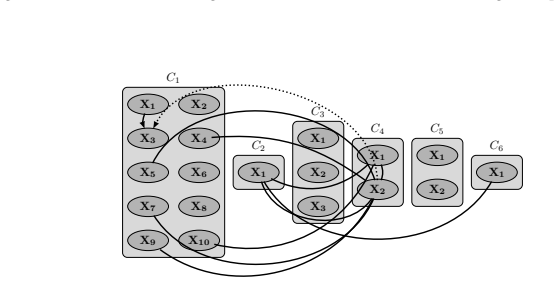

Reference graph
Works this paper leans on
-
[8]
cc/paper_files/paper/2007/file/ 42e7aaa88b48137a16a1acd04ed91125-Paper
URL https://proceedings.neurips. cc/paper_files/paper/2007/file/ 42e7aaa88b48137a16a1acd04ed91125-Paper. pdf. Han Liu, Larry Wasserman, and John Lafferty. Nonpara- metric regression and classification with joint sparsity constraints. In D. Koller, D. Schuurmans, Y . Bengio, and L. Bottou, editors,Advances in Neural Information Processing Systems, volume 2...
work page 2007
-
[13]
Matej Vukovi´c and Stefan Thalmann
URL https://proceedings.mlr.press/ v177/uemura22a.html. Matej Vukovi´c and Stefan Thalmann. Causal discovery in manufacturing: A structured literature review.Journal of Manufacturing and Materials Processing, 6(1), 2022. doi: 10.3390/jmmp6010010. URL https://www.mdpi. com/2504-4494/6/1/10. Jonas Wahl, Urmi Ninad, and Jakob Runge. Vector causal inference b...
arXiv 2022
-
[36]
Pekka Parviainen and Samuel Kaski
URL https://www.sciencedirect.com/ science/article/pii/S0896627316310091. Pekka Parviainen and Samuel Kaski. Learning structures of Bayesian networks for variable groups.Internat. J. Approx. Reason., 88:110–127, 2017. doi: 10.1016/j.ijar. 2017.05.006. URL https://doi.org/10.1016/ j.ijar.2017.05.006. Jonas Peters and Peter Bühlmann. Structural intervention...
arXiv 2017
-
[2006]
Exact block-wise optimization in group lasso and sparse group lasso for linear regression
URL https://proceedings.neurips. cc/paper_files/paper/2006/file/ 0afa92fc0f8a9cf051bf2961b06ac56b-Paper. pdf. Kenneth A. Bollen.Structural equations with latent variables. Wiley Series in Probability and Mathe- matical Statistics: Applied Probability and Statistics. John Wiley & Sons, Inc., New York, 1989. doi: 10. 1002/9781118619179. URL https://doi.org/...
work page Pith review arXiv 2006
-
[2007]
cc/paper_files/paper/2007/file/ 3a0772443a0739141292a5429b952fe6-Paper
URL https://proceedings.neurips. cc/paper_files/paper/2007/file/ 3a0772443a0739141292a5429b952fe6-Paper. pdf. Konstantin Göbler, Tobias Windisch, Mathias Drton, Tim Pychynski, Martin Roth, and Steffen Sonntag. causalAssembly: Generating realistic production data for benchmarking causal discovery. In Francesco Locatello and Vanessa Didelez, editors,Proceed...
work page 2007
-
[2008]
cc/paper_files/paper/2008/file/ f7664060cc52bc6f3d620bcedc94a4b6-Paper
URL https://proceedings.neurips. cc/paper_files/paper/2008/file/ f7664060cc52bc6f3d620bcedc94a4b6-Paper. pdf. D. Janzing, P. Hoyer, and B. Schölkopf. Telling cause from effect based on high-dimensional observations. InPro- ceedings of the 27th International Conference on Ma- chine Learning, pages 479–486, Madison, WI, USA,
work page 2008
-
[2009]
URL https: //doi.org/10.1145/1553374.1553470
doi: 10.1145/1553374.1553470. URL https: //doi.org/10.1145/1553374.1553470. Sahand N. Negahban, Pradeep Ravikumar, Martin J. Wain- wright, and Bin Yu. A unified framework for high- dimensional analysis of M-estimators with decompos- able regularizers.Statist. Sci., 27(4):538–557, 2012. doi: 10.1214/12-STS400. URL https://doi.org/10. 1214/12-STS400. Stefan...
-
[2010]
Genta Kikuchi and Shohei Shimizu
Max-Planck-Gesellschaft, International Machine Learning Society. Genta Kikuchi and Shohei Shimizu. Structure learning for groups of variables in nonlinear time-series data with location-scale noise. In Erich Kummerfeld, Sisi Ma, Eric Rawls, and Bryan Andrews, editors,Proceedings of the 2023 Causal Analysis Workshop Series, volume 223 of Proceedings of Mac...
work page 2023
Show all 13 references
-
[2018]
I+ λ p dg ∥f (k1) g ∥ Idg # f (k1) g =QR (k1) g , from which we obtain the group SpAM result discussed by Yin et al. [2012], i.e., f (k1) g =
URL https://proceedings.neurips. cc/paper_files/paper/2018/file/ e347c51419ffb23ca3fd5050202f9c3d-Paper. pdf. Jakob Zscheischler, Dominik Janzing, and Kun Zhang. Test- ing whether linear equations are causal: a free proba- bility theory approach. InProceedings of the Twenty- S...
2018
-
[2020]
URL https://www.sciencedirect.com/ science/article/pii/S016622362030165X
doi: https://doi.org/10.1016/j.tins.2020.07.001. URL https://www.sciencedirect.com/ science/article/pii/S016622362030165X. Sébastien Lachapelle, Philippe Brouillard, Tristan Deleu, and Simon Lacoste-Julien. Gradient-based neural dag learning. InInternational Conference on Lear...
2020 doi
-
[2022]
URL https://proceedings.mlr.press/ v162/rolland22a.html. P. K. Rubenstein*, S. Weichwald*, S. Bongers, J. M. Mooij, D. Janzing, M. Grosse-Wentrup, and B. Schölkopf. Causal consistency of structural equation models. InProceedings of the 33rd Conference on Un- certainty in Artif...
2017 arXiv
-
[2024]
Daniel Greenfeld and Uri Shalit
URL https://proceedings.mlr.press/ v236/gobler24a.html. Daniel Greenfeld and Uri Shalit. Robust learning with the Hilbert-schmidt independence criterion. In Hal Daumé III and Aarti Singh, editors,Proceedings of the 37th Interna- tional Conference on Machine Learning, volume 11...
-
[3768]
URL https://proceedings
PMLR, 2020. URL https://proceedings. mlr.press/v119/greenfeld20a.html. Arthur Gretton, Olivier Bousquet, Alex Smola, and Bern- hard Schölkopf. Measuring statistical dependence with Hilbert-Schmidt norms. InAlgorithmic learning the- ory, volume 3734 ofLecture Notes in Comput. S...
2020
Reviewed August 7, 2026 · model on record in the stance chip above.
Discussion (0). Sign in to comment.